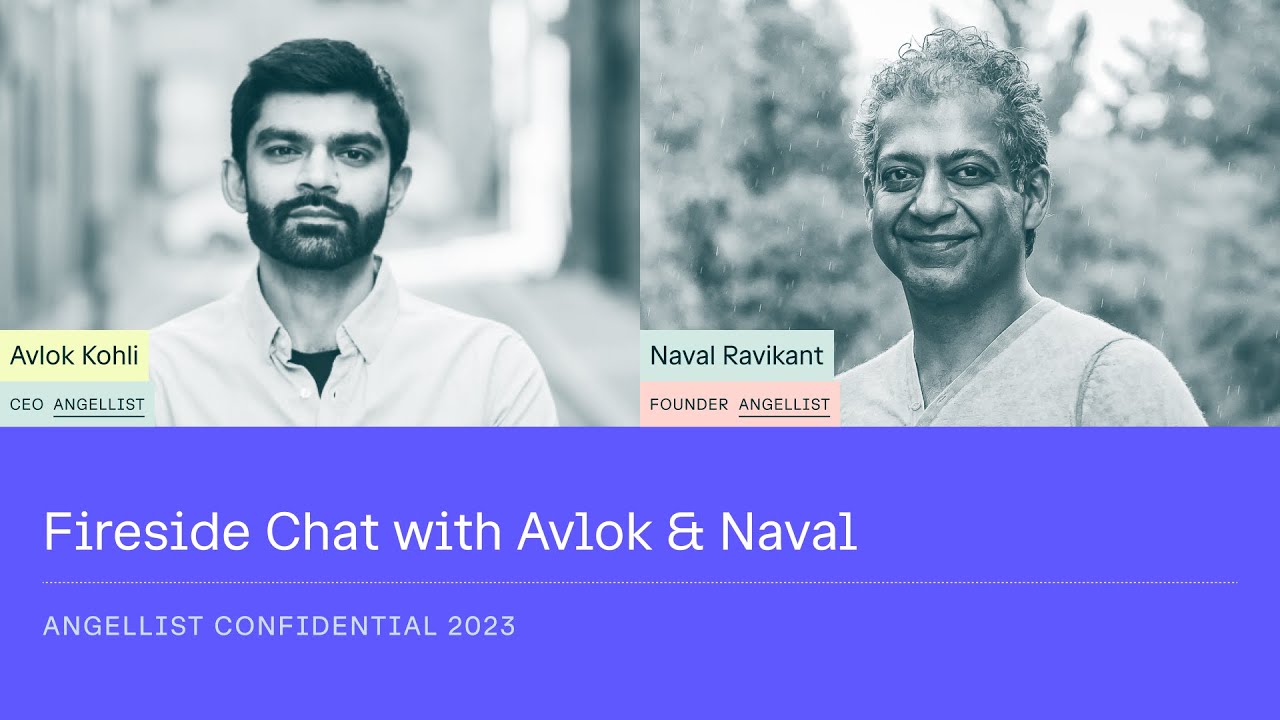
Fireside Chat with Avlok & Naval | AngelList Confidential 2023
Naval Ravikant discusses early-stage investing, valuation dynamics, and regulatory headwinds in tech. He argues entry valuations stay stable despite macro cycles, warns founders against selling secondaries too early, and advises focusing on deep knowledge rather than trends. He also describes AirChat, his new asynchronous voice platform.
Chapters
Hello everyone. For our next session, we're talking with Naval, who of course is one of the founders of AngelList. Just a quick housekeeping, we're actually going to aim for a 20 to 30 minute discussion followed by audience Q&A. So feel free to submit any questions you actually have in the Q&A section on Hopin, and we're going to get to it shortly. So Naval, thank you for doing this.
Thanks for having me. And did I have a choice?
Uh, you did not. Uh, so for the first, uh, section, really want to get into the macro. Um, so today the macro is dominated, uh, with the interest rates, geopolitical conflict, and every headline you see there's something about that. But you've been investing for a long time now across different cycles. I'm curious, are you investing differently in this environment than let's say in the last 5 years or 10 years?
Yeah, that's a great question. It's hard not to look at macro. It's in the news. It seems to affect everybody. It is the dominant story of the age that everybody gets into. So I can't say that somehow I resist the urge to look at macro. That said, it does— it really shouldn't matter because in early stage investing you're talking about 10 to 15 year cycles. Like one of my best investments I think was Notion, which I made first in 2007, '08 timeframe, then again doubled down 2010 timeframe. And what is it, 2023? We still don't have liquidity. I mean, there's secondary liquidity, but the company still isn't at full potential in public and so on. So these things take so long that they outstrip a lot of the macro cycles. A lot of people have a memory of like the last big macro event was COVID. And then before that, there was kind of an uptick in 2012, 2013. There was a financial crisis in 2008. But the reality is, if you were angel investing in 2008 and you had some big winners, they're coming due now. So it just shows you how long-lived these things are. So the conventional wisdom, and I think is correct, is you kind of have to avoid the macro cycle. That said, one can't help but look at it. So in the sense that there's going to be a macro shift that's permanent, for example, if you think we are now going to be in an era of permanently high interest rates, or rather that the era of permanently low interest rates is gone, then that is going to cause you to adjust your portfolio, and that's rational. So you may change the allocation that you have towards risk assets versus non-risk assets. There are also parts of this, of the investing sphere, like crypto, for example, that are very vulnerable to macro. So, for example, the price of Bitcoin should, although it doesn't really today, it should reflect money printing. It should be a reserve asset and a hedge against inflation. In reality, it often tends to behave like a risk asset. You print more money, people take it and go and buy Bitcoin.
Right.
And when you don't print money, you know, people kind of seize up on it. That said, like, I think you have to ignore the macro. It's the rational thing to do. It's the logical thing to do. It's the thing that I have to keep reminding myself, but we still get swept up in macro.
Yeah. Then how do you think about the entry point valuation, right? So if you go back to 2007, 2008, when you wrote that first check into Notion, relative to pre-seed, seed valuations today, how do you think about that with respect to the macro environment?
Yeah, certainly if the entry point valuations were 5x what I thought was fair, then I would probably stop investing, 'cause that would suck all the returns out of the business. But when you're in a situation where it's hard to find sustained inflation-adjusted return anywhere, if the entry valuations are maybe 50% too high, okay, so then maybe on a good portfolio, your return comes down from 10x to, you know, 6x, but it's still the best game in town. And I don't think entry valuations are particularly high or particularly low right now. They, from a macro perspective, they should not fluctuate all the time, because you're talking about a 15-year time horizon, the valuations should be pegged to the discounted cash flow for 15 years out coming back, or even more, because a lot of these companies build value post-IPO. For example, Google and Amazon, you want to hold them post-IPO, not really sell at the IPO. So the same way, I think that the early stage valuations should not fluctuate too much. When they do fluctuate, it's usually because of structural changes in the industry, such as the birth of Y Combinator, for example, or the rise of angel funds, or the entrance of venture funds into seed investing as an asset class. Those kinds of things tend to move the needle, and they do it structurally and semi-permanently. But early stage valuations don't actually bounce around that much. More likely what will happen is in a very bubbly macro environment, you'll just see a lot more investments getting made. Investments that shouldn't get made get made. Maybe the winners or the hot companies have their valuations go up 20%, 30%, 50%, but they don't like double, triple, quadruple. Right. And the same way in a slow environment, just less companies get funded. The companies that get hit harder are at the Series B, Series C, Series D rounds. Like, so if you've raised, $50, $100, $200 million, you're burning $2, $3, $5 million a month, you don't have enough traction, you don't have enough revenue, you don't have enough to show for it, those are the companies that get stranded. Their valuation gets slashed heavily. They do pay-to-plays, down rounds, you get wiped out. So the later stage companies get hit much harder. Got it. And for an angel, what that means is you might have had a hot angel investment that then gets ahead of itself, raises too much at too high of a valuation, and then it's stuck up there.
Yeah.
And now they're having to take money on punitive terms. The early-stage investors are getting wiped out. So it can still hit your portfolio, but it hits it at the later stage, not at the early stage.
Right. Then you mentioned secondaries, right? Let's say you're an angel, and you have all these companies that are marked up at a very high valuation, but in reality, in the current environment, they're not gonna get the next round done at the same valuation. Should angels or even funds take money off the table in a secondary? How do you think about that?
The truth is you rarely get to sell in a secondary unless the company is doing really well. Because the people who are buying on the other side tend to be insiders. They tend to have information. They tend to be on the board, or they tend to be somehow affiliated with the company. So you sell for liquidity purposes. You don't sell for return. If you're selling for return, the highest returns are made by taking a whole portfolio and holding it till the end. And the reason for that is because the winners go really nonlinear. They can ramp in a way that you can't even fathom. 'cause we're talking about global markets, high margins, virtual idea space businesses that can just mint money. So the general rule of thumb is if you sell too early, you leave money on the table. Now you can time markets if you're good, you can get lucky on the sales. And I think like in the last cycle, for example, there was a class of companies that were part software but part logistics. So example would be like the Ubers and Postmates and Lyfts of the world. And these companies, although they had successful IPOs and exits, they just chewed up huge amounts of capital along the way. So if you were an angel and you got to sell early, that might not have been so bad because you didn't have the capital to re-up in later rounds. There's a lot of dilution. But on the flip side, if you look at a company like a Notion or an Airtable or an OpenAI or any of these companies that are all virtual and software, you don't get diluted as much. Right. And they can run nonlinearly till the end. So selling early in these companies, especially once they're winning, is often a mistake.
Got it. Okay. Let's switch into talking about regulation in tech. So I've actually been working in tech since 2009. And for many years, it felt like the frontier was wide open, right? 2009 till probably around 2012, 2013 felt like the golden era. But Over the last few years, the US government feels like they just want to regulate everything, right? And now, of course, the new executive order is out from Biden. I'm curious, how do you think about startups within an increasing regulatory environment? Are there any more frontiers left?
Yeah, I think that's kind of the worst thing that's happening in tech right now. You can complain about a lot of things, but regulators are basically cops with the ability to say no and not the ability to say yes. And as anybody who's ever built a business knows, the hardest thing is just all the rules and regulations and all the people tell and you can say no. One of the reasons why the tech industry is concentrating in California in the United States is because it has been the easiest regulatory environment to set up and tear down a company. And now they're making it harder and harder and even limiting, say, the free exercise of mathematics through an executive order, which I hope gets challenged in court because, you know, that's not how our nation should work. The president just gets to make up laws. These are regulatory barriers and they're barriers to innovation. For example, I think the FDA has held us all back. We'd probably have real life extension drugs on the market right now if the FDA cycle didn't cost billions of dollars and decades of years, and there'd be a more thriving venture community there. And bringing that into mathematics and GPUs and AI, you know, from the people who are screaming doom is hugely negative. It's going to make it much, much harder to innovate. Crypto is already largely leaving or has left the United States. It's become a global phenomenon. And it'll continue to do that. And other things may have to do that, but there, you still can go through a dark ages. You can still go through a time period where there is no single place where the innovators can gather. And regulators around the world tend to follow the U.S. regulators. So there will be sort of this chilling effect, and that's bad because really innovation is the only way out. Knowledge creation, wealth creation, these things are all intimately linked together. And if you tell people, no, you can't do that until we, the anointed wizards, determine that it's safe, that's just the same as saying no, because these people aren't innovators themselves. They don't know anything other than to say no. And I think that this is a chilling effect. It's very negative and, you know, everyone should be doing their best to resist it, including legal challenges, including constitutional challenges, and including being ready to pack up your bags and leave or moving innovation to another frontier. I do hope other frontiers will emerge. But all through human history, all innovation has always been at the frontier. It's always been where there's kind of a— there's a reason why, for example, in ancient Greece, it was in city-states where you could like move from one to the other. You weren't bound by the local warlord. Same thing in Renaissance Italy, same thing in early United States where there was true federalism and the different states all kind of had their own laws and there was a western frontier. Same thing in the age of sail. You have to get away from the people who are already in charge to do anything interesting. And it's hard for people who are not innovating to fathom that, but that is literally how it works. You even saw like Elon, you know, leave California or he's trying to get off planet so he can do his innovation. But they're definitely not making it easy.
Yeah, I guess, how can tech, or people in tech, actually engage then to impact regulation or the lack of it?
Well, the first thing is I think we should call out the people in tech who are demanding more regulation. I mean, those people are not part of tech. They're not innovators themselves. Either they're attempting regulatory capture, or they don't understand how innovation works. So, you know, challenge them, challenge them with better ideas. The second is legal and constitutional challenges. The third is like be ready to move. There's no, there's nothing, yes, there are path-dependent reasons why the Bay Area is dominant in technology, and there are some other good reasons. It's a creative hub, it's great weather, you know, great food, great outdoors. It's a city where you can get work done because it's not too pleasant outside all year round. There's a lot of good reasons, and there's good universities. There's a lot of good reasons why The Bay Area is the tech hub, but I think the single best thing that innovators can do is actually learn how to work remotely. And it's not that easy still. It's still harder than it should be, but COVID accelerated that. Now we have things like Zoom and what we're doing here with Hopin and this livestream, and there's my own app that I'm working on, AirChat, for asynchronous voice and so on. So people are starting to get better and better at coordinating remotely, things like Slack and Microsoft Teams. And the best engineers now are gonna live wherever they want in the world. So I think just having the ability to work remotely just gives you a lot more flexibility. It keeps you from getting bogged down into one way of thinking, one way of people saying no, and just gives you a lot more flexibility. That said, for early-stage teams, the creative teams, it is hugely beneficial still to be co-located. And so as long as that is true, they will keep plucking the, feathers off the goose that lays the golden eggs, right? Until the goose goes fully virtual. Great.
Maybe let's switch into some advice for founders. We're of course living in a very different time now. I'm curious, for any founder pursuing a startup today, where would you recommend they focus their energy? Because there's just, there's so many areas now you can focus on.
Trend chasing is a lot like macro chasing. And often it's too late. So for example, AI burst onto the scene thanks to OpenAI's work over the last few years. Tons of companies were started in AI. Many of them talked themselves into this idea that they would build a specialized model that would be more cost efficient or better at a specialized domain than OpenAI. And I think a lot of them got crushed recently by the recent announcements that OpenAI made. And you could, you could see that coming a mile away. Chasing someone who's already established an industry is usually not the right way to go. OpenAI is obviously building an ecosystem. People can still make money building apps and using OpenAI's tools or similar tools from Google or Microsoft or others, or, you know, the other foundational providers like Anthropic and so on. But trying to trend chase is generally a very bad idea. You just get drowned in a sea of copycats. You might get seed funded, but the A round, B round funding dries up. And so the thing that is always the best to do is something that you know really well and that you have conviction about. Usually it's you've worked on a product because you want it to exist for yourself, or you've worked in an industry that you know really well, or there's some technology that's coming up that you're just passionate about and other people don't get and you're intellectually obsessed with and you convince yourself that it's going to work and you experiment with it and try it. So my favorite companies are always the ones that are doing something technologically challenging and difficult, and the founder is passionate about it, but it's not in any field that is currently a field or a trend or can be easily defined. If it can be very easily defined and you can fit into it, then I just don't think it's that interesting. Now, it's not to say that you can't make money there. Like, look at SaaS companies, right? Like, SaaS ran for a long time, and there were a lot of companies that were taking fairly simple products, but putting a certain pricing model, delivery model, and user interface on it, and then delivering them to large enterprises. I just don't know how much longer that continues. AI sort of blows all of that away and makes it really easy for those companies to now have AI. I mean, it's never trivial, but makes it easier for them to have AI access to their database, natural language computing and processing. And so these highly specialized spreadsheet columns that are now like an app sort of start going away. But you can definitely make money doing it, but I just don't think trend chasing is that interesting. I think a lot of people get wiped out in it. It's like focusing on macro. It's like saying, oh, interest rates are up and AI is hot, therefore what company should I start? That's not, that's not how you innovate. Wealth is a byproduct of knowledge. I always liked David Deutsch's definition of wealth. He says wealth is the set of physical transformations that you can effect. And if you think about that for a moment, that applies at the applies at the societal level and applies at the individual level. And at the societal or individual level, that's a function of how much resources and capital and machinery that you have to effect physical transformations. And it is a function of knowledge. Like, do you know how to, for example, turn coal into diamonds or turn uranium into power and steam? And knowledge is a more important component by far, by far, because the Earth has always had all these resources. They've always been lying around. Despite what Marxists would have you believe, right? No one's— we're not running out of resources. We're just redefining things that before we didn't know were resources as resources. So then the scarce thing is knowledge. And so what you should be doing when you are creating a startup is not what space is hot or what resources can I bring to bear. It's rather what knowledge do I have? It's as Peter Thiel says, you know, what is the secret? What is the thing that I believe and know to be true that other people don't?. And you're only going to know that if you have an intellectual obsession around it. If you were obsessed with this space for some time, for just whatever reason, it was your hobby, you couldn't look away, you were just really fascinated by the topic, you got into it, you figured something out. And because you figured something out, you can bet on that with deep conviction.
Yeah. It actually reminds me, this idea of taking raw materials and turning it into something reminds me of Tesla. With their Gigafactory, where they're literally taking raw materials and creating battery packs out of it. Exactly. So it's like a virtual manifestation of that if you're working in software.
Yeah, like I have a company in my portfolio that I really like right now, and they're doing non-invasive glucose monitoring. So you can put your finger in something, and it'll tell you what your blood sugar is, and even your lactates, and your ketones, and your cholesterol, and things like that without the finger prick. Now they have regulatory things. They got to go through the FDA, so it's a little slower than we would like. But their key insight was like, hey, we can build an MRI machine that's tiny, you know, that's like the size of this cup, and eventually the size of this watch, and eventually the size of a ring. And that's very audacious, a young kid, you know, out of school, quantum physicist, Teal fellow, very bright, but nobody believed him. Nobody wanted to buy into it. Everyone's like, that's not a space, FDA, we don't want to deal with that, who cares about glucose monitoring, give us a SaaS company. And he's just been grinding and grinding and grinding. It's really hard, he's got to build it,— it's not a miniature as an MRI machine. If you've ever been in an MRI machine, it's like a room-sized thing with a giant magnet. And so those kinds of companies, they often tend to fail. They often burn a lot of capital. They're technologically very hard. But I think like almost nothing else is worth trying in comparison. If you are— in his case, he was intellectually obsessed with signal processing from telescopes and then figured out how to apply that to MRIs and then said, well, I can have a smaller MRI and smaller magnet. But there is a clear path from the proprietary knowledge that he had to trying to build this product that if it comes to market will be truly revolutionary. It'll actually change the world. It'll be something that as an investor you can be proud of and be associated with, because one of the problems being investors— let's face it, it's not a job, you know, you're not actually building anything, you're investing, right? Okay, yes, people make a job out of it, but it's not necessarily something you can sit there and take credit for. It's not something you can necessarily be proud of. And one of the things that I like that Peter Thiel said, which is that you should have a definite view of the future. You should actually go out and build the thing you want to see exist, not just say, oh, well, that's going to happen. I'm going to sit back and wait for somebody else to do it. Because history doesn't work that way. Things don't just automatically show up. There are great men and women who go out there and create these things. And so try to be one of those people who creates these things. And if you're going to be an investor, at least bet on things that you think may not exist without you betting on them. So you say, OK, well, I did the homework on this very difficult technology project. And because it's got nuclear fusion, or it's got glucose monitoring, or it's got even very difficult software— like AI is a good example— I made a bet here. I did the homework, and I made a bet that no one else was going to make. And if it weren't for me, at least in some small part, this thing would either not exist or would come to market later. But the other mindset, which is I'm just going to hustle ahead of other investors, I'm going to slip some money in before they get there, and then they mark it up. And it's the thing that everyone can see is winning, maybe you'll make money, sure, but it's a very unfulfilling life. And I would argue long term you will not make the most money because the greatest winners of the last few decades have been unexpected winners. They've been companies like Tesla and SpaceX and OpenAI and Apple Computer. These were companies that were written off. They were essentially written off because it was believed that their dream was impossible and too expensive. But now I think SpaceX is launching a rocket every 3 days out of Florida. Tesla, obviously Teslas are crushing every other electric car out there and are basically the gold standard for not just the best electric car, but also the best self-driving vehicle. So when you see these impossible dreams come true, not only is it the most fulfilling thing, it's also where you make the most money.
Yeah, that's great. Speaking as, Founding a company, you just mentioned you're working on an async app, AirChat. I'm curious, you're back as a founder, starting something new. What's it like being in the trenches again as a founder relative to when you started AngelList?
I mean, starting a company is way harder than being an investor. So you almost have to get over the PTSD of it. It's like with a breakup. You go through a bad breakup, you have to get through it, and then you can start another relationship. But you have to forget how bad the breakup was. So it's very similar. You kind of have to get through the PTSD of it. But that said, like running a company, starting a company, building products is just so much more fulfilling than investing that I'm happy to be doing it. I'm happy to be working on a product that I actually want to see exist because I was a big Twitter user. And the problem with Twitter for me, or now the artist formerly known as Twitter, now X, the problem with X for me is that it's very hard to have a conversation because everyone can butt into your conversation. It's also all text-based. Space. Text is the dominant media on Twitter/X, and so it's very hard to have a civil conversation. There's a lot of anons. And I enjoy podcasts and speaking, but they have their own problems, which is always a one-on-one. There's no audience participation. It's very synchronous. You got to schedule. It's like this thing, it's heavyweight. You have cameras, you have people, you have time commitment. And as long as I've been, you know, sentient, I've been dying to have conversations with other smart people. And the internet should solve that problem. Why can't I talk to the smartest people on the internet? And why can't I listen to them and do it in a free and civil conversation? And that's the problem that AirChat is trying to solve. So it is trying to take podcasts and make them much, much more lightweight, easy to set up, easy to tear down. It's asynchronous, so you can talk any time you feel like from anywhere. You have good tools to figure out who is worth talking to, which conversations you want to be in. And there's very good tools for then getting the output of those conversations out to the rest of the world. And I was waiting for this product to emerge. I just didn't see anybody building it, so I got into building it. That said, it's hair-raising. It's very difficult. Being a founder is never easy. And if it's getting easier, then I would argue you're doing it wrong. It means you're almost slacking off, right? Because it is a zero-to-one journey. And if you go back and you're not experiencing the pain again of being a founder, then you didn't go back to zero. You're trying to shortcut it somewhere. Now that said, the older you get, the more experience you get, the more you trust yourself, the more idiosyncratic you become, for better or for worse. So you end up running the company the way you want. So AirChat is just 10 engineers and myself and a co-founder and a designer. There's nothing else to it. Everybody works very small teams, very direct. We ship a lot of code. I don't listen to product managers or even the feedback or analytics 'cause it's just what I want. And yeah, look, anything in social media is very hard and will probably fail, but it's incredibly fun to build something like that, and it's very pure. It's, we all get together and we craft the product that we wanna see exist. So it's fun in that regard, but yeah, I'm cheating in the sense that I don't need the win, right? But on the other hand, I'm having more fun doing it than anything except early stage AngelList, where it was kind of very similar. It was a very small team, and against the odds, we kind of just just did whatever we had to. And probably the best advantage of doing it a second or third or— I mean, AirChat's not even my fifth company. It's probably closer to like 20th. But let's call it like number 8 that I would actually acknowledge, right? Because there's a lot of wreckage that I just won't even talk about. But yeah, it's like the number 8 company that I've started that I can legitimately say, yeah, I raise money and involved with on a day-to-day basis. The biggest change is just my internal state. I don't stress out as much about things that I used to stress out. So hiring people, firing people is much easier than it used to be. Decision-making is much faster. Knowing what doesn't matter and what does matter, not getting stressed out when something goes wrong. Yes, you still get stressed, but not at the same level. So it's really your internal mindset that changes. Like, I don't— like, for example, if you look at someone like Elon Musk, right, he's running— I don't even know how many companies 5 companies, 6 companies, right?
6.
6 companies, yeah. So he's making high-value decisions all day long, right? So he doesn't stress about this. Someone says, okay, booster rocket for Starship is down, we need to replace with this part, it's gonna cost— He just calls a shot and he moves on. He does not sit there with recriminations, ruminations, surveys, thinking, backtracking. Yeah. He has judgment and he has faith and confidence in his own abilities, and he knows when to call the shot and he knows when to delegate. When he's interviewing somebody, he knows, yes, this is the kind of person I can work with or not. Not necessarily just because are they good or not, that's something he probably has been able to do for a long time, but adding in, do I want to work with this kind of person or not? Is the style the kind of style that I want? So you make decisions faster, you have less ruminating over them, you have, you know, you correct mistakes more quickly, you don't second-guess yourself as much, and you're okay with the outcome. You don't stress out. You can solve problems with lower stress. I have a friend who took over a company in the crypto space. It's just been— he's been getting beaten day after day after day, just punched in the face, like just the worst things imaginable, you know.
Isn't that how it always is though?
This is extreme because crypto in a down market is so down. And you know, you find fraud, you find malfeasance, you find theft, there's missing money, there's bad contracts, there's just stake everywhere, lazy people, retired people, crooks. Like, it's just literally the worst I've ever seen. He's literally getting punched in the face every single day. And I've never seen it this bad. Like, I have taken it pretty bad, especially in the early days of AngelList when we had regulatory issues. But watching him, like, I can't even look. It's sort of brutal. But, you know, when he started out, I would have said, yeah, he's going to be a mediocre to pretty good founder type. But now watching, he's going to be great. He's going to be great because he's gotten beaten so badly. That when he comes out of it, things that faze other people, that hurt them, he's just going to be like, no problem. You know, he's probably going to be like, this is so easy. Let me run 2 companies. Let me run 3 companies. Let me be an investor too. So it's just during the formative years, you know, if you get punched a lot, you just get better at it.
Yeah. So first-time founder, just aim to get punched a lot.
That's your consolation prize.
That's great. We'll do one last question or topic I wanted to cover. Of course, this is your 8th company that you want to claim, and you're running most of it remote. But for anyone new that's starting out, if you're just starting out in tech, would you— are you recommending people move to San Francisco, or are you sort of saying like, hey, remote can work?
It's always a tricky question. I think it's very contextually dependent. If you are a crypto company, you probably don't want to be in the US, let alone San Francisco. If you're an AI company, you probably want to be here just because all the AI people are here and just the serendipitous networking will help you so much. I think in general it's good to have a small creative team in the Bay Area. Just because the serendipity factor is so high. You run into investors, you run into potential recruit, you run into co-founders, you run into other smart people, partnerships, everything will be easier. That said, nobody in their right mind I think is scaling companies in the Bay Area right now. Maybe outside of San Francisco proper, but the companies that were scaling here, like Twitter and Coinbase and Facebook and Google, I don't think they're adding a lot of headcount here. Right. So I think like small teams should be co-located. Creative teams should be co-located. And most of the tech industries, you would benefit from being in the Bay Area. There are exceptions, there are just not a lot of them. So one exception might be If, you know, you have a founding team of 3 people and you're convinced that 2 of your engineers are the best in the world and they just happen to be outside of the Bay Area and they're not going to move, then maybe. But then even then I would say one founder should be here and plugging in. If you're in the defense industry, for example, then like Anduril or, you know, something like that, you're going to be down in San Diego. And I think SpaceX started in the LA Pasadena area because the rocket scientists literally down there. You could probably do— there's classes of companies you could do out of Boston, a lot of fintech companies you could do out of New York. That said, it's really hard to point to huge tech companies that were built recently outside of the Bay Area.
Right.
There are certain exceptions, like Seattle did well with both Amazon and Microsoft. Yeah. But places like LA and New York are too full of distractions. And they're magnet towns for finance and for Hollywood. And so it's very hard to rise out of the noise in those areas. Obviously San Diego has a military base. Austin just, I don't think it's created, unfortunately, the massive tech companies that you'd want to see. And so right now you're probably still best off being in the Bay Area without a very good reason.
Got it. OK, great. Well, we're 30 minutes past, so I think it's a good time to skip into audience Q&A.
Sure.
All right, so the first one we have is, given your extensive experience with startups, and investment strategies, what are your thoughts on the venture studio model in particular? How do you see this model evolving with the startup ecosystem? Are there specific verticals where it's been impactful?
Yeah, so you can actually go to AirChat, just get airchat.com. I did a whole thing on venture studios. I did like a 20-minute talk on venture studios. And I did it because an entrepreneur came to me with the venture studio. And I was like, let me just put this to bed once and for all. So there's venture studios and there's accelerators, and they've diverged. There's accelerators like Y Combinator, where it's a standardized program. They take 6% or 7%. They give you a bunch of cash. I think it's $500K now. And you go through a process, but you are your own company. It's your own idea, and you're meant to go do your own thing. I think those models can work. They are significant accelerators, especially for people who are coming from out of market, or teams that are still forming, or they don't know exactly what they're working on. So it has actually replaced a lot of the angel mentorship that used to happen at that level. Now Venture Studios is a different thing. Venture Studios in particular means like there's someone sitting at the top who has an idea, and then they have some capital, and you kind of work in their Venture Studio. And then when they have the right idea with the right capital, they try out a few things, and then they spin it out and somebody else takes over. They own, you know, 20, 30, 40, 50 50%, they put in the capital, the idea, and there's a team working on it. The history of venture studios is not good. They're generally a fail. And there are a few tiny success cases. There's a company called Overture that came out of Idealab. You could argue Uber came out of venture studio. I don't think it really did if you look closely underneath the covers. And then there's companies like Hims, you know, which are— they like sell, you know, various simple prescription medical products online. I don't think these are huge successes in the first place. Yeah. And venture studios assume that the limiting thing is the idea.
Mm-hmm.
And then it's the capital. But that's not true. Try the following phrase on. Paul McKellar put this on Twitter a long time back, and I loved it, and I expanded on it. So full credit to him. But he said, I have a great idea for a novel. Does somebody want to write it? You know? I have a great idea for a movie. Does somebody want to make it? I have a great idea for a TV series, do you wanna go do it? I have a great idea for a painting, a great painting, do you wanna go paint it? No, obviously that's not how creative acts work. I have a great idea for a scientific breakthrough, I need some physicists to work on it. It doesn't work like that. You have to create the thing yourself. The thing that is scarce is the entrepreneur. So the people who are saying, I have a great idea for an app, or I have a great idea for a startup, but somebody else should build it, and I'll provide the capital and the idea. The idea is not the scarcity. Every idea that you can think of has pretty much been thought of before. It's the details, in the execution. It's wandering through the maze of potential ideas, figuring out dead end, I built this, that didn't work, turn right, build this, didn't work. That's the hard part. It's wandering through that maze with conviction, with passion, with knowledge. That's the hard thing. So the scarcity is actually entrepreneurs who are obsessed with an idea and a space and have knowledge of it. The scarcity is not in the idea. It's actually not in the capital. Infinite capital will show up for the right person with the right idea. There's a lot of checks out there, a lot of people waving checkbooks. So I don't think Venture Studio adds anything. And so because the best entrepreneurs know that, Venture Studios tend to attract a second-class entrepreneur. There are exceptions. So Max Levchin, who started Affirm and before that was one of the founders of PayPal, he ran some successful Venture Studios. But in every case, he was looking for a product and a company that he himself would build and run. And so the successors that came out of those were Yelp and Affirm. But I would argue those venture studios were just Max sitting there grinding every day with his team trying to find the thing that he wanted to do next. And Yelp did have an independent CEO who was very good, Jeremy Stoppelman, and kind of got built up. But Max was on that from day one. And even when he was building that, his first spinout from that studio was called Slide, which he ran, which failed. And so he even called it wrong. He was sitting there planning to run the company, and he couldn't even tell what was it wasn't going to work. And then he kind of came back and became chairman of Yelp, and Jeremy ran it, and they successfully built it into a great company. And then he did it again with Affirm. But notice that he was the one who kept looking to run the company afterwards. He did not try to farm it out to somebody else.
Yeah. Yeah, the other successful example that I came across was Sutter Hill Ventures. I think Snowflake came out of that.
Yeah, Mike Speiser is a good friend of mine. We started the Opinion Stack. Together. That was the third company I co-founded. Mike was a good friend— is a good friend, and he started Snowflake Pure Storage, and now he's working on a bunch of others. But that's not a venture studio in the sense that Mike isn't handing it to other people from day one. Mike is building those companies. He's an entrepreneur. He's like the Elon Musk of storage and SaaS and so on, kind of hiding out, but not as well known. But he is in there every single day grinding on these companies.
Got it. Great. The next audience question is, are there specific sectors that you're bullish on for the next few years? I think we somewhat touched on that.
Yeah, I don't really think on sectors that much. And, you know, anything I tell you is probably wrong. I think there'll be like a more interesting sector yet to emerge. Unfortunately, there's a class of sectors that I think are closed off because of regulation. Like, I wish that like bio and health would emerge. We all want to live longer and healthier, but I think the regulatory aspect kills it there. So we're getting narrowed more and more down. For example, if you looked at crypto and AI, which have been like two recent emerging sectors, the thing that they have in common is that they just depend on mathematics. Yeah.
Right?
There's not a whole— it's just compute and mathematics. And so it's hard to ban them. It's hard to stop them, although now they're trying in both cases, but hopefully freedom of speech and smart thinking people will defend those things. But we're kind of down to the math domains. We're down to software. Everything else is regulated.
Yeah.
That's not entirely true. Like self-driving cars are starting to work now, control routes, you know, well-mapped areas, certain use cases, but they are starting to work. And I think this is one of the big breakthroughs in AI. Robotics maybe may get a breakthrough because of AI, because in the past, We were trying to program robots directly, but now we may use the modern AI model of you just dump huge amounts of data into a model and that model itself figures out how the robot should behave through feedback. So we may see some innovation there, but I don't want to predict actual sectors breaking out.
Yeah.
The good news is on the self-driving cars side that because there's some very big players involved, there's a lot of data that the regulatory apparatus has been not as bad as I had feared. If you look at AI, where AI has really made big breakthroughs is in 4 or 5 areas. It's basically self-driving cars, but I would call that backup driver today, right? Backup driver or control route driver. Then there's transcription, translation, voice synthesis, image summarization, coder, Backup coder. I still wouldn't call it like the creative high-end coder. It's just another tool that lets anyone who is creative, including existing coders, level up to yet another, another point, but it's becoming indispensable there. So in these areas, I think AI is causing breakthroughs, and then those itself may then break out. And robotics is an example of that. Self-driving cars, another example of that.
Yeah. So that's actually really interesting with robotics. I've actually been following that quite closely. I'm curious, how do you keep track of the technological developments in all of these different areas? Because there was just an explosion of it.
Yeah, you just have to follow your own natural curiosity. If you're curious about it, it's like the little quip I made on Twitter was, if you're interested now, you'll be interesting later, right? So you just have to genuinely be interested. If you look at it and you're like, wow, that's fascinating and super cool, then you'll get into it later. Like, I kind of missed Tesla because I was just not into electric cars. I just wasn't. I could have faked it. I suppose, but I just wasn't, I didn't care enough about it. But on the other hand, something like robotics I am into. So every time there's some interesting story about robotics, I track it. The reason why I'm in that glucose monitoring, non-invasive glucose monitoring company is because I wanted that product. I was wearing a continuous glucose monitor for a while just to track my own blood sugar and for health reasons. And I was like, yeah, I don't want a pin sticking in me. I don't want to do finger pricks. I want to actually know, this should not have to work that way. So I think you just have to follow your own intellectual curiosity. And it's the old man who chases two rabbits catches none. So if you chase like 50, and if you're chasing them just because you want to figure out what's hot and coming up, you'll never get there.
Yeah. OK, great. We'll do two more on the audience Q&A. So first one is— or the next one is, in your view, what are the key indicators that signal entrepreneurs should consider pivoting or letting go of their startup venture? Balancing the tension between perseverance and practical realities?
Yeah, you know, this is a great one because it's a great question. Because what happens is you sometimes have these entrepreneurs, probably the biggest reason, like the best companies that you think should work fail is because the company, the entrepreneur gives up. Like when the entrepreneur gives up, the company is dead. On the other hand, you do get these entrepreneurs who have read that statement or have imbibed that statement and they're just too bullheaded. They stick with something that is clearly not working and not going to work. It's very— and this is a Dunning-Kruger thing. You kind of have to be self-aware. You have to be self-aware enough to figure out, like, is this going to work or not? And I think this is where good investors can be really helpful. Find the smartest investor you can that you trust and get that person's authentic feedback and listen to them, because they'll have the long view and they'll have multiple data points, and they can tell you like, yeah, I mean, you're a good person, you're working hard, but this is not gonna work. You should give up or pivot or try something new. And I think that taking that third-party feedback seriously would be very helpful, but you can't just take it from the average investor. If you get enough advice from average people, it cancels to zero, it's meaningless. Like, if you want the wrong answer, just ask everybody.
And how do you pick the right investor to listen to on that topic? Because in this day and age, there's just a lot of promotion and content and everything. Because when I started my first company, I think the number of investors I could raise from were literally 20 seed investors. So the signal was very, very high to begin with. So I'm curious, like, how do you think about—
Pick the smartest person you can find, the smartest person you can get to. I mean, this is all downstream of intelligence and knowledge. So if what they're saying is generally true, and if what they're saying is generally intelligent, they'll have a good point of view on it. And I find that with startups, like, a lot of times early on, you have 5 problems to solve, you know how to solve 4 of them, and you don't know how to solve the 5th, but you're like, I'll figure it out later. Right. Usually you can't. If you can't even figure out the theoretical solution to number 5 at the beginning, you won't figure it out at the end. Things just get harder later, not easier. So if there is a showstopper early on that you're kind of overlooking, usually out of the desire just to be successful in the and say I've done a startup and the startup's gonna succeed. You kinda have to face facts on that one. Also, one thing I've learned myself the hard way is that it is easier to tear down a company and restart it in Silicon Valley than it is to constantly try to be pivot or keep something alive. There's very little stigma associated with capital loss or shutting down and restarting, and investors want to back entrepreneurs experience, they know how difficult it is.
Yeah.
So one of the common complaints you hear from people who know nothing on Twitter is they say, "Oh, you're backing failures and losers. No wonder venture capital doesn't work." No. It is so difficult to build something brand new that the world has never seen, and to break through the noise, and to get people to pay for it, to make an institution. And once it becomes an institution, then it's like a money printing and product printing machine that's almost hard to stop in the other direction. It's so difficult to do that, that very, very, very few people succeed on the first go around. For every person you heard who succeeded on the first go around, they actually did 5, 10 other things at the same time or before. Even Mark Zuckerberg and Bill Gates and Steve Jobs, it wasn't just their first thing. They'd built many, many projects along the way. They just started younger than you and they parallel tracked and they got lucky and they were good. So as an investor, you do want to back previously failed entrepreneurs. The ideal is to find someone who's failed through no fault of their own, or as little fault of their own, or they've learned their way past it. Either the whole sector failed, or there was a co-founder that's no longer with them, or there was a particular shot or a bet that they took, and they followed the bet properly, the bet didn't pay off, and they realized it didn't pay off, and they moved on. But it's easier to start over, so trying to like cling through with your fingernails to something that's not working, it can waste you a lot of time.
Yeah, makes sense. And the last question from the audience is, when you're deciding with whom to work or invest, what personal qualities or professional attributes you prioritize to ensure mutual success?
Yeah, I mean, the old Warren Buffett line is intelligence, energy, and integrity.
Yeah.
And you can't give up on any of the three. You want very smart people, you want very, very hardworking people, and you want people who are completely trustworthy. And trustworthy is hard to figure out without having worked with them for a long period of time. Intelligence is actually harder to figure out than you might think, because you can usually only spot intelligence up to your own level, right? Above that, it looks like alien. So a lot of people, I don't think, have a high enough bar for intelligence, and I think that would be a big one. Energy is the easiest one to spot, self-motivated. I would add another one to that whole set, which is just agency. Like people who just solve problems without even being asked to solve the problem. They identify the problem, they go solve it, they don't necessarily even have to update you every step of the way, they're not asking silly questions, and they're just coming up with solutions. Because building a startup is an infinite set of problems that are being thrown at you, and there comes a day when you realize, I can't even look at every problem, let alone think about it, let alone solve it. It's not even possible.
Yeah.
So at that point, as Vinod Khosla famously said, the, the team you build is a company you build.
Yeah.
And so at that point, the team you have built is the company you have built.
Right.
And your ability to solve problems is based entirely on how many problem solvers you have below you. If you have somebody who takes 10% of your time in management and solves problems, well, you can only have 10 of those people working with you. Mm-hmm. But if somebody takes 5%, you can have 20 of those people. So people who are low ego, ha, take agency, solve problems, don't have to thump their chest about it, and are just professionals. They just get stuff done. You know, I think like in AirChat and AngelList, like when we were building the teams, I used to think of it like a Navy SEAL team, right? Everyone is just really good at what they do. They know their job, they do it, they don't complain, they're not egotistical about it. And if they have to constantly be corrected, or they have to be led around by the nose, or you have to clean up after them, or if they question even their judgment, it's not going to work out.
Yeah, makes sense. Well, I think that's a perfect place to wrap. Thank you again, Naval. Appreciate it. Thank you.
Thanks, everyone.
And so we're a wrap for day 2. Tune back in tomorrow for day 3, and we're going to start at 10 AM Pacific. Thank you, everyone.
More from Avlok

Knowing When to Sell: Lessons from Two Very Different Exits with Superhuman + AngelList

30 - Network State Conference 2025 - Avlok Kohli on why Angellist built their Founders Cafe
Why LPs Are Using STABLECOINS to INVEST in Startups | Avlok Kohli on TBPN April 4th

Avlok Kohli, CEO of AngelList on How He Turned AngelList into a $4 Billion Dollar Company | E18