How to Actually Lead Your Family
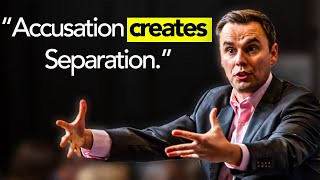
Brendon TEST Burchard explains how to lead your family through dialogue instead of accusation, emphasizing unity, respect, and personal freedom. He focuses on reasoning and open discussion as the foundation for better family communication and cohesion.
Without dialogue, there is no unity. Accusation creates separation. Opening up that dialogue and having them hold that discussion longer without labeling, judging, criticizing, demeaning. We all care about love, truth, honesty. We all care about respect, responsibility, tolerance. I want to hear your real thoughts, how you feel, what you dream of. I want to hear what you're struggling through. The difference between control and reprimanding is discussion. When somebody you know violates whatever value is love, truth, compassion, care, responsibility, respect, obligation, doing the chores, paying the bills, doing something that they said that they would do, following through, doing something, well, whether it is, you know, relational or it's procedural, like they're doing something or they're relating with somebody when somebody doesn't do it to the standards of the family. And those standards have already been shared, right? It's values based standards, which means it's been shared. People, people know, hey, we don't do this or you don't do this. Instead of reprimanding, there's a discussion. This is super hard. I know this growing up because when I did something bad, sometimes I would get screamed at and other times mom or dad would sit me down and go, hey, what was going on for you? Are you okay? That's not what you normally do. That's not how we act. What's going on? Can you all identify that difference that sometimes you were screamed at and sometimes maybe you got a discussion. And great families had the shared expectation of standards that are value based, not conformity or control based. Meaning you didn't have to be perfect, but there was a shared something where we all care about love, truth, honesty. We all care about respect, responsibility, tolerance. We all care about unity as a family or cohesion. But there's something that when it goes off, instead of somebody going off at you or you going off at somebody, it's more like a discussion, what happened? And there's interest in the discussion. There's interest in returning back to higher character. This, by the way, is super elevated, very rare in most families. But that's my job for you today as a high performance coach. I'm always here to tell you what is the next level, what is the aspirant? What is that principle that will get us to the highest levels of family cohesion and love and care and well being and success over time? This is one of those, I think this is a really hard one because most people don't have discussions, they have accusations. If you want to understand your next level and most of your family communication instead of accusation, you're going to move to Discussion. And this is the hardest one, because of course you want to judge. Of course they broke a standard. Of course you want to scream, of course you're mad, of course you want behavior change. But when you lead with discussion, this is how you actually bring in reasoning into families. Reasoning, you know, like the old school idea that man, women, humanity, what separates us from others is our ability to reason things out. We don't talk about that anymore, do we? Because the ethos of logic and that we grew up in more of the old world philosophy and principles has been lost to just how do you feel? And we've gotten this place where we don't have discussion anymore. We have reaction, we have accusation, we have complaint, we have blame. And because we do not have dialogue, our families die off. Because we don't have discussion, dialogue, inquiry, reasoning together, we just have judgment together. Without dialogue, there is no unity. Without dialogue, there is no unity. There's no chance at unity. Instead, there's separation. Because the accusation creates separation. Accusation creates separation. The more we immediately accuse, judge, blame, criticize, the more we push away, the more we open it up and enroll, the more people feel that psychological safety that others might talk about, the more they feel like, I can share my truth, mom and Dad, I can tell you how I feel. I can tell you what's going on at school without being judged, labeled, criticized, negated. When I understand what we're supposed to do together, I know how to then have a discussion when we aren't there. And in a discussion with less judgment and more guidance, with less judgment, more active listening, all of a sudden the family gets healthier. It's the game changer. If anything I've been able to do in my coaching practice with families, it has always been about opening up that dialogue and having them hold that discussion longer without labeling, judging, criticizing, demeaning. If we can do that, we'll change the game. So now we're going to go from interdependent, the family to the individual. And the family itself champions the freedom of the individual. So what does this mean? Like, I think tactically, it means each person wants to see the other person in the family actually find themselves, actually be who they really are, actually pursue things that they find passionate, interesting, curious, meaningful, fulfilling. It means, I want to see you be who you are, and I want to see you do your thing. Let me say it again. I want to see you be who you really are, and I want to see you do your thing. And if that is obvious, it means I want you to have your freedom. I want you to have your freedom when you're the person in the family who wants others to have freedom, independence, autonomy, in the language of the research, when each other, we all hold that space for one another. I want to see you, I want to see you happy. I want to see you be who you really are. But it's not just I want to see it, I want to hear it. I want to hear your real thoughts, I want to hear how you feel. I want to hear what you dream of. I want to hear what you're struggling through. And you have the freedom to share that. That's a whole other level. That's a whole other level when I'm listening for what brings you alive, what your passions are, what you want to learn, what you want to achieve, how you want to be, what you want to do in life. And I honor that champion your freedom. Now, we all have been part of family systems, I'm sure, or you know, and I say part of family systems because we have our own family. But when you were a kid, you had friends and you were part of their family a little bit too. And I remember growing up and one of my friends, his parents were incredibly abusive towards him, just in every way. You know, the way they spoke, the way they treated him, physical abuse, emotional abuse, it was really bad. And they never even thought about whether he was really a person as much as whether he just did what they wanted. But the real curse of the situation was he didn't know what they want because they didn't even convey it. It's just if he did something wrong, he got smacked. I saw him, he was my neighbor. He always struggled with this. And it was so difficult because he could not win. And he couldn't win because there was no part of his parents minds that saw him as an individual. He was either a compliant dog to them or not. It was really awful. And I bring that example up because these things happen in the world. And when someone doesn't see another person as an autonomous being, wanting their own way of life, wanting their own style, wanting their own happiness, wanting, wanting their own way, and the family dynamic doesn't support that, you usually see that person not only being traumatized, but usually acting out, usually going to demonstrate or act out irresponsibly because there's no freedom here. I'll go get it over there and let me show you how free I can be. And so it's really important that we understand how important this is. And boy, I wish I could share with the world more about this, but I did write a book called the Motivation Manifesto. And it's built on the philosophy of personal freedom and how vital that is for you to get that in your life. Because when people see you demonstrate and live a personal freedom, you know who you are. You like that person who you are. And you're going to pursue things that are meaningful and important for you. It's like you're the role model of that family. You're the role model of those around you. It's so critical.










