How to Evaluate Opportunities
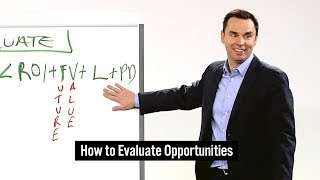
Brendon Burchard walks through his framework for deciding which opportunities to take. He weighs return on investment, future value, sanity, lifestyle, and personal development to make better long-term decisions.
People in productivity always ask the first question. They say, well, Brendan, how do I evaluate things? Because I'm a productive person. But you know what happens to me is I keep getting distracted or I keep. I don't know which one to do. I've got two good options. I'm not sure which one to do. I'll share with you my shorthand. I got two frameworks that help me every single time. They're like back and napkins, things I can do that really helped me decide between two different things because I get offers all the time, as you can imagine. I'm like, it can be overwhelming. And so here's how I do it. Future value plus L. Oh yeah. Plus pd. Okay. This is my magical shorthand that helps me so much. The terms of any deal, the terms of any deal has to be less than ROI plus FV plus L plus pd. Okay, next up, just checking if you're here. It's a super simple one. Okay, I got option A or option B. I'm going to run them both through this equation and whichever one wins is the one I'm most likely to choose. If they're really close, I'll run them through the second framework I'm going to show you. So the first one is easy. Time, energy, resources, money. This means the terms of any deal have to be less than. So in other words, what I put into something, whatever I put into something has to be less than what I think I'm going to get out. How many follow? Very utilitarian, right? Very utilitarian value here. If I'm going to put a bunch of stuff in, I better get more out. Okay. And what I found is if I have a deal and I'm going to put a bunch of time into it, or energy or resources or money, I better get more out of it. But what my magical thing was, was the S. This is the one no one ever thinks about. And everyone screws up and they make a lot of decisions. A lot of utilitarian minded people, very logical, very logical, strategic people make decisions based on time, energy, resources, money, and they forgot the S in the equation. And you have to think about every bad decision you ever chose versus something else. He said, I wish I wouldn't have done that. You just did not consider this thing called sanity. How much time, energy, resources, money, insanity and am I going to have to put into this thing? And I really got to think about that because how many of you ever did a deal with something where it literally you had to work with someone who drove you insane. Great money, great output, but the input of my own sanity, it would have driven me crazy. Entrepreneurs make this mistake, especially all the time. You don't think about how much craziness is going to go into something. You just get attracted to the time, energy, resources, money. You're not thinking about the lifestyle or the community or other things that could really shape how sane it is. Right. That's one thing I'm proud about with what we do with CHPC is like we make this a very sane, calming, comforting community. We step by step. It, it's not scary because I think a lot of other people, it's just easy to get attracted to things that drive you insane. And I think it's important for you all to care about your saying so. You can bring the yes. Okay, so whatever time, energy, resource, money, insanity I put in, something has to be, this is less than sign. I learned that in math once has to be less than what I get out of it. In terms on, in terms of roi, you know what that means? Return on investment. So this is a straight one to one. Whatever I put into it, I better get that out. In investment, I better get that out. It better save me some time, build my energy, build my resources or my money. Oh, I don't want to do it. That's straight up return on investment. And then FV is where most people fail to have strategy. FV stands for future value. Never do anything just for roi. This is where they wreck kids in business school. They wreck them because we're still teaching straight up balance sheet mentality in the world. That's why our relationships are wrecked. Because we're trying to have a balance sheet scorecard with our spouse. We're trying to equate things out with our spouses. How's that working for you? And so we start ruining our relationships because we are trying to get that balance sheet just even. And in real life, we want future value built into deals. I want you, if you're going to do something, I want you to be able to look out and say, wow, that's gonna benefit me in 1 year, 2 year, 3 year, 4 year, 5 year. Like, I can see how that moving that piece right now, that's gonna be a building block that's gonna serve me later on. And if you can't see that whatever deal you're doing as a stepping stone, don't do the deal. And especially don't get trapped in the idea of thinking whatever deal you're gonna do is a final stepping stone. Cause a lot of People, especially when you're starting, you're like, that deal will change my life. That's it. That's all I need. I'll. That means your short term survival thinking, not strategic growth thinking. When you start thinking about future value, you make very different decisions. Very, very different decision. It makes you write different books, it makes you build different programs, it changes the way you sell, it changes the products that you build in your company. You got to go back to future value thinking, including every little thing that you do. If you hire people, don't hire people to fill in a short term. Hire future value players. Can I get an amen on a Sunday? Right? Don't go out with somebody just because they're just there. Date future value people. Don't have short term friends just because you need to lean on somebody who's a complainer. Create friendships with future value people. Your job is to always be honoring and protecting and standing at the gates as guard and champion of your future. Everyone raise your right hand, say, my future. Future matters. My future matters. So I have to be strategic. So I have to be strategic. The way to be productive is to be more strategic. The way to be productive is to do the things that add future value. You got to look past the short term, go for the long term plays and the long term value will change your life then. If entrepreneurs typically suck at sanity in their evaluations, then on the other side, they always fail. On the big L lifestyle, they'll take the deal because it's good time, it's energy, it's making a lot of money. It's not too crazy. It's not too crazy. I can handle it. But they're not thinking on the other side. Boy, if I say yes to that, that means I'm going to be working 28 more hours a week. Who's ever said yes to something that made you work 20 or 30 or 40 more hours a week and you didn't anticipate it? Yeah, I've been there too. And listen, is that related to your productivity? Yes or no? Yes or no? Yeah. When you make decisions and you're not looking at the future value or thinking lifestyle, no wonder your short term productivity is wrecked because you said yes or jumped into something that wasn't your thing, it wasn't of your character, it wasn't who you are, it wasn't the lifestyle you wanted to be, it wasn't who you wanted to become. And that's because you didn't take into account personal development either. You can't keep saying yes or keep evaluating things and like, well that sounds good just because it's good. Does it serve who you want to become? What's the number one most important thing you need to do to win every day? Now most people will say you got to have a morning routine. And honestly, as I've become one of the world's leading high performance coach over this last decade, when I've had the opportunity to meet with, interview, coach or advise some of the world's most influential people. People who literally move the needle of the world forward. People who we all look up to and celebrate as I've been working with them, most of them do have a morning routine. But the morning routine is actually not the most important secret. The most important secret is knowing. How do you assess your performance each day to identify where you need to focus on and improve the next day, week over week, month over month, year over year? To do that, I created the High Performance Planner and if you haven't seen it, you can click the link in this post right now to get access to this. This is a two in one day scheduler and productivity journal that give you the right mindset prompts that allows you to score yourself in each major area of your life and ultimately to maintain momentum in achieving long term success. It's called the High Performance Planner and you can get it right now.










