How To Take Risks
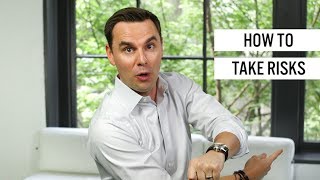
Brendon Burchard breaks down risk-taking into three moves: make challenges harder, do things differently, and be more personal and vulnerable. He draws on his experience as a speaker and content creator to show how embracing risk drives higher performance.
Hey, everybody, it's Brendan. Have you ever heard that advice to take risks, but you felt like, I don't want to take risks. No one likes risk, right? No one wants to say, when they wake up in the morning, I'm going to take tons of risks today. Usually, risk brings about fear. We're worried that if we take a risk, we'll fail, other people will judge us, we'll look stupid, we'll feel uncertain or unsure of ourselves. And nobody likes those feelings or those outcomes. So as much as people say, take risks, and it's easy for us to say, nah, I'm not into that. But we also know intellectually that we can't grow unless we take more risks. That your next level of success, that leap from this level to that level, there's going to be risk there. You know, it's from here to there, and there's that gap in between. You don't know as you take that leap, if you're going to do well, that's the risk. You might fall, you might fail, you might not do well. But if you're not making those leaps and taking those steps, you'll always be stuck where you were yesterday. And to grow, we've got to have a lot of courage to jump into those risks. So let me give you maybe a framework for how to think about taking risks. You know, I always think about three ways to think about taking risks so that I'm continually pushing and growing myself. So the first thing I think about when I look at my career or I look at my life, the first risk I want to take is I want to make whatever I'm doing harder. I know that sounds weird, but I'm like, how could I make my job more difficult? Because in the taking that risk to make it more difficult, I'll grow. I'll give you guys an example. Last weekend, I had the blessing to keynote a conference in New Orleans. Some of you all were there. It was at the Superdome in New Orleans, which holds like 100,000 people, but they kind of spliced it in half with a curtain. And they had 20, 30,000 people in the audience. This was for the Beachbody convention, and it was a blast. Now I could get up and talk to 20,000 people pretty regularly in my life. I'm doing it again next weekend. It's what I do as a motivational speaker. Right. I'm used to doing that. But I could just go on stage, do my thing, and get off, and that wouldn't be serving the audience as much. And so I asked my question my myself, how can I make this presentation even harder on me so that I can grow? So I text two of my friends who happen to be in that organization. Tony Horton, many of you guys know he is kind of the founder and trainer for P90X and Chalene Johnson, who does piyo. And I text them both. I said, what's your hardest exercise move that people usually can't get? Because both those people are going to be at the conference, and this was a lot of their superfans. So I was like, well, let's go. So Tony told me, he's like, the donkey kick is the hardest one. The donkey kick is basically you do a handstand, you kick your legs out, you land back plank position, you run your leg through, like threading the needle in yoga, and then you return and you do a burpee. Okay? And Chalene said, well, the hardest one is like what she calls the piyo flip, which is like, imagine doing a bridge, right, but then going to kind of one arm. And like, you're doing a bridge this way, and one arm goes that way. I mean, it's not easy. So. So I decided in front of 20,000 people to do those two moves back to back in a suit. So imagine doing a handstand in a suit, kicking your legs out, threading the needle, then flipping over, doing a full extended bridge. Not easy, but I did it because it would be hard. Does that make sense? Part of the reason I got better as a speaker is because I was pushing myself. Pushing myself. I mean, I used to be. It's very comforting and easy to get a big speech and, you know, have a transcript or all these notes to read from. But I said, one day I'm going to be able to get up on stage and give a speech with no notes whatsoever. Now, that's hard. That's not comforting. It's not easy. But it's by putting challenges in front of ourselves that we grow. And that's part of taking risks. You know, I always say to people, look, if the only challenges you're dealing with in life right now are the ones that life dealt you, then you're not living a fully conscious life yet. And what I mean by that is you're living a life of reaction. If you're not moving and put. If you're not moving towards harder and more difficult goals, if you're not giving yourself challenges, if you're not taking risks consciously, then you're just reacting to the world. You're not growing. And so challenge yourself the next time you're going to go do something, your art, your career, put yourself out there, try something, make that sales call. How could you challenge yourself to make that process even harder? So. So you get better. Obviously, you know, you need to do that in the gym too, right? I mean, part of growing a muscle is stretching it and making it harder, making it difficult, pushing it beyond its current capabilities. That's how you grow muscle. Same thing. That's how you grow in life. The second big thing I think about is how do I do what I'm doing and take a risk by being different, Right? So think about what I've shared so far. The first way to take a risk is to make your process harder so that you grow and stretch. The second way is do something very different. I mean, maybe you're already good at something, but now you're going to completely switch up how you're doing it. Right now, many of you know I have a podcast about to change that podcast from something that's been very successful. You know, we had top 10 for over 100 weeks in my category. We're completely changing that up. So for those who listen to the Charged life, that's going to be switching up this weekend to the Brendon show. And it's completely different. It's a new format. We don't need to do it. The old way worked fine. But part of taking risks is making yourself evolve, not being the late comer to evolution, right? So think about how can you do something different? I'll give you an example. When we first started my YouTube channel back in, like, 20, 2014, when we really started doing weekly YouTube videos, Travis had this great idea. He said, you know what? What if we did our videos in black and white? And back then, nobody was doing videos in black and white on a weekly basis as part of a show, certainly not in personal development. So we did it. It was completely different. It was a risk for us. I mean, would it work going from color to black and white in the modern era? It did. And some of those videos took off. I mean, million views, 2 million views now, some of them entering the 3 millionth view. That that happened because we decided to take a risk and be different. So how can you be different in your category, in your career, in your field of interest, whatever you're doing, how can you purposefully choose to evolve and do something different? Because that's a risk. And sure, not all risks are rewarded, but I'll tell you what's never rewarded. Stagnation. And then the last One part of taking a risk is being more personal, teaching yourself to share more, to be more vulnerable. It's hard. I get it. You know, I'm in front of a camera, in front of stage, all of my life. I shouldn't say my adult life. I mean, over the last 10 years of my life, it's been a very public journey for me. You see, if you're on with us on Facebook, you know, this is. We have 5 million fans on this Facebook page alone. Doesn't count our other Facebook pages. You know, we've just started, and we're growing our Instagram channel. Hey, guys, on Instagram. I mean, this has been a journey for me of being in front of the public eye. But even me, for my next level, I'm going to have to share more about my personal life, be more thoughtful about that. And that takes a lot of vulnerability. It doesn't scare me. I just know I need to do it. And I'll give you an example, you know, when I first started my career in personal and professional development, you know, because if you ask me, Brendan, what do you do? I would say, well, I'm a writer first and I'm a trainer second. I've been blessed to train more people on the topic, motivation to high performance than anybody else in the world. Now our videos have been viewed over 100 million times, over 10 million fans across our Facebook pages. I've been blessed to reach a lot of people, but I can share with you. When I began my career, I thought I had to be Mr. Buttoned up, you know, so proper, because I came from the consulting world. You know, if you ever had a real job in organizational America and then you start doing this, it's hard not to be stiff, you know, and not share as much. But I remember the first time I ever shared with my audience back then. I shared with them about how when I started my career, I went broke. And I mean bankrupt broke. And I was in bankruptcy, and I was struggling to start my career, do my own seminars. I had no idea what I was doing. You know, people were making fun of me. I'm sure people are making fun of me right now on this live cast. You get used to that part. But, you know, it was new and it was scary. And I'll never forget, though, that after I shared that, so many people would come up to me and, like, I've struggled with that, too. I've been bankrupt or I came from poverty, and I worked hard and I made it, too. And people would share their stories with me. And it was really inspiring and taught me that, you know, people won't believe your successes if they don't believe the struggle. You gotta share where you've struggled more in life, and that feels like a risk. But, you know, you got to be honest. Does your family and your friends and the people you serve, do they know what you really think, what you really feel, what you really desire in life, what you're really going after, what you need? Because if they don't know that about you, that's not taking risks. Look, being quiet and avoiding difficult conversation is not taking risks, and it's not the path to growth. The path to growth for so many of us is. Is another level of personal authenticity, another level of personal sharing. And if you don't do that, then you're not risking. You're just going through the motions. So I would say that today, when you're thinking about the next level of growth for yourself, think about risk. When you think about risk, think about it in these three ways, okay? Number one, think about how can I make my process even more difficult? How can I take on a challenge that's hard for me, that would push me outside of my comfort zone? Number two, how can I do something different? I mean, even though I don't need to do something different, like really switch things up? And then number three, do something more personal. Share something more personal and watch how those risks start rewarding your life. Look, we can all go from, you know, an average person to an achiever, and we can all go from an achiever to a high performer. But it's going to take some new habits for you to get there. And I hope that this conversation about taking risks inspired you to think about just that. Thanks for watching. Make sure you subscribe to my new podcast, the Brendon Show. It's available on itunes and Stitcher and wherever else you get your podcasts. And it's the exclusive place where I share my thoughts about life, about current events, about what I'm going through, about my advice for you as you seek to live an even more extraordinary life, you. It's called the Brendon show, and it's available anywhere you get your podcast. So make sure you subscribe. And if you're ready to take your life to a whole new level, make sure you grab my book, High Performance Habits, How Extraordinary People Become that way. It's available on Amazon right now, and when you order your copy, you're really supporting my channel and the message. And you're also getting a book that will reveal to you 20 years of my research into what is it that helps people go to a new level of success in their life? What does it really take? What habits are proven to help you reach long term success in your career, your health, your personal life, your relationships? It's called high performance habits. How extraordinary people become that way. It's available on Amazon right now. And finally, make sure you subscribe to my channel so you get notifications. And every time I release a new video and by subscribing, you support me, my message and this channel. So I'd really appreciate it. Make sure you hit subscribe.










