Simple Time Management Rules
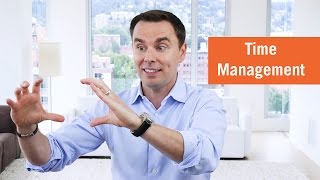
Brendon Burchard explains how to align your daily, weekly, monthly, and yearly goals with your life priorities to get more focused and productive. He walks through the framework that connects what you do each day to what actually matters to you.
Time management, Everybody hates that topic, right? You think, oh, time management. As soon as I say time management to you, you go, impossible. There's no work life balance. There's no way I can manage my time any better than I am. Because you're already sometimes caught in distraction, or you're being interrupted all the time, or you have all these obligations. It's impossible to think about the idea that you could have harmony in your life. So why even friggin try to do better with your scheduling each day? Why try? Well, because you and I both know that sometimes if you don't have a high level of focus and the resulting progress and momentum in your life, you're not happy, you're not contributing what you could. And worse, without time management, you'll never have freedom. Because without structure here, it doesn't give you more time over here. I tell people all the time, you want more freedom, more free time in your life, then get more focused, clear, productive and effective in managing the time you have to to enlarge your freedom over here. So let's talk about four big ideas in time management. Before I even get to the daily stuff, let's talk about the big stuff. All time management should always start with a higher level conversation about your life goals, about what do you really want to achieve in life, and working backwards from there. Because most people say, well, you know, time management, check your email just twice a day. I'm like, okay, yeah, that's a great tip, thanks. But what's your goal? I mean, what do you really want in life? If you don't start from there and then work backwards, then you're just kind of doing random tasks each day. You'll find yourself doing busy work, but it's not your life's work. You might be getting progressively faster or better or higher achieving or more respected over here, but it's in the wrong area. So let's not make you effective and productive going down the wrong path. Start with the big question, what do I really want for my life now? You've been through enough. What now? You're older now, you're more mature now, you're more independent. What now? What do you want now? And when you think about that, think about three big categories. First, think about yourself, your character. Who do you want to become as a person? Who would you feel proud to be? You know, what would create a lot of self respect and integrity in your life? Where you're thinking, that's the kind of person I want to be. Start there always. Like what kind of person do you really want to be? What would you have to achieve to feel good about yourself? Second, think about your relationship goals. Like, how do you want to show up for your family, for your spouse, for your team, for those that you lead or serve? What kind of person shows up for them? What's that energy like in your interactions? What do you ultimately want to have or experience in your family? Like, how would you know you're successful unless you're gauging somehow what you want in your relationships? And then also think about your growth goals. Like, what would make you exceptional at what you do? What would really bring a higher level of excellence into your life? What about growth goals in terms of enrichment? What would make you happier? What would make you feel calmer, more stable, more mindful, more joyous, more happy? I know these are random sets of questions, but they're all tied to one simple idea. We should know what our big picture is, what's our life goals? And then work backwards from there because then it gets easy. Now we just break that all down and say, okay, in terms of time management, let's just take the easiest units of measurement. That's the year, so you have your year goals and that's the month. I never ever want you to start the first of the month. Let's say it's, you know, the very first day of the month. I don't want you to start that day without sitting down and saying, okay. Based on where I'm at right now, what are the major goals that I need to work on? On myself in my relationships and in my career contributions this month? What do I need to hit this month? How do I need to show up? How do I need to develop the relationships? What's needed from me? And what could I give and deliver this month? And do it on a 30 day cycle? Just say okay every month. Because you know, sometimes last month you got distracted, you got thrown off your practice, you lost discipline. So at the beginning of the month, it's just a, it's a useful trigger. It's a timeline. It's there every month, right? The first of the month, what do I want this month? When I meet people and I ask them, what's your 30 day goal? And they can't even come up with one. Then I'm really worried about them. Because the bigger question, what's your 30 day goals? What are you really going after you this month? Then once you've got that in place now it gets easier because those monthly goals can be broken down into either deadlines or milestones or things to contribute or create that month. And then the next level of time management comes down to the weekly level. And on that weekly level, what I want you to do, block out time each and every single week to focus on what's important to you. Every week you should have a workout somewhere planned in there, or several. Every single week, you should have some free time planned in there. Every single week, you should have some family time in there. Every single week, you should have some creative time time in there. Every single week you should have them catch up time. These are blocks of time that should be in every single week. And if it's not there, then those don't become a habit. Those don't become specifically any progress in your life. You have to have blocks of time that are the same blocks of time every single week. They don't have to happen at the same time, but you need to make sure you're blocking out those things each and every single week. Like workouts, like family time, like friends free time, like creative time, you get last your daily time management. Here's all you need to know about daily time management. It starts in the morning when you wake up. Before you check into the world, check your email, check your phone, all that nonsense, I want you to sit down with a piece of paper or your journal or your calendar and sit down and say, okay, what must happen today? What three things must I move forward or achieve today so that I know that I am focused, I am progressing in life, I'm gaining some momentum towards those big life goals. If you don't have that sit down session in the morning and you fool yourself, you're like, oh, well, you know, I'll think about it after I check my emails or my text or after I respond to all these things, you don't do it. And you start living a reactive life versus a strategic life. You start living by impulse and interruptions versus by intention and inspiration. So what I want you to do is make sure every morning before you go and respond everything to the world, sit down with a piece of paper and say, what must happen today to move me forward? Do all these things, you'll start to not only have a better sense of your day, your week, your month, your year, but you have that momentum again in life. Because until we get you focused, until you create that discipline to do these things on a continual basis, what ends up happening, you live a life that's completely random. And then at the end of the year, like, oh my gosh, I didn't change. Or you get in the middle of the year and think, oh my gosh, I plateaued. Or you find yourself 10 years out and say, what did I just do with my last 10 years? That only happens when you don't think about it, when you don't strategize. And now you know at least how to begin that process. So do that and you'll experience more of what we call the charge life. Hey, my friend, it's Brendan. I hope you enjoyed this episode. Do me two favors. Number one, subscribe to this channel so that you continue to get updates every time I release new training for you. And number two, if you would like to get ahead a little faster in life, what I'd like to do is give you my 10 steps to achieving anything 10 times faster. So if you have a big goal, a big dream, a big mission in life, and you just like to achieve it faster, what would you need to do? You know, this is exactly what I keep next to my computer or next to my bed. And every time I have a big dream, a big goal, I open it up and I kind of use this as my checklist to get ahead faster. Because you and I both know if you're going to be more effective or more productive or you are going to achieve your goals and your dreams faster, you're going to have to switch your perspective a little bit on achievement itself. You have to adopt new thinking patterns and habits. You're going to have to have new daily rituals and habits. And your entire approach to learning and skill development must be better. So in order to help you do that, just go ahead and click the link in this post or go to brendan.com 10x that's Brendan B-R E N D o-n.com 10x and you can download this guide for free. Just tell me your name and email. I'm happy to email that to you for free. The same guide I use to achieve any goal or dream faster. Thanks for tuning in. Until I see you next time, go out there every single day of your life. Live fully, love openly, and make your difference today.










