Why Perfect Isn't Perfect
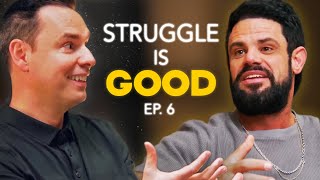
Brendon Burchard and Pastor Steven Furtick discuss why struggle matters more than perfection. They share personal stories about failure and growth, arguing that difficulty is essential to maturity and strength, not something to avoid.
When we get in trouble, we want a perfect picture. I won't begin until I have the perfect skill. I won't begin until I have the perfect plan. A lot of maturity in life happens when suddenly you stop bemoaning the struggle and you start to realize that the struggle is absolutely part of it. For your character development, for your ability to cope and do better in the next struggle, train yourself to be in a good place. Learning from your past lessons and preparing yourself now for the struggle that you're in. The inevitable is that there will be struggle and there's inevit backed. Don't be surprised. The struggle. Hey guys, it's Brendan. And as you know, I rarely do sit down interviews with anybody. And so this is a special episode. I'm doing a six part series with my friend Pastor Steven Furtick talking about how you can use faith and mindset and high performance to improve your life. This was a rare sit down interview for either of us in our busy lives. We're both New York Times best selling authors, we both teach reach millions of people every single week. We have the opportunity of reaching so many people. Me with personal development and high performance training. He of course in ministry in Christianity, in sharing his message as a pastor of faith and how to improve your life through a connection with God. And it was kind of a cool sitting down and coming together of these two worlds to talk about one thing, mindset and how you can become the new you. What his new book is entitled do the New you. It's a six part series so I hope you'll enjoy it here. It's rare that I put anything like this on my YouTube channel because most of my channel is my keynote presentations or my live cast or replays for my courses. But you're getting an exclusive look right here in some behind the scene conversations I get to have in my life all the time. But this time we recorded it. So with no further ado, please enjoy this conversation with myself and Pastor Steven Furtick, author of the new book do the New you.
I always used to do teachings with our interns at the church. Brendan and I would open it up to question and answer and there was always something along the lines of, you know, I feel God called me to be an amazing songwriter. I feel God has called me to make movies or I feel God has called me. So it's a dream which I respect because God called me to be a pastor when I was 16, right? And I felt it and I sensed it and I glimpsed it and I didn't know how it was going to happen, but here I am in front of these interns and they're going, what do you do when God gave you a dream? And I landed on this saying that I used to tell him, and it was kind of a testimony of my own life. I said everything that God unlocked in my life that was next was a result of being fully committed to my now. In other words, all of this vision about the future. Did you ever think that you would pastor a church that would have this impact on the world or write books or anything? In a sense, yes. I had dreams and I had hopes and I wanted to be used by God. But it was showing up to, you know, teach the Bible to 20 kids.
Right.
@ Santee Circle Baptist Mission. It wasn't even a chartered church yet. It was Santee Circle Baptist Mission. And it was the kids that were brought in on the van from neighborhoods where, you know, they didn't have any parents dropping them off at church. So we went to get them and their attention spans were horrible and they didn't want to be there for the Bible. They just want to come get the food and play kickball. Yeah, that's where it started.
It started. You had a direction, not a fully formed perfect dream.
And don't you think people are over obsessed with the dream and sometimes unwilling to just follow the direction that they have for this day?
Yeah, they want to. When we get in trouble, we want a perfect picture. It's like, I won't begin until I have a perfect picture. I won't begin until I have the perfect skill. I won't begin until I have the perfect plan. And I think so much of what I learned from reading the Bible is that he gave direction, but he also gave struggle. Yeah, there was never like, you just glided into the promised land. It was just like, how many times does Saul have to try to kill David before you realize, oh, he didn't just say, you're king. It's like you realize there's this journey and that struggle is a part of it. And a lot of maturity in life happens when suddenly you stop bemoaning the struggle and hating the struggle and getting mad at the struggle. And you start to realize that the struggle is absolutely part of it for your character development, for your relation with God, for your ability to cope and do better in the next struggle. And so I always tell people in high performance, I'm like, don't be surprised at the struggle. I mean, working with a fighter, I'm like, don't be surprised you just got punched in the face. Don't be surprised. You're in round four and your legs are given out. Don't be like. Don't be surprised about the inevitable. And the inevitable is that there will be struggle, and there is inevitable. You'll be backed. You know, you'll be backed. Yeah, don't be surprised. You'll be backed. Don't be surprised. There'll be a struggle. And that's why I love this chapter, because you went into this idea of, like, help me fail.
Yeah.
And when you went in there, I was like, okay, you like that one? This is turning on.
So if you read it, let me give you a little bit more color. Okay. I hope you've read the book, and if not, I hope you get the book so that you can just get this back in your heart over and over again. Because some of my lessons that come to me don't come when I'm just sitting down, reading the Bible or studying a commentary. It'll be something I'll hear somebody say, and I'll go, oh. Oh. That's kind of. That's kind of interesting. This guy comes over to lift weights with me last year, and he brings his spotter with him. Now, this guy's a professional bodybuilder. But I know that the moment that stood out to me was when he was maybe on his, like, 12th or 13th rep on a shoulder press, and he said to his spotter, three words, Help me fail. Now he's, like, at the end of his rep, what they call, like, the effective rep. I don't know all the terminology, but, you know, it's always the rep that you can barely do that produces the growth. Like, if you want to build strength and muscle, the first 10 reps that you did easily aren't building any muscle. It's the one that you thought you couldn't do. That's where the growth starts. So he gets to that point, he does a really hard rep, and then he goes to do another one, and he tells his spotter, help me fail. And I thought, that's interesting. If somebody's spotting me, I say, give me a spot. Or I might say, help me, or I need a little help. But he was so specific, helped me fail, that I realized he was saying, naturally, I understand that growth happens at the point of failure, not before. In order for my muscle to grow, I have to fail with good form. Now, that's important. Like, I'm not a workout expert, but don't be breaking your back trying to just fail. You can fail and fall on the floor and knock your teeth out if you don't know what you're doing. That's why he had a spotter. He's saying, I need to push through what I think I can do, and I need to get through that, but I can't cheat it or I'll hurt something else. So I need you to help me through this rep that I don't think I can do. Make sure that I'm going to be okay at the end of it, because that's how my muscles will adapt and I'll get stronger for the next one. So I use that for an analogy where in my life, I'm coming up every day. I mean, every day I'm coming up on a mood, an attitude, a fear, a failure, a disappointment, an interaction. Let's keep going. All the things that we all run up on where it feels like I completely blew it, or there that is again, Or I'm still weak. I thought I'd gotten over that. I thought I was through that. I thought I was better than that. What was a big shift for me in my mindset was not only the first mindset. I'm not stuck unless I stop, like, push through it. But to know that that's where God does the most. Growing in me is the moments where I actually feel like I didn't do it that well. I didn't do it that good. I preached so many sermons where I got off the stage and thought, God, you showed it to me. It was so beautiful. But I didn't get it to them like you showed it to me. Then I might hear from somebody four months later, hey, you remember that sermon you preached? I'll go, yeah, I remember it. It was a mess. And they'll go, man, that saved my marriage. And I realized that at the moment that I was feeling the worst about it, God was doing the most in the pandemic. We had nobody in the room. And there's this auditorium with thousands of seats, and there were five people. There's Holly and a few staff and the camera people. And I'm preaching. And I walked off stage, and I felt so weird. Like, I'm used to preaching to a lot of people. And I get off the stage and somebody meets me backstage and says, how does it feel to preach to the biggest crowd you ever preached to? And I'm like, that's not funny, man. It's really awkward. I'm up there preaching to nobody. And they said, no, no. There were more people watching online today.
Wow.
Than Any crowd that you've ever preached to, all in just that service. You just preached to the most people you ever preached to. And it was when I was seeing the least that I was ministering the most. Wow. And I want to get this in your heart as we close this mindset masterclass, not as we close this process. Because it is a daily decision that you have to make. Which me will I be? Which you will you do? You're not done choosing. It's not a one time event. I want to give you this last little nugget for the seasons where you're struggling. It may not even just be one rep. It may not even be just one day. It may not even be just one month. You may go through long stretches of time. Yeah. With a little reprieve. But you might say this is mostly a struggle. The stage of life my kids are at right now, this business challenge relative to my industry, this rhythm of my life that feels completely unsustainable. And while I don't always think that we should seek out more struggle, I think we have to know that when we struggle, God gives strength. If you can know that in those moments and say to God the greatest three word prayer that I never heard, help me fail. I don't ask God to help me fail. I want him to help me win. Help me succeed, help me crush, help me kill, help me destroy. You know, like, I want to win.
You're saying, help me stretch, help me grow, help me know for those who are like an aversion to fail. But I think it is important that.
Well, I chose the language help me fail because it's inevitable that you are going to feel like you're failing, but maybe you're not. That's what I think is so interesting about you being a success coach, is that some people go, well, a success coach, is that really scriptural to success? Well, first of all, God told Joshua, I'll give you good success. The kind of success that God gives a good success where you make a difference for him and you don't rip your life apart. I mean, you wrote a whole book called High Performance Habits about people who are not just succeeding over here and then making a mess of their relationships or destroying their health. God wants to bring all these things to integration in our life. But I think just as important as what's our definition of success? Is the question, what's your definition of failure? Who said it failed?
Right.
We talked in an earlier masterclass about disappointment. And disappointment is relative to time. And when you remove the element of time. You don't have to be disappointed because it's going to happen, and it's in God's hands.
Yeah.
So what do you walk people through when they are experiencing what they perceive to be failure? But, you know, as a coach, this is a growth moment. This is a growth season. Yeah.
I think the first part is always, as I said earlier, just remove the surprise from people. It's like they're so shocked that they had a bad performance. I was like, you've been on tour for three years. You didn't think one of them you were gonna suck, or you just remove, like, the struggle and the failure, it is going to be there, and it is a personal definition. You thought you failed, but 15,000 people chanted, you thought you failed, but you weren't arrested the next day. You thought. We have these cataclysmic things about failure, and we always realize failure is a personal definition. So first, I want to say, why were you surprised? Second, what is your definition? Tell me, what does that mean that you failed? And what's interesting, when people use the terminology of failure, they drop into the fixed mindset right away because they believe that the failure stopped something. I failed. And it's just like this defined event, and their progress stopped and their growth will stop. And so their definition of failure often comes with, like, a stop sign. And I have to say, oh, there's no stop sign. That was an incident in life. Tomorrow there's gonna be 40 other incidents. That was one struggle. You're gonna have another thousand. So there was no stop sign. It was something that occurred, but it occurred in the stream of life. And now you're downstream of that difficulty, and now you're gonna face another boulder that's similar. Okay, how are you gonna navigate this one? Cause that's what that gave you. That difficulty gave you navigation instructions. It wasn't a failure. It was a navigation instruction manual.
It was like, I love that.
Hey. Okay, you hit this thing. It didn't go right. That boulder is going to appear in the stream again probably a lot of times until you learn. Right? So now you know the boulder is coming up. Well, let me skill up. Let me learn how to navigate that. Let me learn how to use my oar and snap my hip in the kayak to pop around that boulder.
Yeah.
Let me skill up so next time I face it, I'm a little stronger.
Yeah.
I'm a little smarter. I'm a little more wise. And so that's a developmental standpoint. It doesn't say, I stopped There, it's forever fixed. I'm always gonna be ruined. Here it says that's probably gonna come up again. Let me teach myself. How would the best self deal with it? How would I skill up to deal with it better? It's taking a struggle that's inevitable and it's equipping ourselves for the future. And maybe what came out of that struggle is I'm gonna equip myself to be kinder next time. I'm going to equip myself to be more patient. I'm going to equip myself to develop a skill that I can do this or that so that it doesn't feel so harsh or surprising or awful next time. Because that's maturity, is we get better at things. Like you do as a speaker. Right. My metaphor for that would be I train myself to speak to a small group and then a slightly bigger group and a slightly bigger group. And. And it's like the problem was I was probably level of a thousand people. I still felt like I wanted to throw up before going out there. And I had to say, I need to train myself to be in a good place to handle life's challenges. And that's what I want people to hear is like, the struggles are inevitable. Train yourself to be in a good place. Learning from your past lessons and preparing yourself now for the struggle that you're in. Cause the season that you're in, which is why I love the chapter title here, it's like the season that you're in, you're equipped, you're emboldened, you got backing. And you have to step in faith and stay in motion and not hit the stop sign.
Step in faith. Because the struggle is not a stop sign. It's a strength builder. Struggle builds strength. So write these two down. Struggle builds strength. Not all struggle. Some struggle. You're struggling because you're stubborn. Like you're not supposed to still be struggling with this. You're supposed to apologize. Quit trying to prove you're right. But when the struggle is something that God is taking you through and leading you through, it's going to build strength.
Don't put a stop sign on the struggle.
Don't put a stop sign on the.
Struggle, especially when it's bad and you didn't want it. I mean, people, I know you, you minister to people who've their struggle or their challenge. In this season, they lost a child. And when you tell them, well, just be strong through it, it sounds so flippant. But sometimes when you say there will be strength, you'll be provided for. But also, don't stop there. You know, don't forget you do have maybe another child. Or don't forget that your life doesn't have to stop because they were called. And so I think it's a matter of when our struggles hurt us and there's no growth from them, is when we put that stop sign and we think that ended our life, that ended our progress, that ended our reputation. And so when I say, don't put a stop sign on a struggle, it's not trying to say that anyone ever wanted those terrible things that happened to us that are our struggles and problems. It's saying when you have that terrible thing and that awful thing and you can't find the strength. When they hear guys like us say, well, there's strength there, and they're like, I can't find. There's no strength that came from this awful. I lost my dad. There's no strength from that, Brendan. I go, yeah, it doesn't feel like it. And you might be right, but don't stop living. Because your dad didn't want you to stop living. He doesn't want you to stop living. And so the most important thing when you say that there's a season for everything and that God is with you, there is don't put stop signs on the struggle.










