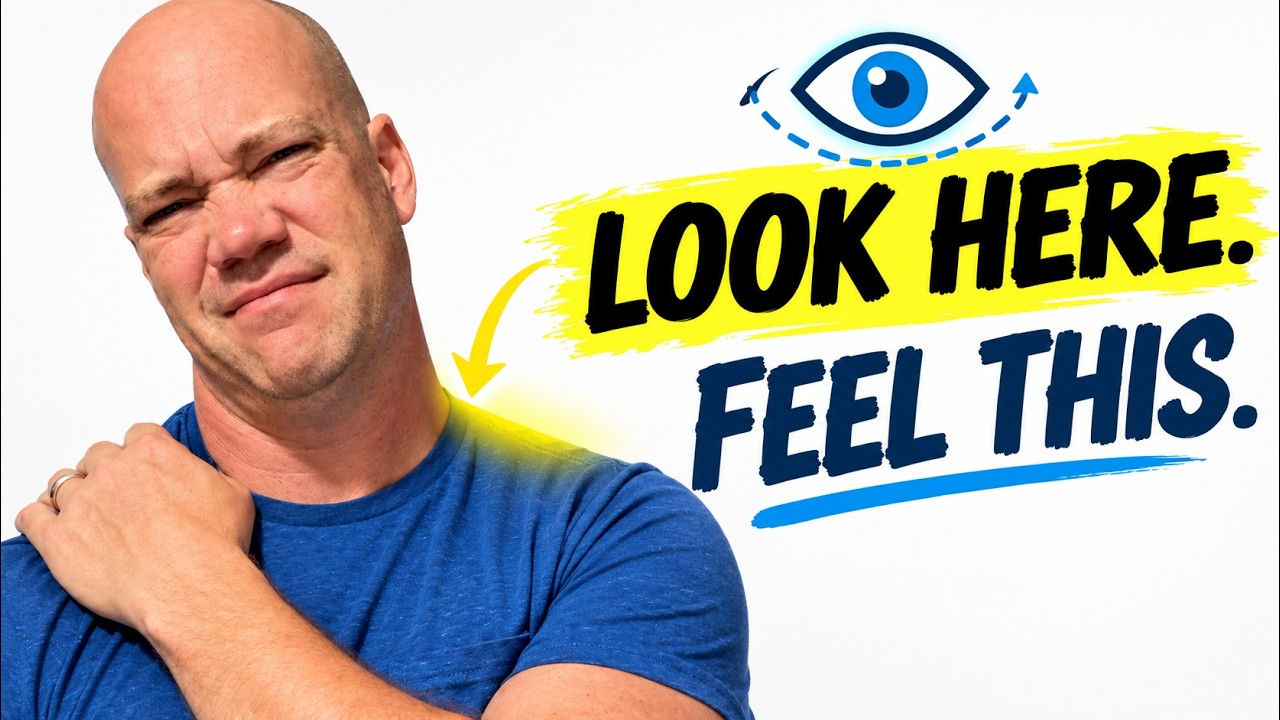
In this instructional video, Bill from Beyond Fitness Online presents a simple eye‑movement exercise aimed at loosening tight upper trapezius muscles and potentially enhancing vision. He begins with a self‑assessment: reaching behind the back with the arm to gauge trapezius flexibility, performing a lateral neck tilt to check range of motion, and using a Snellen chart to record baseline visual acuity. Bill explains that the nervous system can lock the trapezius when eye tracking is not smooth, as the body seeks head stability for clear sight. The core intervention is a smooth‑pursuit eye exercise using a marker as a visual target. Viewers first move the marker left‑right, up‑down, and diagonally while keeping eyes on it. To increase difficulty, they progress to horizontal and vertical figure‑8 (infinity) motions. The routine lasts about 30 seconds, followed by a short rest. Afterward, viewers repeat the lateral tilt, arm‑reach, and Snellen tests to see if flexibility and vision have improved. Bill invites viewers to share results, subscribe for weekly videos, and ends with a health‑focused sign‑off.
Chapters
If your traps feel really tight, you don't need a massage, you need to do this simple exercise. Hi, I'm Bill from Beyond Fitness Online, and today I'm going to show you a simple eye exercise that can help relax your shoulders, make them feel looser, and maybe even improve your vision. That exercise we're going to do is called a smooth pursuit, and I'm going to show you that in just a second. But first, what we want to do is get an assessment. So first thing you want to do is take your arm and reach up your back As far as you can and get an idea of how well you can reach there and what kind of tightness you have in that trapezius. You also may want to test your lateral neck range of motion, so tilting your head side to side. Make sure you're not rotating or extending your head, but actually just tilting. Also, make sure you use a Snellen chart or something to measure your vision. That way you can see if your vision improves while doing this as well. Studies have shown us that the trapezius muscle gets locked down by the nervous system when we don't track things smoothly, and it does that because it's trying to create more stability in the head so that we can see things better, because seeing things is our number one safety mechanism. So what we're going to do is an exercise called smooth pursuits to improve that smooth tracking and then allow the nervous system to relax the tension in these muscles. So to do that, it's simple. You can use your thumb. I've got a marker today, and I'm going to use the tip of the marker as my visual target. And what we're going to do is hold that out in front of you, and we want to do it smoothly. So I'm going to show you several different ways. The simplest way is just to go left and right, keeping your eyes on the tip of the pen the entire time. You can go that way, you can go up and down, and you can even go diagonal. Now, that's a great place to start, But what we want to do is really make this a little bit more complex, because in the real world, not everything just moves in a straight line. So level 2 of this is going to be taking this pen and moving it in a figure 8. So I'm going a horizontal figure 8, or an infinity sign, and then you can also do it vertically, where it is more like an 8. It's okay to blink while you do this, but you just want to make sure your eyes stay on the target. Okay. Do this for about 30 seconds, take a rest, and now retest your lateral tilt. See if you can reach higher up your back, and also check the Snellen chart and see if your vision's improved. Let me know how this worked for you and what's improved. And if you found this interesting, I post new videos about this kind of thing every week, so don't forget to like and subscribe. And until next time, live healthy.