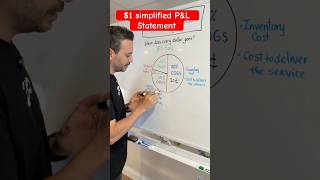
A brief finance lecture by Bill Hanna, CPA, explaining a profit-and-loss statement by tracing how $1 of sales is allocated: 50% (50¢) to COGS, 25% (25¢) to operating expenses (OPEX), 5% (5¢) to interest and taxes, leaving 20% (20¢) as profit. The talk uses a pizza-slice metaphor and mentions examples for product and SaaS businesses.
Chapters
Hey guys, Bill Hanna here coming back with another finance bite. Today we're going to understand the profit and loss statement by following the journey of $1 that we make in sales. So we make $1 in sales and we'll look at it in terms of a pizza pie. Where does the money go when we make $1 in revenue? The first slice of that $1 will go into cogs or cost of goods sold. This is the cost to deliver the product or the service. So if this is a product or a physical product based business, the cost is going to be the inventory cost, the cost to acquire the inventory or to make the inventory. If this is a SaaS business software as a service, the cogs is going to be the cost to deliver the service to the customer, which is typically the server cost and the customer support cost. Okay, so the first slice goes from the $1, 50% COGS, which is 50 cents in this case. So let's write here 50 cents goes into COGS, cost of goods sold. Up next, the next slice is going to go to OPEX or operating expenses. And this is going to be the day to day expenses. Salaries, rent, marketing expenses, cloud hosting services and things that you need to run the business on a day to day basis. And that is 25% of our $1 in sales, which is 25 cents. So 25 cents goes right here into OPEX operating expenses. Up next, the next slice is going to be a smaller slice of the pie. It's a 5% goes to interest and taxes. So this is the interest on the loans if you have an outstanding loan for the business and taxes, paying Uncle Sam your estimated taxes. So 5% on that, which is 5 cents. So what do we have left? We spend 50 cents, 25 operating expenses and 5 cents here for interest and tax. We're left with 20% profit or 20 cents. So there's the leftover at the end, 20 cents that goes into the profit of the business. If you want to learn more finance bites like this one, go ahead and follow the channel.