How CFOs Evaluate Net Loss vs. Cash Burn
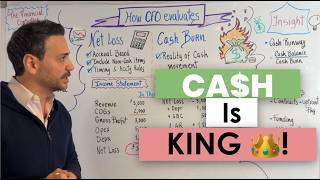
Bill Hanna, CPA, explains why CFOs should track cash burn instead of net loss. A company with a $3M net loss might only burn $1M in cash once you adjust for depreciation and working capital. Calculate runway by dividing cash balance by monthly burn, then start fundraising before it runs out.
Chapters
In today's video, we'll discuss how a CFO evaluates net loss versus cash burn, because from what I've seen, CFOs don't lose sleep over accounting losses, but CFOs will lose sleep over running out of cash. So why are we covering this topic today? Well, we'll discuss how to differentiate between net loss and cash burn, and that will help us learn when to sound the alarm in terms of running out of cash. And we'll also talk about strategies to fund the business from different multiple sources. So this sounds good to you. Let's dive right in. Welcome back. This is Bill Hanna, your favorite financial controller. You can find my free lectures here on YouTube. But if you wanted to go in depth and take your career to the next level, you can find my courses on the Controller Academy website. I'll leave a link to that down below. So jumping into today's topic, which is net loss versus cash burn. This topic is highly relevant to companies that are pre-profit. Typically, these are companies that are VC-backed, high-growth companies that are still generating losses and cash flow negative. And so when we look at net loss versus cash burn, we're looking at the economic reality versus the actual cash reality of the business. So with net losses, This is accrual-based, so this records revenue when earned and expenses when incurred. It's also going to include non-cash items such as depreciation and amortization, and it's going to be relevant to timing and accounting rules. So timing here is, for example, the matching principle, recording revenues and expenses in the same period, which reflects the economic reality but not the cash movement. And that's why we need to look at the cash burn for the business. So what about cash burn? This reflects the reality of cash movement in the actual bank. Okay, so let's look at an example of an income statement. We have revenue of $5 million, COGS $2 million. That will give us a gross profit of $3 million. Then we reduce our OpEx, operating expenses, $5 million, depreciation of $1 million, we get to a net loss of $3 million. And here is the problem with a lot of the finance leaders— will focus on this accounting number right here, while what they really need to be focused on is the cash burn from operation. Okay, so let's look now at the cash flow statement. And if you wanted some help with the cash flow statement, what I'll do is I'll leave a link down below to a video detailing how to create the cash flow statement. Along with an Excel file that you can download and practice for yourself how to create the cash flow statement. Okay, so we look at the operating section of the cash flow statement, uh, net loss. So we'll begin from our net loss, which is the accounting loss, $3 million, but we'll need to adjust for the non-cash items. So we'll adjust here for two non-cash items, and then we'll adjust for the changes, some of the working capital accounts. So we'll take the net loss of $3 million from right here, that goes right up here, and then you'll add depreciation. So depreciation was $1 million, we'll add that right back because depreciation has no impact on cash, it's an accounting exercise. We'll also add back SBC or stock-based comp. Stock-based comp is a number that is buried in operating expenses and represents maybe the option expense or the employee option expense, or if you issue equity to the employees, that's going to be the expense that you recognize each period for that expense. But it's non-cash, so we're going to add it back to our net loss. So now we adjusted for the non-cash items, and then we will adjust for items that are working capital. So for accounts receivable, in this example, accounts receivable balance went down month over month. Which signals that we collected more cash than we— what we recorded on accounts receivable. So that went down by $1,500 or $1.5 million in this case. So we're going to add back $1.5 million to our balance. For accounts payable, accounts payable balance month over month went down, which signals that we paid more to vendors than what we recorded in expenses. So that's going to be reducing $1 million to reduce the balance by $1 million, and that's going to give us the cash from operating activity negative $1 million. So now, as you can see, this is the most important part here because the cash from operating activity is negative $1 million. Net loss was $3 million, which is the accounting or the economics of the business, while cash outflow was $1 million, which is the actual cash movement from the business. So income statement helps you decide the past while cash flow statement helps you decide the future of the business because it looks at the actual cash movement of the business. Also, notice that the cash flow statement is a simplified one. We're only looking at the operating section of the cash flow statement just to simplify this example, but also you'll have an investing section and a financing section that goes below that. So just make sure that you look at those, and if you have a recurring item on those in terms of cash movement, to add that here so that you're looking at the actual cash movement from the business. Okay, so now that we understood the difference between net loss and cash burn, that will help us get into the inside section of this video. So in the inside section, we'll talk about cash runway. Cash runway tells you the length of time that you have before running out of cash. So cash runway is the cash balance that you have in the bank divided by the cash burn that we got from down here. So in our example, the cash balance is $18 million. Divide that by the cash burn, which is $1 million. And that will give you 18 months. So that tells me that I have 18 months before I have to raise funds again, which is something that you have to do before the end of the 18 months, right? So you don't want to wait till the very end. To begin raising funds. You want to begin at least 9 months before that milestone is reached so that you have enough time to find investors, show them your projections, and raise funds. Okay, let's talk about strategies to fund the business. There are 3 main areas that you can fund the business from. The first one is your customers. So this is saying try to collect your money up front. So try to negotiate your contracts with customers where there is a component that is collected upfront. So in essence, you're really financing your business through your customers. So if you're a B2B SaaS business, for example, structure your contract with the customer so that you're collecting a whole year worth of service upfront. That will help you have some funding, uh, at the start of your business. The second area of funding is going to be VC. So typically when you go to a venture capitalist firm, you need to present them with a 5-year forecast for the business. Showing how you're going to accomplish each milestone of revenue in these 5 years. Uh, make sure when you go to a VC, this is one of the tricks that I noticed in my career. When you go to a VC, typically that's going to follow a success in the business. So this is something like having a major influx of customers that are coming in, that are taking your service. Uh, you have an increase in revenue in one period, so you can go and show a trend, a strong trend to the VC and say, my business is doing these big successes in terms of customer acquisition or revenue generation and say, here, my revenue jumped 2x period over period, and that's why my business is worthy of investing. Another area of funding is going to be venture debt from banks. So banks will do a venture debt. A venture debt is that the bank will give a loan to a startup, which is a very risky business for the bank, but they do it because they get some equity. So they get to make interest on that. Typically an interest between 7 to 10%, and then they will get some equity in the business, usually in the form of warrants or options. So they have some skin in the game if you succeed as a company. So typically what you do is you go to a VC and you raise, hopefully after some success in the business. After you raise from a VC, you go to a bank and you say, hey, I just raised this money from a VC, and that shows that I'm legitimate. That will show the bank that this is a good idea to invest in you because a VC already invested in you. So there's some momentum here. So these are the 3 areas for funding from customers, negotiating contracts that will give you revenue upfront, funding from a VC by building a 5-year forecast for your business and showing how you're going to hit these milestones. And then from a bank in terms of venture debt, giving the bank some skin in the game in terms of warrants. Okay, so to recap, it's really important for a finance leader to understand the difference between net loss and cash burn. Net loss is important because it shows the accounting and the economics of the business. However, with cash flow, it shows you the actual cash outflow of the business, which will help you plan for the future in terms of fundraising and the timing of that fundraising. I hope that you enjoyed the video. Share it with someone else who might learn from it, and I'll see you in the next one.










