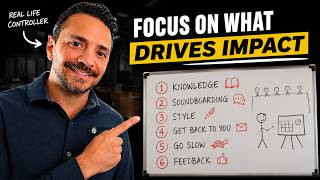
Bill Hanna walks new CFOs through preparing for board meetings. Spend 1-2 weeks learning your financials cold so you can answer variance questions. Soundboard your deck with a peer, speak slightly slower, and use the "later" technique to defer detailed questions you'll answer after the meeting.
Chapters
So I just came out of a board meeting where we present the board of directors the results of the previous quarter and guidance for the full year. And I wanted to share with you how I prepared for this meeting. So I spent about 1 to 2 weeks preparing for it, and I wanted to go over 6 items here that helped me really calm my nerves and give me confidence on the day of the presentation itself. So if that sounds good to you, let's jump right in. If you're going to present to a board of directors in the capacity of a CFO, VP of Finance, or controller, congratulations, you've reached the top echelon of the finance ladder and you've reached the crème de la crème status in finance. So here is my steps to prepare for a board meeting. The first area, and there's no replacement for this area, is going to be the knowledge. So your job is to know whether you're going to be doing the research of the material yourself, or you're going to have someone under you who's doing the investigation and giving you this knowledge. There's going to be no replacement for that because this is going to give you the confidence that you need in the meeting. And if you forget about all the other areas, which include speaking style and rehearsing and all of these things and storytelling, if you have the knowledge and you have nothing else, you're almost good to go, but we'll talk about the other areas here as well. So what do I mean by knowledge? What do I mean by that is that if you're saying a revenue variance to budget of let's say 25%, you can pinpoint where is this 25% coming from. This is coming from customer XYZ. This is coming from maybe a 20% drop in sales in the previous period. You have to understand where it's coming from because you will know in the meeting if you get a question, you'll be able to answer it. And that's going to give you the confidence. And this executive confidence is really what separates someone who is a pro from someone who's an amateur. So there is no replacement for knowledge here. So this is the first area you need to be focused on. Spend 1 to 2 weeks on that. Now, second area is going to be soundboarding. So soundboarding is something that you can do with typically with your manager. So if you're a CFO reporting to the CEO, have a session with them and walk them through the presentation because then they can point out some of the areas that are difficult to understand, or maybe some areas where you're too zoomed in into something and getting into the weeds where you need to zoom out a bit, right? Because in a presentation, in a storytelling for the board, you need to focus on the macro, right? You need to zoom out and not talk about very specific numbers. You talk about specific numbers when you get asked the question, but you overall focus on the overall picture of the presentation and the story of the company. So soundboarding is really important. Have a session with someone. If it's not your manager, someone who's your peer and soundboard how you're going to present to them. The third area is going to be the style. Now people can differ on the style a lot. So one of the key things in style, what I always say to everyone who's presenting is a saying from Dr. Seuss. There's a line from Dr. Seuss that says, You are you and nobody else is youer than you. It's funny, but it's true. Nobody else is going to have your same style. So you should stick to your style and make incremental gains over time. No one's going to be born a presenter from the get-go. So make incremental gains. Don't focus on becoming an amazing presenter today. One of the things that I like to say is there is a word like, you should try to cut that out completely from what you say. A controversial take on um. I think some ums are good in the conversation when you present. A lot of ums can be distracting. So removing all ums is, in my point of view, is not the best because you sound like an anchorman from CNN and nobody really wants that. You want a human to be presenting. You want to humanize your presentation. So some breakage in the way that you speak and very few ums here and there is actually a good addition to the way that you present. If you, in the style here, if you script, so people who script and read the script, that's a big no. I don't want you to be reading. I don't want you to be memorizing. You need to be speaking as presenting, as a human, right? This is really important in the style and executive presence in the meeting that you're able to just look at what's in front of you, zoom out and tell the story, right? And again, you're not going to nail it from the first go or the second go. This is something you incrementally improve over time. So this is number 3 regarding the style. Number 4 is the power of later. Later means I'll get back, I'll get back to you later on that. So know that this is something available to you at any moment in a meeting. If you've got a question that is too difficult, It's okay to say, I'll get back to you later on this aspect, right? So this is going to help you kind of calm your nerves as you go into the meeting that you're not expected to know every single little thing in your presentation. Uh, you're not a computer, you're not a machine. So there is later, the concept of later, keep that in your back pocket just to kind of give you more confidence as you go into the meeting. Now, another aspect is to slow. To slow down. There's a difference between speaking slowly and speaking fast. So for example, if revenue grew by 125% quarter over quarter, rather than saying it fast in the way that you speak, revenue grew 125% quarter over quarter. This is not a contest on your speed. We're not measuring your speed, your ability to speak very fast. Again, it's not an auction, right? So saying something like revenue grew 125% quarter over quarter, is the perfect way. The pacing and enunciating each word is really important. So I would slow down rather than going fast, right? But don't go too slow. Don't put the audience to sleep here, right? So just go find a good pace, but tend to go on the slower side rather than the faster side. Okay. Finally, number 6 is going to be feedback, which means that after the board meeting itself, you have a conversation with your manager or with a peer that presented on the the same meeting and kind of gets their feedback on how easy were you to understand, how easy were you to follow, uh, was it clear enough and all of that. And that feedback is going to help you, uh, grow and make iteration on the way that you present, uh, in the next time. Again, it's incremental process of getting better. Nobody is going to become 100% pro at this from the get-go. I'd like to know in the comment section below, what is your tip? What, how do you calm your nerves and gain confidence before a board meeting? So, uh, please go ahead and share that with all of us. And if you liked the video, give it thumbs up, share it with someone who might benefit from it, and I'll see you in the next video.