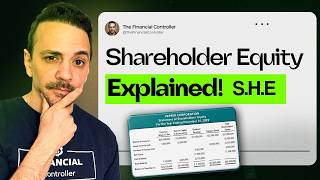
In this video, CPA Bill Hanna walks viewers through the complete process of preparing a Statement of Shareholder Equity (SHE) for the fictional company Spa Booker for the year ended December 31, 2025. He begins by explaining why a SHE is required (typically when a company undergoes an audit) and what it represents – the changes in equity over a period. He then shows the necessary source documents: the current and prior‑year balance sheets and the stock purchase ledger. Using these, he builds a fluctuation analysis to capture year‑over‑year changes in the equity section. He creates a new spreadsheet tab, sets up columns for Common Stock, Additional Paid‑In Capital (APIC), Option/Stock‑Based Compensation expense, and Retained Earnings, and populates beginning balances from the 2024 statements. Next, he records 2025 activity: seed‑funding issuances (calculating common‑stock par value and APIC), option expense, and the net loss affecting retained earnings. He demonstrates how to sum the rows, verify that the ending equity matches the balance sheet, and format the statement for readability. Finally, he interprets the results for investors, highlighting equity growth, dilution, and ongoing losses, and provides a link to the example file and a call‑to‑action for his Controller Academy.
Chapters
Today's video is going to be a step-by-step tutorial on how to create the Statement of SHE, Shareholder Equity. As you guys are aware, there are 4 financial statements: Balance Sheet, Income Statement, Statement of Cash Flows, and the Statement of SHE, Shareholder Equity. It's almost as if there are 4 siblings and 3 of them are the favorite sons, and then there's one that nobody cares about, the Statement of SHE. So when do you need a Statement of Shareholder Equity? Typically you'll need that when the company is big enough to get an audit. Once you get an audit, then you have to prepare a Statement of Shareholder Equity. So let's go ahead and dive into today's video. We are preparing the Statement of Shareholder Equity for 2025. So we're looking here at the balance sheet. This is what you're going to need in order to create the Statement of Shareholder Equity. We have the balance sheet for Spa Booker as of December 31st, 2025. What we'll need to do is to bring in the balance sheet for the prior year, which is the end of 2024, so that we can create a fluctuation analysis, and then we'll use that to create the Statement of Sheet. All right, so we'll bring in the 2024 balance sheet, which we have right here. We have the typical sections. We have our assets, liabilities, and then we have the equity section. The statement of shareholder equity, simply put, and this is the important part here, just represents the changes in the equity account. That's it. It's not really complicated. Investors care about the statement of she because it shows them the changes in equity. Equity really is what they own in the company after paying off all of the liabilities from the assets What remains is the equity. That's why this statement is really important. So what we need here is the balance sheet for prior year 2024. The first step in creating the Statement of Shi is to create a flux or a fluctuation analysis. Go ahead and create that together. We'll say this cell here equals the balance and the cash minus the prior year, right? And then we'll drag that all the way down. And that's really our fluctuation year over year. Let's go ahead and format it. I'm going to copy the formatting of this column here. Just so it looks nice when we are working on it. So what we care about here is this section, the equity section. So the changes are here. I'm going to highlight them in yellow so that we know what we're working with. So we have a change in common stock that went up by $2,625, a change in additional paid-in capital seed, and a change in our additional paid-in capital for option expense, and a change in retained earnings. Beside this information, what we'll need is the stock purchase ledger. So throughout 2025, we raised additional seed funding and we have additional stock that we issued. New investors. So we'll pull that up. We have here our stock purchase ledger, and it shows us that Marathon VC and Smart Money Fund purchased these number of shares in 2025. So with that information, we can go ahead and begin drafting our statement of shareholder equity. So we'll create a new tab here, and we'll call it Statement of She. Bring in the company name, equal sign, and bring in the company name from the balance sheet tab. And I will write the header statement of shareholder equity. I can also bring in the date, equal the date here. I'll put in the date for the year ended December 31, 2025. Our column headers are going to come straight out of the balance sheet. So when we look at the balance sheet, we have common stock, we have additional paid-in capital, we have option expense, we have retained earnings. So I'm going to begin with common stock. So I'm going to create a column. I'm I'm going to call it Common Stock. And for Common Stock, I'm going to have quantity and amount. So I'm going to write quantity and amount. And then after the Common Stock, I have the Additional Paid-In Capital. So I'm going to write that as well. So I'll put APEC for Additional Paid-In Capital. The next line item is going to be here, Additional Paid-In Capital option expense. So I can just write simply options Expense, or stock-based comp if you have something else other than option expense. The next item is going to be retained earnings, so I'll just write retained earnings. Then I'll begin with the first column here and I'll say beginning balance, right? So this will be the balance as of December 31, '24. That becomes my beginning balance in this statement. The quantity of common stock was— I'm going to get that from the stock purchase ledger here, the two amounts that we raised in 2024. 4, and then the amount is going to be the par value. So this number of shares times our par value, which we have here in the ledger, 1 cent. Additional paid-in capital was the remainder, so that was the number of shares times the $6.52 minus the 1 cent, and I have to put that in parentheses. Notice that same amount of additional paid-in capital beginning balance was our 2024 If you look at the 2024 balance sheets, we had $1.7 million, $875,000. That is the same amount that we have here as a beginning balance in APEC. Option expense will, will bring in our 2024 balance, and retained earnings will do the same thing, will bring in our balance from 2024. Okay, great. So now we have our beginning balance row. Now we can begin layering in the activity during 2025. So the activity that we have is an increase in common stock because we raised more right? So we'll say additional seed funding, and how much do we raise? Equal to the $131,000 plus the other $131,000. That is what we raised. How much do we raise it at? Well, the par value is going to be $262,500 multiplied by our par value. That becomes the— just the common stock value, which is the par value. Additional paid-in capital, same thing. We'll say the number of shares multiplied by the difference between the purchase price of the share minus the par value. That's our additional paid-in capital. Then the next item is going to be option expense. So I'll write here option expense, and I'm going to bring in the value from the balance sheet. We increased by $2,173, so that's the activity, right? And then retained earnings, I'm going to say this year's net loss. We're going to bring in this year's accumulated deficit, which is an additional $788,000. That becomes our retained earnings. Okay, so now we can sum it and we can say total. First, we'll number or format these numbers. So dollar values will be dollars. These here are numbers, not dollars, and these are dollar values. So in terms of total, this can be summed. Equals SUM, and you bring in all of these, and you drag it across, and you have your totals. You also total here on the right side of the statement, and you'll say equal to— the quantity is not going to be added because it's a quantity. You cannot add it to the $1.26 amount. So this par value plus APEC plus option expense plus the retained earnings, that's $9.26. That's the beginning value. You can compare that to $9.26 here in 2024. Makes sense. And then we'll sum the other rows as well. So we'll sum dollar amount, and this will be only option expense in this row and retained earnings in this row. And then we can sum all of that. That will give us the ending balance. So the ending balance here, we can do a check ending balance, and we can say equal this ending balance minus the equity ending balance in our balance sheet in 2025. We'll see that the check is 0. So that means we did correctly, it ties out. The next thing is we're going to format our statements. We can bold the title, we bold the headers as well as the column here on the left, and we can do some formatting to make it look nicer. So that's our statement of shareholder equity, or for short, statement of SHE. How do we read this as an investor? If you're looking at this and you're looking at your beginning equity, $926,000, your ending equity is $1.8 million. So equity went up, which is good. You always want your equity in the business to be going up. As an investor, this is what you own in the company. However, it went up by only about less than $1 million, mostly because we raised additional funding, which is dilution to the original investors, right? So we raised funds. So this business still relies on outside funding because it's still losing money. Notice here, retained earnings increased by, or rather, to a more accumulated deficit of $1.5, almost $1.6 million. So the business continues to lose money. So this is how you read a simple statement of shareholder equity. There will be a link to this file down below. Go ahead and grab a copy of it so you can play around with it and see for yourself. And also, if you're looking to learn from me and liking my teaching style here, go ahead and check out the Controller Academy where you can learn the controllership function and earn a CPA certification in the process. If you like the video, give it a big thumbs up, share it with someone that you know that who might learn from this, and I'll see you in the next video.