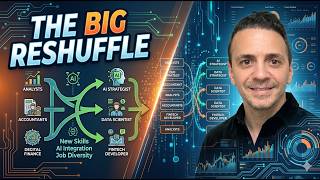
In this 2026 presentation, Bill Hanna, CPA, examines mid‑2025 U.S. unemployment data, showing that finance managers (1.9%) and accountants/auditors (1.3%) enjoy exceptionally low unemployment, contradicting doom‑laden narratives about AI replacing finance jobs. He explains that AI is reshaping, not eliminating, finance roles, creating new career paths such as solution consultants, implementation managers, controllers, and product marketers. These roles are proliferating at AI‑native ERP firms, payment platforms, composition‑accounting startups, and billing solutions, which are actively hiring CPAs and finance managers to shape and sell their products. Hanna then provides a practical framework for selecting AI tools, emphasizing data privacy as the top priority, using employer‑approved solutions, and recommending the ChatGPT Teams version with specific settings (disable “Improve the model for everyone”, SOC 2 Type 2 encryption). He outlines the critical vendor certifications—SOC 1 Type 2 for internal control impact and SOC 2 Type 2 for security, availability, and confidentiality—that finance teams should demand. The talk concludes with three key takeaways: AI is essential for productivity, finance jobs are evolving rather than disappearing, and security must remain paramount.
Chapters
4.2% is the national average of unemployment in 2025. So in mid-2025, the average unemployment rate in the United States was 4.2%. The average for finance managers was 1.9%. Also, you can see that the average for accountants and auditors is 1.3%. What does that tell us? Well, that tells us as, as of this year, 2025, AI isn't impacting the job market for accountants and finance managers for the reason that we'll get into now here in a minute. Another graph that shows this perfectly is that the average here, the national average, 4.2%. But if you look at it by job, for example, credit analysts, that's 1.5%. That's a very, very small unemployment rate. AR clerk, 1.4%. Again, tiny. Accountants, 1.3%. So it isn't really the doom and gloom that everybody's talking about, that accounting is going to be replaced with AI. And let's talk about why that is the case. The reason for this is that there is a new career path or new career opportunities that are opening up because of all of this explosion of productivity tools. So finance people and accountants today are finding opportunities as solution consultants. These are the teams who join sales calls to ensure that the tools match the client technical needs. Implementation managers, controllers, and finance people now are working with new clients to activate and optimize financial tools. Product marketing— product marketing is translating the product feature into consumer— customer benefits and create a go-to-market strategy. And where are these jobs being created? These are all the firms that are like ERP firms Payment platforms like Ramp, Bill.com, Stripe. ERP— there's a whole new breed of ERP firms that are being now made under AI-native ERPs like Dual Entry, Rillet, Campfire. Composition accounting— there are companies like Xactly, CaptivateIQ. These are companies that hire half— almost half of their headcount is accountants and finance people because these are the people who know how the product should behave. Billing solutions like MaxYou, Tabs, and Chargebee. All of these companies— there are hundreds of other companies that I'm not including here in this sheet that are starting tech or fintech companies in the finance and accounting space and need to hire CPAs, finance managers, controllers, people from all aspects of finance and accounting to help them develop the product and sell it and implement it to new customers. Let's spend some time talking about how to choose the right AI tool. There are some things to keep in mind as we're thinking which tool to use with AI. Uh, the biggest thing or the biggest concern is going to be data privacy. That should be your top priority or concern when you're choosing an AI tool. Uh, the first aspect that you got to be thinking about is using approved tools, only approved tools. So large companies require employer-approved AI solutions to prevent data leaks. Uh, to give you an example of that, uh, my wife works at Ernst Young, the accounting firm, and inside of Ernst Young, there are maybe a couple of tools that are being used and approved by the firm. Uh, one of them is Microsoft Copilot, and the other one is, I believe it's called EY IQ, which is an internally It's a chatbot that is internally developed that behaves similar to ChatGPT but is secure within the bounds of IT and data security within the firm. So within your company, depending on the size, you need to be thinking which— or asking the question, what tools are approved by the company to be used in terms of AI tools? So your biggest concern is the data leak. So in that sense, when we're thinking about ChatGPT, ChatGPT is one of the most commonly used tools with AI. So I always recommend using Teams, the Teams version within ChatGPT is the one that has the strongest data privacy. Um, I also recommend to disable Improve Data for Everyone, and I'm going to show you here in a minute, uh, in the data setting. So with the Teams version, you can see that in ChatGPT Team, um, as of the time of making this course at the end of 2025, the cost was $25 per month. And beside of all of the benefits that come with using it, uh, there is the, uh, data security items here. Um, there is the SOC 2 Type 2 encryption in transit and at rest, data excluded from training. You're not gonna get that with the regular, with the free version or with the Plus version of ChatGPT. That's why I always recommend to use, to use the Team version of ChatGPT. Now when you're using any version of ChatGPT, whether it's the free version, the Plus version, or the Teams version, you need to be going into settings. So I go down here to my name, I click on Settings, and I go to Data Controls, and there will be one here that says Improve the model for everyone. Um, you'll turn that off. This way your data isn't being used to train the model for other users. And in general, you need to be discussing this with your IT department, depending on the size of the company that you work at, uh, whether there's a full-blown IT department or maybe one person that works in IT. Uh, you need to be asking what are the approved vendors to use in terms of AI. But let's say that you are the one who's being tasked to go out there and vet and find the vendor to use for AI for your company. What are the things and the questions that you need to be asking when you're interviewing the vendor or looking over the documentation that this vendor have for data security? So the first thing you need to be looking for is SOC 1 Type 2 certification. Um, this is required when vendors impact your internal controls over financial reporting, So this matters when the AI software is going to process things like journal entries, reconciliation, financial reporting data. So these are things like maybe ERP software like NetSuite or Rilette that you're gonna engage with. Or if you're using a billing solution like Maxio or Chargebee, you need to be asking this question whether they have a SOC 2 or SOC 1 Type 2 certification. And this matters because auditors will verify whether vendors could affect financial statements. SOC 1 Type 2 protects you during an audit walkthrough. So always be asking the question about SOC 1 Type 2 certification. And the other one that's big is going to be SOC 2 Type 2 certification. This is critical for security, availability, and confidentiality. It confirms the vendor security controls were tested over time, not just designed on paper. So to get the certification, this vendor has to go through an audit themselves. An auditor comes out and checks their internal controls and make sure that they have data protection, operational effectiveness, and an industry standard is required by most mature finance teams before onboarding a SaaS or AI tool. So the takeaway from all of this is that AI is essential, is going to be part of your daily work, it's going to be your friend, it's going to increase your productivity. And if you don't adopt AI now that everybody is jumping on the, the bandwagon you're going to be left out of the race. So you need to be getting into it. Uh, the second thing is that jobs are evolving. Jobs aren't going away. Again, we can't predict what's going to happen 10, 20 years down the line. We can only look at maybe the next 5 years. Jobs aren't going anywhere, they're just evolving. Finance roles aren't disappearing, they're transforming into exciting new career paths. The third thing is security first. Always prioritize data privacy and require prior certification like we talked about SOC 1 and SOC 2 Type 2 certifications.