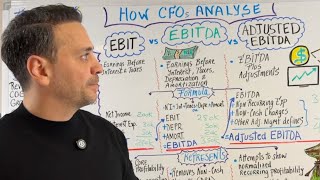
In this instructional video, CPA Bill Hanna walks viewers through the three key profitability metrics—EBIT, EBITDA, and adjusted EBITDA—using a single fintech company income statement as a running example. He first defines EBIT (earnings before interest and taxes), shows how to calculate it by adding back interest and tax expense to net income, and explains its focus on core operating profitability. Next, he introduces EBITDA, adds depreciation and amortization to EBIT, and discusses why it is often used as a proxy for cash operating performance and for cross‑company comparability, while warning that it can be manipulated. He then moves to adjusted EBITDA, demonstrating how to further add back non‑recurring or non‑cash items such as legal settlements, founder relocation costs, and stock‑based compensation, and calculates the adjusted figure. The video explains the practical uses of each metric in valuation (e.g., applying earnings multiples) and in loan covenants, emphasizing the subjectivity of adjustments and the need for critical scrutiny. Finally, Bill offers CFO takeaways, framing EBIT as a measure of disciplined profitability, EBITDA as a gauge of operating strength, and adjusted EBITDA as a management narrative tool, and stresses the importance of understanding intent, assumptions, and risk when relying on these numbers. The video concludes with a call to action for likes, shares, and channel membership.
Chapters
If you ever wonder why CFOs talk about EBIT, EBITDA, and adjusted EBITDA like they are three different animals, well, you're not alone. On the surface, they may seem similar, but when you dig deeper into the meaning of them, you realize that they tell very different stories about the business. In this video, we're going to break down the calculation and the meaning behind each of these metrics using the same income statement example. And by the end of the video, you'll be able to calculate and interpret these 3 different metrics and also know when they can be misleading. If this sounds good to you, let's dive right in. Welcome to another video with your favorite financial controller, Bill Hanna, here. I bring about 20 years of experience in corporate accounting and finance, which I teach here in a free form on YouTube as well as paid courses on the Controller Academy. So today's video is about how CFOs analyze EBIT versus EBITDA versus adjusted EBITDA. And so to explain this, we're gonna go with the income statement. So we have a fintech co, we have our revenues, uh, cost of goods sold, gross profit, all the way down to net income. We also have some select transactions here which will come in handy in the calculation, as we'll see here in a minute. So we'll begin with EBIT. So EBIT, so stands for earnings before interest and taxes. So let's go ahead and calculate that together. It's going to be net income, which we have here, net income $200,000, plus interest expense right here, interest expense $30,000, and taxes $50,000. When we add these two or three together, we get 200 plus 30, that's 230, plus 50, that is $280,000. So we're saying that our EBIT, or earnings before interest and taxes, is $280,000. What is the idea behind EBIT? EBIT measures core operating profitability. So we're saying that the interest and the taxes that are paid are not part of the core operation of the business, okay. So it includes all operating costs here, but it only excludes the interest and tax expense. Okay, now let's move over to EBITDA. This one you have to be a little bit more skeptical about because it adds back more items. So with EBITDA, EBITDA stands for earnings before interest, taxes, depreciation, and amortization. The formula for it could be one of two formulas. It could be one, net income plus interest, taxes, depreciation, amortization, or EBIT, since already net income plus interest and taxes is EBIT, it's EBIT plus depreciation and amortization. So let's go ahead and calculate that. So EBIT in this case is $280,000, so we'll put that in here. We'll add depreciation. Our depreciation from the income statement is $50,000. We'll add amortization. 20,000. We'll add it together. So 280 plus 50 is 330, plus 20 is 350K. So what does that 350K represent? Well, that takes EBIT but then goes a step further by removing non-cash items like depreciation and amortization. So it's saying, I want to focus on the core operation of the business. But I want to further remove these two items, depreciation and amortization, because these are non-cash items, right? The reason we do this is that because it's often used as a proxy for cash operating performance. So instead of looking at the cash flow statement, a lot of times as a shortcut, an approximation of the operating cash flow of the business. Not exactly the same, but an approximation. It's also a good metric for comparability across companies and industries. So you can take EBITDA because it already removed depreciation, which is if a company is capital intensive and has a lot of depreciation. By removing that, you can look at the day-to-day or month-to-month activity of the company and compare companies across different companies or industries altogether, especially when you take EBITDA and you create a ratio out of it. So if you take EBITDA and divide it by equity in the business or assets, you can get a ratio, a percentage and that become very comparable across companies. So it is a really good metric to have to measure all of these things that we talked about, but you have to look at it with skepticism because sometimes it's a way for companies to inflate its earnings by adding back depreciation and amortization. Amortization can very much be non-operating item because think of business combination. If you acquire a patent in the process and you have to amortize that, that's not really part of your ongoing expense to operate the business. But if you're amortizing, for example, a software license to run the business, that is very much part of you running that business operation. And so you have to be skeptical into what goes into this. And management, management will often, whenever they display EBITDA, they will provide a reconciliation of how they arrive at that EBITDA number with all of the line items that goes into it. Okay, so that is our EBITDA. Before we move on to adjusted EBITDA, I wanted to give a shout out to the new members that joined the channel, the new CFO members, uh, Lewis, John Michael, Sidi, Zahra, and Pacha5361. Thank you guys very much for joining the channel. If you didn't know, you can join the channel by becoming a member, CFO or controller levels, and that will give you many perks. And together we can create this channel and make it happen. Your support is what keeps this channel going. Okay, let's move on to adjusted EBITDA. So adjusted EBITDA, what it says, it says that we're going to take EBITDA that we calculated right here and we're going to make some adjustments. And the reason why some companies use adjusted EBITDA is because they want to tell the story of their profitability a different way. So they take their EBITDA and they add back some items. So what are— what is an example of these items? So remember our income statement here. We have here some select transactions of some of the expenses that live in the income statement, but we're going to call them out here because we're going to add them back to our EBITDA. So an example is a one-time legal settlement. So the company had a lawsuit and they settled the lawsuit with the opponent, and now they have to pay a settlement to say, in this case here, $40,000. So what we're saying here, this $40,000 is non-recurring. It's a one-time item. So we're going to go back. We're going to go and add it back to our EBITDA. We have a founder relocation cost. The founder of the company is relocating to our new office in San Francisco, and all of a sudden we have to pay $15,000. So we're saying this is a one-time non-recurring item. Stock-based compensation such as options expense. This is a non-cash item. So with adjusted EBITDA, what we're doing here is taking EBITDA that we calculated right here, and we're going to add back non-recurring items such as one-time legal settlement, founder relocation costs, and non-cash charges. We have here an example: stock-based comp, and sometimes other adjustments that the management defines. So that's why it's very critical for you as an investor or a CFO. If you're reading this, you need to look at the items that are listed in there and see if it makes sense for these items and ask questions, and that's where a good CFO stands out by asking these difficult questions about what's included in these numbers. So let's go ahead and calculate that together. We begin with EBITDA, we have $350,000. We're going to add back non-recurring expenses, non-cash charges, the sum of these items here, 40 plus 15 plus 25, that's $80,000. So we're going to add that back here. I'm going to get adjusted EBITDA of $430,000. So all of a sudden, as you see, our profitability got better. We went from $280,000 EBIT, which is our operating profit. We have EBITDA of $350,000 because we added back some items. and we even have further adjusted EBITDA by adding back some of these non-recurring, non-cash items. So, what does adjusted EBITDA do? It attempts to show normalized recurring profitability. Normalized, meaning we normalize for non-cash items. Recurring, meaning that we remove non-recurring expenses. So, what is this used for? It is commonly used in valuation. So typically when a VC or a private equity evaluates or values a company, they take their earnings and add a multiple. So earnings, for example, in this case, uh, let's say net income, $200,000. They say the multiple for this industry based on the growth rate of this company, 10x. So they multiply by 10. So $200,000 times 10 gives us $2 million. Well, we said, wait a minute. Actually, our EBIT is $280,000. Multiply that by 10 and that will give you $2.8 million. Well, you say, wait, wait a minute, we can add back depreciation amortization and that's $350,000. Multiply by 10, $3.5 million. You get the point here is that with adjusted EBITDA, we say, well, it's $430,000 times 10x, that's $4.3 million. So, uh, usually that's the way it goes is that Management will say, here are my numbers, and you'll ask the questions and push back to arrive at what makes sense in terms of the true earnings potential for the company. So it's common in valuation. It's common as a lending covenant. So what's a lending covenant? A covenant really is just a fancy word that means condition. So when you go to a bank and apply for a business loan, the bank will say, I'll give you the loan, looks good to me on paper, I'll give you the loan, but as a condition in the loan agreement, I'll say that your adjusted EBITDA cannot fall below $400,000, right? And if you fall below $400,000 in adjusted EBITDA, you're essentially in violation of the agreement, right? So it's typically used for a bank to hedge against the bet of giving a loan, a business loan, to a company. So it's used in private equity deals, like we said. Um, and this is very highly management-defined, so quality varies. And this is where we said you gotta ask the tough questions because it's very subjective what management thinks is not recurring, uh, versus what is recurring. Okay, so we talked about EBIT versus EBITDA versus adjusted EBITDA, and now we'll talk about the CFO takeaways. But before that, if you really like the video, give it a big thumbs up because this is how I know that you like this content so I can make more of it based on your feedback. Okay, so for the CFO takeaways, EBIT is about disciplined profitability. So what do we mean by disciplined? Discipline here means the decisions the management make about running the business. Remember, EBIT includes depreciation and amortization, right? And because it includes depreciation and amortization, these numbers are going to affect EBIT. So, uh, this discipline here means that the company makes the right optimal decisions about how to use capital. So if the company is making bad decisions, going out and creating big manufacturing facilities that you don't need, these depreciation numbers are going to hit their EBIT and it's going to affect that number. So that's why EBIT refers to disciplined profitability. EBITDA is about operating strength because EBITDA removes the capital structure from depreciation and the M&A, merger and acquisition, activity like acquiring a company and getting an intangible asset in the process. So that all gets removed in EBITDA. That becomes then the operating strength of the company. And adjusted EBITDA is about the management narrative. How the management decides to tell the story of the profitability of the business by saying, hey, we are more profitable than what you've seen in our net income. We are even more profitable than what you see in EBIT and EBITDA. We are even more profitable because of these items that we're adding back here in adjusted EBITDA. So in summary, your job as a CFO, controller, or investor is to understand the intent Assumptions and risk. Intent: what does management intend to show in any of these metrics? Assumptions: what goes into the calculation? And here, annual adjusted EBITDA. And risk, in terms of understanding if you believe and buy into any of these metrics, what is the risk you're taking as an investor, CFO, or even as a bank? Thank you so much for watching. If you know someone that will benefit from this comparison here. Go ahead and share this video with them, and I'll see you in the next video.