A $48 Million Mission to Make the Garage Door Industry Sexy | Podcast EP. 272|Toolbox for the Trades
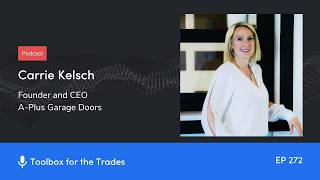
Kari Kelch grew A+ Garage Door from $36 million to $48 million in one year by aligning the company around revenue KPIs and a $1 million bonus bell-ringing system. She shifted from hiding her ownership to proudly branding the company as woman-owned, raised prices through disciplined strategy, and is on a mission to make the garage door industry "sexy" by professionalizing it like plumbing and HVAC have done.
Chapters
Hello contractors and welcome to Toolbox for the Trades. My name is Jackie Aubel, and today I got the pleasure of speaking with Kari Kelch, the CEO and founder of A+ Garage Doors in Utah. I spoke with Kari about what it took to grow her business to $48 million and how her team helped her get there. We talked about a ton of stuff from private equity to making the garage door industry sexy. I hope you enjoy this conversation as much as I did. Keri Kelch, you are the founder and CEO of A+ Garage Door in Utah. Today we're gonna be talking about how you stopped underselling yourself and then set out to rebrand an entire industry. I am so excited to have you on the show. Welcome to Toolbox for the Trades.
Thank you so much for having me. It's just really an honor to be here.
The honor is all mine. You have such a cool story and I cannot wait to get into it, but to kick us off, we're gonna start this with with an icebreaker. So in the last few years, you've quickly become quite the notable figure in the trades. Shout out to my team. You actually graced the COVID of ServiceTitan's Toolbox magazine. I would love to hear how you like to unwind or decompress after a long day.
As you know, like, work always kind of gets into all day, every day, and even into your nights. But I really find that when I get home, I really can just decompress. It's like where my sanctuary is. So that's been helpful. Just being, hanging out with my husband. We like to play board games. As much as it sounds corny, we really like to play Catan.
First off, I really love board games. I just don't have a lot of friends that like them. Catan is so much fun. Is that something that you guys just like discovered together or is it something one of you loved?
Yeah, like obviously I've loved them. I think that actually helped bring us together is because we both really are competitive. So we like board games and our kids, we have our kids play board games, my family plays board games. So it's just kind of a big game kind of family.
Oh my gosh, so much fun. Well, I know what you and I are gonna do if we ever get trapped in a bunker together. So that's really exciting. So for folks who are unfamiliar with your story, can you tell me how you got into the trades?
So I was a mortgage broker that really had no business being in the trades, just 'cause I didn't know anything about it. I was dating a guy that worked for a garage door company and he kept coming and asking me to open up a garage door company for him. I kept saying no, I didn't want to be in business with them. I just didn't know what I was doing there. But he knew I was an entrepreneur and he knew that I had my 3 kids and I wanted to get a place where they could come and work when they got old enough because they were still just little children. After many months of asking, he convinced me to open the garage door company and it was going to be a set it and forget it. He was going to manage it. The kids were going to grow up and then be able to work there when they turned like 16. It was, it was the perfect dream. And nothing ever goes as planned, as you know. So, but thankfully, like when the mortgage industry, the housing crisis happened in 2008, I was able to transition into garage doors. So I already had the company up and rolling by then, and it was a very natural process just to jump right in.
That's so interesting. I really love that your motivation was, I want to build something so this way my kids have something to go into. I don't think I've actually had anyone explain it that way before. That's really, that's really awesome.
My dad had that for us when we were growing up, is once you get out of your, your school years, then you can go and start working in his cabinet shop. And it was a small, smaller cabinet shop. And a lot of my other siblings did that. I didn't, but they went and did it. And I thought, that's a great thing to offer the kids because they can't always get a job at age 16. But if you're like, oh, you're going to come and, you know, clean up the warehouse or go help do a fix a garage door, then they could do that at age 16. So sounded like a good, good idea.
Yeah, well, it definitely was a good idea, as we'll get into now. So for folks who aren't familiar with A+ Garage Door, can you just tell us a little bit about the business and the kind of growth that you've seen in the last few years?
Yeah, so we do residential garage doors and, and now we'll do commercials. It's in Utah. We've grown into Nevada also, but we're all of Utah. I'm just going to go back to last year in 2025. That was such a fun year. 2024. We did $36 million in revenue and we have some really, some really good profits margins there. But in 2025, then I gave my team a really big goal of hitting $48 million and we actually hit that goal. So going from $36 million to $48 million in residential garage doors is just phenomenal growth to me and to my team. I'm so proud of them.
That is awesome. I mean, there's obviously a lot of things that came into place in order for that to happen. Is there any specific thing that you changed in the business or that your team changed that you can really point to as like, this is really what helped set the stage for that type of growth?
Yeah, I mean, there's, there's a handful of things. It's never just one single thing, but there's a couple of things that we did that I thought were interesting. I didn't know that they would have the effect that they did. One of them is we wanted everybody focused on the same thing. So instead of have, of course we want everyone to have their own KPIs and they do, and they, they track those. But we really wanted them to celebrate revenue. So whenever revenue comes in, we want everyone celebrating revenue. So we have everybody in the office gets a bonus based on revenue. So what we do is every time we hit $1 million, everybody would come together, we'd ring a bell, and then they would celebrate and cheer, and then they'd go on their way. And so every time you do that, and pretty soon we're like, oh, we're doing it every 9 days, then we're doing it every 8 days. And, and these are things that the employees can comprehend and they know that, oh, if I answer this phone call and I get this guy out in the job, then we're going to have more revenue. So they just like simplify it. They know how their job affects revenue. And so everyone's just pushing for revenue. So we changed that. Still looking at their own KPIs, obviously, and watching and tracking them, but just having a celebrated, like gamifying it, you know? So now it's a game. Everybody wants to get revenue. Even my guys in my fleet, they know, they keep guys in trucks. There's more revenue. We're ringing the bell more often, you know, pretty soon we're ringing it every 7 days and then every 6 days, now every 5 days. It's just been fun.
That is really cool. And I like the cue of the bell. Very Pavlovian of you. When you say revenue coming in, was that like, was that celebrating a big install job, for example, or was that just, you know, what were the parameters?
Because revenue sounds like a big problem. No, every million. Just every million, every flat million. So we hit a million, we ring the bell. We hit another million, we ring the bell. And every time we hit a million and we ring the bell, they know that their bonus just grew. And so they're excited about it because they're like, my quarterly bonus is going to be good.
I like that because it's very different from like maybe a dashboard that people can even just see on the wall or whatever of like how things are tracking. It really is a very different type of sensory cue as to how everyone's doing. Like, oh, when's the last time we heard the bell? Oh, it's been a minute. Let's see what we can push. That's really cool. I love that you did that.
Yeah, I mean, I would love to claim it as my idea, but it's not. My team has brilliant ideas.
So, well, shout out to your team for thinking of that, and shout out to you for hiring the team that thought of that.
Right, thank you.
I want to get a bit into your belief system, because when you and I first talked, you told me that one of the hurdles you had in this idea of starting a garage door company is you had this belief that nobody wanted to buy a garage door from a woman. And I would love if you could tell me a little bit about that and how you overcame it.
Yeah. So when I started in 2005, and maybe there's some truth to it, that I felt like, especially in the Utah area, people weren't interested in buying garage doors from women or having women, you know, be the ones that own the companies. I know it's just my own belief, but I held onto that. And so I felt like, you know what, I'm going to stand behind the scenes. I'm going to make it look like you can't even tell who the owner is. And I push other people to be out in front. And we did that for a lot of years. And it wasn't until I had a CFO— and this CFO came from hotels, a lot of big hotels up in Park City. So he left that industry and came and started working for us. So he really knew what he was doing. And he was just telling me, he's like, you get to lean in. Like, you guys are special because of the way you do things. And lean into that and own it. And so it was really having somebody else see my value and then just tell me, like, this makes you super valuable, before I could see it myself. And that's when I started to come out and do more. Like, he knew I owned it and ran it because he's working right there with me. I mean, he's a CFO, right? He's working right there with me, but not a lot of other people did. Wow.
And when did you make that change to being in the shadows, being this like clandestine business owner, to actually being forefront about this is a woman-owned business, my name is Carrie, I run, I run things here.
Around 2013 is when I started. I did some, some courses and, and I was still like, I'm not going to promote it out, AI, in my social media, or I'm not going to go put it on any of my ads. But I would still go and network and go to a lot of events. When she came in as my CFO in 2017, he really pushed me to do better and to like to show up more. And I started showing up more like for my employees and talking to them more and getting them classes and things like that to help them with training. I still didn't put my face all over the company until my CMO came and that was in 2025. So he came and we just did a rebrand. He's like, "I want 'em to know that it's a woman-owned." I was like, "Intentionally?" Like, for real, like, you just want to announce it out there. So I was, I've always been proud of it, but I really wasn't having the public see that perspective.
Yeah, well, this is an interesting conversation I've had a bunch of times on the show. You know, I started this show in 2020. I joined ServiceTitan in 2017. When I came into the trades, the lack of female leadership was really like, it was obvious. It was a lot of companies run by men. And so when I started the show in 2020, I really tried to make an effort of like, I really wanna like highlight female owners. And I have to tell you, just in the 6 years this podcast has been running, I used to have to search for female owners.
Yeah.
Not so much anymore. And so it's interesting that you now have 2005 to 2025. There are not enough words in the English language to describe how much we have changed in that 20-year span. But it is interesting now that you have a CMO that's like, no, we are leaning into this because this is unique and people like this.
I'm really glad that so many women are stepping up and owning companies and able to, to know that they have something special like to drive them. And there's— it's beautiful to me to watch that.
Yeah. And to that point, I'm so happy that you stepped out and you are talking about it because you don't get to $48 million by, you know, sneezing. You can— it's a real— it's a whole lot of work. And I wanna circle back to your CFO again, because he also brought your attention to the fact that you weren't charging enough. And I wanna hear a little bit about what that was like. You and I, uh, have a friend in common, Ellen Rohr, also friend of ServiceTitan, friend of the pod. And she just, she speaks so highly of you. And we know Ellen is the money lady, right? I wanna hear what it was like for you to realize that you weren't charging enough and what that felt like to raise your prices.
Yeah, we'll have a really good CFO in your company that you trust and they'll just show you the numbers, right? So once they show you the numbers and you're looking at 'em, you're like, okay. So it's not like they have to convince you of anything. They just show you the numbers and they speak for themselves. So every time that we would start going into it, kind of getting off track, show us the numbers and we'd get back on track. And so it wasn't necessarily him going, you need to charge more. He would just show us the numbers and then we're like, we need to charge more.
So, yeah. Okay, cool. It's interesting when we're talking about belief systems, right? Because there's stuff that you can't quantify, like the thoughts in your head, what you think people are thinking. But then when it comes to numbers, it's like the numbers don't lie and you can't keep going at this rate and grow your company. So that's awesome. And it sounds like you've made some really great choices of people that you've surrounded yourself with and the team that has helped you build A+ to where it is today.
Oh yeah. Absolutely. I am the biggest cheerleader of all my team. They definitely weren't qualified to do what they're doing when they started, but they just earned it over and over again and stepped into it. So I'm super proud of 'em.
That's awesome. Well, just sticking in the belief system a little bit more, I know that podcasting, doing what you're doing right now is outside of your comfort zone, but you're doing it anyway. So just for the folks listening, like I would love to hear how you push yourself to do things that make you uncomfortable.
Really the only time we're growing as individuals is when we're living in that world of the imposter syndrome, right? So when you're like, I'm uncomfortable, I feel like I'm pretending that I'm somebody I'm not, and you're living in that imposter syndrome, that's really when you're growing. And so I always tell my team, you know, get in that, be okay being in the imposter syndrome. Everybody has it, everyone has it. And people that say, oh, I've never had it, then I'm like, okay, that's great, you're probably narcissistic. But you know, I mean, you just every— almost everybody has imposter syndrome going on. And I talk to my team about it. And if I'm going to sit there and tell them, hey, do things that make you feel uncomfortable, like, you know, be okay being in the imposter syndrome and like, and talk about it, then I have to like, you know, practice what I preach. So this is something that I get out and do. And yeah, you know, we've been talking about doing a podcast for over a year now, you and I, and I just kind of push it off, push it off. And then I'm like, okay, I gotta— if it makes me cringe a little, then I'm just gonna jump in and do it.
Well, first off, I'm so happy that you're here, and I do love the practice what you preach. That is something I try to remind myself too. I'm a leader as well in my, in my position, not to the extent that you are, but I am. And it's like, I really try to model the behavior that I want my, my team to do. And so, but it can be hard. And I, I do really love what you had to say about everyone has imposter syndrome because Sometimes I forget that other people have that too.
Yeah. I really like dug into this when I was taking a golf lesson. I hate golf. I know everybody goes out and golfs and they're like, oh, what are we gonna do? We're gonna go golfing. And especially in the industry, right? When all the guys get together, they wanna go golfing. And so I'm like, okay, I'm gonna lean in. I'm gonna go take a golf lesson. So I'm, I have this golf coach and he's teaching me some, some swings. And I was telling him, it's, it's just awkward. And he's like, okay, what's awkward? And I'm like, the swing's awkward. And he's like, it's awkward or it's, you know, unfamiliar. And I'm like, well, I guess it's unfamiliar. And he's like, we'll keep doing it because the longer you do, the unfamiliar becomes familiar. And then you're not in that awkward stage and you're not in the imposter syndrome. So I started to unpack that and go, you're only in the imposter syndrome and tell you, like, do it enough, and then you're like, oh no, I got this. Like, if I went and did what I was doing like 7 years ago or 10 years ago, easy. I've easy got that. I know how to do it, right? It's just going forward that, that really feels awkward and then feels uncomfortable, and that's when you're growing.
Yeah, embracing discomfort to grow, essentially. So do you still hate golf, by the way?
Yes, it's one of those things. I gotta get there someday.
I'm more of a pickle girl myself, but that's another podcast. I want to talk about one of your goals with the garage door industry. So when you first entered the garage door industry, you kind of saw it as like, the word you used was dirty.
Yeah.
Like, so I want to talk to you about your personal mission to make it a sexy industry. So tell me about that and what progress have you made so far?
Yeah. So let's go back to that. So when I say it's a dirty industry, Remember, this is 20 years ago. These owners would open the company and they would offer like lifetime this and lifetime that, and then they would sell the customer. And then after 3 years of doing that, they would shut down their company and then they would open a brand new company and just take all the customers. And if somebody called in, they would say, oh, they just went out of business, but we can take care of you if you'd like. And it's the same exact people. And I'm like, that to me is dirty. It wasn't professional at all. And I know that I'm not the only one that had this same goal in mind. But in our small little Utah, I just, I made up my personal, like, let's go get this, let's do this. The other thing that I noticed is nobody wanted to work for a garage door company. Like, I was talking to my brother at the time who didn't have a job and I was like, well, come work for our company. And he's like, Carrie, I would rather be a gutter cleaner. Or do sewers. And I'm like, ouch. And then I was like, this isn't a really— and when I say sexy industry, I'm talking like firefighters is a sexy industry. Everybody wants to be a firefighter. And if you looked at it, the hours are crap and the pay is horrible, but it's still a sexy industry. And that's what I'm talking about, is how do you get it so people want to do that? And at the time, plumbing and HVAC, that wasn't a sexy industry, and they turned it into a sexy industry. And so I'm like, we absolutely can do this. And now you have people that can proudly wrap that, I'm a garage door tech, or I work in garage doors.
It's interesting just seeing how, again, in my— you've like, you've been in the industry since 2005. I've been tangential to the industry since 2017. I feel like even just in my time, you've seen progress made. What do you think has done that? Do you think it's companies like yours that are actually, you know, creating a, a real team and a culture? Like, what do you think it is that transforms that?
Yeah, that's exactly what I think it is. It's really when you professionalize companies and other companies around see that, then they're— they want to get on that playing field. And so they've got to get more professional to compete with you. So absolutely, it's stepping up and being the example.
Yeah, the rising tide lifts all boats. I haven't said that for a while on the show, but I've said it quite a few times and it does go true. So now you've got a new mission. You want to make private equity sexy. We've had private equity folks on this pod before, uh, straight private equity companies. We've had people come on the show, say how private equity has changed their lives because of the partnerships. Also gotten some people that are like, have no interest in doing this. I want to own my brand. So it's kind of a mixed bag. In your opinion, what does good private equity look like? And what did you prove was possible at A+ before you sold? Because you have since partnered with private equity.
Yeah, so I'm gonna start with what did I prove at A+.
Yeah.
At A+, I proved that you can have a great culture and a great bottom line. You can be very profitable and still put money into the culture and put money into growing, and you, you can do all that, right? So you can take care of your employees and you can also grow the company and have a very functioning company while keeping your EBITDA strong. So I feel like that's what I proved at A+ before. Now, since joining with Guild, I feel like they— to me, they've— they're doing it right. I'm really proud of how they're doing it. But I see in a lot of different industries that they have not done it right, and it hurts a lot of people. So VE investors, I think they go, oh, like, this might hurt my investors. But if you look down the line, we're not talking about the investors or even the business owners that cash out and get out. I'm talking about like, what about the employees? What about the employees' families? And then what about all the customers? That's where I feel like huge growth can be made is how do you keep the culture? How do you take care of the client? Like, how do you keep all of that very attractive so somebody would choose to pick— I would choose to pick a garage door company that is owned by PE because of all these other things. So I think that to me would be making it sexy.
So Guild Garage Group is the one that you partnered with. I interviewed them last summer. They spoke very highly of you. So what do you think it is about Guild that makes it a good partnership that folks who are thinking about partnering with private equity should look out for?
It comes down to like who the founders are, like know who you're— know who you're teaming up with. I was really drawn to them because the 3 people that are doing that that started Guild, they have a lot of passion, they have a lot of drive, and they think outside of the box, but they listen to you as you know where you're at. So it's been nice to be able to have that back and forth with them and be able to, to express what needs to be done. Like, I feel valued and I feel listened to, and they're like, we're just figuring it out. And sometimes when you're just figuring it out and you're eager to get it right, sometimes you, you go above and beyond. And so they really went really heavy with relationships. Like, how do we build these relationships? Relationships matter. The employees' relationships matter. Our customer relationship matters. Our brand relationships matter. So that's been a big force and driving force for them.
Yeah, I mean, the word I'm hearing is humility. It's going in with an open mind, an open heart in some ways, and being willing to not come in and say, I know exactly how this has to run in order to work, listening to the people that you're partnering with and hearing their needs and helping them solve problems. It's really interesting, and I'm happy that you've had such a good experience because I know it can be an exciting but also stressful time for owners to make the decision to partner with private equity.
Oh, definitely. It's scary. It's hard. I mean, this is my baby. I've started it, I raised it for 20 years, and then I'm like, okay, well, don't mess it up, you know? So it's been nice knowing that somebody cares as much as I do.
Yeah. And you're still very involved with A+ and Guild as, as well, right? The other garage door companies that they have.
Mm-hmm.
It's really cool. I have to ask about family because you have mentioned siblings and just a bunch of people that have, uh, you have a big family and a lot of them have worked for you.
Yeah.
Um, so running a company where family is woven in kind of sounds like a gift, but I can also see it being an enormous challenge at the same time. So I'd love to hear about the rules that you've had to develop and the hardest calls you've had to make. To keep business and personal separate to the best of your ability.
Yeah, so this is something we struggled with. We didn't always get it right, and we've kind of had to morph into it and to, to perfect it. Everybody's family is different. Family dynamic has a culture, just like your company is going to have a culture. And our family dynamic was really— we were raised kind of in business. My dad was a business owner, and so we knew that You know, business was business, personal was personal. We kind of kept those separate. That just kind of bled over to A+ and so we really kept— you couldn't let the emotions get involved in business and you can't let business get in, destroy the family. So we kind of had to get that balance going on. Like we had some strong guidelines. I think you hold family to a higher, like you kind of hold them accountable a little bit more than you do everybody else. So you're almost harder on family, or we are. Just because you know what they're able to do, you know what, what they're capable of. I think when you have family working for you and they fall short, sometimes their fall short isn't really even that bad. Sometimes you tend to be harder on them. There's no free rides at A+ Plus. Everybody that is here has earned their way up. So any of my family that's in any kind of a management role, it's because they have earned it over and over again. One of the hardest things that I've had to do was you really have to call people out, and sometimes you have to like fire your nephew, or I even like let some of my children go when they were working here. And but it's, it's all the way you do it, right? So I think like letting somebody go, it doesn't have to come and just hard fire them. You just let them know like maybe this isn't the best opportunity for you, maybe there's a better opportunity somewhere else. But yeah, those have been some hard moments.
As we're talking and I'm just like kind of piecing together other conversations you and I have had, I feel like your superpower is definitely relationship building.
Yeah. And I think I can see the value in where somebody, where somebody like their strengths lie. I love to feel like, you know, somebody's working on something. I'm like, you're going to be really good at this job or this project.
You are at a very exciting time, like we said. Closed out 2025 with $48 million. Your team opening up in different locations, you're putting yourself out there more, you partnered with Guild. What is next for you in the next couple of years? Like, what are your goals moving forward?
You know, I'm gonna stick with A+ and just keep growing A+ because I know we have so much potential here and it's really fun for me. Self-proclaimed like a serial entrepreneur, right? I know that people come and offer me opportunities and it's like I want that so bad. I'm pretty sure I'll get into something. I just don't know what it is. I have to have something keeping me busy all the time. But right now I'm loving what we're doing at A+. I love the opportunity that all the employees have. I love growing all the brands and our guild. It's just, it's been a good time for me.
That's awesome, Kari. I have a question. You know, you've been in this business now since 2005. If you could go back in time and say anything to 2005 Kari, what would you say?
Oh, it would have to be about confidence. Like, you know what, you're gonna mess it up and it's gonna be still okay. You're still gonna be okay. You're gonna have the bad days, but it's gonna be okay. Some of them are really hard. Like, I don't know other business owners, but I struggled during COVID not because financially, but just the emotional aspect of having to like furlough so many employees. And I don't see an employee, it's just like a number on a sheet. It's a family. I'm like, It's interesting, I have one of my friends call me that owns a business and they were literally just so upset. They're like, I gotta let this person go. They've got 5 kids. And, and I was like, I get that. I know what that feels like. It's really hard to make those decisions because you're not, it's not just a number. And you do need to be strong in business and you need to be able to have confrontation and be okay with that. And you have to make the right decisions, but it's okay to care and it's okay. It's like, yeah, that hurts. I'm sorry, but you do have to do what's best for your business.
Oh, I'm glad that you brought that up about COVID I, not that no one else has, but I think it was just such an emotional time on so many different levels. I actually hadn't really thought about it until now, the pain that must feel to have to furlough employees that you are really invested in and are doing a good job for you.
It was definitely what, what kept me up for sure. Just a month or two before COVID I think it was probably a month before I met, that's when I met Jake Wold with RightWay. So he was, he was He was running White Right Way in California and he came to the IDA and we went out to dinner and it was him and me because the vendor was taking us out to dinner. So I met him. And so when COVID happened, like, I'm like panicking because I don't know anybody else in the industry really. And so I'm texting him out of the blue and I'm like, how's it going? What are you doing? And pretty soon we're on a call and I'm like, how are you doing with this? What are you doing? Are you letting people go? Like, It was nice to have that, but I think that also kind of bonded me and Jake because we were both going through this traumatic thing at the same time with the rest of the world. And it was someone I could call and talk to about her. Yeah.
Yeah. I mean, definitely it's— you are incredibly self-aware, it seems. And you know, sometimes when we talk about these belief systems, right, that we inherit for whatever reason and that we have to go against, I do feel like you use your own personal experience to inform how you relate to people and how you show up every day. And I think that is That is the true success story when you have those types of, you know, belief systems that are crappy in your head is like you get through them and then you use that knowledge to help it infer how you relate to other people and that just makes you stronger.
I 100% agree. That happens all the time.
Carrie, this, I am so happy I finally got to sit down with you and to share your story. Is there anything we should have talked about that we didn't get a chance to?
Oh, probably, but There's so much, like everything is changing so quick. Like being vigilant on like what's happening with like how fast Google's changing and how AI is now affecting your online presence, things like that. I mean, there's so many things we could go on for days about what people should be aware of, what they need to put on their radar. And I know a lot of people have it on their radar, but what do you do with it? You know, where's, where next? Where do you go? How do you, how do you get the right solution? So there's, there's a lot, and I don't know if anybody's gonna know for sure. Hindsight's 20/20, right? So then you're like, oh, I picked the right thing, or should have done that.
Not to self-promote my show on my own show, but actually the episode before you, I had Stephanie Allen and Jen Bagley on to talk all about how AI is disrupting the Google of it all, the, like, the search engines and everything. Stephanie essentially had to break her website down and build it all up from scratch so it could be crawled again by these LLMs and it's just, it's wild. I like ChatGPT came out when in 2023 and now it's like, well, everything we know about digital marketing does is, is wrong. So throw out that playbook and now let's, yep, set out the new one. It's, it's wild.
Yeah, 100%. We're having to do the same thing. Like, you know, break down your website, build it back up cuz AI needs to crawl it for sure. I mean, it's just the way your marketing is completely changing.
I know, terrifying for me as a marketer, but exciting maybe also. Let's go with exciting. Let's frame it. This has been a kind of mental health episode. Let's frame it as exciting.
I do think it's exciting. So I remember feeling like this kind of nervous when we were talking about going from phone books to digital. So I've already lived it and I know again, when I come back to myself, you know, it's like everything's gonna be fine. It's gonna be okay. Just keep moving forward. Same thing I would have said when we're doing the phone books, right? We're going to phone books and then we're going to online. Everything's going to be fine. It's uncharted territory, but you will be fine.
You will be fine. You'll be fine. You'll mess up. You'll be fine. Carrie Kelsh, thank you so much for joining me on Toolbox for the Trade. This conversation flew by.
Yes, it did. Thank you so much. It's been great.
More from Bill




Capturing the 80%: How SmartAC’s Gen-2 Targets Non-Membership Homeowners | Podcast Ep. 296

Build better customer data with every booking in ServiceTitan | TAD Tune-Up Series

The Biggest Change for Roofers Coming From Other Roofing Software to #ServiceTitan?

