Acquisition Strategy: Why the Playbook Matters More Than the Deal | Podcast Ep. 277
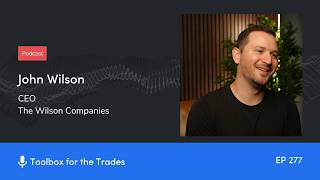
John Wilson grew The Wilson Companies from under $5 million to a projected $42-$43 million by 2026 through a disciplined acquisition playbook that emphasizes operational foundations and internal leadership development. His strategy shifted from rapid small purchases to a 100-day integration process, standardizing on tools like ServiceTitan and Sage Intacct to smooth acquisitions. He aims for $100 million in revenue by 2030, with leadership placement in new markets as the main bottleneck.
Chapters
Hello contractors and welcome to Toolbox for the Trades. My name is Jackie Aubel and today I am speaking with John Wilson, who is the CEO of The Wilson Companies and the host of the Owned and Operated podcast. John was actually one of my earlier guests in 2021. He was episode number 46, so this is a 5-year check-in to see how he's grown since then. This is a really fun episode and I hope you guys enjoy it as much as I did. John Wilson, you are the CEO of the Wilson Companies and co-host of the Owned and Operated podcast, a podcast that's been going for about as long as this one has. You were a guest, a very early guest on Toolbox for the Trades, episode number 46, and you're coming back here to catch us up on what's been going on with you and to hear all about your current acquisition strategy. I am so excited for you to come back, John. Welcome back to Toolbox for the Trades.
Thanks for having me back. It's fun to come back. It's fun to do. I've done a couple like return interviews and it's always funny to like our last one was 5 years ago, which a lot's changed in 5 years for me. So it's funny to like, hey, what was I thinking 5 years ago? So I, as I was listening to prepare for this, I was, I cringed myself out quite a bit.
Yeah, yeah. Um, I think we might have talked about it at some point. I had a comedy podcast before I had Toolbox for the Trades, and I've gotten to a point, I think, where I am beyond cringe. Like, I've put my face and voice out on the internet for now over a decade, and I just— you can— I can't— I— it's— it just washes over me now. I just— I notice it's— I'm very meditative about it. I notice the cringe and I let it pass.
You're like, I've developed as a human. I've moved on from this. Yeah, but no, it's fun to be back. It's, it's, uh, fun to be back. You run a great show.
Oh, thank you so much, John. As do you. And I'm really excited to get into this. Uh, let's kick things off though with an icebreaker because we have acquired some new listeners since the last time, uh, that you joined us. But I do want to let people know, even though John might be a little embarrassed, at least, you know, check out episode 46. It was a very good and still chalk-filled with some really helpful tips. Icebreaker time. You've said in the past that you are better at Call of Duty than people think. What else about you surprises people who only know you from the podcast or from your speaking engagements?
I am probably one of the nerdiest people that you would have ever met. Uh, so like my idea of a good time is like, I'll play Magic: The Gathering with my friends. And at one point in my early 20s, I was, uh, like top 20 world ranked in World of Warcraft. So there you go. Wow. So yeah, probably one of the nerdiest people you've ever met.
Um, John, you are one of the nerdiest people I've met, but I want you to know that you are in good nerd company.
Thank you.
Um, for my 35th birthday last year, I went to New Zealand because I love Lord of the Rings.
Oh, absolutely.
And I don't know how much of a fiction reader you are, but I'm currently knee deep in a series called Dungeon Crawler Carl.
Have you heard about those? Oh yeah, no, totally. Yeah, I've read them all. Yeah. People, it's a funny series. So I've been consuming that genre. Again, nerdiest person you've ever met. I've been consuming that genre for like 7 to 8 years. It's called lit RPG. And you're the 5th person in the last month that's like, hey, yeah, I'm reading this book called Dungeon Crawler Carl. And I'm like, okay, great. In that sort of genre of fiction, it's one of the most extreme. So I'm like, hey, if you liked that, you're gonna love the rest of the genre because that, But yeah, no, very familiar. I've read every single one. Yeah.
And the new book is coming out in May 2026.
Yeah, I heard— someone told me they were making a show from it.
Someone just bought— they— someone bought the rights. And I think that's why it's starting to hit the more popular zeitgeist. But if anybody out there is a big old nerd like John and myself, highly recommend Dungeon Crawler Carl. So you were an early guest again 5 years ago, back in 2021, where you were kind of in the early innings of your acquisition run. So I would love to— if you could catch our listeners up Talk to me about where the Wilson Company stands today.
Yeah, yeah, yeah. It's a funny return because at the time we hadn't hit $5 million of revenue yet, and that was like the big next hurdle for us to cross. Like, I remember it and we were just like chasing down $5 million of revenue, like very passionately. So today we've done, I think, 13 or 14 total acquisitions. And when I re-listened, I think we had done 4 at that time. So we've done another 10. We're around $43 million is where we'll end this year. Now, most of that's actually not acquired. We talked a lot about acquisitions the last time I was on here, but in 2022 through 2025, we just learned how to run a good business. So we acquired a lot less and then we started acquiring again here a few months ago. Around $42, $43 million is budget for this year. We've acquired 3 companies so far this year, so we did sort of like kick it back into gear. Around 200 team members, 3 states, 4 locations. So that's Wilson today. Quite a bit, quite a bit different from our first interview. Yeah.
And to kind of recap and refresh my memory, your family's business was kind of the original service business and then you expanded to creating the Wilson Companies and that's how you started acquiring. So is your family's business still the—
that's pretty much the brand. So we've actually just made everything Wilson, uh, at this point except for the 3 that we just brought on. A few of the brands we might keep because they're in Nashville, Tennessee or Indiana, and like I'm not present in those markets, uh, so my name doesn't mean anything to them. But in Ohio, we'll probably rebrand to Wilson. Um, but yeah, it's basically the, the way we see it now is we're just one big company. And at the time we were focused on this company and that company. And, you know, we're all just Wilson.
Got it. And are you still primarily doing residential service and replacement, or have you expanded out into commercial, new construction, anything like that?
Residential plumbing, HVAC, you know, if your toilet's broken, if your air conditioner's broken, I'm the guy in 4 cities.
Awesome. Awesome. So you mentioned 2022 to 2025, you really had to focus in on learning how to run a good business. What was the signal you got that told you, hey, I might need to like hold back on these acquisitions and really like dial in on the process?
Yeah, our last interview was kind of, uh, a comical timing because, um, what happened for the rest of 2021— so we, we spoke in February and, uh, that year I think we were like 30 employees-ish, uh, and in that year we bought a business in July, and then we bought another business in September, and then another in December. And we went from 30 employees when you and I sat down that first time to 105 at the end of the year.
Holy cow, that's quite the jump.
Yeah, well, it was kind of— it was even more fun, like, re-listening to this because a lot of our conversation was focused on how everything breaks when you triple. And like, right after we spoke, we went on to to triple in, yeah, a few months. So, I mean, that just took years to piece together. Yeah, it was $4 or $5 million. And then in '23, we were at $13 million. And it was just a big jump. We had to figure out how to build an HR team, an accounting team, a marketing team. What does call center look like? We had 4 or 5 branches and we moved them all into one large facility. So we moved a bunch and that was time-consuming. For 2.5, 3 years, we were just really focused on just building the business and learning how to build the business because we had gotten up to 8 figures of revenue kind of on the back of acquisitions. And once we got to the $10 million mark, we just didn't really know what we were doing. I mean, we still don't, you know, we still learn every day, but like, we didn't know how to run the size of business we were. So it took, uh, yeah, I would say 2 or 3 years to put all the pieces together And in that time we went from $10-ish million to around $30 million.
That's still pretty impressive. It must have been, uh, quite the whiplash for you. What kind of support did you have to get in order to get to where you are today?
If I could do it again.
Yes, please.
What I would have done is like this, the senior leaders we have on the team today are just incredible human beings and like that's the support that we brought on, but we brought all of them on like 2 years later than we should have.
Sure.
So, you know, our, our now director of marketing came on as a marketing manager, but I think he, he came on in 2024 and like 2022 would have been amazing to have him on board. And our director of inside ops, same thing. We brought on a strong controller 2 years too late. So we eventually got a lot of support and that's what has really helped our company today. But for those first couple of years, it was Brandon, my partner and president, and myself, just like by the skin of our teeth, holding it together.
Dang. What was it like integrating all of that talent from different brands and putting them all under one roof?
Very messy.
I can imagine. How willing— how specific are you willing to get?
I mean, I'm pretty public about it on the internet. Like, it was messy for the most part. Like, it ended well. So the end of the story is like, we're big. That's cool. The middle part got a little hairy, but yeah, it was really challenging. You know, you're combining 4 different cultures. You're combining like some of them doing great as a branch and some of them really doing horrible. I mean, we had one company that had 30 employees and I think it went back down to— it went down to 10 when we— over a 12-month period. Now, granted, that's back up to 25 and that's in the electric trade. But yeah, it was really challenging.
Yeah. And did you have— when you, when you did those acquisitions, did you have the original owners of those businesses involved or did you buy them out?
We bought them out.
Got it. So it was all new leadership for these new teams and then them all kind of being—
which was most of our challenge. You know, I said if I could do it all again, I would have stronger senior leaders earlier because, you know, we've done 3 acquisitions this year so far. And I mean, it's been, I'm not, it's not like it's easy, but I haven't lost much sleep. It's been like pretty straightforward because the team is just like going in and executing and doing an awesome job. But like back then that was me and Brandon. So we just, yeah, we didn't have it. And when we went to go hire leaders, we hadn't quite hired the leaders that we thought we had or that we knew we needed. So I mean, hiring leaders is really hard.
Oh yeah, I can imagine. What have, what are some of the things that you've learned about hiring leaders since since then?
Well, I think the biggest thing is if— and it's sort of obvious in hindsight, but you're— if you're hiring someone external to your organization, they don't know you and you don't know them. They don't know your cultures. They don't know like you— like your core values are one thing on a piece of paper and another thing lived. It's really hard to get them to understand the business, just like it's hard for us to understand them. Senior leaders take a kind of a while, and senior leaders to me would be, you know, there's frontline managers like service manager, install managers, and then senior leaders would be above them. So like a director level, VP level, whatever your titling structure is. Um, but senior leaders take a while to like get into the business and understand it and then make an impact. Like sometimes it's 6 to 12 months before like you're really driving, uh, through that person. So what we started doing is we started de-emphasizing external hires and we built a leadership development program inside Wilson. We just graduated our third cohort and I think we've hired 19 managers and supervisors out of that over the last like year and a half. And that has been huge because that allows us to take technicians or frontline admin staff, train them into supers or frontline managers. And now we're building the path from frontline manager to senior leader. But that's been like basically the answer. Yeah.
Is growing and hiring the talent from within.
Yeah.
Yeah, that's really cool. I love that. I can imagine that it's also appealing to any external hires who see that you have a direct path to— I was about to say to ascension.
Yeah.
What am I? Yeah.
I mean, yeah, right. You have, you have Dungeon Crawler Carl on the brain.
Honestly, he uses the word gore all the time.
A lot.
That's like one thing I've noticed. And I'm like, I'm just going to like slip gore in there at some part.
Yeah, it's like this. It's like the smuttiest book in that. It's such a ridiculous book. So like, more people keep coming to me and be like, yeah, I'm reading this. I'm like, how? How did you find that one?
That is so funny. I love to hear that. I want to get into that a little bit more, this leadership path, because what I've heard from uh, some owners historically is sometimes you take a great technician, you put them in a supervisor role, and it flops. So how are you able to figure out maybe who's the best person for that, or how do you prevent the flop?
Yeah, I think that's totally right, and that was always our track record too. Um, so what we started noticing in 2021 was that when we placed a leader inside a new business with not a lot of supervision because there it's a new branch they struggled a lot and we just did not have a great success rate. And when we promoted someone up, we just had a higher chance of them being successful. Now, there's still, you know, there's still some flops, but it was a greater chance of them being successful. So what we started doing was we started this leadership cohort and a couple of different— one, you have to apply to get in it. It requires a level of commitment, like you have to show up for X amount of times. If you don't, like you're removed from the program. You have to get like references from your coworkers to get into it. The idea there is like, hey, if this person enters this program and graduates, like they're likely to be your manager. Are you good with that? Like, would you want to report to this individual? So there's a little bit of a sourcing part of it and reference part of it. They get interviewed 3 or 4 times, like trying to understand like, hey, do you just want more money or do you want to change your career? Because management is changing your career. Like, this is a totally different career path than just continuing on to be the best plumber you can be that maximizes their income. So really driving that home to make sure that they understand what they're, what they're about to go through. And then the cohort itself is 12 straight months. It is a highly interactive, like, when they graduate, they can run a business. Like, there's P&L training, there's marketing training. And it's live P&L training. Like, hey, here was January's P&L. Here's what happened. What should we have done differently? Like, what do you think we should do? And then let's go do it. So it's project-oriented too. Like, one of the projects was material. Like, hey, I think it was actually January. So, hey, our material, what do you think happened in January that we can control in this cohort? Well, materials are bad and, you know, 2 points too high or whatever. So, they took that project and each of them is represented in some department of the business and they went out and executed on a solution to solve it and in February it was 5 points lower, it was lower than budget. And then March we repeated that. So, it's a very hands-on, I mean, you could think of it like a college course, like you're walking out knowing how to run a trades business.
Dang.
So, that was our solution.
That's a really cool solution. I love that you have them actually apply, there's an interview process, you get buy-in from them and also you get endorsements from their colleagues.
Yep. And their superior.
Time— and their superior. The time period is pretty intense. The time commitment.
Yeah.
Uh, dang, did you— so who's in charge of this curriculum? Who's in charge of the leadership courses? Is this something you guys made yourself, or did you pull from other, uh, from other businesses that did something similar?
Uh, kind of a combination. So, uh, Brandon, my partner, is the one that administers it. And he gets a ton of joy out of it, which is awesome. And he, like, we built a lot of it internally, like, here's what we do. And then we also were part of Nexstar, we're part of CertainPath, we have a lot of people just because of the podcast. Like, we know a lot of people, so we were able to pull in a lot of resources and make it really impactful.
That is awesome.
It's an incredible program.
Yeah, that sounds incredible. I'm like, that sounds— I feel like sometimes I love the question you asked too. Do you want more money or do you want to actually change your career? Career, because I think management feels like the lazy next step. And I feel like a lot of the time people aren't necessarily fit for management, um, or they get into management and maybe parts of their job that they really enjoyed, they no longer have access to.
Yeah.
Um, so I really like that you're fielding those questions and that you made that distinction, um, internally. Because if someone comes up to you and it's like, oh, actually I just want to make more money, oh well, how about let's figure out a path by which we can get get you selling more?
I mean, we have that conversation almost every time we open up a cohort. So we're actively interviewing for our next cohort right now. And this one's a little bit different because, uh, it's multi-location. So we're like figuring out what that looks like. It's probably gonna be, it's a weekly program. So there's 52 classes. Uh, so it'll be weekly over Zoom and then once a month we'll fly everyone in and like do a high-touch 8-hour thing or something like that. But yeah, we go through that conversation every time. Like, hey, why are you interested in this? Like, what's your motivation? What do you think? Yeah, I want to make more money or I want to be the boss or like whatever. And like, hey, maybe like maybe that's the path for this, but also maybe not. Like maybe like this guy over here is doubling your income inside your department. Maybe you just need to like be better at your current role.
I love it whenever I'm on the show and I start like going into my own thought process and I'm like, oh wait, no, I'm interviewing. Log back in, Jackie. Listen to this later. Okay, that's really, really cool, John.
It's been a big win for us. Yeah, it's been a big win.
Yeah, it sounds like it.
So we've promoted a huge amount of the people. We've pulled them— like, they finish out the cohort, they finish out the program, and then like we're working on the continuing ed part. Like, they still meet once a month and like connect and learn, and they're still doing like projects. We've pulled a number of people out of there and put them into supervisor and frontline manager positions. We're about to go multi-location because the problem with multi-location is leadership. Like, that's the problem. And we learned that last time was like, hey, the reason this was such a pain point was because we didn't know how to recruit leaders the way we thought we did, which great, no problem. We learned. And now we have these awesome individuals that are able to deploy and go take on a branch.
When you say multi-location, are you talking about multi-location of the whole Wilson Companies or multi-location?
Okay.
Got it. How many locations are you guys out at at this point?
We're at 4 today and we were at 1 in January. So yeah, that was kind of funny.
Well, yeah, let's get back to this acquisition stuff, right? So you had this acquisition plan that was a 100-day plan rolling up small plumbing companies and learning everything you could. Um, how has that original framework changed, uh, now that you've had this gap in that break?
Yeah. We spent, let's call it 3 years building the business and basically figuring out what we were doing. I said this last time, but I'll repeat it. Almost every day I walk into the biggest business that I've ever worked in. So I don't know. Like, I just don't know. I really don't. And I'm— that's half the reason that we started a podcast was I don't know, but I bet smart people would tell me what the answer is to whatever my problem is. So yeah, we're constantly learning and iterating. And in those 3 years, we learned how to run a business. We learned how to build all the disciplines that were required to do it. And it came to a point roughly in the $20 millions, uh, like low $20s, that we thought, hey, I think we have got a team, we've got a structure, these processes feel repeatable, and we're starting to outgrow our overhead. Which the way we thought of that is our revenue and gross profit is accelerating above what, like, I don't need to add more people administratively to continue growing our gross profit dollars. When that happened, the obvious answer to me was, well, we need more gross profit dollars, and I bet it would be really easy to just go— easy, air quoting— to go buy a few branches and contribute their gross profit dollars to Wilson. So that's what we did. And we spent about a year preparing. We built the leadership cohort so that way we could deploy leaders. We built, you know, we went on to Sage Intact, which is like an ERP accounting software instead of QuickBooks. That way we could easily integrate and pull multi-unit reporting. We prepped with ServiceTitan. We fixed our price book. I mean, it took a year of work to prepare to go back to multi-location. But when we did it starting in January of this year, we hit it pretty hard.
That's awesome. What were some of the specific things, if you could, just for our listeners, that like the squeaky wheels that you had to— like you had to oil in order to get you guys ready to absorb a new— a different branch?
Well, accounting is hard. Accounting is the tough one.
Is it?
Yeah. Accounting is— it's kind of wild. Like accounting sort of drives the bus, which is not, I think, what operators want to hear. Uh, they're like, yeah, we're gonna go do some sales. And I'm like, totally, but like, is your accounting integrated? Because nothing matters if we don't know where the money is. So that was sort of a shock, uh, for us. A couple other squeaky wheels was like how we had vendor relationships. Like ServiceTitan is a good example. How, like, how do you set up multi-entity through their, uh, enterprise module? And, you know, you have that same conversation but across your 30 key vendors, like the people that like drive the business every day. So that ended up being a much bigger pain point than we expected. But one of our— we talk about this like sort of tongue in cheek, but so we did a deal a month so far this year and it was a fast pace for like a non-private equity backed, like it's still just like me. And I think doing that amount in the time that we did it was better because the squeaky wheels became way more obvious. If I, if I had just done one and then like integrated it over 6 months, I think we would have made the wrong decision. Because as I think about like, um, like our tech stack as an example. So we bring on the first company in January and we made some allowances on what technology we would allow them to keep. Didn't think much of it. Ah, it's just a second branch, whatever. It's no big deal. Okay, well, we brought on the next one 30 days later. We made the same allowances for technology. So they have a little bit of a different tech stack, which doesn't sound that complicated until you centralize everything and your call center is looking at 4 different tech stacks to book a lead. And then you add the third brand and it's like, okay, got it, this does not make sense, we have to go back to the drawing board.
Uh, yeah.
So yeah, vendor negotiations, our software stack, those have been the biggest like squeaky wheel problems Um, unfortunately I think we have a solution for it because we had to, because we did so much in such a short period of time.
Yeah. It's kind of like just going at it and not waiting, like letting things be good enough instead of perfect enabled you to move quick and discover, uh, problems that would've been—
they would've been really big issues. Yeah. We, we went out and, um, again, we, we've just been so blessed to like see all these other companies at scale. That have followed a similar path to what we're trying to follow. And we know what it looks— we didn't think about this at the time in January and February, but in March we were like, oh yeah, we remember that company and it's $120 million. They have 25 brands and they have 25 tech stacks. And that is a nightmare. We need to solve this today.
Oh my goodness. Yeah, that's— tech stacks are something that really compound over time because, you know, on the ServiceTitan side, we've had several acquisitions internally where people come in and it seems fine. Okay. It's like, okay, you use— this is not our specific example, but okay. Yeah, you use Teams instead of Slack. Okay, whatever. Okay. You don't use G Suite. Okay, whatever. It's fine. But when you have to move quickly and efficiently, that kind of stuff really blocks.
It's real friction. Yeah, it's real. And it's real at 3, let alone, you know, our goal over the next year is we'd like to buy 5 more. So 3 is a problem and we're sitting here like, okay, this was an error. We need, we need to fix this.
I have, yeah, I have to just say real quick, man, like your attitude is contagious, man. If I could bottle your positivity and share it or your growth mindset just in the way you're talking, I'm like, I love that.
I mean, it's all a game. Like, this is just a game. It's a game. And we mess up a lot and it's usually pretty funny. Sometimes it's not funny at all, but like, you know, we figure it out.
Dude, that's amazing. Staying on the acquisition part, I would love to hear what your thoughts are about what makes a good acquisition versus what makes a bad one.
So we're thinking a lot about this. We've had some really interesting opportunities over the past couple of months as we're like sort of reopening the acquisition door. I think we said this, but I run a podcast and that's only relevant because a lot of our deals come from the podcast. People just reach out to us. So we get like 2 or 3 a week right now, and it's listeners and they say, hey, I heard you—
buy me—
acquired. Yeah, basically you're like, hey, can we partner? Can we merge? Can you buy me? Like, you know, pick a, pick a problem. So all 3 deals that we've done this year have all come through the show. And then we have one under LOI that came through the show, and then we have like 8 active conversations all through the show. So we're really spending a lot of time thinking about Yeah, what makes sense, what doesn't. So we had an awesome company come across our desk and it was like, I don't know, $12 or $14 million commercial plumbing business, which like as a one-off sounds incredible, right? Like amazing margin, amazing. Like, I mean, you want to own it, I want to own it, we all want to own it. But, you know, thinking through like exactly that conversation of like, what's the tech stack? What does integration feel like? Like, does this just make sense? Can I do this in 60 days and be done? Or do I have to learn a new business? And, um, in this case, I'd have to learn a new business. I don't know how to do commercial plumbing. I'd be totally relearning it, and it would probably slow us down in the long term. So, um, so that's roughly how we think about it. So if we go back to the conversation of what were the squeaky wheels, how do you do deals that reduce the number of squeaky wheels that you're gonna have to deal with? Are they in plumbing and HVAC or electric? Will I have to relearn a business model, or is it residential service? Do they share vendors? Is it an easy integration from whatever they're on to our systems? So that's most of where we spend our time.
Got it. So for you specifically, a good acquisition is one that integrates pretty well with the type of business that you already do. It's not necessarily expanding or requiring you to learn a different type of service model.
Yeah, I think we have a We have a playbook. We have a playbook and the playbook works. We spent years doing it. We took the business from $10 to $30 million organically, no acquisitions. Like, it works. And we've gone and acquired these 3 businesses this year and we've doubled 2 of them in the first month. Like, the playbook works. So we're just like, hey, that's the easy button. If there's an easy button, that's the easy button, is you go buy companies that aren't running our playbook and you give them our playbook. And then they grow. So yeah, anything that's like, hey, we can knock this out of the park, we'll pursue. But if I have to learn something new and like edit the playbook, I like— I'm open to learning, I'm open to editing, but I think it will slow down what we're doing as an organization.
No, I think that's really good insight. I mean, you say it's an easy win, but it's still not because you're taking on another brand.
It took a decade to learn the playbook. Like, I'm a decade into this, but today it feels easy.
Sure. But I've been talking about all the logistics that come into acquiring a brand. Even if you have a playbook, even if you've done this before, you guys are set up to, uh, absorb another brand. Adding an additional complexity of a service model you're not familiar with is obviously gonna slow that down. Totally. And even though it could look like $12, $14 million win, in the long run, that could prevent you from—
Yeah.
Yeah. It could be a loss and it could prevent you from acquiring two smaller residential companies that would equate the same value. but, and wouldn't be as much of a headache in the long term.
Yeah. It's very similar to what we just talked about with like friction in your tech stack. Like, hey, Teams or Slack doesn't sound actually, doesn't sound important, but like it's important. Like how do you talk to your team every day? It kind of matters. And to me, like commercial or new construction is like the same thing. Like, hey, this is like, this is a totally different thing. It's not gonna get the same type of resources. We don't have the playbook. We don't know how to do this. We are smart people. We have a great learning curve. We could figure it out just like you could figure out how to navigate between Teams and Slack. But is it worth your time?
I would argue no.
I would also just move people over Slack or Teams or whichever side you're on, whatever.
Smoke, smoke signals. That is fascinating, by the way, that you are finding a lot of your acquisitions through the podcast. I'm not surprised. It's because you've done at least 300 episodes. You've got about 100,000 followers.
Yeah.
And you started this in 2021. Um, I would love to know, and you also said you started it because you wanted to learn from people that are doing this.
Yeah.
So what was the original goal of the podcast? Was it just that or was it something else? And now what has it become? Has it mainly become an acquisition pipeline or, you know, is there something else that you're getting out of it?
Yeah. So like a little bit of personal background. I, for better or worse, dropped out of college 3 times. And as you're growing a business, it's pretty isolating. And when you're growing a business and you really don't know what you're doing, like, I don't know what I'm doing. Like today, like I have a, I have a kind of a rough idea, but like, I don't know, I still feel like, you know, I'm new to this. It's hard to figure out what to do next. It's hard to figure out what the answer is. And you want to like make friends and have like, you know, Pantheon's kind of like that. Like you want to network, you want to be around people that are enduring what you're going through. So yeah, the podcast was started with a purely selfish motivation of I'm going to start this show and I'm going to bring on the smartest people that I know to share their story and tell me what I'm doing wrong because I'm sure it's something. I mean, it's, it's been incredible. Like a lot of the stuff that we're doing today was formed over the conversations that we have had with people on our show. How to go multi-location. Like, I, I brought Tommy Mello, I brought Chad Peterman, I brought Chris Hoffman, and that was the conversation. Hey guys, tell me how to go multi-location. Like, that was it. And they did. And it was incredible. I'm really grateful for it. So, yeah, so I learned a ton from it. And that was, that was sort of the goal. Over time, I wanted it to become the resource that I never had when I started off in the trades. You know, when I started off, when I bought the first half of the business, it was 2016. The amount of content that existed in 2016 for the trades is much different back then than it is today. Uh, I'd like to think that I helped contribute. You contributed. Like, we're all contributing to this information on how to do this, but 10 years ago, like, it was one book and it's back here on my shelf. It's HVAC Spells Wealth. And that one book was the thing that taught me how to do this for 5 years. So at that point, I just wanted to share and give back to the industry and like help and also selfishly learn. I mean, today it's changed my life. It's— I mean, it's, it's, it is, it's crazy. It's changed my life. The amount of friendships we've made, the amount of people we've met, what it's done for our core business has been incredible. It's been a lot of fun. It's been a really fun part of my life.
That is awesome. I mean, I— it has been— it's been a— it's been crazy seeing how much the podcast landscape has changed for the trades since I even started this one. I remember in my first few seasons, I would email people and tell them, hey, you want to come on the podcast? And they'd be like, what's a podcast? I'm like, oh, okay. Now I don't have to explain that because there's you, there's Tommy Mello. Like, there's people—
there's— so Chris has a great—
yeah, there's, um, uh, I can't think of any of them, of course, but there's so many different vendors and contractors who are running their own shows. And I think as a knowledge share, it just makes everyone better, um, which is so cool. And I love the investment you've made with the in-house studio and everything and the team you've got going.
I think, I think it's fun. I think, um, you know, as, as you think about the, like, the overarching story of my life, I bought this small plumbing company and I was a plumber and we grew it and It's big now, so that's cool. Um, but we also started sharing on the internet, and now I don't even know how many people— it's like 50 or 60,000 people a month listen to our podcast. And it's like, this is crazy. This is crazy awesome. Like, we're just a plumber, but I, I, I like to think that I'm adding value to the industry. So it's kind of fun as I think about like my career and like what I've done. Like, yeah, I've helped and I've built a business and I've done all that stuff. But I like to believe that I've made a dent in our industry, which I would have never thought 10 years ago.
That's so cool, man. And again, congratulations. Those numbers are great. So you've said publicly that you expect to hit $100 million by 2030. With the pace you're moving now, I've got 3 acquisitions already this month.
I got some—
Yeah.
What do you got for me?
What's the biggest thing you think standing between you and that number right now?
I think it's pretty achievable. So we're in the low 40s. Um, that's today, not really adding the full playbook. So next year, probably like late 50s. We still have more acquisitions coming down the pipe. I honestly, I like the biggest obstacle is probably our ability to create and deploy leaders because the rest of it doesn't feel that complicated. We have access to acquisitions. We have a very unique pipeline. We have the ability to drive integration fast as long as they're in our sweet spot. Uh, like we, we can bring on a company and they're like fully Wilsoned in about 60 days. So we can do it fast, but the, the biggest problem is going to be leadership. So as we go, you know, acquire a new, you know, we're looking at Detroit and Columbus and Dayton right now. Like I've got someone for Indiana. I've got a great guy in Nashville. I've got, I've got a great team here in Stowe, but who am I going to put in Detroit? So I see that as our biggest obstacle. The cohort, I think, is going to help. But as you start placing, like, that's really good for frontline leaders. As we start placing like general managers, it feels higher risk to me. But I think that's our biggest obstacle, basically ourselves. I think we're our biggest obstacle. I think the rest of it, like, this is an achievable target.
Very, very cool. And I mean, the fact that you have that in-house leadership development, Yeah, course I think is really going to help you. Hope that, that's, it sounds like it will. I mean, as if I was somebody, even like if I was a recent grad or a few years into a career, that seems like a really big draw for somebody who is looking to grow themselves in their career over time. So I don't know, I'm pretty hopeful for you.
Yeah, I am determined that we will figure it out. We have tended to be able to figure most things out. So I think we can figure this one out. But that's the biggest obstacle for sure.
John, you've been so, so gracious with your time today. I'm actually going to come on Owned and Operated, and I think we're going to try and do it so that these episodes come out the same week. So if you're listening to this show, make sure to check out Owned and Operated wherever you get your podcasts. We'll link it in the show notes of this one. I'm curious, John, you've had over 300 episodes. I'm Coming in on 300. Is there any moment in the last 5 years of podcasting, is there any like one lesson or one anecdote that really sticks out to you as like, this was like an oh crap moment and you just were like floored? Like it was, I don't know, either it was really memorable or very surprising to you. I would love to hear about a really interesting moment you had while interviewing someone.
Tommy Mello's inspirational for a lot of reasons, and I'm not bringing this up just because it's him. But he did have— we talked a lot. This was about 2 years ago. He said a line that still sort of stuck with me and sort of refocused how we were thinking about the business at the time, which was whenever he walked into the room, he was talking about revenue and everybody else was talking about EBITDA. And I think that that is funny and accurate. I'll talk to companies 10 times my size and they have a rough idea of what their revenue is, but they know their EBITDA to a penny. And that has just been like more and more confirmed over time as, hey, this is the real thing to be focusing on. Like, as my job is to be focusing on this. And I think contractors, it's so easy to get caught up in the revenue game. I've said it a few times here, but it's because I think most of the audience is a contractor and that's what they're going to resonate with. That was probably the biggest long-term change for us, was totally pivoting our thinking from revenue to EBITDA. And how do we think about our business? How do we talk about it? How does our senior leadership talk about it? Uh, we are today, we're an EBITDA-first business. Like, I'm not totally sure what we did in revenue last month. I know to the penny what we did in EBITDA. Uh, so I, I think that was probably the biggest change in our business, was really understanding what drove the value of our company.
Got it. I'm thinking of another Tommy Mello quip that was like, uh, revenues for vanity, profits for sanity. It feels like EBITDA over revenue is the next iteration of that.
Yeah, I mean, of that thinking. I've talked to someone, um, I was talking to the guys that ran the Flow roll-up, and again, they, they knew their EBITDA down because it was the most important number to them. I was talking with someone from Koch Industries, K-O-C-H. It was kind of funny. We were having like— she or her kid goes to my kid's school. So we're like sitting there at like a playdate or something. And she was describing what she did and she described the size of her business. And it was like smaller than I would have thought. And I was like, well, that's kind of— that's kind of weird. Like that section, that business unit is like $30 or $40 million. Like, can you explain that to me? Like, from what I understand of this, like, I thought it'd be a billion dollars or whatever. And she said, oh no, that's the cash flow. And I'm like, oh, this. And she's like, I'm actually not sure what the revenue is. And I'm like, that's even better. Is like this entire, like, Koch Industries, huge company is dialed in on the actual cash that gets spit off from their business unit. And that's how they describe the size of it. Wow. Yeah. Her sentence for it is— I was trying to unpack that and figure out how to add that to our own business. Was if your team doesn't know the profit of the business that they're running, like, what are you even doing? So that hit home for me. And now everyone does.
That's awesome. That's so cool. John, is there anything we should have talked about that you wish we did talk about?
If I can give a closing line, it was fun to relisten to a show from 5 years ago when my big target was to break $5 million. And it was funny to just like reflect on the last 5 years because now we're going to be around 9 times that size in 5 years. And I think like my message would be, I'm genuinely not the smartest guy in the room. I'm a plumber from Akron, Ohio. Like, if you want to do this, like, you can probably do it because I just did. And there's 2 interviews 5 years apart that show the difference. So I think give them both a listen and imagine yourself on your own journey because you can probably do this.
What an incredible closing statement. John Wilson, thank you so much for joining me again on Toolbox for the Trades. Everyone listening, check out Owned and Operated. I will be a guest on there shortly. Uh, thanks so much, John. This was a great chat.
Thanks for having me on.
More from Bill




Capturing the 80%: How SmartAC’s Gen-2 Targets Non-Membership Homeowners | Podcast Ep. 296

Build better customer data with every booking in ServiceTitan | TAD Tune-Up Series

The Biggest Change for Roofers Coming From Other Roofing Software to #ServiceTitan?

