AI Readiness: Preparing Your Foundation for ServiceTitan AI | Podcast Ep. 83 |Mastering ServiceTitan
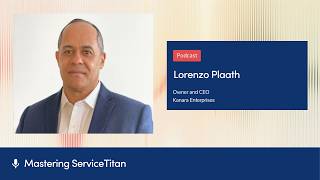
Lorenzo Ploth, CEO of Conara Enterprise, outlines a 30-60-90-day plan for contractors to prepare for AI adoption in ServiceTitan. Without clean data, standardized processes, and proper governance, AI voice agents can misrepresent your business and lose leads. Success requires data cleanup first, then standard operating procedures, then AI tools.
Chapters
Biggest challenge that you want to avoid is for that voice agent to misrepresent your business or misrepresent things that you do in your business. And then you almost lead the customer and you know what's happening. They pick up the phone and they call the next contractor down the road.
Welcome to Mastering ServiceTitan, where you get expert advice from power users. I'm your host, Josh Liu, and today I'm joined by Lorenzo Ploth. The CEO and owner of Conara Enterprise. And we are talking about being AI ready in ServiceTitan. And so Lorenzo, welcome back to the show.
Thanks, Josh. It's an honor to be here today and looking forward to this discussion.
Yeah, same. Could you quickly introduce Conara Enterprise, who you are, what you guys do before we jump in?
Yeah, in Conara Enterprise, we are obviously a ServiceTitan partner. We are helping our customers in the home services industry with implementing, optimizing in streamlining their ServiceTitan platforms to make sure that not only they get the best out of it, but they can grow their businesses to the next level. Awesome.
And we are talking about such a big topic today, a very timely topic. People are really interested in AI, adopting all these new cool AI tools. ServiceTitan's got a bunch of them as well. Not a lot of people are talking about what you wanted to share, which is how to be ready for AI. So what does it mean to be AI ready and why is it so important?
Yeah, that is a very, very important and timely topic. As you said, Joss, a lot of chatter and today around AI is about all, you know, the new shiny tools that a lot of people see out there. But a lot of folks forget about what is, what does it take, especially for home services owners to be ready for adoption of that AI models. And then obviously making sure that they have the right model or the right AI tools to help them business grows because. Not every tool or every AI model will be able to help them grow in a way, in a manner that they want to grow. So it's very important that we talk about what is the baselines that need to be in place in order for them to be ready for AI adoption.
And I know you talk to contractors all the time, and this is a very timely topic. What is the sentiment or like what are the common questions people are asking about when it comes to AI and readiness?
Really good question. And yes, It's almost coming up in every single interaction with every contractor today because of, again, the noise and the news and everything about AI. A lot of questions that they ask, is it for me? Is it really ready for me? Is that specific tool for me? And then they want to try it out just to know that it might not be for them, or there's specific things that they have in place that, or not have in place rather, to adopt AI. So for example, voice AI that, you know, is coming out and being executed today. There's a lot of components that needs to be in place. For example, their data, their workflows, their processes that needs to be in place. And a lot of them is not ready for that. So those are some of the most common questions and concerns that a lot of them raise during my interactions with them.
Yeah. So let's try to answer some of the questions for them. I know you put together this beautiful 30-60-90-day AI readiness plan for ServiceTitan. It's great for contractors. Maybe can you share a little bit about just at a high level, what is this 30-60-90-day plan?
It's very important that we have a structure to this because a lot of folks, you know, they jump in without structure, without a plan. And, you know, my approach would be to have a proper approach, which is that 30-60-90-day plan. And not rush through it. So, you know, at the top, the first 30 days is to focus on cleanup and standardization, you know, making sure that there is a clean audit being done on their ServiceTitan account, making sure that the data quality issues has been resolved, making sure that they have documentation, you know, workflows, making sure that there's baseline metrics for them to focus on during that first or after the adoption of the plan. At the 60-day mark, I typically focus on enforcing those workflows, you know, in terms of the governance structure. So we implement standard operating procedures or SOPs. We focus on configuring the platform to support those procedures and set up accountability reports on the dashboard so that they can see the true value of, you know, the data that they are using. And then as technicians closed jobs in the field, that they can see those come through on a real-time basis as well. The last 30 days is the optimization and increasing the scale of their platform. This is really where the rubber meets the road, where things get fine-tuned and be ready for that AI adoption and making it easy for them to put in, for example, a new voice agent on their platform that works well, that understands their business. And understand every concept or component within their business as well.
For the 30-60-90, do you think it's like a holistic across all of ServiceTitan plan, or do you recommend people approach it as like, oh, there's one specific AI tool I want to use. How do I prepare for that one specific tool?
It comes down to the operational components within each of the organizations because you have a variety of organizations. At different offsets, or, you know, anything from $1 million to $100 million and above. Every organization in that spectrum will have a different approach and have different needs. So during the assessment phase, I would say, you know, focus on what is the components that will help you improve your business at that specific point. There's no point in putting in specific things or products that will not support your business at that specific time and scale. I think it's the approach of crawl, walk, and run. You don't want to just jump in and run. So in order to do that, you want to make sure that there's specific things like your price book, your customer data records, all those type of things is set up properly. And as you grow with those standard operating procedures and everything that you actually scale, and then you can put on the components like pro products, like Scheduling Pro, Feed Pro, and things like that. But out of the gate, you know, I think it's important that every contractor assess their current state, make sure that they have a very good grasp of what their current state is, and then grow with the adoption of those platforms going forward.
Is some of the assessment phase done before the 30-60-90, or is some of that done in the first 30 days period?
Yeah. Some of that is actually done during the 30 days, and there's some components that we can look at before. The 30 days, but it's really when we sit down with the customers or the clients that we go into detail. So for example, again, we do a detailed audit on their price book. We look at their job types, their membership programs review, and we are looking at the structures of that. We take a snapshot on their matrixes. So for those that have key KPIs, um, for their booking rates, average tickets rates, revenue per technician. Membership conversion, all of those, we want to make sure that that's all captured based on their, their KPIs. And then obviously we also look at other third-party integrations, you know, like accounting, marketing systems, uh, ensure that that data flow is also fluent between the systems.
Gotcha. That makes sense. You want to make sure the picture's clear before you decide what you're going to do with it. What do you think is like the biggest AI tool that contractors are wanting to use that maybe they are not ready for or have some cleanup to do?
Well, it goes without saying, I think the AI voice agent is what most contractors want to use. And I think the reason for that is obviously they don't want to lose leads, especially us sitting here at the verge of the busy season coming up. They want to make sure that they capture every single opportunity that can come through. So I think, you know, the AI voice agent is one of the biggest components that they are looking for. So at the same time, it's a quick win for them to be able to capitalize on that. So making sure that they have the data structure and everything ready for that voice agent, because the biggest challenge that you want to avoid is for that voice agent to misrepresent your business or misrepresent things that you do in your business. And then you almost lead the customer and you know what's happening. They pick up the phone and they call the next contractor down the road. So Right.
Do you have any, maybe some key highlights to cover in that first 30 days? Let's say there's someone listening and they want to adopt AI voice agent. What are some of the key things that they should like clean and standardize in that first 30 days to prepare?
I think, you know, starting with their job types, looking at the skills, the backbone of their platform is obviously their price book. So making sure that they have a standardized price book set out and making sure that, you know, when they put pricing out, for their customers. And this becomes a new phenomenon now with contractor sharing pricing online, that it is accurate and it's all driven from your price book. And then obviously making sure that availability is set accurately. So your dispatch board and making sure that all your technicians is fully trained and equipped with all the tools on ServiceTitan Mobile to be able to execute on those when they come through.
And then how about the next, going from 30 to 60 days, let's say they, they've done all that, they got their foundation set. What are some key highlights for the next phase if they want to adopt the AI voice agent?
And I think this is where I've seen a lot of contractors had challenges is with respect to standard operating procedures, right? They would have a specific approach on a specific workflow, but it's not fully documented and shared with their teams, nor is their team trained on it. So for example, Do they have a standard operating procedure around booking, around dispatching? How do I complete my job in a proper invoicing flow? Because those are, you know, standard things that drives not only your business, but it drives accountability across the team. So you can have full visibility and see what these teams, team members are doing. Secondly, I think, you know, getting proper governance around the dispatch board. So establishing great rules around how jobs getting assigned to their teams, how do the work gets managed. So if you have CSRO dispatchers, making sure that everybody's on the same page with respect to that. And then I would say, you know, great approach would be once that is in place, look at DispatchPro to make your life easier if you don't have it already.
Yeah, the governance piece and this accountability piece, it seems like such an art. Maybe.
Yeah.
Yeah, it seems like less of a science, more of an art. And I can totally see why mentally you're like, oh, this feature works. I've got it all technically set up. But then the human element can come into play. And it seems like that's where things can get a little messy. Do you have any tips on governance overall, like maybe from like a 101 or just starting to learn how to get better at this? Any tips there?
That's a great question because as I'm visiting contractors across the country, and training their technicians. Some of the things that I like to do when I visit these locations is do ride-alongs. And I know a lot of others might not do that and, you know, feel like it's a waste of time, but I feel it's a value add because I get proper insight of how technicians, for example, handle their operating procedures within ServiceTitan and can easily identify gaps and you can help them streamline that as opposed to create workarounds for that. And I've seen, you know, if you put the human element around training them, it goes a long way. So very often I would also have champions in the tactician teams that can help them or help the other members. So you identify a team member that would be a champion for Silver Titan or the implementation of that or training, and then have checkboxes. So, you know, you will have a list of items that they will go through. Just making sure in the beginning they, you know, they check everything. And then, you know, I create, I call it cheat sheets, but it goes a long way with these guys when they ride in the field and they need to do or close a job quickly. Just having a cheat sheet to look at it quickly and, you know, close out the job. So from my perspective, that can help with the governance and improve that.
It's such a good point because oftentimes you can think, you know, what's going on. You know, you hear it, all the managers are sharing things about, but it's this game of telephone sometimes. Things get more vague and you kind of have a fuzzy picture in your head of what's going on, but then until you actually see it firsthand, you don't really have the clearest picture. So I like that advice. Even though people may have heard it, big question is if they're actually doing it. And I think if they do, they'll, they'll be surprised.
Well, you learn a lot and, uh, you, you also get a feel of what the technician goes through on a day-to-day basis. And, you know, I've been in this industry now more than 10 years and I've seen everything. And it's about the approach that you have because you want to put yourself in the position of the dispatch, the CSR, the technician, or you want to put yourself as a business owner in his shoes to see, to understand what he wants to see and how you can help him grow through our approach from a coaching perspective, because the platform is one aspect, or, you know, ServiceTitan enables them to grow and to scale. But at the same time, it's coming back to the philosophy and the mindset, you know, how strong they really want to grow. And, you know, like we talked about earlier, is that 20-80% rule around the mindset and then the rest is the tools and the resources that you can use to help your business grow. And in some cases, we've seen significantly for those that put the plan in place.
Yeah. So during this first 30, 60 days for the AI voice agents, when you're working with contractors, what do you think are some lessons or mistakes or challenges, uh, that they experience that others can learn from?
The number one thing that I see, Josh, is the call handling standards, because there's so many different ways that everybody does the script, right? So if they can focus on their call handling standards, define a booking script that is precise and easy for their customers to listen to, the call categorization and making sure that there's a proper escalation plan as part of that. So If the bot can only go as far as this, is there a way that they can put a human element in it if possible? But think about the whole call handling process from a script perspective, the rules that you put around it, and then also the inbound outbound routing through ServiceTitan, you know, what that looks like. So those are some of the biggest challenges that I see. And then obviously the field process enforcement. Again, I want to come back to that because those are the guys that once this call is booked, that will receive the notification that that call is booked. So making sure that everything is set up, the arrival times, the diagnostics, and then obviously the presentation of all of that with the customers.
So yeah, I feel like that's why it's so helpful to talk to somebody like you, because for a business, they're kind of— they can only see what they see versus, yeah, you've seen it multiple times, many angles. And I think A big piece of this is, you know, the questions to ask that they might have not thought about at all and just jumped right in. So it can save a lot of headache, I'm sure.
Yeah, absolutely. Yeah.
How about the last 30-day phase, the 60 to 90-day phase? Is this at the point where they would have already gone live, I guess, with the new AI tool?
Yeah, definitely. That would be, you know, for me, the last 30 days would be the product adoption phase, right? So now making sure that they have products in not only the AI voice agents, but look at potential other products like Dispatch Pro, Marketing Pro, Scheduling Pro, and Sales Pro, obviously that they look into those. And this is where, as I said before, like helping to grow and pretty much have Silverstein become a well-oiled machine through automation for them to be able to take advantage of this. So a couple of weeks ago, we saw Chris Hunter and another gentleman having that discussion and we saw what it can do. When it's fully automated, but I'm sure behind the scenes there was a lot of work put in place in order to get them where they needed to be. But when it is done properly and it's done well, it becomes exciting to see the capabilities of AI and what it can do for your business.
Yeah, that was an awesome webinar. We'll link it in the description. Chris Hunter and Brooke, or I think he goes by Lawrence sometimes as well, uh, Riley, right? We'll link that in the description. He's using a ton of these AI tools and he kind of shares the end outcomes and, and what business looks like today, which is very different. So it'll be like a different view at this, whereas today you and I were talking about the nitty-gritty, like what's all that work going to take? Yeah. So I love the 30, 60, 90 day plan that you put together. You have the checklist. Each phase has certain deliverables and metrics to measure before moving on to the next phase. I did want to talk a little bit about mindset in a bit, but before I do, anything else on the, on the 30, 60, 90 structure or plan here?
Yeah, I was just going to chime in there a little bit, but you know, I think part of that last phase around them adopting it is also how do I recognize the work that has been put in? For me, it's like looking at a before and after picture from an analytics standpoint, where I was, where I want to go. And I think also there's, where's AI playing a big role in that advanced reporting analytics. So they can go beyond just what the dashboard says, but they can actually go into AI-driven outputs. And making predictable decisions for their business. Because I think if every business owner is going to look to scale and grow, you want to have a level of predictability and see what is the things that you can achieve, especially, especially during slow times or even during busy times to be more efficient and be more productive as a team in the organization. So I think having that performance benchmark and reporting analytics will definitely help them achieve those roles or those goals and having to build that return on investment story because it is at the end of the day, if you look at it, it's a journey that you have to go through and you want to have success through that process.
Yeah. Do you have any examples of what that could look like? Because this part is to me, sounds like the exciting part of the transition or the implementation, any examples of what that looks like at the end?
One of the big things that when I typically do the audit upfront as well is to see what their job margins is, uh, and then obviously the job costing and then obviously the business margin. And I think that is where you can have a really good benchmark to see, well, my job costing, is it accurate today? Where is it today? And then from a margin perspective, if you are at a specific rate, let's say for argument's sake at 40. And you want to be at 50 or 60, what will that look like? And how does the program that you've gone through help you establish that? And I think those are really, really good benchmarks for that we can look at to see the growth in the business. And even though the business might have not grown from a resource perspective, but you've grown in terms of your average ticket, the ticket size, and then obviously your customer base. That is items that you will look at from a benchmark perspective to see if this program has produced a return on investment that you, that you did.
If there's one word I could describe this process, it feels very thorough to me. It feels thorough. It feels real, like concrete. You know what you want to implement. You're assessing and setting the foundation. You're implementing it, creating accountability and processes. And then at the end, you have a clear number. To show what the impact was. It's a really nice flow through the whole process versus like, oh wow, there's a shiny new thing over there. Let's go turn it on.
Yeah. And that's what I'm trying to educate the home services business on because we know it, there's a lot of shiny tools out there and a lot of times we get caught in that moment with this new shiny tool that can do it as, and I've seen it so much. In the last year that people spend money on things that becomes a white elephant that they are not using. And just to know that, well, it doesn't help me perform my business. So if you really want to put a structured approach to it, this approach will definitely help you, you know, getting a return on investment for what you're looking for from AI standpoint. And AI is great. We should just use it in the right manner. We should make sure that we think through it and utilizing the AI tools that is created in the right approach.
Thank you for sharing that, and I would love to talk a little bit about that thinking process, that mindset piece. Before we started recording, we were talking a lot about a lot of the investment in yourself that you've done on the coaching side and learning to work with people, and I mean, all your experience. AI is big, scary change, you know, people are calling it the next industrial revolution, like the next internet, and I feel like a lot of people have different stories and meaning and, and and whatnot they're taking away from this. What are your recommendations from a mindset perspective for contractors trying to adapt to this like huge, it can be intimidating, you know, change that's coming?
And to your point about investing in yourself, again, finding the right mentors, finding the right resources out there that you can look at. So, you know, for us and specifically for me, I invested in myself from a mentor standpoint. In Anthony Robbins. And through that process and his philosophies, it became very clear to me that, you know, you have to have a good solid foundation, not only as a business owner, but as an individual to make sure that you have the basics in place. You know, do you have a healthy state in terms of your mind? Is your body healthy? And all of these things contributes to decisions makings that you take as a business owner, and that has an impact on your businesses as a whole and on your family and your team members. So taking care of yourself and looking into that and making sure that you're in a great state of mind is fundamental. And from my perspective, I've learned a ton over the years from Tony and his team, and I'm still investing in it for my own sake and for my business sake. And I've seen the results because of that, because it helped me make decisions that was able to grow my business. And put me in a state of mind that I can focus on today and put myself in a better place. So I would definitely say from a mindset perspective, that is 80% of where you need to go. The other 20% is the tools and the resources that you need in order to be successful. But, you know, with that approach, I think people really will be successful. And I'm not saying go with Tony. There's tons of other business or coaches out there. That do the same thing. Pick the coach that resonates with you or the member that resonates with you and play full out. Because if you play half-heart, you will not get the success. Play full out, play hard, and be competitive.
Do you have any favorite client stories or moments where you're coaching or working with a contractor, maybe like a mindset shift type of moment or a turnaround type of story? Any of those come to mind?
Yeah, definitely. And this is not specifically, you know, AI component, but the mindset shift with this one specific client that I work with, uh, Vito Services there in the DC area. When they went to ServiceTitan, they were completely overwhelmed with the changes. And I went to visit them 3 times. Uh, and the feedback that Jim Vito, the owner of the company, was giving me is that They've gone through it, they've implemented successfully, and both me and the ServiceTitan team has been phenomenal in helping them. But the feedback that I got is Lorenzo kept us accountable. He made sure that our mindset is ready every morning because when we started the morning, we started with a loud bang of music. We did our priming and we got ready for that. So that's put them in the right state of mind. There was tough times. There was tough conversations, but they are one of many successful implementations that we have on ServiceTitan. And, you know, together with the ServiceTitan implementation team was one of my great success stories.
I know you've seen so many implementations and helped so many people. You've partnered with ServiceTitan and implementation to smooth, make the transition smoother and more successful. If people haven't listened to your first episode on Mastering ServiceTitan, we will link that in the description as well. All about ServiceTitan implementation. And it's just, it's so cool to see you come back to talk about implementing AI now on top of it all. Anything you wanted to share about Kinara Enterprises today for people who are interested?
ServiceTitan is a huge tool and it's changing contractors' lives. We here at Kinara, we work very hard to make sure that the contractors is getting the right information, the tools. The resources and the training that they need to be successful with their implementation. Here at Canara, we can certainly help whether it's, you know, preparing for your AI journey or just optimizing your account from a price book, inventory, or reporting standpoint, setting up your memberships. I think, you know, we have been doing this now for close to 10 years. And I started the journey with the Silverstein leadership team way back in 2016 when we when we started with Service Experts down in Texas, and I've seen the product evolve. I've seen the great things that the Titan teams has been doing, and we are here to support that journey, not only for ServiceTitan, but more importantly for those customers that we serve to make sure that they are successful with these ServiceTitan accounts, you know, see the growth in their businesses because that is where the satisfaction comes. You know, you can help them. They can do the right thing. But if you have the growth, uh, like, you know, Blandon's in North Carolina that I helped with, I was so happy last year at Pantheon to see that they were one of the biggest growth companies for SilverState. And, and, you know, the little bit that I had to do with it, I felt proud because it was helping them to grow their business and being successful in their business.
Is there a certain contractor or a certain problem space or challenge that when you hear it, you're like, oh, I, I love to work with these types of customers or clients?
I love to work with the customers or the clients that is about to give up on platforms like ServiceTitan, that wants to go back to pen and paper or wants to jump ship to go to another platform. Those are my favorites because once we walk them through the process, And, you know, the structured approach is typically what I put in place, whether it's just implementing and re-implementing ServiceTitan or AI. Once they get that and they see how we transform their business, it makes a huge difference. And the satisfaction is for them to say, I'm not going to another platform. I'm sticking to this platform. So that is the biggest, the most fun for me.
So, wow, that's awesome. So if that's you out there, definitely reach out to Lorenzo. And of course, if there's other opportunities like implementing AI tools, which is really, really timely. A lot of people looking at it. Make sure you talk to Lorenzo to get the foundation set up and have a structured plan. Anything else before we wrap up? Any parting thoughts?
No, Joss, I just want to thank you and looking forward to working with you guys going forward and see the journey of AI evolve in the home services industry. Amazing.
Thanks so much for coming on and we will catch you all on the next episode.
More from Bill




Capturing the 80%: How SmartAC’s Gen-2 Targets Non-Membership Homeowners | Podcast Ep. 296

Build better customer data with every booking in ServiceTitan | TAD Tune-Up Series

The Biggest Change for Roofers Coming From Other Roofing Software to #ServiceTitan?

