Building a $50 Million Mom N’ Pop Shop | Podcast Ep. 108 | Toolbox for the Trades
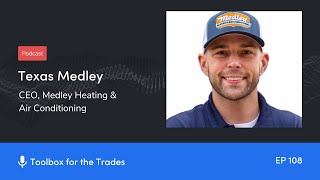
Texas Medley built Medley Heating & Air Conditioning from a bought phone number to $4 million in revenue with 22 employees. He left HVAC as a teen for grocery retail, came back through trade school, and now chases a "$50 million mom-and-pop shop" with a flat structure and people-first culture.
Questions this video answers
Between 22 and 25 employees (varies day-to-day).
About $4 million this year, projecting about $5 million next year.
A "$50 million mom-and-pop shop."
About 25–26 years old.
Texas Medley. You are the CEO at Medley Heating and Air Conditioning in Dallas, Texas. I am so excited to have you on the podcast. We are going to kick off the way we do every single time, which is how did you get into the trades?
Sure. And I'm super flattered to be a part of this podcast. So thank you. Thank you for having me.
No problem, no problem. I mean, honestly, I might have just booked you because your name is that good. I just, I want to say Texas Medley as many times as possible.
Yeah, I kind of got introduced into the trades very, very young. 12 or 13 years old. I would go help my dad in the summers. It was my summertime job installing duct work, installing air conditioners. And a lot of times I hear these, these guys on these Facebook groups, they'll talk about, they kind of grew up in the trades too, or they got their young kids coming up in the trades with them and they'll let their kids hand them tools and things like that. Well, I didn't get that. I got to do real work, like 12 or 13 years old. It was, hey, don't step anywhere but on these rafters because if you do, you're going to get, you're going to go through the house, you're going to get hurt and get to work. And that was, that was how I learned. 12 or 13 years old. I would go to work with him throughout the summers and did that till I was probably 16 when I left the trade and said, I'm going to go get a real job. And I went and worked at a grocery store.
Oh my goodness. What was it about the trades? Do you remember being a 16 year old thinking like, this isn't a real job.
It was hard. It was, I felt like it was, I don't want to say like I felt like it was beneath me, but I felt like, and this is such a shallow things to say, I felt like I was smarter than that. Like I'd watched what my dad did and I was learning from what he was doing. And I felt like, man, you're here because you didn't make the best decisions throughout your life and that's why you install air conditioners. And so that's what I thought it would be. Obviously you get a little older, you get a little wiser and you realize that's not the case, but 16 year old young man working like that and 100,000 degree addicts isn't exactly exciting.
Totally. And I didn't mean to put you on the spot with that question. I just wanted to to highlight. Even for someone who grew up in the trades whose father was installing air conditioners, you still had that negative connotation, that negative stereotype about what service work was, which is something that I kind of did too, even though my dad was a carpenter. And I think the reason I ask you this question now, you're the CEO of a company, we're going to get all into that. But how much you have to work to get a different perception and what's required to change your mind. Also, historically, I don't know if you know this, but 16 year old boys tend to not make the best decisions. So we'll, we'll give you a pass on that.
Yeah, I was the exception. I made great decisions when I was 16. Never made a bad one.
No, no. But you went to go work for a groceries, Go for it.
Well, you're onto something though. And I've never thought about this till just now. Typically the negative connotation or perception that people have of the tradesmen is because of the way that tradesmen present themselves by and large to the public. But isn't it interesting, and I bet I'm not alone, that my perception came from the other side and it was, this is why my dad does this, that's why I don't want to do it. So landing at, landing at the same place in that the realization is that the trades are not for smart people. This is where you go when you can't do anything else. Or this is where you go because you didn't have the aptitude for something more. I think that by and large the general public may feel that way and I think that that's kind of changing and that's not the case so much anymore. But it's interesting to think that even the child of somebody in the trades kind of landed at that same place.
I interview a lot of folks on the show who got into the family business and they weren't gonna, they had other plans. They have degrees. They have, they were on their own path and they were like, no way was I gonna work at my parents and my dad's business and my parents business. And now they're like, well I love it and I'm doing some really awesome work. So I think it's just really interesting how that, how so many people on the show come to the trade like don't want to be in the trades but then end up in them later. And I want to talk about that with you because you went to go work at the grocery store and I, you told me that you learned a ton when you were working there, right?
I did. I, I have nothing but good things to say about that time in my life and the experiences I had there. In fact, I would tell anybody who wants to, not that I don't have kids, so I can't say, you know how to raise a kid, but I would think to offer if you want to, if you want to give your kid good, well rounded life skills, I can't think of a better place to have them work than as a cashier or a sacker at a grocery store. You learn people skills and customer service and dealing with money and product merchandising. I mean, you're Learning this like 16, 17 years old, how important these, these things are and you get all of it every day. Obviously my path was a little different in that I, I went beyond entry level positions. But even those lower entry level positions offer so much to the people performing those tasks.
Totally, totally. And you were there for a few years right before you boomeranged back into the trade. So what level did you get up to at the grocery store?
I was second in charge of a store as a assistant store manager.
So you were second in charge at a store. So you were second in command essentially. So you were, you know, there was only one other person ahead of you.
Yeah, well, you know, and I had a really cool role in that. They, I think that they saw something unique about me in that they would send me to different stores. I was never at one store very long. I think the longest I ever stayed at a store was maybe a year. I got bounced store to store to store to go help struck sometimes struggling store, sometimes they weren't struggling, sometimes it was just a swap. But I got a really unique perspective because I got to work under a lot of different management and leadership styles and a very short period of time. And I got to work in high volume stores and low volume stores and mid volume stores. So I've got this really unique perspective in this. Not even what I was trying to get, but this great education and that I got to work under hard ass managers, really soft, easygoing managers, Managers that were leaders and not just managers, really just a good overall experience that time of my life and learning from those people.
That's awesome. So talk to me a little bit about how you came back to the trades. What was the push? What made you think, start thinking about H Vac again.
So I was working at that grocery store and there was a couple of things that happened. First of all, I started getting in trouble for Things that I thought were the right thing to do, I would ask for. Okay, I'll give you an example. They would have merchandise that needed to be marked down and gotten rid of before it went out of date. But they had this allocated spot in the far back side of the store that no one went to, a very small shelf, no one paid attention. It just went there to die and expire. Basically learned from old school type manager. Got through all that stuff in a buggy and rolled it to the front of the store and just slapped a low price on it. It'd be gone in 20 minutes. Well, I did that a couple times. I got in trouble, but I was in my mind I'm getting rid of the stuff that we want gone. But you're mad at me because I'm not putting it where you wanted it. And I just, it didn't set right. But the catalyst, the real catalyst was when we had this district wide meeting with all the assistant managers and the district manager had this report he wanted filled out at the end of the quarter with everywhere that you were struggling and how you were going to improve on those key performance indicators. I'd worked, I don't remember. It was probably like 11 that morning till 10 that night was my shift and at the end of that shift I had to have that report ready. So I stayed at work after 10 and I probably worked on till 1 or 2 in the morning, sent it off, thought I did a really good job, had a solid action plan of everything we were going to improve everything that wasn't looking good. We were going to make this right, good, actionable plan. Got an email back the next day and it said, I said use 12 point font.
Oh my goodness.
I was just absolutely defeated.
Wow. If anyone wants a quick lesson as to how to devalue your employees in one email, rewind to 30 seconds ago. Holy crap. That's horrible.
So I was absolutely defeated at that point. I was just whatever. And I stayed there a couple more months and then I, I was out.
So when you first off, I, I mean I could talk about that grocery store incident forever, but we, this is a trades podcast, so we're going to move on. I just want to acknowledge that that is, I've been on the other side of emails like that and there is truly no way to, to just destroy morale with something like that. And also, what is this high school? Who cares what size font you're using? But I digress. So you were working in grocery store, you were learning all this great stuff, you climbed up to second in command. And then it sounds like you were just being demotivated and you just weren't enjoying kind of this bureaucratic nonsense that you were getting pushed up against. So you decided, well, let's go back to H Vac. So how did you go from going back to H Vac to starting Medley heating and air conditioning?
Sure. So you gotta keep in mind there's this lull period where I didn't touch tools, at least for H vac. From the time I was probably 16 till I was probably 20 some somewhere right around there.
And.
My dad was working for a guy named Steve. And I called Steve and I said, hey, Steve, I'm thinking about getting back into the trades. Can I come help you on some installs? Now, Steve was a one truck operator, so he had no aspirations of growing beyond that. But he said, yeah, you can come help me on installs when I have a big job, which is maybe once or twice a week. I said, cool, I'll do it. Took my 401k that I had at the company and did personal training in the park on the side to put myself through trade school. I went to a local community college and went to a trade program that they had offered. And while I was there, I actually learned, met a couple of the teachers that had companies of their own. So I would also do installs for them when Steve didn't have installs when I wasn't, personal training so that I could not go completely broke.
Personal training, like gym personal training?
Yes.
Nice. Okay, cool.
How I supplemented going to school and working between these other guys because I wasn't making any money. I was totally broke and I quit my job. I forget where I was going. Anyways, call Stevie said, yeah, that's cool. Go to school, learn how to do this. He worked. He would work me in the day doing installs. I'd go to school in the evening for H Vac. And I did that until I graduated school. When I got out of school, I was kind of excited because now I'd be less broke because I could do an install in the morning and in the evening now. And so I hop around working for different contractors, whoever needed a hand. And so at one point there was, I don't know, three, four, five contractors that I was just doing installs for.
That's awesome. So you were. So you weren't actually looking to become a contractor for any other business. You were more just like, I've got all these contacts and I'll just fill in and find shifts and do two Installs a day, five days a week, six days a week, and I'll be making money.
No, I actually thought I wanted to work for a company. Nobody would hire me. I didn't have any experience. I didn't have really the kind of experience. Yeah, I didn't have the kind of experience that they were looking for.
Even though you went to trade school?
Even though I went to trade school. Well, okay. No, no, no. Okay. Excuse me. Excuse me. By this point, I had made enough contacts and just organically grew this thing to where I didn't care if I had a regular job or not at this point. But while I was in trade school and early entering it, nobody would. Would mess with me or touch me.
Got it. So while. Because no one was messing with you while you were in trade school, you started developing your own contacts and before. By the time you graduated trade school, you kind of had your own book of business. Business. Is that what you're saying?
Correct. And then I don't know if I want to tell this or not, but when I went to trade school and I needed work and the teachers, I. I told them I had. I told the teacher I had been doing this way more than I had.
So you know what, Texas, you're the CEO of your own company right now, so it doesn't really matter.
I still kind of feel bad for it. I hold a little guilt about that still.
Well, you know what I will say, if I am a Medley heating and air conditioning customer and I hear this podcast and I hear that you're still feeling guilt about a little white lie you told in trade school, I would probably be very comfortable giving you my business. So you kind of started your own business then by necessity, because you weren't. You weren't being able to get hired as a tech anywhere else. Is that. Am I understanding that correctly?
Okay. So I had this subcontractor install thing going on. Once I had accumulated enough experience to test for my contractor's license, I did that, and the guy who I primarily worked for, Steve, helped walk me through that process. So I got my contractor's license and then I started. At that time, it was a different name. It wasn't even Medley, but I started what is today, Medley, and I did that for about a year and still made no money. So I still had to install for other people.
Oh, my goodness.
And so I had. I would actually show up with my company name on my truck, and I had to put this magnet that was just the color of my truck over my company name. It was Bad and.
Okay. Dang. No, go ahead. I didn't mean to cut you off.
No, no, it's cool. So then about a year of doing that, I was starting to get just a little bit of momentum. People talk. I didn't know anything about marketing. I had no clue how to market. Not. Not all I knew to do was go on Facebook when people ask questions, go in there and answer those questions and hope they call. That's all I know.
Pretty good intuitive marketing.
Honestly, it worked well. About a year into having my business, Steve was getting ready to retire and asked if I wanted to buy his phone number. Basically buy his business. But all I got was a phone number. I didn't get a truck. I didn't get assets. I didn't get any company name, but I got a phone number. And he made me a deal I couldn't say no to. So I bought that phone number. All of a sudden I had a phone that rang.
Oh, nice.
Yeah, it was really different. And that became what Medley is today. So it took this 30 year old business, 20 something, 30 something year old business of this single operator, and that's where we started to sink our teeth into and latch onto. We now had a customer base.
That's awesome. And how old were you when this happened, do you remember?
Probably 25, 26.
Thank goodness. Yeah, yeah, yeah, 25, 26.
Into a short period of time.
That is a lot fact. Into a short amount of time. And now also, your dad's technically working for you too, because Steve is the one who was giving your dad jobs back in the day, right?
That's right. That's right. So when Steve left, I inherited my dad as my. I guess I kind of had two first employees, so my dad was part of that deal. And then my best friend, still to this day, I was like, hey, you want to go do something cool? You want to figure out how to run a business and quit your job? And he was like, yeah, my wife's eight months pregnant, but yeah, let's do it. And she was. She was pissed.
I'm sure she. She thinks of it fondly now. I'm sure it's just a funny memory between you guys, but I want to talk about those first few years of business because you mentioned that they were incredibly hard on you and your w. So talk to me about those first few years and what that was like and how did you reach your limit where you realized I got to be doing stuff different than what I'm doing right now.
You know, I think for a lot of People, I don't know if there's this, this magic breaking point where you're just like, okay, I've had enough. For me, it was just this constant waking up every day being miserable. Wake up miserable, Go to bed miserable. Wake up miserable, Go to bed miserable. Phone won't stop ringing. Got mad customer over here. You got a customer that needs to pay a bill. You got bills you got to pay, and you've got just all these things going on, and it creates, like, this, this anxiety that you can't describe. It's not like a paranoia anxiety. It's just like this internal anxiety that you just can't escape from. So in that, only thing I knew how to do was work harder, because I can outwork anybody, but I didn't know how to work smarter. And that's what I had to figure out. So this led to a period of time, I wouldn't say where I was depressed, but it was a depressive state of being where I would wake up early and I wouldn't come home till 11, 12 at night. My wife felt like she was living by herself. She felt like she was single. We just moved to a new area, so we were in an area where she wasn't close to any of her friends or family anymore. I was in an area where I wasn't close to any of my friends or family. It just was this really dark place to be, and she was ready to leave. And in hindsight, I, I, she would have, she wouldn't have been wrong in doing so.
Yeah. Oh, my goodness. And that's so tough. And also, I just want to call out, you're still, like, super young when this is happening, right? 25, 26 years old and probably 27 at that point. 27. Right. And I like what you. I don't like what you said, but the word miserable is just so. I don't think anyone's ever used the term miserable on this podcast before. Like, they've said synonyms. Up to it, obviously. Like, it was so hard, and I didn't know how I was going to get through it. But misery is just such a strong word. And was that because you were essentially doing everything in addition to, I'm assuming, running calls as well?
I mean, it was the culmination of doing everything, doing the field work, trying to be present at home and failing, trying to do installs, trying to make everybody happy, letting someone down. It's just, it's when all those things start colliding at once. It's not any one of those things. It's not doing an install. It's not running a service call. It's not paying the bill. It's not any one of those things. It's when they all are happening all the time. And where the fear and the misery kicks in is the fact that when you start to realize, I can't stop this, there's. This isn't going to end. So it's not like there's this light at the end of the tunnel. It's not like you say, okay, once I get these calls done and I get these bills paid and I do this, then I'm good. That doesn't happen. Good doesn't ever come. There's no finish line. And so you stay in this dark, depressive, miserable place until you change something. And that's when I said, hey, we gotta fucking change. This is ridiculous.
That's great. And you mentioned earlier, I know how to work harder. I know how to work myself. Because you thought the solution was, well, if I just work harder, it'll get easier. But that mind shift shift, that mindset shift that so many people come on this podcast to talk about is really like, you can't really work your way out of this. You can't just go harder, go harder, go harder, because you're just going to burn yourself out. You have to work smarter. And I think that's kind of what you're saying here, right?
Well, certainly a lot of that, but getting out of your own way. A lot of head trash that we deal with, a lot of limiting beliefs and a lot of things that we put in front of ourselves that we think we can't do when we can. You know, I hate the topic of raise your prices, but we'll use that for an example. You say you can't raise your prices. Why? Everyone always says, well, I can't do that in my market. Try it. See what, Watch what happens. Nothing. Nothing happens. Now that's another topic, I guess, for another day. Because I don't think that that's the answer to everything. I think everybody. That's kind of everybody's default answer to every problem they have is raise your price. And that's, in my opinion, not. Not the right answer. But that's another story.
So tell the folks listening a bit about where the business is today. How many employees do you have AR that kind of stuff?
Sure. Between 22 and 25 employees, depending on what's going on that day. So people come, people go, that sort of thing. We'll do right around 4 million in revenue this year. And probably about 5 next year. But our focus is not on this hyper growth. That's not where my heart is. For me and for our business, revenue is just another, another KPI. Are, are we doing better today than we did a year ago? I don't have an inferiority complex. I don't need to tell people I did $100 million last week. I feel just fine if I did them spiting words.
Texas.
I know, I know. Somebody, somebody's gonna. I'm gonna get nasty DM in my inbox. What do you mean by that? Who are you talking about?
So you're focused on. I know. This is one thing I really wanted to talk to you about because you're really focused on building a strong foundation within the business. So because you want to grow, but you don't want to do it super fast. You want to do it in a smart way. You want to do it in a way that is going to be the best for you, for your team and just for the health of the business as a whole. So what does that look like?
So I tell people that the big vision is a $50 million mom and pop shop. And if I had to call it something in my mind that's what it is. Where it's more of a flat structure in terms of if I'm walking down the hall and the technician wants to talk to me, I'll talk to him. I want to have that personal relationship and obviously I get it. My time becomes more scarce as you scale up and I'm certainly not naive to that. But I don't want anybody to ever feel like they're not part of something bigger, that they're on this team and there's this team. I don't want that. It's one team. Same with customers. I want them to feel like when they see our growth, when we reach, you know, a big milestone one day when we're a top tier company in the market, I don't want them to say like I've heard them other. I don't want them to say like I've heard other companies, customers say about them, like I was with them when they were nobody. Now I just can't deal with them no more. They're too big. They don't care about me. I would rather our clients say I was with them before they were anything. I'm so proud that they grew and that I got to watch that.
I think that's a pretty. I'm sorry, I just wanted to stop you and say I think that's a Pretty great vision. Keep going.
Oh, thanks. And that's the same way I want the people who work here to feel. I don't want anybody who comes in to feel like they're late to jump on the bus because they're not. It's still early. At $100 million, it'll still be early because there's, you know, Simonson that calls it the infinite game. We're playing the infinite game. We're not going to reach the finish line and I'm cool with that. But I want the people who work here to feel like they're part of something bigger too and that they have a home here and that they, these are their boys, these are their girls. This, this is where their friends are, not their co workers. I hate them. I hate the word employees so much. First of all, I hate the word.
You're not the first person to say that, by the way, who's come on the show and said I hate the word employees. So continue.
Tell me why it feels like I'm better than you. You're an employee and I'm up here. I hate that. I don't really like the word co worker. We're just team. You know, it's kind of cliche because I hear other people talk about their family but they don't really live that. I really feel like this is my family. You can walk in here and you'll see 20 year old men hugging 50 year old men before the end of the day and saying, hey, I love you, I'll see you tomorrow. And it makes me proud that this is the way people feel.
And I could see why. If that's something that you value so much in the organization, why you want to focus on slow and steady growth opposed to rocket ship fast. We're going to hit X million by the end of the year or something. Because when you have something that precious, it's really hard to maintain that as your company hits different stages. At least what I've learned while talking to contractors in this business. So I want to hear a little bit about how you communicate with your employees because I know that's something that's so important to you and culture building is something that's so important to you.
So I think one of the, you know, taking it back to the grocery store, all the good lessons I learned there, I got to learn a lot of what not to do. Also like that email we talked about. So I always am trying to be very self aware of how I'm being perceived by others, but also inviting them to Check me when I'm. When I'm not being the way I need to be now. Right place, right time. I don't need somebody just mouthing off because they feel like mouthing off. But anybody here knows if. If I'm acting out of line, hey, correct me. I made mistakes, too. I'm human. I'm not perfect. And I don't expect you to expect me to be perfect. Please let me know when I need to get back in line or what you need from me, and I'm going to do you the same, or I'm going to give you the same courtesy and correct you in areas that I see you need to be coached in. But don't let me walk around. I need a bunch of yes men. I don't need people who are just going to tell me what I want to hear all the time. What's going to make us better? What's going to make us improve? What's going to make this company better, which is in turn going to make your life better, which is going be to. Which is in turn going to make your family's life better. I don't get that. My idea is not always the best idea. Don't just go along with it.
Yeah. And I think when you say, my dream is to build a $50 million mom and pop shop, that's really what you're aiming towards. You want to surround yourself with people that are going to tell you the truth. Tell it like it is. And not just say yes to you because you're the boss.
Yeah, yeah. And don't be afraid of me. But. And my hope is that in presenting myself in that manner, other people can accept responsibility without fear and welcome criticism without fear. I think a lot of people get defensive, and oftentimes they're right in feeling the way they do it in feeling defensive because, well, last time he told you something, what'd you do? You scolded him. You know, he don't want to act like that to you no more. Versus giving them that open line of communication, showing them letting your guard down, saying, hey, dude, I'm sorry. I made a mistake. Let's fix this. And you find that your guys, when they start making mistakes, are not afraid to tell you they made one, first of all. And beyond that, it's almost like a. A deeper level of sincerity when. When they do make a mistake, they. They feel bad. They want to make it right because they're like, I messed this up. I gotta fix this now instead of, oh, it. I don't care about this place.
I love what you're saying because I think it really speaks to how you must be mindful as a leader and how you act and how you show up. Because how you act and how you show up will eventually be how your employees act and how they show up. Because just like children look to their parents for modeling behavior, employees will also look to, I think, their leaders for the same thing. So I think it's beautiful that you have that and you've been able to foster that culture that. That people aren't scared to admit mistakes. There are so many people who have jobs where they are scared to admit when they make mistakes because they've seen what that could mean in their place of business. So I really applaud you for that. I think that's fantastic.
Thank you. And I forget who brought this to my attention, but it's so accurate. If you want to see where your business sucks or you want to see where you suck, look around and see where your business sucks. Because it's going to tell you it's going to be a direct reflection of who you are. If you suck at customer service, well, guess what? Your customer is getting. They're getting some customer service. If you suck at, I. I don't know, whatever else, then that's probably what you're going to see. Looking back at you, if you come in negative all the time, guess what kind of culture you're probably going to have. So we just tell people, show up. Come. Come as you are. You know, you catch me at my house, I'm gonna be the same person that's talking to you right now. Maybe a little bit less choosy with the words, but. But outside of that, it'll be. It's gonna be the same thing. That's what we want people here to. To bring with them. I want them to show up as who they are. That's why we hired them. We like them. I want you to be who. Who we hired. Be. Be that guy. Be you, and go be you out there in the market, too.
I love that. So going back to building a strong foundation, right, you have to identify people that are really good at what they do. They're eager to learn more. They're eager to optimize and deliver excellent customer service and be the best they can be. Unfortunately, sometimes people aren't the great aren't the best fits for jobs.
Right.
And I'm going to ask you a bit of a tough question, because I could tell how much you care about the people who work for you and cultivating this sense of family within the organization. What have you had to do in the past where you found out that an employee who maybe you really enjoyed and loved their company, what have you done when you've decided, I really don't think they're a good fit for the business anymore? How have you handled that?
So there's a couple of things there. Again, my friend Wyatt speaks to one of the great efficiencies he now it's me. One of the great efficiencies that he finds in his business is from retaining people and not having to teach people the culture all over again and getting them up to speed on the processes and how we do things here. So he takes a lot of pride in retaining people, and I do, too. So typically we really. It's hard to get fired from this place. Don't lie, cheater, steal. I mean, that's. That's what it comes down to. Don't lie, cheater, steal. We will give everybody every opportunity we can think of to not only correct behavior, but to improve. And so we don't like firing people. That's a failure on my part. First of all, I take that serious because no one here gets hired without talking to me at some point, just like they don't get fired without talking to me. Because I want to know where we failed and if we're having to let somebody go. We failed because we didn't do a good job in the hiring process. And beyond failing the people that work here and wasting resources on somebody that we were not, that was not a good fit for us. I wasted a piece of that person's life, too. And I take that very serious. So obviously, good hiring processes and trying to weed out a lot of problems before they enter into the organization. Not that you're always going to get that right because you're not really trying to minimize how frequently you're turning your employees. But we will. I'll give you an example. We have a gentleman. He's a. He's a great technician. He is one of the top producing lead turnover service experts that we have. He was hired to be an installer, and he sucked. So we tried him in the warehouse and he sucked. So then we tried him in service. He's a rock star. So we want to find where someone belongs just because they don't belong where we thought they did. Again, back to my flaws and being wrong. I'm okay saying, hey, I hired this guy for the wrong job. Okay, let's find the right job. Now don't just say, okay, what do we do? We hire this guy. And what we do? Oh, he sucks. You need to get rid of him. He sucks and he sucks. No, maybe it's not right. Does he really suck? Does he suck at everything? Did we try anything else? Do we suck? Maybe. And so that's kind of the approach we, we take. And you know, it's not going to always work out. Sometimes people are just not a good fit. And that's okay too. But I hate firing people. I don't like what that does to their lives. I feel like that's a failure, a big, a big failure on the company's part when they have to fire somebody because they weren't, they didn't possess the aptitude that they expected them to have.
I really like this answer a lot. I want to put florally flowery language around it, but I just want to say I really like it. I appreciate you taking responsibility for that. And I think one thing that really struck me when we did our pre interview was how much accountability you took for your employees livelihood. You said it multiple times. You know, I have to run this business so these people can feed their families so they can do what they want to do. And I always admire that when I speak to an owner. And I think best practices, tips, tricks, you know, quick ways, workflows aside, that really, that care really translates. So, so it resonates so deeply with your team and I think it's so hard to replace. I just want to commend you for that.
Thank you. Thank you. You know, it's one of those things that I certainly know. There's a lot of blind spots that I have, especially as it comes in relates to. Excuse me. I know I have a lot of blind spots, particularly as it relates to business and particularly as it relates to leadership. But I think that the one thing I have going is people. And so I think that people should lean into their strengths and let someone else pick up on their weaknesses. And so I just really try to lean into that thing and take care of these people the best way I know how and let them lean into all the areas that I suck in.
It's so powerful, I think, to admit that you suck at something, isn't it? When you, when you kind of let go of that ego of I can do everything, I can do it all perfectly and you just admit, you know, I suck at this. I think it's so, so powerful and freeing from a professional standpoint.
And it's so much easier just to say I suck. You go do it.
That Is true. Another top management tip from Texas Medley.
Just tell everyone you suck. Have them do everything.
You just wrote a book right here. So let's. We talked a little bit about employees. We talked about. I want to talk a little bit more about hitting the solid foundation. So you're kind of aha. Moment of, I got to do something different or else my wife's going to leave me. I'm going to be miserable. That happened when you were around 27. Where are you at now? So where's the business now? You're pacing to hit 4 million. You seem a lot less miserable in just this interaction and the interactions I've had with you before that. So how many. How many years did it take you to kind of get out of that rut and really go towards efficiency, going towards mindset, shift all the stuff, all the. All the groundwork. You have a lay to make a good foundation.
I think it would be unfair for anybody who listens to this to think that, oh, wow, okay, his life is great now because it still has issues. You know, it's still. We're talking about that. That infinite game. There's no point that you reach where it's just all the stress is gone. Life is good. I don't have to worry about anything.
There's not.
So I still. Not that I found anyways. Maybe ask Travis Smith or somebody like that.
Or Travis Smith. Travis Smith actually will be on this season of the podcast, so I'll ask him. Noted.
My boy. You have to ask him about our trip to Whataburger.
I will, I will.
Make sure you throw that in there.
I will, I will.
What was I talking about?
I said, you know, tell me about the time before, you know, you hit burnout to where you are today. Like, how long did that take?
Yeah. So it's not like you wake up one day say, okay, it's all going to be different. And I made this decision now. Life is perfect. It doesn't work like that. There's no silver. Silver bullet. It just doesn't exist. It is okay. I tried 10 things. One of those things worked cool. Keep the one, trash the other nine, try 10 more one's gonna work. You add that one to your little staircase of things you're doing now, and you trash the other nine. And you just keep doing that. And over time, just, things just get a little bit better every day. And with coming. I think part of it is also coming to grips with the reality that you're not going to wake up to a perfect life where there is no stress accepting that and then accepting the responsibility that comes along with that. So, okay, my life's not going to be perfect today. No problem. How's it going to be better than it was yesterday? Because all I need is better. I don't need perfect. I just need better. And I just need better all the time. And so it's. It's unfair for anybody who's looking for a better life to think and see these people. I think I'll. I'm gonna say this, and I hope this part really gets published. Social media is so dangerous with these, A lot of these contractors. It's so dangerous. Scary what these, let's call them influencers, these influential people are oftentimes inadvertently doing to contractors who are in that place that I was speaking about where I was, because they don't show the darkness that got them to that point. They don't talk about that because no one wants to hear that. It's depressing. No one wants you going on there and talking about all the dark stuff you went through. But I think we kind of go tilt the scales a little far the other direction, too, where all we show is our badass cars and our vacations and our everything else that we have. And I don't think that by and large, the influential group of contractors, I don't think that they do a good job of reminding people that they didn't just wake up to that. Yeah, you know, the. It's not to say that these people can't have that, because if you possess enough tenacity and you have enough aptitude and you want to work hard enough and then you put forth, make right decisions and sprinkle a small amount of luck on. On top of it, then, yes, you can have that, too. I can have that. Anybody who wants that can have that. But it's unfair to say that it was easy because I know for a fact all these guys that we see on Facebook and whatever else, social media, it wasn't easy for them. They may want you to think it was, but it wasn't, I promise you.
Yeah, I think that's so important to say. And a couple people have shared that message as well on the podcast. It is so hard when you're comparing your day to day life to someone's highlight reel. And it's not to take away. Away from the success that other influencers have achieved, right?
Absolutely not.
But when all you're seeing is this, life is great. Oh, my gosh, I'm the best. Here's. Look at all of my Beautiful things and you're not seeing something that, that, that balances that out, then you as a, as a startup contractor may say, what the hell is wrong with me? This guy or this guy or this girl did it so easily. What's wrong with me? So I think it's really important to remember that.
I agree. And you know, I feel like there's this milestone where a lot of them reach where they, they enter into a place where they feel comfortable sharing those things. But oftentimes there's this damaging period before they're willing to admit that, where people are already listening to them and already gravitating toward them, not recognizing that they're being hyped up. And again, it's not, it's. I don't think it's with malicious intent. I don't think that anybody's trying to be harmful. I don't think that at all. I do think that without enough self awareness, a lot of harm can be caused. However.
I agree, I agree. I really enjoyed this conversation. Texas, I think you are a straight shooter. I think you've been super vulnerable and I've really enjoyed that. And I love that you're focusing on slow and steady growth opposed to fast and outrageous growth. And I think it comes from a place of really caring for your team and I think that's fantastic. What advice would you like to give anyone who is listening to your story and is like, that's what I want to do. I want to work towards a mom and pop shop that maybe is 50 million one day, but I want to do it, want to build a strong foundation and I want to, I want to do it right. What would you say to them?
Have fun. You know, remember why you got into this. Remember why you're doing this. Try not to get too stressed out in the process. And it happens to all of us, it happens to me. But try to enjoy this moment because those moments are gone. Those moments of me riding around with my best friend in my truck that I was so stressed out during that period of time because everything was falling apart. Well, as dark as some of that place was, a lot of those times were really great also. And I didn't get to enjoy them enough because of all the stressful situations. So trying to remain mindful of, hey, it's not as bad as it seems. It's gonna pass. Have some fun and just remember why you're doing this. Remember, remember to take a second, smell the roses. I like to say, whatever, be present. Try to, try to enjoy this moment because this moment will be. Will be gone, and you'll be onto another stage. And there will be something about this moment that you're glad is behind you, but there will be something about this moment that you're gonna miss also.
If you had to choose a song to be the soundtrack of your life, Texas Medley, what would it be?
Oh, I saw you sent me that. There's too many.
I know everyone hates it.
So I won't go too far down this rabbit hole. But some trying times as a young man. Fourth, fifth, sixth grade. Very, very dark place in my life. And didn't like where I went to school, didn't like where I was living, didn't like a whole lot of things. There's a lot that I just was very displeased with. And every morning, I would ride the bus and I put my headphones on. I'd listen to music by myself because I didn't talk to anybody, had nothing in common with anybody. But there was this one song that really resonated with me, and I don't know that it's the soundtrack of my life, really, but it is. Sing for the Moment by Eminem.
Oh. With Aosmith Captures.
Yes. That song. So many emotions.
I love it. I, too, had. It was the Eminem Show. That was the album, right? With the. With the Red Curtain. I, too, had that album, and I very much enjoyed that song. So that is an excellent selection, Texas Medley. Thank you so much for being a guest on Toolbox for the Trades. I really love this.
I think that there's. I think that's, like, probably, like, first part of my life is that one.
Oh, keep going. Keep going.
He has a new song out that could be, like, part two.
What's the second song?
It's called Higher. Every time I think I've reached my. Every time I think I've reached my ceiling, I go higher. So it's like, this is like, you know, first 30 years and second 30 years.
Brilliant. All right, Eminem. I mean, Eminem's great. We love Eminem. Thank you so much, Texas. This was a great interview, and I really appreciate you taking time out of your schedule to chat with me.
I'm sincerely flattered and appreciative that you would take time out of your day to speak with me.
Of course.
More from Bill




Capturing the 80%: How SmartAC’s Gen-2 Targets Non-Membership Homeowners | Podcast Ep. 296

Build better customer data with every booking in ServiceTitan | TAD Tune-Up Series

The Biggest Change for Roofers Coming From Other Roofing Software to #ServiceTitan?

