Building a Legacy Brand in the Trades | Podcast Ep. 192 | Toolbox for the Trades
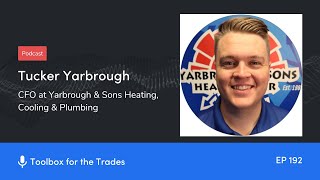
Tucker Yarbrough, CFO of Yarbrough & Sons in Oklahoma City, built a legacy trade business on transparent finances shared monthly with staff, community-focused marketing that spotlights technicians, and a profit-sharing program that ties annual payouts to company performance. He grows one project at a time while keeping the company locally rooted and family-oriented.
Hello, contractors, and welcome to Toolbox for the Trades. My name is Jackie Aubel and today I am chatting with Tucker Yarbrough, CFO at Yarbrough and Sons Heating, Cooling and Plumbing. Tucker and I spoke about building a legacy brand, creating a net profit sharing fund for his team, shouting out his texts on social media and more. I hope you enjoy our conversation as much as I did. Tucker Yarbrough, you are the CFO at Yarbrough and Sons Heating, Cooling and Plumbing in the Oklahoma City metro area. Today you and I are going to be talking about building a legacy brand through steady, consistent growth. I am so excited to chat with you today. Welcome to the Toolbox for the Trades podcast.
Hey, Jackie, thank you so much for having me. I'm excited about it.
I am excited too. Well, I'm going to kick this off with an icebreaker and I would like to know, I know you're a big reader and for anyone who is watching us this on YouTube, you'll see he's got literally probably about 100 books behind him. Tucker does. So, Tucker, I would like to know what book has had the biggest impact on your life.
So probably biggest impact on my life. In college I had a professor who to graduate with his core set of honors, you had to take his class. It was his mentorship class with him three years in a row. So six semesters. And for six semesters I read nothing but how to Win Friends and Influence People by Dale Carnegie. So as far as the book that I've spent the most time with is definitely how to Win Friends. And it's nothing revolutionary, but it's a constant and consummate reminder of doing the small things to win in relationships, how to win that capital, how to win, you know, the literally how to win friends, but also how to continue not just to leverage those relationships. I know a lot of times how to Win Friends gets a bad rap sometimes in today's world of it can be seen as kind of a manipulation book of sorts. However, Dale throughout it is really conscientious about making sure here's how you exchange value, not just get value out of relationships. So I'd say probably the most time I've spent with the book is how to Win Friends.
That's. I think there's definitely some good takeaways from that book. My favorite fact about that book is that the writer Dale Carnegie is not actually a Carnegie. Did you know this?
I did not know this.
Yeah, he's not a Carnegie. He's not from like the Carnegie family. His last name just happens to be Carnegie.
Ah, that earned some credibility.
Yeah, it's like if you're. If it's like, if so. If it's like your last name just so happened to be like, Jobs or something, and it's like, oh, like from Steve Jobs or, I don't know, Bezos or something. And it's like, oh, my gosh, a Bezos is here. It's like, we got him. I know.
I think the story of Teddy Roosevelt in there, though, of him knowing everyone's name at the White House and knowing their family, like, that's. You can't get more impactful than that, though.
I 100 agree. And I'm a really big into calling people by their name, not to an excessive amount. Do you ever notice that sometimes people will say it a little too much?
Oh, yeah, yeah, yeah.
I think there's like a fine line there.
It hits that point, though, where you're. You're not sure if they're. If they're trying to remember your name because they might just be bad with names, trying to make a point of, like, getting better with it or if it's the man. You read how to Win Friends one too many times and have taken it way too literal.
Yeah, yeah, there's. There's like a. Yeah, there's like a literalness to it that sometimes I've just been like, stop saying my name. I know.
Yeah.
Do you have a specific way that you memorize people's names?
So I, I have. I have the memory of an elephant. I. If it's. If it's there once, it's there forever. And so I can. A lot of times what I'll do is like, I. I legitimately imagine myself, like, dumb, but like, you know, those fat sharpie markers, literally just like grabbing it with my whole fist and writing their name as big as I can. And like, that's like the. How I remember it. And I'm like, all right, that's the thing. And then just try to make it a point to say their name at least once after I meet them or make like a co introduction to my wife or somebody on my team that way. Now I've used it. And so that's just one little trick. But really, I was blessed with a good memory.
So lucky I was not. And I found that the best strategy is just to come clean and say, I'm so sorry. I know that we've met before. I know we've had conversations, and I cannot for the life of me remember your name. Would you Please remind me of it. And so coming forward with that, with that, that radical honesty almost, I think has been my way. People are usually pretty receptive when I do that.
So in college, I was, my last two years in college, I was in charge of freshman orientation, helping coordinate all that. And so, you know, that puts you on stage in front of several thousand students at a time. And so my, my wife and I, we were dating then and we'd been dating for a long time. And I told her one time, I was like, hey, if somebody comes up to me, they're clearly an underclassman and they know my name and I can't remember theirs. I said, I'm going to do just a quick handoff. Here's my trick is, you know, so Jackie, if I didn't remember your name, I'd be talking to you. Hey, what's up? Oh, hey, I'm so sorry I haven't introduced you to my wife, Cass. And then Cass would come up, shake hand, be like, hi, I'm Cassidy and wait for your name. And then I know the name now, so I've just got it. Just a little sneaky little trick just to avoid the, the confrontation.
That's a solid trick, Solid trick. So a bit of a spoiler to my next question. I wanted to know how you got into the trades. The name of the company you work for is Yarbrough and Sons, obviously.
So they're rock stars. They've been in the industry for whoever knows how long. I mean, I think they're, they're, they're as old as a modern, modern air conditioning itself and just know the business inside and out and know what buttons, buttons to push to get us to grow. And so at the time I was 22 years old and full of, you know, full of, of ambition. And here we go and nothing's impossible, you know, but looking at it now from, from the chair that I'm in, it took a lot of humility from, from my dad to turn over the reins and say, okay, let's try something new that we hadn't done before and kind of give up that, you know, closed fisted control of the company and open up, open up his hand and say, okay, here, here's the reins and let's try to grow this thing. So joined Service Nation and then two or three months later we joined, we signed up with Service Titan and really got kind of ingrained in culture and business system that you know, both Titan and Service Nation both push on H Vac companies and just started trying to grow and advertise and market. And you know, we, we took kind of a unique approach to our marketing and you know, because we were a small company, didn't have the cash for it. And so really it was that, that really propelled us into growth mode.
Yeah. When you and I first spoke, you said that maybe, Maybe you spent $30,000 a year on marketing prior to getting on board with SNA and with Service Titan.
And that was probably almost all in like sponsorship stuff. It was like putting up banners at local high school fields and like Goodwill giving money here and there to different sports teams within the community and stuff. So to call that even advertising, I mean, really wasn't, wasn't a whole lot either.
Yeah, for sure. But you did kickcharge your company's marketing by engaging your employees and community on social media. So tell me a little bit about that.
Yeah, so we had that first year, 2018, I had kind of pushed and poked dad to let me have a marketing budget of some sort. So we settled on, gosh, I think that first year, four and a half million, I think it was maybe, maybe $90,000 that we were talking about. And you know, and at that time was, that was a bunch of money. And it's still, you know, it still is a bunch of money. But to, to get the needle to move, gosh, you, you're not spending close to the 10% that you need to be at to, to grow. And so not knowing what we didn't know, we called all the local news stations and said, okay, you know, send somebody down, sell to us. Let's see what it costs to advertise on TV. And at the time in 2018, it was 450 or $500 for a 30 second spot for the, for local news. And you know, your, your budget won't go very far. And really you can't track anything. And so during college I got certified in Google Ad pay per click, and so got certified in all those, while I was in college just because I thought it would be useful for us. And so after all the local TV people left and we were done with our final meeting, I flipped my computer around and showed dad and said, okay, give the money to me. Let me see if I can try it. If I'm wrong, the worst we can be is, is wrong. But we're not going to be any worse off than we are right now. And you know, so to, to his credit, he said, okay, and here we go. And so our first move was really taking serious YouTube pre roll and taking video really serious we lead with video, and pretty much everything we do and highlighting our team was. Was. The next thing was, okay, these big companies, I can't touch their budget, but what I can do is ground us. I can make us real. I can make us feel like we're in the community. I can, you know, shoot a commercial where the person that you're seeing. And when I say I can shoot a commercial, I mean me with. With a. With a.
With an iPhone.
Yeah, with an iPhone.10 at the time, you know, shooting whatever I could. And the audio was terrible. The video was bad. But we started to gain traction through Facebook, through YouTube, of people recognizing not only just the Yarbroughs, but our team, when they were out and about, he was saying, hey, you're the guy on the commercial, or something like that. And so that kind of just doubled down that reinforcement loop for us of, okay, there's something to this community marketing. And I think a lot of times, whenever you hear the term community marketing, it's. I think we put it in a box of its outreach. It's involvement in the community, and it is those things, but it's also your community, as a business owner, is your team. And how can we leverage our team and our team's relationships? And so what we did was we started tagging anytime that they were in a picture for us or a review spotlight or a commercial, we started tagging them in those posts because I knew if I tag you, well, now your family's gonna see it, and your grandma's gonna see it. Well, now, if grandma sees it, game over. You know, we're in Oklahoma. I claim that we're in the South. That's a heated debate, but we're either south or Midwestern, one of the two. But if grandma on the south sees it, she's sharing it to her entire network of friends. And all of them spend way too much time on Facebook. And that's who we're after. And so I want them to see that, you know, we're proud of Robert, and he's doing a great job. And now Robert's grandma is going to share with her friends and family that, oh, my gosh, Robert's company is showing him off. And so just the social impact that that had and really, even, like, leadership capital, gaining that it had was incredible. And so that's. We still do that today. That's that we've just supercharged it with an even more aggressive marketing budget.
What would you say to contractors listening that would tell you, why the heck would you do that? Because that would feel like me just saying, hey, these are my best techs, come and poach them.
If your techs, if your best techs are a Facebook message or a DM away from leaving you, they're not your best techs. They might be high revenue producers, they might be great assets to the company, but if they're going to leave because someone slides into their DMs and gives them an offer that they can't refuse or whatever, I mean, gosh, I think that that screams more problems of culture than it does who they are. If they're going to leave, it's not because of the Facebook message. They're thinking about leaving already if that's all it took to push over the edge. Whereas I think the upside, and yeah, our guys, I get told all the time from people that, hey, other companies are messaging us and our techs will show me the messages. And, man, they're promising everything but a new Lamborghini, it seems like. But at the end, it's the trust that you build with your team that they're showing me those messages. And it's not posturing, it's just we're laughing and having a good chuckle about it because the trust is there. And the upside is that now we get their family to see the post that they're in and, you know, the Instagram reel or whatever it is that they have a part in doing that shows off, hey, your son or daughter is an expert at what they do. And we're, and we're proud of, of the work that they do.
Amazing. And I know that team and culture is so important to you. When we first spoke, you mentioned how you and your brothers and your father are really trying to build this legacy brand. Right. It's either going to go to the next generation of Yarbros or you're going to sell it to your team. Was that something that you guys envisioned when you sat down after all your brothers had joined the company and you guys realized, hey, we've got to do something different if we're going to support all of our families and our team's families. Has that always been the North Star for you guys?
You know, I think that's been something that's been developed over really probably the last couple of years of private equity sweeping through the, through the nation. You know, prior to 2020, when, when private equity really started to gain speed, the thought of, of an exit, we weren't there. We didn't have, you know, gosh, we didn't have the, the capital, the Cash flow or the. The EBITDA to even consider. You know, we didn't even know what those terms meant, really. And so to have those conversations, I think it was one of those where we didn't know what we didn't know. But as we kind of leveled up and grew, we got into rooms with people who were making moves and, you know, selling out or acquiring or whatever it looks like. But to us, with dad, you know, with mom and dad having sold back in 2000 and just the story that they share, which is kind of the hurt and the fallout after they sold, they were transparent with their team and, you know, hoped and, you know, painted it as, hey, we're gonna. You know, you guys all have a job. We're going to do this thing. But the fallout from it was, well, Darren's not our boss anymore. And the trust. The trust factor got hurt. And so, not that all exits look that way, but that was kind of a driving force for. For mom and dad. And then as me, Will, and Colby have stepped in and we're growing the business, and we have a long Runway ahead of us. You know, any conference we go to, you know, Will is. Is the oldest of us, and he's 34. And, you know, so we've got a long Runway ahead of us at these conferences. We're the. A lot of times the younger people in the room at any given time, and so talking to folks who have made exits or made moves and just what it. The. The hardship of what it can do to the team. One of the things that I wrote while I was in college, just in. I can't even remember what class it was, but we had to write a personal. Personal slash professional mission statement for. For our life. And what I kind of arrove. A rove at A Rove. I don't even know if that's a word, what I arrived at or a rove at. Who cares?
Arrived at who cares.
Yep. What I came to was, you know, I would rather enjoy a lesser peak with more people than a higher one alone. And because ultimately, that's. That's the stories. Those are the. Our life is nothing more than the stories we get to tell. And so I would rather, you know, achieve success at a lesser scale with more of my team who helped build it than one with fewer. And, you know, and I know I might be. Again, it might be age, and I might not be seeing it for the full picture that it is, but I think to have that vision now and that ideal now is important, especially in the light of Private equity rolling up and, you know, hearing about, you know, success and, and grandma sees it, game over. You know, we're in Oklahoma. I, I claim that we're in the South. That's a heated debate. But we're either south or Midwestern, one of the two. But if grandma in the south sees it, she's sharing it to her entire network of friends. And all of them spend way too much time on Facebook, and that's who we're after. And so I want them to see that, you know, we're proud of Robert and he's doing a great job. And now Robert's grandma is going to share with her friends and family that, oh my gosh, Robert's company is showing him off. And so just the social impact that that had and really, even like leadership capital gaining that it had was incredible. And so that's, we still do that today. That's that we've just supercharged it with an even more aggressive marketing budget.
What would you say to contractors listening that would tell you, why the heck would you do that? Because that would feel like me just saying, hey, these are my best techs. Come and poach them.
If your texts, if your best texts are a Facebook message or a DM away from leaving you, they're not your best techs. They might be high revenue producers, they might be great assets to the company, but if they're gonna leave because someone, you know, slides into their DMs and, you know, gives them an offer that they can't refuse or whatever, I mean, gosh, I think that that's, that screams more problems of culture than it does, you know, who they are. If they're going to leave, it's not because of the Facebook message. They're thinking about leaving already if that's all it took to push over the edge. Whereas I think the upside, and yeah, our guys, I get told all the time from people that, hey, other companies are messaging us and, you know, our text will show me the messages. And, man, they're promising everything but a new Lamborghini, it seems like. But at the end, it's the trust that you build with your team that they're showing me those messages. And it's not posturing, it's just we're laughing and having a good chuckle about it because the trust is there. And the upside is that now we get their family to see the post that they're in and, you know, the Instagram reel or whatever it is that they have a part in doing that shows off, hey, your son or daughter is an expert at what they do, and we're. And we're proud of, of the work that they do.
Amazing. And I know that team and culture is so important to you. When we first spoke, you mentioned how you and your brothers and your father are really trying to build this legacy brand. It's either going to go to the next generation of Yarbros, or you're going to sell it to your team. Was that something that you guys envisioned when you sat down after all your brothers had joined the company and you guys realized, hey, we've got to do something different if we're going to support all of our families and our team's families here. Has that always been the North Star for you guys?
You know, I think that's been something that's been developed over really probably the last couple of years of private equity sweeping through the. Through the nation. You know, prior to 2020, when, when private equity really started to gain speed, the thought of. Of an exit, we weren't there. We didn't have, you know, gosh, we didn't have the, the capital, the cash flow, or the, the EBITDA to even consider. You know, we didn't even know what those terms meant, really. And, and so to have those conversations, I think it was one of those where we didn't know what we didn't know. But as we kind of leveled up and grew, we got into rooms with people who, who were making moves and, you know, selling out or acquiring or whatever it looks like. But to us, with dad, you know, with mom and dad having sold back in 2000 and just the, you know, story that they share, which is kind of the hurt and the fallout after they sold, you know, they were transparent with their team and, you know, hoped and, you know, painted it as, hey, we're going to, you know, you guys all have a job, we're going to do this thing. But the fallout from it was, well, Darren's not our boss anymore, and the trust factor got hurt. And so, not that all exits look that way, but that was kind of a driving force for mom and dad. And then as me, Will and Colby have stepped in and we're growing the business and we have a long Runway ahead of us. You know, any conference we go to, you know, Will is. Is the oldest of us, and he's 34. And, you know, so we've got a long Runway ahead of us at these conferences. We're the. A lot of times the younger people in the room at any given time. And so talking to folks who have made exits or made moves and just what it. The hardship of what it can do to the team. One of the things that I wrote while I was in college, just in. I can't even remember what class it was, but we had to write a personal, Personal slash professional mission statement for our life. And what I kind of arrove. I don't even know if that's a word what I arrived at or arrove at. Who cares?
Arrived at. Who cares.
Yep. What I came to was, you know, I would rather enjoy a lesser peak with more people than a higher one alone. And because ultimately that's. That's the stories. Those are the. Our life is nothing more than the stories we get to tell. And so I would rather, you know, achieve success at a lesser scale with more of my team who helped build it than one with fewer. And, you know, and I know I might be. Again, it might be age and I might not be seeing it for the full picture that it is, but I think to. To have that vision now and that ideal now is important, especially in the light of private equity rolling up and, you know, hearing about, you know, success and, and fallout stories. There's both of that on the private equity side. But knowing that, hey, we can be a beacon of hope for our team and technicians around the OKC Metro of, hey, if. If you want to work with a family business, you know, we're the one to work with. And so our goal that has, you know, kind of come to the forefront for us is we want to be the largest small business you ever work with. And that being on that, when you call, you get somebody who knows answers. When you call, you get somebody who's willing to sit down and talk with you. And so. But in the way we think of achieving that is either, like we said, our exit being, you know, passing on to the next generation of Yarbros or to our team.
This is really interesting. We got a comment on one of our episodes on Spotify a few. A few months ago. Because I've had private equity partners on this show to talk about the benefits and whatnot, because they're, I mean, you know, there's incredible financial opportunities for owners, operators who've created great turnkey businesses who are looking for an exit. It's really interesting that your dad had that experience, didn't like, like, I'm sure he. He liked parts of it, but he ended up going back to running his own business. And upon seeing what his team, how his team responded to him leaving, how that's informed, how he's running this one because I know that he, your father believes that as long as you take care of people, being your employees and your clients, the money is always going to start, sort itself out. And it sounds like that's still something that you guys live by today.
And again, not to say that I think if that's taken flippantly, it can be, well, you know, damn the pricing, you know, it'll figure itself out, you know, so that's not to say that you don't have to pay attention to margin and coach your team to charge for what they're worth. But you know, at the core of what we do, if we're going to give generously to our team, if we're going to give generously to our community, if we're going to serve the way we want to serve, we have to be profitable, full stop, end of sentence. But when faced with the decision, be the more generous, you know, choose the more generous of the two. And that's, that's at the core of everything. Everything we do is recognize that, you know, running the business by the spreadsheet, you know, can get you far, but running it by the people gains you a lot of trust and a lot of social capital that I believe will take the business a whole lot further than making strictly numbers driven decisions would any day of the week.
Interesting. So tell me a little bit about how you share success with your team at Yarbrough. Cause I know you guys have a pretty unique system in place.
Yeah. So to tell the full story, 2017, we had a bad year. We lost, you know, gosh, a couple hundred thousand dollars. Now it wasn't a true loss. We built a building and you know, we built it out of cash flow. And so we were kind of lying to ourselves on total P and L. But nonetheless the P and L said we lost quite a bit of money. And that was kind of that watershed moment going into 2018 of we have to change, something has to be figured out. And so in 2017, you know, dad for years had still had paid Christmas bonuses to the entire team. And in 2017, you know, actually took out line of credit money and paid Christmas bonuses out of the line of credit so that the team would still have what they expected as far as their, their Christmas bonus was concerned. And you know, after talking with John and Vicki laplant over the next two years and you know, really trying to figure out what, what can we do that will still offer benefit, offer success and offer a bonus structure, but tie it to the success of the company. And so in 2019, we implemented kind of our, our profit sharing, our profit sharing bonus structure, which is every month we share the numbers with the team. We have a big 1800 square foot break room, slash training room at our new warehouse. And you know, I've got a big 8 foot by 5 foot whiteboard and I'll get up there and write up all the numbers of profit and loss and I write pretty much everything. I'll, you know, show our revenues, our cost of goods, what we paid in wages, and write down the KPIs of what we need those to be in line. And then once I get to overhead, I just write overhead, write the big number of whatever overhead is and say we need this to be 30% plus or minus 2% on the month. And then show what we made in net profit. And if what we made in net profit is greater than 6%, we'll take 10% of all profits and put it in the profit sharing fund. And so it's 10% of every, you know, not everything above 6, but once we hit 6, it unlocks the profit sharing fund. And 6% was kind of that floor of okay, if we're going to continue to grow, we need to retain, you know, we need to make sure we're hitting at least six. And you know, and thankfully for the last several years we've been floating, you know, 15, 17% net. So that hasn't been a conversation, but it is a conversation. You know, heat and air. We're slow in Oklahoma in November, December, January and February. You know, it's miserably beautiful outside during that time of the year. And so sitting down, having those conversations of we lost money here, but it's okay, we lost money here, but it's okay. And I think that's really grounded the team in what it looks like to run the business, you know, and at worst, we don't get buy in guys, you know, guys glaze over, they don't care. They just see, okay, great money went the profit sharing fund. You know, and at best, guys are taking an interest. You know, our team members are taking an interest in what we're doing and what the numbers say about where we're at. And I've had those conversations with a couple of our technicians who's thought, you know, some of our young guys were like, well, I thought I wanted to go run a business, but man, after looking at the P and L, I think, I think I can have more success here. I said, that's the whole goal is, is for us to make you more successful and give you a path to more success than you could on your own. And so that's kind of the way that we've structured it. Last year we paid out about $125,000 in profit sharing to a team of, we have 48 minus the Yarbroughs. And so, you know, that led to the average being around 2,800, $2,900 or something like that. And so we, we give it based on position in the company. So we split it out into shares. And so a lead technician or a lead installer will get two shares and apprentice will get one and a manager will get two as well or three. And so that's the split. And so it just kind of grows as the company grows and as we get more efficient, those, those shares go up. So I think the first year we paid out, the average was like 15 or $1,700. And then, you know, over the last two years we've, you know, really doubled down and the average has climbed up to about 28, $2900.
That's so cool. And is that a one time payment after the success of the full year?
Yeah, so that's after the full year. So that's, that's on top of, you know, Spiffs. Any other monthly bonus opportunities that are out there and things like that. This is just, hey, here's, here's the profit sharing. Here's your cut of what the company profited. So that's just an extra. And we run October or November to October. So November 1, October 31 is the profit sharing. That way we can get it out before the holidays and so we can get money in everybody's pockets before they have to go buy, buy Christmas presents.
Oh, very thoughtful of you guys. That's very cool. I don't think I've ever spoken with a company on the podcast who's done something like that before. That's pretty, I think that's a really genius idea.
And we, we robbed and duplicated it from somebody in the service nation. Again, I don't know how much it gets, you know, tied together that, hey, what the company does and what I do on a daily basis ties to the profit sharing. But at bare minimum, I mean, gosh, it helps us have conversations of here's why the profit sharing bonus is less or more than it was last year. It gives justification and credence to what that number is as opposed to what a lot of times it is, which is, oh well, the, the big boss said, here's what we're getting this year. And then, you know, it's easy to just blame the man for whatever outcome as opposed to having an internal locus of control and recognizing that, hey, what I do can impact the outcomes here.
Well, you, as. As operators, right, you guys are able to show your work almost going back to a math thing, even though it's. It's both of our weaknesses here. I also want to say I really love the transparency of it because you're giving all of your employees a peek into what it actually takes to run the business. So you mentioned the technician who was like, you know, I thought I wanted to go out on my own, but now I'm like, I don't really want to do this. That's great. But then on the other side, potentially, you're grooming employees for taking over leadership positions in a couple of years, however long that that looks like. So going back to this core of you guys building a legacy brand through steady, consistent growth, you're kind of planting seeds in the right minds, hopefully, and showing folks like, hey, this is what we do to make Yarbrough successful.
Yeah, absolutely. And I think that's one of the things that, gosh, through Covid growth, you know, it seemed like everybody was exploding. I mean, we were one of them. And I think 2024 has kind of grounded a lot of companies and put us back to reality. It's, you know, closing rates aren't floating nationally around 60, 65% now. They're back down in the, you know, mid-40s to mid-50s. And so they've taken. They've taken a dive. And I think this is the first year that it's back to normal in such a way that, okay, growth isn't going to come easy just because we're in business and have a sign hanging on Google that says we're. We're open. So where we're at right now is we got to nail it. We got to nail it before we scale it and, and try to figure, okay, what seats does everybody need to be in? And like you said, the team members that start asking the right questions start asking and figuring out, okay, how can I be more successful? Because that's what we're looking for, is we're looking for, for self starters, you know, that's. That's at the end of the day, who we need to help scale the business. And our goal, you know, over the next 20 years is to become Oklahoma City's premier H vac cooling, you know, plumbing and electrical company and be that. That Family business, you know, that's grounded in the state and really double down on our name, our reputation, the legacy we have here and that whenever you spend money with us, it stays in Oklahoma.
Amazing. Well, I want to touch also on this consistent growth element too because obviously I've had folks on this show that have done insane growth year over year over year. But I do every, not every once in a while, but I have quite a few guests who are like, I'm focused on consistent growth. Like I don't need to be shattering records. I don't need to be like the, the biggest and the best at all times. So I'm curious, like thinking about consistent growth, how did you and your brothers and your dad kind of implement what you were learning from John and Vicki, like in a, in a consistent way to see results, Right?
Yeah. Having a coach is, I, I can't recommend it enough. And finding the right coach that fits your, your core values and, and your culture. Having a coach there to watch what you're doing as an operator, as a manager and is so powerful because it takes that. It takes stepping up and out from your business to see what the problems are and see what needs to be done. One of the things that we started doing was we would get almost paralyzed because you go to these service nation, you go to talk to other service titan contractors and you get so many ideas and you get paralysis of analysis of, oh my gosh, you come back and a lot of times it's easy to think, man, we suck. We should just close the door. We're lucky to be in business.
Hey, who let you into my inner monologue?
Exactly. You know, it's easy to have the, those thoughts, but taking one thing at a time and making it a stone and giving it a six month run is pretty much what we've done is you know, growing up, dad always had a had and has a saying which is, you know, how do you eat an elephant? One bite at a time, you know, one bite at a time. That's all it takes. And so taking projects and giving them their due time and I think as operators a lot of time what kills us is we get ADHD if growth isn't occurring at the rate we want it to. Well, as opposed to finding the slow, you know, not the slow, but the consistent model for it or the, you know, maybe not so flashy model because we're ADHD folks, we go looking for the next big thing that's going to make the huge swing for us. And I think the biggest thing that we've kind of come to and really take pride in is, you know, it's the tortoise and the hare story is. I think that we can, we might not build as big of a business as the person who's blitzscaling, but I think that the foundation and the relationships that we have within the business are going to be a whole lot healthier and a whole lot happier than, you know, one where we're not sure if we can trust the person who got implemented because we're growing it such a rate that we might not have time to vet the person out. And ultimately there's a. I want to be sensitive to the fact that there's no right way to build a business. There's no right way to scale a business. There's plenty of entrepreneurs who are blitz scaling and, you know, you talk to them and oh my gosh, yeah, everything that they're doing is just sunshine, rainbows and gold. But for us and what we want out of it, it's not just building the business. You know, I think it's easy to take a look at, you know, the, the Michael Gerber call to work on your business and not in your business, but I think what would you be doing with your time otherwise? You're working, you're working, and I think your life spent with people that you love, know and trust. You know, I think that that's a, a life worth living. I think that's, that's one worth pursuing and one where you're grounded in community and where you get to benefit. There is no separation of family and business. You know, that's a myth. Every contractor knows that's a lie. Every contractor is a family business, regardless of if their family works in it or not, because it infiltrates every piece of who you are, every relationship you have. You know, it's getting the phone call from, you know, friends and family at church on a Saturday night at 9:00 clock saying, hey, we're out of AC and, well, because contractors are helpers, you're going. And I think that building the community around us is more important than maybe achieving the breakneck growth that's possible. But I think that the slow and consistent approach for us is doing it well. And building trust along the way is the most important thing for us.
Yeah, I had Jamie Didamenico on very early in the show and he was telling me about implementation and very, very similar to what you said. When you go to conferences, you listen to experts in the field or listen to podcasts, and you hear about people that have, you know, skyrocketed their business to the hundreds of millions. It's really easy to get that imposter syndrome, like, well, what the heck am I doing? Or get overwhelmed with analysis paralysis and just try to implement way too many things at once. And he was talking about how you just need to implement and actually track it and see if it's, if it's going well and if it's working for you. Like, that is, that is the thing. And for ADHD folks, which, yeah, I am too, it's hard because the best, the best start, the best thing with projects is the very beginning when you start them off.
It's the idea phase.
Yeah, it sucks following up and actually doing them. Least favorite part for me too. So I hear you with that and I think that's really important. I also have to say then, I don't mean to be divisive. Right before your episode airs, we're gonna have another conversation air with Lydia Brewster from Aqua Clear Water Systems. Lovely, lovely, lovely person, very smart, going very far in her career. And she is very anti saying we're a family business, which is so, which is so prominent like that verbiage is so prominent in the trades. And I think it's just interesting how you're like, nope, we are a family business. Even if your family's on the business, you're a family. And I think it's just fascinating to get into these little nuanced ways is how people like, describe their business and the words that they use. So I just wanted to throw that out there if you have any thoughts to that.
Yeah, absolutely. Last year was the first year we hosted this group, but we're hosting them again this winter. It's a group of companies that John and Vicki are coaching as well. And so they came and we did an end of year success planning. And I had a, had a hot take in the room, which was, I said, you know, nobody cares if you're a family business. They don't.
Oh, you mean customers.
Yeah, customers don't care. Customers, they don't really care. I mean, they care if you have enough good reviews. They care if your trucks are clean. If your reputation appears to be what you say it is, where we're doubling down with the family business side is with the technicians, with our people. And again, there's the horror stories of family businesses out there. I'm not going to sit here and pretend to say that every family business deserves to be a family business. But one of the things that is undeniable with us is at the core of everything we do is a love for one another, and that extends to our team. There's a story that I love telling about my mom. I was probably 3 or 4 years old, and I'm 4 years younger than Colby and 6 years younger than Will. And we were leaving the shop one day, and me and Colby, we're pretty much the same personality type, or I guess opposite ends of the same personality type. Our ends are always the same. The ends are, you know, we. We agree on what. What the outcome should be, but the means, the how is where he and I would bicker, we'd argue, and so we butt heads a lot as kids. And we were arguing and going back and forth, and I don't know, you know, mom must have had a stressful day at the shop, and she slammed on her brakes and threw us all forward, and she snapped her head around, and, you know, she looked at us and she said, I don't care if you like each other, but you will love each other. And that story, you know, that, I mean, it's burned into my memory of, okay, the love I have for my brother, the love I have for my team. It's. That is a heart position. That's a mind position. That's not a feeling. Liking someone is a feeling, but love is a choice that we have to choose. It's a sacrifice. We're willing to put it on the line and go to bat for this person. And so I think that while there is a lot of stigma, and I'm not going to be oblivious to the stigma of family business, but I think when done right, it has a lot of potential to be a really powerful force within the small business community.
Yeah, well said. Well said. So, Tucker, you're a great talker. You've got a podcast yourself called the Blue Collar Bros. Podcast. Where can listeners find it and what can they expect to hear when they listen to it?
So we're on YouTube, YouTube, Facebook, and Spotify. And really, right now, what we're focusing on is, you know, we'll do an episode where it's just the three of us brothers, along with our marketing director, who's our producer, you know, shooting the bull, talking about what we're hearing in the industry, what we're seeing, you know, how Will and Colby maintain close rates, what best practices we've implemented are. And then about every other episode is an interview with one of our team members, and we have a really long tenure at the shop. We have, you know, average tenure is about seven years. And our churn is about 15 to 12% just any given year. And so we're a pretty sticky company. Once somebody comes to work for us, we're good at hanging on. And so interviewing our team members, hearing their journey into the trades, what it's like working for a family business, what it's like seeing the business grow. Because a lot of these team members that we've interviewed have been with us for 15 years, you know, 12 years, and really have seen the evolution of, of Yarborough and Sons. And so we'll eventually get into talking to other industry experts. But, but the first project we wanted to tackle was interviewing our people and getting their stories out because I think that the everyday H Vac and plumbing heroes journey into the trades is, is a story worth telling.
Amazing. All right, we'll check it out. We'll definitely link it in the show notes so folks can find it if they're interested. Tucker, this has been a great conversation. I'm going to close this out. I want to. Are you consuming right now? What books are you reading? Movies, tv? What are you really into right now?
So I just, just started reading Day Trading Attention by Gary Vaynerchuk. It's his new, his new book, I think. It came out a couple months ago and I'm an audiobook guy and if I really like it, I'll go back, listen to it again, but not while I'm working and take notes. So it's definitely going to be a back to back listen for me. Just because the approach that he's suggesting to marketing, gathering attention and just overall branding and advertising in day trading is super relevant because he just wrote it and he's kind of uncovering and discussing things that they're doing at VaynerMedia for their clients and how, you know, they're tying in just the whole spectrum of platforms as opposed to isolating. Just, you know, okay, we're doing traditional with this and social with this and, you know, he's breaking down that even, you know, social isn't just social. You have to approach every platform differently. And so it's, it's pretty, it's pretty heady. But super interesting read so far.
Oh, interesting. So it's not about day trading stocks. It's about. No, it's still about marketing.
Yeah. Day trading attention. So it's. He, he's after, you know, eyeballs, you know, where, where is low. Low. Undervalued. Sorry, undervalued attention. Where it's at, how to gather it and what approaches you should be taking on different platforms. You know, from LinkedIn to YouTube, TikTok or whatever.
Interesting. Very, very cool, Tucker. Thank you so much. I have one more bonus question for you that will really. That will reveal the nerd in both of us. Who is your favorite Lord of the Rings character and why?
It's the main character, Samwise.
Oh, Sam. I was like, frodo.
No. Hey, I knew.
Also. Also my face. I was like, Frodo. Like, I had no poker face at that at all. Also, Frodo's great, but, yeah, Samwise is the best. Tell me why you love him so much.
No, Samwise. Gosh, you can't watch it, read it, listen to it without recognizing that Samwise. Samwise is the main character. There. There is, you know, Frodo. Yeah. He gets the ring, he gets the glory, but. But Samwise is the little engine that could. That kept the story churning.
Yeah. Wouldn't have happened without Samwise. I love that my favorite is Eowyn, for obvious reasons.
Okay. Absolutely. Yeah. Hey, that's a. You know, that's a touchy subject. You get into the Elvish world, so who knows? Yeah.
No, no. Eowyn. She's the one who killed the kid.
Oh, my gosh. Yep.
Faramir and Eowyn. Yeah, yeah, yeah. He killed the Night Witch of Agmar.
Yeah. Well, now that we've just discred my nerdom, that was a great episode.
Fantastic episode. Now everyone knows that you and I love Lord of the Rings. Tucker, thank you for being a guest. I look forward to seeing you again and hearing all about how Yarbrough and Sons is doing. I have no doubt you guys are going to continue to be doing great things.
Perfect. Thank you so much. I appreciate your time.
More from Bill




Capturing the 80%: How SmartAC’s Gen-2 Targets Non-Membership Homeowners | Podcast Ep. 296

Build better customer data with every booking in ServiceTitan | TAD Tune-Up Series

The Biggest Change for Roofers Coming From Other Roofing Software to #ServiceTitan?

