Facilities Management Is Critical to Customer Experience | Podcast Ep. 153 | Toolbox for the Trades
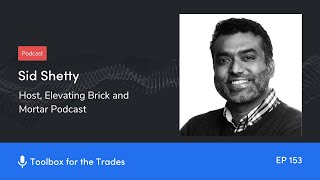
Sid Shetty, CBDO of Service Channel, explains how facilities management directly impacts customer experience. He discusses the skilled-trades labor shortage and how IoT, AI, and data-driven workflows help teams shift from reactive to proactive work. Service Channel's marketplace connects facilities teams with technicians through integrated work-order routing.
Sid Shetty, you are the host of the Elevating Brick and Mortar podcast. We are here as two podcasters who are trying their best to elevate the trades. I am so happy to welcome you to Toolbox for the trades. How you doing today?
I'm doing well. Thank you for having me, Jackie. I excited to be here.
I am so excited for you to be here as well. We're going to kick off this show with an icebreaker, which is what I've been doing for the last couple episodes. I would love to know, Sid, if you are a superhero, what would your superpower be and why?
Wow, okay. That's an interesting question. Well, okay, so I have two boys, three and five. So you can imagine there's a lot of this discussion happening in the Shetty household. You know, if you were to ask me this question, when I was a kid, I would think I would have started with Spider man and then Elevate. Then I moved on to Superman and then Batman. But since I've had a family now and I have two kids, I've been giving this some thought, which is interesting because, you know, you don't expect it to be on a podcast, but my kids ask this question, and we talk about superheroes. One of the things I realized is that superheroes actually have sacrifice, and they have unfortunate circumstances in their life that led them to become superheroes. And I keep trying to figure out which one actually gets to be a superhero and still have a great family. And we came across the Incredibles.
Right.
I don't know if you remember, you know, incredibles. Mr. Incredible gets to be a superhero with his wife and kids. And so that would be my answer now, you know, Mr. Incredible, because then I can fight crime with my family every day.
That's such an interesting answer to this question because you talk about how most superheroes have this tragic beginning that enables them to embrace their superhero powers. And that's a really interesting way of looking at it. It's like, well, what kind of sacrifice am I making for, like, the power to fly or to be invis?
That's right.
Honestly, the Incredibles. Fantastic. I think that's a wonderful answer. And that is still. It's Pixar, I believe, still one of the best Pixar films out there. So. That is so cool.
That's right. We get to enjoy it with my kids. So, you know, it's top of Mind, too.
That's awesome. I actually was listening to another podcast the other day where something similar to this came up, and someone literally was like, well, I have two young boys, so, yeah, actually, we talk about this all the time. And I'm like, oh, that's so funny. So I want to hear a little bit about your podcast, elevating Brick and Mortar. Who is it for and why would someone listen?
Yeah, so it's an interesting narrative, right? Or story. So, you know, like you mentioned, I'm the CBDO of Service Channel, and I've been in our company for 15 years and been in the space for around 17 and a half or more years. And, you know, you'd agree that if you look at our space, it's got some of the best people. Like, if you think about who you want in your corner when things aren't going great, it's someone in facilities or the trades, because every day they wake up and they're solving somebody else's problems.
Right.
And one thing that we don't do well in our space is actually promote ourselves. And we have a bad PR problem. Like, a lot of our. The impact that we make to the businesses that we work in isn't actually crafted in the right way, isn't actually spoken about in the right way. In many occasions, like, you would think of facilities when something goes wrong, and so you kind of become the fixer upper department, Right? And that is anything but. If you think about any physical brick and mortar space, when you walk into that space, the first thing you notice is how you feel. And what does the brand feel like, you know, and what is it actually doing to elevate your experience? And a big part of that is construction and design and architecture and facilities. And so that physical brick and mortar space has an impact on the customer experience and on the brand, and we don't talk about it enough. So, you know, last year, our marketing team, you know, they kind of know, like, this is one of my personal kind of goals as well, which is to kind of elevate the conversation, elevate the space. Stop talking about how to fix things faster. Let's talk about, you know, the impact that our industry makes on the overall brand and customer loyalty and experience and so on. And so our marketing team, you know, someone by the name of Corinne Pierce, who leads our branding, it was like, hey, we should go and start a podcast. And so Bill Pollack, who was the president of Service Channel and now is group president, was like, yeah, we should get set to do it. And we, you know, I, of course, had never done podcasts before, and we were like, you know what? This makes sense. Like, we need a platform for the Leaders in our space that are doing things the right way are taking on challenges that, you know, maybe most are afraid to or haven't yet got to. Let's create a platform that gives them a voice and allows others in the space to listen and learn and share and learn from, like, how these experiences have shaped other leaders in our space. And so we were like, all right, let's go. And so we came up with the concept of elevating brick and mortar, and it's been a fantastic experience. We just completed our second season, so around 26 episodes, and we've been kind of floored with the reception we've been getting. We have just crossed 60,000 downloads of the show. This is outside of LinkedIn, impressions and so on. And what it tells us is that this resonates with people. We don't talk about Service Channel. We talk about the industry, what's happening, the trends, the challenges, how we kind of can overcome them. What does the future look like? And of course, we have guests from everything from design and construction and realty, you know, and you have a couple of economists. Economists as well. And so essentially, you know, we're trying to share these experiences with our guests, and the guests could be from any one of those functions. And, you know, we've been super ecstatic about the reception, and, you know, the fact that it actually is being listened to and it's helping a lot of the folks in our space, you know, folks that come up and say hello and tell us how they used it, is absolutely rewarding. So that's why we're here and why we're doing what we're doing.
That is incredible. And I mean, for the listeners who haven't caught on yet, the reason I know about Sid is because the company he works for, Service Channel, recently integrated with the company I work for, Service Titan. And it just so happens that both of these companies decided to make really great people the head of their podcasting platform. That's why we're having this conversation. Right. But I'm so happy we are, because you started off your description of elevating brick and mortar with, we have basically a PR problem in this industry. And your industry and Service Channel is facility. Facility managers. Right. Facilitate. Is that the terminology that you would use?
Yeah, Multi site. Facility managers. Yep.
Multi site.
That's who Service Channel caters to.
And so these are the customers of some of Service Titan's customers. So my contractors listening right now who do commercial and new construction. The. The people that Sid serves are the people that you serve in Those spaces. And I love what you had to say about when we enter a space, it changes the way we feel. It. It change. It impacts us. It impacts customer experience. So it sounds like with elevating brick and mortar, you are really taking the facility manager by the shoulders and saying, hey, like, you make a giant impact on your end customer, whether that be, I guess, a restaurant, a, a retail store, or any other type of business space. So I think that's so cool. And I mean, that's honestly part of Toolbox for the Trades. You know, we also believe that the trades has a PR problem, and that's what we're trying to do here with Toolbox for the Trades. We're trying to elevate the contractor as a service entrepreneur, someone who is building businesses, who's building a business within their local community, employing members of their community, and serving families and businesses all over the nation. So I think our, our goals with podcasting are very aligned, which is why I'm so excited to have you on. So I would love to know what are some of the biggest takeaways you've learned from two seasons of the podcast? And congratulations on two season in. In 26 episodes, by the way. That's a major accomplishment.
Thank you. Yeah. You know, it's interesting because one of the common themes that we talked about over the past year, which is the two seasons, has been the fact that, of course, facilities and, and like the physical brick and mortar functions don't necessarily get the credit they deserve when you're speaking at levels that tie into top line revenue or customer experience, when in fact, that is what drives a customer to walk in through your door. Someone can do a lot of things today sitting on a couch, but they choose to get up and get ready and go into their car and drive up and walk into a physical space because that physical space has something to offer and that is very much tied into all of the functions and operations and so on. So we talk about how we can change that narrative so that it kind of enables and empowers the folks that are in our space to go and educate folks in other functions in their company. We also hear that one of the biggest challenges today is actually the skilled trades.
Right?
Yep.
There's a massive shortage of folks that are entering the skilled space. There's a huge percentage of folks in the skilled trades that are going to retire in the next five years, and there's not enough blood coming in. And so, you know, there's kind of pressure on the system because, you know, there's Only a finite number of technicians that are skilled, that are available to providers to go higher. And so that means that it ultimately impacts cost, it impacts speed of service, which means that facilities, teams or multi site teams have to make choices and it's more competitive because this is a finite resource. And then that impacts the experience, you know, our consumers, who's the actual end customer for this entire ecosystem?
Right?
It's the consumer walking in to buy something. That person ultimately could have an experience that is less than ideal. And so, you know, we talk about how can we leverage technologies to, you know, educate and train technicians in our space. You know, I've spoken to a partner that does just this. We have integrations with companies like Service Titan because part of how we can solve this is helping make providers more efficient.
Right.
If providers are more efficient, they can use their resources more effectively. And so they might not need as many folks to help manage the same number of service requests. Of course, you can't change the fact that someone with a wrench in the store is, you know, you can't multiply that, but you can make them more efficient.
Right?
Yeah. We hear about the new technologies that exist today that, you know, we have to do a good job with embracing. You know, we as regular folks, you know, in, in our own personal lives have suddenly been exposed to AI and, you know, generative, you know, AI and machine learning and all of these things that before were limited to companies that had them in their products. And now, you know, anyone can just download ChatGPT and start using it for just random, regular things.
Right?
How does that play into our space? How does that new technology and access to that technology change facilities management, change all the functions that are working in the physical brick and mortar environment. Because if we are one step ahead or two steps ahead and can be prepared and can leverage the right partners and the right technologies, it's only going to make the case for us to go up and speak to the leaders in all the organizations that our customers work at to say, here's the impact I'm making, here's the impact I can make if I had investments in technology and I can embrace it. And how can I then use those technologies to actually bring consumers through our doors? Because, you know, if I can leverage, you know, robotics, you know, for example, you know, Panda has, you know, this thing called the Auto Walk, which is a robot that, it uses a walk, but in a, you know, in a very specific fashion, like a human being would, to cook things that, you know, are controllable, like you Know rice and noodles and, and stir fry vegetables because before a physical human being like was doing that action all day for 12 hours a day. And it's very, you know, cumbersome.
Right.
So they came up with, they leveraged robotics to go and build this so that they could, you know, make the person in the kitchen's life easier. And then that person could choose to go to the front of house and spend time with the consumer and be with the customer.
Right.
You hear of such stories with Chippy, with Chipotle, you hear about White Castle using AI in their drive throughs. So now when someone walks in, drives through and actually makes an order, they don't talk to human being, they talk to someone who sounds like a human being. But they're taking the order with extremely high accuracy. And so now you're reducing the friction while leveraging technology and then you can repurpose that individual to be in front of the customer. So no one is saying we're taking the jobs away, just repurposing the jobs in areas where the customer can benefit. So these are all the different topics and things that we're hearing as we talked about different individuals across different functions. But you can see like a common theme here. You know, people, technology, data and you know, and AI and so it's really cool.
I will say I think that is all fascinating. I had no idea about some of these robots that are going forth and I'm not sure how familiar you are with the Service Titan product suite, but we have a series of pro products that are add ons to our core and I swear, if they come up with like Technician Pro or like some sort of pro product that is just like a little robot of a, a person, I, I, that'll be crazy. But this is what I'm hearing when I'm talking, when we're talking about AI and automation, which we talked a lot about at Service Titans last user conference. Don't think of it as replacing jobs or getting rid of the headcount. Get it? You think about it as automating previously tedious tasks. That would take a lot of mental, not, maybe not a lot of mental power, but that is so repetitive that you could program it in such a way that another like a robot or AI could take that over and now your resources can be used in a much more effective way potentially. So I love that, I love those types of conversations. I'm so happy to hear that you're having them too. Along with hiring which man, if I could rename this show, it would Be called, like, I don't know why indeed isn't working for contractors or something? Because literally, that's what I'm hearing constantly. It's so hard to find talent. And we have this whole wave of contractors who are getting ready to leave the workforce. And it's scary. It really is. So we try here at Toolbox to really elevate the trades and showcase what kind of careers you can have here. Because, honestly, if I could do it all over again, maybe I would learn how to become an H Vac installer, so. Or sales woman.
So, I mean, look, it's. You know, it's. Not everyone has to go to college, right? And that's been like, one of the challenges that, I guess the narratives that has, you know, folks say, has caused kind of a reduction in the number of folks that are getting into the trades. You know, people that are skilled with their hands, can make a great living and can have, you know, a great career. And that's what we're, you know, we talk about, like you, with companies that, you know, are. Who are providers and also multisite retailers who have switched, like, who have been on the provider side and on the multisite, and then, you know, go back and forth. And everyone. What they're saying is, like, look, this is something that is a great career, and folks can come in and you can get trained and, you know, you can get certified and you can have, you know, a lot of, you know, choices on, like, how long you work. And now. Now, mind you, it is tough. It's tough, right? It's tough. It's a tough career. Because let's not forget, like, if you're an H vac technician, you're on the roof, like, in 110 degrees, you know, fixing someone's H Vac unit. So, you know, you have to, like, take all of that into consideration. But if you enjoy working with your hands and you enjoy working, you know, outdoors, like, you can make a great life out of it. And so that's what we're hearing as well, which is we need to do more. And I think there was collective responsibility is with everyone in the industry, right? So it's with the facilities teams, it's with the providers that are hiring these technicians. It's with the trade schools and organizations that basically bring facilities managers and providers together. For example, there's an organization called Connex FM that I'm on the board of directors of. And part of one of the things that we're trying to figure out is how do we make Trade schools feel listened to and heard. And so one of our board members actually is from the trades, from a trade school. And we're trying to kind of build a conduit so that trade schools can have access to companies that can hire folks that are graduating from their schools and make it easier for folks to find careers that are fulfilling. And yeah, it's not going to be solved with one thing. It's a collective. And I think the collective responsibilities also, all the different types of companies that are involved in delivering this entire service to our consumer, ultimately, who is the one that matters? Because if they don't spend money in your store, nothing else matters, right?
Yeah, for sure, for sure. And I love that you're on that board. It's called Connects fm, right?
That's right. That's right.
All right, great. Because I know there's going to be folks that are listening to this that are going to want to Google that. We'll link it in the show notes. So when you and I first spoke, you told me that one of your hopes for your industry is that it become more proactive and less reactive. Can you tell me a bit about that? Because that is also, I mean, another thing that we talk about here and what service Titan tries to do for its. For its customers. So tell me a little bit about how you are hoping for that for facilities management.
Yeah, I mean, if, if you think about just the nature of our industry.
Right.
It is, it is, it is very normal to think that in our space it is okay to be reactive because that's kind of the job. Which is when something breaks, you figure out a way to fix it.
Right.
But not really.
Right.
You can figure out a program where part of what you do is actually help resolve issues when they take place, which could be an asset that broke down or whatever. Right. But if you actually have the mind space and the investments and the team to think about how you could leverage technology, the right partners, the data that you are creating every single day, or data from your partners and technologies that you might be using. How could you use all of those tools to craft a program that has a mix of reactive and proactive and predictive.
Right.
So that you're not just relying on, you know, your store managers or your general managers, depending on the type of business, you have to report when something breaks down and then for you to figure out how to resolve it after that.
Right.
With things like Iot or Internet of things, with sensors and smart assets. There are ways that our technologies that are tools, that are products, that actually allow you to not just have condition based monitoring, which is like sensors that tell you when something is going wrong, but you can actually capture that data and come up with predictive models that say, based on our data, something might go wrong and then you can plan for it and send someone out proactively to look at the issue so that your asset doesn't actually fail. Because, you know, if you think about restaurants or convenience stores, you know we're talking about revenue generating assets, right? You've got gas pumps, you've got, you know, Slurpee machines, coffee machines. These are assets in the grills, right? In restaurants, these are assets that if they go down, impact your revenue directly, right? They impact wait times, they impact how much money you're going to make because you have product to sell and you know, you don't want to be in that situation. So the cost of that asset going down is really, really high. So if you have a program that proactively allows you to manage those assets the way they're supposed to, and then show up when you see the right signals or the right data to say, we should take a look at this asset because it might break, then it allows you to change completely how you manage your portfolio of locations and all your assets. And so with tools like Service Channel too, right? Our entire premise like Service Channel allows and helps multi site brands to manage their physical spaces and assets. And so think about any brick and mortar space, any of those assets. You know, you want work orders to be created proactively, and when those work orders are created, you want the work to go through the right workflows and go to the right providers and technicians that can resolve the issue in the fastest possible way. And then you want to be able to make the right decisions. And to make the right decisions, you need data and insights. And you want to be able to look at your program holistically and decide where you want to spend your money, whom do you want to spend your money with, right? And then justify why you need more investments. Because in facilities, budgets are not going up, right? They're always going down unless you make the case for why you need it, which is the impact on the brand, the impact on the experience, and the impact on the top line of the organization you work for. And so if you do all of these things and if you can kind of surround yourself and immerse yourself with the right technologies, the right partners, the right team members in your own organization, then you're able to leverage all of that to go from being a reactive team. Where you're always behind the eight ball to being a proactive team that essentially has the mental capacity and the bandwidth to think about the impact they want to make and removing the friction from the general manager or store manager. You don't want them thinking about facilities like they're there in the store every day with the customer. You want them selling and you want them delighting the customer. They have 99 things to do. Don't add one more thing, which is to report when something breaks.
Right.
You should know. And you can only do that if you have all the right tools and the partners and so on. So that's essentially the state of nirvana you want to get to. And depending on the customer or the organization, they're all in different kind of levels of maturity, which is fine. The best part is nobody is already reached that state where everything's perfect. It's a journey. The important part is you have to start somewhere and that's the kind of conversation that, that we love having.
I love what you had to say about all of that, Sid. I think that is so important. And I personally, I always like get a little giddy when the Internet of things IoT comes up because I think it's such a fun premise. We actually had Josh tekel on episode 119 talking about his, his tool, smartac.com which enables technicians to put in this little sensor and you can see when the system is failing or if it's operating, you know, as usual. So this way our contractors can be product proactive in that way. So I love that you brought that up because it's definitely something that we've talked about here. Yeah, you also talked a little bit about Service Channel and what you guys are doing. So let's just pause for a bit and talk a little bit about the Service Channel and Service Titan integration for folks who may not know what is Service Channel.
Yeah, so. So Service Channel is a technology platform and marketplace, right. That allows multi site brands to manage their physical spaces and assets to ensure that their customers have the best possible experience. And so, you know, what we want to do is have the right technology to automate as much of the workflow as possible, make sure that the work is going to the right provider, make sure that the right providers that do great work actually are surfaced in our marketplace so that customers that are looking for great providers can find them. We want to surface the right data to help those customers make the right decision and we want to basically enable and empower our customers with the right technology and the right data. But also to educate and elevate.
Right.
So educating our customers on what should they do, what are the new technologies that they can leverage that, that integrate with Service Channel to help them achieve their goals and ultimately elevate, which is. Help them elevate the conversation, which is how can they go and tell their CEO and CFO about the impact that their team is having on the top line, on the customer experience and on the brand. And so Service Channel was founded in 1999, and since then we've been on this journey to help shape the entire facilities management space. And we have seen success. We today are in 73 countries. We have 350,000 locations on our platform worldwide. 600 plus are the biggest brands in the world. We have around 75,000 providers in our network worldwide. And we're processing somewhere 18 million work quarters a year, around $9 billion in spend on our platform. So, you know, we've, we're in a. We're very privileged and we take that position that we have as a leader in our space very seriously, which is to actually lead our industry and find ways to really help our facilities teams to get the most out of their provider partners and deliver the best sort of customer experience to their end user, which both is the store manager as well as the consumer walking into the store.
Right.
And so part of that entire equation is your customer, which is, you know, the provider, the technician who's basically out there in the field helping service those locations and is ultimately impacting the outcome of the facilities teams that we work with. So for us, you know, the service provider is our customer too.
Right.
And so that's what excites us about the partnership with Service Titan, because I think we're both in the, in the, in the, in the business of enablement.
Right.
We're trying to enable the teams that use us to deliver the best kind of service. And to do that, you know, they need access to data, they need workflows, and we're doing everything we can to reduce the friction that they have to do their job.
Right.
If a technician, like I mentioned, is on the roof and fixing an H VAC unit, the last thing that they need is a clunky piece of technology that does not help them do their job in a convenient way.
Right.
And so Service Titan is a leader in your space and Service Channel is a leader in ours. And so combining and finding a way to simplify the work streams and kind of integrate our workflows enables the right work orders to go to the right provider, to the right technician and for them to do what they have to do in a way that helps them do their job right, and then at the same time informs the store manager about progress and the facility manager about what's going on and captures the right data so that they are effectively communicating what they're doing and what it's going to cost and so on. Because ultimately, you know, we see that even if you are a great provider, sometimes if you don't use the right tools and you're not effectively communicating with the right players, you are still perceived as a bad provider because no one knows what you're doing. They don't know that you're making progress.
Right.
And so that can only happen if you have the right tool that is not causing friction and then has the technicians who are actually getting the job done to be able to communicate, capture. And I think that's why we're super excited, because I think Service Titan offers that to its customers. And an integration can only make the workflows even more seamless.
I 100% agree. So just so folks know, this integration with Service Channel and Service Titan is live. So the way this works is that you can automatically send Service Channel work orders directly into Service Titan without providers having to work in two systems and copy and paste from email, which saves a ton of time. And also, I would say to anyone listening who's a Service Titan customer or who maybe is not one yet, you, you know, it would be nu Service commercial, new construction facility man, or facility managers in general. Chances are they're one of these 700,000 providers that service Channel provides, that Service Channel serves. So please, you know, find out about that. And if you are a Service Titan customer, you find out your customers are using Service Channel, know that you can turn on this integration yourself. We'll have all that information for you in the show notes. So check that out. Now, Sid, you've been so generous with your time. I really want to get in again to this one point, because your customers are our customers customers customers, especially our customers who do commercial and construction work. I'm curious, how can our commercial listeners, our commercial contractors, better serve your customers, the facility managers? Like, how can they do a better job?
Yeah, that's a great question.
Right?
Because look, ultimately I think facilities teams want to know what's going on, and they want to know that the provider that they're partnering with has the right tools and the right talent in terms of technicians to get the job done and to get it done right so that it does not interfere with their operations. In the actual location, but also that, you know, they don't have to kind of have a recall, you know, because something wasn't done the right way the first time. So part of what we are trying to do is, is kind of break this myth that the cheapest provider or the cheapest rate per hour is the best, right? It's not like ultimately, you know, you could be charging $75 an hour when everybody else is charging 85, and you could be taking three times the number amount of time to do the same job, right? So that just price doesn't matter. So what we're saying is, look, it's price, it's quality, it's the speed of service, it's the level of administration or ease of administration to actually service the customer. And so I think if you're a provider, I would say find the right technology to enable and empower your techs and then make sure that whatever it is you're doing, you're effectively capturing that information. You're effectively communicating progress to the location. And you can do that through our platforms, Right? Because an informed wait is a shorter wait, right? So if, if you're a store manager and you are expecting something to be done and you have no idea when it's going to get done, you're already frustrated, right? But if you already see progress, you see notes and you see information that tells you like someone has picked up your request, someone is working on it, you already feel a sense of ease, right? And so I think if you do some of those basics, right, you know, pick up the work orders, inform the FM that you got it, you know, show up on time. When you show up on time, you know, come prepared, you know, know what the issue is up front, you know, take a look at the request so that, you know, if it's a part, what part is it, can you call the store up front and ask them if it's a light bulb? Like, what kind of light bulb is it? So you come with it, don't just walk into the store and look up and say, yep, a light bulb's out. Yeah, we knew that. Like, it's in the request. And then you're going to go out and get a part and so on. Come prepared, because our customers care that issues are resolved in their first turn. Because someone in a store with a ladder, it is disruptive, right? It does create this operational hindrance, if you may, for the end consumer who's shopping in the store and so on. And so if you can do those things, get those basics Done. That goes a long way. And then platforms like service channel, our responsibility and our role is to surface all of that great data and present it to the customer so that they can look at your performance across all those KPIs, and not just a single one, which is the rate per hour, but all of those KPIs that actually matter. And then we can help you be found by more businesses that are looking for great partners. And ultimately, that's what we're trying to do here, which is make sure that the best performers are found. Because ultimately, if you kind of promote excellence, you know, the standards of the entire space go up because everyone who is not performing well and was getting away with it now can't. And they're going to have to raise their own performance. And then you kind of help raise the bar on the whole industry. And kind of. That is something which I think every provider should aim towards. Because if you do that, I think you're going to do great. Your business is going to flourish.
I agree. Sid, thank you so much for your time today. Is there anything else that you would like to tell our listeners besides that they should check out the Elevating brick and Mortar podcast if they want to hear what facilities managers care about? Is there anything else you'd like to share?
Yeah, I would just like to say thank you for everything you do. Sometimes it can feel like a thankless job in a provider and a technician in the trades. You know, sometimes it can feel like every day and every, you know, every second, like you're just chasing. But I just want to say that it's very recognized that ultimately that makes a huge impact to every organization. And even if you don't hear it every day, I can tell you that on our show especially, and on your show, right, we talk about how much this matters and we talk about the impact it's having on all these businesses. And as a consumer, I can tell you that I appreciate when I walk into a physical space that when it's clean and it looks well kept, I appreciate that there's a whole network of providers behind the scenes that are ensuring that they do that for the facilities teams that they work with. So just huge. Thank you. And we started off the show by talking about superheroes. And I can say everyone in our industry kind of is like a superhero without a cape.
Right?
Because you kind of show up when things are going wrong and you resolve the issue, you get it done, and then you leave to the next problem. So, you know, that's something which I think only if you're in the space you kind of understand. But part of our job is to kind of evangelize that and share these stories and, you know, anecdotes and case studies with the world so that everyone who is not in our space understands what we do, why we do, and the impact we have. So, you know, that's the journey we're on. And I just want to say thank you to all your listeners and to you.
Thank. Well, thank you. What a wonderful way to end it. And you just gave me a flashback with the cape. Remember that? Once again, the Incredibles, where the one superhero gets his cape stuck in the jet engine or something. Don't wear capes. They're a hazard.
That's right.
That's right.
So our technicians, our service providers, very smart that you have not have elected not to wear the cape. Thank you so much, Sid. Have a great rest of your day and really appreciate you joining me today.
Thank you for having me. It's been a blast. I really enjoyed our conversation. Thank you so much.
More from Bill




Capturing the 80%: How SmartAC’s Gen-2 Targets Non-Membership Homeowners | Podcast Ep. 296

Build better customer data with every booking in ServiceTitan | TAD Tune-Up Series

The Biggest Change for Roofers Coming From Other Roofing Software to #ServiceTitan?

