Finding a Mentor in the Trades | Podcast Ep. 90 | Toolbox for the Trades
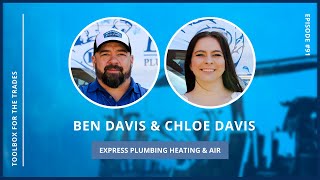
Ben and Chloe Davis of Express Plumbing, Heating and Air in Idaho talk about starting in the trades, rebuilding the company in 2006, and scaling it through mentorship, KPIs, and ServiceTitan software. They explain how they trained their team and now mentor other shops.
Hello, contractors, and welcome to the Toolbox for the Trades, the show where we share the top tricks, tips and tactics from service professionals worldwide. Today I'm speaking with Chloe and Ben Davis, the father daughter duo who run Express Plumbing, Heating and Air in Idaho. I spoke with them about the power of mentorship, investing and learning and how implementing best practices is the easiest, hardest thing you'll ever do, but so worth it. After learning from their mentors, Chloe and Ben were able to triple the size of their shop. I hope you find this episode as informative and entertaining as I did. Chloe Davis and Ben Davis from Express Plumbing, Heating and Air in Idaho. Welcome. Welcome to the Toolbox for the Trades podcast.
Hey, excited to be here.
I am so excited to have you guys here. You've been a part of the service tech community for a really long time. You're some of our most vocal customers. Chloe, you and I have partners partnered on webinars before you guys are such advocates. And I just, I'm delighted to have you here. And we're really going to talk today about how you guys have went from being mentees to mentors in just a few years. So I'm really excited about that. But before we even get into that, I'm going to start this podcast the way I do every single one, which is, how did you get into the trades? And Ben, you can take this answer first.
How did I get into the trades? Well, I guess I was just a young man. I was framing houses way back in 1999, and the guy that I was framing houses for, he decided to start a plumbing company up and with another guy, and that didn't work out. So he would always breed in the plumbing van to where we were framing houses. And one day he's like, hey, can you go run a service call? And I went and ran a service call and I. I did a terrible job for the customer. I think I ran a main line and charged the customer like 40 bucks. But I fell in love with the trade. I absolutely love the trade. So I was like, yeah, get out of the framing of the houses. And, you know, I actually started my own company right after that. I was 21 years old. I started Triple A Rooter and I ran it for nine months and I failed.
Oh, I didn't know this.
And so nine months, I had like a big phone book bill and all that. And I was trying to sell my equipment and sell everything that I had. So that's how I got my first real plumbing job, was calling around the local plumbing shops trying to Sell my stuff.
And they were like, oh, and you, are you a plumbing tech as well? And you're like, yeah. They're like, oh, come on board.
No, no, I was a terrible plumbing tag. I didn't know nothing. I, I even showed up to the interview with like holes in my paint. I was poor. I was so poor. We were living in a trailer park. And yeah, I'm really glad they gave me a chance though, because it, it started a whole new career for me. Just a path that I, I love now.
That's awesome. And I would love to learn how. And I actually want to clarify real quick. Chloe and Ben, you are father, daughter, duo. I realized that if I did not clarify that already, people would assume you're married. And if they watch the video, they'll.
Be like.
So Chloe obviously know how you got into the trades. You were kind of born into it. But Ben, I would love to, if you could tell me when you started Express Plumbing. So it sounds like you started one business, didn't work out the way you wanted it to, got back into the trade. It provided a great career and a life path for you. So when did you go back out and say, okay, I'm going to try it again.
In 2006, just like everybody else in the trade. Felt like I could do it better. Felt like I wasn't being appreciated by my skills and abilities that I had at that time. The boss ended up saying a couple things to me. There was a technician that was side jobbing and we jumped in the van to go spy on him side jobbing and confront him on a job in our van. And we were sitting out in front of the house and we're watching this technician do a service call with our equipment in our van. And he just looked at me and he said, you know, the difference between me and you is that I'm a white collared business owner and you're a blue collared employee and you could never be what I am. So that kind of got my gears running and I, I went home and I talked to my wife and I just said, you know, I really want to give this another shot. And she said, go for it. So 10 days later, I just fired up my own business again and quit my job.
Nice. And that was in 2006?
Yeah, it was May 10th of 2006. Was my very first day out on my own and geez, I didn't know anything. Oh man.
You didn't know anything two years ago?
Yeah. Talk about a nightmare. I think I started off in a 1989 Ford Econoline van. I just, every day I went and got suckers and chocolates and everything that you could imagine. I just went door to door to every business in this valley. I just hit them all. I ended up with like 191 property management companies. McDonald's, Walmarts. I mean, I was everywhere. Buy the end of it. It was kind of weird too. Like my first month was 10 calls. My second month was 20 calls. Third month was 40 calls, and it just kind of doubled every time. Got all the way up to 130 jobs a month within six months and never looked back. I mean, it was pretty cool.
That'd be scary to do that much in a month now.
So cheap.
So, Chloe, this was all happening while you were, you were growing up. And I would love to learn when you first decided to join Express officially and you know, when you decided to commit to it as a career.
Well, it was kind of right after I graduated high school. It was the question of like, all right, well, what are you gonna do? And I'm like, well, why don't you, you know, work at Express while you at least, you know, start your college career and start figuring that out. I said, okay. And I'd taken a lot of college courses in high school, so I had a lot of credits, but they were to like science and like, just stuff to be like a radiologist. So more along that lines. And so started going to school and I was like, you know what, I'm just going to go ahead and get an entrepreneurial bachelor's degree because that's going to teach me everything about business. And no matter where I go, it would be really good to have that type of knowledge because I think that's any anywhere you go is a business anywhere. So I was like, this is gonna be really great foundational knowledge. And kind of started working Express. I was marketing. And I like to put that in quotes because all I did was just post memes. Yeah, Chloe's marketing. That's how I got hired on. The second time around was marketing. I had worked a little bit in the call center during like summer between junior and senior year. But after I graduated and it's like, alright, well, Chloe's marketing. I'm like, okay. So I like the idea behind marketing just because I knew I didn't know it. And that's the part that I really liked. It was like that challenge of like, okay, you know, there is something deeper to marketing. There's a psychological part of it. There's the way you put your Colors, you know, the way you use your fonts, like all this stuff. Like, I really like the undertones of how you say things or what you do. So I really liked that. But I never really had gotten there at that point in time. So all I did was post memes or I didn't know what to say about the company or who I was talking to, or I had no idea about demographics and how to angle that type of message to them. So I had taken a couple courses in business and it kind of started rolling a little bit, Clicking. And I remember my first marketing course we had taken. We had already shot our first commercial by then and had already done radio commercials. Oh, our first commercial. It's really cool, but it definitely has no target demographic on it. And the message isn't clear now that I know that. But I remember taking my first marketing course and being like, oh, this is amazing. And I just started loving express more and more as I just kept working with it and getting to know the people and just our overall vision and mission. It's always been to make it a really good place to work for everybody. You know, that that's just ever since I was growing up or ever since I had started the company, that was just number one goal was like, we need to make a place where everybody, this is their career. They can, you know, everybody can be successful here. So I think that was like the biggest thing that I really liked about it. Definitely in my core now I think that's like my biggest thing I always think about is like, no, this is. It's not just a business. This is a place that affects, you know, families, a lot of families to keep them food on the table. And it's really cool when you get here that you know, an employee who just got on, bought their very first car, and they're driving around like pulling up, and it's really cool to watch their lives excel. So I think it was just also in my blood. I can't really pinpoint like an exact moment, but I'm like, yeah, because it just kind of blended all together into like, yeah, I'm here. This is awesome.
That's great. And you've been there now full time for how many years? Like two or three?
Something like that? Five. Five. Five years. So I graduated in 2017.
Got it from high school. That's right. You and I first got acquainted during, I feel like the pandemic time warp.
So I think around 20 times.
Who knows.
Those years blend together. And be honest, 20, 20 was not a year.
So I Didn't send you guys this question before. Before, ahead of time. I just thought of it now. But Ben, I'm curious. Did you ever think of creating the business as a place for your children to work at, for Chloe to work at one day? Was that ever in your mind?
I don't think so. I. Growing up the way I grew up, I always was expecting the shoe to drop. Right. I always expected somebody to take this away from me or for me to lose it somehow. And even as it was growing, there was moments, I mean, I think every business owner goes through it where you just almost want to quit or shut the door because it's overwhelming what you have to learn or what you have to deal with on a day to day basis. So the first nine years, I would say at least four times in that time period, I thought I was going to lose it or I thought it was going to be taken away from me somehow. So I, it was a job that I was just trying to keep. It's great to have a business and it's great to grow, but you have to grow as a person too. And that's something that we all have to really reflect on if we want to accomplish this because we are managing people. So we have to come come up with a clear vision for them and, you know, help them achieve goals too. And you kind of lose that when you're just running with it. You know, you, you're so focused on that next bid or that next project or, you know, running out here and make sure that we're boring in this line correctly or. And you're just working. Yeah, it's like 16 hour days all the time and you're not getting paid very much either. So it's, it's a lot of stress now. I can see that it is that by far. Yeah, it's. It's a, awesome business with amazing people and has a great culture and, and we can, we can see it how it is. Like it's kind of untouchable really, with the people and the education within it.
That's awesome. So thanks for answering that.
But yeah, I always thought we were always gonna lose it.
No. Yeah, I mean, I think you really spoke to the first few years of being in business and starting a business. There's so much stress. There's so much stuff. You have to focus on what makes the business great now, which is that great culture that you both said, which, by the way, total theme throughout this podcast. It's hard to do that when you're just figuring out where's my next job coming from? Am I gonna be able to keep the lights on? It's so tough. So we're gonna get into some of the mentors you guys had a few years ago. Chloe already kind of said about two years ago is when some really cool stuff started happening. But before we get into that, I would love to know, how is the company doing today? And you guys can answer that however you want in terms of number of employees, annual revenue, average ticket, whatever you want the world to know.
Well, you answer that.
Oh, you want me to answer that? In terms of how the company's doing, I think our biggest thing is, like, every time that we think we have it, we find something else that we're like, oh, we could have been doing this better. But definitely, lately, I feel like our biggest stepping stone has been our managerial processes and just kind of going back up to that top layer now. So now the company, I'm really excited about, H Vac. It's growing at 143% right now per month, which they're killing it. I'm loving it. I'm like, come on, H Vac. I want H Vac to be bigger than plumbing. So, yeah, no, we grew $2 million last year. Our budget's predicting 10.5 this year from what we're gonna be doing. And I couldn't be more happier, more prouder of all the changes that we have been making and just the more clarity we've been gaining on it. So I think it's more of less of, like, just our clarity of how to manage people better and have them have clear expectations and goals set for them that I kind of achieve our success off of. Not necessarily, like, you know, the revenue amount, because that'll come. Like, our growth's been coming with that. So we've been really, really proud of that.
That's awesome. I'm so happy for you guys.
So great.
So again, you both credited learning and networking to the explosive growth that you guys have had recently. All of the ways that you guys are streamlining, and I know a lot of it came just from talking to people, from recruiting mentors. So going into the subject of mentors, who would you say have been some of your most influential?
Joe Cacera.
Uncle Joe.
Definitely one of the. I mean, I can barely go a week without him sending me a text message. Or can we have a group with him? And he sends it like, hey, guys, how's it going? Oh, I'll do a call with you guys next week. He's just got a real special Spot in our heart. His knowledge is so extensive on everything. Yeah. Tom Howard, just for the two days, two and a half days that he came down to our shop because he showed us things that I didn't like. I used to have bankers come up, and bankers always be like, oh, man, you know your number so well. You're so smart. And when you surround yourself around people that are just telling you that you're good at something, you don't realize how bad you are at something. Having Tom Howard come down here, it was like, oh, wow, we're not good at anything.
Do you know this? Do you know that? That's a thing. That's a number you need to track.
To see that guy, like, spin off for two and a half days, and. And he just jumped from one thing to the next. And next, he. He created us a budget, and then he chopped up our overhead, and then he showed us how to chop up our overhead per employee that we had. And then he drew a big circle on the board, and he's like, okay, this is your marketing dollars now. Watch this. And I mean, he just, like, blew our minds for two and a half days, and then he just vanished like a little, you know, like.
A little. Yeah, he's like a.
Just little lucky char. Just gone.
Yeah.
Just gone by, and we're like, come back. You know, like, blew our mind. Yeah, visit us again. But he the to me, like, what he was doing, because he gave me a call, and he was like, hey, how's it going? How's your business going? And I kind of talked to him, and he's like, oh, well, I'll come down in a couple weeks and maybe a month, and we'll. We'll kind of dissect it and see what you're doing right and what you're doing wrong. And that was on a Thursday. Then he calls up on a Friday morning. He's like, I'll be there Monday.
I'm like, jeez, Louise, we're not even like, oh, okay.
But from there on, I mean, I. I, like, text him every once in a while or I'll. I'll send him a gift. You know, like, you're number one. I more or less just mess with him at this point in time. I don't really get any valuable information from him anymore just because he's fun to mess with. I mean, he's a great guy and very smart.
Very smart.
You know, we get to the point where we have most of the answers, and it's not a matter of getting any more Answers. It's a matter of applying every day. So that's the big wall that we're against. Like, we can go out and we can talk to Ishmael or Tom, Tommy Mello or Tom Howard or, you know, Al Levy. We have so many friends that we can network with all the time. Like, Al blew our mind.
Yeah, man, he's so smart, too. Yeah, he blew our mind. He sits down there, he just laces it out. You're like, oh, okay, I thought I knew it all. Once again. You never know it all. But, man, he. He can definitely just. Oh, that's your problem. Okay, here's your solutions. All right, now you're good. And you're like, oh, okay. Was that easy? Oh, okay.
Well, then he's sending emails. And then, I mean, these guys just care. Yeah. So much about the industry, and they dive so deep into helping us. But then we just have to go quiet for a while because, I mean, we have to apply. And applying can take three months, six months. I mean, it takes a long time to put something new in place and then test it out for a long period of time. So we visited, like, 10 shops. We had a whole bunch of shops come to our shop. We had a whole bunch of, you know, training coaches come to our shop. We just, like, we threw out $350,000 to learn the last two years. And this year, we cut that budget down to almost zero. And we're just trying to put every piece into play that. That these awesome people have taught us.
Because that's what we can do to show them that we. We've listened and that we really love their valuable information they gave us. You know, I think that was, like, one of our biggest struggles in terms of our, like, us mentoring others is like, we noticed that, you know, we would say, all right, here it is. X, Y, and Z. And next meeting, kg X, Y, and Z. No, I didn't have time. You're like, you're always going to be busy, so stop with that. You have to focus on your vital few. What's urgent, what's important that you need to get done today. Because 20% of what you do gets you 80% of the results. So when we listen to all of our mentors and all these, everybody that we love tell us, hey, you need to do this, this, and this. Now we need to get to the point where it's like, let's just put our nose to the ground and just run with it and apply as much as we can. We were applying during it, but you just so many amazing ideas. Yeah, everybody does everything just slightly different. And I'm gonna be honest. I've. I've seen a lot of different companies, and there. There isn't. I mean, there. I mean, obviously there is, but there honestly isn't, like, a wrong way to run your business. It's about doing it consistently. You have to be disciplined to do that every single day, every hour, on the hour. So that's where we're getting to the point where it's like, okay, we've learned all this stuff. Let's just pick the one way, do it consistently, and then when we want to make it more efficient and more effective, then we can start making those tiny tweaks that everybody's talking about. But that's the cool part. And the hard part about reaching out so much is that everybody has their own opinions and ways to do it, and it is working for them. Everybody's doing something right, and everybody's doing something wrong.
I love everything you all just said for the last few minutes. Um, and I just want to tell you, Chloe, that you just echoed the words of Jamie Didaminico, who was the founder of Cool Today, who, when he came on the podcast, he said, doesn't matter if you learn all these things. All it matters is that you implement and you're consistent with it. So I just wanted to make that, because Jamie's very successful business person, and.
There'S no such thing as secret sauce. It's all about just applying it. There's no secret way to do a business. I'm gonna be honest. Everything that we learned, there's no secret to it. Matter of fact, we were trying to complicate it too much. Oh, it can't be that easy. Oh, the KPIs can't be this simple. No, they are, so stop complicating. It was, like, the biggest thing we had to get over our brain. Like, we talked to our leadership team, and sometimes the response was like, well, we don't know it, or we don't know the standard. We're like, uh, you were trained four different times on this. You just need to believe it and stick with it. So just applying is, like, the biggest thing. Even if it is, you don't know 100% if it is the right way. Just apply it. Just run.
Yeah. And I just want to highlight real quick, you just threw out a bunch of names, all of which have been on the podcast, by the way. So thank you for validating my guest choice, Al Levy. He really preaches org charts and organizational Settings. Ishmael Valdez from NextGen and Tom Howard from ServiceTitan really preach KPIs and Joe Cressara really big into sales processes. I think you threw in another name in there too.
All of those right there is like how to run a business org charts and processes.
You make them all your friends, you're gonna be perfect.
That's it. That's your business right there.
That's a secret sauce, honestly. So. And I love that you just went into. Okay, we put. I really just want to. I wish I could give you both, like, nice hugs for. Way to put so much money into learning and development. That is awesome. So now that you guys have taken a step back, you're mentoring other shops, which we'll get to in a second, I want to know what process do you go through internally amongst each other, maybe among your leadership team, where you figure out, okay, we learned this from Joe. We're going to implement it and we're going to track it. What does that process look like when you actually identify a new thing you want to try out? How do you implement it? How do you measure it? What does that look like?
You want to take it or you want me to take it? Definitely implementing it. It's gotta be their idea. It can't just be, unfortunately, like what Joe says or what these people say. It's gotta be their idea. You know, people are going to push it harder when they actually have a say and are able to help. So what we have implemented isn't 100% of what we've learned. Even though we know that that weighs better, you know, it's. It's got to be what that team, what our team believes in. Because when they believe in it and they helped create it in some capacity, even if we have a template or something to create it off of, they're going to stick to it more and believe in it more. So that was. That was the area that we were having struggles with is like, okay, boom, Joe, process done in a box can sell now. We didn't sell. No, like, not. Not what we were wanting to. Not the goals that we were wanting to hit. So it got to the point where we had take a step back and look at our leadership team and say, do you even believe in this? And they're like, well, we watched the videos and you're like, oh, okay, okay. I love our team. They're amazing. But this is what all businesses are going to struggle with, just so you know. So you can't just hire a sales company and be like, boom, boom, Pat's off the back. Here it is. There's a sales system. No, you have to make it your way. The expressway. The, you know, whatever your name, company is, you can't just be, oh, this is this way. No, like service MVP way, which is what our foundation is built off of. But it has to be our way. So once we finally sit down and get the leadership team to write it down, we literally put the steps and then why we do each step. Why is each step valuable? It turns out to be a pretty big document. But you have to explain the why to your employees. Why do we do this step? Why do we put out a rug at the door? They have to understand that it's not just a step that you need to follow. There's actual value behind it and there's a certain result you'll get from it. So everything down from just handing over a business card, we put down the why's. And then after that we said, hey, here are the standard KPIs. All right, now let's go ahead and just start coaching guys and evaluating them on their process, seeing what they need, what their strengths are and what their opportunities for improvement are. Sit down with them, go over goals, launch them out there, bring them back with the follow up. Are they doing it? It's just a whole accountability process that you have to implement and, and maintain.
Well, and we sent out. So we made the management team come up with their own process on it, and then we sent the management team out in the field and made them complete the process. So. So they believed in it. So they knew it worked. The biggest thing is it ended up being where nobody believed in it. And we're just making people watch videos or we're making people memorize a script, but they, they don't. They didn't believe in it. So once we came up with our own, they came up with their own. Then they were able to practice it on their own, and then they truly did believe in it. Like, we sent out Brad, which has been our COO of the company for 11 years. He's been out in the field for. Well, he went out in the field for about a month and he crushed it.
He freaking killed it.
He crushed it.
Oh my God.
It was amazing. Like, average ticket of like $2,600.
Customers are raving about your percent close rate. It was amazing. But he was the one that, when we role played with him, like, role play. Okay, role play. Constantly. When we role played with him, he was the one that naturally did it. And Got every single step from memory. My mind was blown. I'm like, how come you haven't been pushing this out, dude? Like, you know it like the back of your hand, you know? But, yeah, he went out there and freaking killed it, which is awesome. But I think we all hear that expression of don't work in your business, work on your business. Well, there's a certain point in time where you get big enough, where you have to work a little bit in and then on your business. And I heard that from Anna Llano from Rhino Strategic Solutions. She did a podcast with Chris and they kind of really talked about that. And I really like that expression because I've heard that a lot. You know, work on your business, not in. But at a certain point in time, you get so disconnected from those processes and from what your standards are that you don't really know if they're achievable, if they're clearly communicated or whatever it may be. So when we did send out our management team back in it, it was like, hey, work in and on. Now you have firsthand experience of what these techs are going through, not just sitting back and saying, hey, we should do this well, okay, so. But what do they feel like out in the field when we implement something like that? Is it actually efficient? Is it effective or is it a nuis? You can't mess with these guys head. You know, they gotta go out there and they gotta perform really well. So support them in the field by making processes are really good to follow that make their jobs as efficient as possible.
It's a feedback.
Being part of the Rhino family is amazing.
Yeah. Rhino.
Rhino.
Oh, I almost did like a, like, I guess it's just like a one like little like unicorn rhino horn.
We've had Chris on this podcast too, so. Yeah, and his podcast is wonderful.
Love Chris and love Anna. She's the. She's the real, real deal over there. I love her.
She's a powerhouse. Amazing.
I just want to recap what you said, because again, it was just so good. It's like you're not only defining the why of why you do these processes, but you're also inviting feedback and allowing collaboration with your team members, with your management team. So you guys, as the other owners, aren't this. We are doing it this way because this person told me, it's like, hey, this person told me this. Like, what do you think about that? Like, let's talk about it. Let's see if we can make it work for us. I love that approach.
Well, that's when the real results started clicking. Yeah, I mean, we just had so many people come into our shop and so many people trying to make us change direction and then we were going to other shops and we were learning little bits and pieces and trying to change directions. But until we made it our own, it didn't take off like a rocket ship like it is now, which is absolutely so blessed.
It was really amazing too because we had servicetaging, which is an absolutely amazing tool where we were able to get these KPIs and get these standards and then be able to use forms and Content Portal. We use Content Portal a lot for more individual interactions. So when these guys set up goals, their goals are only published for them. So they can constantly see what's their next goal they want to hit. We also utilize it for publishing the expressway. So we published it. We gave them a whole week to read it and then we brought every single tech in in groups or one on one and sat them down. What do you think? Is this achievable? You know, and got their verbal and physical commitment to doing it. Because it wasn't like just us publishing it and the leadership team believing it. It was okay guys bringing them in and saying, how do you feel about these goals? And went over everything with all the way down to how that affected the profitability of the company for them. So they were able to see a breakdown of that and every single one of them, like, it was really great to see it because once it was published, you could tell that people are like, oh. But once he sat down with everybody and went over it and talked to explain it to them and coached him over some mental barriers. There was a couple of guys that had some mental barriers, you know, that they were feeling kind of torn between the standard and how they could achieve it. But we were able to bring him in and help tear it down. And I am so proud of some of these guys. Light switch, like crazy light switches out there and we're just pumping them up and so excited to see it. So it was really cool getting their verbal and written commitment that this is achievable and that they do believe in it. And if they had anything they wanted to say to us, we listened and you know, we would bring it back and talk about it and then publish what we thought was, you know, good tweak to the standard process. So it was really cool listening to their feedback and getting that. That love.
That's awesome.
I think it's so cool that we're coming to you live from Van 145.
Yeah, Van 145.
This is a real van. Like we're live inside of a real van.
This is a real service van. Just so you know, this baby's got.
30,000 miles on it. It's already done a couple of million.
She got full ticket guest today.
Guys, if I had a driveway and I could broadcast my podcast from my van, you know I would. For anyone who's not watching the video we have, we upload this video on YouTube. Some. Most people listen to it on the podcast feed, but Ben and Chloe have a wonderful van set up. It looks very clean from what I can say, by the way. Like, looks very clean.
Well, that's our standard.
So this is one of our favorite guises vans. His name is Chance, one of the most amazing technicians you ever seen in his life. And the only reason why the van's here right now is because he's having heart surgery. He had heart surgery yesterday. He had a stroke two months ago. 25 years old, and he had a.
Stroke during work too. He called up management and Brad, like sprinted, drove over there to go pick him up and drove him to the hospital. He had a stroke while he was in the van, pulled over and Brad went and like took him to the hospital and everything.
And he'll be back to with us by the end of the month. We're taking care of him fully right now. But yeah, this man's lucky. This, I mean, the guy that rides around this van gets hundreds of five star reviews, crushes it every day. Amazing guy. We love Chance.
Yeah, he's just one of those, like, really genuine, just, just amazing people. Like, he's just so ethical, moral, happy. Like, I don't know, he's kind of like the perfect tech in my opinion just because of like his overall personality and abilities to work. So I'm very proud to have him on our team.
Oh, my goodness.
Well, Ben hired him. Ben met him at a funeral and hired him on the spot.
My best friend died and he. He was related to my best friend. So I saw him across the way and I'm like, oh my goodness, I gotta go talk to that guy. And I convinced him to quit his job and come be a plumber for me.
Well, that is certainly one recruiting strategy we have not heard on the podcast yet. But good to know. Always be recruiting.
Always be recruiting.
Wait, is it ABC Always be closing? Yeah, no, it's abr. Always Be recruiting Parentheses ev. When at a funeral. Okay, so you guys have learned so much from mentors. I want to talk about now how you guys are starting to become mentors because you. You're having a lot of folks visit your shop. You're really open. You always invite people to come. When they do, what are the top tactics and insights that you like to share? I know we've probably covered a few of them, but is there any big ones that come to mind?
Well, we. We started training or, you know, meeting with companies every two weeks. We had four companies that we were meeting with every two weeks. It was great. We saw some of them be able to grow a million, million and a half within a short period of time just by applying things. I think the thing that we learned the most was this is so big, and there's so many pieces to it. It's really. I mean, we can boost them up, we can inspire them, and we can give them, like, a couple little pieces, but to get them to recognize the whole picture is so hard to do. And a lot of times they slide right back into their old spots that they were, or they just won't do something like buy a VN or they just won't change. So it did become a little frustrating for us because, you know, if they miss a meeting with us, like, we're free. We're not even charging them. And we're like, oh, come on, you missed the meeting. Like, this is ridiculous. Or it was like, every week or every other week, we're telling them to do the same thing, and they're just not doing it. So then we go two months, and we're like, guys, you have to change your ways. You have to change.
And then they'll do it, like, three months after us. Tell them to do it. And they're like, wow, you're right. We're like, ugh. But then we tell them to do something else, and then it takes even more. Like, it wasn't necessarily like you pushed a ball off of a mountain and it started getting snow. It was like we pushed it a little bit on a flat surface and then pushed it again.
So there was a couple companies, though. Aaron Quality Plumbing today. Oh, man, that guy is a beast. Chris Hunter hooked me up with that guy. He was buying a septic truck, and Chris Hunter told him to call me because I have septic trucks. But that kid applies everything you tell him. He'll do it, like, right on the spot and grows really quickly.
We're like, why don't you go buy a van or two? He's like, I bought three.
So we had a lot of shops come to our shop which we, we, we would give them a week and we would break down everything. Everything. So we'd break down our forecasted budget, our capacity planning KPIs, all of our KPIs that we track. They would be part of our daily huddle.
They could go on a service van ride with text.
Yeah. So we didn't, we didn't hold anything back. Whatever we learned or whatever we did every day, we just invested full days into these companies just to try to give them something that was never given to us.
Also coach them on their service Titan profiles to help them get that KPI. Because I know like Titan, there's a lot of different ways you could do that. So taking a step back and just helping kind of explain like the best ways to do things in Titan and how to understand the KPIs you're getting. Like even to this day, I get a lot of our leadership team that comes up to me is like, how is this calculated? I'm like, explain this like four times. But I don't. I mean, I do mine, but sometimes I don't like, alright, I gotta explain it again. It just keeps me on my toes. But I definitely take for granted like how well I know Titans link together and how everything's calculated. Because I could, I could pull out everything and tell you, you know, how every tiny little KPI is calculated in Titan. But a lot of the team and the people were coaching had no idea. So their average ticket, they had no idea what it was actually calculating to get their average ticket. So it's kind of hard for, to help them manage their KPIs. That's why it's hard too when you're, you know, on the. All the different groups and people are talking about their KPIs and average tickets. I think one of my favorites was somebody had just gone on Titan. They're like, my average ticket's lower than my other program. How do I make it go up? But I was like, oh my God. Do you know how it was calculated before? So you get the same calculations so you can guarantee similar results to transition or do you want to calculate it differently? There's just a lot of questions I had with that one. I was like, okay.
It was, you know, trying to teach guys not to like shame their people. Like he's the, he doesn't know how to fill out invoices. So I'm going to, I'm going to go in front of his peers and rub his nose in it. I'm like, don't do that. You know, or. I think the most exciting part about having him here for a week was watching my whole entire team have to train another company. It actually benefited us quite a bit to watch, you know, our project manager have to train another company, or a technician have to train another company, or us even have to explain everything that we do do. Because sometimes we'd be like, oh, maybe, you know, maybe we should change this because.
We'Re running it. Yeah. We're like, oh, okay, but we're not.
Going to do that anymore. Akins. Steve Akins was supposed to be here next week, but he canceled on us. And that's, that's one thing that, like, we'll put out, you know, like we put out the rug. We're. We're here to help you, but we have so many people either call a whole bunch of times and never show up, or they say they're gonna show up and they never show up. And it's like, we, we, we gotta focus on us, and we can't continue to, you know, be set up like that.
I think the other thing that we're realizing, though, and Ben and I were kind of talking about it the other day, was just, just how complex it actually is. Like, if we were to just us talk to ourselves two, three, four years ago, like just us right now talking to our past selves, it would have gone all over our head and we would have said that wouldn't. Doesn't work too. So there's, there's another part behind actually seeing everything click together rather than being told how to do it. Because one action in your business affects a bunch of other areas indirectly or directly. So you never know what results you're actually gonna get, especially when you're changing so much so quickly, because everything interacts with each other. Your business is a living, breathing person, and it's got a lot of people in there with a lot of emotions. So it is really hard to change a lot. But if we were to explain what we're doing nowadays, oh, my gosh, I think we would laugh at our faces. You're doing what? That doesn't work. You can't do that. Don't get, you know, So I think, I think it's a grain of salt, too, with a company that's learning because there's other things they have to learn prior to the knowledge we already have that we had to quickly run with.
Or just trying to get a guy to stop getting in a van. You're like, yeah, so you're gonna stop running service calls, right? And Then you talk to him, two weeks later, he's like, oh, I'm still in a van. You're like, oh, my God.
See, that's the phase where you need to work on your business, not in your business. We're at the phase where you need to work a little in and then on.
Yeah, the feedback loop. Right? Well, I was just gonna say, like, the way you guys had set that up, that's so generous to have so many be like, roll out the carpet, literally, for them. You're like, okay, come check out what we are. But I also think people change when they're ready to. That's my opinion. Just from. Ran this podcast and from life. And I think you guys, having gone through this journey yourselves, if we had talked to ourselves four years ago, be like, what? Like, it really is. It's so. It's really rare. Yeah, it's so rare to get them at that point where they're ready for the change. But I love that you guys have given so much back to the community, and I think that speaks a lot to your character that you're willing to help and just.
Hey.
Yep, come. Come out. Come on down. See what we've got going on here.
Yeah, we had, like, a shop a month for a while there, and it was. It was a lot. It was.
It was. It's still really fun to watch, like, who we can still influence. Like, we give them so much that it does take a really long time to continue to apply everything that we have taught them. Like, they're taking notes the whole time, and they go back with, like, a list of, like, oh, so much to apply. So I think a lot of people that still had came to our shop. It's still really cool to. To watch them still apply and have those type of learning curves.
So, yeah, there's three shops that we're still rooting for. Like, we. We love them to death and. And they're. They're still doing a really good job and they're still growing really well, you know, and that's not bad. Out of a dozen.
It's really not.
And, like, three are running for it.
Even if there's some folks that have visited your shop and maybe they haven't implemented the way you wanted them to, Two, three years from now, they could meet someone else and be like, oh, crap, this is what Ben and Chloe were telling me about.
And yeah, we get that. We also still do that. I think we still reference the time we visited next gen. We're like, that's what he meant. Like, it's just cuz you're just not. Yeah, I agree. You're just not ready for that. Or you just don't have that other foundational knowledge behind it to fully appreciate what information is being given to you. But yeah, we still do that to this day.
We replay that, that, that day that Ish gave us like all the time. Because Ishmael, man, he. He had it so dialed in and, and we were such a small fish when we went and visited him, so. But we took a whole bunch of notes and as we've grown, we've tripled in size since we've visited Ishmael. So now, now we're starting to hit those different levels. We're like, gotcha.
That's awesome.
Gotcha.
Yeah. It's so funny. It's like almost like you just hit your head like, ah. Really? Once again, it's so easy. We are over complicating it. When we heard him or when we heard anybody bigger than us talking, we were over complicating it. We're like, it's no way it's that easy. No, it is. It is that easy.
Don't.
Business is not hard. It's the easiest, hardest thing you'll ever have to do.
You have to put effort towards it and you have to inspire people, you know, but.
Easiest, hardest thing.
Be consistent.
Yep, it's. Yeah, it's. It's been the easiest, hardest thing we'll have to do. Like I said, once we get something implemented and it's rolling, it's so easy for. But it's hard to, you know, identify that, get the whole team to change, do it consistently. Move, Inspire people to do it. Inspire people to do it. Yeah, it's. It's easiest, hardest thing you'll ever have to do.
That might be the title of this episode. Chloe. I really, I have to say, guys, I've really enjoyed this conversation about mentorship. I don't think we've had this kind of conversation on the podcast before, and I think it's totally needed. And I love your perspective of just having gotten all that information, figuring out how to implement it, and now trying to teach it to others and seeing like how some people get it, some people don't. I mean, it's. I think it's great. It's wonderful. So I want to. We're almost at time, so I want to give you the opportunity, opportunity to geek out on anything that you may want to geek out on, but you haven't been able to geek out on yet. In the context of this podcast.
There'S.
A lot of things I always want to geek out on, but anything for you in particular?
I don't know. I have no idea.
Watch that brain thing.
As far as the. So I think the biggest thing for us is when Titan came down and shot our shop, it showed our training facility. And I think the misconception on that is that you have to build a training facility or you have to train your people. We have a training facility so we can sharpen the tools of our people that are already skilled and that are already embedded into the trade. We didn't build a training facility to take people from scratch to the trade because that's really hard and really, really, really expensive. So if you have a technician that, you know, a plumbing technician, and they need to produce, let's say $30,000 a month and you take six weeks to train them, you're already down $45,000. Now when you launch them out in the field, you're hoping that they start to produce that $30,000 a month. And that's usually not the case. So let's say their first month out, they produce 15,000. Their second month they produce 20,000. Or maybe they even progress backwards. By the time you can build a person from nothing to something from scratch to a professional technician, you might be out $100,000 on that individual. And that's really hard to gain that back from just taking a person right off the street to train them. So if you're going to do that, make sure that you're already, you know, you're vesting towards somebody that already has some really good skills and some really good customer service skills. And maybe you just have to, you know, put an edge on that blade, but you don't have to make the whole knife. So just don't get it confused by looking at, you know, at that point in time we were, you know, five million dollar shop and we have a training facility, but it's only to sharpen the already created knife. It's not to create a knife from scratch. So a lot of people were calling us or are talking to us or, you know, sending us questions across Facebook and they're trying to take people from, you know, completely green to a technician, but they're only a three million dollar company. And that's really trying to explain to them, you know, don't do that. It costs way too much money. You're not a school, you know, you.
Barely even have a standard yourself that you're holding your guys accountable for. What are you gonna teach them? Like just to wing it out there and hope they are naturally good.
So try to get people that are already qualified in the trade and then, you know, put that edge on, sharpen that knife. But don't try to take anybody from completely green to certified technician because it's gonna, it's gonna sink your company.
Especially if you don't have a turnover process to be able to at least get him out there, starting doing that experience and then get a, you know, somebody else out there to actually flip those bigger projects. You know, if you're just kind of banking that he's gonna go out there by himself and start producing, that's where you're definitely gonna start feeling that hurt. It's just, yeah, that investments just too large. Especially like Ben said for a 3 million dollar company, especially when you're looking to build a training facility like you have your own plumbing and heating system, go, go use that. If you're swapping out systems, keep the old Betsy that you uninstalled instead of.
You know, ten, twenty, thirty thousand dollar sign on bonus, maybe ten grand every six months for a qualified technician. Grab somebody that's already good at the trade, that already has potential in the trade and that's going to be a lot cheaper than trying to take somebody from scratch because they might not even like the trade when you launch them out there. They might not feel comfortable charging the prices that you need to charge to keep your business healthy because they didn't.
Even realize that that's how much plumbing costs or H vac, just as all of our customers do.
I always feel bad when I see somebody go all out on a training facility. You know, they've seen the Titan video and they're like, oh, this is how he did it. And it's really not that way. We do have a training facility. We do use it all time, but we're using on technicians that are already there. And all we're doing is taking a technician from 30,000amonth to $60,000 a month. We're not taking a technician from zero to 30. That's, that's all we're doing. So you can geek out on something now. Go for it.
Oh no, I was just gonna say like that's a, that's a good topic to geek out on. You know, we have people from all different types of shop sizes that come on this podcast and training facilities have been brought up. But it is something to consider, like what is the actual cost going to be? And depending on where you're at, that's going to you know, that is going to inform whether or not it's worth the investment for you. So thanks for. Thanks for going talking about that, Ben. Chloe, anything you want to geek out on?
Yeah.
Oh, I think my more favorite thing that we've been especially just fine tuning is the accountability process as well. I'm just trying to make it as easy as possible for the management team to be able to keep up on what technicians in what part of the process of accountability, whether that is the curbside evaluation, the ride along all the way up to maybe a team consulting and then afterwards the follow up to see if they actually met their goals. But that has been definitely, especially for somebody that's taking on more than eight points of contact for direct reports, it is a little bit overbearing just because they have so many people they have to put through that. I don't know if anybody else has utilized this, but it's Monday.com. i have absolutely loved it. It's been one of my favorite things to build out. And you can automate a lot of things. The biggest reason why is because I just love how Service Titan operates and I love everything I can do with it. So love the module dashboard. But I do sometimes have some KPI barriers with it, especially for my managers and having multiple divisions and multiple trades. Having the module dashboard, yes, I can filter the business units, but there's other things that we need for each division, such as plumbing or H vac or our septic division. It's a lot easier with a separate dashboard. So we've been utilizing custom dashboards a lot and just making sure that we have, yes, the guys who are not performing, but also the guys who are performing. I feel like a lot of times the squeaky wheel gets the grease. So as part of your accountability process. Accountability is not a bad thing. It's a service you do for your employees. It's a service. And Joe taught me that. Uncle Joe taught me that. Being a dispatcher, when you're holding guys accountable, it's just a service for them. So as a manager or an owner, when you're holding people accountable for results, it's a service and you're giving them everything. A clear standard, a clear way to get that standard achieved and any coaching that they need and you're putting it in their hands. So it's no longer that Jimmy's not at the standard. What we're gonna do about Jimmy. It's okay. Jimmy's not at the standard. Let's go do a curbside with him. Okay. He's here's what he needs to work on. Hey, Jimmy. Always has to be positive. Here are the four strengths and three opportunities for improvement. Let's pick two opportunities for improvement you're gonna work on in the next 14 days. And here's your action steps. And then once that happens, following up. Did you meet your goals? And so getting people, because we. Ben has brought up a lot of guys from the field into management. So management's a different skill. So if you have a really good technician, keep him there, keep him there. Because management is a completely different skill. It's one thing to do, it's another to actually hold people accountable and have that discipline of following back up and just sticking to that standard. You have to stick to that standard. It's not the person, it's the process. So when they're not performing, it's not because of them, it's because they're not doing a step in the process. If they're doing the process 100% of the time, but we're not achieving the KPIs we need to, then it's the process. So we gotta tweak that. So it's shifting their mindset to be able to stop thinking about it's the person. And it's really hard. When you do take a technician out from the field and make him a manager, you really have to realize that you need to give them a management system because your managers are going to manage based off the system you give them. So if you just bring them up and just let them go willy nilly, they're going to be doing a lot of lip service. They're going to be doing a lot more personal attacks, you know? You know, and not really meaning to because that's how they feel a manager is. The word manager has a really bad stigma to it and people think it's actually managing people. You are never managing a person when you're a manager. Never. So if you think that as a Manager, I need 10 people to be a good manager. No, you manage a process. You do not manage people at the end of the day. So they have to get that thought process in their head. And I think that's where a lot of that transitional periods, like people are like, well, we need to hire our first manager or when do we hire this manager? Because they see how many managers we have and we're like, hold it up. No, no, no, no. Do you have a process that you can hand off to somebody? That's my first question to you because my favorite was like, yeah, they're an office manager. And I'm like, okay, did you have. You have an operation manual, a job description, the tasks that they need to be doing, any way to measure their performance? No, we just gave her the title. I'm like, oh, no. Well, no wonder why you're having behavioral issues with this individual. You gave him a title. Everybody loves titles. But if it doesn't have actual, you know, metrics to be able to measure, then they're just going to be seeking attention through doing actions, keeping themselves busy. Oh, I got this little tiny thing done. Well, Amanda, that's actually not what we're wanting you to do. But how's Amanda supposed to know she can't read your mind of what you think an office manager should be doing?
A lot of times we want to get away from it, right? We're like, oh, I'm so tired of managing people. I'm so tired of talking to these technicians or whatever the case is. So I'm going to hire my first manager so I can get away from doing this task all the time. And that's the wrong way to look at it because you're not handing over a process to, you know, treat those people the right way. You're handing over a problem. You're like, I don't want to do this anymore, so I'm going to hire Bob over here to start doing it.
For me and hope Bob can do it better. Yeah, and Bob's never gonna be able to do it better.
You see, so many times the, the companies fall apart right after that, or, you know, it's just such a wrecking ball. So definitely create a process, learn the process, and, and hand over a process to your new manager and then hold them accountable for that process. Don't hand over a problem to your manager. But anything below 5 million, they're handing over problems. They're not handing over over processes. And that's super frustrating.
That's. We were at a point where, like, we had so many managers in our office, they kept waiting to hire people to do like, oh, we need somebody to do data entry. And we're like, well, doesn't the CFO you and the office manager did our entry? Like, why do you guys need a part time data entry person? Like, what is going on?
52 people at $5 million and now we're at 39 people at 10 million.
It's not how many people we have in the company. If you ever are like, I want to make it to 100. Okay, but what does that look like? How many seats in the bus are you gonna have. How many are gonna be technicians? Did you know there's actually a ratio to that?
Two to one. Two in the field, one in the office. You're trying to look for every single. You know, I was talking to Ken the other day, and Ken Goodrich, name drop.
I'm sorry, you dropped this name. Ben. Would you like it? Would you like it back?
Yeah.
But I was talking to Kim the other day and we were talking about numbers, and you know how you're trying to get, you know, 200, $250,000 out of each one of your employees a year, and you have the two to one ratio from your field to your office. And he goes, well, yeah, but that's been the same number that we've been trying to do since the 90s. And I'm like, yeah, it's the same number we're trying to do nowadays, too.
Even with more technology that's more efficient. Oh, my goodness. That's my biggest thing is like, nobody automates thing. So we always have to go around, double check, how are you doing this? Because, you know, we'll tell them, hey, you need to fix this, and we'll kind of watch them build a new process. But you have to double check that process because a lot of times it's like, yeah, so I haven't put in this document this, this, and this. I'm like, why? You just have Sirs Titan email you a report. You know, Titan Auto emails reports to you, right? And they're like, oh, yeah. I was like, yeah. So it's always helping them, too, with that.
It's a lot funner nowadays. And as you can tell, she's super smart. So it keeps me on track.
And I give him the stink iron. Then I'm like, what are you doing over there?
Because I'm still like a, you know. Yeah. I'm like a flamingo or something.
Let me fly.
I like to put wrenches and everything or.
Or, you know, question a lot.
The controller of the company, the CFO of the company is like, stop spending money. I'm like, oh, but we need this.
So he, like, takes her down like, all right, let's go get this.
Yeah. I'm like, if I make her hurt by it, then I don't get in trouble for buying it.
It's technically approved. It's auto approved that way. It's fun. It's. It's fun now. Yeah.
So much fun.
I love the dynamic, guys. I really do. I want. I have two more questions for you. And by the Way the answers to the. Your answers to the geek out question. Best answers I've heard so far. So thank you. So if you guys could go back in time and give yourself one piece of advice from earlier in your career, what would it be?
Just keep going. I don't know. I think, like, everything that I've learned, I've had to have learned at that point in time. Yes, I do wish I could have ran faster and gotten the knowledge faster. I feel like everybody does once they finally learn it. But one of the biggest sayings I've heard is even popcorn is all in the same oil and it's all the same temperature, but the kernels don't pop at the same time. So having to take that step back and realizing, like, okay, I, yes, I wish I could have, like, told myself this much. But like I was saying, like, I wouldn't have gone. It would have gone over my head. Any piece of advice that I would have gave in would have like, so.
Every piece just came in at the right time. Like, we would learn something and apply it and then we'd learn something else. And I don't think we would have believed in some of the pieces that we're doing now. Even if we were able to tell ourselves five years ago, there's no way we could have envisioned it working in that way.
We wouldn't really understand, like, the true purpose behind it either and believed in it as much. It would have been empty if we would have given ourselves like that type of advice. It just would have been an empty thing that we applied versus what we have been doing. That's why we believe in it so much and that's why we push so hard. It's because we have all this foundational knowledge. So while, yes, I wish that we could have ran faster, so to speak, I don't think that we would have ran as fast as we can right now because there would have not been that love, that heart behind it.
It was so lucky, though. I mean, like, coming from you. Live from Van 145, Service Titan. I don't even know if we would be where we're at today without Service Titan because it was adopting that super expensive program that everybody was questioning on how much it cost and what is this going to do? And then going down the Pantheon and getting our minds blown and networking with some of the. Like, me and Chloe were riding up the elevator with Tiger Plumbing. Yeah, Tiger Plumbing. After he got off the stage and we were like, in awe. Like, he started $10 million and we're like, asking him questions, how do you get there?
We didn't even think you could get that big, like, where we're at, you know, we. We knew that there were some big companies over here, but we honestly had thought at that point in time, like, boom, we're done. We're good. This is as big as we can get. But then when we went down there and we're like, you can be. How much? You know, I think I remember seeing Ken Goodrich on stage and being like, how big are they? And they're even bigger now. And I'm like, oh, what? It definitely opened our eyes. And then.
I just wish we would have done that earlier.
Yeah.
Titan, that was the rocket ship, you know, that was the first event we have ever been to, that was the first time we ever networked. Otherwise, we were just stuck in our.
Little box, little old Idaho.
So we were just really fortunate that Titan exists and really.
And it cares so much. It's okay. I love, like, looking at old videos of Titan, like, what the program used to look like, even when we got on. Freaking love it. Because just seeing how much they care and how much, like, we have been able to create this amazing program and constantly make it better. Like, I remember, I don't think there's a lot of things we could do today without service Titan, just because, like, how much we built around it.
And at first we modified the software to work what we were doing.
Yeah.
But if you really start to dive into Titan and you start to check all the boxes on it, that's like the way that you should operate your company.
Yeah.
And you shouldn't fight any of those boxes.
Like memberships. Well, they were selling those average ticket. Well, average sale versus average ticket or options per a project. We didn't. We did not. We were anti projects. So it was great. It was fantastic. I loved our mindset back when we started.
So if you could just fill all the boxes on service time, that's how a company's supposed to operate. And that's the coolest part about software. I remember way back in, you know, 2006, 2007, just doing handwritten invoices. I'd get back to the shop, I would read every single technician invoice. I'd have to go through, like 100 of them. A lot of them I would rewrite because the technician would say something inappropriate on it. Like, I. I pulled out shit. And you're like, oh, you can't say that.
That's not a word you could use on an invoice for A customer, sir.
And so I'd have to rewrite these invoices. And sitting there and I'm just like, man, could you imagine if we had something. I'm sure restaurants have something, gas stations have something, but there's nobody investing into our industry. And the whole time, here comes Service Titan like a wrecking ball. And.
And didn't that camera system still had floppy disks up until like a bit ago?
VHS.
Oh, VHS for the longest time. Come on. With USBs existed.
There was softwares out there, but they didn't do near what Service Titan was. Was aiming to do. You know what they were gonna especially.
Like, how much they're able to tie everything together. Like you could get this software. And I remember I was trying to calculate booking rate back in the day when we didn't have Service Titan. And I had to go to three different places, our software to see if the job was created. An Excel document, a sheets document that we had the people fill out to put information in. And then the third place was our phone system that I had to go in there, line everything up, listen to the calls and put. Oh. I calculated bookie rates, though. I. I knew There was a KPI before. KPIs existed, but it was. It took me like hours to figure it out. Oh, my goodness. Manually.
That's insane.
We're really lucky. Really lucky. So Service Science blessing.
Yeah, Love it.
I didn't pay them to say that. Thank you very much.
She didn't pay us. If you're not watching the video, I will describe it to you. It's Serve. It says Powered by Service Titan in the background.
It's actually a whole bunch of stickers that Tom Howard gave us that we put everywhere.
Yeah, we just slapped them on everything. Like, you're not Powered by Service Titan yet. We'll slap it on there.
Oh, my goodness, guys, I love that. That's so. I mean, that's always great for me to hear. I've been on Service Titans payroll for about four and a half years now, which is insane. So I always love hearing these things. And I'm definitely going to share this with the rest of the team. I have one final question for you. I have literally, I've loved every second of this conversation. If you had to choose one song to be the soundtrack of your life, what would it be?
One song? Yeah, I. I feel like, okay, gotta really think about this now. Like, Don't Stop Believing by Journey. It works. The first, like, song that popped in my head.
It works.
It worked. What's yours.
Jeez? I don't know.
It's a hard one.
Yeah, that's a hard one. All mine's rap. So the other day, Tom Howard calls me up, right? He's like, oh, man, they've got this going on at Titan. Don't tell anybody. You got this going on. Don't tell anybody. Like, that's. That's, like, what he says, like, all the time. So don't tell anybody that I'm telling you this, but he's like, oh, we got this country singer. He's gonna come and sing at Pantheon, and his name is Brad, blah, blah. He goes, have you ever heard of him? What do you think? And I'm like, I don't listen to country, Tom. I, like, never heard of him. So then Tom starts singing the song to me, and I'm busting up laughing on the other side of the phone because I'm like. Like, I don't. I don't know who you're singing right now. He's like, well, do you know this song? And he starts singing another song, and I'm like, I am dying. I am dying. So I'm like, sure, Tom. I'm like this. Yeah, you know, go for it. So, yeah, I don't listen to country. I listen to, you know, R B or rap, and that's just kind of where I grew up. So.
Pick a song, Ben.
Yeah, we'll.
Just because you don't stop believing.
Eminem song. Yeah.
Do an Eminem song that he.
He sang at the Super Bowl.
Lose yourself.
Yeah.
The eight Mile song.
Yeah.
Mom's spaghetti.
Yeah. It's. It's true, though. It's like the whole thing is like, you know, now's your moment. You gotta take it. That's how I feel. Like, a lot of times, like, when I listen to that song, like, I'm like, yeah, get out of my way. Like, this is my moment. You gotta get up there and just start going for it.
Yeah, I like that. We'll go with that.
We'll go with that one.
That's a good. Lose yourself.
Yeah. Lose yourself. Yep. You gotta lose stuff in the moment when you got applying stuff. Stuff. And you're running for it.
Yeah, I love that, guys.
Yeah.
I love spaghetti.
Well, I grew up on that music, too, so.
So did I. I mean, I was. I was vibing to that super bowl halftime show, just like all the other millennials, Chloe and Ben Davis. Guys, this was a delightful conversation. Thank you so much for donating an hour plus of your time for Toolbox for the Trades. I really, really appreciate it.
It went by fast. I know it did.
Yeah, Yeah.
More from Bill




Capturing the 80%: How SmartAC’s Gen-2 Targets Non-Membership Homeowners | Podcast Ep. 296

Build better customer data with every booking in ServiceTitan | TAD Tune-Up Series

The Biggest Change for Roofers Coming From Other Roofing Software to #ServiceTitan?

