From Reactive to Proactive: Implementing a Vivid Vision | Podcast Ep. 187 | Toolbox for the Trades
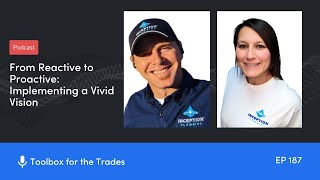
Darrell Whitaker and Lindsey Ramsey, co-founders of Inception Plumbing in Kansas City, use a detailed three-year vision and weekly leadership meetings to run their 15-person company. They're building a 7,000 square foot training center to teach plumbing and raise the trades, balancing their roles as visionary and integrator.
Questions this video answers
January 2017
Around 2019
Approximately 7,000 square feet
About 15 employees
Three years
Hello, contractors, and welcome to Toolbox for the Trades. My name is Jackie Aubel, and today I am chatting with the co founders of Inception Plumbing, Darrell Whitaker and Lindsey Ramsey. The three of us spoke about creating a vision for your business, how to do it, and why it's so important. I hope you enjoy our conversation as much as I did. Daryl Whitaker and Lindsay Ramsey, you are the founders of Inception Plumbing in Kansas City, Missouri. Today, we're going to be talking about how you go from a reactive strategy to a proactive strategy. And really, we're going to be talking about how to create the vision for your business. I'm so excited to chat with you both today. Welcome to the podcast.
Thanks for having us. Totally love the show Toolbox for the Trades. I remember when you first started it, and I've been a fan, so thanks for having us on.
Yep. Exciting. Of course.
Thank you so much for being on and thank you for being a fan. It is such a. I'm so humble and it's such a privilege to be able to do the show, and I love hearing when people listen to it and take value in it. So thank you for sharing that. Let us kick this off with an icebreaker. So you two are a married couple. You know, if I didn't already kind of make that clear in our intro, I want to know about your first date as a couple, and maybe, Lindsay, you can kick this one off.
Oh, goodness, yes. So we met in high school, and I was the typical good student athlete. Daryl was more musician, creative kind of person. We didn't really run in the same circles, but funny enough, we just kept getting stuck in the same classes, and we kind of developed a friendship, you know, little flirting back and forth. And it was chemistry. Yeah, it was chemistry class. We were about to go on Christmas break, and we're like, oh, my goodness, we're not going to see each other for two or three weeks. And he. He finally got the courage, I think, to ask for my number.
That was the bonus move I ever did, I think.
So he got it. He didn't really know anything about what I did outside of school or anything. Called me. We went out, hung out at a party, and we've been together ever since.
Wow. And boldest move you ever made, Darrell. Sounds like it was a good move.
We sat in classes together and I always did her art homework and she'd do my math or help me with my math. And so. Yeah. Oh, my goodness. Yeah.
Yeah. And I'm so happy you gave that detail about you doing her art and her doing your math homework. Because we're going to be talking about how the two of you guys work kind of as a visionary and an integrator. So it's like you almost, you guys have been primed and ready for this, running a business together since you were teenagers, which is super cool.
Yeah.
So, Darryl, I would like to know, how did you get into the trades? Because if my memory serves me correct, you were the one who got into this industry and you kind of took Lindsay along with you. So me about that story.
Yeah. So always been about working and you know, from a young age, like trying to get a job. Like right when I got out of high school, I was just like working at different places. I worked at a mattress place where they would rip the mattresses down and put new mattresses on these old boxes. I, I was carrying 100 pound bags of sugar. I probably didn't weigh about 170 pounds, but I was carrying 100 pound bags of sugar in the caves. College wasn't for me. And I was just going through all these jobs and my neighbor asked me, he's like, hey, Junior, you want to come to work with me? You know, he's like this old, old time plumber and big gray beard. But I went to work for him and I was intrigued immediately because they're out there in this big dirt pad and they're poking these pipes up and they're supposed to be imaginary walls that are going to be there. I'm like, how do they know this stuff? Like, what are we doing here? And I found myself real quickly asking a lot of questions and eventually they didn't even have the answers. Like, this is just how we do it. I was like, no, I want to know more. I want to know more. And you know, got my license. And before I knew it, I was running the crews. And you know, I, I spent a long time in, in the new construction. Like I think 17 years. 17 years building, you know, structures and commercial structures and stuff. So just was really intrigued by plumbing, that's how. And I just, I ran with it.
So amazing. And so tell me, what was the transition from working in new construction to then running your own business? Tell me that story, how you got there. And then, Lindsey, maybe you can chime in and tell me when you first joined the business.
I kind of got to a plateau in my career. I wanted to go to the office, I wanted to learn more. Got into the office, didn't really, I wasn't grasping what was going on. And I was just like, you know, I don't know if this is for me. I was like, I think I'm going to start a business. And immediately I started researching, reading, read the emails before I even started my business. Michael E. Gerber of course, I quickly got some mentors and started asking questions. And I found out that where residential service was, where to go. And I never sold a garbage disposal to a customer. Installed one. Didn't know anything about it, but I knew that's where I was going to go. I dabbled a little bit in construction, but I knew real quickly that that's where I was going to go when I started. So I started the business.
And when did Lindsay. When did you come on?
Yeah, so I. Daryl got into plumbing and I went off to school to play softball. I was a athlete and so.
Wow.
Yeah, she's a Division 1 athlete.
Oh, no way.
I watched her on US ESPN.
But they. That's not cool, you know, while you're playing. So I had to pick a degree and I picked business. I got a business degree and took a lot of math classes. But I remember I used to get, you know, these, you know, what are business people who graduated doing? And it would give a percentage. And some said entrepreneurs. I was like, wonder what they do, you know. And so it's kind of a funny story because now here we are. But I didn't go and get into business. I actually started coaching at the local high school. So I loved coaching softball and I really enjoyed teaching math. So I went back and got my math degree, my teaching degree. And I was doing that for about 15 years when Darrell kind of. I could tell, you know, we weren't seeing a lot of each other because I'm coaching and he's plumbing. So he, he had decided to start. Start the business. And I had been kind of helping on the back, back end quite a bit with the books, with this. We had didn't have a lot of things in place. We didn't know what we were doing. Uh, we were just kind of winging it, I guess you would say. And so we weren't. We. We weren't really seeing each other very much. Cause he's working really late and then I'm coaching late. And so. And is. It was kind of the business had reached kind of a point where I had to come on board full time or, or it was going to stay where it was. And so we had some really good coaches that they, they encouraged me to come on full time. So I took a really scary leap. I had been teaching and coaching for 15 years. I really enjoyed it. But also I. I had encouraged Daryl for us to start this business together. And I knew that in order for us to expand and scale and grow and do anything, I had to, I had to be there to help support. So that's kind of when I came on board full time, was probably 2019 maybe. And really my focus was to scale the business and see what we needed to do to become better at what we were doing.
Excellent. And Darrell, you started the business around 2017, is that correct?
Yeah, 2017, yeah. With some pre planning too, of course. You know me, like, that's the way I think. I'm like, I did a little pretty thought process, you know, but yeah, 2017, January.
Okay. Well, I would love to know how, Lindsay, you got the courage to make that step, because that is big. Like, that's kind of like we're either going to stay at this business level right here with inception, or I'm going to join and we're going to take it to the next level. That must have been so scary, especially with foregoing what I imagine was a steady salary, a steady income on your end, and also stepping away from something that you really enjoy doing.
Yeah, it was really scary. So the first two years, it was literally Darryl in the truck doing everything, taking phone calls, doing the work. I would help with invoicing. We weren't cod. We weren't doing a lot of things that we should be doing as a residential company. It kind of got to the point where, like I said, we weren't hardly seeing each other at all because we were doing. We're living separate lives. And even though I wanted this vision to grow just as much as he did, and I, you know, I did a lot of, you know, soul searching and thinking, and I had some really good mentor mentors to kind of help me make the decision that this is what's best for not only your company, but our relationship to. To stay. Stay focused on that as well. I had made the decision in my head. Making the decision in my head wasn't quite as difficult as telling everybody I was. Yeah. And I, I loved my work. I was in the same school. I didn't like, bounce around. So I was, I was a dedicated teacher and coach for 15 years at that building and had a lot of relationships, but they all understood. They completely supported it and they were sad to see me go, but also excited for me to, to take this on. So I, I knew that it was. It nothing was the change. To change wasn't scarier than staying the same. Staying the same would have been. I think one of my breaking points was we were walking around the parks together in the summertime. So I was off. And, you know, he. You know, he makes his own hours, right? And he takes a phone call because he's. He's answering the phones, right? So he takes a phone call and he's. I hear him talking to this customer and he's like, oh, yeah, you know, it'll be about two weeks. I said, two weeks. I said, what's going on tomorrow?
Yeah, I knew somebody can.
What do you need to. We. But he's. He's registering in his mind, like, is this a good call for me to go take? I need to do this or I need to do that. So I, you know, I knew that we needed to change some things to grow our business in scale and also really to, you know, save our relationship.
And Tell me what to do.
I have to say I. We're going to get a little bit more into your relationship in a bit. But I just want to say that what I've noticed In just the 10 minutes of talking to you and the little bit of talking I've done with you guys before we hit record, I just want to compliment you on your relationship dynamics. I see how the two of you cheer one another on, and I just think that's brilliant. So I wanted to share that.
Awesome. Thank you.
Yeah, we put on a good show. Honestly, I've had a couple of touch.
Points with you guys now, and you're pretty consistent, and it's hard to put up that act if you're not, like a professional actor or public figure. So I'm going to call slightly BS on that. But anyway, when you guys first talk. Oh, so you reached out to me proactively to talk about this specific topic on Toolbox, the trades. Darryl, as a listener, you thought that a ton of people will get value out of this. So tell me about what Vivid Vision is, what it is, and how it changed your mindset and how you run your business.
So I guess I'll just kind of start with. With the Vivid Vision. It's a book. It's by Cameron Herald, I believe. I think. I hope I got that right. He. He writes that to talk about how entrepreneurs or owners should get real granular with their vision and really get into the details of what it looks, smells, and feels like. I mean, everything down to, you know, what type of coffee station you have. Because typically what happens is the. The traditional mission statement, vision statement, they're too vague and you'll read them to your team and you know what it means, but they don't know what it means. So if you was to ask any individual in your company what's the vision of the company, they'd likely all have something different to say of where we're going or what it's going to look like. So yeah, the Vivid vision is basically the concept of breaking down your business into different your different functions and mind mapping out what you think the business is going to look like. So you get real granular with paragraphs, admin operations and functions like that. And then you put together a five to seven page document that really expresses what things are going to look like in three years.
So amazing. Yeah, I, I agree with you. When I was a business minor and whenever I took business classes, I spoke about mission statement and vision statement, I kind of was like, what is this? This kind of just feels like, you know, if we're going back to like art and math, this feels like the art part of business. And a lot of the times it's really hard to grasp onto it. Ironically enough, at Service Titan, the place I've been at for almost seven years now, holy cow. Our mission statement is to be the number one operating system in the trades. It's like, okay, great, I can hang on to that. That is something I can really, that can help guide my everyday actions as an employee of Service Titan. Right, right. And it sounds like that's exactly what you were doing for Vivid Vision. So tell me, what is your vision for inception Plumbing?
I think it. There's two things here. One of the main things for me is I want to build a business that inherently adds value to our team and the marketplace. Right. Business first. Right. We have to have a business that functions really well and does those things. Second, my vision for the company is to adjust cause. Basically. I know you know of Simon Sinek, I wrote a just cause. And our just cause is to remind the world of the forgotten tradesmen. Through education, we look to change commoditized views to one of merit and necessity. So for me, the big vision of the company is to raise the trade up and really invest in building plumbers for tomorrow while taking care of the market today. So and that's what I'm going to do with this building in this training center. And that's kind of the whole concept behind the vision is to something bigger than just ourselves.
Yeah, I think it's important to do that because obviously if you run a business, you're an entrepreneur, you want to work for yourself. You want to be kind of in control of your own destiny. But I do think it's important to go beyond what being an entrepreneur is going to do for you and your immediate interests and think about how it's going to impact the people that you touch, be it employees, be it customers. And then what is the legacy of your business down the line? And I really commend you for that. I think it's such a, a beautiful statement that you have and a vision that you have for Inception Plumbing. And I think it actually goes so well with what I'm trying to do here for Toolbox to the Trades, which is why when you reach out to me, I was like, yeah, let's chat.
Yeah, right. I mean, in that concept of the pyramid, there's a. What is that, that book? It's called Fix this Next. Fix this Next. It's a really good book. But they have the impact areas of the up the top of the triangle. And obviously, you know, sales and profit are the foundational elements of a business. But as you climb the ladder, you want to have a legacy, you want to have an impact. Right. And the visionary dabbles in those areas all the time and sometimes doesn't land on a good, solid sales and foundational element like a real business. Right. So trying to connect those with the integrator and playing in the clouds at the top of the pyramid, it's a tricky thing. So we find ourselves doing a lot of impact on our team, trying to impact their lives, you know, and getting ahead of the cart, the cart in front of the horse a little bit. So.
But anyway, amazing. So you mentioned mind mapping was this tool that you used to develop this. So tell me, just tell me the step by step process. Like how did you go ahead and create this vision?
Right. So he speaks in the book to go somewhere that's like relaxing, like sit by a lake and get paper. I'm very digital, so I like to type everything. I use AI I listen back to stuff. Like I'll type stuff and then listen back or I'll voice it in because it's faster and more effective. But he just find a comfortable place. And actually I did it down here with the garage door open, looking outside. And then he says, you have to own this too. Your vivid vision is not. No one else is building this. This is yours, right? You have to build this and own it. So he said basically pick different functions of your business. So you'll pick marketing and you'll write it on a marker board and write a Circle around it and then you'll, you'll, you'll pull branches off of that and then you'll write some other things. Let's just say branding. And then you'll write a circle around that. It's basically like a folder structure. So we've created one folder and we've created four folders right. Around different elements. Then we get granular. So okay, well, branding, what does that mean? So then you, you do other branches and then you put other maybe sentences and then eventually you're building solid paragraphs for that whole marketing function of your business which can be put on a document. Yeah. So you're kind of mind mapping these things out. And this is something that I've been doing ever since I started the business is organizing my thoughts. And I can't express that. It, it's called an organization for a reason. Right. I always use the analogy like you go to the beach and you got this guy sitting on the rock over here and he's got like a hot, a hot cocktail and maybe a, you know, nothing, nothing there. And then you got this guy over here who's got like, you know, he's got something over their heads, keep the sun off of them. He's got lawn chairs, he's got a cooler. He's got an organization. You want to hang out there. Right. So I can't express enough. If you can't organize your thoughts, you're never going to build anything. So always writing and organizing your thoughts in some type of mind mapping Boulder structure is really the inception of building something great. So, so I've always done that. So I related right away when I read the book, like right away.
Wow, okay. That is actually something I personally struggle with. And I guarantee you a bunch of people listening to, listening to, struggle with.
Yeah.
You know, in my job, which very different than a, the job than your job. Right. But I think there we probably have similarities in that it's so easy to get caught up in the day to day, the day to day restra distractions and kind of use all of your energy on those short term wins instead of focusing on the longevity of your team of your business. So do you have a specific like daily practice of organizing your thoughts? Like what does this look like? Or are you just so good at it, you do it just without even thinking?
Far from good at it. So actually I got it from the concept of the EMDs and they have a thing called I hate to just get in the weeds here, but they have a thing called the seven centers of Management, attention. And it's basically, I just think of it as these solid areas in which all of your business structure should be organized in. Right. So you have your business disciplines. I'm not going to go too deep here, guys. You can cut me off. Your business disciplines are on the top of it, which are your marketing, your money and your management. And then on your bottom, you have lead generation, lead conversion, and client fulfillment. And then in the middle, you have your leadership. So I see those for me, as I think of them as libraries. And then every one of those libraries should have a book, like a solid subject topic, and then topics inside of those with chapters, and then you have pages or steps. So taking that idea of picking seven things, like I just said, where all of your business functions and different stuff will land in, and then mind mapping folder structures underneath that and organizing your thoughts is super powerful. So I use word docs and I literally just have those five documents and then I have my subjects written out and then I bullet point information and I scrunch it all the time like accordion style, and I just organize my thoughts. So anytime we go to work on something, I will immediately go, let's. Let's see what we have first before we try to reinvent the wheel, because we might already have this written down. That's just how I work. Like, I obsess on it.
No, I. I really like that, actually. And I. This is stuff I struggle with. So I. That's why I'm glad you went into the weeds. And I just. Can I just say, for someone who it sounds like has our very artistic foundation, you really have a very organized brain.
I know. Lots of coffee. Lots of coffee. Obsession to win. Probably, you know, I'm that mind. But Lindsay and I are both very obsessed to. We want to win. We want everybody to win. And I want to be the best and learn everything I possibly can about business and how to. How to do it. Right. So.
Amazing. All right. So, Lindsay, were you going to say something?
No, no, I was just gonna say. Yeah, well, I'll just kind of circle with what Daryl said. You know, I was in, you know, education for a long time, and we did curriculum writing and planning. And it's kind of the vivid vision that he was talking about, the mind mapping. It's like a backwards design so you know the end result and you want to backwards design how you can get there. So his organized the way he organized things in his. The seven centers. We also give it to our team in trainual, for example, so everybody knows what's going on. So that backwards design of the Viva Vision he organizes, he's. He's amazing at organizing his. His thoughts and getting it out to our team. So it is interesting. As a visionary, a lot of them aren't as organized, but he's very organized.
Yeah. I don't know. It's a curse in a. And a gift, you know. So we're two in a box. And that's something that Cameron Herald talks about. Hopefully I'm saying his name right, but he talks about two in a box and the concept of the CEO or the CDO and the CEO being two in a box, the integrator. But you can flip the roles as in, like the visionary doesn't have to be an outgoing, charismatic person that gets everybody pumped up. It could be the, the integrator. Those characteristics can, you know, usually the integrator is probably likely the person that organizes everything and then the visionary is running around crazy. So we just have to know those strengths and where we fit in the bottles together.
You're stronger together as two units in the box. You've got more power, more potential versus on your own.
Yeah.
So, Lindsay, tell me, how do you integrate Daryl's vision, his very organized vision, how do you integrate it?
Yes, that's a great question. So like I was saying, that backwards design, I know his plan. Right. I know where he wants to go with the company and my job is to bring it to life. So a lot of things I do is, number one is getting our leadership to understand the vivid vision and where we're going, how we're going to release it to our team, how we're going to bring it to life. We do look at that, the vision with our leadership team and say, okay, are we heading in the right direction? We know this is where we want to go and this is what we want to do. So having it, it allows me to be more strategic about our decision making and be more proactive about the things that we buy, for example, or invest in, rather than just saying, oh, let's do this today, or let's do that today. It allows us to look ahead and say, this is where we go, want to go now. We need to all be going in that direction. So my main focus, as you know, the, what I guess what you would call the integrator, is to get our leadership team all rowing in the same direction. So instead of one person going this way, one person going that way, we're all going in the same direction. So aiming at the same thing and, you know, talking about it, you know, talking about the vision and making sure it's, it's, it's part of our culture.
Yeah. So as you know, you know, Data and tracking KPIs and tracking like daily, daily performance is really big in this, in, in any business really, but very much in home services to make sure that you're, you know, keeping a good profit margin, that you're all doing well. Vision statement, like this is something more like nuance. This is something you can't really like put your hands on. It's not like, oh, we're 58% to our vision today. We really got to step it up, guys. So I'm curious, like, how do you parse through that? Because it is such a nuanced thing and you can't really. There's not a number that you can look at that says, oh, we're pointing towards our vision. So how are you tracking your success when it comes to this?
So I can take that. So there is a financial and sales section on the Vivid vision. And there are some metrics. There are specific amount of people, specific amount of trucks. There are some things in the, in the Vivid vision that are measurable. The idea of having them in front of your face all the time and like kind of crossing things off, super powerful. That can really help is this, you know, being able to cross things off, but there are specific measurables within it.
So I, I mean, yeah, no, that's a great, that's a great question. And Daryl recently invested in. We have. Our viva vision was eight, eight pages, I think maybe. But we've got really huge posters and we had them print out. It's really beautiful. I wish we would have brought them down here. But he printed them out. He had him printed out. And we're hanging out, hanging them up. And so as we do these things, part of it is, you know, culture. You know, some of it's like having this amazing break room facility. Are we play games, you know, our team plays games. We have fun. But obviously, you know, we have X amount of journeyman plumbers. We've invested in this many apprentices to teach them the trade, things like that. So as we're getting those things done, we're going to put. He said, cross them off. You're not going to cross them off. We're going to highlight and put a sticker by them. Right. But recognizing that we're doing these things because you do, you can get down in the weeds and look at the KPIs all the time. And of course we have Service titan, we love it. It gives us all kinds of information. But, you know, there's more than just data that is about the vivid vision. It's bringing a culture to life. And, you know, some of those things aren't as measurable or tangible as. As looking at a KPI sheet.
And I just wanted to speak to that. I feel like the vivid vision, like, whoever's listening to this for the first time, they're probably like, what are they talking about? You know, so there's obviously going to be a link to download it and get an understanding of what we. What we came up with. Right? So again, I can just picture myself listening to this and going, what are they talking about? A vivid vision, you know, so you're.
Doing a better job of explaining it than you think you are. Trust me, as someone who's been doing podcasts for a really long time, you're like, am I even using the English language? You are, and you're both doing a great job. And yes, we will have links to a lot of the resources in the show notes if you guys are interested in that. Please check out our show notes wherever you're listening to this. So I'm actually really curious about what your company looked like before you implemented Vivid Vision and what it looks like now. So, Darrell, why don't you take that?
So I would say, and I was thinking about this, I don't feel like it looks a lot different. I just feel like there's clear objectives and things to aim at. When we first bought this building, we're standing in here, right here, we have a 7,000 square foot area down here for training that we're developing a building. And immediately I just went to. I call it painting. I just started painting the picture. You know, I was stealing labor from the company and getting them down here and helping and. And everybody's like, what? You know, he. Daryl's doing something here. Like they're, you know, and. But they don't really know what I'm seeing, you know, and so just saying that, I think it just helped me communicate. The ideas come very easy for me. Like, I can have 20 ideas and I can put stuff. But communicating that effectively to my team is really hard because I just see it clear as day. I see it all happening around me. So the vivid vision has helped me articulate and clarify exactly what I'm aiming at, and it allows Lindsay to, you know, read those things and articulate that to our team better. So.
Got it. So you're not just the crazy founder who's like down in the. Doing some wacky projects. You're actually.
Hey.
He's trying to champion the trades and create a training center so we can make more incredible plumbers. Like, it's not just like, Daryl's doing something weird downstairs now. I can't. I don't know if I feel like.
I'm building the ark, you know, and like, I'm building the ark and the floods come in and I'm the crazy guy. You know what I mean? So really, like, no, guys, I have a plan. Let's go. Right?
Like, amazing. All right. I think I asked this question before in terms of kind of how you think Daryl and I. Maybe Lindsay, you can take this one first. So, like, tell me how you keep up with your vivid vision instead of getting lost in the day to day. Because I really think this is a challenge, like, keeping lined up with this, like, this is our goal versus, like, oh, these are the fires that we have to put out today. Like, how do you balance that?
Yeah, that's. That's a great question. One of the things we do to make sure the VIVA vision is constantly around us is we. We have our leadership meeting meetings weekly. We develop rocks. I don't know if you are familiar with that language of traction, but we have our leadership meetings and we develop rocks and, and we, we bring up our vivid vision and say, okay, how are we going to bring this to life? And then we make our rocks based on that vivid vision and meeting those, those, those goals for the VI Vivid vision. So we talk about it every week because we make our rocks for that a hundred days. And then we say, okay, where are we at? You know, how are we doing? So that's one way we really keep ourselves focused on the vivid vision. And of course, the second part is that, you know, take the leadership team taking that to, you know, each individual person on their team and making sure that they're communicating that as well. Like, hey, guys, this is what we're doing. You know, this is why we're doing it. And again, like I said before, putting those, those vivid posters up around, around the shop and saying, hey, look what we're doing. You know, look what we're bringing to life and getting people excited about. About the vision.
Yeah, and attracting people too. That's another thing. The vivid vision, if you get enough of it out there and enough people read it, the idea is also you might find people that want to come help bring the vision to life. So I think it's not just us doing it. It's getting it out there, letting people read it, and you're attracting people. You want your competition to have. You want everybody to have it. It doesn't matter, you know, they can't bring your vision to life. So I think that's another important thing is just to make sure people are reading it. You're getting it out there, even your customers, you know, let them understand who you are, you know, and you'd be surprised. You might get two, three new employees just by one person read it and their, you know, cousin does this and, you know, and it's like. And then they're here at the door, like, man, this is a place I've been looking for. So that's another idea with vision is getting it out there.
Yeah, you know, this has been a theme that's come up in the show quite a bit, which is that, you know, the trades now have been proven to be, you know, recession proof, pandemic proof. Everyone getting, you know, having college degrees and being in incredible debt like the trades offers so much to folks that are interested in it. And if I was someone who was looking to get into this line of work and I came across Inception Plumbing, and I see, oh, their vision is to create an excellent place to work for their employees and an excellent experience for their customers. And they're setting up the future. They're setting up, you know, they're taking steps to set up the future to create more incredible plumbers. Like, that's like, oh, that's something I can get behind. So I really, I align with that tremendously. And I'm glad you, you spoke to that. I would love to know what advice you would give other owners or operators who are listening to this and are like, oh, I kind of want to go through this vivid vision exercise. I kind of want to see what they're talking about in Inception. Like, what advice would you give people who want to take a stab at this?
I'm going to. I'm going to circle back to organizing your thoughts. And I know that sounds so boring, and I'll just be transparent. When I got out of high school, I mean, I was not a book reader. I was not a writer or a typer. You know, I didn't do any of that stuff. And I found that as a creative, a hyper creative person, I do find deep fulfillment in the creative work I do and the positive impact it brings to my company. I find that organizing my thoughts is like, number one, you can't do it enough. Everything you're thinking and you're looking around like, why Is this not happening? You're just thinking that. And if you don't put it on paper and collectively put it together, it's never going to come to life. So just organize your thoughts, write your thoughts down.
Like you said earlier, Jackie, a lot of people just, they. You can get so bogged down with fighting fires day in and day out, with all the things that happen in a business, but it's about being proactive rather than reactive. And, you know, just sitting there and thinking about what do I want my business to look like? You know, I don't want to put out these fires every day. I don't want to run around like a crazy person. You know, I don't want to have to run out of my house at 8 o' clock at night to, you know, go help X, Y and Z, really just thinking about, you know, what do I want this to look like and how do I bring it to life? And it just, it gives you a sense of excitement to be able to put something together that hopefully is going to not just take care of you and your family, but a lot of other families and give them something to, to be proud of.
And legacy.
Yeah.
Yeah, Legacy is important too, right?
All of it. All of it.
Okay, so real quick. I love having married couples on who run the business together because it's so common in this, in, in the service industry. I want to know what challenges, if any, you guys had to overcome as a couple to make, to make you more effective as co founders.
Two in the box. Back to the two in a box mentality of, you know, she's an integrator and I am the visionary of the company and just kind of knowing our boundaries, knowing our strengths and weaknesses, and knowing when to just, you know, shut up too sometimes, but just stop. And working off each other's strengths has just been the big thing for us instead of focusing on each other's weaknesses.
So, yeah, it's changed. The challenges have changed over the years due to the different dynamics going on in our business. So when we first started, it was kind of like we didn't really understand what roles or responsibilities were. We were all just, you know, doing my strengths and then doing his strengths. So, like, we were just mixing kind of our duties and so it took a while to understand, like, okay, I have to be responsible for this and you're responsible for this, and we can't, you know, just mix and match. So at first it was just knowing our roles and our strengths and sticking to them, and now it's, it's Turning off, for me, anyways, when we first started the business, it's like, you know, it's okay to talk business 24 7. You know, we're all excited and ready to go, and this is all new. But then as the integrator or the COO or whatever, I'm in it. Like, I'm in it, you know, every day, and I'm dealing with just everything about operations. And sometimes when I go home, I need to turn off, and I'm pretty good at turning off. I can just clear my mind. I say I'm good at it. I'm not really, but I try to turn off. But when we go home, it is difficult sometimes to separate that. That business from just. Just relax, you know, relax and enjoy each other's company and, you know, just have fun and don't think about business. So I would say that's a. A challenge for us because we always talk business almost 24 7. And, you know, sometimes, you know, when you're trying to bring something to life, you know, those discussions can, you know, I don't want to say heated, but, you know, sometimes the. The visionary and the COO don't necessarily see eye to eye on everything, and it's. It's. You got to be intentional about it, I think.
Yeah, I just bring 20 new ideas every five minutes, so. But they're organized. Let's just say that. But yeah, got it.
So what I'm hearing is, you know, the two. Two parts, one box, right? Like, you guys are stronger together than. So you're operating as the two of you as a unit almost, and being really intentional about. When you're talking about business, when you're not talking about business. And it sounds like you're comfortable getting into heated conversations knowing that the other person has the best interest, your best interest, the company's best interest at heart.
Absolutely.
Oh, yeah, absolutely. The visionary. I guess you would say he does. He has a million ideas all the time, and my job is to sift through, you know, okay, well, what's the best one? What's the best one to put into play right now? But we can't put them all into play because I'm looking at the financials and the data, and I'm like, okay, what's. What's the best one that we can put into play? And so it's fun. We both love talking about business, but we're both very. I don't want to say stubborn, but we both.
Yeah, we're very stubborn.
We both think. We both think we know a Lot.
Yeah, sure.
Either one of us.
She knows. She doesn't know as much as me neither.
Neither one of us are, you know, weak minded people. So we both are. Have strong personalities and, you know, we're very obviously courteous and understanding of each other, but we both have very strong opinions.
We share an audible account. And I'm like, I'm reading this new book and I'm up doing push ups and, and making, you know, coffee downstairs and telling Lindsay about this new book. And then next thing I know, she's in my audible account, you know, listening. It's on a different chapter, so the chapter moves. So I know that she's listening to the book that I, you know, like, this is how we roll, you know, like, we love it. You know, that's why I'm here for the climb. I'm not here to land on the mountain with a pile of money. I. I get fulfillment from the climb and that's where the growth happens and stuff. So I'm here to climb, baby. You know, let's go.
He's dragging me up the mountain. No, just kidding.
Well, I can imagine, you know, if you are the coo, if you're doing operations and you're like, oh, crap, we went way over our budget on, say, I don't know, employee rewards or something. And now a visionary comes to you and goes, I just got the best idea for this new employee incentive plan. You're like, hold on there, bud. We just like blew our budget this last month. So, like, yeah, I. It sounds like you guys have a really great rapport. Um, I wouldn't be surprised if you get some folks reaching out to you proactively after this episode airs to ask you how you do it. Um, so I give massive credit to you, and it seems like you guys both have your heads screwed on real tight and, like, are aiming for the same thing. And I could tell you're both really passionate about it, which is awesome.
Well, somebody, if somebody calls out and asks how we do it, Lindsay always says, what is it? What is the line?
Oh, yeah. People ask me what I do. I'm like, I don't know what I do all day, but I do it all day. But I do it all day long, so.
Right.
I do, but I'm doing it all day long.
Yeah. So I resonate with that. Okay, so I know you guys got a 7,000 square foot training space, and for anyone who's been watching on the YouTube, you can see it right behind Lindsey and Darrell. So how do you plan to use it?
Part of that just causes, you know, to raise in the consumer's eyes the plumber. Right. I kind of go back to the analogy of. Not analogy, but, you know, people buy granite countertops, and they. They buy these. These fancy faucets, and they're like, I just need the plumber to hook it up. And just a little over, you know, 100 years ago or whatever, 150 years ago, we were bringing water into people's communities with wooden pipes and saving lives, and we were praised for that. So to me, the technical aspect of plumbing, I call it sots. I call it sales, operational, and technical. The technical aspect of a plumber is super important piece of it. But if you just focus on the technical aspect of it, and which we'll be teaching down here, it does. It lowers your. It lowers the perception of the plumber in the eyes of the consumer. The sales. And that's a bad word, is just. It's just your ability to communicate with the customer, and operational is your ability to communicate with an organization. So my main goal down here is to take people and teach themselves operational and technical ability so they can. When they go to service a customer, the customer's like, wow, you do really good plumbing, and you communicate really well, and you do a great job. You know, operationally, everything was smooth. So that's what I'm going to do with this facility. Not just teach the trade, but the sales and operational aspects, too.
So very, very cool. So just so folks can get an idea of where you guys are at in your journey. So, Lindsay, when you joined, it was Daryl. You were essentially you in a truck, and you had, like, what, one or two helpers or one or two technicians kind of on the side. Was it just you?
Just me.
It's just Daryl. He was answering the phone, and he was running calls.
Dang. Okay, so now where are you guys at now? How many employees do you have?
Yeah, so I think we have 15 right now. We just onboarded a new person as well. So, yeah, it's a. It's exciting. You know, it's. It's crazy. You know, really, it's like when you look at the number, sometimes you're just like, what's going on? But, you know, that vivid vision again. It's helping us paint the picture of where we want to go and who we want to be. We want to be able to service our community, and you can't service a community with one or two people. You do need a team to be able to service a community. So that's part of Our vivid vision is to be able to, you know, service our community really well.
Awesome. Awesome. All right. Well, guys, this was such a fun interview. I really enjoyed it. You gave me a ton of inspiration for my work and my life. I'm sure you did the exact same for our listeners. You already mentioned audible. I would love to know what you guys are listening to, reading or watching right now. Like, what media are you consuming that you're excited about?
So the book called Second in Command, it's by that. That same person who wrote the Vivid Vision, and it. Basically, it's talking about the coo, the integrator. I'm actually reading that. And again, Lindsay took it over, which is funny. And then obviously Traction, always going through that book again. And Lindsay reading the.
Yeah, I just got done reading. Got Get a Grip by Mike Patton and Gina. Gina Wickman. I think it's about an organization implementing Traction, which is about, you know, your leadership meetings and things like that. And it's. It's super helpful because literally what that is, is bringing your vivid vision to life. That's what that book is kind of about somebody's journey, putting these meetings together to bring this vision to life and get their organization get a grip. Basically, you know, this is where we're trying to go. How are we going to bring it to life? So I just got done reading that, and then Daryl's been talking in my ear about this second in command, how I need to read it. So. So I did. I started reading it and. And. But no, it's. That's what that is. It's about, you know, bringing the. The COO is what they call it, but the integrator, bringing the visionary's vision to life. They have different Strengths, but the CEO's job, you know, is to complement the CEO and. And help bring the vision to life. So it's a super. It's a good book. I'm enjoying it.
About halfway through, we like to just do books for a quarter. And for me, I like to do books for a quarter and then try to implement something the next quarter and just change it up. Because if you just keep listing it, change just. It's too much. Like, I can't even type that fast. You know, it's like, oh, my gosh. So I'll try to listen and then do some integration and then listen, you know, you might only get one or two things. You know, you don't. You're not expected to do the whole book. Just grab those little pieces and try.
Amazing. Well, Daryl and Lindsay, thank you so much for giving me some of your time today to talk on Toolbox for the trades. I loved chatting with you. I can't wait to see where you guys are going to be in the next couple of years. So please keep me posted. Thank you so much for being on Toolbox for the trades.
Awesome. Thank you so much. Thank you, thank you.
More from Bill




Capturing the 80%: How SmartAC’s Gen-2 Targets Non-Membership Homeowners | Podcast Ep. 296

Build better customer data with every booking in ServiceTitan | TAD Tune-Up Series

The Biggest Change for Roofers Coming From Other Roofing Software to #ServiceTitan?

