From Whiteboard to $30M: Scaling a Roofing Company From Scratch | Podcast Ep 241
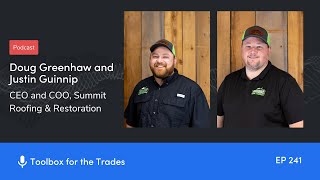
Doug Greenaw and Justin Gwennup built Summit Roofing from Doug's solo start at 17 into a $30M company. A tornado in 2023 brought $18M in work, forcing them to ditch whiteboards for ServiceTitan and CompanyCam. They're now targeting $50M next year while figuring out how to scale without losing their culture.
Questions this video answers
Summit Roofing and Restoration.
Atoka, Tennessee.
Approximately $18,000,000 (tornado year; 2023).
Pacing to hit about $30,000,000 this year (host references "tracking towards 30 million this year"; they later estimate ~32M).
Four locations and roughly 60 employees.
Hello contractors and welcome to Toolbox for the Trades. My name is Jackie Aubel and today I'm chatting with Doug Greenaw and Justin Gwenup, the CEO and COO of Summit Roofing and Restoration in Atoka, Tennessee. We talked about the early whiteboard days of the company building a strong foundation for growth and what advice Doug and Justin have for other roofers considering service Titan. I hope you enjoy this conversation as much as I did. Foreign Doug Greenhaw, you are the president and CEO at Summit Roofing and Restoration and Justin Gwennup, you are the COO and you guys are located in Atoka, Tennessee. Today I'm going to be talking to the two of you about how you grew your business without a tornado building a 30 million dollar roofing business from the ground up. I'm so excited to chat with you guys. I'm going to ask you to say hello at different times so folks can can hear your voices. Doug, why don't you say hello to our audience.
Hello.
And Justin, why don't you say hello?
Hey, how's it going?
I am so psyched to talk to you guys. We are going to start with one of my favorite but controversial icebreakers. Doug, I would love to hear if you got a call that Justin was in jail, what would you assume that it would be for?
Well, years ago it would probably be drugs and running from the cops at this point, probably knocking off a candy store.
Got it. Got. Well, if you guys listeners, if you aren't, if you aren't hooked in yet, I don't know what to do with you. Justin, same question to you, but about.
Doug, you know, he stays out of trouble now, but I would say it's probably going to be whenever I had a shank in his backpack and he goes through tsa, that's probably what he's going to, that's probably what he's going to go to jail for.
I love this. So just for a little background on the audience, Justin, you met my friend and colleague Ellen Rohr at an event a couple months ago and she introduced us over text. You were fantastic and I had to have you on. I agreed. But when I did the intro call with you and you brought Doug on, I was really excited to see the two energies that you guys have amongst each other. But let's get into it. Let's get into the story of your business. Doug, your family has a long history in roofing dating back to 1972 and you started trademark roofing your own business at 17. How did your family's history in the business shape your decision to become a roofer?
Well, growing up, roofing is all we knew. Thanksgiving, Christmas, my grandma roofed, my aunts, all my great uncles, bunch of good human beings. And roofing was the only thing I was around. And truthfully, I never thought about a different opportunity. You know, in kindergarten, when they asked me what I wanted to be when I grew up, it was a roofer. So that's pretty much all we've ever been, all my family's ever been.
And that's really impressive that you started your own business at 17. Is that the aspiration you had? Or did you think you would? Was that always what you wanted to do? You always wanted to be a roofing entrepreneur now?
Not really. You know, back then, we just roofed the houses. We didn't actually really run a business. And my great uncles in 2007 decided to retire. They were the last ones in the family roofing. One of my other great uncles pushed me to try to, you know, do it myself. And it's what we did. It wasn't really planned. It's just there wasn't a lot of opportunity around 2007, 2008. It was bad.
Yeah, don't I know it. I think you and I are around the same age because I graduated high school in 2007 and I went to college personally, but starting in that time was pretty bleak.
Yeah, it was. Yeah. I would have graduated in 2008 if. If I would have graduated, but I never made it that far.
Can I throw something out there? I do want to point out. I do want to point out that kindergarten was the last grade that he finished too.
I have A cold order GED.
A court order GED. I think you guys. You guys both have GEDs. I remember right from our pre interview.
Yes.
But like, we. I, like, I told you, like, you were in very good company on this podcast. There's so many folks I've had on this show who did not finish high school, definitely didn't go to college, and now they're running multimillion dollar businesses. And that's one of the reasons I love doing this show, because I think it busts that myth that you need to have a proper education in order to be successful. And you guys, here are two living, living breathing examples that that's not really necessary.
Well, I believe you really just have got to have a lot of grit. You really got to be willing to work. And education probably helps in some areas, but it definitely doesn't have to. You don't have to have it.
Yeah, for sure. So, Doug, you've been in the roofing biz your whole life, but you've also known Justin since you guys were kids. And by your own admission, you lied to him to get him to come work with you in 2018. So, Justin, I want to hear from you. What made you decide to come work with Doug? Because I don't believe you had the same background in roofing like he did. That's right.
Well, so, no, he. He roofed from the time he was young. Whenever I quit school, I quit. I went a little farther than he did. Whenever I quit, I went to work carrying shingles, and I did that for about three years. And to say, you know, he says he lied. I kind of knew what I was getting into. You know, it was an opportunity. I was working at a factory. I kind of felt like I got the shaft. Dedicated a lot of time and a lot of my life to it. They just gave me a bad deal.
So, you know, factor actually shut down today.
Yeah, yeah. Factory had been open for. For 50 years or something like that. I accepted the offer that he gave me, and everybody was saying, hey, why would you leave a guaranteed job to go work at a roofing company in another. Another state? On a serious level, I trust what his opinion is and what his. What his thoughts are and what his direction is. And it's always been like that. Whenever I came in, it was kind of chaotic, but he told me that, you know, he had everything together. And after I got there and accepted the job, I realized that, I mean, that was a matter of perspective, you know?
Yeah, no, I definitely knew everything wasn't together. That's the reason I was trying to recruit him, truthfully. You know, I met him when I was about 8 years old in the trailer park when the mother married my cousin. And we've been close ever since. And he had moved to Arkansas, so I didn't get to see him a whole lot. Justin's always been way smarter than me. I wanted to be around him, and I wanted him to be part of it, so.
Well, what I'm hearing from this is you guys both have a fondness from each other. Like you knew each other since you were kids. You both trusted that the other person had a good head on their shoulders and would do their best to give their all to the business. So paint the picture for me. What did the business look like before Justin came aboard?
We were using acculinx as a CRM, but not nowhere near to its full list. And primarily we had whiteboards on the wall that we Kept up with what people owed us and what jobs we had going. And I take pictures of it every night just in case a disgruntled employee erased it, you know, because would have made for a really bad day. And he really brought a lot of the technology and a lot of the processes that we use now. Like I said, he's always been a lot more intelligent than what I am, especially in technology. Just stuff makes sense to him that don't make sense to me.
So tell me, Justin, when you got in, you saw this whiteboard that was very easily erasable. No undo button on a whiteboard. When you first came on board, what were your top priorities in kind of getting the business in check?
So whenever I came in, I came in as an insurance supplement technician. Right. So I honestly thought that it was a simple job. It's as simple as filling out these cocs. Like, I thought that was all there was to it. And I thought that for a while, because whenever I got there, they were so far behind on CoC. So a CoC in the roofing industry is a certificate of completion that you send to the insurance company to get paid. And they were way behind on them. So I'm thinking, okay, well, all I got to do is fill this Word document out every day, held up, you know, I got a sweet deal, you know, and I found out that that was not all it was. That was just what had to be done to get it caught up. It was insurance supplement to begin with, and then just trying to get Excel, you know, something as simple as Excel, because I had to track all of the supplements that I sent out to follow back up with them. I said, hey, what's the Excel login? He's like, hey, what in the hell is Excel? I was like, you know, okay, I made a mistake here. I really should have went with McDonald's on this one.
You know, I'm pretty sure they with hiring. We did have one guy that said he applied for us in Doordash, and Doordash didn't call. So he came here. He's been here six years now.
Yeah.
Oh, dang. That's awesome.
Yeah.
So even though you weren't on Excel, even though you weren't embracing technology, working off a whiteboard, you were still making money, right, Doug?
Yeah, I think we were probably in the 3 to 4 million ish dollar a year range at that point.
Yeah. But no insight into, like, what was your overhead, what was like that, whether that was your revenue, what your profits were like, any of that kind of stuff.
Nothing now, nothing. We just go out and work hard and hope for the best, and it usually worked out.
Yeah. And I think that's actually what I hear a lot from the story of the technician turned owner. Like, you know how to do the work, and you know how to do the work well. But when it actually comes to the mechanics of the business and making sure the business is run well, that can actually get really difficult.
Yeah.
Well.
And back then, I didn't realize that there was conventions, there's reps, there's people you can hire or people that you could just talk to and they would actually help you with this. I assumed that everything was top secret. Nobody shared anything. Well, eventually realized that was wrong, and that's been a big part of our growth, is other people helping us.
How did you realize that?
I think through the manufacturers. They set up little conventions, and you would go out to them, and obviously there's people trying to sell you stuff, but then you would run into other companies and they just share information with you. I thought that was odd because, you know, I'd never been exposed to any other business owners. So we just kept going to those, and then eventually just found, like, Home Service Freedom, which has been phenomenal for us.
Home Service Freedom, that's Tommy Mello's organization, right?
Correct. Yeah, yeah, yeah, yeah. Now, if you don't. If you don't get your money's worth out of that, it's your fault. And it's a phenomenal thing. And that's really where we figured it out. We just got invited to go to something, and it's like, well, these people actually helped. And every time we'd be driving out there to it, working on problems, we'd be driving back inspired with all the things that we were going to change. And we just kept doing that and kept doing that. And then eventually, you know, got exposed to some people that had really done hundreds of millions of dollars a year that were just normal people that were willing to help us, because the people you see generally on these podcasts, and everything's perfect, everything's going for not. You know, that's not completely real. You know, you talk to them on the backside, and you get to see what's really going on there. This isn't easy. You know, if it was easy like this, everybody would do it. Running a business and trying to grow, it's. It's a struggle.
Yeah. And it's a total mind shift, I think, from. I've never done it, but from the people I've talked to, shifting your Mind from working on the business instead of in the business is so pivotal in those moments to actually get the systems in place to set yourself up for growth. Otherwise you're just burning yourself out.
Yeah, well, you get so used to running around and putting all those fires out and staying chaotic, and before you know it, you learn to like it and then you don't know how not to do it. It's a difficult thing.
I think it. Actually, I have a theory about this and I think it's that I would imagine. And when I propose this theory, this is because I'm putting myself in your shoes. Right. If I'm someone who's an expert at roofing and I know how to roof my face off, I'm so good at it. If I'm stuck with a marketing problem or an accounting problem that I'm not familiar with as an owner, I want that almost dopamine rush of going to fix a roof and doing it really well, because I know I can do it, rather than admitting, oh crap, I actually don't know what I'm doing in these spheres. And that's a little. That makes me feel a little insecure.
I think you're absolutely correct. And I think to begin with owning a business, you assume that you have to know everything. That you can't say, hey, I don't know how to do that. I'm going to have to find somebody that does. But it can't be me. I mean, as a new owner, I assume everybody starts that way if they haven't been exposed to anybody that like. No, that's not how it is. Like you, you're going to run into things you have no clue what to do with. You may know a lot about a lot of things, but you can't master everything.
Yeah, 100%. And I think honestly the most successful businesses I've had on the show this week, I also recorded with a H VAC plumbing and electrical company that's at the 45 million dollar mark. And we talked all about humility. It's like the only way I was able to grow is because I was able to admit to myself, I don't know what I'm doing in some of these areas. And I needed to get the help, but I'm glad you guys got that with home service freedom.
Yeah. Well, and to begin with, I think you feel like you can go learn that stuff. You're just being lazy. You need to go, you know, but you can't master everything. And when you get somebody that truly understands it better than you and they take off with it and do better than you. You know, to begin with, it kind of hurts your feelings a little bit. Like, somebody does better in my company than I can do. Well, that's actually the goal. But to begin with, that's hard to. It's hard to turn loose. And Justin has probably actually struggled with turning loose more than I have over the years. He's been rough on people over the years as far as how they operate.
Justin, would you agree with that?
Yeah, probably so. A lot of that came from. I had an assistant general manager and, you know, something got screwed up. I got my ass chewed out for it. So I said, you know, what if this is going to get wrecked and I'm going to be the one that gets in trouble for it, I'm getting the gratification of wrecking it, you know, but, yeah, that. That is something I have struggled with. It's wanting to make sure that it's done correctly, and that has been a problem. But I've gotten better about it, of trying, you know, trusting people with it. You can't believe what.
For anyone who's not watching the YouTube, Doug is shaking his head while Justin is talking right now.
It's different now than what it was when we first started or whenever I first came in. You know, whenever I first came in, I had to do everything, like, anything that. That had to be done. Now there we had other people on the team, but, you know, I had to do it. If it was anything related to something that other people couldn't do or that I didn't think they could do and it needed to be done, I would just do it. I'm probably guilty of holding on to some of that, but, hey, I'm right.
There with you guys. I've grown, like, again, I'm not on the business owner trade side of things, but I've had a team. I have a small team here at Service Titan that I love working with. It's tough, just like, letting people fail because you realize, like, I have to let them fail and let them see the consequences of doing this the wrong way, because if not, I'm. They're never going to grow and I'm never going to be able to move up myself.
Yeah, and we've talked a lot about that. It's like, you have to let them fail. Obviously, if it's detrimental to the business, detrimental to the customer, you can't let them fail. Other than that, you have to just repetitively watch people make mistakes that, you know that you've Done yourself. But, you know, telling them it really doesn't work. You have to let them fail. And as long as they learn from that failure and it's not a repetitive one, it was. It was a good investment.
Yeah. Yeah, for sure.
As we've grown, especially when we purchased our new building, it really helped us recruit better talent. And there was other things we did. We're a better company to work for than we were eight, nine years ago. So we do have a better quality of people now, which has made it a whole lot easier to turn loose with stuff and built it to where it's actually a career to come work here with opportunity so then you can start getting people. Prior to that, we only got the people that had no other options, unemployable, you know, nobody. They could get a job anywhere else. So they try here. Well, that's. That's when he was taking care of everything because we, you know, we couldn't get good people.
Yeah. And what it was. Do you feel like it was when you created that career pathing and you started really building up the business and then you were able to attract better talent?
It was, people want to be part of something that's exciting. They want to be part of something that's growing. They want to follow somebody that's headed somewhere that obviously they want to go to. And making sure your people see where you're trying to go and what you're trying to do and let them be a part of it. It's like home service freedom. I went out there last year and I think we took five people. Well, that was great because some of my managers got to see what we're trying to do. Well, this year we're taking 25, so we're going to. We're going to take almost half of the company for a week to go to Home Service freedom so they can see what we're trying to do. So they come back with the same fire that we come back with to get this done and continue this growth.
It's interesting, right? It's like thinking about the investments you have to make to keep your people interested and to keep them excited and on the same path as you like. That's something I feel like you don't learn about as a businessman, as a. As a business owner, until you actually get into it and you see the difference it makes.
Yeah, no, it makes a huge difference when they see it too. When they come to you and say, hey, we need to invest in this, we need to go do this versus you coming back with 50 ideals. Because I'm kind of the visionary here. So I can come up with about 50 ideals a day. And I think they're all great ideals. He does not think they're all great ideals. But no, what does he know? You know, he's just the implementer.
Nothing like an implementer to shut. To shoot a visionary down.
Yeah, yeah, I just look at him. No, that's terrible. We're not doing that. And then he'll keep on until we have to do it and then, you know, it works a lot of the time. But I don't ever want to say, hey, that was a great idea because then he's going to come with more.
You know, don't want to encourage them. Yeah, no, I get it.
No, it's like the gremlins in the water, you know, you don't, don't keep doing that.
That's a good. Actually, I do want to put a pin right now on the implementer versus visionary dynamic between the two of you. But I do want to make sure we talk about this tornado because this was like a pivotal moment in your company recently. In 2023, you had a tornado hit your township, your service area, and that led to an 18 million dollar revenue year, which I think at the time for you guys was like, holy cow, this is insane. Right?
Yeah.
So with seeing that success, you guys came together and you're like, hey, how can we create an 18 million dollar year without a natural disaster? Right. So I want to hear what were the key elements of that plan and how did that experience solidify your partnership and push you guys towards embracing new systems and technology?
We're kind of starting back the year prior to that was a really bad year for us. We had a commercial estimator sign a bunch of really bad contracts that we had to honor.
Oh, shoot.
Yeah. And we lost somewhere around $750,000 that year, which was. Was more money than.
Very loud whistle.
Yeah, that was more money than we had. So obviously we were in a little bit of debt. We finally, after that year got over January, we started following a company. We were going to make some changes. Some of the stuff we're doing now, I think in April we had, we hit a record month. We sold a million dollars of residential, just residential in the month. And then all of a sudden we got hit with a tornado. It was devastating for the community and you know, we didn't plan obviously for that. Power out, cell phones were down. I couldn't even call my guys. But that next morning, all my guys showed up to the office ready to go. And we built a process and we probably got 70 plus houses in the dry before rain ever hit that never got wet.
That's awesome.
Yeah. And we, we pushed our roofing schedule back and just dried in and we, Justin built a little system. He realized quickly we were fishing to have some problems because of the communication. And that was a wild ride. Like people literally running us down in the road and you know, just got force fed a bunch of business. And the guy named Brian Carpenter from ABC I talked to a lot and he said, what are you going to do with all of it? And I said, what are you talking about? He said, all the money. He said, are you, what are you going to do? Because you know, a lot of times I owner buy them a vacation home. I was like, no, I'm going to reinvest. I know what we're going to do. And we got to end that year. And everybody says like, hey, you know, you're not going to be able to do that again this year. You know, you're not going to have the storm. Plus a lot of those houses y' all roofed, y' all would have roofed next year and the year after. It's going to hurt you on those. Like, no, we're not moving backwards. So it had actually snowed. We were shut down. This was January the following year. And me and Justin still come to work every day and we just, we just sat down and he built a spreadsheet and we figured out, okay, rep should be able to sell this much. We can produce this many leads through marketing. If we do this, this is how many reps we need for a year to produce this same number. And we just broke those numbers apart backwards and realized, okay, we need to bring in this many people and we need to produce this many leads. So that's what we got to working on right there. And we figured, hey, we could hit 18 million in a year. Didn't think much about we're going to hire all these new people. They got to be trained. There's a little ramp up time in here. We just like, hey, we ain't even found these people yet, but we're just going to, we're going to do it. And we did. We actually beat that prior year by I think three or four hundred thousand dollars.
Dang.
You know, so, you know, and everybody said we'd go backwards because of what happened and they, they were wrong. We did not. You know, that's awesome.
That's quite an accomplishment. Justin, anything you want to add about that tornado and how it, you know, kind of shaped the company in a really profound way.
You know, it. It helped. It helped this business tremendously. And all of the money that was made from that tornado was invested right back into hiring people, buying vehicles, marketing, all of that. It wasn't like, hey, we got to, you know, we made all this money and we got to party. No, it was like, hey, we have a goal, and, you know, this money is going to go towards getting us to that goal. And it did. And it, you know, it. It did. Tornadoes. I don't know. You know, there's a lot of people that do storm chasing, and it's tough because some. You're standing there talking to people that have lost everything they have, you know, like, they've lost their home, they've lost everything. So helping them has to be what's on your mind and not just how much money can I make off of this. As long as you have your mind on helping people, the money will come, you know, but it can't be your first priority.
Yeah, I can't imagine what that must be like emotionally, to have to respond so quickly to a place that's been devastated in a place that you guys live in, essentially that, you know.
Yeah, now it's our hometown, and you're pulling up to a house with someone standing in the yard, just looking, you know, and you can't imagine how they feel. And for us, what we decided was we're going to push through and we're going to get this done, because if we can at least get them in the dry before it rains, we can stop more loss. We were able to successfully do that to pretty much everybody. I don't know of one customer that requested us to get, you know, to dry them in that we didn't get to before the rain hit. The tornado didn't actually have rain with it very much, so it didn't. Didn't do a lot of damage there. And we drove around and we passed pizzas out, we gave water out to our guys, to customers. Just whatever we could try to do in the midst of that to help. We bought a bunch of tarps and just allow people to come pick them up from the office if they wanted them, just come get one. You can have them. It was a small thing, but, you know, it's all we could think of right that moment to, you know, to try to help those people.
Yeah, well, you know, this some. It's interesting on this podcast, you know, we talk a lot about business success and growing businesses. And different strategies for making an impact. And sometimes it, it feels a little impersonal a bit because we're talking business, we're talking strategy, but when I hear you guys talking about this tornado, the specifically one that, that hit in 2023, you can tell there's a lot of emotion behind it. And I'm just curious, how does it feel to know that you had such an impact in the community after such a devastating event? That has to be pretty rewarding. I mean, in addition to the revenue gains you guys got, like, you probably have made a really incredible impact on your community.
Yeah, I really believe we did. I didn't think much about it to begin with until afterwards because there was no time to think. But I was super proud of what we did there. Obviously there's always some things you could have done better, but I was very proud of what we were able to do.
So I want to pivot a bit because you guys are home Service freedom folks. It does not surprise me that you have been one of the early Service Titan adopters for roofing. And when we first did our pre interview, you talked about this interesting quote unquote journey with Service Titan. It's had its challenges, but it's also, you've seen a positive impact on your growth. You're tracking towards 30 million this year, which is awesome. So I want to hear a little bit about the specific bumps in the road that you've encountered with Service Titan and what advice you would give other roofing contractors who are interesting in making a considerable tech investment like this.
It's been a long road. I'm trying to think back where you even start with that. I didn't. There's things Service Titan did. I didn't even realize when I signed up for it. I just, for me, we'd been kind of following it. I saw people that I, I respected use it and they spoke highly of it. And that was good enough for me for roofing really to begin with. It just wasn't completely designed for us. And Service Titan's working very hard to change that. And one of the biggest problems that we really ran into was whether it was, you know, the Service Titan implementer or third party people that you would hire to help you get it in, they really just don't understand roofing and they don't understand your workflows. And a lot of those conversations would be like, yeah, we'll do this, I'll make you a video and I'll send it over. And really what they're saying is, I don't know how to do this. I'm going to go try to figure it out and hope you don't remember to ask me later again about how to do this. And just connecting those dots, I think they probably do a phenomenal job and the other trades, because they're so used to it, of getting that put in very quickly. We have talked to several roofers and they're really struggling. It doesn't have to be that way. And Service Titan sees that and I believe they're doing a lot of work to do go the other way. But like pictures and roofing, we take a lot of pictures. Service Titan's not good for that. You need company cam to integrate with it. Fortunately, Service Titan has a direct integration. But, you know, we were three months in the implementation when we realized that the price bookish. You know, there's just a lot of things that are there, but not a lot of people know how to make it work. We finally did get all of that going. The, the call center has been phenomenal for us. The dispatch has been phenomenal for us. Now the estimation process, the financing, all of that's working really, really well. But yeah, it's, it's definitely been a. Been a long road. Anybody that in roofing that wants to move forward and getting that, I would definitely ask a whole lot of questions and really, really sit down with somebody at Servicetight and maybe ask to meet who's going to implement it for you and walk them through your process and make sure they understand what it is that you want. Because I really just jumped in. I was like, hey, good enough for them, good enough for me. I know that we're a little bit of a guinea pig in how we want to operate here. So I know this is going to be fun. And I'd remind myself of that every time I wanted to jump off the front of the building out here. You know that I asked for this.
We talked about this in our pre interview, but I also want to bring it up here. First off, thanks for being our guinea pig. Right. Service Titan's mission is to make the best operating system for the trades, the trades in general. And roofing is a part of that. Obviously, we can only become experts in industries one by one. So the fact that you guys have stayed with us and helped us improve our process really means the world to us. And now you're being candid about your experience on the show, which we so appreciate. It's important because the stuff you guys are doing now is going to make it so much easier for other roofers down the line to implement and get the most out of it. So, Justin, anything you want to add as director of operations? Because I'm sure just as much as Doug was in it, you were probably in it too.
Yeah. So it was. Part of it was we came from Acculinx and the process of running a job in Acculinx is completely different. We had to change some processes around to operate on Service Titan, which is for the better because it gets our sales guys only selling. You know, we had them doing a few other things, but this gets them strictly focused on selling, which is what they need to do. Once you get those processes changed around, it is a lot better. It. It was rough, but there's a lot of positives. A lot of positives. We used to think that we answered every phone call. We had a cell phone that was the office phone. We found out very quickly once we get on Contact Center Pro that that wasn't the case. So there's no telling how much money we've had in lost revenue from just not being able to see phone calls. It has been phenomenal, but it is not, you know, it's a mountain you're going to have to climb.
It such a robust technology that there's just. There's so much to it and there's no other CRM out there that's that in depth. And Service Titan playing with. It's like playing with a loaded gun. Things happen when you push buttons and sometimes customers. We sent out a unsold estimate campaign through email and had the notifications on for bad emails and all my managers got 3,000 text to bounce back emails, follow up on estimates that weren't ready yet. You know, CSR is going through and saying, oh, there's an unsold estimate and calling it. There was a porch. It was supposed to be built on it as well. It was kind of like playing with a loaded gun. And as we continue to critique that, we start to see what our daily closing rates are. We see what our daily average tickets are. We're seeing what our booked calls are per day. We're really getting a lot of metrics that's allowing us to really grow and steer this business. But it was just so hard on the front side because truthfully, about anybody you talk to, whether it be with service tightener, the third party, they really don't know what completely to do to help you. And most of those people didn't operate businesses. So it's always going to be tough for them to relate and understand exactly what it is you're trying to do. And our original guy, he, I don't know, he just disappeared one day. The service type guy, he just showing up for meetings and was no longer available.
And then they gave that Homer Simpson meme pretty much.
Yeah. And then they gave us another guy which was a really knowledgeable guy, probably one of the most knowledgeable guys I would imagine in roofing that was very helpful for us. But like two days after he picked us up, he was starting his one month vacation. So it was like, man, we're getting killed here. We're supposed to go live like in two weeks. Service Titan, they sent a bunch of people out to the office, try and help us. They send engineers. We've been on calls with the development team where they're developing things with us, you know, to better it for roofing and they've, they've been really open to helping. And coming from Accu Links, which was pretty much you just turn it on and use it. I never even spoke to anybody there. They weren't developing, they weren't working with you. Like I said, I was with them from 2018 until, you know, recently and I've never even spoke to anybody there. And with Service Titan they really are wanting to get this built correctly and they're actually probably doing it very fast. It's just kind of very impatient. It's like, I really want this feature, but they're getting it to as quickly. I don't regret it at all. I think if you want to scale your business, if you really want to dial your numbers in, you have to have it. There is nothing else out there like it, but you have to be willing to put the work in. We've had people, several local roofing companies come to our office and do little walkthroughs and they see how we operate and they're like, yeah, I'll get back with you. You know, like they, they're not willing to do the work. They're okay doing what they're doing and it's going to be a lot of work. There is no, hey, you're going to buy this software and they're just going to build it out for you and they're going to turn over and hand it to you and you're just going to start functioning. You're going to have to be a part of that.
Yeah, it's a very active process for sure. I will be the first person to admit it. I will say, you know, just to kind of give general advice to anybody listening who's thinking about implementing Service Titan or any other type of really robust technology. Right. What I've heard from coaches who've come on this, like Service Titan certified providers, mapping out your processes and getting super crystal clear about what you want from your software, what you're expecting, having that written down, not just in your head, that's going to really help you as you are onboarding. And I know you mentioned, you know, you had to change some processes because of the way Service Titan works. And sometimes that can be a real barrier for entry. It sounds like when you sign up, you just have to be really open to change and being open to switching things around and being comfortable getting pushed out of your comfort zone, essentially.
Well, you do. And like I said it, I wouldn't go back, you know, and not do it. I think where we messed up to begin with, obviously the implementer, something was going on. He just disappeared. But we, me and Justin weren't heavily involved the first month or two. We had hired somebody that was very familiar with Service Titan on the H Vac side and they did a lot of good work, but it was kind of on fire when we got involved. We should have been involved on the front side of it and thinking that, hey, they're going to build this out. Because that's kind of what we thought, hey, they're going to build this out and we'll have a couple meetings with them and then we'll take off with this. Well, you can't have a software this powerful that works like that. It doesn't exist out there. You know, you're building a custom CRM essentially, that can do almost anything.
Kind of going back to what you said about being open to change. Yes. If you're going to, if you're going to jump on this, you have to be open to change. If you're not open to change, well, you know, it kind of goes back to if you're trying to grow your business and you're not open to change. If you can't change a CRM, you know, you're not going to accept the things that people are telling you that you need to do anyways, you know, so.
Well, now that you guys have some metrics, right, you've, you're pacing to hit 30 million this year. You guys have four locations and 60 employees, which is really, really impressive. I'm really curious, you know, how are you continuing to set ambitious goals after exceeding your initial expectations with this tornado? Like, I'm like, where are you guys pointing your ship next? What is the next big goal that or thing that you have your sights on.
So the, the next big goal, revenue wise is probably going to be next year, hoping to be able to hit 50 million. But we're going to, now that we have Service Titan, we're going to have a lot of other revenue closing rates, a lot more detailed goals to go along with that, you know, as well, which are truthfully, some of those numbers are more important. The big revenue number always sounds cool, but it doesn't mean a lot. If you make a lot of money, you know why you did it. So that's, that's where we're shooting forward next year. We're looking at 50 million. I think we'll hit 32ish million this year and we'll go just a little bit over it. So we've been living in rapid growth for a few years now. I guess we kind of got used to it. And that's in uncharted territory. Every day. Every day you find out something that used to work forever no longer works anymore. Now you got to build a new process. You need new people. There's a whole nother position that now we need. You know, you did right when that person shows up and you can't remember when they weren't there. Like they've been here two weeks, but in your mind it's like they've always been here. And that position just takes off. It's like, how do we survive without this?
Yeah. And with, with Service Titan, with the way that you can track the marketing and all that, just tracking marketing and tracking closing rates, you can increase your closing rate and get you a lot closer to your goal than just having to spend a lot more money and hire more people. You dial your closing rate in. If you're closing, one in four will figure out how to close two out of four, you know, get it to 50%. You're spending the same amount of money on your marketing, you just turn in more of it into revenue dollars.
Got it. And how are you guys keeping your team rallied against like with these big goals you mentioned already? You know, you're sending all them to home service freedom. You're getting them excited about the fact that they're part of a company that's growing, that has big goals. Is there anything else that you're making sure to be doing or anything like that to kind of keep the culture all rolling in the same direction, you.
Know, actually care about your people is a good way to do that. And it's not something.
Not really.
Yeah, that's not. And that's not something you can fake. You have to actually care about your people. And we do. And like I said, it's really not hard to keep people motivated for growth because I believe humans naturally like the ideal of growth. Who wants to sit at a company that's going backwards or a company that does the same thing every year? People want to be part of something, excited. And as you grow like that, the type of people you attract to that, they're naturally going to want to see that growth because that's a better opportunity for them, better opportunity for their family. More likely that they may be able to pay for their kids college if their kid wants to go to college. It makes a big difference.
Awesome. So I want to hear a little bit about. You guys are thinking about starting your own podcast, right? You want to interview local business owners to build an audience and I want to hear, like, what your hopes are for the podcast and what kind of plans you've got ahead because I'm sure there's folks listening who will probably want to tune in.
Yeah. So what, what we want to do, we want to interview local business owners. Other roofing companies will be an open book for them because they're, you know, maybe they can take something from it, but get business owners in and find out what they're doing that's working for them. Because we may be able to take something that they're doing in another industry and implement it in our business. But it's also to, you know, let people tell their story, how they got started, you know, the struggles. Because this is. It's not easy. I mean, building a business is not easy. It's. It takes a lot of time. It takes a lot of energy. There's people that do it every day that you never hear from them, you never see it. You just don't know the struggle they go through to get their brand recognized. And that's what we want to highlight, you know.
Yeah. And also just kind of hopefully be able to pay back some of the people that's helped us or pay it forward and let some of these other local companies come in that don't realize there's resources and people out there that actually enjoy helping other companies. There's very few days go by either me or him isn't on the phone with some other company. Sometimes our competitor, you know, trying to help them solve a problem, trying to point them in the right direction. I love hanging out with other business owners. I learned a bunch from them, you know, hopefully they learn some stuff from us. I used to think Everybody was nasty competitors that didn't talk. And it doesn't have to be that way. I guess there's some out there that's like that, but really just get something out there, hopefully be able to help some people in the industry.
It's my favorite thing about working at Toolbox for the Trades and working in this tangentially to your industries is the fact that there's so many people willing to help one another. And that's why I have so many people who want to come on this podcast because they're like, let me tell you what I did, let me tell you how I screwed up so you maybe don't do it yourself or you know, let's problem solve. The community I have been able to witness and be a part of in the trades is really tremendous and I think you guys are going to be great additions to that. So you're going to have to let me know when the podcast launches and maybe we can do a cross post episode or something because I'll definitely want to tune in.
Yeah, I appreciate that.
Doug and Justin, we've reached the end. Any final words you want to impart with our audience?
Hey, look, seriously, if your plan is to grow your business, if you're going to Service Titan, be open to the change. I mean you absolutely have to be open to the change. Don't just do something and tell your team they have to do it because you, you're not going to get their buy in, they're not going to do it, you're going to fight it.
And if any of, especially in people in the roofing industry are considering jumping onto Service Titan, I'd encourage them to reach out to us. We'd be happy to talk to them, talk them through their process and see what they're planning on doing and going and try to let them know the hurdles they're going to run into on the front side because it make it a whole lot easier if somebody, you know, had of informed you on the front side. Hey, this is what you're going to run into and here are some things that you're probably used to that aren't going to work like that anymore.
That's really generous of you. We appreciate it. Doug and Justin from Summit Roofing and Restoration, thank you so much for joining me on Toolbox for the trades.
More from Bill




Capturing the 80%: How SmartAC’s Gen-2 Targets Non-Membership Homeowners | Podcast Ep. 296

Build better customer data with every booking in ServiceTitan | TAD Tune-Up Series

The Biggest Change for Roofers Coming From Other Roofing Software to #ServiceTitan?

