Getting Smart in HVAC Home Service Technology | Podcast Ep. 119 | Toolbox for the Trades
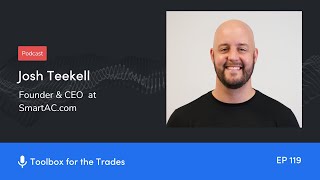
Josh Teagle built SmartAC, an HVAC monitoring system that uses magnet-mounted sensors to track system performance and alert contractors to service opportunities. The sensors cost about $10 a month per system, stream data every 22 seconds, and combine rule-based diagnostics with machine learning to catch problems early. Contractors use it to sell maintenance memberships and schedule proactive service calls.
Questions this video answers
$10 per month per monitored system (includes hardware, mobile apps, dashboard, and customer success).
About 2.5–3 years of sensors in the field; broadly marketed ~1 year.
Data at ~22-second granularity.
Approximately 6–7 years.
60 of the most common faults were validated.
Josh Teagle, you are the founder and CEO of Smartac.com in Houston, Texas. I first heard about you from the one, the only, Ken Goodrich. And upon meeting you and learn a little bit about you, I found out that Smart AC is doing some cool stuff with Service Titan. So I'm so excited to have you on the podcast today and learn a little bit about that. But before we get started, I'm going to kick off this show the way I do every single one, which is how did you get into the trades?
Yeah, so my background is selling to homeowners. I built a very large backyard makeover company before getting into technology. So my background was in home sales, but not in the trades. But when I got into technology, it was very clear that technology could make a big difference in H Vac and so really never worked as an H Vac contractor, but been working with H Vac contractors for a number of years. So it's a really fun area to work. And we found that technology is just expansive. What can be done with it in the trades?
I 100% agree, and I want to learn a little bit about what made you switch from working in the trades to going into tech. Tell me a little bit about what made you make that career shift.
Yeah, so I always wanted to do tech, software, hardware. I have an engineering background and really enjoy that type of stuff. It was really a buddy of mine that had a concept for our first product, which was an energy saving product that kind of kicked off the foray into H Vac. Our first product was actually a product that saved energy on H Vac and had some data capabilities. And it became evident through talking to our customers that they really valued the data. And so that kind of led to the pivot to smartac.com but honestly, the cross section of technology and selling to homeowners was really where I wanted to live. And H Vac was the best opportunity that we saw.
I love that. So I think this is actually a perfect opportunity. I realize I didn't prep you for this question, but I want to clearly identify what smartac.com is, and I think the best way to do it is for me to tell you what I remember it to be and then you can correct me. Does that sound good?
Yeah, go for it.
So what I remember smartac.com to be, as you described it to me a few months ago, is it gives. It's like data in the H Vac units of a homeowner's home, where the contractor is getting constant feedback about the performance of that unit. So instead of the two days a year where someone goes in to service an H Vac unit via service membership, instead contractors getting real time data on the effectiveness of that unit and they're able to proactively call the homeowner and say, hey, we're noticing someone's up with your unit. We should send someone out there as soon as we can to adjust it. How did I do? Grade my. Grade my pitch.
So I think you're. You nailed the nuts and bolts. You nailed the nuts and bolts of what it actually does. That what. The reason we built it is quite different. But. But yes, as far as what the actual physical sensors do and, and you know, what's, what's going on behind the scenes in the, in the software and the sensors. You nailed it right on.
Amazing. So tell me why you built it. What was the need that you identified in the H Vac market that prompted you to build smartac.com?
Yeah, so really the reason we built the platform was about giving contractors in the H Vac and plumbing space another way to acquire and retain customer relationships.
Right.
So when we did our, our research into what had existed in the past in this space with fault detection, things of that nature, it became evident that everyone understood the value of being able to have that remote visibility, but it just hadn't been done in a way that was scalable at a price point that made sense with an install that didn't take a couple hours.
Right.
And so really what we wanted to do was take the old school tried and true methodology and theory of using maintenance agreements to grow your business and then not really change anything in the theory that, you know, acquiring and retaining relationships until there's a big ticket item is the entire, you know, name of the game. Right. But how do we bring technology into that equation to allow that contractors to push that angle more?
Right.
So we built the platform to help to help our partners acquire and retain relationships, really through smart maintenance monitoring only in some cases. But then just after studying the industry, it became evident that maintenance many times is a loss leader. And so we were like, okay, if we have technology, if we have emails, we have apps, how do we go about grabbing that customer relationship more often and then keeping those customers more efficiently and then doing a better job of converting those relationships when there's a big ticket item to be had and there's a need there?
Thank you. That was beautiful explanation. You mentioned that memberships, as they exist today, are a loss leader. And so often on the show we've credited Strong membership programs with building sustainable growth. So tell me a little bit more about what's wrong with the traditional service membership programs that we see today.
You know, so I wouldn't say wrong things wrong with them is probably not something I would say. It's just they're not as efficient as they, as they could be. So one of the main things I tell you know, I get the opportunity to work with some of the larger companies in the country on their maintenance agreements and how to incorporate technology into them. And usually what I tell them is everything you've been doing made sense for the last three, four, five decades.
Right?
It wasn't wrong, it was good.
Right.
But now the one thing you want to think about is you have another arrow in your quiver to accomplish those same objectives.
Right.
And the biggest setback that a lot of these companies have is people and equipment and trucks. And they're not always as scalable as what our partners would like them to be. So we try to, we try to reinforce that now there are scalable methods with technology where you don't have to add more trucks and people to grow your base of customers. And at the end of the day, you know, all of the largest companies in the country are the ones that generally have the largest base of agreements. And that's because, you know, having that steady drum beat of customers that have been with you for a period of time and, and know that they are covered and they have a company of record and this is their company, that's really what allows those conversions to go up.
Of course, I love what you're saying about what smart maintenance can provide the customer because we have all of these tools, like you were saying, we have emails, we have apps, ways to engage with a customer more. But I really think what your product offers is being able to give the customer information that they actually want. So can you tell me a little bit about how smartac provides a better experience for both the contractor and the customer?
Yeah. Great. So we created the hardware required for this kind of business because it didn't exist at the price point we needed. Right. We really don't see ourselves as a hardware company. The software is where the magic happens, right? So once the sensors go in place, and that's actually, I will show you that because it's important. So I mean, the install is like that, right? So you put a sensor on the supply vent, you put one in the return, you put one in the pan of the evaporator, and then very quickly you understand event to vent performance for heating, for cooling. Water leaks, air filters, a lot of different stuff like that. But the beauty isn't really the data or the sensors. The beauty is in the experience you can offer the homeowner.
Right.
And so our app is branded with the partners logo and anything they ever need they can take care of right in the app. So if they want to schedule service, it's a couple of taps done. Of course that's what the integration is going on with service titan now and finished here in the next 30 days. If there's a water leak, they get a notification of it immediately. If the air filter needs to be replaced, they see that we actually gamify the breakdown risk is what we call it of the system. So obviously doing tune ups and changing filters makes a big difference in how likely your system is to fail. So we inform the homeowner this is what you need to do to keep your system running well. And then we have some optional features like live chat with a technician in real time looking at your data or a way to build loyalty with comfort credits over time. And so all those things are a great experience in the app. Now I think it's important to state that we don't really think homeowners care about air conditioning. Like they just don't until the day the system breaks.
Right.
But on that day they really, really do. And so you need to give them the tools to be able to take care of that problem. And then we like as well that the platform allows the homeowner to have value all year long. Right. So like you said earlier, traditionally it's two, three days a year that there's value happening.
Right.
Whereas when you have 365 days of monitoring and monthly reports of the health of the system, it just gives that customer, puts the brand of our partner front and center more often and gives that customer that understanding that they are receiving that value all year long.
Yeah, I really like that. And for anyone who's only listening to the audio, not watching the video, Josh basically threw a magnet on something that was the installation process. It looks like you just like, like not violently but like you know, assertively put a magnet on a piece of metal which I mean what, what a way to demonstrate easy installation. You're really focusing on the homeowner which I absolutely love because so many of our customers here at service site and so many of the guests I talked to on the show are always, are always putting the homeowner front and center. But when I think of my put myself in the contractor shoes, I'm saying I'M thinking to myself, like, wow, okay, I now have this group of customers that have installed this smart AC product where I'm getting really valuable data on the effectiveness of their system. Now, when I speak to this contractor through email or through calling them, whatever, I can provide them with highly personalized data regarding their unit, which just is a game changer and increases conversion by an insane amount. I can't even of the number off the top of my head. So is that the primary benefit you're seeing from partners like Gettle?
Yes. So I actually like to just give an example of what this approach looks like. In the past, everything has been proactive. I'm sorry, reactive.
Right.
The homeowner loses comfort. They call out to the company, and the company is reacting and going out to fix it.
Right.
What's unique about having the visibility of the health of the system remotely is that the approach is quite different. It becomes proactive. And so what that looks like is you call Ms. Jones and you say, hey, we installed these sensors at your house 18 months ago, 24 months ago, and we haven't reached out because everything's been fine. But yesterday, the performance of your system dropped off a cliff, and today it got even worse. So we wanted to reach out and see how would you like us to handle this? We can snooze it for two, three days, see if it gets worse. Or if you'd like, you can pull up your app and look at the exact data I'm looking at here at the office.
Right?
And so now you have a transparent situation where the homeowner is in the loop, they're making a decision with you. And many times, you know, they take one look at a graph that's falling off a cliff with cooling or heating and say, oh, yeah, this is bad. Come on out.
Right?
And so what you've been able to do is you put them in the loop. You made them feel part of the process. It was a transparent situation. You're able to sell armed with that data, right. That they've seen. And then many times, you can actually avoid the actual loss of comfort.
Right.
And if we were envisioning 20 years ago, what would a magic situation be? It would be. Well, outages just never happen. When something's trending down, you fix it. And you never have that outage on a weekend with a party. So, yeah, that experience, being proactive, it's best for the homeowner and it's best for our partners because they have the opportunity at that revenue first. And many times know there's something wrong before the homeowner even knows.
Yeah, I, as you were talking, I was thinking about that. This technology really enables the homeowner to collaborate with the technician with the service company. Give putting that data in their hands, allowing them to reference exactly what you're talking about, I would imagine gives them a sense of personal power that historically they haven't had when it comes to servicing units. Because like you said, it's like I don't know how my air conditioner works. I don't necessarily care about it. I guess I'm going to trust you. But being able to show that data builds trust and validates the concerns of the service company.
Well, this is, I mean, this is.
A little bit tired of collaboration. Yeah, I'm sorry, I didn't mean to cut you off. Please go.
No, you're good. No, we do too. It's a little bit of a tired analogy, but it's the right one.
Right.
And your car, you have an ignition, you have a dashboard.
Right?
Well, the H vac systems really, they have an ignition with thermostats, they don't have a dashboard. And you feel a lot more confident now when you go to get your car fixed, when they stick a diagnostic tool into it and show you, hey, this is what it said is wrong or there's a light on the dashboard. As opposed to the olden days when you know, when you just prayed and hoped that they were telling you the truth and you needed what they said you needed. Right. So yeah, transparency is core to, to what we believe is right for consumers and, and it really helps the, the, our partners in this case as well.
Great. All right, so I am very curious and I'm going to preface this question with the fact that I'm not a very technical minded lady. I'm much more a, I never forget what's the left versus right brain. But anyway, I'm more of a talking person, not so much of a math person. Can you like break down for me in layman's terms how smartac actually works, how those magnets actually work and push data to the app?
Yeah, yeah, definitely. So, yeah, so like you mentioned earlier, super easy installation. Magnetically to the vents, we have accessories if it's a different application and we have a number of different separate accessories for different applications around the country. There's different orientations, but then once that data is coming in, it's coming in at 22nd great granularity. And we can see the runtime of the equipment, we can see the understanding the basically the performance Right. The air going back in to be heated or cooled and the air coming out of the vents to heat or cool the space.
Right.
So that's that delta T kind of vent event allows us to understand how well the system is operating. So there's really two getting in the nitty gritty here. There's a little, there's kind of two main ways that we do that. Number one, when it's is understanding the equipment that's being monitored. So once the, when the system, when our system is installed, the technician takes a picture of the nameplate of the AC equipment. So we know exactly what type of equipment, like the speed, the, you know, all the make, model, all of that. And so what we've done is we created the 60 most common faults for air conditioning in a psychometric chamber with Enertec. So our algorithms are looking for specific faults signatures that we know exist right in the wild.
Right.
So that's kind of a tried and true old school method. But what we also do is we take all of that data and it's 50, 60,000 data points a day per AC system, and we put it into a machine learning model, a regression analysis to basically look to see if things are changing over time.
Right.
So of course it's very important that you're washing all that data with the outdoor conditions and things of that nature of. But we do that and then very simply we can see that if today it's 85 degrees and two weeks ago it was 85 degrees and we've seen a trend of the way the system has performed at that similar outdoor conditions, then it's very obvious something is changing.
Right.
And we're not talking about 1 degree, 2 degree. I mean it's very clear to see a 6, 7, 8 degree difference over time. And that just allows you to know that that system is headed for breaking down where comfort will be lost in the home. And then with that data, we serve it all up to our partners in a dashboard. So we talked about the homeowner experience and that's great. We actually have a pro app as well where they can see all the data in the field for the technicians. But the dashboard in the office is really where if you put thousands of these in the field, you don't really care about the data of all of them. You care about where is there money to be made, where is there a customer who's about to lose comfort that I can help out? And so that's really, you know, that's where the magic happens where we take that data we crunch it, we got a team of 20 people here doing that, and then you see it in the dashboard and you can click on the blinking red light, look at the data, a little bit more granular if you want, and then pick up the phone. So at the end of the day it really is just an end to end service to be able to find out how healthy the system is and then respond proactively and then of course give the homeowner some, some visibility into what makes that possible. And so they have the best experience possible as well.
Technology is crazy, man. It's just really wild sometimes. But that is so cool. You've mentioned a few times that, you know, this historically was something that would be very expensive, right. That the technology didn't exist yet when it came to the way old membership agreements had worked out, work out and some, many of which still do today. So tell me a little bit about the cost because I'm sure there's tons of people right now who are listening, are like this sounds really cool, but how much is it? Where does that, does the homeowner take the bottom line? Does the contractor finance it? What kind of, what does this look like with your partners?
Yeah, so the short answer is it depends. We typically are working with companies that have already utilized technology to grow their business, right? They've deployed a CRM like service titan, right. They, they many other software and hardware companies we, we trade kind of opportunities with and so people understand that technology can take them farther. And so it really just depends on whether or not what they're trying to do. If they're trying to grow their business, which most of the companies we talk to are, then you really want to find a kind of a nice combination. And also you should be using our platform in the most cost effective way possible. So if you're out on a one year old system or a two year old system, you know, maybe it doesn't make sense to give it to them for free, right? Because realistically you're probably a long way off from, from being able to change out that equipment. But of course, if it's 5, 6, 7, 8 years old and you're within striking distance of, of them being a very valuable customer, then then people use a different way. So I always try to encourage our partners to bake it into their maintenance agreements, right. Make them more sexy, give them more appeal to the average homeowner to say yes, right. Take that conversion rate from say 20% to 25% or 30%.
Right.
With adding the technology and then if Ms. Jones or Mr. Jones says no to that. Do what we call smart maintenance, where you have one visit a year, where you still have the visibility the other 364 days, and try to get that at a very reasonable price point. And then if they say no to both of those, you really can still accomplish a lot of the business objectives just by monitoring the equipment, having that branded monthly report to them of the health of their system, live chat, having the brand in the app front and center, and then subsidize when it makes sense. We have some partners that literally give it away in every single situation, and we have some partners that only sell it, right? So it really just depends on what's the business objective. But historically, people spend about 400 to $600 to send a tech out to a house twice a year, and generally they're charging about $200, right? Give or take. And so they have to go out to the house multiple times a year and they really have to be selling something on average to the homeowner to make that even, to break even proposition.
Right.
And so we think that, you know, monitoring only is something that can be done way cheap, way more cheaply, or way more cost effective. And then maybe just incorporating one visit and monitoring is a good option as well. So. But I didn't say the main cost. So we actually, we sell the platform and the sensors and the software and everything we've talked about just for 10 bucks a month, right? And that's per system that's monitored. So that includes the hardware, that includes the mobile app for the homeowner, for the technician, the dashboard, all the customer success.
Right.
And so that has been very exciting to see when we, when we deal with the partners and we say look, for 120 bucks a year, you can know that, you know that you are the company of record, right. And that you will, you will be standing ready when there's money to be made. So, yeah, we worked really hard to make the product cost effective. And we actually have a special deal for Service Titan customers as well. So we give away a free water sensor. A lot of Service Titan customers do plumbing as well. So we give away a water sensor to go in the plumbing pan or, I'm sorry, the water heater pan, so you can kind of grab that trade as well. Or we allow them to give away free filters for their customers when they sign up for their smart maintenance plan. And we also have a long life battery pack as well. So many of our partners are leaning into monitoring only, right? Not going until they know there's revenue and the homeowner has seen it in the app.
Right.
And so in those situations, you don't want to be changing out batteries every couple of years. So we have a long 6, 7 year battery pack as well. So we have some great, great incentives for Service Titan customers, which admittedly end up being some of the best companies for us to work with. And so really excited about the partnership, the integration and what we can do together with Service Titan.
This is so cool, Josh. I mean, when I first spoke to you, I was blown away by how cool this technology is and I'm still blown away by how cool it is. And I just think this is going to revolutionize the way that service companies nurture their customers. And I think it's going to be so cool to see maybe like a comparison study because how long have you guys been in market? How long have you been selling the smart AC to contractors?
Yeah, so we've had the sensors in the field for two and a half, three years. We really wanted to make sure we got the product and the offering perfect before we took it to market. And we wanted to work in every single central air application around the country. So it's been about the last year. It was in ahr last year. So we're coming up on our one year anniversary of kind of being live to the market. Of course, we were building the platform with feedback from some of the biggest names you mentioned, Gettle and Ken. But yeah, about the last year since we've been pushing it out in the market in a big way.
That's so cool. I can't wait to see like what data you pull after being on Market for 3, 5, 10 years. Cause I really think this is gonna be a game change. So tell me a little bit about some of the feedback you've gotten from contractors so far. Are there any real stories you'd like to share?
Yeah, so we have a lot of, a lot of, you know, just boring, mundane data stories that I won't bore you with. But I think some of the biggest ones are, well, the most important ones for us are when people have a dramatic change in their take rate to plans.
Right.
So, you know, we, we've seen our partners triple their conversion rate from 20% to 60%.
Right.
On people signing up for an ongoing relationship through a membership. And so that's really, that's the reason we made the product. So we get most excited about, about that. But there's been great stories, you know, catching water leaks when someone was leading out, leaving out of Town, Right. You know, a lot of that up north with some pumps and basements and things of that nature. And then just, you know, a lot of these become non stories.
Right?
Like instead of there being an outage for a party, an alternate universe happens and it doesn't happen and they don't lose comfort.
Right.
And so it's kind of like a referee, right? If you're being ignored, you're doing your job well. Right. So I think at the end of the day, it is a very different experience for the homeowner. And sometimes that isn't dramatic, it's just, you know, hey, we saw it, let's head it off now. But most of our exciting wins, our, for our, for our team is when we see our partners, you know, do a better job by, you know, spending three or four hundred, you know, two, three hundred dollars on a lead and converting half of those to an ongoing relationship instead of 20%.
Right.
And so that's really the metrics that we, that we track, we both look at historically and we track on a going forward basis to see the difference that we can make.
That's so cool. That's just so cool, man. So because you've been fine tuning this program for years, what's one thing contractors should consider before working with smart ac?
So I think I mentioned this earlier, but our best partners are the ones that know their numbers, that already utilize technology, a CRM, to know those numbers.
Right.
And so I think I mentioned this earlier, but I think the main thing you have to consider is just we're not asking people to do anything different from a strategy standpoint. We're just saying, hey, here's another tool to do the same exact strategy you've been doing for five decades, right? I mean, Jim Abrams came up with maintenance plans back in the 80s, and that was a brilliant concept at the time and really hasn't changed much until now. So really it's just kind of think about your business, think about what are your objectives if you're trying to grow the business, think about what are the KPIs that drive that. And then our platform ends up being utilized in very different ways for very different customers. Right? It really just depends. Our partners, it depends on what their business objectives are. But usually there's one or two wins where they see, hey, here's a KPI that we can make better. And let's deploy this in a test and then measure, see the difference in the KPI and then not scale until the data says it makes sense.
Right?
So, so we drink the same Kool Aid that we tell others to drink in that. Look, at the end of the day, we want people to see the difference and then not scale until it's been proven. Just like we don't ship a feature in the app until we've tested it for two weeks. People should test our platform in their business to accomplish the objectives they want before they scale. So that all boils down to. It's a new arrow in your quiver. Think about how you would go about this with this arrow if you were starting, kind of starting from scratch.
Got it. So tell me a little bit about the relationship with Service Titan. As I mentioned before, you and I talked, and then while we were talking, it was like, oh, wait, you're already partnering with us. Huh? And so it's been a few months since you and I have caught up, so. And totally fine if you don't have all the answers here. But for Service Titan customers who are listening, who are interested in smartac, what can they expect in terms of what will the partnership look like?
Yeah, So I think it's growing into perhaps more of a channel partnership. Right now, we're mostly at the integration of the software phase. So really, in a perfect world, people wouldn't have to be logging out of one dashboard and logging into other to see data. We care most about the experience of the customer. Sometimes that's the homeowner. In this case, it's the contractor dispatcher in the office. And so the integration allows our data, our lead, our opportunity to make money to flow directly through. Into. Into Servicetitan so that it's blinking red right there. Sure, if they want to dive into way more nitty gritty data, they can. But many times, especially after geeking out for the first two or three weeks, they just start to trust the snippet of data on the screen and saying, hey, the Split's off by 5 degrees.
Right.
And so that integration is great. But then also the scheduling is a big integration as well. So if you're having the opportunity of going out of the house multiple times a year, having that scheduling being done right through an app allows you to save phone calls, make it more automated. And so there's a lot of features that are coming down the line with the integration that will just allow it to be seamless in Servicetitan, would we like more eyeballs on our dashboard? Sure. But really, at the end of the day, it's about the right experience and fitting into the normal workflow. And so we're excited to partner with Service Titan on that and then, you know, and then eventually also have dashboards to show the KPIs, the changes tagging homeowners when they have the our system installed. So you can actually see with the actual data that it makes a big difference in the churn rate or in the average ticket or you know, the closing percentage and things of that nature. So obviously Service Titan is the best data company in this space and we consider ourselves to be a data driven company as well. And so utilizing some of the KPIs from Service Titan and showing how we can impact those KPIs is really where the, the most exciting opportunities lie outside of just having the integration of working in both platforms be seamless.
Amazing. I am so excited for this all to be finished. For everyone listening, we'll link some resources in the show notes so you can check them out there. But Josh, man, thank you so much for taking the time to tell us about Smart ac. I. You're so passionate about this project and I could tell just by the way you speak about it, you've got me excited about it. I can't wait to have the partnership live and hear from our customers about how this is going. Before we end, I want to give you the opportunity. Is there anything else you want to talk about that we haven't covered yet?
No. Jackie, I think this has been really great. I think for so, for so long. We have been building this in stealth for like two or, or three years and we were just really excited to show the world what we built and so very excited to have this opportunity to get it out there a little bit broader and we'd love to work with any and all Service Titan customers and we want feedback too. I think at the end of the day, anyone that thinks they have it all figured out is just not going about things the right way. So we definitely listen to our partners and we want feedback. If there's features or, or different things that will help our partners grow their business in a better way, then we want that. So I always want that to come through. Even though we are confident in what we built and passionate about it, the only reason we even built this platform is because we listened to our customers and what they wanted. So we'd like to continue to do that moving forward. But thank you very much for this opportunity, Jackie. It's been a good, fun chat.
Of course, of course. All right, last question. My favorite question to ask. If you were to choose a song to be the soundtrack of your life, what would it be?
Yeah, that's a hard one. You know, I'm a. I'm a. I'm an Eminem fan, so I would probably say Not Afraid would be a good one. Just a good combination of lyrics and overall vibe. But that's a tough question.
Thank you. It is. I love asking it. Ben Davis from Express Plumbing also put Eminem. So I need to make a playlist of all these songs. I'm saying it on air, so I commit to it. But, Josh, thank you so much for joining me today. Thank you for giving us some of your time today on Toolbox for the trades, and I hope to talk to you soon.
Thank you, Jackie. Appreciate it.
More from Bill




Capturing the 80%: How SmartAC’s Gen-2 Targets Non-Membership Homeowners | Podcast Ep. 296

Build better customer data with every booking in ServiceTitan | TAD Tune-Up Series

The Biggest Change for Roofers Coming From Other Roofing Software to #ServiceTitan?

