Getting Started with ServiceTitan Inventory Management | Podcast Ep. 01 | Mastering ServiceTitan
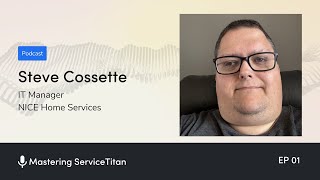
Josh Lu talks with Steve Cosette, head of IT at Nice Home Services, about inventory management in ServiceTitan. They cover setup tips, common mistakes, and how to organize your warehouse better.
Foreign. Welcome to Mastering Service Titan, where we get expert advice from power users. I'm your host, Josh Lu, and today I'm here with Steve Cosette. Steve is the head of IT at Nice Home Services, and you may know Steve from the Service Titan Masterminds group on Facebook. He's always helping people with all their various tech challenges. We were just nerding out right before we started recording about different things he's working on. Steve, so excited to have you and welcome to the show.
Nice to be here.
First question for you. We'll jump right in. Why do you love the topic of inventory so much?
Inventory is. I'm a person that has always been good in math. Well, mostly, I guess school would disagree, but I've always been good with math, and I like things to be in a certain order and stuff like that. When my boss approached me about a problem with logistics and all that stuff, he's like, do you. Can you help? It was less of a you're going to help and more, do you want the help? Because he knows that's going to be a big one. It's like, yeah, of course. Sure. No one in the company had. You need to have a very analytic, analytical mind in order to get to do logistics. Things have to follow a certain thing, a certain, you know, workflow, or it's going to get completely messed up. So, yes, essentially, that's how I started with Adventure. We had a message, I helped fix.
It, and right before we started recording, you were showing me all this crazy code that you were working on. And for people listening, Steve actually taught himself how to code. And I was like, how did you do that? And he's like, I just like to mess around and tinker with stuff.
Yeah. You know how when you're a kid, you notice something and you're like, oh, that is so sweet. And you start messing with it. It's like, you know, getting books about it when you were a kid, or you were asking your parents how to do it, and later on you make it a hobby or something, or something more than a hobby. That's how it started.
That is awesome. So at the most basic level, could you describe, for those who don't really understand inventory, what exactly is inventory management and how does it work?
Inventory management is a system that allows you to track logistically, you know, through data and reports and whatever, exactly what's going on in your warehouse when it's happening and how much it's costing you and all that stuff. And every single step of the. Of. Of the process of your day. The way that it works is that you have multiple little modules, you have purchase orders, you have returns, you have inventory counts, you have the transfers, you have adjustments. Each one does essentially reflects what you do in real life on your warehouse. And everything that you do in real life has to be entered in the system. If not, you're making multiple mistakes at once.
Yeah, talk about multiple mistakes. I remember our previous conversation. You mentioned this nightmare on tax day. Can you talk about how bad inventory management was at your guys company and what happened?
So before we got into Service titans inventory management, we were using QuickBooks Desktop with inventory tracking. I mean, it's a good software, but the problem is that that software has virtually no guardrails. In other words, the person that manages your inventory can do whatever they want to your inventory. What happened is that a. Around the end of the of a year, I believe it was in 2021 when our boss was starting to look at the numbers, you know, for his income taxes and if that. I noticed the warehouse looked extremely bloated value wise, like we're talking about 200k upwards. And it's like he knew you did not have 200k in the warehouse. So at that point he was like, okay, we need to do a recount. But he noticed things were so far gone that he basically was like, all right, let's just bring down the whole house and just redo it from scratch. Recount everything and bringing it to Service Titan. When we did that, the inventory module in Service Titan was only freshly out the door. It hadn't been too long since it's been released. So I was a little wondering about it. You know, I wasn't too sure about it. We decided, you know what, let's just jump all in and we'll deal with the repercussions afterwards. There was some repercussions, but it was actually pretty painless. I'm not saying that there was not any mistakes and there's still mistakes that we're still working through. But yes, it's just that's how we started with a messed up inventory and now we are much better off.
Yeah. And I wanted to go over some of those mistakes a little bit later in the conversation so people can learn from, you know, the journey that you took and they can start fresh and correct. Before we get there, can you talk a little bit about some of the other issues that can happen if you don't manage your inventory properly. You mentioned like knowing the cost of things.
So I guess it depends how each company does Their inventory tracking some of them completely gives control over to a local vendor that replenishes the warehouse. Depending on a set template that they can just say you have that much in your inventory. It's kind of a case of a letting someone else do it. Some people are going more towards a ignorance is bliss kind of approach. In other words, they literally don't track it. They, they make a, a guesstimate by how much they sold in the year or something like that. I don't, I'm doing a lot of assumption here, but if you track it, you at least get, get very close to what is your actual value. And it just makes it easier for you to also build your pricing and you know, knowing what's your actual material costs, how much you know, and all that stuff. It just makes it easier to get good numbers for the, for the business owner.
That makes sense. If you want to run a profitable business, you got to know what your actual costs are. Right. And so the ignorance is bliss. People, it's kind of seems kind of scary because in reality their profit margins or they may not really know what's going on in terms of how successful their business is.
Correct. Yeah, it's just for some companies, I guess it depends again on sizes. If you're a company that does 20 million a year or 50 million a year, if you don't do inventory management, I would say that's a red flag. But if you're a company that does less than 1 million and you have like 5, maybe 10 employees, you might not need a full blown inventory management module. That's why, and I'm assuming we'll talk about that later, Inventory management can be enabled at different levels, at different, you know, grades, if you know what I mean.
Yeah. And I also. Do you think a lot of people, they just don't tackle inventory because it seems too painful?
Honestly, the most painful part about inventory is not tracking the actual materials. It's the human factor. And in a lot of cases that is the problem. But it's just sometimes people don't do it right or they don't understand that. They don't understand the nuances of the system and if they. Dad, they don't do it right. It's just coordinating all of that that is the painful part.
Right. I was looking at the chat that you so graciously moderate on our Facebook Mastermind. So I just want to shout that out. There's an inventory and purchasing chat display discussion group on Facebook Masterminds. You could join Steve's in there moderating and helping answer questions. This seemed like the consensus is people look at inventory management and they're like, wow, this is a huge mountain to try to solve. Now if you were to tackle this with some advice on getting it set up, what's the first thing that you would do first?
In order to have as much tracked and veg materials as you can, you kind of need two pieces depending again on the company and how you do things. I would say in your pressbook, make sure your materials are all assigned to your tasks, at least with an average quantity. Like for example, if you're going to do an AC tune up, you're going to need a set. I don't do, I don't know of H vac myself, so I don't know exactly. But you're going to have a set amount of materials. Get with your managers, say, okay, we use an average that much R410 a, we use that much, you know, bolts and whatever. Just put that in your tasks if possible, with the right cost. Because again, at the same time you'll be able to look at your job costing based on what you entered in your pressbook and see how much you would be getting in profits. So as accurate as you can get it, you'll be able to see how much profit you're making in your gross profit, your costs, your labor costs. If you put some some hours on your tasks. It is awesome. You know what I mean?
So first things, clean up your price book when it comes to the materials. How about the physical warehouse? Any first step they should take there?
In a physical warehouse, they should make everything in bins. What I mean by that? They should order everything as much as they could, as much as they can classify things in bin like in the however you want to do it. I guess it goes from warehouse to warehouse depending on how big you are. But A one, a two, a three, a four, B one, B two and so on. Just make sure that it's all classified noted down so that you can enter it in your templates and service stacking so that when you do transacting like that, it will tell you that part is in A1, that part isn't, C3, that part isn't. It's easy, it's easier to find and then you can also label those bins.
So first step is cleanup. It sounds like cleaning up the physical warehouse and then cleaning up your price book. And it sounds like if people just did that first step and then decided to tackle inventory later, inventory management later, they would at least get some Benefits from that.
Oh, yeah.
Now, how about where does count the count come in?
Counts are. Inventory is a thing that will never be 100% accurate. You can try to strive for 100%, but in reality, it's never going to happen. So your accounts is that every again, that's going to vary from company to company. But every, let's say, month, you want to do a count of each one of your trucks, you want to do a count of your warehouse, see where you're at and adjusting and bringing it up to snuff. Because if your inventory is too skewed, then it's not going to be useful to you. It's going to lose its usefulness. It's a little bit like cutting your hair. Like every month you got to clean your hair, you start looking like a hobo. You just got to do it.
I was supposed to get a haircut before we did this interview, but I didn't. So my hair. You're all trying to look like a hobo.
You're not even close.
Let's go to some of the mistakes and some of the learnings from when you first set up. I remember you mentioning you're getting set up on a, like a weekend or something like that. Is that something you guys messed up originally?
Yes, we got set. We set our up on a weekday. The problem with that is that as your job's complete, inventory gets depleted from your system. So as you count already, let's say you do an account and you're messing with things already. If you're, you're a job completes, it's going to deduct from some of the inventory or it's going to cause some export errors. And do it when things are as quiet as possible, either through an evening when all the trucks are back in the, back in the shop and all the jobs is completed, or on a, on a, on a day that your, your, your company is closed, your inventory is essentially your backpack. If you don't have a, a good inventory account, then why are you doing the inventory tracking in the first place?
So it's like what, you can't count things if things are constantly moving in and out of the backpack. It's like you need the backpack to stay still for a second.
Exactly.
Get an accurate count.
Yes.
So that would be maybe on a Sunday evening or something like that?
Yes, Sunday. Even Sunday the day. If you know your company is closed on Sundays or a weekday evening. Like if you do account in your main warehouse. Again, depending on how big your warehouse is, it's Going to take you a couple of hours. You're going to enter that in the app, save it, and then you're out. It's just then maybe you can do the next day, like the warehouse. Like for now you can. You might be able to do warehouse later though. Keep in mind, service, service, when enable it, it's going to track everything, all warehouses, all trucks. So I guess for now you'll be able to do adjustments to just bring your trucks back in. There's multiple ways to do it with varying degrees of annoyance, of complexity, but it depends how you're willing to do it. It's just. Yeah, that's essentially it. Sorry, I'm getting too much in the weeds.
No, that's exactly what this podcast is for. So in terms of complexity, is there a way to tackle inventory management with just one step? Like, do you have to really put every single bolt in tiny little material? Or is there a way to just start with, I don't know, like an 8020 approach here?
Yes. So I would recommend for those that are thinking about going to inventory, get with your management, see how far the rabbit hole you want to get. Like, if you're a small company, you might be okay with only tracking equipments, like only tracking the big things like the thermostats, the equipments, maybe, maybe not even the thermostats, like the big stuff. If you want to get more tracking and inventory, you can get into bolts and sheets of metals and gases and all that stuff. I know for a lot of companies the R410A is A. It's a government regulatory thing that you need to know how much you have and stuff like that and make sure you're not being, you're not being stolen from and stuff like that. That is, that's why the R410A, you know, might also be a good idea to track. But that's essentially it. And some good thing too, to know is when you do tracking, you need to understand your unit of measure. That's one thing I had a hard time explaining last time that we talked. You need to measure, for example, your R410A. Are you going to track it by bottle? Are you going to track it by pound? Are you going to track it by, you know, like, however you do it. Like, for us, we carry a small, you know, a small weighting thing that they put that, the thing in, say, okay, that, that £20 jug has £16 left. I know it's not 100% accurate because it also counts the weight of the, the jug but it gets it close. So this way we kind of, you know, keep a good track of our, you know, of our stuff. But this also applies to, to boxes of screws for example. Are you going to track the screws themselves? Are counting it one by one or you're going to get boxes of screws and what you take approximately is left in the box and you have to define all of that. And because service lightning right now does not have a way to track the unit of measure, it has a feel for unit of measure but honestly it doesn't show anywhere. So it's completely useless. So what I do is I add it to the description and I add it to the inventory templates so that it's easier for people to see when they transfer or when they use it. That's how it works.
Do you think strategy wise it's pretty much across the board it's better to just tackle the big stuff like equipment and then forget all the small little materials and, and then once you have that down within servicetent inventory, then bring in all the smaller items.
Yes, yeah, you can do that. The other thing is you have to keep in mind too that in order to add stuff to inventory you need to be doing your PLS and Service Titan which like you said, you can make the small materials just not make it inventory trackable and just do all the peels on service Titan. Just do keep in mind as later on if you need to actually turn inventory tracked or you know, turn serial number tracking that you're going to need to maybe re, you know, duplicate the material which can cause a bit of a mess because if you export to QuickBooks Desktop, an item that is non inventory cannot be switched to inventory mode. It's just so you need to basically deactivate the old one and create a new one which can create a bit of a mess and a lot of duplication.
What other prerequisites are there for the metric tracking for inventory management? Yeah, you mentioned pos.
Well, because if you don't have pos, then what are you going to do? You're going to adjust your inventory as you're at it. You can make POS that are going to be like your purchase orders that are going to be like from each vendor that you use. You enter the cost, anything like that and you just, when you receive it, it gets added to the invoice that's and that adds to your inventory and adds to the invoice or you make a PO that's not linked to an invoice. You Receive it, it gets added to the warehouse or to the truck or you can do transfers or anything like that. So yes, if you don't have any pos, if you don't make pos, you're not adding to inventory unless you're, I wouldn't say fudget and just do adjustments but then you make a lot of adjustments and it gets hard to track. And where did you get that from? It's not written in the adjustments and eh, it's just accountability wise. It's better to just follow the process as much as possible.
Yeah, I think that's a theme here is like you want to follow the best practice like use the guard. The guardrails are there for a reason. Or else you can get kind of hey, why are you starting messing with one thing and then another thing gets a whole lot of whack and then you're fudging everything and there's probably someone listening who's just cringing right now at how their account is set up. So it sounds like to sum up the prerequisites we have clean up your price book with all the materials you got to be using POS within Service Titan. Is there anything else we're missing?
I would say if I were the company that were just about to be ready to turn it on, spend, have your tax at least one or two. Not your tax your warehouse associates at least one or two hours a day for maybe one or two weeks beforehand. Go on Next. Go on Next. Go look at sold estimates and try to go to your order normal ordering process. See how the inventory moves, how to track your inventory. Have test like let's say you fill a job and say all right, let's go look at inventory. How much bolts I have. Play with it. Go try to get accustomed to it. We're not going to be doing all the possible mistakes that you will do afterwards, but at least you'll be able to get your feet wet.
Next is your best friend. Definitely practice in there beforehand.
Next. Or practice and a lot of people don't know the difference between the two.
Oh, can you share the difference?
Actually yeah. Next essentially is the version of Service Titan that usually is the next one that you don't have on live yet. It gets refreshed with your live data once every week if I'm not mistaken. I think there's some times that it gets kept but as far as practice goes, it gets refreshed only once per update. When an update comes out, it gets refreshed, it gets updated and then until the next Release it's more stable. Practice next tends to be more laggy, more unstable. But practice is probably usually your best friend.
Okay, so use it in practice first and then, then go live. Or would you go practice first and then next and then go live?
You can play a bit of a mix of the two. Use the two as your. Sometimes you might run out of, of a material in and practice. You just switch to next and just play with other stuff. It's just use them as tools because nothing is live.
Gotcha. How about the inventory app? When does that come into play? Is that like too advanced for people just getting started?
No, I would say that's a good idea to learn about that. It's basically just a simplified interface for service sentence and service license inventory. It allows you to do some tasks in the warehouse. Like I keep taking, like, you know how sometimes you go to Walmart on the. There's columns that are right in the middle of the Walmart that have price checkers on it similar to that. Put your, your, your small tablets on, like on your shelves, anything like that, they can just pick it up, open the app and just start doing the transfers and stuff like that, like straight from the tablet. They can even create users that are basically tailored for those tablets that are going to be able to do transfers. The app can do transfers, it can do receiving, it can do also inventory counts. It's very, very useful. Instead of having to lug around a big laptop or Microsoft Surface, anything like that with the desktop interface that's always super tailored to touch, it's just a lot more useful.
Okay, cool. I want to transition a little bit to the people side of things. So, you know, we have all these great ideas. We want to implement these things. We're going to need some people to help us.
Yes.
What advice would you have on actually putting this into action? Hiring the right warehouse manager, working with your technicians, things like that.
Of course, you need a warehouse manager that's going to be willing to do the work and not fudge the numbers. That is something that even us wrestled with a lot. It is always a. It's always difficult because you always want to try to find someone that has the same philosophy as you as far as tracking inventory. And we're the kind of person that track a lot of stuff, so. But sometimes some people have, you know, how people are, how human, how humans are. And inventory is one thing. Sometimes that frustrates a lot of warehouse managers because there's a lot of moving parts and there's also a lot of hands in the cookie jar. What I mean by that is if you don't lock down your warehouse and you have a lot of people transferring stuff, they don't always all enter in and service titan or, or they don't enter it properly. So then you're kind of like left with a messed up warehouse. If there's parents in the house, just imagine kids entering in the house and starting to look for food. They're going to empty out your pantry and all this stuff and be like, okay, what do I have left now? It's basically that you just got to, you know, keep track of your warehouse, set up workflows in your company, that only some people have access to it. Make sure that your technicians are taught to enter the materials that they use. Because, yes, we can add it to the task as much as you want, but you will never be able to add 100% of your materials. There's. Sometimes they're going to sell a thermostat that might not get added to an estimate. They need to add it to the invoice or it's going to remain under the truck even though it's no longer there. It's a lot of messing with people, like making sure that they track everything. And it's just complicated. But it is a constant struggle.
That's business for you, right? The people side is like the hardest side. Is there anything that you guys practice, like, how do you do it? Are there certain meetings or trainings that you regularly hold to keep people orderly and on task?
Not necessarily. It's more of a question that we see the problems as they come and they usually tackle that. We usually tackle it as much as we can. The one, like I said, the constant struggle, and it is still struggle for us, is to make sure technicians add stuff to the invoice and properly. Sometimes it's being added wrong or not at the right place or we have to keep going behind them. It's just it is what it is.
Is what it is. That's actually a really good mindset, probably for inventory, because it seems like you're never going to get it perfect and you just have to live.
I said never. 100% correct? Nope. But some might say that if you're never Gonna get it 100% correct, why even bother? Because having it 60, 70% of the way there is much better than having it 0% of the way there. In other words, you have at least an idea of how things are running. And yes, you might spot sometimes, like we have happened in the past, that we've spotted. Hey, why does that material cost that much? We are like for example, it shouldn't cost 60 bucks for a roll of tape. Then we go look, okay, we're going to fix it and then our cost goes. We find bugs. It's like in programming, you find bugs, you fix them.
Speaking of programming, I want to close with introducing and sharing one of these tools that you've created to help continue to serve our community and our customers. Can you tell us what is my h vac tools.com, why did you start it and what exactly does it do?
Myhvactools.com is a small service that me my boss from my from Nice Home Services and Cherie which is our well she went through multiple positions but now she's a CSR manager as well as marketing. I've created a lot of integrations in Nice for everything over the over the years, one of which is the Calendar Sync. Calendar Sync was created from a need from our salespeople sometimes going like needing to go to leads but they don't know when their leads are. Yes, they can check the app, but they would like to just be dinged like an hour in advance before the lead to know when their lead is. This is what it does. It takes the appointments from Service Titan and synchronizes them over to Google Calendar and or Microsoft Outlook so that whoever uses those calendars can know when their appointments are. It also includes the job details like some of the job notes, when it's scheduled, what location it is, and so on. It's a really awesome tool. We've had quite a few clients. We used to have a free version with the API as it is right now we cannot offer that anymore. But it is a very nice tool that we've had quite a few clients and yeah we've had. It's very useful.
Awesome. So check it out@myhvactools.com Steve thanks so much for joining us. In summary, I just want to give people listening a few action items. First, clean up your warehouse. If it is a mess, get some bins, label those bins, get your warehouse cleaned. Second, get your price book cleaned up with the materials assigned to tasks and even if you just stop there, you'll see a huge difference in your business and how it operates from there. If you can get your equipment into inventory management within service sign first. That is a great place to start. Just like Steve said, you don't have to have it all or nothing. That that's a common bias we have. Is this all or nothing thinking you can slowly get there, 60, 70% and then get the little details later. So that's enough for you to chew on. We'll end it there. We'll link some help articles and videos on how to exactly set this up today. So if you're inspired, check out the links in the description and we'll see you on the next episode. Thank you so much, Steve, for joining us.
You're welcome.
More from Bill




Capturing the 80%: How SmartAC’s Gen-2 Targets Non-Membership Homeowners | Podcast Ep. 296

Build better customer data with every booking in ServiceTitan | TAD Tune-Up Series

The Biggest Change for Roofers Coming From Other Roofing Software to #ServiceTitan?

