Getting Unstuck: How to Break Through the $5 Million Ceiling| Podcast Ep. 37| Mastering ServiceTitan
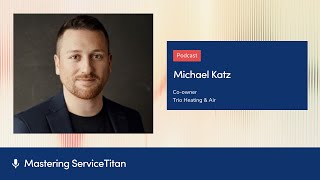
Michael Katz, co-owner of Trio Heating Air & Plumbing, shares how to scale a service business past $5 million. Focus on revenue-facing roles with clear KPIs: call pickup under 15 seconds, CSR conversion 80-85%, sales conversion 20-30% from marketed leads. Stack incentives for technicians (membership commissions, time-on-site targets 60-90 minutes) and installers (revenue thresholds trigger $2,500 team lead bonuses, $250 callback penalties).
Questions this video answers
Within 15 seconds.
80–85% conversion (with spiff tiers at 90% and 95%).
2–4 minutes per call; example monthly minutes target given as ~650–750 minutes.
Bonus equal to roughly the first month of the membership (example amounts mentioned: $20–$25 per sale).
Tiered rewards from about $5 up to ~$250 depending on ticket size (examples: $5 for <$888, $50 for $1,900–$5,000, up to $250 for $5,000+).
The revenue facing people are the people that are going to make or break the business. Call center, service technicians, sales installers. Those are the people that are interacting with your customers. Those are the people that are controlling your main KPIs.
Welcome back to Mastering Service Titan, where you get expert advice from power users. I'm your host, Josh Liu, and today I'm joined by Michael Katz, the co owner at Trio Heating Air and Plumbing. And this is the second part to a three part miniseries on getting to your first million, getting a five and what it takes to get to 10 million and beyond. And so today we're diving into getting to 5 million. Michael, we were just talking about how right around a million, you went to your first pantheon in 2022 in the spring here in LA. Can you paint a picture of what did the business look like at that stage and what you think of your first Pantheon?
Yeah. And thank you again for having me on this amazing thing. I love talking to you so much. 2022, we were on HouseCo Pro at the time and we were dying to get on service time because my brother was just, you know, raving about how good this software was. We had the courage, we made sure to sign up for it. So we did it and we were invited to Pantheon. You know, the business was an absolute chaos. You know, if we're not there catching every ball that's dropping, oh my God, like we're going to come back to lawsuits and stuff. We were able to get help from our csm. They gave us free tickets. So we were like, all right, you know what, let's do this. And we went over there. Now we were just starting to get to know the trades industry. We're coming into this beautiful event Coliseum. I did a little bit of research around the time because I was just getting into the industry. So I started knowing the names of the industry, right. I heard about, well, Tommy Melo, always a big fan of him. Ken Goodrich, right, A billionaire in the industry. Been doing it since the 80s. And then the Godfather, right. And then we have Leland Smith. And then we had up and Comers, right. Ishmael at the time with NextGen about the business itself. It was at the point that we were just breaking, breaking the million into two or three, trying to figure out what to do, but we really didn't have processes that made sense. We didn't know how to use ServiceNow in the proper way. We did not have the proper pay plans because we kept hearing different pay plan plans that are the best. We were just setting up everything, the warehouse, the shop, trying to understand the size of the office we should get because we noticed we're growing fast. We go for like 5,000 or 20,000 square foot. Should we do at least for two years. It was just a mess. It was, it was, you know, a lot of problems. So I'm shocked we're able to get away for a few days and our phone was ringing off the hook every second. Got into the pantheon and going into one session and my mind is blown. I, I finally got the right answer that made sense to me. Everything started to click. Every two, two seconds, David and I are looking at each other like, oh my God, like, this is incredible. And then I'm sitting in another session and again my mind is grown. And then I'm talking to Leland, you know, owner of Service Champions, guru in the industry. Absolutely incredible. Build a business to 100 something million, you know, sold it. So good with his numbers, so good with his processes, like, really incredible. And talking to him and I'm getting so motivated and I'm talking to Ken Goodrich, a billionaire, right? Billionaire in industry. I only heard about Jeff Bezos and people at the time. It just, the, the idea started to form. We just started to understand what are the right pay plans we need to have. What, what needs to happen every single day, what needs to happen every week, every single month. And everything just started forming. So now we were on a race to implement. There was just so many ideas. Now the problem with that was, what's the first thing? What do you do first? My train of thought is everything, let's just take a big old bite and maybe I'll choke, maybe I'll, you know, figure it out. And my brother has a little bit of a different mindset, so he was making sure to direct me and say, no, you finished this first and you finished this next. So the idea was, and this is the transition from 1 to 5 to even a little bit of 10 million. You have your customer journey from the moment they see you online to the moment they're becoming a repeating customer. And you have a lot of questions about how is this supposed to look like? What should I do? Does this make sense to my business model? Do I believe in this, do I believe in that? Or do I even have a say? If it comes to call center, which is one of the first things there's first of all, marketing and branding, which is a very big topic which I can talk about, but when it comes to call center and I want to talk about revenue, revenue facing people, because Your revenue facing people are the people that are going to make or break the business. By revenue facing, what I mean is call center service technicians, sales installers. Those are the people that are interacting with your customers. Those are the people that are controlling your main KPIs. If you dump $10,000, $50,000, $100,000 into marketing spend and your call center is converting at 60%, where's the remaining 41? You need to make sure that you are actually having the KPIs for each department and having the process for each department. You're not going to be able to get the five and you're not going to be able to cross the five if you don't have these things in place for call center. And hopefully in all these different sessions that we're doing, people are pausing, writing things down because I'm going to try to break it apart for each department and a few things that are actionable that someone can take and do things that are not overly complicated. And again, I hate the world for having ChatGPT now when I was doing 16 hours a day, working seven days, working my ass off, trying to figure out how to write stuff, feeling like I'm a, I'm a dyslexic monkey trying to come up with stuff. So nowadays everything that I give people, they can literally just record me. Dump it into ChatGPT. It'll give them an action plan for, for the next six months. So whatever. But it's okay. When you have your call center, you need to make sure that calls are being picked up within 15 seconds. Why is it important within 15 seconds? First of all, customers have a very short attention span. If you're not picking up the call, they're calling the next person. If I'm calling and no one is answering and I have a leak and I'm looking at the water, I'm hanging up during the night. Spike, you think I'm going to leave you a voicemail? No, I'm not leaving you a voicemail. I'm going to leave you a bad review. Maybe. You got to make sure your call center is picking up in 15 seconds. In addition to that, there's also a lot of AI and Google automation. So you got to understand that Google wants to make sure which is the biggest source. Google is the behemoth, right? Like you got to make sure to have Google operating as Google wants you to operate. Google wants to give their customers quick responses. Google wants data. Google wants to make sure that you're not playing with the system or with the customer. So if One company is 60 seconds to pick up the phone, or three minutes to pick up the phone, another company is 15 seconds, right? One, five. You're going to make sure to. Google is going to make sure to put you as a priority. In addition to that, if you're giving Google the data, the email and the name and everything that Google is wanting, you're filling up all the blank boxes. Google's giving you blank boxes. That means fill those suckers up. So if you fill up that information, Google is going to actually like it. They're going to give you more. If you're going to try to play with the system, you're not going to play with Google. They have so much AI on levels that you don't even aware of. So if you're going to go in and say, customer decided to cancel the appointment because you want to get a refund for that, click. And you're doing, you know, something like that, it's not going to work. And at the same time, you also don't want to overpay Google. You're like, let me beat my competition and just throw a little bit of money or talk to someone who's a marketer and get some idea. But pick up the phone quickly. Number one, don't have a long message. Don't have an automated. Press 1 for this, do this for that. The phone is ringing. Thank you for calling Trio Heating in air. My name is this and that. How can I make you smile today? How can I help you today? And also, don't say, how can I make you smile If I'm a csr, I'll shoot myself in the head if I have to say, how can I make you smile today? Like 50, 100 times a day, or CSR is absolutely hated. Now. What is the KPI for? Call center? You picked up the phone quickly. Okay, your CSRs, do they have answers for all the questions that customers are asking them? Anything that repeats more than twice a month has to be a process. That's what people need to remember. Anything that repeats more than twice a month, if it's happened multiple times a day, that's a pain point. Your CSRs are struggling. You're giving them brain damage. You got to help them. Once you give them the answers and basic questions, you give them the guidelines to what to do and what not to do. Great. Now your CSRs are not going to answer a question about, oh, a heating and air conditioning system is going to be $9,000, because then your salesperson is going there and now the client is stuck on 9,000. You might even get a negative review. Make sure that they have answers on all these different things. And then the last thing that you really need to know, make sure that you have anything above 80%, 85% conversion rate. Once you have those few things, you're already rocking and rolling. Once we get to the 10 million, it gets to other stuff, too. How do you get back to the customers that didn't book and all these different processes? But let's start with that, because that's actionable. You can do that in a day, and you might have to sit down in the call center and actually show people how to do it. That's number one.
Let me pause you there for number one real quick. So CSRs, KPIs, answering within 15 seconds and hit a 80 to 85% conversion rate. Can you talk a little bit about spiffs that you do for CSRs and how you incentivize them to hit those KPIs?
So the SPIFFs that we're doing are based off of number of minutes. So average number of minutes. I don't want my CSRs to be on the phone for more than five or six minutes at a time because it's just a little bit too long. We don't need to know everything about their grandkids and, you know, who's going to school in summer. But basically, you want to keep your minutes aligned. So it should be anywhere between two to four minutes. Four minutes. You're giving amazing customer service. Minute and a half, two minutes. You might be rushing through calls. Just be careful. You might not be collecting all the information your technicians and salespeople need. The spiff that we give them, I give them three different tiers. At 90% conversion rate, that's where your splits are starting. That's your bonus. And that's going to get the people to want to answer the phone and book more calls. If no one, if anyone, ever use it before. But 90%, I'm going to give them, for example, 650 minutes. I figured out how many minutes in a day, in an hour a CSR can spend on the phone. And I want to make sure that CSRs are not just picking up five calls a day. If there were 30 calls. So I found the balance of how many calls my business is bringing in. And you can look historically, what did we have last month or the month before? Even if it's not accurate, you'll be pretty damn close. So you figure out how many calls do I want them to pick up to make sure that I know this CSR that came to work is picking up the phone. So, for example, with us, it's 650 minutes, for example, or 750 minutes. So these are your minutes in a month, and service time will track that automatically for you once you got to that point. For example, I'm not saying that's our bonus, but it could be 150, $250, something like that. Now, that's a lot of money. But if I know that out of three times that I'm sending my technician or sales rep out there, or four times, whatever it may be, your conversion rate, right, Turning a call into an actual sale, they're closing the deal. And I know that the average ticket, which is basically my average sales, is, let's say, around 5,000 or $10,000. And I know that call center is booking at 90%. If I have some incentive for my CSR and they booked 10 more calls in a month, I booked a few more jobs. Here is my revenue. So from that profit, that's how I figure out my bonus for the CSR. The next bracket I give them is 95%. Once you get to 95%, the bonus almost doubles because you want people to reach. You want people to really aim for that really high conversion. Now, data accuracy is the most important thing. You got to make sure that you have data accuracy, because your call center csrs, they will get very creative. They will find the loopholes, they will bypass things. Give someone a bonus, they'll find a loophole. So you got to make sure to do that. And the second thing that we have is going to be for membership sales. Anytime someone sells a membership and we want to sell memberships over the phone. I know some people love memberships, some people hate. It's kind of like two camps. Memberships is helping you in slow season. And I can tell you that we are in slow season right now, February through May in San Jose, California, and we have generated four so far. 4, $400,000 from members that we went back out to and. And were able to actually generate more sales stuff that they needed. Last year, they didn't have the money for an air conditioner. Now they do. Say whatever you want to say about membership, but it's keeping our boards full. We're calling them up around that time, and we're able to generate revenue. Anytime a call center representative sells a membership, we give them a bonus of the first month of the membership. So every time they sell a membership you get 20 bucks. $25. You sold five memberships in a month. Great. Made 100 some bucks. You give them a conversion based on that, you give them a conversion on memberships. Every time you convert a membership, you get a bonus. And we also have calls book per day. We have brackets going from 10 to 15 calls, from 16 to 20 calls, from 21, 20 keeps going up depending on how many calls you book for a day. I'm going to give you a dollar for every call booked. Once you get to the brackets, I'm going to give you $2. So let's say you book 10 calls. Great, great. You get a dollar for each call you made. 10 bucks. Book 15 calls. However, I'm going to give you $2 for each call that they broke. I made 30 bucks. And then so on and so forth. So these are the standard bonuses that we've had in place since forever. Now we took it a step further for slow season. What we did is we told them for a shortened period of time and you can do it year round. Any revenue that comes in from calls that you booked from outbounding. Because call center people hate outbounding. Right? They don't like it. Let's say you've made an outbound to a customer from a year ago. You said, hey, we did a repair for you, Mrs. Smith, and wanted to come by. You know, it's been a year. We want to make sure that we check everything that's still in place. You book that call for a technician, technician went out, you're gonna get bonus from $5 to $50 to $100 per sale, depending on what it's sold for. So anywhere from 88 bucks to a thousand bucks, you're gonna get $5. Anywhere from, let's say 1900 to 5000, you're gonna get 50 bucks. Anywhere from 5000, you know, 10,000 and up, you're going to get, let's say even $250 I can afford to pay you. And these call center reps started bringing the phones, they started working them. So these are just some ideas. There's no rules to these things. Just figure out what's the budget, how much these extra calls are going to give you. And that's how you come up with that.
Yeah, that is super helpful. I like how the tiers just like exponentially go up. So they're chasing those big, ooh, what's some customer out there who hasn't changed or their unit's super old. Let me see if I can book this job. Proactively, that's, that's really smart.
Yes. And it gets your CSRs also to want to understand service line more because now they're like, I wish there were notes on this call, you know, and now they're like, why did a technician didn't add a picture and how can I do a report to track my things? There's a lot of beautiful things that are happening from those.
Very cool. Now moving on, the next revenue facing person. What are the key KPIs for service techs and how do you manage that.
In Service Titan Membership conversion? Definitely you want to have memberships because you need to have, I think, what is the numbers that they say at least 50 or 150 or 200. I have the number written down somewhere. But you need to have a certain amount of memberships per technician for slow season to keep them afloat because you know if summertime comes in and you weren't able to give them work and you lose them, you lost your summer. That's your only time for revenue. You got to make sure to keep people during slow season and not have them leave you because everyone are struggling anyways. Give them something a little bit extra, a few hours, clean the shop, do this, do that, anything you can do. Summertime comes in, you're rocking and rolling. We want to make sure that they're selling memberships the way we do that is also given something that's a benefit to them and the client. So they have the same bonus as the call center. As soon as they sell a membership, they get the first month in a membership. In addition to that, we make sure that this customer, if they ever call, they get assigned to the same technician, you know, so we never give it to different technicians. They already worked on the rapport. They might be warming them up towards a system replacement for two years because the customer knows they need to do it and they're dumping so much money into repairs and at some point, you know, the customer is like, let's just do it. So you worked on that for two years and we have that happen a lot. The second thing, we want to make sure that technicians are presenting all the options to clients. And I think this is really important. If you're not giving options, you're giving ultimatums. So we're making sure that our technicians are given options from the small band aid solution to the top of the line repair option. In addition to a replacement option. Our goal is to be there on time to help you, to answer questions, to educate you, to give you pricing, to make sure pricing is matching if your house is worth 500,000 or if it's $50 million, because we don't raise our prices based on your tax bracket. So we want to make sure that we're actually charging the same, giving you all the options and move out of your way. Let the customer make the educated decision. We know that our customers are mainly looking for quality at this point. We established ourselves as a company that's focusing on quality and customer service and experience and being very transparent with our clients. So the moment that we get there, we understand what our KPIs should be for close rate. So we have KPIs for close rate for repairs, and we also have KPIs for when a technician has a client that's requesting a system replacement and they have to send someone to actually quote it, right? The project manager to go out there and quote it. Or you can call it a comfort advisor or a sales representative. Right? Just for simple terms, we give them those KPIs and we want to make sure that they're also spending enough time at the client's house. So service time gives you that option too. You want to make sure technicians are not late. They should never be late to their first call. You can give me excuses about your second and third, not the first one. So being on time, spending at least 60 to 90 minutes, which is what our call center says on the phone with the client. To really do a full evaluation, give the customers reports with everything that you found. So you know to keep it transparent. Based on these conversions, we're going to make sure to actually bonus them as well. If you close more than this many calls, or if your average ticket is above that, depending again on your. On your KPIs, then you can get one more percent in bonus or commission. These are, for the most part, for service technicians. We have a really nice vacation set up for them. Actually four times a year, we give them KPIs. We say if your average ticket is around this, or for example, your. Your revenue per call ran, you went to like 100 customers in a quarter. For example, let's say if your revenue per customer based on all the revenue you sold divided by the amount of customers you met with is up to a certain threshold, we actually send them to Hawaii. We let them pick the island they want to go to. We give them a credit card for spending, it's for two people. And we give them. It's like three or four nights, and again they choose the island. They choose where they want to Go. We book the flights, we book the hotel. This is like a quarterly competition. We do, we have the memberships for them. They make commission off of repairs. They also make commission off of sold jobs by sales representatives that were there if that was the situation. And yeah, they have additional bonuses if they reach certain amount of KPIs as well as obviously reviews. We pay $25 to $50 per review that you're getting. That's always happening. Happy customer photo. 5 bucks selfie with the customer. Both of you smiling. Goes on the website. So These are typical KPIs we'll have for them.
Dang, that's awesome. It sounds like such a joy to work at Trio as a technician. That's amazing.
Yeah, no one pays more than Trio. Trust me. No one pays. I've never had a technician sit here and show me a pay plan that's better than ours.
Amazing. How about moving on to the salesperson or the comfort advisor? What are the key KPIs there and what are your incentives look like?
They're very similar to service technicians. They have only one KPI really, which is conversion. You want to make sure that your conversion is where it needs to be standard for industry. And heating and air conditioning would be. If you go to what's called a marketed lead, meaning customers shopping around on Yelp or Google and asking quotes from two or five different companies, that's a marketed lead. Typically you're supposed to be anywhere between the 20% to 30 something percent. If your company has a really strong brand, you're dominating the industry you've been around for a very long time. It should be even higher than that because there's a proof of concept there. So customers would lean more towards going with you. So anywhere between those. Now if you have something that's called the TGL in service time tech generated lead, or as they call it in the industry, a tech turn or flip or whatever you want to call that, a handover. Basically this is a situation where a technician, you know, gave the customer the options for repair and the customer said, actually, let's pause here, I don't want to do any more repairs. I already spent too much money on this. Let me see if you can give me a quote for a system so they move it over to a sales rep. Typically those ones should close between anywhere between 35% to 50 some percent. You're not competing with other companies. Right. It's a little bit of a different atmosphere for that based on conversion. They have the same Hawaii incentive. Also we have it for install sales and service. So everyone can win it. Those are pretty much it. They'll get the same thing for membership sales, so they'll get the same bonus. But that's mainly for them, just conversion.
And then last but not least, installers.
So installers are amazing. And by the way, for salespeople, they will also have so another KPI that they'll have. Let's say I gave you a commission structure that says that and I'll give you the pay plan that we have. Our pay plan basically starts at let's say 10% for marketing leads and then it'll be a sliding scale based on discounts. The more discounts you give, the less commission you make. Makes sense, right? The business is losing money. We're lowering the commission with that. So it's increments of 5%. Now if you were able to have a certain conversion rate that's above a certain number per month, we can add more percentage to your commission. If you have the ability to actually close at 30% or 40 or 50, you actually can make half of a percent, 1%, 2%. It keeps going up more. So that's an incentive for them, right? You can do it based off of discounts. Whoever has the least amount of discount, meaning the job is more profitable, pay your guys more. It has to always be a give and take. It has to be a win win situation. We can just block them, right? In addition to that, we also have the beautiful thing that we do which is based on categories. So service time has the price book, the price book has different categories. And we tell them if you sell two instead of one category, you sell two categories. Again, additional 2% commission, you sell three, again, additional 2%. So we're always giving sales guys the ability to actually sell more products and more offerings out there. And we give them the simplicity of building it in packages inside of service time installers moving on to them. My favorite department, you know, the department that we were able to break any industry standards, we went from one year from one install crew to four, from four to eight, we're able to keep that consistent. And then the next year from 8 to 12. So we're able to glue that department every single summer. And now I'm going into my third summer, I can say third or fourth kind of. And we're going to be doubling the department from 12 crews, hopefully to about 20, 20, some crews. A lot of the times people incentivize and spiff them based off of. And by the way, all of these spiffs and Everything works for 1,000,000, 5,000,000, 10,000, 20, 100. It works for any size company because you got to give your people more to do more. You can't just, you know, push them to do more. So incentives for installers are going to be based off of how much revenue was brought into the business, meaning how fast are you working or how much are you maybe dragging your feet at the job. Milk in the clock, right? We have. Unfortunately, those situations happen, and it's backed by quality of work. A lot of my competitors, they incentivize their employees to work really fast. And there's a saying in some of these companies that as long as the system is up and running, that's all we care about. Charge the customer. That's not the belief that we have at Trio. We. We stand behind our quality of work, so we're proud of that. We want to make sure that we're not just getting people to rush through the work and then come back and fix it. Right. Dump it on a quality control guy to go and clean up the mess. Our pay plan for installers is if you reach $75,000 in revenue based on our average ticket and how many jobs you can do in a month, 75 per person. So it's 150 per van. @ that point, you're very profitable to the business. I will pay the team lead $2,500. And I would pay to help her 1750. That's a big chunk of Ching. It's a big check coming in every month. And every time there's a callback, anytime the system broke down, we got to go back and fix it. It's costing the business money. Now. I'm not going to charge the installer how much it's costing the business, because then I'm going to be removing their bonuses after the second callback. Right? Business operation, like, there's lost revenue. There's a lot of things going to that overhead. So I'm going to charge them. You know, I'm going to deduct $250. So once you get to two callbacks, you lost 500 bucks. Three callbacks, you lose your bonus. That means you're just not profitable. You're just going out causing problems. That's the incentive that we have for them. And then reviews are for everyone. Same across the board. Everyone gets it. Pictures with customers, everyone gets it. We also have monthly competitions. We call it a monthly all hands meeting. We bring everyone in the company once a month, put people together, let them talk to each other. They're always on the phone and chat and text so they see each other. And then we pick top performers. And it's not based on numbers, it's based on characteristics, you know, and it's not always about sales and revenue. So These are the KPIs, in addition to making sure that they're coming, you know, on time, right into the customers, communicating, helping them. Those are the main things that you have to have. Without that, like your, your business is gonna, you're gonna have to keep moving things for them to move along as opposed to people pushing.
Really highlights getting the processes in place and then the focus, you know, for each role, everyone knows what they're focused on and everyone's marching towards the same direction. Going back to that pantheon. Like let's say you were there 1 million, now you're gonna grow to the 510. You put these KPIs in place, let's dive into reporting. So, you know, from a best practice perspective, we put these in place. Now how do we be accountable to this new process?
Yeah, so what we do is, and I'll share exactly how our business operates right now, what we found that works best for us. We have something called a daily huddle. We have a weekly leadership meeting and then it basically works off of the same group of people. Call center manager, service manager, all the managers for the different departments. And I'll talk about what we go over, what we check. And then we have our monthly. So in our monthly, it's going to be more high level. That's mainly the business owners with the person in charge of financing. If you're at 7 million, 10 million, hope to God you have a finance director. If you don't have a finance director, oh my God. But you sit with them and then you go over profitability and things like that. In the daily huddle, what we're trying to understand is how do we win the day? How many calls do we need to have for the number of people that we need to have based on conversion? So if the call center is consistently converting at 85 or 90%, how many calls do we need based on two to three calls per technician per day and you know, so on, so forth based on teams and all that. So we go over that every day and also the next day we're checking to see how many calls did we get and how much did we project it to sell, if we sold that. So we go through department by department, based the KPIs and follow up on it every day. And the idea is it's a 15 minutes. You go quickly through your numbers. You don't explain things. We just try to understand we needed 20 calls for the day, we only have six. What is call center doing, what is marketing doing? You know, and then sales. We want to make sure people are consistent. And also we have another thing that we use Service 9 for follow up things that were sold but we didn't actually, you know, we want to make sure what's the number? We have 150 or 250,000 sitting in the pipeline. We got to make sure there's a movement so there's a guy presenting it and the number has to go down. Same thing with collections. We have this much sitting in the pipeline. They have to go down and they don't explain. They basically just show the number. That's enough to know. Leadership meeting once a week. We basically sit for an hour. It's not 15 minutes. And we go over specific APIs. We have reportings for everything in service line. Obviously we go over trailing seven days and trailing 30 days. Right. How are we looking like with our close rate conversion, callback rate, collections, all these different things. We go over job costing in service time, job costing. Basically, you know, for people that don't know, you go inside of the invoice and service line of the job, the job was, let's say $20,000. You go into job costing and it shows you what was your labor spent, what was your materials and equipment, what was your vendors, you know, handyman. If you send out all these different things, so it really breaks all these different things apart. We know that for example, our labor is supposed to be around 9%. Depending on the season off season, it could be even 12%. That's what we decided for us. And as soon as it's above what it needs to be like, it's wrong. That's the moment that the manager, the install manager has to explain what happened there and go dive into it. Same thing with equipment. We figured out it wants to be between 20, 25% as soon as it went up. We check when we do those things daily. We don't have big projects coming every three to six months. When we found out we forgot price increases. We got to increase the price. And then your warehouse manager wants to quit because you're dumping so many things on him to suddenly do and you're giving him a very short deadline because we're bleeding money. So we go through these things every day. It's chewable bites and it's small actions. If it's within once A month or once every quarter and you drop a bomb on someone, sometimes they don't know how to fix it. If I go to my, the install manager and I basically tell them, listen, your labor rate is at 25%, 30%. What the hell are you doing? Sometimes it could be really scary for a person to even know where to start from. But if we're going over it every day and every week and we're saying, listen, you're trending up, it's not looking good, you can implement stuff and slowly drag it down. So it's not a pointing fingers meeting. It's about these different KPIs from the Daily thing that we do for that we have the monthly, the monthly meeting is mainly finance, you know, or COOco CFO. These type of managers, you know, sitting. It's not all managers from call center, for example, they don't have to see it. And we go over profitability of the business. What was our budget? Did we hit our budget? And we want to make sure that we're profitable. And at that moment these KPIs from service time tell us our equipment, our sales, our conversion and we know exactly what the business need to focus on.
Is that monthly meeting kind of like you're going to figure out how to SWAT team, like what's the biggest issue now for the next month and how to tackle those things.
Just to highlight things here you can come up with, you can choose your projects, right? You can decide call center is what we need to focus on or oh, this is what we need to focus on. But when you have KPIs for your business and these are not options, there are something in business that are a must, like paying people on time, labor rate, expense rate, marketing, you know, percentage. All these different things are things that you have to basically, you know, you have to, to know. So at that point we figure out what's the next thing to focus on, what's the most important thing. And other projects are going to have to hit the back burner because these things are going up to the front of the line.
It sounds like the biggest difference here getting to 5 million versus the last episode, getting to million is that 5 million. It sounds like you got to obsess about your numbers, know which ones to focus on and which ones are important and then implement the process and accountability to keep those numbers where you are.
With 5 million, you have to have the basics. You have to have the most basics in place, meaning you know, the scripts, process, training, all these different things. You don't have to Reinvent the wheel. Like we said, you have to have KPIs to understand this is the standard of my company. This is where I want to keep them. If you remember in the 1 million you have, you need to have your core values and all these different things at 5 million. Afterwards you need to make sure that you're following up on these numbers and you have all of your incentives in place. An additional layer to that to add to that cake is going to be for the org chart. You need to have your organizational chart too. People need to know whether if it's on a wall or a file that you can share with people as your business is growing, who is reporting to who. Because a lot of times what happens is the five or ten different people are rehashing the same topic because they don't know where to communicate and all that. So you need to have a proper org chart in place to share with your employees. And you need to also have at this point the task management system. Because a lot of things are going to come up and you don't want to work with papers. You have to have a management system. For example, for us we use Google Chat, anything Google, so Google Drive, Google Chat, Google Voice. That's the software that we found to work best for us. Some people work with Slack, some people work with a lot of different things. Service 9 actually has features for task management as well as those are the org charts. You know your task management and then you move over to the next thing, which is going to be okay. I decided I want to grow. I want to go to 10 million, I want to go to 20 million. I'm aiming high. I don't want to have a work life balance. I want to be crazy. And at that point you basically go into recruiting because at that point you are not going to spend time finding someone who has a spark in their eyes and train them and mentor them and make them the best sales guy in the country. No, you get a guy that's already there, you recruit them. So at that point you're getting into that, that step and that's your 10 and enough. Awesome.
Great sneak preview for the next episode of getting a 10 million and beyond. But what a great way to end it. Thank you so much for, for covering that and being so transparent with everything. You're like giving away all your secrets, which is amazing.
And any person, by the way can reach out to me on LinkedIn, on Instagram, come for a shop tour. We don't charge for these things. We help out. When I, when I train someone I learn so I meet through a lot of different business owners and we always talk insure secrets and we'd love to help anyone because I really want to save people time. I don't want people to not see their kids, not see their significant other go through situations. I lost a lot on the way. A lot on the way. Right. And I spent time at the hospital too. Like I really pushed myself to a burnout. So I want to make sure that people are, are not going through it and those things are, it's a playbook that you just have to follow. So I'll give you the playbook. It won't cost me any money and there's more than enough for everyone in the industry. So we just got to help each other.
Yeah. Thank you so much. And we will catch you all on the last next episode of the miniseries on getting to 10 million and beyond.
More from Bill




Capturing the 80%: How SmartAC’s Gen-2 Targets Non-Membership Homeowners | Podcast Ep. 296

Build better customer data with every booking in ServiceTitan | TAD Tune-Up Series

The Biggest Change for Roofers Coming From Other Roofing Software to #ServiceTitan?

