How Caring for Customers Creates a Successful Business | Podcast Ep. 159 | Toolbox for the Trades
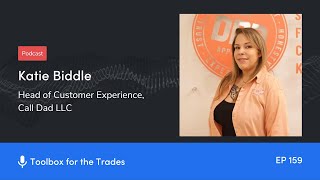
Katie Biddle, head of customer experience at Calldad AC & Heating, talks about how the company grew by focusing on customers. They rebranded, added virtual assistants, and built a training program called Dad University to keep their team sharp.
Hello, contractors and welcome to Toolbox for the Trades. My name is Jackie Aubel and today I am chatting with Katie Biddle, the head of customer experience at Calldad AC & Heating in Charlotte, North Carolina. Katie spoke about how the $16 million company rolled out their rebrand, how the team uses virtual assistants to cover late night shifts and their five year tech training program that recently got 500 applicants. I hope you enjoy this conversation as much as I did. Katie Biddle, you are the head of customer experience at Call Dad AC and Heating in Charlotte, North Carolina. Call dad grew from 10 million in 2022 to 16 million in 2023. And you guys are actually budgeting for 38 million in 2024. You guys have been named Inc 5000 fastest growing priority privately held company for two years in a row. And you've been awarded the customer first award by On Call Air, which is a carrier service titan integration. Katie, I am so excited to talk to you today.
Likewise, Jackie.
Thank you for having me. Yeah, of course.
So we're going to kick this off.
The way we do every single show, which is with an icebreaker. So if you could meet any living person for dinner, who would you pick and why?
I would pick Elon Musk. Everyone wants to sit at the table with the person that made it. And regardless of what you think about his opinions or his political views, he's strange and interesting and I think it would be a great experience to sit down and talk with them.
Yeah, that's actually an interesting answer because I guarantee you it likely be an interesting dinner to remember. I mean, I'm sure you would get some tidbits that, that you wouldn't get from just a normal person.
Exactly. And he's not afraid to fail, that's for sure.
Oh, I love that they're not afraid to fail. Yeah. Yeah, for sure. So we're going to go right into it. How did you get into the trades?
So I was in college working a part time retail job and the CEO of Called Dad's mom walked in, she said, I'm really impressed with your customer service. Are you looking for another job? And I said, well, I may be. How much are you paying? So I ended up going to work for her. And it's a very small upstart heating and air company. So I wore lots of different hats there ordering parts. I did inside sales. I was, I was the team. She worked there part time. So from there I worked there seven years. Then I moved to Charlotte and worked for six, several larger scale companies in inside sales. Call center management, and really just grew and grew in the trade.
That's awesome. And so when you went to work at the other H Vac companies, you eventually came back to call dad.
Oh, called dad is actually a different company. His parents sold that company and then they opened up a different business when they moved up north.
Oh, got it. And you're still with caldad. Okay, awesome.
Yes, it was a different company, A different named company back then.
Very, very cool. 20 years ago. I love that your recruiting story, because it's one that we've heard echoed on the show time and time again, which is, you know, if you meet someone out in real life, out in your community who offers amazing customer service, like, that's the kind of stuff you want to be doing to hire great people to help grow your business. You know, there's a hiring shortage. We talk about it all the time on the podcast. So people say that they do exactly what the owner's mother did in your case, which was like, oh, this lady is super helpful. Very nice. I'm going to see if she wants to work in H Vac.
Funny story with that, we were on the way to Pantheon this year, the annual convention, that service site, and has and I recruited for our Dadu. We'll talk about that later. Our dad, we recruited our Uber driver, who was someone who would be great for a sales position, and also the guy at the rental car place that really, really was super helpful. And when our client got canceled, oh, my goodness.
So, dad, you recruiting in Florida. I mean, that makes sense, right? Because you guys are pretty big so called that currently has eight locations in north and South Carolina. So you were. Pantheon Service Titan's conference was in Orlando, Florida, and you were locating and you were recruiting in Orlando.
Actually, it was on our way from Charlotte to Orlando. Our flight. Got it, got it, got it. So we had to get an Uber driver, we had to get a rental car. It was a whole debacle.
Okay. But always be recruiting. I love that. And I'm sure that your passion for H Vac helps in that recruiting. And when you and I first spoke and we decided to have you on the show, you talked about how passionate you were about H Vac. So I was wondering if you could tell us a little bit about what makes you so passionate.
Absolutely. I don't like to be bored in an H Vac. There is never a dull moment and busy season. You're almost on autopilot. It's muscle memory. What have you done for years and years that just kicks and that, that it's almost fight or flight. You know, the phones are ringing so busy, and you're just. Just doing what you do. But in shoulder season, I get the chance to work on a lot of passion projects. I just redesigned our memberships. I write a lot of copy for our marketing team, which I don't get the opportunity to do quite as much whenever we're super busy, and then work on processes and procedures that will help us create that infrastructure for our growth for the following season. Then never adult Mom. I'm never bored.
Yeah. And you guys are growing at a tremendous rate. I mean, I mentioned it at the top of the show. You guys went from 10 to 16 million in a year. You guys are looking to. I mean, 16 times two. You're looking to more than double in 2024, which is when this episode is going to air. I know that you operate out of the Charlotte location, which is the headquarters. You have eight locations now. So as someone who's the head of customer experience, I'd love to know how you give that homegrown touch to every.
Okay, great. We are having to move more away from that because we are so well known now. We'll do people's rental properties in other areas, we'll do their vacation homes, and either Charleston or Asheville. We are really focusing on giving that hometown touch. We all the time get a question, where's your office? And we have a list of locations, all of their addresses, phone numbers, the staff at that location. So they're prepared for any question that comes that way. But the biggest one is, where's your office? So in our Hickory location, we train our staff to say, oh, we're right off Tate Boulevard. Just. Just like, you're around the corner. Of course, we're in Charlotte, but they don't know that.
Yeah, exactly. And I know that's something that's really important for a lot of service companies that I have on the show. They really love the opportunity to talk with their customers and be connected to the community. So as someone who's so focused on customer experience, it's probably something that's very important to you that you give that feel, even though you guys are growing at a pretty rapid rate at this point.
Exactly. We still do that. It's just a little bit more difficult now that our taglines comfort to the Carolinas. And we're growing and branching out, so people are picking up on that as we go.
Oh, I'm sure, I'm sure. Have you ever had a customer that's like, I know Hickory and I have never seen your H VAC location down there. Have you ever run into that?
Not. Not so much. I mean, we just rebranded fairly recently. So when we had our old company name all the time, like, you're so big, I've never heard of you. Well, we never advertised really, besides the Internet. So there were a lot of people that had never heard of us before.
Amazing. And we're going to go into that rebrand in a second. I have to say, just off the bat, the. The name Call Dad. Incredible. Incredible. If you guys are based in Los angeles, I would 100% be utilizing your services. The phrase Call Dad, I can imagine is. Could be so comforting to people because, you know, when you're a first time homeowner, when you're dealing with some of these things, what's your gut. What's your gut instinct? It's to call your dad. Who in typical families was the mechanical one, the handy one. I would love to learn a little bit about how your team, the customer experience team, the csrs, handled the rollout of this new brand across eight locations. Tell me a bit about that.
So we kept it top secret. It was an eight month project. It was very secret. Only C suite new until a week prior. And our owner has had a quarterly meeting with everyone and explained the why behind the change very, very thoroughly. I'm a huge Simon Sinek fan. He spoke at the Pantheon a few years back and his start with the why has been foundational for me. He explained exactly why we changed the name through and through. And I felt like that was integral to them being able to explain it themselves. I also created a script and we validate their question, their concern, oh, you changed the name. That gets people kind of nervous about continuing to do business with you. A lot of times we said, nothing has changed besides the name. It's the same great people, same great service. We just wanted to change our name to align more of what our vision for our company and our customers is. So. So it's only gonna take our service up a notch. Nothing's changed at all.
I love that. Now, you mentioned specifically that you kept the change very tight to the chest. It was C suite only. Can you tell me a little bit about why you chose to make that decision?
We had this huge reveal. We didn't wanna worry anyone as well. That can be concerning when you're an employee. You don't really know what's going on. So we had the whole plan in place. We had all the location managers, trucks wrapped just a week prior. All the Uniforms. It was a huge process. So that. That was kind of why it was a surprise. No one walked into that quarterly meeting knowing that we were changing the name. But when they walked out, they had their uniforms, all the location managers, trucks were lined up, and it was a really exciting time for us, and we wanted to be able to create that excitement for them instead of, oh, the company name's changing.
Yeah, I really like that. That's kind of a nice way to do. I mean, I like it for two reasons. I love that you were tuned in to the employee experience. Being aware that, oh, they may hear name is changing, they may get nervous. I think that's very, very important. And I think I really want to commend you and your team for making that decision. And then I also think you turned what could have been a very, like, whatever experience into an exciting one. You get new uniforms, you get new rack trucks. You have these new scripts. It feels like it almost was used as a rallying point amongst your team members that they were able to share in this excitement and this new change together.
Yes. It was an exciting time. Looking back at last September, everyone was just. It's hard to explain. There's just a real synergy in the air.
Yeah, for sure. I want to keep talking about the rebrand a little bit. Can you tell me if you can remember? It's totally fine if you can, but can you remember a little bit behind the why, like, how your leader, who's the owner? Correct.
That is correct, yes.
How did they position the change? How did they pitch it to the employees? How did they communicate the why? Do you remember any specific talking points that were really very, like, not important? What's the word I'm looking for that were very, like, energizing, I should say. I think that's the word I'm. I think that's the word I'll settle on. It's not my favorite word, but that's the one I'm settling on.
It works. Our company name prior was sky, and when you think of heating and air, there's no correlation with Sky. And it's well known he purchased it from a gentleman or two gentlemen who had been the owners of the company since 2013. He bought it in 2017, and it had been a constant thing, like, what is Sky? What? I just don't understand it. So he definitely talked about how we build relationships. Like, this is what we do. We build relationships. And that's why we changed the name to call dad, because that. That is what we're about, is Building relationships either with our customers, with our employees, regardless of who we touch, that's. That's just so important to us. So that helped kind of them to understand the why behind it.
I really enjoy that. I think that's a really important thing to do. And I, again, I keep complimenting you on how you did this with your internal team, because I think it is the way to go. You know, I see a world where you kept this. You didn't keep this tight to the chest. And word started get out among the employees, like, oh, you know, that they're going to change that name. And they're like, what? And then all these rumors start floating about and people are making assumptions. So I think the way that you did the grand reveal, you got people excited. You had a speech and a position statement ready for why this was happening. I think it probably really made a difference amongst your employees.
We recorded his speech as well, and we show it to all of our new. It's part of our onboarding process now as well. Oh, I love that.
I love that. That's so cool. Now, I want to know, as the head of customer experience, you mentioned that you provided all your front office folks with a script with how to answer common questions. Can you tell me about your process for, like, how did you even begin to start thinking about, okay, what are all the questions that we could possibly get from customers? How did you go about developing that script.
With anything? I try to put myself in the shoes of the customer. What am I thinking when I call in? What am I thinking about this experience from top to bottom, end to end? Where are the pain points? What's the deal? And I just came up with all the questions I could think. We acquired multiple businesses that were named something else. And then we were sky, and then we were called Dads. There were lot of different scenarios to look at. So we have a whole script of different questions that are asked, and it helps them think on their feet whenever they have someone on the phone. Maybe they weren't super familiar with what the acquisition was, and it's helpful for them, for sure.
Amazing. Is there a specific way that your team navigate? Because I imagine the script has to be, what, like, 20 pages long or something? Or, you know, how does your team. How's your team able to quickly find those answers in real time?
I have a playbook that we designed, a CSR playbook, and there's a little section on scripts, and a lot of them actually just have it posted at their desk because it's been a common question Since September until our entire customer base goes through a season. And then they're familiar with it. A lot of them just have it posted right at their desk. It's not that long. We use brief, brief answers. We don't want to over explain it as they just post it right at their desk.
Got it. So just leaning into now, like how you train your team into new messaging, right? Once this new name was launched, once you were sharing it with customers, how do you, as the head of customer experience, work with your front office staff to make sure that they're delivering that message in the way that you want them to?
It's been a process we implemented. If we can't get there the same day, your diagnostic is free. So impressing upon them that sense of urgency, like you, you need to call our dispatch manager, you need to call the location manager. We need to do every single thing we can to get to someone right now. Because that's what dad does. He's there right now. Just impressing that over and over to where it's just, it's ingrained in them has been one of the biggest things because that, that's what we stand on, is that we're going to be there. So that's the most important thing.
I love that. That's great. So when you and I first spoke, you said that you have had a lot of success with virtual assistants. So I'd love that you've integrated these virtual assistants. How did you reassure your local team that they weren't being replaced by local assistance?
Well, we, you know, we talked over and over about how quickly we've grown and any sort of assistance that that they can get has been very helpful because we've been overwhelmed and, you know, finding staffing to suit our needs and they're just incredibly happy not to have to work after hours. But we did want to reassure them you are not ever going to be replaced. This is not something. This is just a supplement what we do to. So we have the kind of support that we need to support the business and how we're growing.
Got it. So you got your local employees buy in as you integrated with this virtual assistant team, do your local employees also help onboard the virtual assistants and work with them directly?
Some of them do, yes. Our more seasoned team members will jump on teams calls and my inside sales coordinator will explain kind of the sales process and do some scripting and role playing with sales appointments and setting up comfort advisor appointments. Memberships of a lady who is great with memberships that will jump on. Yeah, they they have a lot of communication with them as well because they do work some during the day as well. So they can hit their their 40 hours.
Excellent. So the virtual assistants work 40 hours?
They do, yes. And we have three on the customer service team now.
Wow, that's incredible. I have to ask this question because I've seen it come up in a ton of service titan webinars and also just feedback I've seen on our Masterminds group and our toolbox for the trades group. Do you ever get folks who are calling in, who are local to the call dad service areas who get one of your virtual assistants who are overseas and are concerned, maybe they hear an accent that they don't recognize? Is there any type of pushback in that way?
We have had a little bit of that from time to time. Not as much as you would think. They're good at dodging the question. And we do service a lot of rural areas where they may not be as open to speaking with someone in the Philippines as someone else. Would they do a good job at dodging the question. Their customer service speaks for itself. If you're giving good customer service, you're less likely to ask that question.
Yeah, I 100% agree with that. And I think it's brilliant the way that you're utilizing this team virtually to make up for this, these after hours times where your employees want to usually be with their family. But yeah, that's a question I've seen come up a lot with folks that are investing in virtual services to help with that overflow. And so given that you've pretty successfully integrated a virtual assistant team at caldad into your local team, I'd love to hear any advice you have for folks listening who are thinking about implementing virtual assistants into their workflows. What would you recommend?
The first thing is to find an agency that provides what you need. It depends on what you're looking for. Are you looking for customer service? Are you looking for accounting? What is your need? There also are different pay scales that they offer different support from the agencies that you get as far as timekeeping and making sure they're on task. So finding the right agency is first and foremost the biggest thing and then providing a very robust training for them because they don't know, typically don't know much about the US or heating and air or plumbing or whatever trade it may be. So having them to have a basic understanding of it is also super important.
I really love that answer. And one thing I'm noticing as I speak with you, it sounds like, you're really talented at taking in other people's perspectives or not just you. I should say the called AD leadership team, thinking about other people's experiences, whether that be your. Your employees, whether that be your customers, and making sure that you're answering any questions that may come up. So it sounds like you're very proactive in your communications.
We try. That's one of our pillars that we stand on, is that we foster communication.
Did I just guess one of your pillars?
You did.
Well, honestly. Honestly, though, the fact that I was able to guess that speaks to the fact that you were living one of these pillars. Do you. How many pillars do you have? I don't mean to put you on the spot, because I know sometimes folks are like, wait, what's our mission statement? But can you recall how many pillars you have?
We have five, and they're right behind me. So if you don't mind me turning around right click.
Oh, yeah.
Of course. We serve like family. Of course. Dad would. Small acts equal big impact. Fostering communication, cultivating curiosity, and we keep it fun.
I love that. And I need everyone to know that even though the words we foster communication was literally behind Katie, as I was talking to her, I was looking at her face. I was not reading the board behind her. So I did not cheat. I promise. All right. This is great. I love this, and I think this is a fantastic example for folks listening who are growing as quickly as Call dad is. And one of the things I wanted to talk to you about is I want to know what are some of the hardest things you're coming up against when it comes to managing multiple locations from one central office hub?
So we. This was a incredibly tough learning process for us. We used to have office coordinators at each location, and it. It did not go smoothly at all. Parts were always a challenge, trying to reach out to one person at each location. They're only one. It was not smooth. So in April, we decided to bring everything to Charlotte. So it's almost. Almost opposite. It was easier for us to have everything in one location, everyone at the same spot, to where you could just pop into someone's office or pop over to them and ask them that question as opposed to having to try to get them on the phone, you know, someone's out today, so they're the only person that has that answer. So it's been a learning process. We took our office coordinators and offered them either a dispatch position or a custom service position based on their skill sets and where we. We felt like they would be happiest. And it's worked wonderfully. There are days where it's still challenging with parts. That's been the biggest hiccup for us, is parts, and we've worked on a lot of different processes to get that smoother. But that's still our biggest sticking point is trying to find the location of parts and who can find out, who knows, who can call that sort of thing. But the disconnect really, really closed a lot. Whenever we brought, you have multiple people you can call for one question with dispatch or four parts.
Yeah, yeah, that makes sense. I mean, I think if you think about growing a business, it's like, okay, we're going to have multiple locations. Okay, it makes sense to have an office manager in each one. But then when you think about, you know, we're all serving this greater purpose of growing the Caldad empire, it does make sense to have everyone kind of in one location, at least in one time zone. Because I know remote work is also very popular and really growing in the trades ever since COVID But it sounds like for your business needs, it really makes sense to have everyone kind of in that one location to support one another.
It sure does. And it's nice being able to build the relationship with people who are on site, too, because when they're at a different location, it's hard to really build any sort of relationship. And when things don't go as expected, it's nice to have that fall back on.
Yeah, I agree. And thank you for being honest about. You know, this is one of my favorite things about the podcast is talking with folks and hearing what worked, what didn't work. So I love that you were very forthright in talking about, you know, we tried this first, and now we're doing this, and it's much better because that's what this is, this podcast is all about. That's what this industry, I think is all about. So thank you for sharing that. So we're going to pivot a bit to recruiting, because you've mentioned a bit now about recruiting, about onboarding, and before we go into dadu, which I believe stands for dad University. Is that right?
Sure does.
Amazing. Okay, I want to know from your perspective. So you've worked at several different trade businesses over the course of your career. In your opinion, what differentiates a successful business from a stagnant one?
Caring. And as hokey as that may sound, if you have leadership that cares about the employees, the employees are more likely to care about your customers. And hiring people that care, that is One of those intangible qualities that you can't teach anyone. I can teach a lot of different things, but I can't teach caring. I can't teach being on time, I can't teach being coachable and attitude. So those. That's the foundation on people can tell if you care. That's a huge, huge thing. I've noticed when people don't care, customers feel it, your employees feel it, the morale drops and things just aren't great.
Yeah, yeah. I mean, I don't think it's hokey at all. I think it's a truly honest answer. I think if you're just focused on, you know, let me know if you let me know if I'm putting assumptions on you. But when you say caring, I'm thinking of having a business that cares about its people, meaning its external customers. It's not just caring about the numbers and the growth numbers and revenue and all that stuff. So giving it that human touch like a dad would.
Exactly. Yeah, you're exactly right. And the, of course you have to have operational excellence as well to, to grow and to do good things. But as far as the foundation of what I've seen over and over and working for multiple companies, the ones that care are the ones that are successful.
Yeah, I agree. So let's talk about dad University in that, in that way. Right. I. This is the training school you guys have set up to meet your workforce demands. So tell me all about.
Yeah, so this was our answer to the staffing shortage. Anyone in the trade knows there's a staffing shortage. There has been for quite some time. It's not getting any better. They're not falling out of the sky anymore. So we have a three year program and they start in the classroom and then they alternate between the classroom and the field. So they get hands on and classroom experience. It's a five year commitment. Three years in the school and then they're required to be here two years. It's a complete $42,000 investment per student from us over the course of the three years when they come out. They're EPA certified, they're NAEP certified, they have their journeyman certificate from the state of North Carolina and they're paid along the way. There are four different levels and each one comes with a pay increase. You have more knowledge, you're paid more, you're able to. One of our top technicians is actually a DADU student, our very first class. That's been really exciting to see someone have so much success and such great numbers through that we're getting ready to start our fifth class in just a couple weeks. We have 20, 20 students and over 500 people that applied for it. And yeah, 500 people.
My mouth, my jaw is on the floor for anyone who is not watching the video or if my, the camera wasn't on my face. 500. How, how, how, how, how did you get 500 people to apply for this?
Well, we advertise in lots of local job hunting groups. Indeed, indeed. Has, is wonderful for us. Also our instructor filters out a lot of them. She is a certified teacher and she graduated from UNC Chapel Hill. She spent four years in the field as a technician and we kind of, kind of refer to her as the, the mom of Dad U. She's a great, great lady.
Oh, amazing. So you've just been posting in local communities where you want to serve and do you, what's your messaging? Do you talk about, you know, these are all the things you get. It's a five year commitment, but you're going to achieve X, Y and Z. Because that's the one thing I was like, oh man, a five year commitment, that's, that's pretty intense. That's, that's longer than college. So I'm wondering how you weigh the, I mean, I know, I know what kind of opportunities can be unlocked in this field, but it's still something that I think we're actively educating the general public on. So I'm curious, like, how do you, how do you sell that five year commitment? Like, give us five years and we're going to give you this.
I feel like a lot of people want to be in the traits because they've heard how much money you can make, how wonderful it can be, but they don't know the pathway, they don't know what the opportunity is or how to get there. So when they see that, are you looking for a career? Not, not just a job. It's really appealing to a lot of people. Like we're showing you how to do it. We're showing you how to get from here to here. Yes, it's five years, but you're learning the entire time. And then after that you have a two year commitment to the company. Because we've invested so much, I think it's a fair trade off. And we haven't, we always have a couple that fall out, but very few, I haven't, have, haven't fulfilled their commitment.
Yeah, I actually really like that because you're telling them the how, you're showing them the how. You're not Giving them the, oh, gosh, I feel like there's a clever way to say this and it's not going to come to me at this moment, but I do really enjoy that you're telling them like the step by step process because I actually think, you know, comparing to the college model, which I tend to do, because that's. That was the mod went through college is like, here's your degree, good luck. I mean, sure, there's like, you know, there's alumni associations and all that stuff, but. And different colleges have different ways to get folks ahead, what have you. But I think it's really interesting to offer people that security of like, this is how you become a top selling technician. These are the certifications you need. And if you join us at caldad, we'll take you through this step, pay you along the way. And all we ask is that once you're done, we really just get two years of your time because for the first three years you're in that education space.
And we're entirely transparent with them too, as to what they're obligated to. And we're a great company, or at least I like to think so. So people want to be a part of our team. And 500 people applying, blown away this past time for sure.
That's incredible. If I could give you an award, I would add it to one of the many awards that you guys have gotten. That is, I guarantee you, you are going to get some Facebook friend requests, you are going to get some emails after this episode airs and people are going to be like, tell me how you did that. So thank you for diving into it and I'm so happy we got a chance to talk about Dad U. Katie, I have loved chatting with you. I've loved hearing from your experience and the experience of your colleagues. And is there anything we should have talked about that we didn't get a chance to?
I think we covered everything that we wanted to that I thought would be helpful to other folks. This has just been so enjoyable.
Oh, well, I'm so happy to hear that. That makes me very, very happy. And just as a little shout out, I found you because you are a member of the Torch Network here at Servicetitan.
Yes, yes.
So why don't you tell us a little bit about how you got involved with Torch and what you've seen since joining the group.
I didn't know what it was. I saw these signs at Pantheon that said Torch Network lunch. I'm like, oh, I want a fancy lunch. What's that? So I reached out to our customer success manager and said, hey, how do I go about this? I applied, got in, got my little swag bag and then got into my first Spark Sessions meeting, which you meet with people, other contractors, and you just talk about specific things. Like our last week was customer service and you all share ideas and experiences and what you've learned from throughout the session and throughout your career. And it's been really helpful. There's one lady in particular that we're similar size, multiple locations and we've been running, running things by each other. It's definitely a good value, 100%.
I love my torchbearers. I also love the folks internally who run the Torch program. They're wonderful. So thank you for sharing your story here on Toolbox for the Trades. Katie, it was a delight talking to you. Thank you so much for joining me.
Thank you for having me.
More from Bill




Capturing the 80%: How SmartAC’s Gen-2 Targets Non-Membership Homeowners | Podcast Ep. 296

Build better customer data with every booking in ServiceTitan | TAD Tune-Up Series

The Biggest Change for Roofers Coming From Other Roofing Software to #ServiceTitan?

