How Furnaces Work In Simple Terms
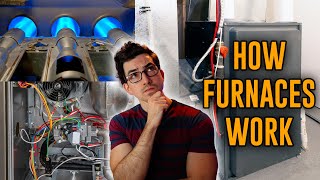
Richard Kohberger breaks down how gas furnaces work: burners ignite fuel in a heat exchanger, a draft inducer pulls in air and exhaust, and household air gets blown past the hot exchanger to warm your home. Condensing furnaces hit 95-98% efficiency versus 80% for older models, and he walks through the safety switches and shows a live startup.
What's going on, everybody? It's Richard Kohberger here, the blue collar nerd. And in this video, I'm going to be going over how furnaces work. So the root concept of a furnace is actually pretty simple. Basically, we've got a gas, a fuel that contains heat energy, and we want to release that heat energy into our house. The way to get heat energy out of gas is by igniting it, lighting it on fire. But we only want the heat energy in our house. We don't want any of the combustion byproducts getting into our house because that's, that's dangerous to breathe. So inside of a furnace, we have these curved tubes called the heat exchanger. So we blow gas inside of those tubes and then ignite it. And that, of course, makes the tubes very, very hot. Then we suck in air from our house and blow it past those hot, hot tubes, the heat exchanger, to get all of that heat in the air and then blow that now hotter air back into the house. And then all of those nasty combustion byproducts that we don't want to breathe, they those stay inside of the tubes and get pushed outside through something called the flue pipe, which is basically just like a chimney. So like I said, the heat exchanger, like the Internet, is a series of tubes. And to keep fire burning inside of those tubes, we need to be supplying that area with fresh air, with fresh oxygen, because the process of combustion burning needs oxygen. Plus we want to be pushing air through those tubes to be making sure that all of the exhaust gases actually get pushed, pushed outside where we want them to go. So to make those two things happen, a furnace has a part called a draft inducer. It's basically a fan. And like the name implies, its purpose is to induce a draft going through that heat exchanger, supplying oxygen for the combustion process, as well as helping to push the exhaust out. Now, if you have a furnace in your house, then inherently that means that you have a big unattended fire burning in your house. And if that sounds kind of dangerous to you, well, you're right. And that's why furnaces are equipped with several parts that are only there for safety purposes. For example, this piece here is called the pressure switch. And its entire purpose is to prove to the furnace that the inducer is working before it lets any gas through. The inducer absolutely must be running before we let any gas into the furnace. Both to make sure that the combustion byproducts get exhausted properly and, and to make sure that we get a nice Steady burn of fire versus just like a big explosion, which would obviously be bad. So the pressure switch detects the change in pressure that is created by the draft inducer. If no change in pressure is detected, then gas will not be allowed through. But assuming everything checked out and that change in pressure was detected, well, then the next step in the sequence of operations is for the furnace to allow that draft inducer to run for a little bit. And that's to help push out any uncombusted gas that might still be lingering in the heat exchanger. Again, this is a safety measure to help ensure that we don't get any explosive ignition of the gas. So while that's happening, this little guy down here starts getting real hot and glowy. This is called the hot surface igniter, and it is what ignites the fuel by getting its surface really hot. Then once the inducer fan has run for a little bit and the hot surface igniter is hot, then the gas valve opens, and gas is allowed through. And that gas then ignites across multiple burners that are all pointing into the heat exchanger, like flamethrowers. Now, mounted on the far end at the very last burner is a little piece called the flame sensor. And its purpose is to wait for it, sense the flame. So if there's something wrong with the igniter or something, we obviously don't want to be blowing around on ignited fuel. So the flame sensor detects a rapid temperature rise to confirm that the flame is burning. It's also very intentionally placed at the far end at the last burner, opposite of the igniter. That's because when the fire first starts, it's going to begin at the far end, that first burner, and then propagate across the rest of the burners until it gets to the very last one. And so the flame sensor is placed there at the very last one to make sure that the fire made it all the way across all of the burners. There's also another safety component built into furnaces known as the limit switch. The limit switch will cut the furnace off if it senses that the inside of the furnace has reached a temperature past a certain limit. Basically, it cuts the furnace off if it's getting too hot to prevent overheating. This could happen if airflow is restricted. If you've got a dirty filter, for example, and we're not able to blow enough air through that hot heat exchanger, well, then you're going to. Heat is going to build up, and it's gonna get too hot. You also might have Some sort of problem with the main blower motor that pushes air through the whole system. If there's no air moving through the system, we're not exhausting the heat and therefore it's gonna get too hot. Now, one thing a furnace doesn't have a built in safety for is carbon monoxide leaking into your house. I mean, it does protect you against that. Assuming everything's working properly, the combustion gases are supposed to stay inside of those tubes of the heat exchanger. But if that heat exchanger were to crack, well then there is an opening where those dangerous combustion gases can get into the breath. And there's no built in backup to protect you against this. Which is why if you have a furnace, it's important to have a carbon monoxide detector on every level of your home. Heat exchangers have very hot, intense fires burning inside of them over and over again for years and years, Much like me in my teenage years. That is really hard on the material and eventually, given enough time, it will crack, much like me now. So that's the basics of how a furnace works, at least how a non condensing furnace works. But there is a second type of furnace called a condensing furnace. Condensing furnaces are more efficient than non condensing furnaces. So furnace efficiency is measured by a standard called afue, that's annual fuel utilization efficiency. Basically it's a measure of out of all of the heat energy contained in the fuel, how much of it is actually getting into the living space. For a non condensing furnace, that's usually about 80% for a meaning, 80% of the heat that was contained in that fuel ends up in our living space. And the rest of it ends up getting exhausted outside with all of the rest of the combustion byproducts. Condensing furnaces, on the other hand, can have afues anywhere from 95 to 98%. So how do they do that? Well, when we burn gas, one of the byproducts is water vapor. And that water vapor is hot. It contains latent heat. And the way to release that latent heat is to condense the water vapor back down into a liquid. With a non condensing furnace that happens outside. We just exhaust the water vapor out along with the rest of the byproducts, and it turns into steam and eventually condenses outside. But condensing furnaces have basically this second heat exchanger. It looks like this, the exhaust gas, including the water vapor, is run through there, and that causes that water vapor to condense and release the Heat, which allows us to utilize that heat instead of just exhausting it outside. Now, since we have condensed that water vapor, condensing furnaces do have water to deal with. So they typically have these little drain lines on the side of them. That's in addition to this drain line, which is separate, that's for the air conditioner. Usually the easiest way to spot a condensing furnace is that it will have a PVC flue pipe versus a metal one. And that's because with a condensing furnace, the air that we're eventually expelling outside contains that more condensed water vapor that can cause the inside to get very wet, plus it's acidic water. And so with a metal flue, a metal exhaust pipe, that's problematic. So PVC is used instead. Now, we couldn't use PVC with a non condensing furnace because. Because with a non condensing furnace, we're exhausting 20% of the heat. And so that flue pipe gets very hot. So if you have a non condensing furnace, meaning you have a metal flue pipe, don't ever touch that pipe. If the furnace is running or ran recently, it's gonna be really hot. Now, like I said, condensing furnaces utilize 95 to 98% of the heat that's contained in the fuel, which might sound really efficient, and it is. But modern heat pumps can have efficiencies approaching 500%. But that's a topic for another day. I'll be making a separate video about that. So for now, let me take you up to my furnace and I'll walk you through everything we just learned. Okay, so here we are at my furnace. Now, as you can see, I've got the metal flue pipe here, which means that I have a non condensing furnace. And if we come around the side here and look at the sticker, we can confirm that. Because you see, I have an 80% AFUE or annual fuel utilization efficiency. So if I had a condensing furnace, that number would be in the 90s. So the furnace is off right now, but I'm about to go down to the thermostat and set it so that it's calling for heat to turn the furnace on. But before I do that, let me walk you through what's going to happen here. So over here on the side of the furnace, this metal pipe, this is the gas line, goes up through here. And that is what supplies gas into this guy. This is the gas valve. That is what opens and closes to regulate the flow of gas down here through these burners. So gas is going to be shot out of these little nozzles through these tubes. And then on the other end of those tubes are the openings that lead into the tubes of the heat exchanger. Now, if you look deep down in there, you see that kind of white rod that has a piece of metal sticking out from it there at the very back, that is the hot surface igniter. So that's what's going to get real glowing hot to ignite the fuel. Then the fire is going to propagate. Whoop. All the way across. And you see that other stick back there pointing down? That's the flame sensor to make sure that the flame made it all the way across. Now, this big assembly here, this is the inducer. So that's pulling air through the heat exchanger and then pushing it up and out through the flue pipe. So it exhausts outside. That is attached through this little orange tube to this guy. That's the pressure switch. That's what confirms to the furnace that this is working. Okay, so right back here, if you see that little guy, that is the limit switch. That's to make sure that the furnace isn't overheating. And then we have similar switches here and here. Actually, I didn't talk about these, but these are the flame rollout switches. Those are basically to detect that the fire that is supposed to be shooting that way into the heat exchanger is not actually coming this way towards us. And then once all this is running, there's a blower motor behind here. That's the main fan that moves air throughout the system. So air from the house gets sucked in through here through the filter that's right behind this little metal door, and then goes up through the hot, hot heat exchanger. And then all of the exhaust goes out through the flue pipe. All right, so let's go turn the unit on and see all that in action. Okay, so I just set the thermostat. And if you can hear that the inducer motor is running. So that's running to make sure if there's any uncombusted gas, then that's going to get taken out of the heat exchanger. Now you see that glowing real hot? That is the hot surface igniter getting ready to ignite the gas. And then there it goes. All of the gas is burning all the way to that flame sensor. So the furnace is confirming that there is, is in fact, flames going all the way across. So now we're going to get that heat exchanger hot for a minute, and then the blower motor in here is going to turn on to start moving air through the system. It does warm up the heat exchanger for a little bit before turning on the main fan, just so you don't get this long initial burst of cold air coming through your vents. But then that's it. We're going to start getting hot air coming through the vents until the thermostat reaches temperature, and then it's going to cut this off. Anyways, that's all I got for today. Hey, if you'd also like to learn how air conditioners work that, then check out this video right here. Appreciate it. Peace.
More from Bill




Capturing the 80%: How SmartAC’s Gen-2 Targets Non-Membership Homeowners | Podcast Ep. 296

Build better customer data with every booking in ServiceTitan | TAD Tune-Up Series

The Biggest Change for Roofers Coming From Other Roofing Software to #ServiceTitan?

