How KPI Tracking Can Transform a Business’s Profitability | Podcast Ep. 203 | Toolbox for the Trades
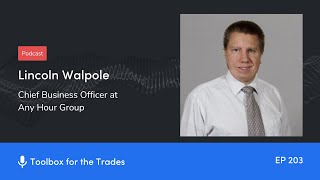
Lincoln Walpole, Chief Business Officer at Any Hour Group, breaks down which KPIs contractors should track to hit 55% gross margin and 15% net profit. Monitor your full lead funnel from calls to bookings, present 4 to 6 options per customer, and watch cancellations and AR collection closely. Daily huddles and one-on-ones keep teams aligned on what matters.
Questions this video answers
2013
July 2021
Roughly 30 locations and about 2,000 employees across the group
Approximately 470 employees within Any Hour Services
Over 22,000 Google reviews
Hello, contractors, and welcome to Toolbox for the Trades. My name is Jackie Aubel and today I had the pleasure of speaking with Lincoln Walpole, Chief Business Officer at Any Hour Group. Lincoln and I discussed the top KPIs for tracking the success of your business. Improving efficiency, reducing costs, and so much more. Lincoln was a wealth of information and I hope you find his interview as motivating as I did. Lincoln Walpole, you are the Chief Business Officer at Any Hour Group. Today you and I are going to be talking about streamlining efficiency and tracking the right KPIs to scale your business. Welcome to the Toolbox for the Trades podcast.
Thank you, Jackie. It's good to be here. It's always good to associate with you and Service Titan.
That's so sweet of you to say. For the folks listening at home, Lincoln and I have connected several times at Service Titan's user conference Pantheon. He has a wealth of knowledge and I needed to get him on for a full length proper episode. So, Lincoln, thanks so much for taking your time to to chat with me today and to share your insight with our audience.
Absolutely. Good to be here.
Okay, so I'm going to kick this off with an icebreaker. This is a question that I used to ask way back in the early days of Toolbox for the Trades. I'm bringing it back because I honestly, I love this question. Lincoln, I'd love to know what song, if any, would be the soundtrack to your life.
It's a good question. You know, growing up, I used to listen to Eye of the Tiger. That's a great song. It gets you pumped up and you have to overcome lots of odds and you keep moving forward and that's what it's all about.
Lincoln, I'm going to be honest, I'm going to listen to Eye of the Tiger immediately after we wrap this recording. This is one of those songs, you hear that hook and you're like, I got to hear that again. So appreciate the. The Pump up inspiration today. So let's get into it. I know you have a pretty interesting background when it comes to how you got into the trades. Not, you know, your standard way of getting into this industry. So tell me, how did you get into the trades?
Yeah, so I actually have a background in investing. I used to work for a life insurance company. While there, I was managing a $2 billion bond portfolio and I was at TD Ameritrade for a little while as well. But a good friend of mine, Wyatt Hepworth, he is the founder of Any Hour Services, he invited me to come tour his business and learn more about the business, and then the rest is history. We talked for a few years before I joined Any Hour Services, but man, it has been such a fun ride. So I really transitioned from the investment world into general business, is what I would call it, and in the trades and Any Hour Services. And I've been at Any hour now for 11 years. Any hour Services is the platform for the Any Hour Group. And we have a lot of partners that we now work with in the. In our group. We've been doing this for about three and a half years now.
Amazing. So you have this outside industry experience. You have this whole other career before you came into the trades. What did Wyatt say or do that finally convinced you to make the jump?
It's a really good question. So it was really a leap of faith to come over. I had always wanted to do something to leverage people's skill sets. I believe that one of my strengths is to be able to follow through and ensure that people are getting different jobs done. Growing up, I was heavily involved in remodeling my parents apartments as landlords. We've gotten into apartments as well, my wife and me, and we just were very close to the trades, just personally. And we've just really enjoyed where we're at today with Anyhour. It's an incredible brand. They have really good customer service and I wanted to be a part of that.
All right, awesome. Very, very cool. So you gave a little bit of the background here, but just for the folks who aren't familiar. So we've got Any Hour Group, which is a group of service companies, and then we have the Any Hour Services brand. Can you just explain how that all works for the folks listening at home?
Yes, of course. So Any Hour Services is the company that Wyatt Hepworth founded. He acquired that company from his dad actually, years ago. And I joined Any hour services in 2013. In 2021, we actually had a private equity partner come and join us. And at that point In July of 2021, we formed the NER group. And now within the NER group, we have roughly 30 locations. And we have obviously gone out and acquired a lot of different businesses. And we're trying to get each partner to replicate the success that Any Our Services has had. And it's been a lot of fun to work with new people as well. There's so many good people in the industry. And it's been really interesting that every partner that we have is. They're all similar. They want to make a difference in the lives of the people that they, that they lead.
Yeah. That's incredible. So you joined in 2013. I know that Any Hour Services was a 10 million dollar business when you guys joined. And today you have 470 employees within Any Hour Services, 2,000 employees within the group across 30 different locations. To say that you've just like grown a little bit would be an understatement. You guys have truly like 10x your success and it's awesome that you're making this impact across the industry. So Chief Business Officer, you kind of like see how everything works. So I really want to get into KPIs on this episode. So in your opinion, we which KPIs are the most important track to set the business up for success?
It's a great question. There are a lot of KPIs that every department should have. But when we look at the overall business, we think that there are certain touch points that we should be looking at throughout the business. So as an example, we want to look at the entire lead funnel that marketing will obviously be a part of. So number one, we want to know the number of calls that are coming into the business. In addition to calls though, we want to know the number of chats, the number of emails. Basically the entire lead funnel is more than just inbound calls. After that, we then want to take the calls and other leads that are coming in and see how good we are at capturing those leads. So there is a booking rate that is used whenever we pick up the phone. If we take and answer the phone 100 times, we should be booking above 90% of those calls or 90 calls. In addition to that though, that does not capture the entire lead flow because there are potentially missed calls or abandoned calls as well. So we want to know what our total booking rate is, which accounts for all leads that come in and then what percentage of those are we actually getting onto the calendar? A lot of companies are not as focused on the missed calls as well, but we believe that it's important to have a total booking rate that accounts for all calls and other chats and so forth that come in. So to kind of restate what I've said so far, we want to look at the number of calls that come in and then the rate at which we capture those calls. After we do that, we then want to track the number of those calls that end up not being run by a technician. That is called the cancellation rate. For example, if we had 100 leads come in and we booked 90 of them, your total booking rate would be 90%. But then after that you might have 10% of those calls that fall out due to cancellations. Maybe the customer got it fixed themselves, or maybe the CSR or CCR did not build enough value and then the customer decided to go elsewhere. There's a lot of reasons why you might have cancellations, and we believe that the CCR department and the technicians have a responsibility to keep cancellations low. Once we get those calls to the technician, though, there's a lot of different KPIs that we want to track. So one KPI that we track closely is of course, average ticket. We also will track average sale and closing percentage. If you take your average sale and multiply it by your closing percentage, that gets you your average ticket. We also believe though that if you're only focused on average ticket, which is truly a measure of profit, you're going to be missing the boat because your closing rate is really critical. If you have an average sale of a million dollars, but you're only closing 5% of those, long term, you're not going to have a business. You've got to make sure that you're closing on the 70 and 80% range, depending upon the department. So we track average ticket, average sale and closing percentage. Another minute KPI that we will track is number of options given for each opportunity.
Oh, interesting.
On top of all that, so there's a lot of KPIs, right? Another really important KPI that we want to look at is something called demand calls. If we have an H Vac call that we go out to and the unit is more than 10 years old, we want to know what percentage of the time we are turning that over or handing off to the sales department for potentially a replacement, for example. Those are of course the top priority calls that we want to be tracking. And so we really hone in and focus on those top priority calls to make sure that we're truly handing off or turning over very, very often. So we have benchmarks in place for that. As an example, we want to be handing off 65% of those. If we're doing that, then we are fulfilling our duty as a service technician to get it handed off to a sales supervisor, is what we call them now. Those are the KPIs that we have from office to field. But there are a few other things that we also track. Of course. Another KPI that we measure closely is our five star reviews. So any hour services, which is of course a subset of the NER group, has over 22,000 Google reviews over the last many years. And so we want to make sure we're always providing a great customer experience all the way through. Another KPI that we track is of course looking at our ar. After we fulfill the needs of the customer, we want to make sure that we are tracking our AR and collecting upon completion. So if we address those major touch points, we can then identify where we are underperforming in the business to kind of wrap all of those different KPIs up though, we also will track our sold revenue compared to our budget revenue. So when we look at our different jobs that we're doing, we want to look at it from high level all the way down to the technician and to the ccr. But we track very closely our sold revenue compared to our budgeted revenue for the day. It is easy in our mind to fulfill sales through installs and so forth. We know the cadence, the number of technicians we need in self worth. What's really important though in a business is to generate sales. So our big focus is on sales. And yes, some of those fall out as people cancel and so forth. But if we're really tracking sales closely, we're able to help all the rest of our KPIs really perform.
And you're tracking that on a daily basis. Your sold we do versus your budgeted revenue we do.
Yeah.
Yeah. Okay, everyone listening. Can you understand why I wanted Lincoln to come on here and do a proper interview? I guarantee you there are people who are pausing and rewinding and listening to just the last five minutes of what you had to share. I guarantee it. I actually want to circle real quick back on the options KPI that you were mentioning, like tracking how many options you give. Can you talk a little bit about why that's important for you guys?
Yeah. So we believe, first of all, a confused mind says no. So if we look at this, if we only present one option, the customer first of all may feel that the technician did not explore and learn a lot more about the needs and even the wants of the customer. But in addition to that, if you have too many options, maybe you have 10 different options. The customer is going to look at that and be like, I don't know what to do here. So we want to make sure that we have the right number of options. And we believe it's roughly 4 to 6 depending upon the department. And if we are consistently doing that, one, it does indicate that we are exploring with the customer the needs and the wants of that customer. But then two, we're also making sure. That we are helping the customer have enough options from which to choose.
Right.
So those are really important for us. And Service Center's done a really good job of building out our ability to see that KPI. So we track that one very closely again on a daily basis. We will watch that one as well. And of course, it gets down to the very granular level. You have some technicians that are really good at presenting options on every job, and other technicians are not so good at it. What we try to focus on is managing to the average. So what that means is when we have technicians who are underperforming the average, we then want to help them get up to speed on how we should be talking to customers, exploring, looking at their average tickets and so forth. And as we bring them up closer to the average for the department will of course, increase at that point as well.
As you're describing all these various KPIs, I'm kind of picturing you in front of, like, a giant control board, and you're just like, kind of fine, tweaking all of these little elements from capturing the lead to servicing the customer to then collecting on payment and following up. And that is literally what it sounds like you guys have to do on a daily basis to ensure that your company is growing and being profitable and fulfilling your mission.
Yeah. So if we don't know our KPIs, we won't know what levers to pull to help us get back to performing according to our budgets. So we talked about revenue being a key component for us, and it is the most important one for us because we believe it's easier to fulfill the sales that do come through. But as we look at this, if we are really good at tracking our budgets, everything else will fall in line with costs and so forth. If you're watching those. We haven't talked about the financials in any way yet, but as we look at the financials, we're looking at different benchmarks that we have in place for office labor parts per different departments. Because, for example, H Vac, there will be a different percentage of revenue that go to parts than it would be for plumbing or electrical. So you do need to get granular from that standpoint. There are certain benchmarks that all of us need to be achieving in order to hit the profitability that we desire.
That's one of the things I wanted to talk to you about, is benchmarking. Because I feel like benchmarks in some way vary from business to business because every business is different. You're always in A different location, you're serving a different demographic, you might have slightly different benchmarks than one of your competitors or same type of company, but two states over. So tell me what you think about in terms of benchmarks and if you have any that you could share.
Yeah. So at the end of the day, we are looking for a gross margin of roughly 55%. Now, there are some departments that are slightly higher than that and some that are lower. As an example, you might find with H Vac that competition is more fierce in your area. So your gross margin benchmark might be 50%, but 50 to 55% is generally a good estimate for what the benchmark should be for the gross margin. As far as office labor and other OPEX expenses, again, it really depends. We do know in California, we tend to find that OPEX is a little bit higher than where you might find that in Utah and Idaho, for example. So it just really depends upon your area. But at the end of the day, we really should all be aiming for roughly a 15% net profit margin.
Got it. I feel like I know the answer to this question, but I want to hear a bit about how proper KPI tracking can transform a business's profitability. And if you could answer this question in terms of an example at any hour, I would love to hear it.
Yeah. So when it's all said and done, when we look at the financials, we have benchmarks for different buckets of expenses and of course, revenue as well. So we want to compare actual performance compared to what the budget is. And we then know by comparing percentages of revenue, the areas that we are underperforming. Once we have done that, we then say, for example, hey, office labor is high. It's not at 11% of revenue. What do we need to do about it? So we'll then go in and dive into the different office KPIs that we have. So as an example, we talk about booking rates, right? We want to be booking at at least 90% on all the calls that we are generating. If we are coming in below that, it could be due to maybe we're not training up new people as well as we should be. Maybe the calls that we are getting, we're not getting out to them fast enough. So when we book the call, we're not able to generate the right booking rate.
Right.
So as an example, within our group, most companies are booking according to NEXT availability, and they're not booking every call on the same day. We believe that it's a better customer experience to set expectations properly and say, hey, yes, our next availability is in three days and let's go ahead and get you on the calendar. Now when we have that conversation, a customer might say, well, that's frustrating. I want somebody out here now. But what we will tell a customer is, hey, we are three days out for this one because the demand for our services is in really high demand. I promise you it'll be worth the wait to have our technicians come out and service your home. So of course there's ways to build value on that. But we all live within constraints. We'd love to pay people $1 million a year, right? But as you know, we can't do that if we want to properly run a business. So we do everything we can to take the constraints that we have and then deliver based upon the KPIs that we are looking for. So we talked briefly about overarching KPIs, right? We talked about a booking rate, an average ticket, Arkansas, things like that. But within every department, we should be diving in and seeing if we are properly meeting our KPIs. So an example of this, if we look at our call center, if our labor is really high, what is our average handle time? What is our average wrap up time? How well is each CCR doing on booking every single call? Are we paying people to just be in the office or are we paying people to be in the office available to answer the phone? And answering the phone, right. So there's a lot of ways to measure your efficiency. Another thing that we want to look for is something called a service rate. So as an example, we want to make sure that 90% of the time all of our calls are answered within 30 seconds. So we can go on and on about different metrics that we're measuring to make sure that we are maintaining the profitability. But for us, it comes back to the daily KPIs with average tickets, booking rates and so forth. And then on a monthly basis, reviewing the financials. The financials are typically a lagging indicator for us, but it is a good way to look at how we're really performing overall at any hour. In the NER group, we believe that retention is another major KPI that everybody should be tracking. So we track retention by department to make sure that we are tracking closely how well managers are at leading their people. Managers who don't care about people, the employees will fire them and go to a different company. So we take it really seriously when people involuntarily or voluntarily leave our business. Now we also believe in retaining the right people. We don't want to retain everyone. If they are not a good fit for the business, then we want to move on.
Right.
But yes, retention is another huge KPI that we measure on a monthly basis.
Yeah, I was going to ask. I was like retention of customers, retention of employees. We actually haven't talked about that much on this podcast, but I think it's a really strong indicator. We talk about culture a lot on this show because it naturally comes up. I think measuring retention is probably a really big part of measuring whether or not your culture and your management are moving in the right direction.
Yeah, I totally agree. And again, we can get into different KPIs sub KPIs of retention. So for example, what percentage of the time are you actually doing one on ones with your employees? We want to make sure that on a three week basis, 95% of our employees are having a one on one. As we do things like this, we're able to really measure performance. If people don't know why the business is not doing well, then we don't have enough KPIs and measurements of KPIs to ensure that we can move different levers.
Got it. So, full disclosure, Lincoln. I am, as you can imagine, a very artsy person. Not head in the clouds necessarily, but math always makes me squeamish. And I know that I'm in good company here with some of the population. Right. I'm really curious. You talk about KPIs and I understand their existence. They're the reason why any hour services and any hour group has been so successful. Because you guys have fine tuned the strategy so much. How do you get employees to care about and actively work on improving KPIs? When you have your human employee with their own human emotions and you kind of have a number on a dashboard or a spreadsheet, like, how do you get the person to care about that number and get them all rowing in the right direction?
At the end of the day, that which we focus upon will be improved upon. If we never talk about TPIs, nothing's going to change. But if the general manager, CEO, founder, owner of the business, whatever it may be, is focused on certain things, everybody else will need to fall in line and they generally do. If the boss wants a certain number, we need to make sure that we are fulfilling and getting that certain number for that individual. So it's really important in daily huddles, for example, which are held Monday through Friday, that we talk about the things that matter most to the Owner of the business. If the owner of the business doesn't care about it, he or she won't talk about it.
So it's transparency, because any hour is very focused on KPIs. You guys are constantly talking about that. And that's filtering down to every employee at the company, essentially.
Yes, absolutely. Now, talking about retention as an example as well, we believe that the number one responsibility of a manager is retention. And so that's something that we talk about often. What are you doing to retain your people? Let's dive into the KPIs associated with retention. Whether it be one on ones, whether it be weekly department trainings. Are those happening? Are we fulfilling our responsibilities there? Are we also diving into the business? What are we doing to alleviate bottlenecks for our employees? If we go through and we see that employees are frustrated because they're having to work weekends, what are we doing about that? Is there anything that can be done about that? And oftentimes there isn't something that can be done. But at the end of the day, my customers are the leaders of this business, and the leaders of this business, their customers are the employees of the business. And then the frontline employees, customers are the actual customers of the company. And so we talk often about the customer always being right. And so it is our job and responsibility to make sure that we deliver on the complaints or concerns that an employee might have. If we are servant leaders and we're focused upon taking care of the employee, they're more likely to want to stay. The reason why retention is so important, we believe, is there's so much human capital that is lost whenever an employee leaves. You also have a lot more training that you have to do when you have a new employee that joins the business.
Yeah, I 100% agree with that. I love this style of just being transparent about numbers. We definitely do that at Service Titan. You actually at Pantheon, this most recent pantheon, in September 2020, you were on a panel with the lovely Ellen Rohr, who I know is also a giant fan of open book management. When you and I were kind of brainstorming about, hey, what should we talk about? When you come on this show, you were like, hey, man, I got so many questions about KPIs after that session. I'm curious, before we kind of pivot over to, like, efficiency and managing costs, is there anything about that you can remember from that session with other contractors that were really eager to hear about KPIs? Is there anything we haven't talked about that we should have in Regards to.
That, people were wondering what benchmarks to use for different cogs and other OPEX measures. So as an example, people were asking me, so what percentage of office labor should there be as a percentage of revenue?
Right.
And as I had mentioned earlier, at the end of the day, we're aiming for a 15 profit margin. In your area of the world, it could be slightly different. You could have higher office labor as a percentage of revenue, but maybe have lower parts costs as a percentage of revenue than other areas. So if you take a 55% gross margin, you have roughly 40% to play with, because you want to have a 15% margin on top of that. So you have 40% to play with regarding office expenses, your vehicle expenses, and so on and so forth. I would go through and take all of that 40% of revenue and figure out where to allocate your expenses accordingly. Does that make sense?
That does make sense. I'm hoping it makes sense to the people listening as well. I think it does. You're actually very good at explaining Lincoln. And if for whatever reason you decide to totally blow up your life, I think you'd make a great business coach, by the way.
Well, thank you.
I don't know if that would be necessarily blowing up your life, but if you felt like taking your career in a different direction, I think you'd be very good at it. So let's talk about efficiencies. Right. So any hour group, 30 locations, over 2,000 employees, you guys are spending money to make money here. And I know that efficiency is a big focus of yours as the chief business officer of the group. So what are some things you do in your day to day to keep things at a reasonable cost or keep costs at a reasonable level, I should say.
Yeah. So a few things. Just first we'll talk about the call center, and then we can talk about others. But with the call center, we want to know, for example, the number of calls booked per hour. That is a measure of efficiency. We want to measure average handle time, how quickly we get customers off the phone. But to be clear, the number one priority is to book the call and to provide a good customer experience. If the goal is to get them off the phone, you're not going to meet the most important goal, which is to book the call and to provide a good customer experience. So those three KPIs are kind of in conflict.
Right.
You got to watch that. So that is the call center as far as dispatch is concerned. And I've talked to you about this, Jackie. It's really important to have Dispatch Pro operating effectively. Dispatch Pro is a pro product that service titan has. We found years ago. When we turned on Dispatch Pro back in 2020, we found is we dropped by 35% with windshield time. So technicians were able to go to closer jobs while also seeing average tickets ranks. So we are watching closely to make sure that we're letting Dispatch Pro do the work as much as we can. There are, of course, exceptions to that because we want to make sure that we're helping technicians if they need help with getting a win, for example, or maybe somebody's really on a roll, we want to watch that closely to make sure they're going to some really good opportunities there as well. So that is the office with marketing, which is again, part of the office. We have a great cmo, Mike Wilson, but his job is really focused on making sure that we get the best roas that we can to make sure that we get the best return on each of the different ads that we do. So he will go through and take a look at the number of calls generated. He'll take a look at the amount of revenue generated on those calls. We can then extrapolate based upon what our gross margins are, what kind of profitability we would expect to achieve for every call that comes in. So he's heavily focused on those KPIs. There's a lot of other KPIs that he tracks as well. As we move away from the office, we then want to talk about the field. Our coo, which is Jeremy Hansen, he's fantastic. He's really dialed in on KPI's, and he's really good at bringing people along with different change management items that we talk about. But Jeremy is very focused on the entire lead funnel all the way through to the very end with arc. So he's really looking closely at closing percentages, average tickets, gross margins, all the things that his technicians and supervisors can affect. He's also, of course, meeting with general managers, our regional vice presidents, many other people, just to help them see where there are holes in their businesses as well. He's also making sure that another KPI, again is, are we doing weekly trainings? Are we also doing weekly one on ones? All of those different things we talk in our business about. You don't just tell a technician, hey, you need to sell more. The technician's like, yeah, I know. So the answer to this though is how do we do that? What are we doing to sell more? Are we making sure that we are building the value of what we Offer in the in the group. Are we making sure that we are exploring with the customer? Are we making sure that we're setting the agenda? Are we providing a lot of options for the customer from which to choose? All of these different minor steps or subsets of everything that we do are critically important. Instead of just telling a technician, hey, you need to sell more, that doesn't work. They need to know how to do so.
Got it. Oh my goodness. I have these interviews sometimes, Lincoln, and I just am like completely motivated to change something in my day to day. I don't run a business. I run a team that produces podcasts and webinars. But I'm like, oh my goodness, I can't I to go focus on my KPIs after this call. So I'm positive that the folks listening are thinking the exact same thing. I also want to talk about investments and like the cost of doing business. So like I said, any hour. You guys are gigantic. You've got so many different locations at this point, so many different brands. How do you make sure that your business is making the most out of like big investments like Service Titan for example.
That's a really good question. We have to go through and identify what we expect to gain from being on Service Titan versus Successware or Servman or other companies.
Right.
That's really challenging to do with just Service Titan in general.
Right.
But there are many other things that we can measure, performance and the cost and so forth. Dispatch Pro is a great example. We were able to measure average tickets before and after to see if it was worth it to us to continue moving forward. And it was. And that's why we're still on Dispatch Pro.
Right.
And so there are many examples where you may not know for sure if it's going to add value to the business. And so you go in it with your eyes wide open, be very critical of whether you are following the process that is needed, for example, to do Dispatch Pro or are some of the issues associated with not getting enough buy in and thus we're not using Dispatch grow effectively.
Right.
So we have to be very critical of how we actually implement these different software programs, different methods of doing the service system with customers. All of those different things matter a lot. Now another investment that we make within the NER group is a weekly department training with our teams. We can't really measure the difference before and after for some of those, but what we can measure is retention. We can also measure long term if sales are going up and to the right for each individual technician Another thing that we do is we invest heavily in our leadership teams. We want to make sure that every single week we spend an hour talking about how to properly communicate, talking about how can we own our own happiness, how can we help our teams understand what success looks like? So every single week, we meet with each of our leaders in, in a group setting, and we'll talk about different things to help us to expand our mindsets and also to help us to become better leaders. Those strings would include, for example, the color code. We talk extensively about the color code. We believe it's important that we need to lean into the colors of other people to help them to be more comfortable. So as an example, someone who is really red like I am, I want the facts, I want a quick conversation, and I want to move on. Somebody who is a blue also wants a lot of information, but they want to talk more in detail about that than what I would like to do. We want to go through and again teach our leadership team how to best communicate with our people. Because at the end of the day, if someone leaves the business, they leave the business first and foremost in general, because they are firing their direct manager. But if their direct manager is treating that employee poorly, they're going to leave. And so the direct manager needs to be trained and learn how to do things every once in a while. Very rarely, we do need to say, you know what, this leader is probably not a good fit for the business. But that doesn't happen very often.
Got it, Got it. What's the color code? I've heard of disc assessments. I've heard of Myers Briggs. I've never heard of the color code. What's that?
Yeah, so it is similar to disc and Myers Briggs. I've taken both of those as well. But the color code is focused upon the motivations of the individual. So a red, they want to be focused on logic, they want to be focused on efficiency. They want to be focused on leading. They tend to want power.
Right.
Blue. What motivates them is they want relationships. They want to have deep relationships with people that they work with and with people with whom they associate. So as an example, let me just quickly talk about reds and blues, and then we'll talk about whites and yellows. A red will oftentimes have a lot of friends, but they won't have a deep understanding of what's going on in those friends lives. Whereas a blue might have a few friends, but have a deep understanding of what each friend is up to all the time. So when you talk about the Family of an individual. Blues like that a lot. A red doesn't want to talk about the family. They just want to get to the facts of what's going on with their water heater and then they move on with the white. They are motivated by peace and consistency, really. They're very consistent in what they do. They also don't like a lot of conflict. The reds and the blues tend to cause more conflict than the whites and the yellows. The yellows are motivated by a lot of fun. They will often work just as hard as the other colors, but they want to have fun while doing it. Another example of this is with a yellow. A lot of times a contest that revolves around going on a trip is going to be more motivating for a yellow, whereas for a red, they're going to be more motivated by getting money instead of an actual trip. We all have different motivations for who we are and what we do. And we believe it's really important to understand the motivations of each individual. Everyone wants to be cared for, they want to be cared about. But you don't ever want to ignore a yellow in particular for a red. They want to be respected for a blue, they want to be heard and understood. As we think through this, me as a red, I don't want to get into the great detail of what a blue would like to. But in the very moment that I want to move on to a different subject is the very moment that the blue wants to be listened to, to and understood. So as we look at this, the color code's been really valuable for us to help us understand how to properly communicate with people.
Wow, that's really interesting. As you were describing them, I could see pieces of myself in all of those colors. So I would be interested to see how I would turn out on that, on that color code test. But that's fascinating. All right, very cool. I got a final question for you, Lincoln, and then I'm going to let you live your life. I cannot stress how informative and helpful this podcast has been and I know our audience is loving it too. You mentioned 2021. Private equity came in and we have now the Any Hour group. How much did private equity inform the way you guys measure KPIs today?
Private equity groups are very focused on KPIs. They're very focused on numbers because that's all they really can see. They're not involved in the day to day operations of a business. It's been really good to have our private equity partner to help us understand what they believe should be driving good performance, they can, for example, notice, you know, it looks like your cost of goods sold is going up a certain percentage. What are we doing to combat that with price increases?
Right.
So our private equity company has been very, very hands off. They have just really been focused on making sure that we have what we need. They've also been there to help us to acquire other businesses. But as far as the operations of the business, they're not involved much at all. It has been really interesting to see their perspective on things because they look at it from a third party. That's another thing that we talk about in our business a lot though. We want leaders to have an emotional tie to the people that work for them. And so when we talk about pay raises and so forth, we want to have an objective third party. So the manager's manager helped determine whether a pay raise is warranted or not. And so the private equity firm has been able to do the same thing. They've been able to look at it from a hands off approach and help us understand, hey, this is what we're seeing in the business. What are your thoughts? How can we help you get to where you want to be? When we look at private equity again, they're going to be very numbers focused. They're not going to be focused on people much at all. They do care.
Right.
But they care at a much further distance than the operators of the business.
Got it. That's really interesting. It's like you have these KPIs, so this way you can communicate how the business is doing to private equity. So it sounds like it is really important to get this stuff buckled in before you even start considering partnering with private equity, for example, or if you're getting ready to.
Yeah, absolutely. What's really critical for private equity is having a budget and then living according to that budget. When you look at your financials, making sure that you have your benchmarks and that you're delivering or getting close to your benchmarks, that's their biggest focus is it's on the financials. As far as the operating KPIs that we use, there's very little involvement from them on those operation KPIs. It's really focused on the financials and where things are off. They want to help get to that point where you're meeting those benchmarks.
Lincoln, is there anything I should have asked you that would have made this interview even better?
What I would say, ultimately, KPIs matter a lot, but if you run people out of your business, your KPIs are not going to matter. We believe it's really important to have big data, so to speak, but then also to have the human element in your business. If you can merge the human element and then also have the data to back it, that makes for a really powerful company. And at the end of the day, we want to all have a company in which we want to work. If you don't want to work in your business, then it's up to you to change the culture of your business. And so a big focus of ours is always making sure that leadership is providing the optimism, providing the motivation, providing the energy to help everyone want to do better. An excited workforce is a more productive workforce.
I agree. Fantastic end words. Lincoln. Literally cannot thank you enough for sharing all of this insight on this podcast. We haven't had such an informative episode in so long. So thank you so much for donating your time. You are a wealth of knowledge and I really appreciate it and I know our listeners do too.
Thank you, Jackie. It's always a pleasure to speak with you. Thank you so much.
More from Bill




Capturing the 80%: How SmartAC’s Gen-2 Targets Non-Membership Homeowners | Podcast Ep. 296

Build better customer data with every booking in ServiceTitan | TAD Tune-Up Series

The Biggest Change for Roofers Coming From Other Roofing Software to #ServiceTitan?

