How the Trades Has The Power to Change Lives | Podcast Ep. 200 | Toolbox for the Trades
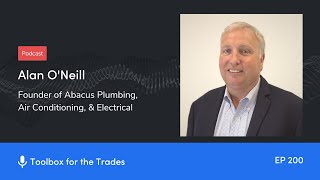
Alan O'Neill started as a plumber's apprentice in Dublin in 1977, then moved to the U.S. and founded Abacus Plumbing in 2003. He grew it to $105 million across Houston and Austin, expanded into HVAC, and sold to Leonard Green & Partners in 2019, crediting loyalty and mentorship as the core of his success.
Questions this video answers
1977
Met in 1980; married in 1984
April 2003
Approximately $105 million (Houston ≈ $80M; Austin ≈ $25M)
Deal closed February 9, 2012 (followed by HVAC launch March 2012)
One that could take my livelihood away from me and, and you know, we'd be on strike and not getting paid for weeks and weeks.
Alan o', Neal, you are first and foremost a plumber, but you are also the founder of Abacus Plumbing in Houston and Dallas. Today, you and I are going to talk about how the trades have the power to change lives, specifically how plumbing turned one kid, yourself from inner city Dublin into the regional CEO of the Wrench Group in Texas, which is an incredible story. Welcome to Toolbox for the trades.
Thank you, Jackie. It's my pleasure.
Thank you, Alan. I am. I cannot underestimate how excited I am for this interview and how privileged I feel being able to speak to you today for episode 200 of the show. Thank you so much for donating your time. I just so the audience knows, Alan was a referral by the wonderful Ellen Rohr. And I did a ton of research on him before sitting down with him today. And I really think you guys are going to love his story. So, Alan, just before we even get into it, just thank you so much for being so generous with your time.
Well, thank you for having me, Jackie. It's absolutely, absolutely my pleasure. Absolutely.
So also for the audience, I had a pre interview with Alan and I truly think that I could have taken that pre interview and just put it on the feed and you guys would have eaten it up. So I can't believe that we're sitting down here just face to face in band barracks in Houston, Texas. To kick up the conversation, I'm going to ask an icebreaker, which I love to do at the top of interviews. And in talking to you before this recording and doing all this research that I did, I noticed that you mentioned your wife Linda a lot. And I would love to know if you could tell us how you met Linda and when did you know you wanted to marry her?
Oh, the long suffering Linda. I actually met her in 1980. I was still an apprentice plumber at the time. I was heavily into soccer, played soccer my whole life. And we had had a really tough game on the Saturday and all the lads decided to go to a rugby club on Saturday night, to a disco, you know, back in 1980. And so we, we went to the disco, a bunch of guys, and towards the end of the night I met Linda and asked her to dance. And, and here we are 45 years later, still together. We've had a great life. She's been a wonderful support system to me. And, you know, we start dating in the summer of 1980. I was only 19 when I met her, she was 17. So marriage wasn't really on my agenda when I was 19 years of age, but we just suited each other. We just kind of, you know, were very natural together. And so one thing led to another. We got engaged two years later, and then we got married in 1984 and have been together ever since. So she's been a wonderful partner. Certainly couldn't have done what I have done without her. Absolutely.
You know, it's so funny, the trades. In the years that I've been doing this podcast. We're doing this podcast for about four years. It's so crazy how often I speak to husband and wife duos who run the business together. But even when that's not present, usually speaking to entrepreneurs like yourself, they almost always cite a really strong woman or a spouse behind them. That's really helping them take chances and run their business. So I just love to hear stories like the one that you just shared.
Yeah, it's. It's, you know, I learned pretty quickly to trust a woman's intuition. Linda has given me opinions over the years about certain individuals or certain. Certain things happening in the business, and she's almost always been right, which I hate him one way and another way I'm very grateful for. But, yeah, she's been a great support system to me, Jackie, and absolutely, she's provided safe harbor while I sailed for it and did my thing, you know, so it's been.
It's been great providing safe harbor. That's a beautiful way to talk about it. All right, so now that we've got the background on Linda, I want to hear, Alan, how did you get into the trades?
Yeah, so I never really set out to be a plumber. I was graduated high school in Dublin, and, you know, around 76. My dad, who was a laborer who worked for the Same company for 49 years, and, you know, I watched him go to work every morning on a bicycle in the rain, the snow, whatever weather Ireland threw at us. And he never complained. And he always said to me, alan, just get a trade and you'll never be idle. Like, get yourself a trade. And college was never on my radar. I didn't know anybody in my circle that went to college. My parents definition of success for me as a teenager was if I could get myself into a trade. So when I graduated high school, there's a national apprentice agency in Ireland, or there was at the time. I went there and said, I'd like to have a trade. And they said, what would you like to do. And I said, I really don't care. Send me for the first thing that comes along. So a month or so later, they contacted me and said, we have an interview for you to be an apprentice plumber. Does that interest you? And I said, it's as good as anything else. I'll give it a go. And so I went and was hired in 1977 and started in the trade. And I can honestly look back over these 47 years and say I've never worked on anything else. You know, it's been my trade for 47 years. Haven't been on the tools in quite a while. I'm not sure I'd remember how to use them at this stage, but you and me both. But yeah, absolutely. But no, it's been a great. It's given me a great life and I love the industry, I love the trade.
Yeah, that's clearly evident based on the impact that you've had on the trade. So we're going to get into you founding Abacus Plumbing in a bit, which, by the way, as of this recording in 2024, the Houston office is planning to take about 85 million this year and Austin about 30 million this year. Is that correct?
It's. It's approximately 80 and 25, so about 105 million between the two locations.
Okay, just 105 million. Just 105 million from inner city Dublin. You mentioned your dad was a labore, right? And that if you have a trade, you'll never be idle. I mean, do you ever think about how far you've gone compared to the expectations your parents had set for you?
I think even the expectations I set for myself, Jackie, you know, like, my goal was to provide a great living for my family and. And in my mind as a. As a young man, that meant, you know, if we could own a home, own a car, not two cars, a car, and maybe have a vacation every year to somewhere sunny. Like when I lived in Ireland, that was my aspirations. Maybe go to Spain or something in the summertime and not have any debt or have as little debt as possible. I mean, to do what I've done, what we've done has been incredible, absolutely incredible. And it's far exceeded any expectations I had or we had, or I'm sure my parents had for me. But it's what the trades can do. Yeah, it is what the trades can do, 100%.
So let's talk about you coming to the United States. Yeah, walk me through how that happened.
I was working for Aer Lingus in Ireland. The National Airline as a maintenance plumber in the airport. It was probably one of the best jobs a tradesperson could have in Ireland and was quite happy. I mean, I was. I was satisfied, let's say, but there was very bad industrial relations problems in the mid-90s in Ireland. And every year we seem to go on strike in the summertime. And I hated it. Like, I absolutely hated anything or anyone that could take my livelihood away from me. And, you know, we'd be on strike and not getting paid for weeks and weeks and weeks. And I had young children, and I was like, this is. This is not what I want. And. But I didn't really know how to get out of it or what to do. So we were on strike one summer, and myself and a friend of mine, another plumber, we were looking, reading the newspaper in the airport, and we saw an ad in the newspaper for a worldwide lottery for American green cards. And we said, hey, let's. Let's do this just for something to do. Let's fill this out. And Ken said, yeah, let's. Let's do it. And so we both filled out an application, and all you had to do was send a postcard with your name and your dependent's name, and you could send one for yourself as head of the household and your wife as head of the household. So you basically had two entries. So I sent two entries, and Ken sent two entries. Forgot about it. Fifteen months later, I'm on a roof in the airport working, and Linda calls me and said, there's an envelope here from the National Visa center in the US And I said, like, to do with the Visa card. I didn't know what, you know, forgotten about it. And she said, I don't know. And I said, well, open and read it to me. So she opened it and it said, you know, dear Mr. O', Neill, you've been pulled out of the lottery. Basically, we had, you know, got picked. And she's like, what is this all about? And I said, let's. Let's talk about it when I get home. So we went home, we realized, like, we could have green cards if we wanted them. And so we kind of looked at each other and said, what we do? And. And we said, well, let's go down the road with this process and see what happens. So, so we did. We, you know, filled out all the paperwork and we went down the road a little bit. About a month later, my buddy Ken also got picked out of the lottery, which is very, very unusual. Very strange that, you know, we would both be picked out because I don't know what the chances are, but they're one in several hundred thousand have been picked out of this lottery. We decided we were going to go. Ken was still making his mind up and I went into my boss and said I'd like to take a year's leave of absence. And this was 90s, you know, start of 96. And so they gave it to me. Linda had an uncle living in Houston. We had considered Houston, we'd considered Atlanta, we'd considered Boston, New York, all the Irish Centers and the U.S. and so we said, let's try Texas. At least we have somebody there. And so we.
And son.
Yes, exactly. If you had gone to Boston, if.
You had gone to Boston or New York, you would have had similar issues with.
I'd be home by now, Jackie. So, so we, we came to Texas and we start looking around and I started applying for jobs. Now, I didn't have a Texas plumber's license, but I had been a plumber for a long time in Ireland. And so as luck would have it, I got hired by a guy by the name of Jim Wilburn, who, who had a small plumbing service company in downtown Houston, about six trucks. I was actually truck number six. Again, I didn't know it at the time, but Jim was a member of Contractors 2000, which became Nexstar, which is originally how I met Alan. I kind of got thrown in at the deep end a little bit. Like I was learning all this customer service stuff that I'd never learned before. I mean, I literally had never serviced a residential customer before that. All my jobs were either industrial or commercial type building work. Jim taught me a lot about the trade. Contractors 2000 taught me a lot about the trade. I was working for Jim for about six months and Linda had had a baby in the meantime. My son Paul. We had two kids, two small kids. And then we had Paul. We started to get a little dissatisfied because I was gone from 6am in the morning in my service truck and I wasn't getting home till about 8:00 clock at night.
Ooh, that's tough.
We were living in an apartment where we were living in a house in Ireland and we kind of looked at each other one night and we said, like, is this really worth it? We're away from our families, we're on the far side of the world. What are we doing? Like, should we stay? Should we go? And I'll never forget, like, Linda goes, why don't we run it by Emma or 8 year old, like just See what she says. And so Linda went to Emma and said, hey, Emma, what do you think about going back to Ireland? And Emma put her hands on her hips and said, you guys took me away from my friends, and now you want to take me away from my new friends. It's not going to happen. And we were like, okay, well, I guess that's. That's our minds made up, you know.
Yeah.
You know, and. And we just said, look, let's get through Christmas. I mean, we came in May. We said, let's get through Christmas and see how we feel. I said, well, I'll tell you what, I'll start applying for other jobs. Maybe that wouldn't have me out of house as long. And so I started applying for other jobs, and I actually got an interview with the Eastern Astros and to be a maintenance plumber in the Astrodome, which was where the Astros played at the time. So I got the job. I got the job. And I said, okay, well, this is good. I'll be in work at 8. I'll be home at 5. You know, can take care of the kids with you, Linda. And, you know, we can. We can go from there. So I went into work to quit, and I went into Jim's office, and I said, hey, Jim. And he goes, alan, what's up? And I said, I'm quitting. You know, I'm gonna go work for the use of Nastros. And he said, you're what? No, you're not. And I said, no, I really am. And he goes, no, go, go, go do your calls, and let's talk about this later. I think I actually shocked him because he thought I was doing really well. I thought I was doing well, but it was. The hours was. Was killing me. And so Jim said, just do your. Do your call. So next morning, my phone rings at 6am and Jim said, are you awake? And I said, yeah. He goes, can you meet me at the Holiday Inn near the Astrodome? Which our office wasn't far from the Astrodome? And he said, can. Can we have breakfast? And I said, okay, so we meet for breakfast. And Jim said, look, I'm selling the company. I'm under Loi. This was the wave of consolidation in the mid-90s, late-90s. He said, I fully intended to promote you, but I don't really. Can't make a move while I'm in under Loi. Like, can you just hang on and after Christmas, I'll make you a service manager? And I said, well, Jim, look, I'm. I'm the New guy on a block. I don't know how that's going to go down with the, with the guys, you know. And he said, let me worry about that. He said, will you stay? And I said, well, let me go home, chat my wife. So I went to Linda, I said, you know, have this opportunity. And she said, well, like, whatever you want to do, I'm. I'm with you either way, you know. And I said, I'll give it a shot, right? So decided not to quit. Jim promoted me to service manager. A year later, Jim comes to me and he says, hey, they want to move me to Denver Encompass, and they want you to be president. Now. Now, Jackie, I couldn't even spell P L, let alone understand what a P and L was. Jim said, look, don't worry. He said, I'll train you before I go. And I said, okay, that's. That's reasonable. But things happen much faster than Jim anticipated. And he went off to Denver. I was told I was president. This was about a $2 million business. My training was the bank bag was on the desk, on Jim's desk, and it said, take this to the bank every day, preferably full. And that was my training to be a president.
So I started picturing a comedic bag of money with a dollar sign on it. Is that what it was?
That's what was, Jackie. So I'm like, I know I can motivate people. I'm good at that, and I can learn the rest, you know. So we were actually. It was April of, I think it was 98 at this time, and we were pretty far behind our budget for the year and got to prove myself because I kind of felt like maybe I was just in the right place at the right time and they were going to get a real president eventually, you know. And so we managed to turn it around and beat budget that year. The first thing I did was I hired a cfo. I said, I need you to teach me the P and L. I need you to teach me every question we're going to get asked on the monthly operating results call. I want to be ready before they ask the question. And so he taught me about margins, what to look for and what not to look for. And interestingly, that guy worked for me until a year ago. He followed me to the new company eventually. And. And Bill was my, like, right hand guy for well over 20 years, you know, And I have a history of developing relationships with people, Jackie, and they become long term relationships. You know, Bill was, was that guy Ken eventually got, came to the states and start working for me. He worked with me at Gerald Plumbing, the first company. And then he worked with me all the way through until he retired about two years ago. So. And his son works for us today. So, you know, those kind of long term relationships. So, so, so that was it. I became president. We grew that company from 2 to 5 million encompass. The parent eventually filed bankruptcy. I was running the company in bankruptcy, which I really didn't like because we couldn't pay bills. And Jim called me one day, he had since retired in Denver, and he said, hey, what are you going to do? And I said, I'm going to start a plumbing business. And Jim said, well, what's your plan? And I said, I'm going to buy a truck and start running calls. And Jim goes, horrible idea. I'll come back and we'll start it together. We'll be 50, 50 partners. And so sit tight and, you know, I'll come back to Houston. So he came back to Houston. We started having Starbucks meetings. I would spend my lunchtime in Starbucks. We planned this new company. He said, look, can you, can you think of a name for the company? And I said, okay. And he said, look, I was talking to my yellow page lady because she's at the time. That's how you got your calls. Jackie. Of course, no pay per click and SEO and all that type of stuff.
Because this is still 90s, right? This is still early aughts.
Yeah. So this was like 2002 to late 2002, heading for 2003.
All right, so we had dial up, but it wasn't the Internet that we have today.
No, it wasn't. There was no, like online advertising per se. The yellow pages lady said it would be great if we had an alphabetically friendly name because some of the yellow page books go alphabetically. So I said, okay. So I went home that night. Jackie, no joke, opened the bottle of beer, set it on the table and opened the dictionary and started at A. And the first word that came to me that made any sense was abacus. And the slogan, you can count on us came to me immediately.
Perfect.
And so I called Jim and said, what do you think of abacus plumbing? You can count on us. And he goes, oh my God, Brilliant. So, so we found that that's how we started. And we started in April 2003 with myself and Jim as 5050 owners and Ken, the guy from Ireland that followed me, and Charlie Brown, who still works for me today. That was, that was 22 years ago.
Charlie Brown, Charles Brown, Charles Brown.
Yeah, that's his name. Charlie Brown. Yeah. So. So, yeah, that's how we started, Jackie. Two plumbers or two owners, a 6,000 square foot building. Like, we went big at the start, trying to. Trying to get going. We had missed the yellow pages for the year, so we. We did some radio advertising and we started. And that's.
Wow.
That's the start.
I want to pause there real quick because I think your story really has this theme of changing lives and kind of almost this magical intervention in some ways. Like, out of hundreds of thousands of people, both you and Ken got selected to get visas to the United States. You happen to partner with Jim Wilburn, who happens to be a contractors 2000/nextar member. So you didn't just fall in with any old service residential plumber. You fell in with one of the best of the best. And you seem to have this aura about you where people just want to keep working for you and want to keep collaborating with you. What do you think that is about you that has engendered this loyalty among so many good people?
I legitimately love my people, Jackie. Like, and it's been a strength and a weakness at the same time, of course, in the sense that sometimes I give people or have given people too much leeway. But. But, like, I watch my dad, you know, get on a bicycle and go to work every day for 49 years for the same company, never complaining. Right. He never could give me a lot of material things, but he gave me the gift of work ethic, which was the best gift he could ever give me, you know, and so my. My kind of mantra has always been like, treat people really well until they give you a reason not to treat them well and be loyal to the people that got you where you are. You know, I mean, I never considered it an expense to take great care of my people. I considered it an investment, you know.
Yeah.
And so we've just always taken care of people and developed relationships, everything from suppliers. Like, I never nickel and dime my suppliers. Like, I have Texas season tickets, and the guy I sit beside is one of my suppliers. That was one of the first suppliers that gave us an account when we opened in 2003, you know, and so, like, those relationships just mean so much to me, Jackie. Like, more than a lot of the things the business created over the years, I think the relationships with our people, with our suppliers, with. With, you know, fellow plumbers from all over the US I think have been a really strong part of who I am, I think.
Yeah. Yeah. And that's actually a topic that comes up on the show all the time. Whenever I talk to leaders who have multimillion dollar businesses who have done big exit exits with private equity or collaborations with private equity, and they have, like, just more wealth than you could ever imagine. They always cite back to culture and investing back in their people and building up the people around them, which I don't think is something people normally think about when they think of really successful entrepreneurs.
I'll tell you, Jackie, we've been blessed. We've won many awards over the years. We've been on the Inc. 5000 list. We've won the Better Business Bureau Award 16 years. We've got all the accolades you can get. But the best gift I've ever gotten as an owner and entrepreneur is changing people's lives. There's one plumber in particular that we hired, Jackie. His name is Chris. And one of the reasons I think Chris resonates with me so much is because he started with me as an apprentice at 18 years of age, the same day my daughter started college. So Chris starts at abacus, Emma starts college. Emma goes on, gets her. Gets her degree in early childhood education. She goes on and does a master's degree. Right. Chris starts as an apprentice plumber, becomes a plumber, becomes a master plumber. I've watched Chris buy a home, buy a boat, buy a second home, buy an Airbnb. Like, I've looked at him, I've watched him do all this stuff. And it's all down to Chris's hard work, of course. But we help change his life, like we change his family tree. To me, that's the greatest gift, is seeing these kids that high school counselors write off in many cases, and they enter the trades and they're really getting a job in their mind. We're telling them, hey, we're giving you a college, the equivalent of a college education, and we're allowing you to make six figures inside four or five years and change your life, change your family's life. You know, that's the greatest gift to me.
You're giving them a career where they'll never be idle.
Absolutely.
Just like your father said.
Yeah, absolutely. And, you know, I've watched, of course, one of the disappointing things about running a service business is you watch people coming and going and they jump from job to job. But the people that have really been successful, Jackie, are the people that have stuck with us, you know, and not because I think we're way better than the competition. I just think you don't gain Much by jumping around. Right. I think the loyalty thing, and that's, you know, as I mentored these young men, I've told them, value loyalty, because we're going to be as loyal to you as you are to us. And, you know, if you stick around, you're loyal, we'll be loyal to you, you'll make a ton of money, we'll change your life. It's been a recurring theme because it's really important to me, Jackie.
Yeah. I wonder if you would have had the same impact at the Astros.
Probably not, Jackie. Probably not. No. No. You know, I honestly think we often talk about that, Jackie. It's interesting. Linda and I often have that conversation. Like, what would have happened? I think we'd be back in Ireland by now.
Yeah.
Because it was a 9 to 5 job, was probably pretty secure, but it was the fixed sum of money every week. You know, there was no great earning potential. It was comfortable, but it's not what I wanted, Jackie. And I don't think it would have fed my hunger for learning and hunger for developing, you know.
Well, that's what I really got when I first talked to you, when you were talking about, I don't want anyone to ever take my livelihood away and I want to kind of have control of my own destiny. Those weren't the words you said, but that's the. That's the what I got from you.
There's a story around that, Jackie. So the first company I served my apprenticeship with, I worked for them for seven years. And I was working in a school in Dublin, Started my apprenticeship in 77, got to 84, was working on a school, and I was getting these weird thoughts in my head, like, they're not bringing material out. Like, something's going on, something's not right. And there was six or seven plumbers on the job, you know, and couldn't figure out what was going on. Eventually, our traveling foreman came out and laid us all off, you know, said, look, we've no more work. This job's just about finished. We're laying you all off. And I remember, like, feeling really kicked in the stomach, you know, we just got married, we had a house. I'm like, I don't really know what I'm gonna do here. So I went looking for a payphone. No cell phones back then, right. And so went and found a faith payphone and call Linda. And I said, hey, I've just been laid off. And in true Linda fashion, she said, like, what did you do? And I said, I don't do Anything I do, anything. And she said, what are we going to do? And I said, I don't know what we're going to do, but I'll tell you what, this is never going to happen to me again. And you talk about a statement that changed your life, Jackie. Like I don't know why I said that, but a decision was made right then, you know. And so it took me a couple of years to decide what path I wanted to go down. So I went back to school at night. I went to school three nights a week for, for three years. And then I went and took a class in industrial relations and human resources and that took two years. And so I was kind of educating myself along the way. All those things led up to, I think, the person I am today. Like when I came to the States and got the opportunity to actually manage people, I think all those things stood me in really good stead, you know.
So, yeah, that's really incredible. And I also just want to call out real quick. So my father is actually born and raised in Germany. My grandparents came over from Germany in some 19, like 61 or 62. It is such a big sacrifice to leave your home country and travel thousands of miles away and be away from your family and what, you know. And it sounds like you and Linda were only going to do that if you had a really incredible opportunity.
Yeah. So it's, it's, it's interesting, Jackie. Like I don't have many regrets, but one regret I do have as a grandparent now is I didn't realize the impact that would have on my parents taking my kids away from them, you know, and because as a grandparent now, my daughter said she was taking the kids and moving to Ireland. Right. I'd be devastated because like when we made the decision to come to the States, we didn't think it was going to change our lives dramatically, but we thought it would change our kids lives. So it was really for them, you know, and we may have a slightly better life here, but not dramatically better, certainly not what happened. Right. We thought we could help change our kids lives, but we didn't realize the impact that would have now. We didn't fall out with our parents, there was no bad feelings and they encouraged us, they said if that's what you want to do, go do it. But, but you know, as a grandparent, I think that's tough to see your grandkids going. And, and my parents weren't travelers and neither were Linda's parents. So now my dad eventually did come after my mom passed away. But, you know, it's a tough thing to do, is to move across the world. And I think that was part of what gave me the hunger to succeed. Jackie. I was like, if Linda made the sacrifice to back me and come with me, you know, across the world. And my kids kind of packed up, left everything they knew, and came to the stage, we're going to make this thing work. Like, I'm going to work my tail off and make this work, you know? And so Linda sacrificed a lot. I think I sacrificed a lot. And we just kept working and working and working to make it work, and here we are.
Amazing.
Yeah, it's been great.
All right. I want to get a little bit into abacus and the growth there, right?
Yeah.
So, first and foremost, I want to talk a bit about how you and Jim split responsibilities as partners. What was that like? And how would you guys resolve any disagreements, if there were any?
We never really had a disagreement, Jackie, until I tried to buy his half the business. Like, that didn't go great.
Sure.
To be honest with you. And that was more. I think we had different expectations of how that was going to happen. We got it resolved and, you know, we stayed friends and all that. But Jim was the. The wise old owl, so to speak, if you like. He kind of had been around the block, had built a service company before, was one of the founder members of contractors 2000. Like, he knew the game. I had energy, he had money I didn't like. He had the contacts with the banks. I didn't. And so basically, Jim ran the administration side of the business, and I ran the jobs and the guys, and that was basically it. And it worked really, really well. That was 2003, Jackie. In 2007, Jim came to me. We were about $4 million at the time. And he said, look, I don't want to. I don't want to do this anymore. Like, I'm done. Ready to retire. He was. He was 67 in 2004. And so I said, okay, you know, and he goes, I want you to buy my half. And I said, okay. It took a year, Jackie, to do it, but we did it. I was the sole owner then and continued to grow it. We grew by a million dollars a year every year from 2003 to 2011. At the end of 11, we were 9.3. We had about 35 people. We were really, really good.
Also, a recession happened during this time.
We never slowed down. Yeah, never slowed down, Jackie.
Which is really impressive.
Yeah, 2008 was tough, but we grew through the recession. And.
And this was doing all residential service, plumbing only. Okay.
Yeah. So in 2011, I was approached to sell the company. Jackie and I went down the road a little bit with it, but I didn't pursue that opportunity and continue to run it. But I did hire a consultant. I hired a consultant to come in and look at the business and said, look, I kind of feel like I've been asked out on my first date and I wasn't ready. Like, sure, you know?
Yeah.
You just. Can you just tell me what to do if these people come along again? Now, at the time, there was no huge wave of private equity in our industry or anything like that. And so a broker called me and said, look, I got this guy from Seattle. He's very interested in your business. Would you at least talk to him? And I said, sure. You know, talk to him. So Colin came in the end of 11, 2011. We really hit it off. Like, I. I went, I like this guy. Like we.
And which Colin is this?
This is guy called Colin Hathaway who ran Skylight Capital.
He was on this podcast.
Was he? Yeah. Yes. Super guy.
Yeah, he's great.
He's great. Colin and I have a great relationship. So. So Colin actually ended up buying the company with Alpine Investments. Alpine investors out of San Francisco, where the money behind the deal. So we partnered up in the end of 11, and he said, look, you got to start air conditioning 2012. So actually it was February of 12th when we closed the deal. So we closed the deal 9th of February, ran our first air conditioning call 5th of March, like literally within a month, got air conditioning going. We were sold in 2015. At that time, there was Abacus, there was Berkey's in Dallas, there was Parker and Sons and Coolray. Coolray came on board in Atlanta. And so that when that group of companies was put up for sale, it was called the Wrench Group. The name, the kind of incognito name, it was the Wrench Group. And when we were purchased, they decided to keep the name the Wrench Group. So that's how the Wrench Group started. And that was 2015. We continued to grow and the Wrench Group continued to add companies. 2019, we were sold to Leonard Green and Partners and out of la. I will tell you, Jackie, that people. There's lots of opinions about private equity and private equity investors and the people.
Oh, yes.
And. And I think I've just been blessed, like, really. Colin was fantastic when we got involved with the Wrench Group. They were. They were fantastic. The Private equity group out in New York were fantastic. Glennon Green and partners have been. I think what's been great about them is they've been very hands off for the most part. They've let us run our businesses. Maybe I got lucky because I've heard a lot of horror stories about owners that sold and weren't happy down the road. But all our private equity partners have been really great to me and the Ranch Group have been fantastic. They've been great. In June 2023, I went to our CEO Ken Haynes and said, look, I'm going to raise. Slow down a little bit. And Ken said, design your perfect work week. What's it look like? And we came to an arrangement that I work part time as a consultant for abacus. That's what I'm doing today, Jackie, is. I was in the office yesterday all day and it's great because I still feel involved, but I don't have the 60 hour weeks that I've been doing for. Seems like forever. Yeah, it's been great.
I'm glad you brought up private equity and because you've been a part of so many different sales. You know, thinking back to you when you got that first call and you were feeling like you got asked out on the first date, you didn't know what to do. Given the atmosphere now and what, you know, what advice would you give folks listening who are either considering selling or partnering with private equity or maybe want to get there someday?
Yeah. So I think definitely two different types of advice, Jackie, for, you know, for people that are considered considering partnering. Keep in mind, the day after the money hits your bank, you're an employee, you're not an owner. Like I said, I've been blessed with Colin Skylight Capital and his partners and Invest Corp were the company in New York. Invest Corp and Leonard Green. They've let me run my business, Jackie. But you're not an owner anymore. I still have equity. I've had equity all along. But, but keep in mind you're an employee and, and you have to be ready for that because there's going to be decisions along the way and thankfully there have not been many in my tenure. But there's going to be decisions you don't like, but you're an employee, so you have to be okay with that. And keep in mind the money's in the bank. Like you've got paid for that. If you don't like the number, don't sell. But, but keep in mind you are an employee. So that's, I think, the biggest Thing entrepreneurs have to get over is you become an employee day after you sell.
You have to, you have to report to someone. And maybe historically when you didn't consult for making decisions now.
Oh, you have to especially decisions that in fact, you know, the well being of the company. I mean obviously you always want to make the right decision, but, but you are responsible to other people. And there's, there's people that have put a lot of money into this company now that have huge interest in what goes on. So you know, you are an employee. You have to make sure that you consult the right people at the right times and do the right thing and be ethical and honest and all those things. You have to have your house in order, Jackie. Like you have to have clean books. I was never the type that did a bunch of stuff for myself out of the company. Like I always toe the line. I, you know, like that's the company's money, this is my money. The two don't really mix. Like I, I was very above board with everything I did. I think you have to get your company clean first of all. Like there needs to be no nonsense going on like company boats or whatever you might, might have, right? But most importantly, Jackie, your company has to be able to survive and thrive without you. So you can't be the guy that has everything inside your head. Like you have to have systems in place, you have to have procedures in place. If you get run over by a bus tomorrow morning, the company has to be able to drive like so private equity will only buy you. I mean, when I think of Alpine and Invest corporate, Leonard Green, all kind of at different stages of sophistication of our business. What they all wanted was access to information systems in place in the business that would allow the business to continue to drive. Should I go away or you know, so you have to have succession planning in the business, Jackie. Like one of the things I'm probably most proud of is that the Wrench Group told me several years ago, look, you have to have the next guy ready. You know, you've got to have, if you want to get out of this someday and, and go to a beach, you're going to have to have a successor in place. And so I start mentoring somebody, got them in place, promoted them to president a year before I wanted to exit, you know, well, not exit but you know, slow down. And he's doing great. And you know, I go in every Wednesday and we sit down and we spend an hour to two hours and we, we go over any issues that May crop up or may have cropped up, and. And some days there's nothing or very little. And yesterday was one of the days when I'm glad I wasn't in the hot seat anymore, you know, so it was just one of those days, you know, But.
So it's a continual mentorship.
It's a continual mentorship, Jackie. Yeah. And. And not that. Not that Tony needs it anymore, like, he's doing so well, but I think having a shoulder to lean on that for somebody that's been there and done that, is very helpful to him. And I think that's something. The Wrench Group have done really well at several locations across the portfolio. You know, the Wrench Group is so big Now, Jackie, like, 28 locations, well over a billion dollars of revenue. It's such a lot to watch over that you've got to have that succession coming behind the leaders and entrepreneurs that started this thing.
I actually am curious. I want to know, because you were so involved in the technical components, and when you and Jim first started the business, you really ran the guys. You ran the jobs. Did you ever struggle with the common difficulty that a lot of folks do, which is, did you ever have to force yourself to stop working in the business so you could work on the business?
I think I was lucky, Jackie, in that. In the history of abacus, I ran one call, which was the very first call. It was so funny. It's actually a funny story I think is worth sharing. Please. Jim and I are in the office on the very first day we're open, and it's like a Wednesday or something, so we're not really. The plumbers are not arriving till Monday, and we're like putting filing cabinets in place, and, you know, we're just getting the office ready. And the phone rings and we both.
Like, oh, we weren't planning.
We went, the phone's ringing, and. And, you know, we're both telling each other, the phone ring, his phone's ringing, but neither of us are answering it. And Jim goes, answer it. You know, so I answer it, and it's our landlord. And he goes, hey, you guys are plumbing company, right? And I said, yeah. And he goes, we have a leak in a building up the road. Do you think you could send someone up to look at it? And I went, absolutely. Let me get the address. So I write down the address and, you know, all the information. And I hang up. And Jim goes, did you just book a call? And I said, yeah. And he goes, who's going to run it? And I said, I guess I am. And he goes, you have any tools? And I said, no, but there's a hardware store across the street. So I go over and I bought a few tools, Jackie. And we had some material in the warehouse because it was being delivered. And I went up the road and I put a pipe clamp on a galvanized pipe that was leaking. I got a check for $180. And I came back and you think I had a Super Bowl, Jackie? I was like, we got a check, you know, and. But that was the last call around, Jackie. Like, the two guys started Monday, and I. I did a lot of the selling, and I did a lot of supervising and managing and, you know, and grew in responsibilities and, like, kind of what I'm doing for Tony today. You know, Jim was that mentor to me. Like, he was, what are you doing there? Why are you doing that? Like. And, you know, not in a. You know, we were exactly 50, 50 partners. So there was no, like, big brother. It was more like, can I help you with that? It was a great partnership, Jackie. And we did really well with it. So it was a lot of fun.
Amazing. And one of those first two plumbers, that. One of them was Ken, right?
Ken and Charles. Yeah. Ken and Charles Brown. So they're the two. Yeah.
Amazing.
Yeah. So great.
Alan, you've been so generous through your time. I have a few more questions for you. I would love to know what's the best piece of advice you've gotten over the course of your career?
I think the best piece of advice I've ever gotten over the course of my career, Jackie, was get yourself a trade, like, from a dad. Like, it was. You know, because I didn't know. Like, I thought I wanted to be a professional soccer player. I just didn't have the body type for. I mean, you know, I was decent, but I was. Wasn't good. You know, I was never good enough to be a professional. But I think, you know, just getting into the trades and then, you know, there was many pieces of advice that Jim gave me and that. Actually, probably the best piece of advice came from Colin. Colin was younger than me, like, at least 20 years, maybe 25 years younger than me. So different in many ways to me, but, like, there was a connection there, I think. But. But Colin said to me one time, I'll never forget it. He said, I always want you to feel safe and happy, and if you don't feel safe and happy, help me. Right. And I took that, Jackie, and said, I will, you know, And I took that Piece of advice, and I turned it around and said, I want my people to feel safe and happy. And so if I, if, If they don't feel safe and happy, I want. No, often and quickly if there's something wrong with them. You know that. Because when people don't feel safe in employment, Jackie, they're going to take flight because they don't want you to give them the bad news. They would rather give you bad news and say, I'm leaving. So if somebody feels unsafe, I think it's bad management. You're giving them hints, they're not doing well, but you're not willing to have the tough conversation with them. So I think that safe and happy conversation that Colin had with me very early on was very impactful for me and helped me turn that around then. And as I was managing people and more and more people, I really wanted them to feel safe and happy and, and honestly, it would horrify me if somebody worked for me and felt threatened by, by me or the company. Right, of course. I mean, let's get it worked out and we can't get it worked out. Let's shake their hand and send them on their way, you know?
Yeah. Yeah. I think that's fantastic advice. I mean, and I think that's applicable not just to the trades. I think that's applicable to literally any industry you can.
It's even applicable in a marriage, Jackie. Yeah. I mean, if you have a partner and they don't feel safe and happy with you, there's. There's a huge problem going on somewhere.
You know, I 100% agree. Obviously, you've experienced a ton of success, which is phenomenal. Well done. Was there ever a day you wanted to quit the trades?
There's many a sales call I went on, Jackie, that I got back in the truck and said, this is a stupid trade. Like, I want to. No, I don't. I don't really think so, Jackie. Like, I never really went home and said, I don't want to do this anymore. Probably because I don't know what I would have done if I wasn't in plumbing. And it's been so good to me. Like, it's been so all along the way. I mean, as a, as a young apprentice, like, working on building sites in the winter in Ireland, like, there was some tough days, you know, having your tea break, sitting on a concrete block. Like, it was, it was rough, you know, but it didn't do me any harm. I can legitimately say I love plumb. Like, I love the trade of Plumbing, but more what it can do for people than the actual physical plumbing itself. Right? I love business. Like, I just love the challenge of business. I remember having a lunch with a friend of mine, an electrician, and we were sitting, having lunch, and. And he said to me, like, what's it like to. To sell your company? Like, what. How does it feel? And, you know, all that. All that type of things. And he said, like, do you miss being the guy? Like, being the owner? And I said, yeah, like, I do. I. There's times I do miss having all the responsibility, you know? And with that, his phone rang and his computer system had crashed at the office, and he was in a panic, and he put the phone down and got on. And I said, I don't miss that. That's what I don't miss. Right? I just don't miss that. And so, like, there's good and bad to everything you do, Jackie, Right? Like, I mean, is there times when I talk to myself like, what if I hadn't sold in 2012? Like, what if? But, but look, Jackie, I have achieved stuff I never thought of achieve. Like, this is a bummer from inner city Dublin here. Like, this is not, you know, this is not a Harvard guy, right? I mean, I remember sitting in a. In a boardroom on the 23rd floor of the Embark Ember Cadero Tower in San Francisco, waiting for the board meeting to start, and I'm looking out at the Bay Bridge, and I'm going here? Like, what am I, you know?
Yeah.
I remember going to New York to invest corpse offices, and they're on Park Avenue, and you walk in the building and it's white marble, like. And you expect, like, Morgan Freeman to come down the stairs as God, you know, like, it's like. And you go up to the. To the boardroom, the oak panel boardroom. You're sitting there going, I'm a plumber from inner city Dublin. What am I doing here? Like, But I wouldn't be there if I didn't earn the seat, Jackie, right? So it's. There's been times when it's been crazy, but I've never, like, literally no regrets. I wouldn't change the course of my career at all. There's nothing I can think of that I would change, Honestly, Jackie, better about my career, my trade, you know.
Beautiful answer. This is your chance to take a megaphone to the industry. What do you want to tell all of the contractors out there listening today?
Taking care of your people is not an expense. It's an investment. I mean, I said that earlier, but I think it's. Sometimes we get misguided. When we have to cut costs and we have to trim things, we immediately look at our people first. But I think taking care of people and investing in people is truly an investment and not an expense. But most of all, Jackie, I think we're not doing a great job as an industry of looking after and taking care of the next generation of tradespeople. We're not getting out there and letting the world know what a great opportunity to trades are. I think every large service company should be at high schools, at career days, at, you know, all kinds of career exposure, letting people know there's a world out there that they just don't know about.
Exactly.
And, and, and what I'd say to any young people listening that may be considering getting into the trade is you're not a failure. You end up with a toolbox.
Nope.
I think a toolbox is every bit as noble as a briefcase. Like, get yourself a trade. Learn to trade well. Be responsible and show up to work every day. And then for, for, for plumbing company owners and business owners out there, take care of these people because these are the future. This is the future of our trades. And our trades won't survive if we don't train and mentor the next group of teenagers and early 20s kids coming into the trade.
We got to take care of them 100%. Is there anything I could have asked you today to make this interview better?
It's been fun for me. I'm talking about my favorite subject, which is me. But no, I think it's been, it's been a lot of fun, Jackie. Like, I love telling my story because I, I know it's unique. I never consider myself some kind of genius. I just think the harder I work, the luckier I got. And I've met great people along the way. Everybody from Jim to, you know, Colin to, to the guys at the Wrench Group that have really taken care of me over the years. And, and I like to think I've paid it back in, in. In the way of conducted myself as a leader and regional CEO and a now consultant. Like, I just, you know, I love the trades. I hope they continue forever. I hope you're sitting here 20 years from now talking to the next guy that, that has done really well.
Oh my gosh. Episode 400.
Yes. Yes, yes, yes.
Alan O', Neil, thank you so much for taking some of your time today to talk with me and for being episode 200. I truly could not have thought of a better person person to share his story.
Thank you. Thank you. It's been a lot of fun. Thank you very much.
More from Bill




Capturing the 80%: How SmartAC’s Gen-2 Targets Non-Membership Homeowners | Podcast Ep. 296

Build better customer data with every booking in ServiceTitan | TAD Tune-Up Series

The Biggest Change for Roofers Coming From Other Roofing Software to #ServiceTitan?

