How to Build a $50M Service Company w/ Your Spouse | Podcast Ep. 68 | Toolbox for the Trades
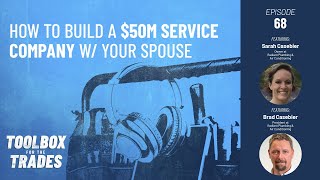
Brad and Sarah Kaspier built Radiant Plumbing in Austin to $50M revenue by 2021, starting with a rebrand in 2005 and launching their service division that same year. Sarah transitioned from nursing into operations while they used tools like Traction and Basecamp to scale, then sold a stake to private equity to fund national expansion.
All right, Brad and Sarah Kaspier, you are the owners of Radiant Plumbing in Austin, Texas. Brad, you are the author of the Survival guide to working with your spouse. Thank you guys so much for joining me today on Toolbox for the trades.
You bet. Thanks for having us.
No worries.
I am. So I read your book from front to back, Brad, about all of the stuff that comes with working with your spouse and having a successful business partnership. And I think you've got some really great things to say. So I just appreciate you asking me to come on interview guys and get a little peek behind the curtain into your relationship. I will start this podcast the way I start every single one though, which is how did you get into the trades? And Brad, maybe you can answer that one first.
Yeah, I was kind of born into it. My dad was a construction plumber, kind of a one man band. And when I was 13, my parents said, you're going to go work with your dad this summer. So they threw me in a motorhome and we got had a remote job that he got a big contract on and it was a seven day a week gig. Um, and that works so good that they said, well, let's homeschool him and so he can keep working. And so I do schoolwork till noon and then he'd come up for lunch. I jump in with him and work out the evenings. And my journeyman's when I was 17, my master's when I was 20, started my own business when I was 23. So, yeah, all the child labor laws were broken and I was. Oh my goodness.
Wow.
Yeah, I've been doing this for a while.
That's insane.
So.
And you guys have been together for quite a while as well. Like you got married fairly young, right?
Yeah, we were 21.
Yeah, it's coming up on our 25th this month or next month.
Oh my goodness. Congratulations. Okay, so if Brad, if you were working, you know, working at school in the mornings and then working plumbing in the evenings, how did you have find time to meet Sarah and be like, yes, you'll be my wife?
Yeah, so I was around 19, I was taking some night college classes after work because I thought I should try this college thing out. And everybody was graduating, was getting really low paying jobs and I was making more than my friend's parents. And it was just like, what am I doing? And all these people are retiring out of the business. And I just made a strategic decision. At 19, I think it's plumbing. But that's where Sarah and I had met and we're hanging out and we're friends and just kind of became more than friends and we started seeing each other more, and one thing led to another. But she was in college to become an rn.
I know. And you did become an rn, right? You were a nurse for very long. For quite a few years, right, Sarah?
Yeah, quite a few, yeah. Did emergency room and labor and delivery.
Very low stress, low pressure jobs, like, easy to do. Yeah, sure, sure. So, Sarah, I imagine that you got into the trades because Brad kind of brought you into them. Is that fair to say?
Yeah, definitely. Married into the biz. He started the business. I guess it was two or three years after we were married, three years after. And he said, hon, I'm going to launch on my own. I was like, that's great. And he said, and by the way, somebody's got to do the bookkeeping.
My mom will help you. She's done it for my dad. She'll show you how to do it.
Nobody disclosed this when I was signing up.
Wasn't in the vows. That was in your marriage vows.
Not in the agreement. Nobody just. Yeah, it was not disclosed. But, you know, over time it was. It needed to be done. And I found a love of accounting that I. That was surprising and ended up enjoying it. So.
That's awesome. That's awesome. And actually a really great segue because in the book, Brad, you very much say that Sarah was the one that had the original vision for the business because you started in commercial first. And it was really Sarah who was like, we should open up a service division. So, Sarah, I would love to tell you a bit about why you were so confident in a service division for Radiant and how you came to that realization.
I think it was one of those things. Brad had been running the new construction side of the business, and he had really grown it, had premium builders and had grown it with several employees. And it was one of those things that I was still working as a nurse. We had three little kids. I think they were all three in diapers same time as like three kids, under three and under at one point. And I'd leave to go on night shifts working as a nurse. And he would come in and go out in the day, and we were just passing, you know, in the hallway. It was just insanity. And at some point, he told me, just walking out the door, he said. He made a comment. He said, man, what would it be like if we were working on the same thing? And I really had to mull that over because, I mean, it's just like looking at the new construction business, it felt a little volatile. It was stressful. Waiting for the builders to pay the bills and looking at the books and me paying our bills. It was just very stressful. And the inspiration really came as I started researching and I didn't even tell them. I was just thinking it was like, man, what would it look like if we just really joined forces? And this is all we were doing? And I wasn't. Didn't have a competing career. Started reading a whole bunch of articles, very inspirational Companies in the plumbing and mechanical magazine, which is. I never thought I'd be reading that magazine, but it was good. And came across articles by Frank Blau and Ellen Rohr and so many others. And back in the day, they had their phone numbers underneath their byline. And so I picked up the phone and called Mr. Blau and called Ellen and others, and they picked up and had really inspirational, very amazing conversations about what a profitable business could look like. And went back to Brad at that point, said, I'm in, but I think we need to start moving in the direction of service.
That's so amazing. Ellen Rohr has been on this podcast. I absolutely love her. And I love that they still had their numbers in the bylines. And you're like, let me just do a little bit of research on my own. So, Brad, tell me what that was like for you. You know, and also, I just want to make a comment. You know, that total passing of each other in the hallways, that's kind of how my parents did it when I was a young kid. That is so hard on a young marriage. And also, I just want to call out, you guys were so young too. You were just in your 20s. Really. I commend you on being able to do that. That is so tough. So, Brad, when Sarah came to you, I guess, passing the next day in the hallway and was like, yeah, I'll do it, but we have to open a service division. How did you react to that?
It was a little confusing because I'm not. I'm like, I had a stigma about service. I was a construction guy, you know, but then there's this other part of me that's like, that's going to be more recession proof, you know, and we need to be this, this up and down thing with construction is dangerous. And so there's a lot of logic in that. I don't really want to be a service guy or be involved with that. I probably had about seven employees. I was working in the field with them at the time, you know, but the Biggest thing was, is she went and visited a shop that was doing around 8 million in Buffalo, New York. It was a. It was an open house kind of a thing where they. They got. She got a tour and she came back telling me about this. This company. And it was all clean and perfect and shiny and they all. The warehouse was organized at bins for the guys. And everything was completely dialed in. Completely intimidated me because I kind of. I knew what a fireball I had married. And I thought, yeah, she's going to build that. And then I thought, where am I going to fit in that? You know? And I was like, I'm just this field guy and I'm going to get left behind in this company. And it was. It really freaked me out. And so. But after a lot of, like, it was the right thing to do. And I was like, okay, you. I. And I was so consumed with my work, I couldn't do. I'm like, I'll be technical support for you to help you anyway. I can. I'll interview guys, but you gotta. You've gotta run it. I can't have customers calling me and I. Even a technician, like, I'll help him some, but I'm pretty buried. So she was the CSR dispatcher, service manager, sales trainer, everything she learned, all of it, while I kept. And this was some of Frank Baugh's advice, like, don't shut down construction, whatever you do. He said, that kills people. He said, keep your revenue going. And so I. We agreed on that so I could focus my energy and just stay on the ball with construction. And she was able to just completely immerse herself in service. And so she was all things service for three, maybe four years before I started really getting into that with her. Oh, my goodness, really? Yeah.
I didn't realize that that was such so long of a transition. And you actually just brought up a really good point that this theme in your book at the beginning, that you talk about the importance of growing and learning together as business partners instead of individually, and you kind of talk about these different ebbs and flows where Sarah has this really great idea and you're.
Like, whoa, wait, what are you doing?
And then you have this great idea and she's like, wait, what are you doing? And like, how that knowing making the effort to grow together is so important and can kind of create an aligned front. Right. I would just love for you guys to tell me a little bit about why that's important and give some examples of, you know, when you guys have been on the same growth path and when you've been on different growth paths and what the difference is between there, does that make sense?
It's 100%. And it's. It's so real in our lives at various times where I would advise everyone get to all the classes together, do all the coaching together, and be immersed in it together. And then. And then you debrief and everybody's going to take away whatever they're going to take away way. But, man, you get all fired up about a new thing and come home and immediately just start so excited to share it with your partner. Instant resistance. You're scaring them. They don't. They weren't there. They don't have the context. It's super intimidating because somebody just messed with your spouse's mind and sold them on a bill of goods. And you've got to protect them from these snake oil salesmen that are leading your spouse astray. That's the automatic response, like, every time. So it's. We've done it over and over again. And it's. And it's. So. It can go a couple ways, too. Where one is, you can be shut down. You have this great idea, and you feel totally suppressed and shut down. You're like, man, I'd love it if we could do this. Because there's this way. And the other is you get really cocky and arrogant and you do it anyways. And then you just think less of your spouse because they're the resistant one. And you kind of puff your chest out and go for it. And then there's these feelings of just being disrespected and things of that nature that develop out of all this. So I think any personal development, any business classes, anything like that, you should always go together, and you'll get so much more traction out of it instead of getting this much where you could have gotten the whole thing if you'd done it together because of the automatic resistance that creates.
Yeah. I mean, I've never worked with a spouse before, but I have had business partnerships in the past, and I can totally relate to that moment of, you saw something really cool, you take it to your partner. I'm like, we need to start doing this. And all they just heard was, I.
Just created more work for you.
And I don't know how to sell this because I'm not the one who sold this on you. So I totally related to that a lot. I mean, if I were to summarize your book in like, a sentence, it would be, you know, take your partner's Perspective into mind, into my. Into them, into your mind and into consideration. It's really like, what it is, but it's so true, especially when we're in such high stakes as business. And, you know, your. I think you said it in the book. You know, your rent's on the line, your grocery bills are on the line. Those higher stakes make everything a lot more emotional, a lot more volatile. Sarah, anything you wanted to mention, too, on, like, the growth trajectory, especially because you, I mean, you went off and were like, I found that service can be so much more profitable for us. Anything that you want to add there.
Specifically related to just the overall growth that we've had or. I'm sorry, Overall growth, man, it's been just putting one foot in front of the other. It's been a hell of a ride over the last few years. I think ultimately we really discovered that we had a passion for learning and for growth, and that shared passion has really served us well for the business and, you know, just with each other, I think we both have been really committed to trying to be the best that we could be within the business. And then, you know, at various times, we've cared about that in our relationship. I think we've always cared, but there's been times where it's been a focus. So it's. Yeah, it's been really fun.
You know, I'd say there's been. We've had. We've both taken a lot of different roles at various times, but there's been times where we were pretty competitive, honestly, with each other or entrenched in our positions, really committed to being right about something. And it's like, it's really fascinating. I think a good decade plus of that was pretty uncomfortable for us because it was a bit of a battle, you know, just trying to. Trying to, you know, get our influence in or, you know, and. And kind of duking it out, you know, and it wasn't. Wasn't really smooth. And I think kind of going back to that idea of getting that coaching together, it just. You have to be humble enough to get coaching to begin with. I mean, that's. That's step one, you know, I mean, now people are listening to a podcast. They're kind of there, right? I mean, it's. It's the. It's the ones that. That don't get any help or pursue anything. They're really, really in a lot of trouble, and they're just going to be, you know, constantly butting heads. But when you get coaching together and you get that person, that outside perspective, and then you kind of get to see it from another angle finally. It helps so much. It started to really alleviate a lot of the friction that we had. And then leaning into the coaching kind of helped us to be really confident with the decisions we were making and move a lot faster.
Yeah, 100% agree with that. Another call out I wanted to make before you mentioned Ellen Rohr. She famously said, I could not work with my husband. She said it multiple times. I don't feel bad saying that because she says it all the time. The more you guys are talking about this, the more I'm empathizing, just putting myself in your situation of, oh, man, that must be so difficult to be in those competitive, let's call them valleys, opposed to those growth peaks where you're really synchronizing up with one another. But being in those valleys and having that competitive entrenchment, you know, in your own roles, and then also having to come home to one another at the end of the night and be a couple, be a family, be a partnership, that must be. Must be a lot.
It's tough, you know, but I don't think it's weird because I think. All right, so think back to the Industrial Revolution, right? There were not a lot of careers out there to be had. Maybe a doctor and a lawyer and not much. Right. Mostly it was family units kind of working together on a farm or a ranch or something to try to survive. And each partner has their strengths, whatever they may be. And I'll bet you they had conversations about who's good at what and how we're going to be the most successful with the assets that we have between us, you know, And I think these centuries of families working together for a common cause. So I think it's just in modern history that it's weird. But I think, you know, it grew us together. It made us, you know, bond. And then we are. We are connected on this one single thing that we're both committed to being successful. And I think that's a relationship deepener. Honestly, done correctly.
Yeah, 100% there. So you spoke about business roles and how those have shifted and changed a lot. What are your roles today? And just. Could you talk a little bit about how they've evolved over time? And how do you decide who does what? And, Brad, maybe you can take that first.
Yeah, yeah. So today I'm currently the CEO of Radiant Plumbing and Air Conditioning, and we're owned by a private equity firm now. And so I've kind of got a kind of got a board that I report to. It's a little different, but still the same in that they don't know how to run plumbing conditioning service companies. So that's. My job is to oversee this now on a national level. So that's super exciting. And Sarah is now in more of a consultative role, which is kind of cool because she knows literally every. She's set in almost every position in the business. So she's this huge asset for the team and helping us onboard a lot of the new executive team members that are coming on and it's helping introduce them to the business. Some of them never even been in this industry before, so they require a lot of help to get integrated. So that's. That's now. But prior. So Sarah was all things service. And then we started to collaborate on service together and phased out construction. And then just by default because I was a plumber. I was the gm and. But really I didn't know anything about the financials at all. And I was kind of a bit of a jerk about even really learning. She would try to show me stuff and I wasn't really. That's kind of your thing. Right? And there's a big section in the book about how you have to know the financials if you're kind of. It's not fair to be in the business and not understand the financials. That section was about me, where I needed to grow. But there came a time where we were getting big. I don't remember how many millions we were, but I just am an artist. I'm a visionary, and I'm super creative and fly by the seat of my pants. I'm not super organized. And so that wasn't. We really needed a strong operator that was organized at the helm. And Sarah really had a vision for implementing traction. We just got service Titan today. I still. I only open and look at the dashboard today. I don't know how to use Titan. I really don't. But it's. It's okay because I'm surrounded by tons of people who do. I'm just like. I'm committed to not learning still. Still. So we needed. We needed a leader that was into it, you know, and that was really passionate about it. And it would like force this down through the ranks. I wasn't it. And so Sarah really had a strong desire to be the GM and she needed that title. This is. We were just learning about org charts at that time and it was just like really clear that she could hold everybody accountable and get these things implemented in and so that was the right play. And so I focused on sales and marketing, and she became the gm, and we hired a CFO to help her because that was her active role. And, you know, a few years later, it made sense for me to be the GM again. And so we had this conversation. It's like, I think. I think I need to be at the helm right now. And she was like, absolutely. And so, you know, but I'm going to be honest, I'm making that sound really nice. I was hard, painful, ego tearing stuff for both of us. Every single time is hardest stuff I've ever gone through. I grew so much by letting go and not in my identity, her identity. I think for both of us, we both. That was. Those were some tearing moments that turned into radical growth because I'm not. That's not who I am. And I had to learn that in that moment.
Yeah. Thank you for being so honest that it was ego tearing that. Because, yeah, it does. Like, as you summarize and you look back, you're like, oh, yeah, we jumped. You know, she did this for a bit and I did this. But I'm glad that you recognize that in the moment. That was so. That was so, like, just insane to try to do. And I want to talk a little bit about, you know, trusting your partner, but before we even get to that, like, would you guys literally have, like, I'm picturing index cards with your name and responsibilities under them and, like, shoving them in each other's faces, like, no, this is my job. You know what I mean? So, like, what would those arguments look like? What would the I shouldn't say arguments? What would those discussions look like if you felt like the other was overstepping or that, you know, you were just trying to get into these roles? You know what I mean?
I think what was more of an issue was there was a lack of clarity surrounding who really was the ownership, who was taking ownership of a particular role. And there was so many blurred lines that it created a lot of confusion within the company. It created situations where staff would go hit Brad up for something, and just like, it's like that typical parent relationship with children, too. And we all do it. We're always looking for the holes. But you go to one, that person says no, so you go to the other. And it's just the lines were so blurry that it really created a lot of issues. And so that time period that Brad. One of the time periods that Brad mentioned, where we implemented traction, that inspiration and the need for that was because of the lack of clarity of who had the ownership of the role. And along with that ownership, it was the deliverables. When you're sitting in a seat as an employee, you can't as an owner of a company, if you really want to grow it and you want to do it right, you need to take the responsibility of if you're sitting in that seat as an employee that you could be fireable that this role and responsibility comes with these types of outputs. And here's what you're responsible for as an employee to the organization. So that was a lot of the fights were prior to that.
Yeah, I would say. Yeah. And it was exactly her point. We were so inefficient making decisions because we were co managing everything and it was just like so there wasn't so much in each other's lane. It was just like we would get stuck in analysis paralysis and we couldn't make a decision because we didn't agree and things of that nature. So it all kind of happened at once. We hired a traction implementer, which I'd recommend everybody do. And I don't think her point can be overstated. Like as an owner, it's so easy to not hold yourself responsible like you would an employee. Creates a very unhealthy culture. And so like when I was like on for marketing, it's kind of like you've got to deliver 700 calls a month, period. That's, that's what this role says you want to be that you got to deliver that. And it's kind of like I can do it, I'm going to sign up for that. And if I don't, I've let the whole team down. As a team member, not as well. Brad gets a pass because he's the owner, you know, and so our traction implementer really helped us with that. So getting rchar right, getting everybody in seats and then getting the measurables all down just kind of instantly cleared all that up. It was, it's huge. The org chart and scorecards, traction. Probably the most profound thing we did for our relationship and for our business in the entire journey, honestly, just organizationally where we could scale grow and not lose our minds.
And just to be clear, I've heard about traction a lot on the podcast. A lot of folks have recommended it. But the org chart specifically says this is this role, this is who fits this role. And then you have scorecards for every role within the org chart that says if you are operating as this, you must deliver this. And I imagine that if you're keeping up those scorecards. You're holding yourself accountable as employees, not just as owners of the company. You then in turn build trust with one another month over month, month that you know that your business partner is making the best decision that they think for the business.
That's right. And it's all, it's all public and so very vulnerable for everyone on your team. But we're either winning or losing and we're all problem solving as a team. And probably the best thing for us as a couple that came from this too is having this weekly meeting and we would put the issues, ideas and opportunities into Basecamp. And so instead of Sarah, like, I'm really worried about this at 7 o' clock at night, she would say, oh, never mind, I'm going to put that in basecamp. And now that's going to happen in a meeting with the right people in the meeting and we're not problem solving at 7pm and she got it out of her head and somewhere where it's going to get dealt with. So that was huge, huge for us to where we love business, it's our hobby and we talk about it all the time. We don't really have a work life balance, don't really care. We like to play this game really hard, but sometimes you don't want to bring up really difficult issues at seven, eight o' clock at night. But it popped into your head. Now you're really screwed up. You want to give it to this person so you can screw them up. Parking in base camp is just a real gift to where we can talk about the fun stuff and have a place to park those issues that won't be so disruptive to your partner's life. So that was really cool.
That's awesome.
Still is really cool.
And Basecamp, that is a tool that's like a task management tool or like a meeting outlines tool.
Yeah, that's a project management tool. And we took all of the tools from Traction of Rocks and to DOS and the issues and just created projects within Basecamp for that.
Got it. You know, when I first met you guys via Keith Mercurio, who has nothing but wonderful things to say about you guys. Whenever he speaks about you and the tremendous success you guys have had, he says it's because you have always been leaders who tried to push yourself to the next level. You were always, always, always trying to learn. Is that a. Did you have to cultivate that growth mindset or do you guys think that that's embedded in your personalities? Sarah, maybe you can answer that one first.
I think it's both. I think that's been embedded in our personalities and we've continued to cultivate it. I mean, would you agree with that?
Yes, yes. You're, you're. She's a natural researcher and learner. Like from childhood, she's taught herself anything and everything she could get her hands on. So she's never not learning something new ever. So that's her. I think somewhere on my journey, I think I'm. I'm not quite as intense as she is as a learner, but I'm definitely. I love learning and I love mastering things. That's just whatever I do, I'm going to go all in. And I don't have a lot of hobbies, but the ones I, I'm neck deep in them hard. And so the same with business. But I always, I felt probably because I was so insecure from the beginning, it was very clear to me that I was going to be the biggest bottleneck to success. And if I didn't, if I wasn't constantly staying ahead of it, that would be the end, you know. And so I've just kind of been driven by this idea that I have to, I have to keep learning to stay ahead of it.
I love that. I mean, I know John Maxwell has the law of the lid principle. You can only get as big. You are the lid. You are the max of where your business is. And unless you go yourself, your business will not grow. So that self awareness I can see has done you wonders at radiant plumbing and heating and air. One thing I really love about the book is that you talk about pain and discomfort a lot in it. You're incredibly open about vulnerability, about emotions. All of these things that I feel like in business kind of gets lost. Right. Tell me about how experiencing pain and discomfort can actually be positive signals when running a business.
Yeah. So Byron, Katie is a huge hero of mine. She wrote the book Loving what Is, and I was a disciple of this discipline for years and years. She has a worksheet where you get anything you're upset about or triggered about. You write it out and how you feel about it and why it shouldn't have been the way it is and the way it should be. And then you turn it back on yourself and realize that you're the one that screwed up every single time. And so I do this daily. This is a daily practice. I'd get up in the morning and do a worksheet every single day. And it's like what you find is your Discomfort is trying to teach you something. There's all this things going on in the world. My line is, I think all the pain in the world is caused by a should or shouldn't, a story in my mind about what should or shouldn't be. If I don't have that judgment on something, then I don't experience pain. And so all my drama, all my pain is about my shoulds and shouldn'ts. And so just look, read the book Loving what is and, and it rocks your world because it's like you realize that you, you create all your own trauma. And so when in a relationship, if you can go there and stop blaming your spouse or your kids and you really are constantly looking at what, what is it that I'm bringing to this situation? Because I'm, I'm a player and I had, I was a participant and, and I can't really fix anybody but myself. So let me just, I'm upset. So let me look at what's wrong with me. That's how this works. And you turn it into a growth opportunity. And it's really crazy because you realize the world's a reflection of how you approached it most of the time. And so if you're working on yourself, you find your kids and your wife respond to you differently because you're showing up differently, not just expecting them to be everything you want them to be, which is never going to happen.
I love that. I love that very, very. Bringing a lot of mindfulness and self and self awareness into business, which I totally geek out about. I'm a giant like psychology nerd. But your book is also super interactive. You have a bunch of worksheets, you have a lot of question prompts which I think are really great. Can you tell me a little bit about the process you went through in terms of making them?
You know, I just, I really was like, what. What would have helped me? You know, that was kind of the. What was the resource that wasn't there for us when we needed it. And it kind of started from that standpoint in the book. You're absolutely right. It is kind of think of it as a workbook and ideally, I don't care. I don't. You make like pennies selling books. I don't not trying to sell books, but I would recommend buying two books and reading them together chapter by chapter and debriefing each chapter because you're going to find that you see your business differently, you see yourselves in the business differently. And the path I'm trying to take people on is hopefully to expose the real inner truths that you have, what you see, and get it out on the surface so you guys can talk about it and get really on the same page. So you're working together because even if you're just a few degrees off in where you're going with the business, you're going to have conflict because you're making different decisions than you would if you were going to the same location. And so this is where the vision alignment comes in. If you just a ton of work and a ton of questions around getting clear on what it is that you want this thing to look like in the end, and if that's identical, you're going to reduce a ton of conflict.
Yeah, 100% agree with the vision alignment. Can you guys tell me about a time when your vision wasn't aligned and what that looked like in a time where it was aligned and what that resulted in? For anyone not watching the video, Sarah just looked at Brad and was like, which one do we want to tell her about?
Exactly what I was thinking.
Yeah, there's others. Well, let's go back to the early days is probably the easiest, you know, and trying to think about, you know, how fast you want to grow, how aggressive, man. Just that alone, too. Like, it's like if that can be terrifying to someone if they don't get it, you know, or want it. And you might want to go at a slower, steady pace. And like, I would say I was always into making a living, and Sarah's always kind of had this idea that she could be like, get it. We can make some money. And that just never was in alignment for me, you know, for years and years. And I never. Still is my motivation. I just really want to do a great job. But I think that there was a lot of friction between us on that because it was like, let's just do a safe, steady kind of a thing. And I think she was initially way more aggressive. And then I got super competitive and got really aggressive too. And we're in alignment. And then it's like, you know, we're doubling the company and 50%, you know, year over year. Like, 50% growth in the. In the. You know, right now we're growing in the teens of millions per year kind of a thing. So it's. We've learned how to be very successful at a very aggressive pace, and we're in alignment on it, you know, so that's.
And it's amazing how that lack of alignment of where we were going was impacting everything from little decisions to big decisions. I mean, it's just when you don't see the end goal in the same way, you cannot come together and collaborate and actually make effective decisions. I mean, it's always going to be this struggle.
If we're going to grow, we've got to buy a truck before we've hired the guy. Increase marketing for money maybe that we don't even have made yet for a percentage of the total sales to come. I mean, there's a lot of faith involved and if somebody's not on board for that, there's going to be a lot of brakes being pushed. And guess what? The growth won't come because the truck didn't get ordered or you didn't invest in the marketing. So you've got to be completely in alignment to have peace and to get to where you want to go.
Again, I already said it before, but I'll say it again. I think this applies not just to married couples who are working together, but just to business partners in general. And you do speak about that in the book. You talk about the different types of owners and the different type of owner mindsets. How did you come up with these, how did you come up with these different categories? Do you just go to a bunch of different, like meetings and best practices group and just start writing notes, start profiling people?
I was just thinking through everybody I know, you know, and it's like these, like, you know, this, it's nothing, nothing revolutionary about craftsmen or entrepreneurial mindset type people, you know, but this legacy seekers one has popped up around me a few times. I'm sure somebody's written about it. But I, I like, I know a few people that are building something for legacy, period. And it's a total different way of thinking and they're, they're, they've got their kids in mind and multi generational stuff going on. Like all kinds of things that I never think about, you know, like I, my dad made his, I made mine. Everybody's on their own. You know, my kids, I love them and I expect them to go out there and do the thing, you know, I've never built this for anybody. You know, we just did it to do it, you know, and it's just, you're going to think about your business and how you approach it differently. And again, the book's designed to get couples talking about, you know, what are, what is it that I want and why am I doing this and get more clarity about the other person to reduce friction as you go forward. Because if, if this is what's really driving you? I need to understand that and I love you and care about you. I want to make sure you're fulfilled on that journey. We take care of that need as we go there, get aligned on how we're going to build this thing.
Yeah, that's insane. It also is like tripping me out a little bit to think about how so many of these successful businesses that I've interviewed with, I've spoke with at my time at Service Titan are all driven by one of those business mindsets, the legacy seeker, the entrepreneur. All of that stuff, it's really just goes back into the psyche of the owner and what did they want to accomplish? But it does, it trickles down and you need to be clear on those things in order to scale your business, grow your team, all that stuff. You mentioned in the book that Brad, you were often in the growth mindset, whereas Sarah was in the business student mindset a lot of time. And you already said she's a natural researcher. I think a lot of our listeners are in the growth mindset. So could you talk about the challenge challenges you experienced there? And what about being a business student is required to be more profitable?
Well, yeah, There you have Growing business is exciting and a great speech. I think it was Greg Savage said net. No, I'm going to get this wrong.
Oh, no, I know exactly what you're saying. It's revenue is revenue, profit is vanity. And there's a third one, but it's basically a new vanity.
Cash is reality.
Cash is reality.
There you go. Yeah. And this is. Those three steps are kind of part of the growth. Right. So the growth guys into the vanity of the revenue, it's just bigger, bigger, more, more. These are the guys that come and like, how many trucks you got? How much cash do you got? Is the question you should be asking, which is probably impolite to ask, but that's the real thing at the bottom. You know, who cares how many trucks you have? You could be going broke next year. So. But that's, that's kind of the, you know, I was, I, we got in a best practices group and then I just got super aggressive and I wanted to grow big. I wanted to be something or somebody and all you go. And then that finally broke, you know, like a midlife crisis kind of broke because it was just like, there's nothing here. Like I'm, I'm playing this game that isn't real. And we had a profit and loss snafu and we thought we were profitable. And then all Of a sudden, we weren't profitable for the years, like negative 60K. So we paid $60,000 to do business that year. And it was just like I was so depressed and angry, and it was like, why does this piece of paper have so much control over how I feel about life? Really started asking questions about what am I doing with this business and what's it doing for me and how do I want to approach this? And a, we need to get more profitable. Paying $60,000 to do $6 million of business makes no sense. And so we got really committed to profit. And I also got really committed to not getting myself completely spun up about the business. And in a personal and emotional way, it's like, this is a thing I do. It's not who I am, and it's not going to change my outcomes no matter what. So I'm just going to go do the best I can but not have my ego all tied up in it the way I did at that time.
Got it. Sarah, did you relate to that in any way, having your ego tied into the business, or were you kind of seeing it from a different point of view?
Oh, hell no. I definitely have had my ego tied into the business. And it's so funny because you have to go through a reminder of that with each role change, with different transitions, you know, within the business.
It's.
It's crazy at any point that I think that I have it. The very next year, six months later, I get to discover that, no, my ego is still very much tied in it. It's not separate. So I have an opportunity to work on it again. It's a. Yeah, it's a process. Ongoing process.
Yeah. I mean, yeah, you said it perfect. You just said it right. The minute I think I have it, then something happens that just like throws a wrench into all the plans and I have to learn again. It's a constant evolution, a constant growth. Right. I really want to talk about grace and safety because I loved those words you, look, you used in the book. And it's all about giving your partner the grace to learn and about, I think, and correct me if I'm not summarizing this correctly, but also the safety to fail and to make mistakes. Can you talk a little bit about that, Brad?
For sure. And I think this is where this gets maybe a little bit weird for people, but I really feel like from a business standpoint, like, there should be no failure. Like we have to succeed no matter what. But maybe not. Maybe we think about the people we love and maybe Even our employees, life experience. And it's like, sometimes people need to experience something. They may want to try a role or they may want to do something. No. So I'm not suggesting that if you have clarity that this is going to lead to bankruptcy, and you just know that for sure and you have consultants telling you that too, it probably shouldn't do that. But like, if Sarah really wanted to do marketing, and we're both super excited about marketing at various times in our career, and it was like, yeah, go ahead, I think you should do that. And she ran marketing for a while and she enjoyed that, you know, and then. And then it came back to me, and then I ran and I really enjoyed it. But it's like if. Sometimes you just got to try it, you know, and like, I could have really stuck down and said, no, I'm going to be the gm, because I. But I. Sarah really wanted, I think, needed that life experience. And I didn't know if it was going to work out good or bad. At the beginning, I had. I figured she's super smart and she can do it. But, you know, in the. In the end, my decision was thinking about, like, who am I to say that she doesn't get this experience in her life, you know, and there's nothing other than my pain that's occurring here that's in the way of her having this experience. She studied so hard under Ellen and all these other coaches that she worked with, and I think she needed to run with the ball for a while, you know, and that was something that was important for her to get, you know, and so, like, that's important to allow that for the other person. So I think that's where the grace in creating that space to where, you know, if it doesn't work, what does that mean? You know, like, we didn't grow as fast as we could have, theoretically. Right. I mean, who's to say, you know, so it's. I think it's good to just give people space to try things.
Yeah, I agree with you 100%. Sarah, anything you want to add about safety, grace, any of that?
Let's see. No, I definitely agree with everything that Brad's saying. I think there's times within our relationship, within the business that maybe you don't see the vision for what the other person is seeing. And there's a lot of trust that has to be extended. And I think one of the most beautiful things that Brad has given me in our relationship is always wanting me to have all the experiences that I could within this life, even when it's scary for him or. Yeah, I put him through a lot.
Skydiving, running with bulls and Pamplona.
But that's such a beautiful thing to actually watch. I mean, just like, even out of his discomfort, wanting to see me have the life, you know, in the adventures that I want is just really beautiful. And that's not something that I'm actually instinctively good at, but he's a great teacher. That has been really, really beautiful to watch.
That's awesome. I'm so glad you brought that up because. Right. It's like you want your part, but you want. I mean, obviously, you know, you guys are married. You want your spouse to have a happy and fulfilled life. I would imagine that if there's even just business partners listening to it. Don't you want your business partner to have a great experience running the business? Yeah, it would behoove you not to think that way. So I'm so happy we talked about that because, yeah, definitely what you said, Brad, like, what would have happened if it doesn't work out the way we thought it was? Who's to say it would have gone better if it, you know, would have continued in this other way? So I think always putting people's wants, especially if they're diligent learners and hard workers, I mean, like, why not give them those opportunities? I've said it already. You know, big theme in your book is having empathy and compassion for others. How did you first cultivate this? Did you guys. Was it therapy? Was it counseling? And what do you recommend to other couples who are running a business together?
Yeah, I think we had our very hard moments, for sure. And I think a lot of it came to a head around that same time, the year we paid $60,000 to be in business, where I just, like, stuff stopped working in my life. And I got a life coach and I got on antidepressants, and I, like, I am just going to get to work on my. It's like, I got to do something because I was coming. The big day is I drove home, got in the driveway, and then all of a sudden, this huge, massive wave of depression just. Just sank on me like a rock. And I realized driving, I'd been away from that feeling for a moment, but mostly I just carry that weight. And it was like, what is this? I can't live like this. And so Sarah had a friend who had a life coach that really helped her out. Like, that's. That's the lead. And so I said, could you call your friend and Find out who this life coach person is because I need help. And she said, okay. And so that person's life coach made a referral and that guy, turns out was a Tony Robbins guy. Literally didn't know the name Tony Robbins at that stage of my life. And he was a Tony Robbins life coach. And he's. He did a like a four hour intervention on me, the first conversation, and just blew my mind. And I worked with him for a long time and he just kind of got me on this path of really, really reassessing the rules and how I designed the world in my mind. That wasn't real. That had a very punishing reward system though. I wouldn't allow myself to feel good about myself or feel success and really weird stuff that I unconsciously designed as a kid and was still playing with. So really remapping all that and then just, just taking that into our relationship. And I, we were going through a difficult time and I had a. It was a different friend coach and he was like, you know, think about Sarah when you like everything was perfect and like the most you loved her more than ever. Like, when was that? And I identified it and he was like, just go there in your mind and reconnect with that because it's the same person. And I would do that on a daily basis when we were struggling. It was just like, again, I show up differently when I'm coming from that place, you know. And then another favorite is there's a picture of her when she's a kid. She doesn't love the picture, but I do because I just see, I see the child, you know, it's the same person though. That's Sarah. And I still like to, I like to connect that to all people I meet. Like, who were you when you were 6? Because that was a pretty authentic you. You know, you're about halfway a good time, having an adventure, loving, being loved and having fun. And I mean, at our core, I think that's who we all really are. We've just kind of adulted over it with a bunch of bs and if we're connecting with people that way, it's a very different experience. And so I just. It's some things like that that really, really started to help. This is really cool connection between us that doesn't get worse, it gets better.
That is so awesome. Thank you for being so open and sharing that, Brad. I'm a big proponent of all the things that you said and it really goes back to how you see the world is through all of the bs. That's in your head. To paraphrase Sarah on your end, any recommendations that you would like to make to other couples who are running a business together based on your experience?
Yeah, I mean, we've talked about traction. That was a huge thing within for our business and for our marriage. I mean, it was. It cannot be understated. And then the path that we went on with personal development with some of the Tony Robbins classes. Highly recommend Date with Destiny. It's absolutely. It'll rock your world. And then just resources that we discovered along the way. I mean, there's an author named Alison Armstrong. She does a beautiful job of describing who men are and the progression of men throughout their lives and who women really are at their core and their progression through their lives. And it's amazing. It did wonders for our relationship. It was really cool.
That's awesome. Thank you for the recs. You guys have been so gracious with your time. I still have a couple more things I want to talk to you about. The main thing, because, you know, it's the hot topic in the trades world right now. You both sold some of your business to private equity in November 2020. Congratulations. Please tell me, what was that experience like for you individually and your business partnership? Brad, maybe you can go first.
Yeah, it was very exciting. Very hard. A lot of things to think about that you've never thought. A lot of new terminology to learn. It's a wild ride. But we're very excited about the partners we chose, and the team's been very open and warm about it. Really great feedback from our team. Very excited about taking Radiant on a national scale. We're not rebranding people. We partner with Radiant, but we're just finding great companies that fit for us. Now. I'm still in this learning, learning process. I will say it's a little unsettling just because it's been yours and then it's different. But the job's very similar, though. I mean, you're still kind of doing the same things with the same people. So it's not. It just. Again, it's. It's kind of a psychological blender because you just have to process all this stuff, and it takes a few months kind of before and after to what is this new world I'm in? And really, I can say not that different, but there's some ego things connected to it. You just have to process.
Got it. And did you guys elect to make the decision just for expansion? So your goal with Radiant now and partnering with private equity is you guys want to take Radiant to a national level. You were saying that Austin is plug and play, and it sounds like you were really up for that next challenge.
Yeah, I think we needed to do something new and more exciting. And, of course, it's great to take some chips off the table. There's a point where you're going, and it does cross your mind. It's like, I mean, you've got this money in theory in your business, but it's kind of fun to put it in the bank account and keep playing the game. And more opportunities to make more, too. But it's just kind of a nice opportunity to pull some chips off the table and say, all right, we did a really great job, and this is ours. That's nice, and keep playing. So. And then we've got, you know, the backing of this group that's phenomenal to work with, and they're. They're just great at helping identify the companies that we're looking at acquiring and finding the right partners for the next step. So that's been great to work with them.
That's so awesome. Sarah, what's the private equity, you know, element? How's that affected you personally and how you now view the business partnership?
I.
You know, it's been really fun. I mean, being the learner that I am, it's a great opportunity to learn a different facet of business than we've been exposed to previously. And these guys, you're playing at a whole new level, and it's really cool. I mean, I've really enjoyed that. We've learned a lot in the process. It's. It's. You know, we're investing in our leadership team, so we hired a cfo. Super exciting for me. I love that. And so he's on board, and it's allowed me to start to learn the mergers and acquisitions part of the business more and just be more of a senior leadership support, which I've really enjoyed. It's been good.
Nice. I mean, you definitely put in your years, like, nose to the grindstone, just, like, hustling. So it must be nice to be able to kind of do more of that supportive role, which is in no way less important. That's not what I'm trying to convey. I'm just conveying, like, you know what? Because you've been in it for so long now, you can expand that knowledge and apply it to more places. Yeah, that's awesome. The last thing. I kind of want to talk. Well, almost the last thing. We're wrapping up. And again, you guys have been so wonderful. I've loved this conversation. It really struck me in your book how you guys have a board of directors. I thought that was so fascinating. I have not heard that in the trades before. No one's been forthcoming with me about it. Not that it's a secret, but they just weren't, they didn't talk about it all the time. So I would love to learn a little bit more about what was that decision to have one at Radiant. And how did you choose your board of directors?
Well, this, so some best practices groups do have these built in and they can be very casual, they can be a little bit more official. So that's a great place to, to, to step into that because they know your industry and find some people that are, that you respect. They're playing the game at a high level and idea is, is to be your best. You really, you really do need to be accountable to somebody as an owner. You just do. You need. And there's no one, there's no great athletes on the planet that don't have coaches, you know, somebody outside looking at your form. And this is what a board of directors is. And hopefully the diversity of the board provides a variety of experiences. And these people could be paid, but most often they're just a group of friends. Now Keith Cunningham read all of his books and do all of his classes, highly recommend him. He's a great guy. He's become a friend, really cool mentor for us, one of the best. And this guy's just a straight business genius. Doesn't matter what the business is, he knows it and he knows how to, where to dig quickly if you're having problems. So he has a board you pay a significant sum of money to be on and he'll throw, what is it, 13 businesses in one group.
Yeah, it's usually 12 to 15 max.
And you sit for like three days and you've got a couple hours of your own board presentation. And you treat everybody at that table like they're a million dollar investor in your business. And they come, they, and you send them financials, you send them a board report, which I do now for, you know, the PE board, officially a real board, but these, these are peers from all walks of life and you get the most amazing insights. And then when it's, when you're done, then you're a board member for their business and you can beat them up about, you know, why didn't they do this and have they considered this or you know, give them some insights that work for you. And this is just A phenomenal tool to grow. So there's several places to do that. Keith Cunningham's is. It's got to be the best there is. And we did it for many, many, many years. I can't. We had to stop because I've got actual board meetings now and I got to do work sometimes. So there's too many. Too many meetings. So just sadly had to step down from that. But that was tough.
I think what's really important about having a board of directors and whatever the, you know, however you go about forming it. I think what was unique about Keith Cunningham's boards is it was not necessarily tradespeople within that were acting as our board members. It was business owners from all walks of life and all types of businesses. And the perspectives that you would get when they were acting as your board member was powerful, because now you're hearing what's working in the veterinary clinic, that may be a solution for the plumbing and trades that you just hadn't considered. And so that was a really powerful thing. And then there's also the high level of accountability. As business owners, we're not really accountable to anybody other than ourselves. And when you are acting on a board for others as a board member and they for you, you don't want to show up screwing up on a quarterly basis. And if you've selected the right board, they will call you out on it. They're going to call you out on your shed if you're not getting your action items done, if your financials are not trending up. So, I mean, there's some real power to that.
100% on the accountability. I think accountability is so, so important. I have a different background in writing and entertainment and having someone that you're accountable to. Oh, I have this meeting on this day. I have to show work is so crucial because if you're the owner, if you're the captain of the ship, for some people, I'm definitely one of them. If I don't have accountability, I'm not going to do it. It's just the human condition. Right. So to kind of wrap us up, I would love if you could just tell us, what year did you start the service division of radiant plumbing? And where are you now in terms of whatever growth metric you want to give me? You can give me ar, you can give me net profit or number of technicians, I don't care. But I would just really love to kind of see that. What has happened in the time since Sarah joined and you made the decision to start becoming a. Start becoming Business partners.
Yeah. I. So we were Brad Case Beer plumbing LLC in 1999. That's the, that's the creative name I came up with. And then we became radiant in 2005. That's the very minute that we, we hired a service plumber and sent out our first little postcards. And we should close out this year 2021, right around 50 million in revenue.
50 million? That's insane. Congratulations. I hope you guys are incredibly proud of that. It's really. Not many people get to that level so. Well, well, well done. I can't wait to see what you guys come up with next final thing. This is a question I was going to ask you at the beginning, Brad, but it kind of feels like. Feels more appropriate now that we've covered everything. I mean I talked about my favorite parts of the book for sure. You know. Why did you write this book?
I think Sarah and I both had a vision for this concept for years and years. Just because we couldn't find the resource we needed this resource. It wasn't out there. So we, I just, I think is always in me to just get this done. And I, I started, I tried to get started. We were going to co write it and that, that seemed really difficult. And then I tried to start writing it from a we perspective and that's a wild adventure right there because like every sentence I kind of has to. We have to agree. And I just found I couldn't go anywhere with it. And then I was like, I'm going to. I'm just writing the book from the me perspective just so I can get something down. And then before you knew it, I probably had half of it done. And then it sat for like three years and I was kind of mad about it. And we were gonna still talking about kind of co writing and I just like what do you think? And she's like, just write the book. So I, it was in and then a few months later it was done. It was really fun because I just was. I really wanted to do this thing and it was. I had a lot of fun just processing, going back to the roots and just thinking about what would. What were the things that really made a difference for us and what were, what were the biggest gifts that like really changed things, you know, and the clarity that we had. But you've tapped on it a lot. I think there's some structural things that are going to help people in here. And then a ton of it is trying to get people's unconscious thoughts into the forefront of their mind. So that they can communicate more clearly and not. Not operating from this unconscious space of I kind of going this way and I don't even know why. So really trying to drive into some questions and some thinking exercises that get people really clear on what they're about so they can get in alignment. And that's the ultimate goal, is that people find more success and can do it with more peace in their home in the process.
100%. Is there anything we should have talked about that we didn't? Sarah, you want to take that one.
First, man, I don't think so. I think this is a great conversation.
Well, thanks. Thanks. Brad. Any final words or anything you want to close off with?
No, just thank you for the time. If you were interested in finding the book, it's on Amazon. The survival guide to working with your spouse. Need love reviews. If anybody wanted to give me a review on Amazon, that would be super helpful. So that's great. And yeah, just I just really hope that, that people that need the help will, will get it and they find something of value that changes their outcomes with their spouse. That. That's the coolest thing ever is just finding people that have this. Aha. I live for that in my company or any coaching that I do currently. It's just so cool to see people have those breakthroughs and things are different forever because they learned that one thing that made all the difference. And so I'm hopeful that that's there for you.
Awesome. You're not done yet. I have a couple rapid fire questions I did not give you beforehand. And normally they're rapid fire, but there's two of you, so I'll just go back and forth with who's going to go first? Sarah, you'll get the softball question first. How do you take your coffee? Black. Brad, how do you take your coffee? Okay. Brad, now this is not a softball question. You could have dinner with one person, dead or alive, who would it be?
Benjamin Franklin.
Ah, nice. Sarah, who would you have over for dinner?
Madame Curie.
Sarah, what's the number one thing you're trying to learn more about right now?
Ranching.
Branching. Very cool. Brad, same question.
Private equity.
Brad, if money weren't an object so you had unlimited resources, what's the first thing you would do?
Oh, boy. I'm doing it. I'm doing it. I'm living in the mountains and I get to hunt elk in my yard. It's cool. There's nothing else I would do.
Awesome. Sarah, what about you?
Yeah, the same. I think what's fun right now in our current lives is we're loving running the business. It's very rewarding. It's very fun to be working with new partners coming in at the same time. We both have a great love of the outdoors and so we are learning how to become ranchers, or at least I'm trying to learn how to, how to do some form of ranching and get back to our roots. It's very fun.
That's so freaking cool. Any. So, Brad, you actually have a bunch of book recommendations in your book, in your book. But Sarah, what podcast book recommendations would you like to give the audience? If you have any?
I'll go back to the Alison Armstrong books and as Brad said, the loving what is. Those were really big for us. I geeked out with Tim Ferriss for years and years, and Mike Dillard is not adding to his podcast currently, but he has years worth of podcasts and I love Mike.
Nice, Brad, anything you want to shout.
Out real quick, those are the same. I think we love Mike Dillard's podcast. Byron Katie is one of the most influential people in my life. Eckhart Tolle is another one. Really big fans of Keith Cunningham mentioned him all of his work. Probably one of the most profound mentors in my whole life has been Roy Williams, the author of the wizard of Ads. That dude really shaped my thinking early in my career, too. And it's kind of counterculture. He's not normal, therefore, nor am I. But it's, it's, it's just kind of sparks a little bit of the rebelliousness to the industry standards that kind of make radiant what it is. We're kind of rule breakers to some degree, and it's been really, really good. So Roy Williams and the wizard of Ads is a great place to start to get to know his work.
Awesome. He's actually been referred only once before on this podcast, but that definitely piques my interest. All right, final question. Brad, you go first. What's the number one thing every contractor should do to run a successful business?
One thing I would say a robust KPI daily huddle. I think with all the managers present, I think that's just. I don't think you can do it successfully without that.
Sarah, same question.
Agree with that. My second would be lead into getting mentors.
I know you guys can tell you.
To do a daily huddle.
They're going to tell you to do a daily huddle. I know you guys are big fans of mentors, but $50 million kind of speaks for itself, right? Brad and Sarah, thank you so much for your time today. I really love this conversation. Love the book.
Book.
Thank you for being guests on Toolbox for the trades, and best of luck with your future endeavors.
Thank you so much.
Thank you.
Take care.
More from Bill




Capturing the 80%: How SmartAC’s Gen-2 Targets Non-Membership Homeowners | Podcast Ep. 296

Build better customer data with every booking in ServiceTitan | TAD Tune-Up Series

The Biggest Change for Roofers Coming From Other Roofing Software to #ServiceTitan?

