Integrating Best Practices in a Center of Excellence | Podcast Ep. 128 | Toolbox for the Trades
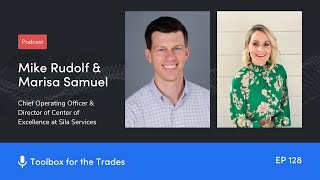
Mike Rudolph and Marissa Samuel from CLA Services explain how they built a Center of Excellence to standardize ServiceTitan across 20 brands and 1,600 employees. Their Titan Advisor scores jumped from 148 to 198 in a year, and shops scoring above 150 grew from 4 to 17. They share what it takes: vision, the right people, leadership backing, and willingness to redesign as you learn.
Mike Rudolph and Marissa Samuel, you are both from cla Services. Mike, you are the chief operating officer. And Marissa, you are the director of the center of Excellence. I am so excited to have you guys here today. Welcome to the podcast.
Thanks, Jackie. Happy to be here.
Yeah, thank you, Jackie.
So I'm going to kick off this show the way I do every single one, which is how did you get into the trades? And Mike, maybe you can start us off.
Sure. Absolutely. Start. So my entry into the trades happened following my junior year in college. I was looking for a job needed to get into the real world. I spent the prior few summers running a shovel on a construction crew. And I was a marketing major with the goal of getting into law school. So went looking for a summer job and found an internship, a marketing internship at a small heating and air conditioning company. Knew nothing about the trades, nothing about heating and air conditioning, but within a couple weeks knew that I loved it. I loved direct interaction with our customers, loved direct interaction with our employees. One of my roles was to put an ad in the paper, and then a couple days later, those customers would call in, I'd answer the phone and set up a lead. And I was able to see from marketing to revenue. You know, that whole cycle where in school we were, you know, working with larger companies that you didn't see that same interaction. So fast forward 20 years, I'm still here. You know, my, my. My time at SILA has taken, you know, me through many different roles in many different states. I was our marketing manager for a period of time. I was our salesman and marketing manager, a GM of multiple different businesses or multiple different locations under our CL umbrella and then moved into some. Some corporate roles that supported our general managers. And, you know, as you said, here I am today as our chief operating officer.
I did not realize that you started as an intern and now you're here. Started from the bottom. Now you're here. Wow, that is. I don't think I've actually had a guest like that on the show yet, so that's awesome.
Yeah, it's been a great ride. I actually did end up going to law school and decided that I preferred this over going into the legal trade. So that has helped me with all the various contracts and customer decisions that we've had to make over the years. But, yeah, I started at the bottom.
If I had a dollar for every person I know who's gone to law school and has not become a lawyer, I would have many dol. Thank you for sharing that, Marissa.
How many would you have of people who didn't go to law school but went into the H Vac trade.
Ooh, probably a lot. A lot of dollars as well. Wait, wait, no. People who went to law school but then ended up in the H Vac trade. That would only be $1. That would only be.
All right, there you go. I'll send you one.
So, Marissa, how did you get into the trades?
Okay, so mine is a lot less glamorous and organized. And to be honest, it could kind of be its own podcast. So I. I'll skip right to the part where my husband and I are young and newly married and we're sort of in this situation that forces me to say. It results in me saying, you know, just please go get a job that offers us insurance. And so my husband Seth, his father worked in the trades, H Vac specifically. So he was like, all right, I've been exposed to that. I'm going to go do that. So fast forward, he's working for three years and his brother is also in the trades, and they decide to start an H Vac business. And they need support for the back end, building it out, all things administrative and financial. And I think I'm attracted to challenge and chaos. And so I was like, okay, I'll jump in. And I'm on board. And I've been here ever since.
Okay. I love how you alluded that there was quite a winding path before you came into H Vac. Was there a particular job you had before getting into this industry that people would be shocked by?
Yeah, so I worked in a salon. I was a hairdresser for years. And then, you know, like I said, I like a challenge. So I was like, all right, let me see if I could do this financial thing. And so I did.
Fun story. My very first job was a shampoo girl at a hair salon. So there you go.
I loved my assistants. We appreciate you.
Well, I'm glad. So for folks who don't know Seala Services, can you give us a brief history of the company and where you're at today? Mike, maybe you can take this one.
So Sila was founded in 1989 by Jack Rother, fresh out of the Navy. Jack was a third generation H Vac professional, and he, he grew the business from a one man show to about 250 employees. And in 2020, we went from our four locations in Boston, New York, Philadelphia, and in between D.C. and Baltimore, and we joined the world of private equity. So, you know what, what that meant to us is, you know, we had built a really Good support structure and we had our central accounting, marketing, hr, it. And you know, when we were approached, we realized that this was an opportunity to continue to do what we had been doing, but do it on a bigger scale. And so with that, you know, over the, the next roughly two and a half years, we've increased the size of the business to 20 brands, 23 locations, serving 14 different states. And today we're over 1600 employees. And you know, it's the same business, but it's obviously different and bigger. But the fun thing is it's one employee at a time, one customer at a time. You know, residential heating and air conditioning, plumbing and electricity.
Nice. Oh my goodness. I didn't realize you had that crazy employee jump from 250 to 1600. That's insane. And for the folks listening, before we hit record, I asked Mike, where are you guys located again, so I can say the general area. And he listed off basically everything east of Texas, I think, which is the way I'm going to say it from now on, except you guys aren't in.
The north of Richmond.
North of Richmond. Okay, east of Texas, north of Richmond. There we go.
There you go.
Wow, that's incredible. And I really love how you partnered with private equity after the company, it sounds, had been going for 30 years without that partnership. Am I right?
That's exactly correct. Yeah.
Yeah. So you have that foundation.
We, we did that. It's funny, you know, that we're, we're talking about the start of the business, the growth of the business, and we're obviously going to talk about Service Titan a little bit. You know, one of the decisions that we had to make as an independently owned company was where do we go next for our operating system? We were not on Service Titan at the time. And you know, it's a, it's a big chunk of change. And it's also, you know, a lot of, you need a lot of resources to be able to make that transition, especially when you're already in, you know, a very big, relatively big organization with 200 plus employees. And part of the decision that we made to pick the private equity group that we did for our, you know, our first entry into private equity was because they had experience with Service Titan. And you know, what we'll get to in a little while is that was the first little nugget or seed that led to the coefficient that Marissa runs today. But we knew as a business that had significant resources and significant support that we even needed more. And so we weren't willing to jump into Service Titan alone. But once we had those additional resources, we were able to and that created the foundation for something that we're using today as we partner with additional great businesses.
That's awesome. I'm so happy you shared that. And you have hinted at the big thing we're going to talk about today, which is the coe, the center of Excellence. And sila's rapid growth and expansion led to this development. What is a Center of Excellence and what is its purpose?
We knew that we needed Service Titan. We knew that there was an opportunity for us once we went live with certain Service Titan to do it better and to, you know, it was one of those situations where we don't know what we don't know when you go into it. And one of the great things about ServiceTitan is how pliable it is and how you can customize it to your business. But that's also very difficult as you're going into Servicetitan for the first time and not really knowing which way to go. So we had some support and after we took our four seal of businesses live onto Servicetitan, we realized that there was an opportunity not only to improve the integration and onboarding process, but also further develop our use of ServiceTitan. And so the conversation started. How do we do it? Do we have a person in each location? Do we hire someone from outside of the business? And you know, and again, what, what are they going to do? And so Steve Zimmerman, who is our chief Information Technology officer, came to us one day with this great idea and a great name of, you know, having a, having a Center of excellence that would specialize and focus on Service Titan implementation and ensuring that we're using it to its fullest capacity. And so, you know, development of a, of a job spec obviously led to, led to some searches and you know, we were, we were lucky enough to meet Marissa through the process of actually, you know, partnering with the, the company that she and her husband and her brother in law started years ago and it was clear that she was the right person for it. But you know, today what is, what does ServiceTitan do or excuse me, the COE do for us? It enables all of our users to become pros and Servicetitan in probably half the time that they would otherwise it enables us to integrate and onboard newly acquired partner companies in about half the time as if we didn't have them. And I'm sure we'll talk more about the benefits, but that's what the COE is. Marisa can talk a little bit more about who's on the team and what they're focusing on and the mission, as you said.
Yeah, no comment there. Beautiful explanation. Marissa, kicking it to you to expand.
Yeah. So to go back to what the purpose of the COE is, it's really to support and develop, and there's two ways we do that. Right. So we support and develop our users, our Service Titan users, whether it's on the side of acquisition or already, you know, we've transferred them over to the coe and they're now in our kind of success program, we'll call it. So we support and develop there, and then we support and develop their Service Titan workflows. Again, whether it's on the new side or your existing. And the result of that is, you know, standard operating procedures are created, best practices are born. And the benefit of it is that we're doing that so that the companies can do what they need to do and that's run their business.
So the way I understand it, and I could still be wrong, so please feel free to correct me, is in SELA headquarters. Marissa, you head up the center of Excellence that is in charge of making sure that all of the different locations under the SEAL umbrella are using Service Titan to its fullest extent, are implementing the best practices and systems and processes that you've created for Service Titan. And so it's kind of like a hub and spoke model almost. Is that right?
Yeah, that's. That's exactly right. Yeah. We're basically like, you know, a little mini Service Titan headquarters right here at sila.
We should put that on our website. It's an additional location. King of Prussia, Pennsylvania is another office. And they can just. We'll get applications, we'll send them to you. That's so great. And I think such an intelligent way to think about software investment for a company of your size, having that internal support hub within your own company that enables you to help the different branches troubleshoot and solve problems really quickly and. And also do that in the way that, you know, CLA wants to do things. Right.
Exactly. Yeah. Best practices, I mean. Right. You can look at Service Titan and decide, you know, it leaves room for creativity for your business, which is the greatest thing about ServiceTitan. But when you are, you know, operating in different locations, but as one, it does require some standardization. And so that happens. That passes through the same coe.
Awesome. So tell me, what's the hardest part of establishing a coe and what's the hardest part of maintaining it?
So I'll speak it to establishing it. It's Marissa's job to maintain it so she can. She can speak to that part, which she does very well. There's. There are two things that jump out at me, right? We're talking to. To folks who will be listening to this, who are in the trade. So we all know the hardest thing is to find the right person. You know, it doesn't matter what role we're trying to fill. You get the right person in it, and it works. The other part was really something that you spoke to earlier is really identifying that we want this, that this is. This is a need for the business and that we're going to double down on internal support in lieu of, you know, continuing to go down the path that, you know, most Service Titan users use, which is getting the queue for service. And as our business reached critical mass and it was clear to us that we can provide better service, you know, at the end of the day, Marista and I provide service to all of our employees, all of our Service Titan users, that it was something that we believed in. And so once you have your heading, once you're committed to it, the rest falls into place, assuming you have the right person. And, you know, once we met Marissa and Seth and, you know, understood how their team was using Service Titan, it was a clear fit that, you know, Marissa was the right person to lead the team. She obviously has experience leading a team, you know, of finance and customer service at the. You know, at her husband's business. And so once she was brought into this role, it was. It was. It was a perfect fit. So we got a little lucky on the establishing side because we were able to find the person without, you know, having to look out there and find someone that we didn't know. But, you know, we knew what we wanted, and she fit the mold. And it's been great because then from that, you know, the rest of the team has developed rather nicely, you know, following her lead.
That's great. And before you take on the hardest part of maintaining it, Marissa, I just want to establish. So, Marissa, you came into SILA because SELA acquired your business.
That's right, yeah. In December of 2021, our business was acquired. We joined the seal of family. And best decision, definitely.
That's awesome. So I just want to point that out, because we talk about private equity all the time on this show. I think really getting to know the culture of the team that you're acquiring and being able to uncover those diamonds in the. Not diamonds in the rough, but Marissa, definitely a diamond here, a stellar example of when you acquire the right businesses, you can really acquire some phenomenal talent. So I just wanted to highlight that because I think that's so important as people think about acquiring, to grow.
Yeah, thanks. I appreciate that. And to tell you the truth, when we were, you know, on this journey to sell, it was very much kind of. We wanted to make sure that we were aligned. You know, the company that we were selling to was very much aligned with our culture and our values. And that seal is. So maybe that's why it all worked. We're kind of just all one in the same, so.
So that's great. So tell me a bit about what has been the hardest part of maintaining the coe. Marissa.
Yeah. Oh, gosh. The hardest part of maintaining it actually comes from a good place because it's due to the rapid growth of the company. Right. So there's this increase in demand. So you kind of establish this system and this process inside the coe of how things are going to, like, funnel in and funnel out. Right. But then this demand, this influx of demand, suddenly you have to reevaluate it and you have to, like, pull the system apart again and look at each piece to say, like, okay, can we be more efficient here? Does this piece even work anymore? Do we need to layer something in? So you're constantly kind of having to redesign to meet the demands. But I have to tell you, one of the most unexpected benefits of that is that it's forced our team to sort of, like, look at ourselves and look at our skills and our knowledge and kind of apply them in new and different ways. So you start to see people kind of like, personally and professionally developing and creating something together. And I think when that happens, when people are developing, like your company is going to develop, so it's almost like our. Our biggest challenge has become our biggest win, honestly.
That's awesome. And I wrote down, you know, you use the word redesign, but also auditing. And that's actually very much a lesson that keeps repeating when we talk about systems and processes on this podcast, is you don't create a process and then set it aside. It's done. Never look at it again. It sounds that Asela is always growing and iterating. So does the center of excellence and how you guys implement these practices across all the branches, 100%.
Like, as the company evolves, so does the center of excellence. I mean, you have to keep up, you know, and that's how bigger and better things happen.
Yeah.
And Jackie, if I can. If I can add to that, you know, one piece of this is, you Know, we partnered with, you know, the team that at Atom Mechanical that Marissa was a part of. And we were able to bring Marissa into a new role that we, you know, that we envisioned but had yet to create. And you know, it worked out rather well. But that's not the only example of sharing and mutual benefit from the partnerships. You know, with acquired businesses there are a lot of opportunities where, and examples in our organization where someone from the acquired business either took on a new role, whether it was regionally or nationally. But also beyond that, it's the idea sharing. And to your point, about constantly evolving process and procedure and best practices, every time we acquire a business and partner with their leadership team and start to get to know how they run their business and the talents on their team, there's always something that can go back to the coefficient that can then get distributed across the rest of the team. So by bringing on a new company that does things differently, it's constantly benefiting the rest of the team. So each month, each week, we're strengthening the whole because someone identifies an opportunity, someone identifies a best practice or shares something that they've been doing. So it's not just where we're pushing out information. The information sharing is going both ways. And I think that that's one of the keys to really a strong operating platform that we have. But more specifically our use of Servicetitan, it's that two way share that has benefited us.
I completely agree with that. Right. ServiceTitan offers so many valuable features and it's true, we bring on a new company and they're using something that we haven't even thought of maybe and we can explore it as a team and you know, again back to the support and develop, we can develop the training that like hey, we're rolling out this new feature because it's works awesome for company X, you know. So to Mike's point, I. 100% information sharing for sure.
Yeah, it's really, it's a feedback loop. You know, you're giving information to these new businesses, they're giving information from you, you're growing from one another. And it sounds like a really symbiotic relationship, which almost makes this next question I'm about to ask seem dumb. But I want to, I want to lay it out which is how has the company benefited from the COE since you first launched it?
I feel like obviously there are so many benefits and Mike will probably, you know, be able to elaborate once I say this, but I think the greatest benefit is this direct line of support and it's not just because you're going to get your answer in, like, almost immediate. Because I will say that's kind of our track record. I mean, we are very quick with our answers, but it's not just that. It's. You are. You're connecting with these people who know your business. So each brand, each shop, we are so immersed in their businesses that it becomes like this personal experience. And half the time they're reaching out for this support. We've developed workflows along the way. We know the names of their memberships, we know the history of their business. So that support, it takes on this next level. And I think that that is such a win for the company. So I'd have to say of all the benefits, I feel like that one might be the greatest.
That's great. I completely agree. If I sum it up in three words, it's better, stronger, faster. Because we have this core team who can support us in our use of service Titan. We're able to support the business operators. And, you know, one of the. One of the really great things about being in the role that I'm in as we partner with new businesses is we pick really good businesses. We work with really good business leaders. And these men and women know what they need to do. They just need the tools to get to them faster. And so the CoE enables them to get from idea to execution in much less time than they would if they had to try to work their way through it. So we develop a team of experts on the coe, we roll out a process and pilot it at one location. It can be watched, it can be monitored. And then we can take all those best practices and take it to all the other leaders who want to implement that in their. In their business to make it stronger. So, you know, again, better, stronger, faster. That's what the, the COE enables us to be.
I love that. And I'm going to just provide some clarification because the way that the COE exists in Sila is you guys have essentially created your own service, Titan help desktop with a coe. Yeah. Would you say that?
Yeah. Yeah, that's definitely part of it. That's definitely part of it.
You know, I. We're going to talk a little bit about advice you would have for folks who, who are like, I want to do this at my company, but before we even get into that, I want to talk about how the COE is structured at Sila, because I know there's internal champions also at every location, and there's this Points for Pantheon system. So I was Wondering if you could just kind of tell me a bit about that.
Yeah, so actually, Jackie, this is my favorite part of the whole thing because this is when, to Mike's point, it's about the right people. And so it is all the right people that come together and they make things happen. And I don't mean just our team. I mean to the champions, which I'll get into. To the SELA leadership team, who obviously fully supports us, and to Service Titan, who, I mean, right now, right, you're showing your support. Our csm, Frank Bachman, my gosh, he not only fully supported this vision and idea, but he, he adopted it, he adopted our language. So it's, it's all of that making this happen. So what I say all the time, and my team would agree, is that we're kind of like a business with a. Within a business, right? We are structured that way, our team runs it that way, and everyone's an owner in it. And I think that's why it works. So it's into three parts. So the first thing we had to do was we had to identify subject matter experts. That's where that ownership comes in. So there's five of us on the team, myself the director, but I hold a seat for that subject matter expert. I hold memberships. We have Alex Dukin, who does all things merger acquisitions. He is full support on the onboarding, whether you're on Service Titan or not. He's the face of all acquisitions. Tammy Huff, she sits for our accounting. She knows Intact as well as she knows Service Titan. She sort of like bridges that gap. She is an expert in inventory, purchase ordering, job costing. Then we have Jesse Dunnett. I would actually be doing him a disservice if I said he is lead for telecom reporting and operational workflows, because Jesse just recently goes back to that demand. It ends up opening up opportunities for people and having them apply their skills elsewhere. So Jesse has just taken on our internal success calls. So he's become like our internal success manager. So we've named Jesse, actually to his credit, named his calls, relay calls. So he holds that seat now. And then we have Terrell Mustafazadi, he just joined maybe about three months ago. So he's the newest member. He is our payroll expert, but he also holds down the support system, which you mentioned earlier. So he designs it, he delegates it. It's a pretty big seat. So that's that second piece that we had to build out, which was a support system. So we had to build out a ticketing platform, not only because it was going to keep our team internally organized and help when things, you know, hit the, the inbox or a case comes in. It's like right away you can, you know, the subject matter expert takes the ticket. It also gives us like this data that we can analyze, right? So we can see where there's knowledge gaps, where there's like, areas of weakness. And that's how we, we use that to kind of like dictate what we're going to develop and what we're going to train on. So for instance, we have our champs monthly meeting next month. We're doing a deep dive into reporting because reporting is number four when it comes in. If you, if we're rating tickets, it's the fourth thing to the top, you know, for an area of weakness. So we'll develop to that. Then the third piece goes to the champs, right? We had to go to each shop, each brand and have one service titan, sort of like the power user, and they were identified by the GMs. So the GM selects somebody and this person becomes our Service Titan champion. The champion is responsible for attending the champ meetings, right? The relay calls, our internal success calls. We channel all of our communication through the champs. They end up being the users that we develop the most, right? These are our power users. So that each location now has their expert. The growth we have seen from having point people and sort of like focusing on one person, the growth we have seen is incredible. It can be seen in the Titan Advisor scores, right? So that the difference in the Titan Advisor scores from when we started till now is incredible. So we had only four shops Champs were identified in April of 2022. We had four shops at that time that had a score above 150. Our average score was 148. One year later, we have 17 shops with the score above 150. And our average score is 198. So the work that the champs are doing, it's pretty remarkable. And learning so much along the way, right? Titan Advisor makes you dig in and you learn so much more about the software. So, points for Pantheon. Every Friday, an email goes out. Our internal success manager, Jesse, narrates and illustrates this beautiful email that's got graphs and numbers and he does such a good job. And we track the Titan Advisor score and the points for Pantheon. So there's different ways you can earn points for Pantheon. We've already the top two champs with the highest points get a seat at Pantheon. This year we had, we announced our two winners and we're already cycling for 2024, we're already starting our points. And how you can get points is if you are the shop that had the largest weekly Titan Advisor score increased by percentage, you'll win five points for Pantheon. You can earn points for your attendance to your relay calls, get you points. Community badges. That's a good one, people. You know, we love the community, so people get extra points for their community badges. And then we have champ challenges. So every month, there's something that will roll out. It's typically around some kind of standardization, which is awesome. Again, you know that everything moves through the champ. So just recently we were standardizing equipment types, so the champ that cleaned it up submitted it. We go in, we check it. The first person to complete this task gets, I think it's like 10 points for that one for points for Pantheon. So that's how we're structured.
Marissa, when you said we're a business within a business. Yeah, you are a business within a business. And I just need to give you guys so much credit for this system that you've built, because this is transformational. I have never met another service titan customer who is doing this type of internal support for their different branches. And what Mike said before, better, faster, stronger, a hundred percent. Like, I am just blown away. I. And also the fact that you name dropped, like, your subject matter experts at hq. I just freaking love it when people come on this podcast and they name drop the members of their team, because I think that is the best. And I just. I'm. I'm. I'm gobsmacked, which I think is the first time I've used this word, that word on the show. I've never heard of this before. This is really transformational. And like, I. I am speechless. We're come to the end of the show and I have so many questions, but my biggest one is obviously SILA is a big organization with a lot of resources here, right? So what advice would you give to a business who wants to create their own coe or. Or do some version of the COE in their own business, regardless of size and resources?
So the advice that I would give it, I wish it was mind blowing, but it's really not. It's basic, but it's true. So it starts like, you have to have a vision, right? You have to question the what, the why, and the who. And then I think you really do have to look at the hill like. Like we've talked about, it really is the putting the right people in the right place. And those people have to be completely open Minded, right? It's like, try, try again, retry something different and that it is not just one person moving the needle, it's an entire team. I mean, right? That's what we talked about. It's everybody from I mentioned, like the leadership to Frank Buckman to the champs, to my team, like, it's, it is a group of people. And man, like, when you start creating something that creativity, it just like breeds more creativity. And it's, it's like such a beautiful thing. I don't know a better word for it. So, so that would be my advice, you know, start with the vision and, and be open, because when you are, gosh, all kinds of stuff comes in.
Mike, what would you say?
You can't beat them. Join them. We've got it. Why try to recreate it, Mike?
Trying to expand to west of Texas and south of Richmond, Virginia.
There you go. Right. But no, it's the same thing that Marissa just said. Know the mission, find the right people, give it complete support from leadership and just go. Like any other new venture, you're gonna fall down and scrape your knees every once in a while, but if you, you know, if you know why you're doing, you're going to get back up and you'll be successful over time. There is no magic sauce to improving businesses and starting something new. You just have to go do it.
That's awesome. And real quick, Marissa, you're a service titan, Certified admin, right?
Yes.
So for folks out there who are like, oh, man, I have to get my internal subject matter experts up to snuff to have this type of process. Can you just tell us a bit about the program and what it's allowed you to do?
Yeah. So, okay, so first of all, I'm number 27, which took me almost a year to move beyond the fact that I was not in the top 25. Nobody told me I had to be. Probably just my ocd. But the program, yes. So I have to say that being a Certified Admin, people that are certified admins, it really does validate your commitment to the software and your knowledge of it. And this is opinion, not fact. But I do feel like it also identifies, like, a certain group of people. Right? Like users. Of course, we all have to know how to use Service Titan. But then there's this group of curious people. They want to know why, like, what's behind all of this, you know, and I feel like those are the certified admins. They're the ones that want to dig a little bit deeper. And it was interesting because when I joined, there were three people in the center of Excellence, and when we all came together, we were all certified admin. It wasn't like, oh, we have this center of Excellence, we better all go get certification. It's just, that's who we were. And I think that's what helps us serve people better. Right. Because it's not just like, you know, go here, click the job, actions drop down. It's like we discover the why behind it. We educate them a little bit more than just click through five times to end up at the destination. So I think the certified admin program, because it identifies the different group of people, I think that is why we're better at our jobs.
Awesome. Awesome. I know that Danielle Combs is going to love to hear that sound bite. As Frank Buchanan Buckman, who has been your CSM and who was the one who introduced us. And I'm so happy he did. Because, guys, this is really. This is a different episode. This is like a very different episode than I've done before. And I think a lot of people are going to be finding, trying to search you guys on LinkedIn and on Facebook to ask you some questions. So thank you so much for giving me your time. I have one final question for you. I do an icebreaker at the end of every episode, which has nothing to do with the trades, and it is, what would you like to be known or remembered for, Mike?
Maybe you can go first as an individual.
Yep.
As it relates to the business, someone that. That moved the industry forward. Yeah. I mean, I'm 20 years in the heating and air conditioning business. I still have a long Runway, God willing. And, you know, hopefully now until the end, I'm supporting businesses, supporting great leaders to do their job a little bit better. I think that if that's what you said about me, at the end of the day, I'd be pretty happy.
What about you, Marissa?
Oh, gosh. It's such a big question, I feel like. But I guess I would want to be remembered for a kind of thoughtful and maybe caring contribution. Right. Whether I'm contributing to a business through my work or to a team through leadership or people through relationships, I would hope that I'm remembered that my intention behind it all was because I truly cared. I love to watch things and people become successful. So I would want to be remembered for. For caring about that, for caring about them through the process.
I love that. Well, Mike and Marissa from CLS Services, thank you so much for giving me some of your time. And this episode was so awesome. So thank you again. I hope that you guys can maybe come back one day, or at least I get to meet you at Pantheon. So I'm hopeful that'll happen soon.
Well, look forward to it. Thank you for your time, Jackie. Really enjoyed it.
Thank you so much.
More from Bill




Capturing the 80%: How SmartAC’s Gen-2 Targets Non-Membership Homeowners | Podcast Ep. 296

Build better customer data with every booking in ServiceTitan | TAD Tune-Up Series

The Biggest Change for Roofers Coming From Other Roofing Software to #ServiceTitan?

