Lessons from Emergency Restoration Services | Podcast Ep 225 | Toolbox for the Trades
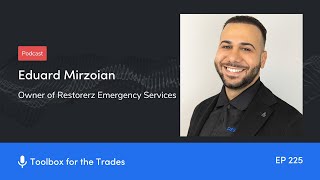
Edward Mirzoian built Restores Emergency Services from a family restoration business into a four-location operation with projected revenue of $22-24M. He switched to simple per-square-foot pricing during the LA fires to speed up customer engagement, and shares lessons on scaling operations and adopting ServiceTitan.
Hello, contractors, and welcome to Toolbox for the Trades. My name is Jackie Aubel, and today I am chatting with Edward Mirzoian, the CEO of Restores Emergency Services in California and Nevada. Edward shared some classic leadership and technology advice. Plus, we talked about how Restores responded to the LA fires. I hope you enjoy our conversation as much as I did. Edward Mirzoian, you are the owner of Restores Emergency Services serving California, California and Nevada. Today, you and I are going to be talking about stepping into a leadership role, knowing what you want from a software, committing to onboarding. And we're going to be talking about how not every software is perfect. Thank you so much for joining me on Toolbox for the Trades.
Thanks for having me, Jackie. Thanks for having me.
I am so excited to get into it, guys. I think you are going to love to hear some of Edward's hot takes here, but we're going to kick it off with an icebreaker like we always do. Going back to one of my classics, Edward, if you had to choose a song to be the soundtrack of your life, what would it be? And why?
Sting, Shape of My Heart.
Oh, hell yeah.
We'll do Shot A Smooth Operator.
Okay, first off, no one has ever, ever had a Sting or Shade song. So you get a billion points from me for that. Is there any particular reason why those songs call to you?
That's just. It's the vibes. I don't know.
Yeah, I get that. I get that. It's just the vibes that you want to cultivate. That's awesome. All right, well, going back into the business side of things, tell me, how did you get into the property restoration industry?
Crazy story, but I'm sure everyone's is. So I was going to school for some. 30 years old. I was going to school for about 15 years ago, computer engineering. Nothing that has to do with property restoration or cleaning up or anything like that. At some point, you know, got dragged into the family business. My family was always kind of into flipping houses and construction, general contracting and stuff like that. And that was kind of like my dad's dad's thing, right? And at some point, he partnered up with a plumbing company, and the first day they opened up, they had three whiteboards at that time full of leads, but they didn't know how to do the actual work. So slowly but surely, I got dragged into it, you know, like one day, two days, three days. And then, you know, I was like, pretty heavily involved in doing, going to school at the same time. But one side of my life I was Hiring and firing people and leading people. And then the other side, I was learning how to put together resumes. So I was like, what am I doing here? I'm just wasting time. But at the same time, my father had a health concern in regards to like some like back problems and stuff like that. That kind of put him out of, put him out of work. So, you know, the business got to a point where we had to, to basically come in and fire everyone and rebuild. So as one technician, me, we closed the office. There was no one else in the office. He would drive, I would pick up calls, we would go to inspection, sell jobs, and then we would go back, grab the equipment and come back and do the job. And that actually, that experience and that journey actually helped me do what I'm doing right now and expedited the process and allowed me to really speak on things that. Not just by speaking on things, just to speak on them, but like with experience and having put the sweat, time, energy into that process and knowing what to expect of people.
Yeah, you got that hands on experience.
Yeah, 100%.
Did you ever think one, you know, it became clear that you had to take over from your father? Was it ever? Did you ever have a thought of like, oh, maybe I'll just go back to school and kind of go the original route? Or at that point were you like.
Now I'm full then, so that's not the full story. So I actually didn't take over from my father. What happened, what ended up happening was that was a completely restoration company than what we have now. So my dad got better, thank God he came back and then my brother came back and we joined. And then at some, at some point there was like too many lions in the den, right? So I was like, you know what, I want to branch off, kind of do my own thing. But I wasn't going to go compete with my own family. And that was in Las Vegas. So I branched off and came to California, Louisiana. And that was six years ago now, right before the pandemic in 2019. I thought I had everything figured out and I was going to do my own thing. And then the pandemic hits and you're like, okay, did I make the wrong move? And you start doubting yourself. But realistically, what happened was the pandemic actually leveled the playing field for me and 20 year old company. So I started doing exactly what I knew what to do and that was build something from the ground up. And I had done it already. So instead of panicking and listening to the news and other people. I just implemented and executed exactly what I knew. So Fast forward now, six years later, we're tracking to 22 to 24 million dollars of revenue, and we have four locations now. And actually we sold the Las Vegas location, the old company. And my brother came and joined me about three years ago, and he's now the coo. And he is. We're three locations deep in Southern California. So we have Orange County, San Fernando Valley, and then we have the South Bay area, which is Gardena. And we actually just circled back to Las Vegas for our fourth location. We opened up in January, and we're just blowing things out the water there. So.
Okay. Dang. Okay, so let me make sure I just got this right. So you got into the biz because your family was already into it. You were going to college and you. But you were also working at your parent, your dad's business. You know, two days, four days a week. Your dad had a health event you had to take over. So you went in there with just one yourself and one tech, and you kind of like just trucked along. Eventually, your dad and your brother come back to that business. Too many lions in the den. I've never heard that phrase before. Love it so much. You were like, okay, I can't too much. I'm going to go off on my own, but I'm not going to, you know, I don't want to affect my other family business. You come to Southern California, you build it up, and then in a few years, your dad and brother, they sell the original family business. And now your brother works for you.
I would say works with me.
Works with you.
No, no one, no one in our company works for me. I hate that. Everybody works with me. Everybody is my coworker. And that's exactly how it needs to be in every business.
I think I, a thousand percent agree. And I. I'm so happy that you adjusted that preposition for me because I firmly believe in it and I agree with it. I think you're actually the very first property restoration company we've had on Toolbox for the trades. So for folks listening who aren't familiar with the. With the operations as a whole, can you just tell me a little bit about the kind of services that you guys provide?
So we do emergency services. We do water, fire and mold property restoration services for residential and commercial properties. We're a bunch of things. Sometimes we're the liaison between the customer and their insurance carrier. And a lot of times we're just a poop cleaning up company and a water extraction company. But realistically, like the property restoration industry and the property restoration business is a bit different than the rest of the trades, right? I would consider it still a home service trade, but at the same time, like, you have to be a few different things. You got to understand the insurance world. Then you got to understand, you know, delayed revenue and collections and different types of things that most plumbing H vac and electrical companies don't need to know about or experience. But yeah, property restoration dope.
I gotta ask and I can't. So for a little inside baseball for the listeners, me and Edward chatted a while ago and it was. We had to push this interview a bit. So I apologize if I asked you this question, but I have to ask, your property restoration company in Southern California, what happened after the LA fires? Were you. Were you just super busy? Like, how did that impact your business?
A good question, because I. It's not a simple question. Yes, there is a lot of work for property restoration companies and contractors and actually everyone in. In the trades in Southern California. But at the same time, you know, one thing we've learned throughout these years is to keep it stupid simple. In our business, we don't do any sort of reconstruction work. We just perform emergency services. And with that being said, like, we want to work with the right customers. That's very important to us because every single time that we have a new client and we have a new project, so many people are involved in our workflow and we just pour everything into the project. So the last thing I want to do is do that for the wrong person and for the wrong client. So we're very picky. But one thing that was very important throughout this process that allowed us to win really hard was our price book. Not a lot of property restoration companies, I would say almost no restoration company in the nation, they're not able to give prices up front, right? And what we did is we came up with a price per square feet to clean and deodorize someone's house from the fires. So realistically, what we were able to do was send someone to the property. We either needed to do a detailed clean of their house or a regular clean. And we had two different prices. And we did that on the back end. We added up the average of all of these actual jobs using Xactimate. This is the insurance carriers software. And we came up with too simple pricing. Our project managers were able to go inspect these properties, give the pricing up front, offer the financing, and that way, you know, the homeowner Knew one, what they were getting into, and they had the other options besides filing a claim. And on the back end, you know, they could always file a claim and turn that paperwork or estimate or invoice or report into their insurance carrier and get reimbursed. So that really allowed us to take on more work, more good work in the area compared to rest of the contractors. And it expedited our payment and reduced our AR because we were giving prices people were agreeing to and a lot of people were paying upfront or financing or doing a lot of other things compared to the traditional claims process, which takes about like 30 to 60 days for some restoration contractors to get paid or more.
Right.
With the influx of claims.
But yeah, so it sounds like you did work with some clients that were impacted by the fires, but probably not ones that completely. Well, obviously you don't work in reconstruction, so not one. The buildings were completely dec. Like, decimated.
Yeah, yeah, we. I mean, we did a lot of work. A lot of commercial 13, 16 unit properties in the Palisades, a lot of custom homes, a lot of custom homes in Pasadena in that area too. But we. We've helped helped out a lot of people. And I think this was like the first time that we were actually engaged in, like, a natural disaster. Right. Usually plumbing companies, H Vac companies, and other trades refer us. So we're a B2B. We have a big B2B team. But this was the first time we were truly engaged with like, direct to consumer without kind of having a middleman refer us. So that was enjoyable, for sure, but it was. It was really sad. It was. I mean, just driving. What we did is like, the first few days we were able to gain access to these areas because of the kind of vertical we're in. Just driving through there was very scary.
We.
I mean, we have a lot of crazy stories, but.
Yeah, well, I mean, I got to give you so much credit for being able to come up with that pricing right up front and being able to get on the ground and help these people right away. Because, I mean, I'm in Los Angeles as well. And anyone who's listening, who's not from. I mean, I. I can't. It was absolutely devastating and unbelievable. So I'm. I'm sure that meant a lot that you were able to actually get in on the ground floor and literally help some of these families put their homes back in order.
Yeah, it did. It meant a lot to us, too.
You mentioned something in that description there. You talked about, like, good customers, and I'm curious, what are good customers to you or good work?
I would say in our line of business, a good customer is someone that is fully invested and trusts the individual that they're working with. Because we're not just there to swing a hammer and do restoration work. The claims process with the insurance company is a long process.
Right.
And if you don't have someone that's done it a million times next to you and you're not ready to take on that information to expedite that process for yourself and your family and really buy into allowing us to be the consultant throughout this process, we'd rather you just go pick another company because really, that's the difference. That's the difference. That's what makes restorers, restorers and other restoration companies other restoration companies. And that's the whole experience. And if we can't give you that experience, then we know where that leads and it's going to be a shitty experience and we'd much rather not go through that with you and not be part of that process. So really, I would say for anyone you know that's looking for a property restoration company, you want to look for a restoration company that's for the people and not from the carrier. And that's. That's important.
Mic drop moment there. I think that's really great. As you mentioned, you scaled impressively. You started restores in 2019 right before the pandemic. Now you're scheduled to hit 20 to 22 million this year, which is awesome. What were some of the biggest lessons you learned as you stepped into the CEO role and you had to scale the business and you did scale the business to multiple locations.
A lot of lessons, but a few, few that I could speak of. And actually two days ago we were talking about this with, with a few of my buddies that what's more important, culture or systems? It was a heated debate, but I think both play a huge role. But I think most people have people problems. I think if you have a really good culture, you could solve or delay to solve some system problems because your people are fully bought in and you don't need to like walk on glass around them. And it's just raw. It's grinded out for some time till we figure it out. So I think any new business starting out, if you could build a culture and be raw with your people, if you could keep them engaged and fully bought in, you know, you could solve a lot of problems that businesses with no culture or very bad culture are going to have and they're going to have immediately as a small business. I just figured that was like, natural to take care of people, especially, you know, in our culture, in our family. Like, I was able to build that culture, but that was the first thing. The second thing is that systems win and building repeatable processes is the most important thing and the way my brain works. And I hope all business owners kind of like train themselves on this to simplify things instead of making things more complicated. And then think about, like, maybe it's easier for me because I understand, like the whole, like coding if this, then that type situations. And the way that I like to think about things is like building a tunnel and having people just go through that same tunnel a million times till we have to change the tunnel, make it bigger. Because our size or quantity or volume or whatever maybe doesn't make sense anymore for that workflow. But I like to think about things as workflows. But it definitely helps when I've done the things myself. So I was never scared to push the limits because I thought, like, if I fail, I could just go back down, figure it out, and then come back up to where I needed to be. So having the confidence to kind of push those limits because you know, you've done the work and worst case scenario, you just take us, take a step back for a little. So you figure it out and then you push forward, knowing when to delegate. A lot of people, you know, especially in the blue collar world, don't know how to let go. They think they are definitely the best person to do do things. I'm a perfectionist myself, but I had to learn that quickly. Like, if you want to grow, you can't do it. You don't get a little golden star if you're the one doing everything right. It's how many people you could bring onto your team, how many lives you could change, and how many people you can empower to go out and build the company of your dreams to help more people every single day. These last two years is when I truly became like a CEO. I think right before people say CEO and it's just three letters, but once you get to the level where you kind of truly understand what a CEO is, it's really job duties and tasks, and you've offloaded as a small business owner everything else that you shouldn't be doing, and you're focused on your people. You're focused on strategy and vision and duplicating and growing the process and just making a better experience for your internal and external clients. And this is something I truly love doing at this point. This is the type of business that I want to do, not be a restoration guy, you know, or a restoration contractor. So, sure, yeah, those are, those are some lessons that I've learned throughout the way.
I mean, these are all lessons that we've, we've heard about on this show, but I think they all go in together. Right. If you have those systems in place that people can easily follow, then you can delegate more easily because you have the systems in place and because you're delegating, you can focus more on culture and you can make sure that you're hiring the right people, putting the right people in the right seats. And that's just kind of like a circle that goes around, around, around. You mentioned with the culture piece that you were talking with some peers and you found out through just learning about their experience, like, oh, I'm actually pretty good at culture for you. What did you do naturally that contributed to a good culture? Was it that you were very authentic and transparent? Were you giving great benefits? Was it a combination of all of a bunch of different things?
There is no, like, magic answer that anyone's going to give and you're going to take that and 10x your business, right? So it's like always the same exact answer. And it's very simple answers. But to answer the culture question, I think I was just able to be me and whoever enjoyed being around me and found value in being around me. I quickly realized who those people are and only hired more of those people because now when someone comes into our business and they don't fit our values and they don't fit, like the energy, the urgency, the output that everyone has, they stick out like a sore thumb. So I think it's, it's not necessarily like, how did you build that culture? It's more of the, the opposite, which is like, we were protective of our culture, right?
Yeah.
So you. We didn't let people in that we didn't like. And when I say, when I say didn't like, it's like, sounds like hardcore, but it's very simple, right? Like, can you imagine working with this person every single day of your life? And how will this person work around your team? It's really that simple. Because when you bring a group of people that enjoy being around each other, like, it no longer becomes work.
Right?
And I think that's one of the most important things. And then, then you, these people already enjoy, quote unquote, work, and they don't even view it as that. You don't need to, even need to set expectations anymore because they set the bar so high and they want to go above and beyond as a group, right?
Yeah.
And then you give those people a goal and you give those people something to look forward to and that becomes a superstar team, which is what we have now.
So, yeah, I'm going to go back to authenticity because that's what I'm hearing in your answer is you were super self aware of the type of leader you were, the type of culture you wanted to create, and you were very protective of it.
Really, that's what it is. I mean, there is no secret formula to that point.
With the secret formula. When Edward and I first spoke, he had me chuckling quite a bit. Because you, in your opinion, you think some folks suffer from this convention training guru disease. And I want to hear your thoughts about that. I promise to the listeners we're going to get into software in a second. But I do think you have a hot take here and I would be remiss if I didn't bring it up.
I'll give you my way of thinking when it comes to things like this. New technology, conventions, gurus, training, and this, this. I have this saying and this is how I actually think about things. It's test everything, but question everything. You need different things at different times. I believe in like seasons of learning, right? And I think this was something that I've heard before, but like I actually implemented it and it aligns. It's like kind of like a diet in my head, right? Like I go on these little knowledge bursts and then I completely shut off everything. Like, I'm not listening to a podcast, I'm not reading a book, I'm not going to a convention, even if it's the best thing in the world. I'm literally implementing. And what people don't do is they don't do this trade off. They're constantly in like one or the other. And that's not healthy because that becomes overwhelming, an overwhelming amount of knowledge and education and opinions and this and that, and then you're just like stuck. You're going from city to city, state to state, book to book, podcast to podcast, and your business is suffering, right? So I think this is like a actual disease that some blue collar group, some of us in the blue collar industry have, in the home service industry have is like, because no one knows our business better than we do. And sure, you could learn the building blocks of some of these things to expedite some of these fit solutions to these problems, but, like, not no problem is the same. And it takes you as the leader to actually make changes in your business every single day to get better. Not someone from the outside telling you what to do.
Right.
You said it yourself. Like, I'm not saying anything on this podcast that you haven't heard a million times. It's just that you have to do it at the right time and you have to have the right people around you and you need to have a goal.
Right.
And that's pretty much it.
And you have to put it through the filter of your business and, like, what your needs are in that moment. I really resonate with this. Not like, I'm not a business owner. Right. I work for a business. But in my role of talking with contractors. And for now, almost five years on this show, we do. We hit a lot of the same stuff over and over again. But I think it is worth it to revisit these topics because some of our listeners, they may not have heard this when we first came out with an episode that touched upon this three years ago, but now they're ready to hear it. Right?
Yeah.
It's all. So much of learning also involves where you're at in the moment that you're receiving that information.
Yeah. It's timing. Sometimes I reread books because it kind of hits different.
Right.
Even movies like, I know Matrix when you were like 12. And then you watch it now you're like, all right, cool.
Nothing like watching a movie that you loved when you were a child and then you see it when you're like an adult and you're like, oh, my God.
Yeah, yeah, for sure.
I had a horrible taste. Well, to that point. And speaking about making changes in your company, you actually have a really unique story with how you got on service titan. So can you share that story?
As you know, property restoration contractors are the preferred type of contractor client for service titan. So, you know, in my industry, everything is kind of closed off, closed APIs this and that. Some people in the industry kind of rule with or tech in the industry kind of rules with an iron fist type situation. And I don't like what our industry had going on. So I think it was like eight or nine years ago I reached out to Service time. I was like, hey, you guys are Armenian. I'm Armenian. I was trying to sell it. Like, I'm a restoration contractor. I know you guys don't take these in. You guys didn't build. Build the software for us, but, like, I really think I can make it work.
Right.
And I got an email Back quickly. I was like, no, sorry, not right now. If things change, we'll reach out to you. So I was like, I've heard great things. I've done my research. Like, I need this software. I really thought, you know, this would be a great fit for our industry because it. And for my business because it was solving a lot of problems that I was trying to fit that was trying to solve with combining, like, three, four, or five different softwares in one. What I ended up doing was almost basically opening up a plumbing company, but not to, like, run it, but just to, like, get the software. I was like, okay, guys. Like, I'm gonna show you guys that it's okay. Like, don't be scared. I'm not gonna complain. We'll work together and we'll figure it out. So obviously, fast forward now we're on the software, and it's great. We've figured out a custom workflow and making it work for the restoration industry. I could see what you guys were talking about when it's not fully, fully, fully fully thought out and built out, but it's definitely at least 10 times better than what I had before. And it's solving all of the problems and actually getting in front of a lot of the problems that we. We have as restoration contractors. I mean, the fires was a clear example of, like, how we got. Got ahead of something instead of, like, doing what everyone else was doing.
Right.
And that doesn't help anyone. So, yeah, that's my. That's my story. You guys wouldn't let me in.
Yeah. For the record, if Ara and Vahe are listening, I do not endorse this, but, Edward, you've now become basically, like, a power user of Service Titan, and with your computer engineering background. Thank you. Had a little.
Well, I dropped out, so.
But you still. You took a couple classes. You got more experience than most. I thought it would be really interesting to have you on. So with that being said, you had to do a ton of work on the front end to even get on board with Service Titan, and you did so much work to figure out what it was you needed. What advice would you give other contractors in terms of how can they figure out what they want from a software and then how do they then commit to the software? Because onboarding is a whole other thing. So.
Yeah.
Question. How do you figure out what it is you actually need?
I think you figure out what you need by actually spending the time and documenting your workflows.
Right.
Like, some people just buy software just to buy software, because it's like trendier. Like they heard it from their friend that it works or whatever it may be. But like good software is made to solve problems.
Right.
Or to enhance certain things in your business. But what ends up happening is most business owners don't know what they're trying to solve for and the software actually enhances their problems.
Right.
And then they start complaining about the software instead of going to fix their business. So like when you're cooking up a meal, you don't last second come into the kitchen and try to like, if you're like, okay, I'm going to make pizza, you want to go shopping for the ingredients so that you could have a successful dinner or meal, whatever you're planning for.
Right.
But most people, like, they get last second, they just get on board with something and then now they're trying to cook this meal up and they are missing half of the things and then it just becomes a shit show. And then they never point the finger at themselves, they point the finger at the software company. So I think most of all software is good if it's used in again, the right time for the right reasons. And you know what you're getting into.
Right.
I'm a big fan of figuring out exactly what your workflows are, what your processes are, what you need, what can accomplish what, understanding if your software is able to speak to other softwares that might be able to do a portion of your workflow better.
Right.
And understanding the bigger picture ecosystem of everything that you're going to be using and then executing on getting into a software, not just getting to the end goal and figure, reverse engineering the thing after and saying, oh, that, well, that doesn't work for me.
Right.
I think that's a big problem that contractors have because like contractors are focused on the day to day, they're focused on projects, but they're a lot of times not savvy in regards to like workflows and business and technology. And it's 2025, you know, technology is highly integrated into our businesses, so it's integrated into everything. Everything.
You, you genuinely. I feel like nowadays you can't. It's hard to exist in the world without a smartphone.
Yeah. I mean, I'm not even doing this podcast right now. It's my AI clone.
Oh my gosh. Imagine that would be. Oh my God. You would have to get out of the restoration business. You would be a gazillionaire. Tell me about committing to onboarding because that's another big thing too. So you do the work and you figure out. You map out your workflows, you figure out what it is you need. You figure out if this software you want to buy can integrate with other software or technology that you use. You're like, okay, this is what I'm going to do. Talk to me about the second half, which is like committing to actually getting started with it.
Yeah. I think a few things like don't outsource thinking.
Right.
And then the second thing is like, software doesn't fail.
Right.
I believe that adoption does. What's crazy about onboarding, especially something like Service 10, right. That it's so detailed that you need the people who chose the software to be the ones leading the charge and onboarding, 100%. I'll just use me as an example.
Right.
This is a bad example, by the way. A contractor will do a demo with a software company and then they will kind of wash their hands, give it to someone else on their team that isn't fully bought in to the software that's going to be onboarded. So they're resenting the onboarding piece and they're not looking at it in detail and not as excited as the initial individual that basically sold themselves on why we need this software. So the first thing that I always recommend is like making sure your whole team is bought in because that's going to be the path of least resistance. That's going to be the easiest onboarding that you've ever done if everyone believes that this software is actually going to be changing their lives in one way, shape or form.
Right.
So once you have your team fully bought in, the second thing you need to do is you need to have all of management and if you're smaller, you know, the owner invested into making sure that the onboarding goes smoothly because you know more about your business than anyone else can possibly know. So the software company is using their best resources, the people that know the software, but they don't know your business. So they're viewing it from a completely different lens and with a completely different brain. But when you. The person that knows the most about your business and someone on the other side that knows most about the software actually collaborate. Not just like onboard, but like collaborate and push the, push the limits. There is no reason why service Titan or any other good software that actually solves a problem will fail for your business.
Right?
Yeah.
So I think that's one of the most important things, onboarding and adoption into the business. I truly believe that there is no bad software. It's just bad. Usually bad onboarding and onboarding I think in your guys's world too is one of the most important things, right?
100% is. And I feel like my onboarding team will appreciate what you just said. In your experience, is there such a thing as the perfect software?
I don't think so.
Wow.
And the reason why, the reason why I said I don't think so is like service titan is great at a lot of things, right. But service titan is made for a specific reason. It solves specific problems. So no one software is going to be able to excel in every single aspect of a contractor's business. So I think the most important thing that any software company can be doing nowadays is understanding that and accepting that and being open to integrating with other partners that excel in things that you know that software doesn't. And I think that's a win win for everyone involved.
Right.
Especially the contractor. And I think obviously as a client, that's one of the most important things to me. The open API, the constant partnerships with high level companies across the board. So to answer your question, there is no one perfect software. But I think a characteristic of a perfect software or someone trying to be a perfect software company is the understanding of partnerships and the open API and integrations.
This has been such a fun conversation. Edward, I have one final thing I want to ask you about because you are a bit of a tech guy is and we've been talking a lot about AI and other new technology coming out here. You made your own AI joke here before. Is there any software or piece of technology that you're really excited about or some new innovation that you're really excited about?
We have a lot of exciting things to look forward to in regards to contractors and technology. Right. Just understanding like the power of AI and how it could empower good people on your team. Every business has, you know, their superstars and then some struggling people and I think just setting the bar super high at the superstar level and being able to duplicate those people. And what I mean by that is like AI CSRs and you know, AI claims consultants in our industry and getting rid of the repetitive tasks and focusing more on needle moving tasks and empowering people to step up and lead and manage instead of doing the repetitive tasks is probably what I'm most looking forward to when it comes to at least like AI and our business.
So very cool. It was really, really fun talking to you. I love that you discussed the culture versus systems argument you had with some peers lately. That gave me a couple of different ideas. So thank you so much for your time. Edward. And I hope we finally get to meet in person one of these days at Pantheon. I think it's so funny that you were talking about guru disease. And there's definitely going to be.
I'm going to go to that one. I'm going to go to that one. But I usually go to like one or two max a year. But Pantheon is definitely not one that I'm going to miss, especially since it's in Orange County.
I know, I know. I'm excited about that, too. Edward, thank you so much for being a guest on Toolbox for the trades.
Thank you, Jackie. Have a great day. I.
More from Bill




Capturing the 80%: How SmartAC’s Gen-2 Targets Non-Membership Homeowners | Podcast Ep. 296

Build better customer data with every booking in ServiceTitan | TAD Tune-Up Series

The Biggest Change for Roofers Coming From Other Roofing Software to #ServiceTitan?

