Money on the Line: Give Your CSRs the Tools to Succeed | Podcast Ep. 188 | Toolbox for the Trades
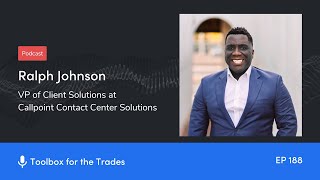
Ralph Johnson, VP at CallPoint, moved from finance into trades call centers and rebuilt underperforming teams using ServiceTitan CRM, weekly one-on-ones with call playback, and performance bonuses tied to bookings. He uses dispatch incentives like 4-6pm booking challenges and emphasizes live agents over AI replacements.
Hello, contractors, and welcome to Toolbox for the Trades. My name is Jackie Aubel and today I am chatting with the VP of Client Solutions at CallPoint, Ralph Johnson. Ralph and I spoke about how to revamp a call center from implementing technology to performance pay to coaching and so much more. We covered so much here. I hope you guys enjoy our conversation as much as I did. Ralph Johnson, you were the VP of Client Solutions at CallPoint Contact Center Solutions. Today we're going to be talking about how you can revamp a call center. I'm so excited to chat with you today, Ralph. Welcome to Toolbox for the Trades.
Thank you. I appreciate it. I'm excited to be here, actually. I've been a long term listener, first time on the podcast, so I'm really excited. Thanks for inviting me.
Oh, of course. So excited to have you here and thanks so much for listening to the show. It really means a lot to me. Let's kick this off with an icebreaker. I would love to know, if you could meet any living person for dinner, who would it be and why?
Well, that's a great question. I'm a big fan of Mark Cuban. The answer unequivocally would have to be Mark Cuban, not just because he's the billionaire owner of the Mavs, of course, and that he sold his company for billions of dollars and he's on a TV show called Shark Tank or did he create a pharmacy called Cost Plus? The main reason is that he really taught me some basic concepts of life in which I live by. And I still live by those concepts till this day, essentially. And it's pretty simple. He talks a lot about how one of the worst advice you can give anyone is to follow your passion.
All right?
And I've always. That has always resonated with me. For some reason. He said, do not tell people to follow your passion. That's the worst advice ever. He basically said a better approach in life would be, it's important for you to follow your efforts. No one quits at anything they're good at. He talks about, I think in my life, if I followed my passion, I, you know, it'd be trying to play professional basketball or trying to play professional soccer, in which I wasn't good at any of those things at all. So sports is a passion for a lot of people, but because when you look at it, when you put in the effort in a lot of things he talks about, it lends to be things that you're good at. So his approach is focus on things that you can put your effort into, and you get better success in that concept. I've lived my life by it, and I've ran businesses by that approach. So it would have to be my Mark Cuban, by far.
That's such a fun. That's such a great answer and really well thought out. And I've never heard that before. Don't follow your passion, follow your efforts. I think another saying that we hear a lot is if you love something you do, you'll never work a day in your life. I know that's something my dad told me, but it's like, I don't know. Does anyone really love what they do for work? I don't know. It's. It's kind of. It's a. It's a. It's definitely something to think about.
Yeah.
And passions change, too, you know what I'm saying? You know, and not everyone has the privilege of following their passion, you know, say there's some people that. I just can't do that. So that's why I believe in, you know, follow your effort. I believe you get much over ROI in following your effort. And that's one of the things that he talks about a lot. So big, big, big on if I think he's a great guy.
So very, very cool. All right, well, let's get into it. How did you get into the trades?
Oh, great question. So in 2012, I was actually. I was in my late 20s and I worked at Wells Fargo. I'd been there for about four or five years as an analyst. Wells Fargo was known for what they call gladiator school, Big sales programs for all their analysts. And actually, at that time, they were in the news for a lot of unethical practices, but they laid me off. In 2012, I went to Costa Rica and I said, you know what? I'm just going to learn Spanish and just hang out on the beach for a little bit. My savings ran out and unemployment ran out, so I had to come back to America. But I did come back learning Spanish, which was great. All right, so that helped out pretty great. But in 2012, basically, I met a man named Matt George, and he eventually became my mentor and the current owner of callpoint, the company which I work right now. He basically had a vision of creating a centralized inbound call center and focused on the three trades only, and that's only plumbing, electrical, and H vac. And basically his idea was to basically be a centralized call center for individual separate contractors throughout the country with an emphasize on performance booking, customer service, and the latest technology and call Centers. So that year really got me to the trades. It changed my whole idea. I wanted to get out of Wells Fargo because really, you know, and being in finance, you know, it was grueling, it was stressful, and there's a lot. And I felt at the time, in 2012, it was just not the best position for me to be in. Someone told me the trades actually is recession proof. You know, everyone's going to need to get their. Their bathroom repaired or shower repaired. Everyone's going to need a H Vac. I live in Arizona. Everyone's going to need a unit. So I. I thought, well, this is a safe way. Let's go to the trades. And that's how I got into it, essentially.
Amazing. Okay, so I know that Matt George originally took you onto his first company. That was the kind of the first iteration of Call point that he eventually sold. And then you ended up consulting for a plumbing and H VAC company for five years, and you grew the company from 8 million to 18 million in five years.
Yeah.
So I would love to know what you discovered about the call center there and how you improved it.
So coming from the call center, working with Matt George from 500 Agents, and then actually consulting, I started my consulting business because at that time, Direct Interview was sold, and I decided, you know what? I'm doing some consulting. I met a small local company in Phoenix, mom and pop shop. 50 employees. They're so antiquated. A lot of technology wasn't there at all. I was just shocked how they ran things. They had those Panasonic phones. The CSRs were answering phones just like that. And I'm like, man, this is in 2018, you know, so this isn't that too. I know. So I was just shocked the way they did things. One of the first things that I did that I felt that they lacked was technology. Was one of them organizational skills, and most importantly, culture of accountability and numbers. That was the biggest things I learned from Matt George. And those are. Those are the key things in really trying to build a successful organization to help grow the scale it. And that's why I knew what to do. And I wanted to put what I've learned in the last five years in the trades to see if I can actually turn this company around. And that was one of the three things I discovered when I got there.
Awesome. All right, so I just want to do a little recap of your journey right now for anyone who needs just a refresher here. So you were working with Wells Fargo as an analyst up until 2012. You took a little Costa Rica break, which by the way, I love Costa Rica. I've been twice and I cannot wait to go back. And then you worked with Matt George at his first company that you know was also a centralized call center. And you got up to 500 agents sold to Direct Energy and then you started your consulting business. So you go into this mom and pop shop and you're like, oh my goodness, they are using Panasonic phones. We have to get these people into the new millennium. So what steps did you take to implement that technology? Tell me what that actually looked like.
Great question. So I'd heard about this company around 2018 called Service Sighting.
Right.
You know, and I'm one of those self taught people and I literally learn everything I can talk about Service site. You know, it's CRMs. There's, you know, there's a couple of successware, there's Sarah, all these different CRMs. I heard about all the great things Service site was doing. I said, listen, we got to get service site one of the most important things because some of the things I wanted to do as far as getting voiceover, IP phone, Internet phone as they call it, be able to look at performance dashboard, marketing reports, ROI reports and then basically, you know, as simple as implementing an ivr if you know what IVR is. An IVR is basically commonly known as the interactive voice response. The best way to describe it, an IVR basically says it's quite simple. Thanks for calling this AC company. Do you want to book an appointment? Do you want to schedule an appointment? Press 1. Test 2, if you want to speak with someone in accounting, press 3. If you want to apply for a job, whatever that may be. Implementing that was huge because now you got a chance to actually have the CSR's focus on actually booking calls and not taking calls from applicants or staff customer that just had a bad experience with a technician, all those things. We had to go ahead and kind of segment that to make sure we're getting the right calls and booking the right calls. So technology was the biggest thing. Like I said, we ended up even having Phones Pro Voice over IP Internet, Phones Pro, which at the time was so crucial was because that's when Covid started after I was there for a little bit. Had we not had Bones Pro Service Titan, it would have been the company would have sold it.
All right?
So that's one that I didn't predict what was going to happen. I knew that they were so behind the technology that we need to make adjustments and thank God we did, because not even a year later, Covid happened. And that allowed our agents to actually go work from home. After four months, they said, hey, we want to bring you on. We like your ideas. All right, let's help scale this company. Will you come on full, full time with us? And are you okay with letting go of your consulting firm?
Right.
I thought it was a great fit. I thought it was a great opportunity. And it came on board full time, four months. Four months later. So that was really exciting.
Amazing, Amazing. I like that you went into details about the ivr, because I haven't thought of that before. But if you don't have that type of system, you're turning your CSRs into secretaries, not just CSRs. And that can be really frustrating.
Very frustrating. 50% of calls come in are, are non bookable calls.
Right.
And it's hard. It's hard. And a lot of companies, is that.
Is that like, is that a global stat that you're able to like, back up given your experience at call point?
I can tell you 50% of calls, yes. It's not, not bookable at all. Yeah, you know, it's, it's a, it's a business, you know, and then the telemarketers are calling, you know, saying employers are calling in sick. You know, I mean, sometimes csr, the glorify secretaries, it would be frustrating to me and say if you get 100 calls a day, 50 of them are junk calls, you have to worry about staffing, you know what I'm saying? You know, all those things are important. So if you can be able to take 20, 30, 40% of those calls to the right department to handle it, you know, and then focus on the calls coming in that are bookable, you know, where you can get your revenue. It's important to do that. I tell every company, start with implementing an ivr, all right? It'll change your life. It'll make your life a lot easier. But that's one of the main things I did. And like I said, service time, phone pros, all those things were all important. So I knew that need to be able to track abandonment rate, track conversion rate. We need to be able to track all these different things. And there wasn't a suffer out there that did that.
Right?
And a lot of them were just like service titan came in there when the game, like they were just on steroids because they just provided all this data and all these things to help you run your business. And I truly believe, till this day, I decided to go read everything I could about service sign, by the way. And I'm self taught. I've never really been trained in service science but I, you know, I have a pretty high score they call it in service science, you know, because I got in there.
Oh, the Titan advisor.
Yes, yes. That's what, that's how I learned. I just explored everything. I thought it was one of the most interesting, interesting CRMs that were out there. And then I got into the reporting. I'm an analytics guy, you know, so I'm a big time into the reporting that to provide you. So you can actually track every agent, you can track every call, every tech to see what their, what the revenue is stuff is so important. The technology that it gave you was just like so on steroids. That's one of the biggest things I did was technology.
Oh my goodness. Now while I am loving you, just loving on service titan, which I always say on this show, whenever this happens, it really means a lot to me that I work for a company that has such an impact. So thank you for sharing that. I would love to learn a little bit more about how you got into training and tracking the progress of your CSRs because prior to you coming on, there was really no reporting done, there was no coaching, none of that stuff. So tell me a little bit about how you implemented these, these systems to make your CSRs better at their job.
Yeah. You know, working in the call center when you have 500 agents, you know, you had to create a process and procedure.
All right.
And one of the biggest things that I did was weekly one on ones with agents. All right, Playing the call forum and tell them all they did great on that call. This, these are great things they did on this call. Tell them things that we could improve on. You know, specifically looking at, hey, you may have lost this call to a price objective. You know, why not try this? Giving them the tools needed to be successful after a job was one of the biggest things. And that came with weekly one on ones playing back to calls and then most importantly, incentivizing the agents on every call they book. You know how huge that was? Let's say I'm going to pay you, you know, $2 per every call you book on a daily basis. That changed the game. Agents weren't used to that. You know, when the company says I'm going to pay a CSR 14 bucks an hour and that's it. I don't care if we call it or not, if it's on that csr, that call that's on board as a matter of fact book it at all. It doesn't mean anything, all right? I don't have to book it. I don't get paid any extra. When you start incentivizing them, guess what? They're still in the game now. Now they actually want to book that call. When a customer says, I don't know if I want to, if I want to pay the service fee. You have tools now that you can utilize to tell the customer, you know, how to give objectives to get over that specific, you know, rebuttal, whatever it may be for that agent. Giving them the tools needed was one of the biggest things. And then of course, incentivizing, like I said, on not only booking calls, but also on selling agreement, I implemented selling agreements. You know, it was important for a company, for company scale. I was a big proponent of selling maintenance agreements.
All right?
You know, that's how you get retention. You get, you get first refusal from any customer. So I trained them how to sell agreements. We sold holding the agreement in that time span. And then attendance incentives. One of the worst things you could do in a call center is an agent not showing up.
Right?
You know, so if you have 30 days of a great attendance, I'm going to give you a check 30 days later for being there. It's so important because that's all killed. I have a philosophy, all right, when I'm, I'm going to call center roll something that I really, really believe that you should never leave any paying customer behind. You know, like the army says, don't leave anyone behind. Customer wants to give you money, he's calling your company. You spend all this money on marketing, you know, why not, why not take care of that customer? Why not be available? Customer shouldn't have to wait on the phone to give you money for three, four, five minutes or something like that. It's just, it doesn't need to happen. So you cut out all that stuff. It helps build a better call center, in my opinion. And then of course, from a dispatch perspective, implemented dispatching for profit. Right check to right job was important. Ongoing training. And I would incentivize dispatchers to get the call on the board. One of the biggest things that I've learned is a lot of contractors, they lose a lot of money between the hours of 4 to 6pm that's the time when a dispatcher wants to go home. It's 4:35 o'.
Clock.
They don't want to put another call on the board because they think, you know, I want to go home. I don't want to have to schedule these guys at all. But if you incentivize a dispatcher, take that one call, schedule it a route it, you don't want to pay them for it. That's what happens. You start seeing huge gains and huge improvements. So things like that, little tweaks to the system. Listening to, listening to dispatchers as they speak with the technicians, listen to agents. Live listening was one of the easiest things too. You know, giving them advice, whispering their advice. Phones Pro has a feature where you can actually go as listen to a call. You can tell them, hey, try this, say this. You know, the customer can't hear you, but it's in their ear. So that stuff was so important that we saw a lot of gains in making those few adjustments when it comes with the agents incentivizing them.
Amazing. Okay. I just want, you gave so much. Great, great, great information there. So the hours of four to six is when dispatchers have the most difficulty booking calls. So Interesting. I guess you have the data to back that up.
I do. You know, people are going to take the path to least resistance.
All right?
They want to go home, they do it. But you have, people are coming home with major issues. Customers are, you know, say, you know, you come home, it's five o', clock, you know, AC is not working. You have two kids, you got to make dinner for, you know, everything. You want to put someone on the phone right then and there. This match wants to get home too.
Right.
You know, so you incentivize them. Hey, let's book these. Let's take care of these customers. We're going to pay you for it. They're more likely to want to do that because they have skin in the game now.
All right?
And I know a lot of people don't believe in incentivizing. I'm a big fan of performance pay. We do it at our company right here. Because the way our operation works here is that we don't get paid unless we schedule the call. That's the way it works.
All right.
You know, if they don't book call, we don't get paid. And I applied that principle for many years and I think it works. Big fan of performance pay. It's something that I think more companies should utilize also.
For your CSRs, you are incentivizing them for attendance, which is really interesting. I haven't heard that before. You incentivize them when you book a call and when they sell a maintenance agreement. So for anyone who's wondering who's listening, can you give and you might not have the answer to this, and if you don't, that's totally okay. What would a salary for a CSR who's not being incentivized look like versus a salary of a CSR who is.
Being incentivized from an hourly perspective, which is the most common thing, you know, between, depending what part of the country you're in, roughly between 16 to $18 an hour. And that's it. There's no, there's no performance here with that at all. Roughly. And that's, you know, comes out to about 30, 30, $32,000 a year, roughly. If you're incentivized now, they can make up to 22, $23 an hour.
Right.
Which can go up to 50, 55, $60,000 a year, if not a little bit more. And then paying them a sniffer maintenance day plan. I had CSRs, and I'm not exaggerating, that made over $100,000 a year.
Right.
Most of that was selling plans to aid to customers and things like that because we needed those plans to help scale the company. But I had a CSR making $100,000 a year. You know that. And once we started doing the incentivization and the performance paid, guess what happened? We started selling thousands of maintenance, we started booking more calls. All these things changed. I wasn't there before. It changed the game. It really did.
Yeah. Yeah. And I could imagine you were saying, you know, a lot of people aren't a fan of performance pay. You are. And I could. The voice I'm hearing countering to you, what I would assume someone would say is, I'm already paying them to be here. Why do I got to pay them more? But the difference is really astounding. You're potentially chang the CSR's life by putting them in a different income bracket, especially with the one who was pulling six figures that you know of and. But that's only a small fraction of the actual benefits that your business is getting.
Absolutely.
You're. You're booking more calls, you have someone that wants to be there. There's nothing worse. When you call a business at five o' clock and just we don't have anything available for you today, it's the worst thing ever. But if they're incentivized, wait. Absolutely. We have employment for you today. We get some today between five and seven, you know, because they have skin in the game now, you know, and then more Importantly, recognizing those CSRs at company meetings, you know, the calls that they Book the customer service they provided. Listen, there's three things that a csr and I actually learned this from your podcast. I forget which number it was, but a guy taught me this from your podcast. So there's three tenets. That's important that a CSR understands that's their role. Okay? The most important thing is booking the call.
Okay?
That's one of the most important things. Make sure the call is booked with that customer. The second thing is the wow the customer. All right, what does wow customer mean? Hey, I'm sorry you're having that problem. You definitely call the right place. We can definitely help you out with that, ma'. Am. I got an appointment for today between four and six. That's wow. And the customer. Oh my God, they love you. That's great. And the third thing is uncovering opportunities within that call. All right, what does that mean? Hey, you know what? Actually the service fee is $69 today. We build a membership plan. It'll give you 10% discount on your actual service today. And we can get you a target appointment today. And it's only 19amonth. Opportunity selling, a maintenance plan. Those are the three things the CSR should do, correct? Most companies, they just want to move on one day just to call. All right, the two things are important. Think about this. You have a 20, 30 million dollar business, right? You know, you're the CSR is the front face of your company, the first person for a new customer spawn in your salesman. And marketing. They're the first person to talk to. Isn't it important that person has all the tools needed, you know, to be able to while that customer talk to them. You're spending all this money on marketing. You know, they're the first phase of your company. You got to train them. You have to make the investment. And paying them $14 an hour, you know, it's just not going to work. All right, you know, if you want ROI on those marketing dollars, you know, people focus on marketing this. I need more calls. Calls, calls. Sometimes you don't need to spend so much on marketing, but focus on making your call center better. Make them more of a performance center. Make sure that they're scheduling the calls, tracking and training them, giving them all the tools necessary, and you'll see way better results in my opinion.
Amazing. And thank you for the shout out. I don't, I can't remember who that was either, who talked about wowing the customers, but we're up to like almost 200 podcasts now, so I can't be. Don't my memory is not that years ago.
I know that it was years ago. I took a lot of tips and tricks from that and I thought that was the most brilliant thing and it made sense. But it was years ago. I think I want to say it was 2019. I know that it was when I first started out.
It might have been 2020.
We started April 2020 first.
10 episodes. Yeah. Amazing. Amazing. All right, I love this. So let's talk about scaling, actually. So. And obviously wowing the customer. This is, you know, this is a big thing. How do you scale your CSR team to match the company's growth when you don't want to sacrifice on customer experience?
I think one of the biggest things that a lot of companies don't use now, if you're small company, a startup, you know, you're not going to have a lot of these tools to you right now, you know, but you can actually. There's software out there, there's workforce management software you can utilize to kind of help you schedule effective coverage between your CSRs and dispatchers, you know, so you want to be able to capture calls during keep volume and most importantly, you want to make sure that every customer is taken care of. Technology is the best way to do it. Service titan, again, I keep going to service. They give you. You can literally see your volume every single day in service titan. It'll tell you what times are your peak times, what times are your slow times. And using technology and workforce management software helps you really schedule your CSRs and your technicians as well too. Gives you an idea how much you need to run the company as well. And then one of the most important thing, and I stress this, all right, not just because I'm in this specific space, right. Is having a backup call center. All right, to be able to back you up.
Okay.
A lot of companies for me, I love training and ongoing training with CSRs and everything.
All right?
So every week, one on ones or trainings, I have to pull them off the phone. All right, you know, who's backing me up? These customers are not being taken care of now.
Right.
You know, but if you partner with answering service that can actually kind of take over where you are lacking. Or even if someone calls in sick, nothing, you're right. Or someone attendance is not there. They're supposed to be there at 7. They show up at 7:30. You need someone to back up those calls because that's revenue. Those are custom that need your help, you know, parting with a great answering service that can kind of step in where you can't, where you need, you need backup at certain times of the day because you know you're getting, you're getting intervals. Say your volume increases at 2 o' clock in the afternoon. You know, all your three CSRs are on the phones taking calls. Those customers shouldn't have to wait. If you partner with an actual company that can help you pick up those calls, take care of the customer, it's the best thing you can do to help sell because you're not losing anything. So many companies don't understand what abandonment rate is.
All right?
Abandoned rate is basically calls that you're banning that you don't know whether you're being abandoned, right? Listen, an average customer in the summertime, they're going to give you maybe a minute on hold, a minute and a half. They're not really loyal. They're going to call someone else, right? You know, your competitor is going to get that, all right, if he has a better understanding of workforce management and can take those calls or if he has a backup, all right, you know, and you don't see those abandoned calls. Service side allows you to see, hey, listen, you had a call coming in. While all you see is ours are on the phone, it's important to capture every call, capture every call. And that's what we try to focus on here at callpoint. Listen, we'll be your backup overflow. You know, we'll do nights, we'll do weekends. We want to partner with you just to make sure that your calls are being answered, all right? That's the biggest thing. Don't let those calls sit through a voicemail. For people that still go use voicemail, or they say, we'll call you back. Or even use an answering service that actually sends you the information. You have to call that customer back, you're losing customers. Callpoint, we actually book directly in the survey site. We've been a service site partner for the last five years. We can actually overflow to us, take that call for you as it gets your csr, book it for you, and it'll show up on your dispatch board and service time. Can you imagine that? And all you have to do is make sure that call is routed, take care of that customer, all right? So it's an even flow. You have to have a backup because you don't know what you don't know when it comes to losing customers, right? Because they're going to leave after a minute or two. I'm not going to win if I have an issue, you know, and my air Condition is not working. I'm going to give you a minute and a half, and I'm going to call the next guy or the next guy or the next guy. And unfortunately, that's how it works.
Yeah, I totally get that. So, okay, going on the subject of call point, obviously you guys are a service titan partner. You do handle. You do work with a lot of our customers, customers to handle their overflow. I would love to know what tips you have for contractors who want to work with someone like callpoint. What should they do to have to have that successful partnership?
One of the biggest things is understand what you don't know. Okay. I've been in this space since 2012. I've learned a lot, and it's important to understand. Hey, wait a second. There's a lot of stuff involved in call centers, and sometimes you want to deal with it. What's your focus? All right, you know, you want to focus on getting your checks better, you want to focus on getting your marketing better, or do you want to focus on getting your calls in? Whatever it may be, it's important for you to understand that you don't know everything. But there's companies out there, like my company, that can help you understand those things. What it means, like conversion rate are your CSR is converting over those things. It's important for them to understand what I call the analytics and the numbers behind your business or their company.
All right?
And that's basically how you become that. To be a successful partner with. With us, we have to be in alignment, is what I say, to make sure that we're your goals, are our goals now, and then make sure we can work together in harmony. And you get an ROI on your investment because, you know, you want to make sure your CL are taken care of. We want to make sure that your business is growing and scaling. So it's got to be a reciprocal relationship. That's the biggest thing for both sides. And we're going to need your help. Give us some feedback, give us criticism. All those things are important.
Amazing. Okay. Very cool. So I would love to know, given your professional experience, what are some common signs that a call center center isn't performing well?
Easiest. I'd say the easiest one is really high turnover. People in your call center. That's really a tall sign. I had a client yesterday. He was telling me, oh, we answer all our calls. Then I said, well, how many CSRs you have? And he said, well, we have two CSRs. I'm like, okay. He said, no, we actually have seven. I'm like, is it two or is it seven? He goes, well, well, the county person answers the call, the purchasing answer person answers the call. The marketing answers the call. I'm like, so you have untrained people, right, that are answering your calls that fully do their regular job and they answer calls? Well, yeah, it's our backup that we have right now. I said, are those people happy doing that? He goes, they absolutely hate it. They actually hate it.
All right?
I said, you're, you're risking, you know, unhappy employees because you're giving them a job that they don't want to do. You have them do it. I said, if it's crazy, you know, when you have a call center where everyone in the office, everyone a company, everyone in the office is answering phone calls, that's a tall tale sign that you've got major problems.
All right?
You know, because that purchasing person doesn't want to answer the call.
All right?
Then he said, well, how's that going? He said, well, they hate it. They don't really butcher it the way I wanted to book. They don't, they don't talk to customers around. Of course they don't. They're not trained, you know, can you imagine that? You know, and it was just shocking. That's one of the tall, tall signs. You can tell they need help. And he, he actually eventually acquiesced and he got, he signed on board with us, which was great. And then, of course, when they're not incentivizing, they're not incentivizing their people. That's another great common sign that ball centers are performing well and they don't understand abandonment rate conversion rates, you know, and when your customers are on hold for long periods of time, that's usually you can tell they're not performing well. Those are the telltale things. And they usually, people will be honest. They'll tell you, hey, my customers are on hold for three, four, five minutes. I'm like, you're losing a lot of money. I feel with contractors, they focus on getting calls, getting marketing, marketing, you know, Google, LSL news marketing service, paying thousands of dollars. These marketing companies bring flaws to them, you know, yet they're not really doing a great job capturing those calls.
Right?
And it's just a waste. I'm just shocked at that, you know, because, you know, there's these great marketing companies out there, you know, and they do their job. They put calls on the board, but you got to capture those calls. You got to make sure they're being converted. You know, you Got to make sure that they're not being lost by your purchasing agent or by your accounting person, because they don't really care.
All right?
You got to make sure CSRs are trained. Those are the biggest things I can tell. And not understanding the metrics, the analytics behind it all, not understanding your company, that's how you can follow call centers. Performing well, to answer your question.
Got it. Okay. I actually have another question for you that I thought of as you were giving some wonderful answers. There's a lot of new technology coming into the space with call centers, especially with AI And I'm curious if you have anything that you're excited about or you're, or you're like, kind of really eager to try out yourself or maybe.
I was at the Service Titan convention in Orlando last year when they're really. Yeah, they're really doing a big push on AI and I saw a lot of really interesting stuff. My opinion of it, it's not quite there yet.
All right.
But it's scary. It's the future. There's no question about it. There is a segmented population that still likes to talk with a live person, you know, so the AI answering stuff, I'm not quite sold on it yet.
All right.
I live in Arizona. We have a lot of retirees here. A lot of retirees, they still like the fact that someone on the phone, you know, now AI, when it comes to, like, scheduling assistant, like in the evening and things like that, you know, that's great, because emergency stuff, you know, but during the day, as far as using AI to answer, I'm not a fan of it yet. All right. But I think in the next year or two, it's going to change the game. I really do. I do like a lot of the TI stuff, the Titan intelligence they call, that's out there dispatch and pro marketing pro, all the stuff they're doing with AI, I think if it's the future and we're looking into it ourselves because we understand we gotta, we gotta evolve or grow.
Right.
You know, But I think they're getting closer and closer from the previous year to where they're at right now. Oh, man, things have, it's changed a lot. So I'm excited. I'm excited for what the future holds for AI, especially for in my, in my business, in my space, you know, and for contractors in the future. I think it's going to be a game changer.
Amazing. All right, well, I, I, I, you've been so generous with your time. I do want to ask, because when you and I first spoke. You, you know, spoke so highly about Matt George, who's the founder of callpoint, and he was a big mentor in your career. I would love, you know, that that kind of topic comes up so much on our show, and I would love to know what you think makes a good mentor mentee relationship.
I love answering this question. All right, so listen, I'm a minority, all right? You know, I worked for a big corporation where I felt like I was just a number, all right? I didn't really have truly anyone that was trying to mentor me or teach me things.
All right?
You know, when I met Matt, when he had this vision, you know, I mean, we would have one on one conversation for hours, you know, call center space, the biggest things I've learned and the reason why I think that relationship works so well, having a mentor and a mentor relationship so important is that alignment, you know, and the visibility it gives you to really look at things different. So I started doing things different, differently because I was seeing things differently, because my mentor, right. You know, he gave me a vision that I never knew, never knew created. And he. He mapped it out, how to get there. Hey, let's get you to do consulting, all right? How are you giving your first client. There you go. You know, how do you open the llc? You know, my analyst consulting business, I have an llc. All of those things I never thought was possible, right? So I'm a big fan of getting a mentor. People don't really appreciate it. Especially for me as a minority in this space, a mentor really opened my eyes, all right? And it gave me so much confidence, the alignment that him and I had on the vision, you know, and more importantly, he was very critical on me. Hey, you know, instead of doing this, he should try that. And I had to be open to that criticism, which I wasn't used to as we criticized, you know, but in order to have a successful, you know, relationship with your mentor, you have to be honest. You have to take the criticism. You know what I'm saying? You know, some of the most defining moments of my life I got from my mentor.
All right?
You know, and that relationship is so important. And I. And until this day, I love working with. I work with him every day, even one of the smartest guys I know. And it's just. It's just because we understand each other, we have a vision for each other, and we. We can talk about things openly. You know, I'm. I'm on a leadership team. You know, we're. We're senior leaders. Of the company, and we can just spit out different things. And, you know, I don't know about that. That relationship is so important. Being honest, being. Being transparent with each other, you know, and then understanding that, hey, we gotta. We. We both are aligned. I always put alignment. Alignment is the biggest thing for you. Get the mentor. Because, listen, if you're. If you have a mentor, that's in a way different, you know, sphere, different, you know, space that you want to get into. That's not a good relationship.
All right?
You know, we're both have an interest in what we do, you know, and we love the riff off each other. In fact, you use a major term on the things we can do to help improve our call center, and we both want to get better and better every day. And that's the mentor relationship.
All right?
I've been trying to get to his level for years, and I think I'm getting pretty close to where he's at. It's because of him. My life has been literally transformed because of him. And since when I got into the trades, I just never had that from corporate America, you know, and that's what he said, and that's why I decided to come back.
Amazing.
When that. The previous company I worked for, when we scaled it, they got bought out by private equity. I said, matt, you know, he had the company. He started another company, Call Point. I said, you know what? It's time for us to get back to the game together, buddy.
Right?
And I've loved it ever since. We. We go to trade shows together. We just spent a week driving. We were on the road all last week. We drove from Sarasota to Tampa to Orlando all last week to different trade shows. You know, in the car together, we just talked about all different things. That's my mentor. He's a great guy, and he changed my life. He's literally changed my life. So I can't. I can't talk more about what he's learned. He's taught me.
I love that. I love stories like that. That. Thank you so much for sharing. So I know you're a fan of Toolbox for the trades. Again, thank you so much for listening. I would love to know. You know, we used to ask this question. If you had a song, if you had to pick a song to be the soundtrack of your life, what would it be? I've since switched it to what are some things that you're listening to that you're watching or reading right now? Like, what media are you consuming that you're.
I like the answer? Both. Both of those, if you don't mind. So I'm a big podcast person. I read a lot of biographies. There's a guy named Charlie Munger, Warren Buffett, big investment guys. They always said it's important for you to become friends with the eminent dead. Biographies of guys that have done it before. My, my, my thing that interests me is the journey of any entrepreneur. Business guy, like how he got there or I don't care about the end result. The journey. And this. There's a podcast called Founders where it's about biographies with, you know, people from like, you know, from Napoleon, you know, to John Paul Getty, you know, some different business guys. That journey is intriguing to me, how they got there, and that's why I love their origin story.
Right.
So I'm big on biographies, business books, of course. That's one of my things that I love doing. Understanding business dies, billionaires and history's great entrepreneurs. Fondler's podcast is one of the best ones. And of course, like I said, I listen to your. Your podcast on a weekly basis, which is also good. I'm a big music guy. You probably saw. I did a couple of music reference right now. I gotta say, there's this new guy called Shaboozi that I'm jamming into. Have you heard of him?
I haven't, actually. Who would you. Who would you equate him to?
He's a country. He's a country rock star. His best would describe him. I've been jamming to his CD or not.
Cd?
Yeah.
They're streaming his songs for the last couple of weeks. Post a boozy and he jams out. You've heard the song before, but you probably didn't know it was him.
Oh, and I'm just. I'm just looking. He was on Cowboy Card.
Yeah. He has a song called the Bar Song.
Oh, wow.
A lot of acoustic and fartering. Great, great song.
Yeah.
Song. Big music guy. Music podcast is the things that gets me going. That's what I'm consuming right now, so.
Amazing. Well, Ralph Johnson, thank you so much for being a guest on Toolbox for. For the trades. I loved listening to everything you had to share. I know our listeners did too. Thank you so much. I really appreciate it.
Thank you, Jackie. It was my pleasure. I enjoyed it. It was really.
More from Bill




Capturing the 80%: How SmartAC’s Gen-2 Targets Non-Membership Homeowners | Podcast Ep. 296

Build better customer data with every booking in ServiceTitan | TAD Tune-Up Series

The Biggest Change for Roofers Coming From Other Roofing Software to #ServiceTitan?

