Resilient Entrepreneur: Scaling a Contracting Business | Podcast Ep. 156 | Toolbox for the Trades
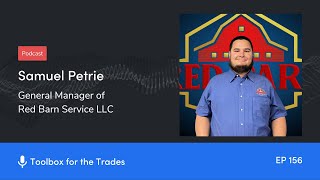
Samuel Petrie runs Red Barn Service LLC in Wisconsin, offering electrical, HVAC, and general construction. He scaled the business through weekly meetings, a locked warehouse system, and hiring for soft skills over experience. Petrie credits business coaches and Profit First accounting for his growth.
Samuel Petrie, you are the general manager of Red Barn Service LLC in North Central Wisconsin. Today we're going to talk a little bit about how you're implementing the newest technology to benefit your rural community. I am so excited to have you on the show. Welcome to Toolbox for the Trades.
Thank you. And it's a pleasure being here. I'm excited to do my first podcast.
Oh, I'm so honored to be your very first podcast, Samuel. I think we're going to have a great time, so. So let's dive right in. I'm going to start the show the way I've been starting all of the shows recently, which is with an icebreaker. And I would like to know, if you had to teach a class on one thing, what would you teach?
So I gave that one some thought, and I'm just thinking about, like, my days of starting my own company and my lack of proper financial structure. I think that that's something that as tradespeople, we greatly overlook when we think, oh, let's start a new business. You know, let's. Let's do this for ourselves, because we can make all the money that the boss is making, and little do we realize that there's a whole structure and processes and things that need to be in place, ideally as a foundation when you start the company. So I think that that would be what I would focus on if I was to teach a class that would ultimately benefit others, I guess.
I love that. And I will highlight, underline bold, 100% agree with you here on financial literacy, not just for entrepreneurs, but also for individuals. I think it's a recurring joke on all the social media platforms, like, why did I have to learn Jingle Tune to the preamble of the Constitution, but I didn't learn how to balance a checkbook in school. It kind of doesn't really make sense.
Right, right.
So you actually have a very interesting story about how you got into the trades. You're multi generation on both your side and your wife's side, but I would love to hear it in your own words. How did you get into the trades?
So, yeah, as you said, I grew up in it. My father started his own Company in 1975 in Indiana. And actually, you can kind of see it hanging behind me here on the whiteboard is a black and white of my grandfather's painting truck from Northern Michigan where he did painting services for farmers and you name it back in the day. So I started out riding with my dad in the truck, playing in the shop, learning to, you know, Learning what I could about electrical and H vac. Started full time for him when I turned 16. Dropped out of home school because I didn't like school and went to work for him full time. Worked for him for about eight and a half years and like I said earlier, decided to start my own company. Thought the grass was greener. And here we are about almost nine years later.
Amazing. And we're going to get to your education in a second. But I just, I just put this together. So your grandfather was in Michigan, your dad was in Indiana and you went to Wisconsin?
Yep, yep.
Oh, I love that, I love that. Do either. Does your father still have his business?
Mostly he works for myself or my older brother who owns and operates his own company about an hour from us. So we do kind of share back and forth. I mean he's, he's 75 years old, so he's mostly retired, but he'll never quit.
I know a lot.
Yeah, he's, he's a master electrician. He's forgotten more than I'll ever learn about it, but.
And what does Red Barn specialize in today? What are the types of services that you offer and what types of customers do you serve?
So we are a multi trade company. I mean we serve electrical H Vac. Our newest trade that we just brought on is kind of tailored mostly at the residential space, but we're also looking at select commercial general construction. The goal with the whole general construction is to hire and run a full service handyman business in addition to the electrical H vac. So within the next 12 to 18 months we'll be kind of bringing that side of the business up to scale. And we're really just looking at it to be able to better serve our residential clients. So we serve primarily the residential markets, but we have select commercial and industrial clients that have been with us since the beginning that, you know, we'll always take care of them as long as they need us.
Got it. And that's because of the actual community around. You said there's a lot of farming industry where you're located, is that correct?
Absolutely. We have a lot of agricultural and I would say there's a lot of industry in our area. Like most of the nation's frozen pizzas that you buy in the grocery store are made within 20 miles of us.
Really?
Like, yes, like millions of pizzas a year get manufactured and shipped out of Northern Wisconsin, a little town by the name of Medford.
And you know, you gotta keep us in those pizza, in those pizza parties. I personally love a Train to this frozen pizza. Also, is there not a frozen pizza company called Red Barn or something? Red something, maybe. Aaron, maybe that's.
Yeah, that sounds close. Yep. So a tangent on that, I shouldn't go down this, but to give you an idea of the type of industry we have, the Tombstone Pizza, which is, I think nationwide famous, was founded in medford, which is 20 minutes from us. They sold the Kraft, who now sold to Nestle. So it's, you know, it's, it's a lot of industry in our area.
Very interesting. And my, my, my colleague Amanda just said that it is Red Baron. And I think a good follow up question, do you have a favorite frozen pizza?
I don't, I'm not a fan of frozen pizza. I like my Pizza Hut or homemade pizza. My wife makes, My wife makes an amazing deep dish pizza in a cast iron skillet, so.
Oh, all right. Well, that sounds delicious. All right. Frozen pizzas aside, you mentioned that you're doing, you're doing this construction side kind of to serve as a general handyman and you said to better service your residential customers. So what kind of need are you seeing with your residential market that prompted the development of this division?
So we see a lot of our residential clients are looking for someone, you know, to change a doorknob, install a new screen door. Very simple tasks that most contractors have no interest in. Most of the contractors in our market, I would say are focused on large scale new construction or large renovation projects. And there's not really anyone in our market that is really focused on the service side to be able to fill that need for the homeowner. So to us, there's a huge potential there with the customer base we already have just being able to continually take care of what their needs are without even spending any more marketing. And the potential that they simply refer us to new clients. So there's, there's huge potential.
Well, you know, I'm thinking about it and I'm. One of the reasons I was so excited to have you on the show is because you serve this really unique industry, this more rural community, farming community. And a lot of the times, not a lot of the times, but I would say recently I've talked more with contractors who are in larger metropolitan areas and I think in that case it makes sense to specialize in, okay, we just do H Vac, we just do plumbing. Especially because you're potentially going into homes with a lot of renters. Right. But I think for your market, this totally makes sense because if you expand to handyman services now when your technician goes to the home and they, you know, do any of those service jobs or, you know, service and repair. Hey, do you need anything else? Oh, yeah, my screen door is actually. Really. Can you help me do that? Like. Oh, actually, can you help me like my. Install the ceiling fan? I think that provides a lot more opportunity for growth. I think that's really smart, Samuel.
Yep, absolutely. That's. That's really what we're looking at for us geographically. If we focus just on one to two trades, we would end up covering a lot bigger territory, which is doable. But now you have that much more added expense and fuel and, and truck wear and tear. Whereas by keeping it condensed, we don't have that. That spend of the truck cost and stuff. So there's a trade off both ways.
Yeah, of course, I would imagine. Also your technicians are probably happier. They don't have to do longer drive times and they're more in their general area probably as well. Right?
Yep. Because they, they, for the most part, all of them live and work within the towns or communities that they live in. So it's very connected in that sense. So you have just last night, one of our guys was sharing on a local Facebook page, somebody's looking for electrical and he's sharing that they should call our company because it's in the area where he lives, literally where this job needs done. So you get that marketing experience differently by a small community because they tend to interact more one on one with each other, whereas your larger metro areas, you don't get that as much.
Yeah, of course. So interesting. I love that we got into this topic. We may circle back to it, but before we do, I want to rewind a bit too, because you actually left your formal education earlier than most. And I would love if you could expand a bit on what that was like and how it affected your trajectory in the trades.
Well, first, I would say that no one should leave an education early.
Great.
I do want that.
The disclaimer. We have the disclaimer on the show. Don't do as I say. No. What's the line that parents say? Do as I say, not as I do. Or yes, understood, you do not recommend this, but nevertheless, I do not recommend it.
And all of. All of my five kids will be formally educated to at least high school and, and possibly beyond.
Amazing.
Anyway, I, I would say it's. It's different because if you don't have that high school diploma, you don't have that college education, you focus more on stuff that you can do. So for me, obviously, it was easy growing up, you know, with my father being an electrician and branching into the H vac side and the. Well, about the time I was born, I was like 2 years old when he took his first factory furnace course. So for me, it was very easy to get into the trades. But I think that's the part that people don't understand. Just this morning in our team meeting, we were talking about with our guys about the process of how a gas furnace goes through the light off and how it works and. And all the flow of what the parts and pieces do to make your house work and alert. So as we're going through that, we all concluded that it's actually very simple to understand if you just take the time to learn what it does and how it accomplishes the task that it's supposed to do. So I guess my point with that being said is it's very easy to get into the trades and it's not hard stuff to learn. You don't have to have a great formal education because so many of us are willing to teach on the job because we need people. And really it's the. It's the common sense skills that you need. You know, it's showing up in a timely fashion. It's being respectful, it's, you know, treating people decent. That's. That's really. That gets you further than an actual education.
Yeah, Yeah. I was just having a conversation with another guest whose episode will be airing around the same time yours is, and she was talking about how a college education doesn't really kind of means debt now. And what I hear so much from contractors, especially contractors who are struggling to staff, they care more about those common sense, those soft skills that you just mentioned. And not so much about the technical stuff, because the technical stuff stuff I can teach the. I can't teach you how to be a decent person.
Yep, absolutely. And it's. It's rewarding now at the point and not that, you know, we're. We're nowhere near the end of our journey, I guess, with Red Barn, but being at the point where we are, it's rewarding to see some of the new talent that we've been able to recruit in the last year because we have a young gentleman that came to us at 19 years old. He didn't do great in high school. He did some extracurricular stuff with one of the military training schools, and he has those soft skills. But as far as, like, classroom learning, he was terrible at, like, his. His grades weren't great. He, he was failing at school, but he's one of our best team members. I mean, he's a hard worker. He'll do anything you need. I mean, he's got a great attitude. Clients love him. You know, he's, he's set for success. And in the next two months we're going to send him to a month long course down in Nashville to better his technical skills. And you know, his really, his future is set if he just continues on the trajectory he's at.
I just want to like, like live in what you just said for a second because that is so powerful. I mean, I think, and I've no, I don't know this fact for sure, but Tom Howard, who works at Service Titan and you know, has been an ally with a lot of the folks who have been on the show, says most entrepreneurs are dyslexic. Can't, don't quote me on that. But one thing I love about working in this industry is that it really shows that if you are willing to do the work, if you're willing to expand your learning past the traditional model of what we're taught, like brought up, you can really succeed, succeed. And I'm so happy you shared that story. That's really amazing. I would love to know. So you learned the technical skills through your dad, right? You kind of, you learned about the, mostly how things work. Yeah. How did you fill the gaps when it came to learning about business? Because, you know, this is an old topic that we've, we've rehashed a bunch of times on the show. You know, you can be a fantastic technician, but being a technician is different than being a business person. So how did you fill the gap when it came to your business education?
Well, we're currently using our third business coach in the last eight years. So we've, I would say, I would say all our experiences have been good for the most part, but we've outgrown certain coaching companies along the way. Mainly the skills they taught us at the time were good for what we needed then. But there's levels to business, which I'm sure you've heard over the years and I'm still learning myself. But the other thing that has been super helpful for me is there's so much free information out there. You know, Audible books. Well, if you have time to read. But I don't usually have time to read, so I listen to a lot of audible podcasts like this show. You know, there's, if you sift through them, you can find the good content and not every piece of content is going to be right for your business. But take what is applicable and use it or adapt it to fit your needs. I mean, that's, that's really. I would say that that's my secret. If I was to say that there's a secret to our success is really just listening to what others have, networking and then adapting that to where it fits in our business. It's not easy, but you can do it.
It's not easy is for sure. Yeah, like that's the understatement of the century. It is very hard. And it takes a lot of humility, I think, and a lot of vulnerability as well, which are two topics that I think we talk about on this podcast. Two follow up questions from what you just said. I would love to know what level you feel Red Barn is at now because you mentioned there's different levels of business. So where would you think you guys are? Where would you say you are now?
I would, I would say I like the scenario that my accountant gave me a few years ago. And it was back when I was at a, I was at a point in the company, this was back probably about five years ago now. I was at a point in the company where due to some circumstances, I had no one on staff, I had lost my two employees and I was faced with start over or basically quit. And I wasn't willing to quit yet. There was, I actually failed at selling the company to a partner. So there was a lot of dynamics there. But anyway, that's a story for another day. I was sitting with him and he gave me this analogy. He said, really, if you picture your business like a jet, the more passengers you add and the more fuel you add to the jet, the further your jets gonna go before it crashes. And so I would say I've kept that analogy with me, which obviously you never want your jet to crash and burn, but I've kept that analogy with me because it's, it's very simple to understand that the more you add to the jet, the further you're going to get. I would say we're, we're in a very, we're in a good takeoff. We're not, we're not on the ground anymore, but we're like maybe, maybe 15,000ft. We're not 30,000ft yet.
Like, don't buckle the seat belts just yet, but any moment now. Okay.
Yeah, we're, we're still in that, in that area where there's, there's some turbulence.
Sure. Can I add on to that? Jet metaphor. And you let me know if you think this aligns. I think also with the jet metaphor I was thinking of, because when I think of jet, I think of like small fighter pilot. And if there's one person in a tiny jet, it can go really fast, whereas the more people you add, the slower it goes. Which has its benefits and has its pros and its cons, because the more people on board, the harder it is to make changes. Do you think that also aligns with. With that analogy?
I would, I would say to a degree. I think a lot of it depends on how good the pilot, in other words, how good the leaders are. The better the leadership, I think the easier changes, and I think I've seen that in myself, just in how you present it to the team. For us, it's a weekly meeting. Typically, unless there's something comes up. We have a Tuesday morning meeting, start at 6:30 in the morning. My wife feeds them breakfast. We generally are there for about two hours now. You know, it used to be we'd just kind of talk. I would have maybe a handwritten list. The last six months, we've actually gotten far enough to where It's. It's a PowerPoint slide that I build and I build that ahead of time. Usually the night before I build it, I put it up on the, on the TV in the break room and we go through it slide by slide. We might have links for videos or whatever, depending on what the training is that, that we're wanting to go through. But it's. You've got to present it to the team with. I don't know how to describe it, but like an interest in this is for your benefit as well as for mine. Like, don't just present it and then let them draw their own negativity from it. Present it and right away get the positive sides out there, acknowledge the negative side. But it feels like to me it's been easier to make significant changes that way than if you just say, wow, this is how we're gonna do it.
Yeah.
Well, then instantly you have that pushback.
It's the. What's in it for me. You know, it's, it's. It's one thing to be at the helm of a company and make decisions that you feel are the best move. It's a whole other thing to sell and pitch those concepts to your team because if you don't have their buy in, it's not probably not going to work. I mean, they may do it begrudgingly, but they may fall back into Old habits, all of that stuff. It's true teamwork.
Yeah. And. And one of those. I would say one of the biggest things that we conquered in the last six months, and they've all known it, we've been working on it for probably almost a year and a half, is to dial in our inventory process, and we're still not done. We've. We've got a long ways to go.
But one of the inventory is never done. And that's.
Right.
You just have to accept that inventory is never done.
So. So let me rephrase that. I'm. I'm not done with this. This level of inventory.
Yes, yes, yes.
So. So what we did to give you the overview, we. We set up truck bins for their restock. So from the warehouse side behind the wall, you put the parts in, they come up. It's like a Milwaukee packout tote. They grab what they need, jobs are picked ahead of time. It's a great process in theory, on and on paper. But we've been working on this for a long time. And the real. The real pain point and I finally pushed it to where we got it done. The real pain point was in the mornings. My guys would come in for their installs and we'd all be in the warehouse picking what they needed for their jobs. Because, you know, we didn't take the time to plan ahead. We knew what we needed, but we were. We were busy enough with the work the day before that no one took the time to pick what was needed ahead of time. So I finally said, okay, we're going to get a better handle on this in order to get better at bonuses, we're going to pick the stuff ahead of time. But as part of that, they were now locked out of the warehouse. So the only people authorized into the warehouse were management or the warehouse people. Now, the way in which I pitched it to them was, now I can track your materials better and I can help you achieve those bonuses on the job. And I had nothing but positive feedback. Like, I kept, like, for the next two weeks after we rolled out, I kept asking him, you know what, what are your pain points? What do you see? The only. The only pushback I had was just if we can get stuff after hours, if we needed, or earlier in the morning, because everybody's schedules aren't always the same. We usually start at 7, but some guys need to go in early, whatever. But yeah, it's been. It's been a great, positive impact to the company.
That's so awesome. I'm happy to hear and I love that you specified the following up and the asking folks about, hey, give me, give it to me straight, how is this working? How can it be improved? What are your take, what are your takeaways? Because that, you know, normalizes the fact that you're open to feedback.
Right? Yeah.
Can you, can you explain to me what the bonuses for the install tickets was all about?
So I'm not done with that. That's something that I'm still working on, but I've been playing with it and what I think we talked about this before earlier, but what my long term vision of our bonus structure is something on a platform that looks and feels like your Service Titan Advisor score. And I, I'm driving that for my entire staff. And the reason I say I'm not done with that is I haven't found the platform yet that I want to use for it.
Sure.
Once I find the platform it won't be super hard to build the structure because it's, and I mean we can, we can go off on this because it ties into so much of, of what we've talked about before is it's going to tie into their Fleet Pro score, how good they are at driving, it's going to tie into their idle time, how good do they track their timesheet. So in Service Titan we have them set up with multiple categories. So if what I want to see is I want to see almost no idle time, I want to see it in the proper buckets. So I want to see, okay, they were at the shop working on something for whatever reason, so then it's in shop time or they were on drive time, or they were on training time or they were in a meeting. I want to see that consistent weekend and week out and that's all going to tie to their bonus structure. So the more boxes, if you will, that they can check in each one of those layers as a team member, the better their bonus is going to be on a weekly, monthly and year end basis.
Very cool. Very, very cool. And I just want to say to anyone who maybe is listening, who's not yet a Service Titan customer, Titan Advisor is a score that we give all of our customers in their instance of the platform where we basically rank how much of the platform you're using and the higher your score is, the more you're using of the software, the more ROI essentially you're getting for your software investment.
Yeah. And that's really where it drove me to Jackie was because I look at, and I think I told you this before you look at your Titan Advisor score, you see where you're red, where you're yellow and where you're green and I want that visualization for a team member to look at it and go, well man, this is worth X points or this is worth X percentage on my tickets. So then it's, it's a self paced improvement.
Honestly, the way that I'm the. I hear. You know I work for a software company so I hear you say I'm looking for the right software to do it. I'm like, sounds like maybe Service Titan can. But I won't make any promises because I'm not on the product team. But I think definitely it's not there yet.
But it would be awesome if that was built in the Service Titan.
Oh my God, that'd be so cool. And then like flash, like what's the fast, fast forward to six months from now and you're using a tool called Bonus Pro or something or like tech Bonus Pro or something.
Yeah, I would, I would happily beta that. I, I would love that.
Samuel, I have to say I've just really enjoyed this conversation and I love how much knowledge you have and how excited you are about growing your business. I have a few more questions for you and then I, I think, I think we're, I think we're great. Honestly, dude, I've had such a great time talking to you. I want to know, you know, when you think back about your own self paced education when it comes to business and using coaches and whatnot, are there any like audiobooks or specific courses that come to mind as like this was really a game changer for me.
Yeah, I. The top three and they're on my shelf opposite my computer here. But the top three I would say that are eye opening are one is the E Myth. Well I've, I've only read or only listened to the E Myth H Vac Contractor with Michael E. Gerber and Ken Goodrich. Ken Goodrich. Thank you. I could see his face. I couldn't think of his name. That is a fabulous book. It's got a lot of great ideas in it. Another good one that I recently just finished up was Tommy Mellow's Elevate. And another that I think most people in the trades are familiar with is a guy by the name of Mike McCallowitz and his Profit first book. I've never, I literally I was given a copy of it going back to that five years ago when my business was at a crossroads. We'll say a good friend of mine in the industry gave me my first copy of that book. And I get home from this event I was at, I'm reading it, and I'm literally sitting on my couch laughing, reading a financial book.
Really.
He makes it fun. And if you listen to the audiobook, it's very humorous. He just has a way about how he presents stuff that is humorous. I would say those are probably the top three audiobooks that I would highly recommend. And it doesn't really matter where you are in business. There's always something to learn. I mean, it really doesn't.
I mean, if that's not the sound bite of this episode, I don't know what is. Little note to my producers. Samuel, you know, you've. I, from what you've told me about your background, you know, left school at an early age, went on your own with this, started your own business instead of your dad's business, had some rough times with the business, tried to sell it didn't work out. And now you're at a place where you're feeling like you guys are really moving and shaken. What should I have asked you that I didn't ask you about your journey that you think could be helpful to other contractors listening?
So some people won't agree with me on this, but I would say, number one, get your business on service titan. And then number two, you should definitely hire someone who has an interest in operating that software. And the reason I say that is what has made the shift in the last year and a half for us is. And I actually took her on as a partner last fall, but I hired my wife's first cousin, who had minimal business experience, had run her own small company. She came in and by giving her the keys to service, heighten, so to speak, within our company, we have changed a lot. Now, obviously, we still have a lot to do, but having that person that pays attention to the details, understands, and not that she understands everything as far as, like, where the numbers come from, but she tries to understand, you know, it's going back to the soft skills like we were talking about with technicians. You can't, you can't teach someone this, but if they have makes a 100% difference in your business, I would say that that's, that's what has really turned the corner for us in the last year and a half. Just having that structure and having a person that, that you can go to and well, now as a business partner, bounce ideas off of her. You know, get creative. I mean, she's as much. Actually let me back up. I should Pull a plug in here. She is actually more involved in the Small Business Leaders page than I am. She's currently the one creating the content for it. So Miranda is very involved in the company and we wouldn't have the success without her.
Wow. Big shout out to Miranda and I'm so happy you just shared that advice because I tend to, at this point in my career at Service Titan, I talk to a lot of folks like you who are customers, but when I first started, I talked to a lot of folks who weren't and were maybe thinking about it. And my number one piece of advice to them was, when you get Service Titan, find a person in your office who is the dedicated Service Titan person and make sure that. And it could be a really fun and engaging job and. And an engaging job. Anyone listening who's like, how do I do that? We have a free program called the ST Admin program, which I will also link in the show notes of this, which basically takes your team member through like, I think it's two weeks of intensive training and I think it's such a game changer. So I so appreciate that advice, Samuel, because. And I'm just going to like echo it. I think it is right on track with what folks should be doing and thank you for the kind praise. Also, it's always humbling to know that I work for a company that folks endorse so graciously. So that makes me feel good and my team members. So I appreciate the shout out.
Yeah, no, I, you know, I've always liked Service Titan, but going to Pantheon this year for the first time was truly inspiring because I got to meet Ara in person, talk to him. You know, he's. He's a down to earth person. He has an interest in what your needs are. You know, he's never met me and it may be a few years till we even see each other again, but he literally had time to ask questions. Where we were, what we did, what our growth trajectory was, all that. And it was very inspiring to see that from one of the heads of such a large company. It's inspiring in the product that we invest a lot of time and money into.
Thank you so much. I will definitely share this message with my team. Thank you so much, Samuel. And thank you again for donating so much of your time today to tell us a little bit about your journey and to help help with other contractors listening. You have been fantastic, my friend. Thank you so much and feel free to reach out to me anytime. I want to hear an update about how the flight is going with your jet?
Absolutely. When I. When I have a new desk, a new landing destination. What's the plane? How about that?
Oh, yeah.
I'll reach out to you.
Part two.
Yeah. Yep.
More from Bill




Capturing the 80%: How SmartAC’s Gen-2 Targets Non-Membership Homeowners | Podcast Ep. 296

Build better customer data with every booking in ServiceTitan | TAD Tune-Up Series

The Biggest Change for Roofers Coming From Other Roofing Software to #ServiceTitan?

