Scaling Services Around the Customer You Want to Serve | Podcast Ep. 144 | Toolbox for the Trades
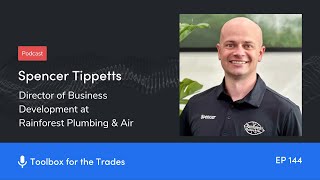
Spencer Tippetts returned to his family's commercial plumbing company to launch a residential division. He switched from radio ads to ServiceTitan for digital tracking, split operations into five separate units, and hired dedicated technicians. The residential business is on pace to hit $5M in sales this year, triple the company size since 2018.
Spencer Tippetts, you are the director of business development at Rainforest Plumbing and Air in Arizona. Today we're going to talk about building a residential division with innovation and creativity. I am so excited to have you on the podcast. Welcome.
Thanks so much, Jackie.
So we're going to kick this off with an icebreaker, which I've been introducing in the last couple of episodes. I would love to know, if you were a superhero, what would you be your superpower and why?
Yeah, that's a, it was a really good question. I, I polled my kids on that question and just to see what they would say. So my, my son said I should have super speed, and my daughter said that I should be able to fly. And so I, I, I guess either of those two would probably do, do pretty well. I, I think I'd find a lot of utility and super speed and flying.
What about super, what about speedy flight? So not only can you fly, but you can fly really fast?
Yeah, definitely. I think at my core, I always feel like I, I can never do anything fast enough. And so, so being able to, to travel faster or, or run faster, it would all, it would really benefit me. So. You know what? I agree. I think super flying speed, that's, that's my superpower.
Fantastic. I love that you consulted with the most important people in your life on that question. How old are your kids?
So my, my son is 6 and my daughter is 4.
Amazing. Well, I, they had a great answer, so please tell that to them. Say that you guys gave me the perfect answer for the podcast. So thank you. I would love to also know how did you get into the trades?
Yeah, so I had an unconventional route. So my, my dad started Rainforest Plumbing and air in 1999. So I was, I was five, turning six when, when, when he started. And so I grew up at Rainforest. When I was a little kid, I would, I would refill the soda machine in, in the warehouse and you know, as soon as I was old enough to, to use a shovel, I, I would be there digging holes and just ended up more of an apprenticeship role. But anyway, so I was always, I was always in the business and my dad encouraged me to go to college and so I, I went and got a degree. And when I got out of that, I, I, I went into the corporate career and, and found out that I, I didn't really like that. It was, it was not nearly as glamorous as what they try to sell you while you're in college. And so I, I, when my dad presented the, the idea of Starting a residential service business inside of Rainforest. I was, I was pretty intrigued. The idea to, to have kind of an entrepreneurial experience within our company, this company that I, you know, grew up with and, and also to just learn at the, at the feet of a master. You know, my, my dad is a world class entrepreneur and so it's, it's really one of the greatest privileges of my whole life to be able to, to come back into this business and, and work with the people I do and, and do what I've done.
That's incredible. I, the way I forgot exactly how you just said it because my mind's a goldfish these days. But the world's greatest privilege. What a way to think about the career that you have and the impact you're making right now. That just really struck me. I wanted to, I wanted to say that.
Yeah, well, I, I really. Maybe it sounds cliche, I don't know if it's cliche or just hokey, but we, we hired a, somebody to grade to level the yard at my grandparents house and a comment was made that, by someone who was, who was there that said, man, can you, can you believe that career? Like he's out there in the, in the heat and, and he's having to work hard and I, I was like, I, I think he's got probably the coolest job in the whole world. All he does is just, he just operates heavy machinery and nobody tells him what, how to do it. You know, Like, I just, I just have a ton of respect for the trades and, and the men and women who do it. It's just I can't think of anything more rewarding than, than solving the most inconvenient problems people have like plumbing and air conditioning. Yeah, so I, yeah, I really do mean that. I, I love what we do and, and just respect these people a ton.
That's incredible. I'm glad that we, we went on that little tangent there because I think, I actually agree with you too. I think there's something to be said. I've. My entire career I've done a lot of things, but more or less it's been in front of a computer. And while I love what I do, there is something to be said about being able to see your work actually being done. Being able to move physical matter. Like in the case of the gentleman who was leveling your grandmother's lawn and, and I think there's, yeah, there's something to be said about that. About actually like using your body physically. Obviously there's the cons to that too. I'm hearing my own dad saying something about his knees because my dad, my dad was in the trades as well. So there's obviously like pros and cons to that as well. But it really speaks to the mindset and having the mindset about what kind of work the men and women of the trades are doing.
Yeah, absolutely. It's, yeah, there's. You're sacrificing, I think some of your, some of your, your physical, you sacrifice some of your body. But I've also thought of it like this, that when you, when I, when I got a, a dog, dogs have to go on walks and, and it's not necessarily because the exercise, it's because of the, it's. They're sniffing things and their brain is just, is activated and I, I feel like when I'm, you know, in a trench or up in an attic, I feel like my brain is just, it's activated and that. So that in a way is what's going to keep me young and, you know, I think I'll live a long time because, you know, what I do is challenging and interesting.
Yeah, I've heard that before too. I do not have a dog yet, but I have been dog sitter to several pups in the last few months. Some of them have actually made guest appearances on the podcast. And my favorite thing is just take them on walks and just let them sniff. It's like this is their walk, not mine. So, you know, go nuts, guys. And the more they sniff, the more tired they are. What kind of dog do you have?
Well, I gave the dog away, but it was, what was it? It was some kind of Australian shepherd, but.
Oh, wow.
Yeah, yeah, I'm not, I'm not a dog guy. I'm a, I like human, human kids. Those are the best for me. So.
Nice. Well, at least you know yourself, you know what I mean? So tell me a bit about. You came in and. Oh, also I wanted to mention this. Your brother had worked at Rainforest before you joined. So what influence did your brother's experience at rainforest have on your decision to join?
That is a good question. Well, yeah, my, my older brother was, he was obvious, obviously my first best friend, you know, so, so I've always looked up to him and, and you know, seeing what he had done at rainforest was, it was certainly inspiring. I was, I was just thinking about it last night that, you know, we, my dad, brother and I, we have so much in common from just family memories and experiences that if, if we ever have a disagreement or Things are getting heated some in some kind of discussion. We always have the fallback of all the things that we have in common. And so it allows us to jump like we, we call it rumbling when we kind of have a disagreement or something. And so we'll actually ask for permission from each other to, hey, can I rumble with you on that for a little while? And, but we can rumble and our feelings won't get hurt. You know, we, we have the, the fallback of our, our past life experiences with each other and then we can, you know, we can come back to the business side of it. So, you know, I, I don't know if that works for every family business, but we do that. That's at least our outlook on it and we're, we're able to work pretty effectively together.
That's really cool. I like the perspective of we can fall back on the things that we all have in common. So the thing. So part of our history that we all share and that we all know we're coming from the same place. And I just note to my producers that opportunity for the title of the show, let's Get Ready to Rumble. Running a family business with Spencer Tippets. I think that's actually a fantastic title. When you say, when you say rumbling, is it mainly just let's. I know you have a different point of view as to how we should approach this. I have a different point of view. Let's get in a room and just talk it out for a couple minutes and like, how does, how does the rumble end, typically?
Well, yeah, I guess I, well, first I should say the rumbling thing comes from Brene Brown, an author. And so I, I can't, can't take credit for the concept, but, but what I can say is that it does work is, is to just, it's to just ask the question, is it okay if I, if I potentially offend you now? You know, I don't mean to, but I just want to present this, this, you know, alternate idea. And so another thing that I've. Another saying that I kind of have is if, if, if you're in a room and more than. Sorry, what is, what is my saying? If, if two people in the room have the same opinion, then one of them is useless. And so we actually, we encourage people to disagree with each other because ultimately we'll make a better, you know, more thoughtful decision if, if those opinions were heard.
Yeah, that's a really great way to look at things because in some ways too, that's also ensuring you're not surrounded by yes people. People who are just going to yes you. Right. Encouraging different schools of thought. And by the way, I think this is a toolbox for the trades first. I have mentioned Brene Brown so many times on the show. You were the first guest, I think that has mentioned her to me before I got to mention her to you. So yay. That makes me so happy. I love that. So how did. And I. What I also love about the idea of asking someone if they're ready to rumble is you're asking them, hey, are you in the headspace to kind of go. Go with me on this? Like, are you ready to kind of to rumble, to spar about something? And are there times when you. Your dad or your brother like, oh, my God, I can't do it right now. Can we revisit this tomorrow? Is that kind of how that normally goes?
Uh, yeah, there's certainly there. That's. We in our. In our family, it seems like we. We try to brand everything we do, but my dad's famous method is he. He calls it the back burner principle. And so that's his. That's his flag for when he. When I don't want to. I don't want to rumble on this right now. Let's put it on the back burner. And. And actually in his desk drawer, he has a. He has a drawer that you pull out, and there's a label on it that says the back burner. And so if he's got a paper or something that he's thinking about, he'll literally put it in the back burner drawer and know that he's got to get back to it at some point.
See, I love that concept. But you know what would happen for me, I know myself really well, is I would have the back burner drawer, and the back burner drawer would just never get opened. I would just keep on adding to it, and then it's like, oh, yeah, I guess I should, like, look at all of that stuff. I'm very much someone who needs, like, immediacy in my decisions, which is something I'm working on. So I definitely give your dad credit for being able to kind of revisit that stuff when he's not ready at the moment.
Yeah. See, I. I call it strategic procrastination. Is.
Let's.
You know, let's call a spade a spade. It. It is procrastination, but there's strategy to it.
Yeah. Yeah, for sure. Oh, my gosh. Got so many great. Just, like, insights on how you as a Family work within the business in just these first 10 minutes. I love it.
I know it's, it's probably super weird, but we, we, we do feel like when you name things it gives it power and so yeah, you know, our, our company name has, has power and, and we, anyway, we have a lot of fun naming things so.
Yeah, yeah, I totally agree. So let's talk about naming things and making a decision to branch out. What inspired the team at Rainforest to create a residential division? You guys were commercial for the longest time. What prompted the, the new branch. Yes branch, new service, new. How would you call it?
Well, in service Service Titan language, it was business units, which that does come into play actually is our ability to kind of like keep the department separate within a single software platform that actually did make things, make things possible. So Rainforest started as a residential service business and early on my dad figured out that he could actually build a business in a, in a commercial space that, and we could compete on a level that well, we could, we could have a business that others couldn't compete with. And so we, we really created the business around a commercial and kind of property management industry. But kind of as the, as the business went, I think my dad realized that there was a, there was kind of a cash flow advantage to having a residential service business. You, you know, you take payment upfront and then you pay for the equipment in 30 days. And so kind of the, that's almost the exact opposite of, of how a commercial business runs. And so we thought that by, yeah, if we had that could kind of diversify us and make us a little more recession proof. And so they had actually had a couple of, of managers in place to try to create the, the, this residential business and they just, they just weren't working out. We kind of, we had a large radio budget that was not really drumming up business like we thought it would. And so that's when, that's when my dad presented the idea to me of, of coming back to the family business, which was something I previously didn't want to do. And so when he kind of presented the idea that, that we could, you know, pull this off and it would be something valuable to the business, it really, it really intrigued me. And, and so yeah, anyway, we came, I came back and we had just signed up with Service Titan and, and had a lot of capabilities that we had never had before. Customer data that we could go back on and that, that's ultimately how we grew up our membership base. But yeah, so, so you know, we, as a commercial service Business. We had just signed up with a residential service platform. And so seeing those, you know, that we had the tool just, you know, we were already paying for the tool. It was, it was seemed pretty logical just to. To leverage it and, and scale a residential service division.
Yeah. Yeah, for sure. And I know that when you first. When the team first decided to launch the residential division, before you came on, you mentioned you had this big radio budget. It was with Service Titan that you realized, oh, this radio strategy is not yielding us anything. It's really. We're just wasting money. Can you talk a little bit more about that?
Yeah. So. Excuse me. So, yeah, service titans allowed us on many levels to. To just track if. If we were being effective. So I, My dad always tells us the story about. In the early days, he would take an ad out in. It was this thing called the Yellow pages. I. I don't even know. I don't even know if the pages were actually yellow. But anyway, I think they were. I think.
So rumor has it that they were yellow.
I don't. It. It just baffles me that, that that's how you used to have to do it. So, so he would do those, and then he did. He just couldn't tell if they were working. He would call from. From the house. He would call the office just to make sure the phone line hadn't been disconnected because it was so quiet. And so. Yeah, right. So right when we kind of really committed to the residential thing, we. We realized that, you know, through. Through ad campaign tracking this. This radio thing wasn't really being effective. Nobody ever mentioned it as the reason, you know, we were spending about as much money as we were making in residential service on advertising. So we scaled that down and took a digital approach, which in hindsight is like, I don't. I mean, that's. That seems kind of foundational. But anyway, it was. It took. Using the software made something that wasn't totally obvious. I guess it just made it obvious to us. And so, so we. We changed how we advertised a little bit, and then we actually hired specific technicians for that division that they couldn't cross over. So initially. Now, hold on. What was the question?
I wanted to know about how you discovered. No, you're doing great, by the way. I wanted you to talk a little bit about how you discovered that radio was not yielding the results that you expected it to.
Yeah, so. So yeah, we were spending as much money on the radio as we were, as we were making in revenue. And so, so we knew that there had to be A change. So in. In conjunction with that, we. We moved things to a digital. We took a more digital advertising approach. And what we had been doing previously was whenever residential calls came in, we just let a. One of the technicians handle it. And so what we learned was if you're gonna. You. You have to. You have to create the business around the customer that you're trying to serve. And so, you know, wearing shoe covers and, you know, giving all kinds of options for different ways that we can solve the problem. And I don't. Little things like that were just. They weren't obvious and they weren't ingrained in our culture. And. Yeah, so. So we. We hired specific technicians for our residential service side, and we didn't allow any crossover. So initially we had some concern about is there going to be enough, you know, are there going to be enough calls for this residential team to handle? And ultimately that took kind of a leap of faith because at the beginning, there weren't any. But by. By kind of burning our ships, the. The burn our ships of fear, we. We just committed to it. And. Yeah, and it. And it seems to have worked out.
Yeah, it seems to have. Like you said that you're pacing to hit 5 million at the end in just residential sales alone. So that does not include the commercial business by the end of this year. And you start when you came on was 2019. Is that correct?
Yes.
Yeah. And, you know, I have to say, when you were describing discovering that radio wasn't working, learning about shoe covers and building the residential business around the customers you want to serve, you were saying stuff like, oh, well, we used to just have a commercial tech go out. I just want to say, I think it's so great that you're on this podcast right now and sharing things. Mistakes that you made. I won't even say mistakes. I would say like the learnings that you made while you were trying to accomplish this task, you're like, I guess it seems, you know, you know, it's kind of common sense now, but you didn't know it at the time. And for so many people listening right now, that's still not common sense. So I just want to like, normalize that for you is that. Of course it's not. You had to take a leap of faith. So correct some of that language in your head. Spencer, you. You're doing a fantastic job.
Well, I, I joke that this was a. It's been a profitable experiment and it, you know. Yeah. And that's actually the beauty of small business where, you know, I used to work. Where I came from was the largest company in the world, Walmart, where, where you can't make a decision ever. It's just not possible. And so, so coming to a small business, it was like, you know, even at the top of this thing, we don't, we don't know exactly what we're doing. We're, you know, we, we collect opinions and we make the decision that we think is best. But I really actually, I kind of like that. Yeah, we're just always, you know, always trying new things and, and you know, it's been, it's been a profitable experiment. I think it's the best way to describe it.
Yeah. And you need to have that entrepreneurial mindset of being able to quickly pivot, of being able to make decisions because I know there were things that you, there were assumptions you made when first starting the residential business. I know another thing was too rainforest. Historically in the commercial side was more plumbing focused. And so when you open the residential division, your first thought was of will make it more plumbing focused as well. But over time it's now been more focused on heating and air. Can you expand a little bit more on that and what you learned through that journey?
Yeah, so we certainly, we have, we owe everything to our commercial plumbing business. It was, you know, they've given that the kind of the winnings from our commercial plumbing business has allowed us to, it allowed us to create air condition, you know, to get an air conditioning license and add that to our business, you know, maybe eight or nine years into. Into rainforest history. So certainly this rainforest had kind of evidence of it being a plumbing company first. And so ways we compensated people and, and just processes internally were very focused towards plumbing. And so something that kind of being, being entrenched in what I was doing allowed me to just kind of see from a different perspective from the other side of that particular issue. And so residential air conditioning, we saw some early opportunities, but things that were preventing. So we, you know, when we first started it, we didn't have a way to compensate technicians for selling new units, which in a commercial setting is not necessarily the way that you are profitable. You want to, you want a kind of an even balance of the two. Or residential is. It's kind of like the replacement is really that's where all the profit is. And so we had to shift a little bit of, of those internal policies and, and that allowed us to, to, to continue scaling it now as something about, something about Arizona. But at your house, if the air conditioner's out, it Is, I mean we're right behind emergency responders in terms of like importance. It is just people lose their minds if, if air conditioning goes down. And so in plumbing there's a little bit more of like a. Well I can take a couple of, you know, I get a couple of bids or you know it's, I've got another toilet in the house we can use but if the air conditioner goes down, it's, it's just straight up. We can't live here.
Yeah.
So. So there's a little bit more of an urgency. And so it was, it, it has appeared to be just a little lower hanging fruit. And so, so our residential air conditioning business is actually quite, quite a lot bigger than our residential plumbing business. And so, so anyway we just found it maybe, maybe opposite of how, how a commercial business runs. We found that air conditioning can scale a little faster. And so we're looking at a lot of our procedures and we think we've really got some things down that we can now just kind of turn valves on and let this thing grow. And so I do look forward to spending some time into plumbing and seeing if I can kind of crack the code there and start scaling that side.
Yeah, for sure. I mean, I don't know. So little peek behind the curtain for our listeners. We record these episodes in well in advance before they actually air. And right now we are in August. I saw a tick tock the other day that said that Arizona was in 33 number was over 100 degrees for about 30 days in a row, something like that. So yeah, I can understand why if the air conditioning is not working, it's a big emergency.
It was actually over 110 for 30 days.
Holy cow. Oh my goodness.
It got up. It was 119 two weeks ago in, in July and that was a, that was one of the craziest days we've had in a long time. So.
Oh my goodness. Okay, so this is really interesting. So rainforest historically a commercial business, your dad set out to make it a residential business when he started it in 99. But by the nature of the market at the time, a commercial business, plumbing business made some seemed more profitable. After coming on board with Service Titan, after just taking a look at opportunities, you guys determined that a residential division could really help with cash flow and make the company more profitable, more areas to grow. So you took what you learned from commercial, applied it to residential and have essentially been tweaking it as you've learned. Oh no, actually in this case we need to do this for Residential or. Oh, actually we need to focus on this type of service instead of that type of service. So it's really cool. It's like you have a bit of a map, but it's almost like the map is in a different language. And so you're kind of taking what bits and pieces you can from that original map and you're creating your own in the process. That's the story that I'm getting from you right now. Would you say that's accurate?
Yeah, yeah, I think that's, that's pretty true. There, there's, there's a lot of principles that are going to be true in every business. And so something that was it, it gets said a lot, I think, in businesses is, well, we can't do that because that just won't work here. And, and I always think, well, you know, it works for like literally every other business. Why wouldn't it work for us? Like, how are we any different? So anyway, you peel back some of the limiting beliefs and, you know, underneath those are, are principles that are the same everywhere. And so, you know, we, we do a lot of like, Tony Robbins trainings and we actually, we have a Tony Robbins trainer come and, and train our management team here.
Oh, nice.
Anyway, so now why do I bring that up? Is. Yeah. Behind some of those things that, those smoke screens or, you know, we call them limiting beliefs, you know, is the way to do it. And it's just more of a how can we make it work? Instead of how, why won't it work? It's just a how, how can we do it?
So, so interesting. Can I just say, whenever I do these interviews with folks like yourself in the trades, and I want to talk about, like, how did you functionally make this happen in the business? More or less, we get into a talk topic about psychology. You've mentioned Brene Brown, you've mentioned Tony Robbins, you've mentioned this concept of rumbling, of limiting beliefs, of, oh, goodness, what was the other 1? 2 opinion. 2 Similar opinions in the same room. That second opinion is useless if it's the same as mine. I mean, it really comes down to mindset and how you think about what you can and cannot achieve. And taking that back to your corporate experience, Walmart, just like if you're a cog in a wheel, it's so hard to kind of get that intellectual itch scratched, I think. And it sounds like here at Rainforest you've really found the ability to do that.
Oh, absolutely, yeah. Yeah, I think. And we might get into that later, but culture Is certainly is. Tony Robbins has a saying that anybody can build a $10 million business, but if you want to build a hundred million dollar business, you have to have a culture. And so yes, that's been, you know, we, we crossed as a business, we crossed that $10 million mark and it became apparent that we need more than just a couple problem solvers. We need this entire group to, to have a voice and, and share their perspective on any kind of problem. Any, any given problem. And then, you know, we can, we can have a machine that is just solving its own problems. And we, we joked that my mom and dad went on a, on a trip and so my dad, like, you know, he thinks the place is just going to burst into flames when he leaves. But between Dallin and I, we, we've got it, you know, we got it pretty covered and we've got a great team. But when my dad came back, he noticed some new policies and procedures that we had implemented. And, and we joked that it's like a, it's like an AI. It's, you know, it's learning, it's becoming.
You know, it's sentient.
Yeah, it learns on its own. It's, it's incredible. So, so anyway, it's, yeah, yeah. Culture and, and that, that, that seemed to be a key to, to be able to. Covid presented well for the first month of, of like the lockdown we thought, you know, we were staring over a cliff.
Yeah.
But it presented an opportunity where there was a lot of liquidity in the market and a lot of, there was just tons of extra money to be spent. And so we, we grew and actually from 2018, by the end of this year we, we will have tripled in size. So in that, in that five year span, we, we will have almost tripled. And so, so to scale that fast as a, as a, as a company was I think only possible if we, if we focused on, on our culture.
And I just want to do a quick shout out. Your brother Dahlan runs the commercial side of the business. So tripled the business from the end of 2018 to now. You are hitting to make about 5 million in residential this year. So that means that, that your commercial department still thrived during COVID which I think is a really big testament to the way that you guys think about and do business.
Yeah, that's right. It's just because the residential thing was kind of my, it's kind of my baby. I was hoping that one day it could take a larger percentage of what Rainforest revenue is, but it Actually hasn't changed because each of these business units has, you know, is, is growing. And so we, I, you know, I think we, yeah, we, we have some maturity as a business that we can now, we can now duplicate and, and scale. And so where I think a lot of businesses maybe get to a point where we are and they say, well, we need to open an office in a different city. We're actually able to, we've been proving to ourselves that we can start, we can go after an industrial customer, we can go after a property management customer and, and a residential, even within residential, we look at them a little differently. We have high end clients, we have manufactured homes and HOAs. So, so anyway we can with here within just one city with one, one office and one, you know, one set of business licenses, we can actually create several businesses and, and grow profitability without having to leave.
That's awesome. That's super cool. Let's get into culture. I didn't ask you any specific questions about it during our pre interview, but I want to get into it, you know, because it sounds like it was such a critical part to your business's growth. So tell me about it, tell me how it's shifted since you've joined and what's so important that your dad can leave for a couple weeks and come back and there's all new policies and procedures. What's that like?
Yeah, so I think in the early days of starting a business from scratch, I can only imagine how hard that is. I think, yeah, just a ton of respect for anybody who starts it from scratch. That is just, it's totally wild. So I think in those early days it was, all the pennies were tracked. It was just a, you know, because we might have need, we might need a few pennies here to, to make payroll or to whatever. And so I know in the early days, for the first couple years of this business, my dad would, he would, he had a drawer in his desk with his paychecks because he wouldn't cash them because he knew it wouldn't, it wouldn't go. And so us as little kids, you know, we had no idea that we were, you know, on the verge of bankruptcy for years. But, but he pulled it off and, and we kind of, we started getting to a point where the business was profitable and self sustaining. That's what's so interesting about culture is like, I don't know, you can, you can read a lot about it and, and you can, you can watch YouTube videos and it's the culmination of like all of the, all of the shared experiences. And so I think if I want to make more than a single person's lifetime of money during my lifetime, I need to take some other people's lifetimes and, and just learn it and start executing it. And so, so anyway, so it takes a lot of those of just research and studying and being interested in that, I guess. And then, and then you just. And then maybe there's an aspect of just becoming, becoming that culture, but certainly a shift that happened was, was allowing. Allowing people's voices to be heard. And so, you know, there were, there were people in the business that, that kind of made that difficult. And I know I struggled coming into it just being. Yeah, you know, just you're. We struggled with, with how you felt here at work. And so I think there was a, there was a switch that flipped that we said all these people here are depending on this company to, for their livelihood and they don't like being here. And so, so, you know, there was, there was a shift where, you know, we celebrate birthdays. Every birthday at this, at the company is celebrated and, and some kind of, you know, a cake or bagels or whatever is every, every birthday, you know, we improved our benefits. I remember I got my first paycheck. So when you get at Rainforest, your first paycheck was always paper and then you, then you could do the direct deposit. So I looked at my first paycheck and on the top it said employee number 20, 35 or something. And I was like, there's only like 50 people who work here. How have we had 2,000 employees over the last 20, 18, 19 years? That means we were replacing the company. We replaced the company twice every year. I mean, that's what our churn was. And so I think that was a signal to me that something had to change. And so, you know, changing, changing how we speak to each other and, and you know, listen and work together. You know, we, we, we celebrate together. Whether it's a birthday or a baby announcement or a home purchase. We have a, we have a Slack channel for, just specifically for celebrations. So, you know, last year we had five babies born in the, in our, the Rainforest family. And you know, just, just homes purchasing all that is just like that. That's what makes this stuff just. It's amazing that that Rainforest can, can do that now. But, but what was I getting at was the, the, the amount of. Oh, sorry. So we did, we changed some of these things and now, you know, our, our turnover rate with employees is, is dramatically less, which has A hard to quantify profitability impact.
That's awesome. I had, I'm so happy that we got on this subject. I talk about culture, I think on virtually every episode here. I love this question that folks can maybe ask themselves who are listening. Is my company a good place to work? Is do people come to work and they enjoy it? And you know, let's. Okay, let's be real. Not everyone wants to work. Right. I wouldn't, you know, I'm sure there's things that you, hobbies that you have, you have a family, you want to spend time with them. I have hobbies I want to do that I would love to just be able to do non stop. The reality of the situation is we all have to work, right? When my employees come to work, are they feeling empowered to get their job done? Are they enjoying the company of their colleagues? Are we working together, rumbling in an effective way? Right. You talked about there being some managers in place who didn't really foster that growth. And I'm thinking about two things like as it affects, as we talk about turnover, we have this one group of people who maybe are kind of set in their ways, who maybe are brain growth down, but we keep them because they've been at the company for so long, so they historically know how to do it.
Well, I'll add a caveat that those people who, who I, you know, those people who, who've kind of made those people were the right people for the time. Yeah, I think it would be impossible to start a small business without some form of micromanagement. You gotta know, in fact, in the early days there was an embezzlement. And so we had a general manager steal a couple hundred thousand dollars. And you know, back in the early days that, that could have tanked the whole thing, but somehow, you know, my dad figured it out. I remember I came home one day and there was a horse saddle in the garage. And we're not horse people. But I said, what's that? He goes, I guess, I guess I have a horse. Anyway, little did I know that, you know, we were using company, this guy was using company money to buy his horses. But anyway, so, so these, you know, people came in after that and, and, and managed the business in a way that, you know, it was profitable like that we owe everything to, to those people in, in the early days. Now I do think that that Covid specifically was, was probably one of the greater challenges that, that a business could, could face. And so, so being able to, to quickly adapt to that, you know, things Things needed to, to change. And so, you know, I, I think a lot of people from those early days that are actually still here, we do have a lot of 15 plus year employees at Rainforest. They changed as well. And, and I think they would, they would also say that they, they really enjoy being at work now compared to, you know, maybe a few years ago. But, but certainly happy people are more productive. There's just, there's no doubt about that.
Yeah. And you know, I'm thinking about employees in terms of longevity. I've been at Service Titan for actually six years. It was like yesterday was like my six year, which is by the way the longest place I've ever worked. I'm employee number 287 and we are well into the 2000s now in terms of our employees. And I think about the company I joined and the company I work for now and it's completely changed and you know, thinking about turnover. Right. We want to keep people happy, but we want to make sure we're keeping the right people in the organization. And I think one of the things that's enabled me to flourish at ServiceTitan, a constantly growing company, is always down to like pivot and change and adjust. And Covid was another big reckoning for my department, specifically where we kind of changed things about, we changed things on, we really knelt in on a content strategy. Sorry, we're getting a little B2B sassy here. But I'm just relating to Spencer's story and you know, I think about how you could have longevity in employees and sometimes that longevity could be to your detriment, sometimes it can be to the positive. So I think my takeaway in our kind of like ethereal conversation here about turnover and about impact is you want to make sure that the people that are staying at your business are the ones that have the right attitude and can pivot and grow and change with you as the business pivots, grows and change. Do you agree? Am I making sense?
Yeah, absolutely. I, like I mentioned, there's, there's, there's principles that are true no matter what kind of business. So service titans experience. In fact, a company like Service Titan with 2000 employees. How do you, how do you. Well, I, I think I, I have interest in that because one day I think we'll have 2,000 employees, you know, across divisions and states and you know, so there's something to learn. But I think there's under, underneath all of it is, is the same principle. And so, so yeah, you're absolutely right.
Yeah, very interesting. This is the kind of conversation I never thought I would be having with people. But you know, my role at Service Titan has allowed me to and I think it's really fascinating. So thank you for going on this like philosophical business journey with me. I so appreciate it. Spencer, you've been so generous with your time. I've really enjoyed everything I've learned from you today. Like just enjoyed it on an entertainment level. And also you've made me think a lot, which is one of my favorite things about doing this show. I would be remiss if I did not ask you because Rainforest Forest is pretty unique. You were actually, if I recall, I think Rainforest is one of the first commercial businesses that we got on Service Titan. So just from a general perspective I'd love to know like what's it like for. You had mentioned it before. You know, you have two business units, the residential unit and the commercial business unit. And I know residential is your baby, but can you just tell the folks listening like what's it like to run these two very different divisions on one platform on Service Titan?
Yeah, so we definitely, I remember when the, when Service Titan was, was kind of pitching us, they actually almost, they almost walked away. They said, you guys just aren't the right fit for this. And, and there was a, there was a kind of parking lot meeting where we said we can't let them leave, we have to have this. And so we couldn't afford not to have it. So anyway, going, you know, creating separate business units. So we actually have five business units. So commercial plumbing, commercial air conditioning, residential air and residential plumbing and then capital improvement. So we do often like 300 water heater change outs or re. Pipe in a condo association, stuff like that. So, so we keep that up there now being able to, you know, the, the business grew and there was a point where it was like what percentage of this is residential or commercial or restaurants or. Or industrial. And it seems like when you focus, when you, when you kind of divide, divide them up, put them in their own little, in their own little buckets, you can kind of, you can more easily see what it's going to take to grow those things. And so I think Service Titan, by allowing, you know, by having the business unit feature, we've actually, we have dispatchers and call takers for each of those departments. And so they all are hyper focused on the problems that face that division. And so that has allowed each of those things to grow just exponentially. Like the, like we joked earlier, it's sentient. Just this thing is like Unstoppable. But as we, as we focus in on it, on an area. So the reason residential didn't take off was because it was just mixed in with everything else. So when you, when you separate it, you can focus on what are the problems it faces in plumbing. We thought, you know, we always kind of worry about those capital improvement jobs because are we relying on those too much?
Because.
Because one of those jobs represents like 5% of our revenue for a year. And so, you know, we separate that and we say, now what is commercial plumbing? What does it need without those big jobs? And so anyway, I kind of see maybe that can happen a couple more times for us where we. We take out a restaurant division or, or whatever it might be. But being able to focus and then have people in those, in those departments who are, you know, they're compensated for the success of their domain. Yeah, yeah. I think service titan kind of. Yeah, it helped us do that. And so again, the principles are the same whether you were a residential or a commercial business. It's just maybe the. How you do it needed to change a little bit.
Yeah. So really being able to pull all of those different service lines away from each other and really see, okay, what's going. Well, what's pacing to plan? Excuse me? What's pacing to plan? And how can we grow these, like, what are little, like, tweaks and levers we can pull to potentially really ramp this up? Oh, I see that. You know, this is happening in the residential plumbing division. Maybe we can borrow from this commercial plumb, like, in terms of insight, I feel like it helps you probably separate all of these things because otherwise everything's just jumbled and you're looking at a global number, which isn't really going to tell you, oh, this department needs more attention. So that's kind of what I got from your answer. Was I right?
Yeah, yeah, absolutely. You made me think of something else, too. That res as a commercial business. We started this residential thing, and I remember when we first started it, we only had two installers for the whole company between commercial and residential.
Wow.
And we would sell these residential jobs for double or triple what we would charge for a commercial one. And. And they had to wait a week because we didn't have an installer for it. So we hired installers for just residential. And then we realized, wait a second. Installs are like. That's like a. That's a thing. That's a. That's a business unit. So actually the next project is actually to. To separate install from. From those and, and watch look at them separately. But the residential experience and seeing how installs have become a really core piece of that business actually made us look inwards on commercial air conditioning. And so now we have, we have 10 installers in our commercial air business on top of the service, you know, our service guys. And so that we, we doubled that business in the last two years because of a lesson we learned from the residential thing. So yeah, it's a, it's certainly a compounding effect and there's, there's momentum, so we're having a good time with it.
Okay. Very cool. Spencer, I really enjoyed this conversation and just like talking about business themes and your journey and growing the residential division at Rainforest, this has been a really thought provoking conversation for me and honestly, those are my favorite. So thank you for, for doing this and I, as we said before, I would love to have your brother Dahllen on as well to talk about what he's doing more on the commercial end. But thank you so much for joining me on Toolbox for the trades. Are there any final words that you would like share?
No, just thanks so much for having me. I think Rainforest is a, is a legacy and to, to be partnered with great people and, and software solutions like Service Titan to, to allow us to do what we do. It's seriously, it is. Like I said earlier, it's, it's the greatest privilege of my life to be able to do this as my career. So hats off to the trades people and the entrepreneurs who do this. Those are the real heroes. So it's just an honor to be numbered among them.
That's incredible. Thanks so much, Spencer.
More from Bill




Capturing the 80%: How SmartAC’s Gen-2 Targets Non-Membership Homeowners | Podcast Ep. 296

Build better customer data with every booking in ServiceTitan | TAD Tune-Up Series

The Biggest Change for Roofers Coming From Other Roofing Software to #ServiceTitan?

