Scaling with Intention: The Systems Behind $45 Million in Revenue | Podcast Ep 240
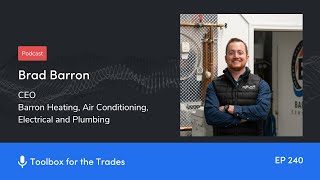
Brad Barron, CEO of Barron Heating, Air Conditioning, Electrical and Plumbing, scaled the family business from under $15M to a projected $45M+ through documented processes, leadership expansion, and a video-first marketing strategy. He acquired local media in May 2024, launched an in-house technician school that has graduated about 30 people, and started Baron Cares philanthropy, which donated roughly $170K in its first 18 months.
Questions this video answers
February 6, 2017.
2023.
Under $15 million before Brad’s tenure; projecting $45 million+ for the discussed year.
May 2024.
About 30 technicians.
Hello contractors and welcome to Toolbox for the Trades. My name is Jackie Aubel and today I'm chatting with Brad Barron, the third generation owner at Barron Heating, air conditioning, electrical and plumbing. Brad and I spoke about the steps he took to take primary ownership of the company from his father, the importance of video marketing, graduating 30 techs from his training school, and so much more. This conversation is full of insights and advice and I hope you find it as interesting as I did.
Foreign.
Barron, you're the CEO of Barron Heating, Air Conditioning, Electrical and Plumbing in the Northwest Washington area. Today we are going to be talking about how you took over your family business as a third generation owner and so much more. Brad, I'm so excited to have you. Welcome to Toolbox for the Trades.
Awesome. Well Jackie, thank you for having me excited to be here and hopefully get an opportunity to dive in some stuff that helps people out there in the trades. That's the goal.
I think we definitely will. And before we even get started, I have to say to the listeners that the reason I was introduced to you is because your colleague Channing Morrison listens to Toolbox for the Trades and he found his way to me and wrote me a very lovely essay essentially about what a great boss you were and what a great subject you would be for Toolbox for the Trades or what a great guest you would be. And that has only happened like two times before out of almost 250 episodes. So if that is not a testament to the awesome work you're doing at Baron Heating, I don't know what is. And I wanted to shout out Channing early on in the episode because I, I'm sure we're going to reference him later on, but I'm going to kick this off with one of my favorite icebreakers. Brad, I want to hear. If you had to pick a song to be the soundtrack of your life, what would it be and why?
Well, I'll go with what my gut says right off the bat. Probably Homegrown by Zach Brown Band would be one nice. We live in a small town just north of Bellingham called Linden, Washington and we back up to a farm. I've got a 1979 Volkswagen camper. We like to go camping, hiking, just being close to family friends like the song says, you know, got good friends living down the street. That's sort of how we live life. Also big Zach Brown Band fan too. So I think that if we could bring him in and I could meet him, that'd be pretty cool. So maybe next episode.
Awesome. Awesome. All Right, Brad? Well, let's get right into it. How did you get into the trades?
So I'm a third generation owner of Barron Heating, AC, electrical, plumbing. I'm a fourth generation working in the business. But when I came out of high school I did not do anything related to H vac electrical plumbing. I started looking into engineering schools and decided to go into the engineering program at the University of Washington. So I'm a civil and environmental engineer by trade. So I have my family business has been around since 1972. I'm like peace, going to Seattle, going to do engineering. So I spent four years as a consulting engineer, got my professional engineering license and then realized pretty early on that I didn't like sitting behind a desk. I like getting out. I think it's one of the reasons I chose civil engineering is you get to be outside with contractors. I have an affinity for environmental stewardship, so I like the environmental side of civil and so had a chance to really mentor under a really great professional engineer but then got to the point where I said I don't want to sit behind a desk anymore. So I made the leap into sales. So I was a sales engineer for about a year at a company that did geotechnical contracting and then decided that I wanted to get back into my roots from a sales standpoint but also an engineering standpoint. So I worked for a multibillion dollar manufacturer of civil products. So that would be stormwater, sanitary, sewer retention, detention, water quality, managed a four state territory. So I was up in Alaska as an Idaho, Montana, obviously Washington state where I'm born and raised and realized that being on the road three weeks out of every month was really challenging. I got a phone call from my dad. We were living in Seattle at the time. My wife and I broke and he said, hey, my business partner's retiring from Baron Heating and ac. Do you have any interest in the family business? And so I got to thinking this was in, I guess August of 2016. We chatted for a long time and made the decision to take the leap into the family business. Had a chance to just really get after things as the business development manager. So I came in and I took my experience from working at a multi billion dollar company, being, you know, employee number 3467 or whatever. I've also worked at smaller companies, little six, seven person engineering shops. And I got to take the best of both worlds, infuse it into Baron. At that time we were about a 12, $13 million business. The first year I was there, we hit the sort of $14 million mark. Never really quite got to the $15 million mark. But I got a chance to work in every facet of the trades. I worked in the fabrication shop for six weeks. Still have all 10 fingers, so super proud of that. That's a win.
Yeah, that is a win.
I got a chance to get to know our shop foreman, got a chance to see how our sheet metal production worked, pivoted over, worked in service for about 18 months. Really enjoyed that. Both residential, commercial, shadowed service techs, maintenance techs, worked with the dispatchers. Just really got to see what the lifeblood of an H vac electrical plumbing contractor is, and that's that service epicenter.
Nice. I mean, it's a great story, and it's one that, you know, we've heard before. Some kids who have parents who are in the business, who are in the trades, they have their own business, and they decide to go out on their own. They're like, I don't want anything to do with this. But they eventually, some. Some of them eventually make their way back. When your father first approached you, was it with the idea that you would eventually take over ownership, or was it just like, hey, let's bring you in and see what happens?
There was no predetermined path. The reason we chose business development manager is I wanted to take my experience from the four companies I'd worked at before Barron, bring them in, and really get an idea of a, is this something I'm passionate about? And I was able to find a lot of passion in what I did and really passion with people. And I think at the end of the day, one of the things I realized in my first 18 months working at Baron is if you don't enjoy working with the people that are to your left and right and above you and below you, why are you working at that company? And that was a question that I wanted to answer. I wanted to see if I could help the culture be a part of culture, growth, growing people. And so there was no. To answer your question, there was no, hey, I'm bringing you in because I want you to buy me out. It was, I'm bringing you in because I want you to see if this is something you'd want to do. And I. My dad has always been a really big advocate for my brother Tim. He's two and a half years younger than me and I pursuing our passions, and I wanted to see if this was something I was passionate about. And the neat part after I dove in is that I found not just one, but Many passions in the business and I had a chance to live those passions out, whether that's something that I thought I would like or something that I learned to like. And I learned like a lot of different things here, things that I wouldn't even expect, and just some really neat things all around people. And I think that's what makes Barron's culture great, is, is our people.
That's awesome. So I want to hear a little bit about this succession plan you had with your father. So 2023 you took on ownership.
Yep.
Looking back, is there something you wish you did differently with the succession planning or was there something that you're very glad you did? Because this is obviously a big thing in the trades, especially when parents are preparing to retire. So I'm curious, what was your experience like?
Yeah. So back in 2019, my dad set up a succession plan that got me to the point where I'm at now. My dad and I are still partners, but I've been slowly buying in. And so what we did is, and I think a lot of family businesses do this is at the end of every year I had a bonus structure and I had a choice and my dad gave me that choice. Do you want to take the cash or do you want to take that cash and buy shares into the company? And so I made a decision by that point at two years in that I wanted to be buying in to be a future owner. And so every bonus dollar I got, I bought shares. We determined the rate ahead of time of what that looked like. And so it got me to a point when I took over as CEO that I was able to be a substantial shareholder of the company and set ourselves up for success. To ultimately buy off the remaining shares of John when he does officially retire. He's still part of the business. He's a huge, just passionate, energetic, marketing, sales minded guy. So he gets to work with our sales team, which is awesome. He gets to do exactly what he loves doing and that's coaching. He helps work with our executive team too, and pass down those 45 years of knowledge he has from working at Baron. Just 45. Right. Not, not, not very long. And so he gets to live out exactly what he wants to live out. And then he is a huge believer in me and the team and reinvests and reinvests and reinvests. And I think that reinvestment has yielded the growth that we've experienced over the years from sub 15 million to where we started to projecting 45 plus million this year. And it's humbling growth. There's a lot of things that I look back on. I said, man, I wish I would have done that different. But at the end of the day, John's a big, big believer in me and our team, and I'm really blessed to get a chance to work with him. I think I'm going to miss a lot of people are. They ask me the question, brad, are you ready for your dad to be done? And I say, when he retires, I don't get to spend eight hours a day with him anymore. It's pretty precious time. And so life's too short to give up on those things. And I have. When I'm ready and he's ready, we're going to make the move. But I am enjoying every moment. My dad and I have a really good relationship.
That is great. And don't worry, we will get into the things that you wish you had done differently. I have that on my questions. It sounds like your dad was really intentional and laid the groundwork for, for this transition to happen gradually over time. And so I think that's the big takeaway that I got from your answer. There is, you know, when your Dad's partner retired 2016, he approached you to see if you would be interested. And then as you were in the company for a couple of years. All right, looks like Brad is really taking onto this. Let's set the groundwork and figure out what the next few years look like so I can also step down and enjoy my retirement. But that is pretty great that you are going to miss spending eight hours a day with your dad. You should definitely share him, share with him this recording because I don't think many children would say that. Not necessarily children in the trade, so. That's really cool.
Yeah.
Yeah, that's awesome. I, I, this question just came to me. I, I've never asked it before, and I can't believe I haven't. Do you feel like part of the reason why you were so invested early on in making Barron successful or taking on the challenges early on, do you, do you feel like that is because your name is literally on the sign?
I mean, I think it would be a lie to say that that wasn't part of it. I think that as a leader, when you are a baron at Barron Heating, there's a, a level of engagement and a level of ownership, if you will, that comes with that. I also genuinely wanted to create a place that I enjoyed coming to work every day. Right. And going back to what I said earlier, if you don't have that life can be really challenging. Right. Because we go through highs and lows. I got three boys and you know, some days I get up and they didn't sleep well the night before and, or they're sick or whatever the case may be. And you know, when I can still get into my truck and start driving my 25 minute drive into work, get to see the beautiful, you know, Cascade Mountains, Mount Baker, and just sort of have that quiet time, but know that I'm excited to be able to be a part of something. Yes, having Baron on the side of the building is part of that. But the 175 employees that we support is another big part of that too. Something that I didn't think, I didn't know how I would feel when I first started. But it really is all about people and it's all about those relationships. Building relational capital, getting to understand people in a genuine way. Culture can't be forced. It's grown people sometimes say you have to build a culture. And I actually, I'm fine if someone thinks that, but I disagree. I think you have to grow it and you grow culture through building trust. You go, you know, you grow it through being able to relate to people and them understand the why behind what we do. You have to give them, you know, tools and training and I'm sure we'll talk more about that later on. But you have to invest in your people and then, you know, at the end of the day we, we're a company that's for profit so we have to track our metrics and KPIs. But if you don't get trust and the why right, your business is going to struggle. And again, I don't know if you're going to get up every morning and be excited to go to work.
Yeah, yeah, I think that's really, I think that's a really good point. You know, I really do think it's wonderful that you spent so many years in the business before taking on the ownership mantle and you, you really like marinated in some of those departments before you moved on and that probably helped growing the trust with some of these employees who probably have known you since you were very young and now got to work with you as an adult and see what you were capable of while also, you know, I'm sure you approach those, with that, those roles with some humility of like, tell me what, what, what don't I know that I should know that type of thing.
Yeah, I, I, you hit a word that's super important and I think this is for whether you grew up in the business that you're in or you didn't. Humility. I'm humbled every day. I've got. You can't see him, but, you know, I've got scars on my body for the things that I looked at and said. I've joked before with different people that I feel like I should put on a master class. That's, you know, why the heck did I do that? And that's where that humble part comes in. Maybe I will someday. I don't know. There's a lot of lessons learned and a lot of things that, you know, I could have done better. But, yeah, I mean, I. We have people on our team that have been here for 25, 30, 40. We have two people that have been here for 40 plus years. So, yeah, they saw me growing up. I went to the barbecues, the Christmas parties, different things like that. And being able to work alongside of them, it's a different level of cool. It's like, yeah, I get to support you and I get to know you better and build that, you know, those relationships. So it's been humbling. Like you said, every day I learn something new. And I think if you can't put yourself in that mindset, it's probably really difficult to grow because you have to grow as a person, then you have to grow as a team. And if you can do those things, then you can grow as a business. But it takes humility. You know, you got to put that ego aside, don't be prideful and say, I don't know everything. And I don't. I surround myself with people at Baron every day that are way better at the things they do than I am. I'm decent at selling, but, you know, I've got a sales leader that is awesome. His name is Marilyn. He crushes it. Right. You know, we've got operations leaders like Channing, like you mentioned before, that are just awesome, awesome people, and I love working with them. And they're way smarter. I've never fully installed an H axis in my life. I have to walk in every day and humbly acknowledge that. But I can reward and grow and elevate the people around me that have. So when you surround yourself with people that are a lot smarter in those different areas than you are, you're gonna have a lot of success in the business.
Yeah, I 100% agree. And that sentiment has been echoed in various ways throughout the show over the years. Now, speaking of humility, not the best transition, but you have seen significant growth at Barron. You. You've tripled revenue from under 15 million to pacing for 45 million this year. That number's correct, right?
That's correct.
So I want to hear broadly, what are some of the key strategies, processes, or decisions that contributed to this really impressive growth?
So when I came into the business, there's a number of different things that I recognized pretty quickly. And this wasn't that the business was doing anything wrong. It's just that we hadn't scaled to a point that we were at where we said, oh, wow, we got to do those things. So, you know, for those listening on the call, if you're at that point where you're. You're reaching a plateau, number one, One of the first things I looked at was processes, and I'm sure that's. I listened to the podcast before. A lot of people talk about that. But, you know, it is so imperative to create processes that are scalable. One of the big things that we're seeing in the trades right now is you've got five baby boomers retiring for every one millennial or gen Z are entering the trades. Right? That's a chasm, a. A giant gap. And that's on us trades leaders to. We have to address that. We have to figure that out. But I share that from a process standpoint in that when you have people that have this 30, 40, 50 years of tribal knowledge leaving, if you don't have processes that can create continuation, when that person retires, you will fall flat, right? You will be stuck. And there's this churn. And we experienced that earlier on, I would say during the first 18 months, we were getting caught up on processes that we should have built earlier on. And it took a little bit to get that momentum and then break that $15 million barrier when we did that in 2019. And so at the end of the day, processes are really big. Along that same note, leadership team development is critical. We were a general management structure when I started. So we had a gm. He was above me, and we had no other managers. Right. I had a business development manager title, but really I was in the business to develop things like getting into electrical, getting into solar, getting into plumbing, launching her own in house tech school, which I'm sure we can talk more about there too. But a general management structure creates. Once you reach a certain size, it creates a bottleneck. So you have one person that, you know, 15 people are reporting to. Any book about business would say, that's a challenge, that's a problem. And so One of the things that I did that that gm, great guy, ended up transitioning down to a business in the Seattle area closer to where he lived. And when I took over the director of ops role, immediately hired in the that first year, six new managers and a lot of people on the call, you know, especially if you're in that early stages of growth, might look at that and go, wow, can I really afford that? You know, $100,000 per, you know, your marketing person or that $100,000 a year service person or whatever it is. And the answer is, you can't not do it, right? If you're looking to scale, you have to do that. And you can't look at the short sighted P and L hit that. It's going to be for the first three to six months, you have to look seven chess moves down the board and go, okay, by bringing that person in, I think I can increase, for example in marketing, my lead count by 50% next year. Well, if you're doing, you know, $3 million, that brings you to $4.5 million in revenue. Whoa. All of a sudden that person is more than paid for. So scaling a leadership team, identifying the areas of least strength for you and putting those people around you was critical. And so today, if we fast forward to Today, we have 20 managers, right? And we have, within that management structure, we have five executive team members that are either officers or directors in the company. We didn't get there overnight, but we had to identify what those steps were. We had to build out organizational charts for the current year you're in, year in. And then also we looked ahead three years. So we do that every year in October where we do our business planning. We go, all right, so for example, we already set our date. Actually we did that last week for our October retreat, the last week of October for our executive team. What are we going to do when we're there? Obviously we're going to look at, you know, our revenue goals, we're going to look at our profit goals and the P and L stuff. But the biggest, most important part is our people plan. What are we going to do for 2026 when it comes to the organization, the org chart, the accountability chart. But then we also look three years ahead every year and we go, all right, if we want to be a $50 million contractor in three years, which, which we do, right, we'd like to hopefully closer to 60, God willing. But we have a plan in place and we look at the year ahead of us, and then we look three years down the road. And I think that that was an important step that we were missing earlier on at Barron that we started to implement. And that is the people plan. And obviously you got to have the financial plan that goes with that and then processes, processes, processes. Scalable, sustainable, stop relying on tribal knowledge, you know. And when we did that, all of a sudden we see people like Channing, who came out of the trades in the field and is now a leader in H Vac because we had written documented processes and mentorship in place to allow him to get to that leadership role.
That's awesome. I've never, we've never talked about how the GM structure can be limited at a certain size before. And I'm really happy that you brought that to our attention. We could go in two different ways right now because you gave me two great segues. We got processes and then we've also got planning ahead. But I want to specifically talk about the last five years. The planning ahead was a little wonky. You navigated a bunch of different areas of growth from pre Covid. Like some, you came in pre Covid, then you had Covid, which was, as we all know, absolute insanity. And then there was a more challenging environment post Covid. You said that like when you took over ownership, that's really when the COVID boom, like stopped. And you're like, well, great, now things are hard again. So I want to talk, I want to hear from you, like how you adapted your business strategy and operations when growth transitioned from 30% year over year during COVID to single digit growth and a fight for leads in the Northwest.
Yeah, well, I think you hit the nail on the head that the growth definitely was rapid during the beginning of my tenure. So when I stepped into the director of Operations role back in 2018, we saw 20 to 30% growth year over year during those pandemic years. 30% growth, that's the equivalent of flying a rocket ship while building it. Right? It's like, oh, it's not. People say flying a plane while building it. You know, bs. That's flying a rocket ship while building it. And we did that without any acquisition. Right? So we've grown to $45 million without acquiring one company taking $1 of private equity. And that's a testament to the team we've built. And so through that, again, the things that saved us truly during COVID because while it was booming, 30% growth year over year, if we did not have those processes in place, we would have floundered. A lot of companies go out of business when they're growing fast, right, because the tide's in, you don't see any of the rocks and all of a sudden you're not paying attention to the leaks, right? Well, wow, we're leaking profit there, we're leaking profit there. Are we really maximizing client retention there, et cetera. And so because we had those processes, we were able to scale accordingly. And then obviously, like we talked about earlier, we have our one year org chart, people plan, we have our three year. And so coming into 2023, when I took over as CEO, we had our sight set in the next three years on a 50 million plus dollar revenue run rate. And to be able to get there required people. And we had scaled up accordingly. I think a lot of businesses, not just trades businesses, but you know, the tech sector, all of that, they ramped up thinking this was going to continue and it didn't. And so we had to adapt. We had to shift our mindset to, all right, we are a contractor at the end of the day, but really what are we? We are a marketing company. And I think that that's a mindset that a lot of contractors have a hard time grabbing because they, a lot of times they come from the trades, they come from the field, and they think my job is to go out and fix or replace things. And it is. But if you have no leads, you will go out of business. And so we had to reorient our mindset to. Wait, hold on a second. Pre Covid, what were we? We were a marketing company. We needed to get leads to be able to solve the problems. And the problem is capacity management, right? How do we keep our crews busy, how do we keep our techs busy, electricians, plumbers busy, et cetera. And so we got to go back to the basics. And yeah, so we saw growth slow, we're still growing and actually this year we're looking at hopefully over double digit growth. So it's exciting to get back into that mindset again. But we had to shift everything back to who are we? We are a contractor that needs to have leads, we have to sell them well, we have to install them well. We have to build memberships, grow memberships. And when we do all those things, we can see a lot of success. But yeah, we had to. It was fun. My dad and I have gone out and had coffee or, you know, beers at the, at the end of the day and I said, hey dad, thank you so much for stepping out of the CEO role. Right when Covid ended, we're like the battle for leads begins and the Northwest has seen there's different pockets of good growth in the United States, the West coast in particular. Northwest. It's. We're fighting every single day. Our team's doing a great job, but we're fighting every single day.
Yeah, it's been wild. We started this podcast in 2020, so right when the pandemic started. Had planned to start the podcast regardless. And then the pandemic came and it was like, oh, boy. Totally different reality that we're launching the show in. And it's been so interesting in the five years. Just kind watching this whiplash almost because people were drowning in leads for those first two years because everyone was home. And then things started to shift and now it's kind of more back, back to normal. A couple other economic factors that are making things maybe a little bit harder for certain areas, but it is interesting to see how people have had to. How owners, operators have had to kind of go back to basics or go back to that pre. Pre Covid existence.
Absolutely. Yeah. It's. At the end of the day, you need to be nimble enough. Whether you're a $500,000 contract or a $5 million contract or a $45 million contractor, you have to be nimble enough to be able to address the challenges and hit them head on. Luckily, we're blessed with a good team that was able to do that. We all roll up our sleeves. We do what needs to be done to get the job done. And again, a lot of that goes back to the things we talked about. You got to have good processes in place. You have to have good leadership structure in place. You have to hire, recruit the right people and make sure that their core value aligned and culturally aligned. So if you can hit those different things, then you can really lean into that, you know, brand first, Toma Marketing, and then utilize the tools around us, like the digital marketing, the AI stuff that's coming out, video marketing, all of it, to be able to create a really nice lead funnel. But you got to have a lot of people involved to do that, right?
Yeah. So speaking of the fact that Baron Heating Air Electrical and Plumbing, you guys are a marketing business at your core, I want to hear about the genesis of Whole Home Alliance. What inspired the decision to acquire a media company and how did that lead to the creation of what you now know as Whole Home alliance today?
Yeah, it's a mouthful, right? Whole Home Alliance.
Yeah, Whole Home Alliance. It's a bit of a. Bit of a tongue twister.
Yeah. So, yeah, last year we made an acquisition that the Bellingham Herald, which is our largest newspaper in the area, literally the headline after we did the press release for the acquisition was uncommon acquisition in Bellingham. Because this Baron Heating, AC Electrical Plumbing that been around for 50 years, decided to buy a media company. And I'd say it was really funny. So this was back in May of 2024. We finally signed the deal and brought Veritas Media in, which was the name of the local media company. I'd actually worked with Josh Burdick, their founder for six years doing video projects for Baron. They were a great company, really good values, aligned values. But again, this goes back to what I said earlier. At the end of the day when I took over in 2023, we had to go back to the roots of we are at our core a marketing company, right? We have to be able to do what we do well, but we're a marketing company. And so I looked at our profit and loss statement, I looked at our marketing investment and went if we're spending six figures on video a year and I've got this awesome organization and I have a good relationship with the owner, why would we not look at folding that into Baron's marketing machine and growing Baron through video centric omnichannel Marketing and video is a differentiating factor right now in marketing with AI and what's happening with AI and fake videos and you know, people responding to emails and texts and LinkedIn posts with robots if you will, digital robot like having legitimate brand focused videos is imperative. And so we decided to bring them in because we wanted to be able to grow that side of our business. We then had a conversation about six months later with our digital marketing company called Imarket Solutions. And the genesis of Whole Home alliance actually started with a conversation I had with Gary Ellix about becoming Imarkets video partner. So they had had a previous partner, won't name the name of that company, but decided to wasn't the right fit. We needed to bring someone in new. And so Gary called me up and said hey Brad, I know you just acquired this media company. We'd like you to come down to our conference in Grand Cayman and talk about a video partnership to help people bring video to life in their organizations. And as a result of that, Josh and I, my co founder of Whole Home alliance and again the founder of Veritas Media said we have so much interest in helping people with video and graphics and branding and all that, what if we created a best practices group where we could take people to the next level when it came to video centric omnichannel marketing. Then we started to have contractors, you know, ask and inquire more and we started growing that and then once they were in the fold they said, hey, you have your own in house tech program. Can you help us build that? So then Whole Home Academy under the Whole Home alliance umbrella became a thing. So we have whole home media and whole home Academy under the alliance. Now we're helping contractors across the United States build technician schools because we got a 15 week intensive program where we've turned out, you know, 30 plus service techs through that program. And we've added technician communication and trust centered service courses with Russ Horrocks, he's a partner of ours. We've added leadership training with Corey Carlson was my executive coach of mine as well. And so, so we're continuing to build and add to these different offerings, if you will. And at the end of the day we get a chance to rub shoulders with some awesome contractors that are part of our alliance. So that's, it was really organic. We didn't market it at all at the beginning. It was word of mouth. Imarket brought us in and then from there it sort of exploded. And it's been really exciting and it's been neat to be able to see how many awesome value aligned contractors are out there that truly want to grow and believe that marketing and training is how you do it.
So not only is Whole Home alliance supporting on the media and marketing side by helping other contractors with their video marketing and omnichannel strategies, you're also teaching them how to build a tech training school. And Barron Tech school, you said has graduated 30 techs as of this recording.
Yep.
And I think this goes back to what you were saying about what has helped you be successful and that I think the tech school goes under the processes umbrella because you're essentially teaching this next wave of technicians to do things properly. Would you agree with that?
Oh, 100%, yeah. Process. So funny story. The third day I was at Bayer and one of the, one of the reasons I actually chose to leave my corporate job, if you will, as a multi state, you know, engineering manager and step back into the family business, if you will, was because I was traveling a lot and I told my dad I was really excited to learn about the business, see what it's all about and not be on the road as much. And my wife was super pumped about that too. So I came in on day one, February 6th of 2017 and my dad said, brad, good News. I'm like, what's that? I got you signed up for a conference. I'm like, great. In my head, I'm thinking like, all right, is it, you know, next month, the month after? He's like, no, it's in three days, going down to egia. And I'm like. So I picked up, I picked up my phone and handed to him like, you call Brooke. You let her know I'm going to this conference. But it was one of the best conferences I could have done early on because I got a chance to meet Gary Ellix, who's a friend, a business mentor, and again, our partner at iMarket. He was a keynote speaker there. And that was where he said, for every one baby boomer retiring, there's only, sorry, five retiring. Only one millennial or Jazzer and in the trades. And I remember sitting there at first and we went to dinner afterward, it was me and my dad, our general manager. And I looked down, I said, yeah, I don't know if I made the right call. Like, that is a big challenge to address. But my wife's a high school science teacher and she's got a master's in teaching and curriculum development. So to the point of process, she's brilliant at taking content and scaffolding how to learn with learning objectives and sequence and the scope and all that coming together. And so we took her after our twins were born. So I have a 7 year old and twin 5 year olds, and we took her and her maternity leave. And Dan Millsbach, who's our her, was our technical service manager and we made him a full time trainer and they co authored the curriculum together. And so we, to your point, we created this process to train. We created processes that the technicians could follow that were proven in the field. And we were able to go from, you know, I think 8 to 10 service techs at the time to over 30 service techs as a result of that.
That's awesome.
So to your point, process is important and process can help people. And if you can do both those things, you're going to be able to scale your business.
That's so interesting that this, that you were slapped in the face essentially with the labor shortage issue within your first week on the job. And I wonder if because you were an outsider, because you came from this civil and environmental engineering background, you were able to meet the challenge head on versus some people that might have been in the industry for longer and kind of were like, well, how the hell do I solve for this? But you coming in as A newcomer maybe were able to look at it with a fresh set of eyes.
Yeah, I think that my background, one of the reasons I got into engineering is I like problem solving. My childhood, I was the kid that brought our neighborhood friends down to the creek and built forts and, you know, created, you know, lemonade stands and did all kind of stuff because I like to be with people, I like to problem solve. And so I think coming in with a perspective that was not industry focused was. Was definitely beneficial. I have a mentality, and it's probably from my engineering roots and maybe how I was raised, but that there's a solution to every problem. There's usually more than one solution to every problem. Our job is to have the tenacity to go after that solution and the discernment to identify the correct one. There maybe was that one moment where, you know, I went as the statistic was rolled out, but then immediately, right, my mind starts to turn and I start to think about how do we solve that problem? And I also have a super awesome, supportive wife who encourages me in all that. So at the end of the day, it's really great.
Hell yeah. Brooking so many shout outs in this episode. I love that. So I teased it pretty much throughout the episode and I knew that, Brad, when we started this conversation, you and I were going to go on for a bit because you have so much insight that I want to hear about. Tell me a little bit about some of the things that you shouldn't have done. I want to hear about a specific example, if you're open to it, of a challenge or misstep during this growth period. And what was the valuable lesson you learned from it?
Yeah, a lot of the missteps that I've experienced are usually involve waiting too long. And so, for example, we have had ideas on how to create a central database for processes to be stored and to be edited. But we waited too long. And so then at the end of the day, we had to catch up and have people spend time versus creating a system. And it's funny, a process for capturing processes is important. Those are the things that you don't think about. And then when you think about them, you're like, we're probably okay. And then you get six months down the road and you go, oh my crap. You know, we need to scale that position by three people, right? How are we going to do that? And we. And we didn't do it quick enough. We didn't have a process in place to scale the process. And I think that's looking back, that was one thing that, you know, I definitely wish I could have done on the more challenging side. You know, people are our greatest asset in a business, and they're also messy. Right. And by the way, I'm pointing at myself when I say that I am not a perfect human. You know, even though Channing wrote that glowing review, I read it and I'm like, channing, like, that's super kind of you, but that's not how I feel every day. But not making decisions quick enough about people, whether it's to bring them on or promote them or to do the hard work and to realize either they're not the right seat on the bus or they shouldn't be on the bus. And weeding and delaying has set us back in a number of areas. You know, we had a. And I won't name the name of the gentleman, but we had a person leading our our service division that was a good man and a passionate person. But he skipped the trust and the why step and jumped to the KPI tracking. And he lost the trust of our technicians because of that. It was all about performance and hitting metrics and hitting KPIs. And again, just the wrong seat on the bus. And so it set us back six months because we had to pivot, find new leadership for that role, and find a different seat on the bus for that individual. And so I knew pretty early on in his tenure that he was doing that and I was coaching and it wasn't working, and I drugged my feet for 18 months, and that's on me as that leader. And we've all been there and made those mistakes because we care. You know, no one comes to work. I hope if you do, you might need to check yourself. But no one comes into work thinking, like, who I'm going to fire today or who am I going to kick off the bus today? We all come in hoping the best for our people and wanting them to succeed and thrive. But sometimes that means protecting the greater 175 people as an example at Barron. And to have those hard conversations, you have to make those difficult calls. Early on in my tenure, I had a mentor to me. He said that clear is kind. And I think that's something that echoes really a lot in my culture building or culture growing of the company. And I coach my leaders. I coach other business leaders in our home alliance as well. I have a group of people I coach on a monthly basis. And that's something that I say at the end of the day. Don't make assumptions Clear is kind, and clarity of expectations allows you to hold people accountable to those expectations. And if you don't do that, it makes having those conversations a lot harder because then you come in and you don't have a lot to lean on. So clear is kind is just sort of a mantra that I live by.
I first heard the clearest kind mantra from Brene Brown, and I was like, oh, that makes so much sense.
Yes.
And I definitely, in my management, I don't have a team of 175 like you do, but I got a couple. I definitely go by that rule myself. But I think what you touched on just now is, you know, the real weight of being an owner operator. You want to do best by the business because you have 170 people that work there. Their families rely on the business's growth and profitability to, you know, to have jobs and to be able to feed their families and all that stuff. But at the same time, you know, you're also a person with feelings and empathy and, you know, you want to give people the benefit of the doubt. And it has to be such a difficult thing as an owner operator to, like, toe the line between being empathetic but also making really hard decisions. And I think in Channing's original assessment of you, he kind of mentioned that there's really like a family, like, team culture at Barren. And I'm curious how you foster an environment where everyone still feels like a big family, but they're also still striving for collective success.
Yeah, I think that's a really good question. I have friends, a lot of different friends that work for, you know, different companies in different industries. And it was interesting early on in my career in general, they would say, yeah, you know, this company, they. They say, hey, you're part of the family. You know, you're part of. You're one of us, and all that kind of stuff. And that's great. But I think how you differentiate between being a family and being a business that creates a family like culture is imperative. And I think it goes back to core values. So we have a mission and vision statement that we hire off of. We have five core values that we hire off of. Originally we had 10. I wrote them. I could only remember eight of them. I remember being called out in a meeting one time. This was during my business development manager days. And I was like, I'm going to draft our core values and I'm going to write right 10. You know, all these companies, you know, that do five. I'm going 10 and then someone's like, yeah, what are your core values? And I got to eight, and I couldn't remember the last two. And I'm like, well, that's a problem. At the end of the day, family values create a culture that you treat others in the way that you want to be treated. And. And to me, that's also biblical. Part of my faith. But if you create a value system that is family like, then you foster a culture. You grow a culture that's built off those values. You hire based on those values, and you fire based on those values. You review team members based on those values. Channing embodies those. He's a great representative of someone who embodies those values. And I think he speaks to that because he lives it, he inspires others to live it. And if you want to grow a culture, create a whole bunch, 175 people that live and breathe and embody those values and protect them with everything you've got. Because, you know, if you don't have that with your co workers, your customers are going to feel, you know, the misalignment, and then you're going to have challenges there. You're not going to be able to engage with your community in the way you want to, and ultimately your company will suffer. So we call that the four Cs of carrying at Baron. Something I created is the idea that we take care of our co workers first. We create that value system. We hire based on that value system. And when we do that, we can take care of our customers and then invest, bless the community in everything that you do. And when all three of those Cs are hit the fourth C, your company will thrive. And it's something that we, you know, we cherish, we live by. But you gotta put your coworkers first. I actually say I'd have no problem getting on the radio and being like, you know, hey, customers, you guys are awesome. But at the end of the day, I want to take care of my coworkers the best I possibly can. I'm not going to do that, but that's genuinely how I feel. If they're taken care of, man, our client experience is going to rock at Barron. So.
Yeah. And you also have the Baron Cares program, which is your philanthropic venture. So I'd love to hear a little bit about that. Cause I know that was one thing that was really important to Channing, and he felt like it really contributed to the culture.
Yeah, we. So going back pre2024, we've always been a company that Gives my grandma and grandpa, Baron, Dan and Vivian, when they founded the company, they were big, you know, philanthropic givers. They took their first fruits of what they made and they gave back to the communities they served. And my dad continued that, and I've continued that. But we felt like it was all over the place, right? It was like, all right, we get this, you know, recommendation here. Let's support that. Let's do that golf tournament, charity event. Let's, you know, sponsor that banquet. Let's help boys and girls club here, whatever it was. But it was all over the place. And I wanted to create an umbrella giving strategy that was aligned with what we did. So we created Baron Carers, which is kindness, appreciation, response, empathy, service. So we sort of did the alliterative thing, right? Care. So we have a kindness camper. It's my 1979 Volkswagen bus. I get to go drive that. We deck it out, get to drive that to different organizations. But what we wanted to do is gain, going back to that third C of the four Cs of caring. We wanted to get input from the community on who were they, what, and who were the people and organizations that we needed to support. Support listening to them. First we got our team members input, and then we month by month give $110 for every H vac, electrical or plumbing system sold to a charity that the community recommended. Right. A nonprofit that the community said they need help. And so we kicked that off in January of 2024. And over the first 18 months of the program, we've donated almost $170,000 to local nonprofits. And it's really neat. And I think the biggest thing is when your company, your coworkers, and your community are engaged, they get excited about what we do, and they get excited to engage with you as a customer, too. They're like, hey, so you're saying if I buy this heat pump, you're going to take $110? We're not marking it up. It's off the first fruits, and we're going to give it to an organization. And so we had a goal. We set out to hit $120,000 in donations. This year. We're on pace to hit 130. So we've done $65,000 year to date through June. And that's a testament to our team living into that philanthropic vision and our customers wanting to be a part of it and giving back, blessing others. If you don't do that, it's going to be really difficult, I think, for companies to Thrive. But it's a hard mindset, Nick. We may have a month where we don't make a lot of money and a good chunk of that is going to the charity. And I don't even blink. I write the check. It's like, nope, we're taking care of those people. We made that commitment and, you know, God's been good and we've been able to be successful as a result of that, and we're excited to see where it goes. But yeah, Baron Cares was ultimately something that the team was asking for as a way to unify, create alignment, and engage with the community.
That's awesome. Really well done on that. That is so cool. So, Brad, you have just been so generous with your time and with your wealth of information. I. We could easily do like five more hours recording, but you got a, you got a company to run.
So.
The last thing I wanted to talk to you about is you're really passionate about advocating for the trades as a great career path. I mean, I think that goes into you building out the tech school, you making such an impact with your community. In your opinion, what specific initiatives or messages do you think are really resonating with today's youth, or I shouldn't even say youth, like with the working people who are working right now who are maybe open to changing careers? What do you think really resonates to them when you try and recruit them or sell them on the trades?
It's education, right? The best form of sales is education. And I think it's something that has been historically lacking. I was, you know, I came through school in the, the late 90s and early 2000s, and it was, if you want to be successful, go to a four, get a degree, go in 60 to $100,000 of debt, and you'll be great. You know, I went that route. I'm, I'm glad I did. I learned a lot, but it's not for everyone. And I think that as a society, as a culture in the United States, we need to flip that mindset and we're not there yet. We have tradespeople that, you know, two years into their, you know, full time post apprenticeship, are making six figures with zero debt. They got paid to learn. We need to inform and inspire people that you can work four days a week, you can have three day weekends, you can be outside, engage customers, work with your hands, do what you love doing, and provide a really good living for your family. Our tech school, like you said, was one of the ways we did it. We just right now are Actually running a campaign for our eighth cohort to be able to fill that, to launch in mid August. So we're excited about that. We'll spend thousands of dollars in a radio ad. We talk nothing about what Barron does. H vac, electrical, plumbing wise. It's about do you want to work for a company that has these values? Do you want to be able to be home with your family, have work, life, balance? One of the other mantras I have is when at home first. Like, how do we help the young men and women out there find a way to provide a good living for their family and when at home first. So it boils down to education. And it's going to take every single contractor out there and beyond to be able to, you know, say that message, to speak that message out. Five out. Like I said, one in. Right. Big retirement gap and we're going to need to fill that. And you can't replace technicians, electricians and plumbers with AI. It's happening right now in the tech sector, and I'm not slamming that, but we got robots, digital robots, that are doing coding 100 times faster than a human can. But you know what they can't do? They can't diagnose a heat pump, they can't put solar on a roof, they can't clear out a drain line. And we need to inform not only the youth, so the middle schoolers and high schoolers, but also those people that they may be in their mid-20s, they may be 40, and they're just not happy with what they're doing. There are programs out there like our Barron Technician School or All Home Academy, where you can come in and you can learn and get paid and earn an awesome living and be home with your family three days out of the week. It boils down to education. There's no need to sell, it's just teach them what is out there. But it's going to take everyone rowing in the same direction to do that.
Yeah, it's. It's wild. I have, I have an entertainment background and I'm in marketing, so I've got a lot of friends who are on the creative side of things and I have started telling people, you know, have you thought about the trades? I host this podcast and through this crazy happenstance, I know about this incredible opportunity that can be there for you. And it's. People are getting more and more interested in it and I've got all those delivery robots all around me in la and they are far, far away from being able to install their own h VAC units or diagnose a heat pump. Let me tell you, those little delivery robots are fighting for their life out there. So I think the trades are pretty AI proof for now. Brad, this has been such a great conversation. This is, I think, honestly, like a classic toolbox for the trades conversation we've had today. Thank you so much for your time. Is there anything we. You wanted to talk about that you didn't get a chance to or any final words that you want to impart our audience with?
I think it's good for people out there, especially if you're a leader in the trade, you're a business owner, to know you don't have to do it alone. You know, it could be via whole home alliance. We've got a great, you know, best practice group that you could be a part of to be able to not make the mistakes that people like I made. Like I said, the why the heck did I do that? Don't do it right. There's a way to do that and there's tools out there, but it doesn't. I mean, EGIA is a partnership that we have as well. They're a great organization. There's a whole bunch. Get plugged in. Be a lifelong learner. Make sure that at the end of the day, you're surrounding yourself with people that uplevel you. I think the last thing I said I'll share with the group and the team and everyone that's out there when you look up. And by that I mean if you're a $5 million contractor, rub shoulders with the $10 million contractor. If you're the 10 to 25, if you're the 25 to 50. I've got this really great mentorship group of people that I call and they'll pick up my phone call that are doing $100 million, $150 million building teams that are far greater and bigger than I. And that is how you grow. Make sure you look up and look around and be willing to be vulnerable, too. I think that's as leaders and a lot of us entrepreneurs are drivers. We want to get stuff done, but you need to look up and see what's around you and establish mentorship programs, establish people that are out there that can help you grow and not do the stupid stuff. Stuff that people like I did during the last eight years here after. Awesome.
Well, Brad, thank you again for your time. This was such a great interview. I appreciate you coming onto a box for the trades.
Awesome. Thank you so much, Jackie. Appreciate.
More from Bill




Capturing the 80%: How SmartAC’s Gen-2 Targets Non-Membership Homeowners | Podcast Ep. 296

Build better customer data with every booking in ServiceTitan | TAD Tune-Up Series

The Biggest Change for Roofers Coming From Other Roofing Software to #ServiceTitan?

