Strategic Vertical Integration: Turning Every Home into an Opportunity | Podcast Ep 235
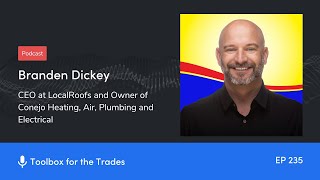
Brandon Dicke started in the trades at 12 and built Conejo Home Services into a $40M operation by bundling HVAC, plumbing, electrical, and restoration under one brand. He runs a separate roofing roll-up called Local Roofs and credits ServiceTitan software and strict SOPs for scaling across a 30-mile radius.
Questions this video answers
Around 12–13 years old.
About 19–20 years old (two years after high school).
About 15–16 years ago (took over appliance/HVAC business).
Budgeted $40 million top-line within a 30-mile radius.
Four acquisitions (part of the roofing roll-up).
Hello, contractors, and welcome to Toolbox for the Trades. My name is Jackie Aubel and today I'm talking with Brandon Dicke. He is the CEO at Conejo Home Services and the CEO at Local Roofs. We talk about a bunch of stuff involving entrepreneurship, involving roofing, involving adding different verticals. I know you guys are going to love this conversation as much as I did, so let's dive right in. Brandon Dickey, you are the CEO at Local Roofs and the owner of Canejo Heating, Air Plumbing and Electrical. Today you and I are going to be talking about how two business models with two distinct logos make one big community impact. Welcome to the Toolbox for the Trades podcast.
Thank you, Jackie. Thank you for hosting me. I look forward to this and I will give you all the information I can give you.
I'm so excited and thank you for coming in person. I loved being able to do these in person interviews whenever we can. So let's get right into it. Brandon, how did you get into the trades?
How did I get into the trade? So at a very young age, my father owned an appliance business and I kind of inherited getting into the trade. So I like mechanical stuff, I like building things. And that's kind of how I got involved in the actual trades themselves. As I got older and more mature and realized school wasn't going to be the venture I was going to take, here I am now, I'm now running multiple verticals. Two different organizations, two very similar, but very different. That's kind of how I got started with it.
You are not alone in being one of the many entrepreneurs I've had on the show who are like, yes, school just wasn't for me. It wasn't really what I was passionate about doing. And you got into the trades really early. You started when you were 12 years old, am I right?
12 years old. That is accurate. 12, 13. Somewhere around there, from what I can remember. And it was at a very young age. You know, some people have the flashlight stories, some people have, you know, watching over their father. You know, my, my thing was I would have to clean my father's work trucks on the weekends. He was not very clean. He was, you know, running his business out of his garage. And he would make me literally carry his tool bag. I was a little guy dragging his tool bag. His tool bag literally had, you know, half of it had trash in it. And I'd have to dig through the tool bag and pass them the tools. And that's where I got the proper, you know, this is a Phillips. This is A flat blade. This is a wrench. This is a service ratchet. It all started right there, working side by side with my father.
Got it. And you worked through that all throughout high school, right?
I did seventh grade is when I really knew school was not the direction or the path I wanted to take, which. That was about the age where I said 12, 13. 12, 13, where I said, you know what, I want to have some sort of career. Whether it's. I didn't know what it was going to be, but again, I wanted to do something mechanical. I liked cars, I liked motorcycles, I liked motors. I tried, you know, working at the grocery store. I tried working at your local cvs and it was quite boring. I wanted to be in a work truck. I liked to meet different people out in the outside space. And I'm an outdoor guy, so I kind of followed my father's footsteps and at a very young age, said school wasn't for me. And from seventh grade all the way through high school, that's what I did. Wow.
And you stayed with your dad's business up until you were about, like, 18, 19, and then you went off on your own and you started your own restoration business. Can you tell us a bit about that?
Yeah, I sure can. So what I did was all the way through high school, we'd get out, get out of school. Everyone would go hang out, everyone would go eat pizza, and I'd go, I'm going to work. I'd go meet my father on the job sites. He would be doing whatever it was he was doing. And when I would go and actually, you know, work these jobs, I said, you know, this is. This is fantastic. I got to get and do my own thing. Because right out of high school, two years out of high school, I started a restoration company, Kanejo Restoration. And I did water, water damage and mitigation. And I got into this business and met my wife right alongside me at that time, and we started this. This business. And my father watched me kind of move away from the family business, and I started really focusing on the restoration side. And he's like, wait a second. You were my retirement plan. Where are you going? So we renegotiated. I ended up two years into the restoration, two and a half years. I ended up selling the restoration business. I built a really nice, healthy business with my wife. My father ended up retiring and we struck a deal that worked for both sides. I love my father. He's still very much involved in part of my life today. And we got into. I took over the appliance heating, air conditioning. And I immediately. We dissected it in the appliance side, Went over to one of my uncles who was in the family business as well, who worked for my father. And I didn't really find the desire to work for appliances, because they're kind of throwaway components.
Yeah.
And it wasn't a good vertical that I saw had a lot of expansion to it. So I got into the heating and the air conditioning, did that for 10 years. And then I started adding the other verticals. I started adding the plumbing, the router. I started adding electrical. I did insulation. We're now doing generators. And I just kind of added more and more verticals.
Okay, so Conejo Valley Appliance, which was the business your father originally started, is now Conejo in general. And it's a umbrella term that kind of. Well, it's not an umbrella term, but it has all these different verticals underneath it.
Yes. Kaneo. Kaneo Home Service.
Kineo Home Service.
And that's. It's a mechanical trade business. Correct.
So you started Conejo Restoration when you were 19, 20 years old. I was not starting a business when I was 19 and 20 years old. And you built it pretty successfully. How did you and your wife manage to do that at a pretty young age? Like, where were you getting your education? Were you learning through trial and error? Like, how did you do it?
So I've always been an instinctual type guy. So if something feels right, I would. I would do it. Which actually has created a nice spot for me, being an entrepreneur, because I think fast. Not only do I think fast, I act fast. I pivot fast. So when I got into the restoration space, I dove on in. I went and bought a trailer. I bought all the equipment. I made relationships. I got in an airplane and went and looked at a couple spots, and I said, I like this space. When I got into this, I just. I dove in. I wasn't measuring anything. It was all off instinct. It was all off of feel. It felt right. And it ended up working. It ended up working out for the better. I mean, it really brought me to the next level and the next start of my career. I became a general contractor. I was doing kitchen remodels. I was doing bathroom remodels. So it made me better in the productive side of the business, in production. So I really got a lay of the land on how construction works outside of appliances, heating and air. And it made me inside of a home. It really be. It became something to where I no longer had tunnel vision. In one entity. And that's where I kind of started expanding to the other verticals, because I saw a lot more per household.
Sure.
And that was important to me because I did not like to drive far. I always had a rule. Like, when I left my house, I wanted to work in my own backyard and to do that. When I got into the restoration, I didn't realize how much work can be done and captured in one home Based upon a relationship and trust. Those two values, you're really able to absorb that home. And they don't go back to the market. They call you. So anything that I can lay out in a vertical, they're calling myself, they're calling my team. And that's kind of how I started with all the different verticals.
That's so interesting. Also makes sense why you didn't like school. If you like to act fast, pivot fast, and do anything fast, because school is genuinely anything but for the most part, at least, the standardized.
Too much thinking.
Yeah, too much thinking, not enough doing. I wonder if, like, all those years shadowing your dad and working in your dad's business gave you kind of this, like, seventh sense for business. Do you think that was the case?
Yeah, definitely. It was. It was part of it. You know, my. It's funny, my mom still today, she goes, I don't know where you came from.
Right.
That's wild. She goes, you know, your dad was a hard worker, you're a hard worker. But not only are you a hard worker, you think so outside. It's funny because, you know, I'll be in an airplane, and I'm in this airplane, and I'll look down, and I look at all the homes, I look at all the opportunity that we're flying over.
Interesting.
Yeah. So I. The way my brain is wired, I'm constantly thinking about opportunity. At what expense? Efficiency. And I did that instinctually for majority of my career up until recently.
Again, started at 12.
Yeah.
Started at 12.
Yeah.
I want to go into the way that you added all these different verticals to Conejo. How did you identify? Well, you kind of broke it down already. Getting into the restoration business, getting into the construction side of things, you were able to see how many opportunities were in one home. And if you could service all the different ways one home would need to be serviced, you wouldn't have to travel a really long distance to continue to get new customers and to expand. So what would a successful vertical integration look like for you as you were growing, Kanejo? How would you track it to make sure that, hey, this is going well. Or was there ever a time where you would do an integration and be like, ooh, this is not what I want it to do. Back. Back out. Back out.
Actually, I did have one of those.
Oh, you did?
Tell me about it. I had one of those. It was windows.
Oh, interesting.
All right.
So I got into the windows side of the business, and businesses are split out. You know, you have your needs and your wants, and in heating and air conditioning, it's definitely a need at certain times of the year.
Sure. Yeah.
You have peak seasons for air conditioning. You have peak seasons for heating. Plumbing is 365. Plumbing is a need, 365 days. Electrical is a need, 365 days. I realized, oh, I want to do windows. Well, windows isn't really a need. It's a. I want new windows, or a new window would look good on the outside of my house. I started really dissecting what it was that I was in in my business. I was mixing needs and wants with.
The windows and needs and wants from the consumer side of things.
From the consumer side of things. So I got into this side of the business, windows, for an entire year. I didn't like it. I don't like the feel of it. I didn't like how it rolled out into my mechanical service business. Installing windows would be more of a vertical end. Siding, stucco windows, roofs, that'd be more on the outside. So I got out of that side of the business. Now, when it comes to inside of the home, how do I find the verticals that I feel work best for my business? I always. This is actually a funny story. Like, every time somebody opens up under their sink, their cabinet, you've got something called a garbage disposal. That is an impression to my business. How do you brand that garbage disposal? So every time somebody opens that cabinet, how do you get them to think of the company that services their home? So I go through a home and I brand it like billboards. Whether it's a garbage disposal, whether it's a water heater, whether it's an air conditioner, whether it's an electric panel, whether it's a gas, whether it's a heater, whatever it is, it's all about, how many times can somebody walk to their home and they see our colors, our mascot, and our brand. And so when I do verticals, like, you can't brand the shower. That's a hard one to do, because showers are beautiful. You can't brand a countertop. They're beautiful. You can't. You can't do that. They're not going to accept that. So that is one of the ways that I have grown. My internal business is figuring out where I could essentially mark the different territories in which I service. You know, you could do it with pool equipment, you can do it with certain things. And that's kind of where I've gone and what I have done in regards to, really, driveway value, I call it. How much can I get? How much value can I get per driveway, per home? And I put all these things together rather than, you know, you have two ways to grow. Either you grow geographically, you got to expand your territory, or you got to expand what you do inside the home. And those are really the two ways. And back when I was talking, when I leave my house, I want to drive 15 minutes, I want to drive 20 minutes. I want a team to drive 15, 20 minutes. So here I have all this top line revenue, which then the efficiencies of that top line revenue then falls to the bottom based upon not having to drive across town, not having to put satellites everywhere. That's kind of. That's kind of what I've done.
That's really impressive. And I love the way that you're thinking about how to maximize the opportunity within the homes that you already serve, making sure to put that branding on the equipment where it's not going to be an eyesore for the homeowner, but whenever they walk past it or interact with it in some way, they're going to reminded of Kanejo Home services.
And it drives marketing down. I mean, the marketing cost itself just. It drives down. And you got to pick something. Like, for me, you got to pick something fun, something exciting, a mascot. You know, you want to pick something that is rude and crude. So every time that consumer sees it, they. They're like, I don't want to look at that. Because then they call you back and you know, hey, can you please remove your stickers? Which there's a whole nother gameplay for that too. But I wanted this bunny, and that was my mascot for Kanejo. Because kaneo means rabbit in Spanish. Correct. So I went this cute little rabbit. And the consumers asked for more stickers because the kids want stickers. You know, I've got stuffed animals. The kids want stuffed animals. It's hilarious. You know, we'll go into a home and a competitor will be there to give a bid. And the kids playing with our mascot and they're like, oh, man, we came up against Kanejo again, like, this is not to our advantage.
And it's gauge the rabbit.
Right, Gauge the rabbit.
All right.
Gauge the rabbit.
But also, what's, I think, so clever about that is that when that homeowner, if that homeowner chooses to sell their house and new owners come in, and now there's something wrong with either of that equipment now. Oh, we can just call these people. They clearly installed the equipment prior to this.
Interior billboards. Yeah, yeah, it's interior billboards. And there's really not an accurate way of tracking them. You could do the codes on them. You can do different numbers on them. Ultimately, it's top of the mind awareness. Putting that into the consumer's brain day in and day out. And again, the more impressions, you know, it's how do you take a home service company? And you almost act and integrate like a trash company where they come to the front of the home on a weekly basis and then you go, okay, well, how can I get in front of the home on a daily basis? People are opening their sink on the daily. People are driving their cars into their garage on the daily. And water heaters live in garages.
Yeah.
So you put things where people are walking by putting their trash cans on the side yard. What lives on side yards? Air conditioners, electric panels, gas meters, generators. And as long as you brand that with something that is attractive to the consumer, you can't beat it.
Yeah, I think that's fantastic. Well, I would love it if you're open to sharing this. Where is Conejo now that you've taken. So you took over from your father. How many years ago was it?
15, 16 years.
15, 16 years. And it was appliance and H vac. You sold off the appliance to your uncle, kept H Vac, added all these other verticals. Where are you guys now? Is there a revenue number you'd like to share?
So when I took over the business, my father was doing like $1.2 million a year. We are this year budgeted $40 million. Top line in a 30 mile radius.
Yes.
Okay. That's the key component because there's a lot of companies to go get $40 million. They're, they're coast to coast. They're. They're traveling. They've got satellites, which. Yes, that's another model, and that's another way of doing it. And I have another business which we will talk about later on that does the other model side of it. Yeah, so I really get to see this thing overlaid on both sides, which is fun. But yeah, I mean, that's. That's where we're at, that's what we're doing. There's other fun things that I'm going to be coming up with here in the next year or so. We're going to add some more verticals onto Kanejo which are going to be really exciting coming down the pipeline. And it's going to be things that really nobody has done yet or nobody has seen in our. In the heating, air conditioning, plumbing and electrical. You know, everybody's doing heating, air, plumbing and electrical. That's kind of a condensed vertical where everybody. It lives under the same roof. I'm going to add another couple things that it won't be windows, but I'm going to add a couple things that are really going to work to the other trades, such as the plumbing side and the H Vac side and the electrical side. It's going to bring everything together and that. That should be really, really fun.
That sounds exciting. I'm looking forward to hearing that update. I like that little teaser you threw in there. So you already mentioned it. So, Kanejo Standard. This is the kind of story I've covered on Toolbox for the trades before family business, second generation comes in, you grow it extra astronomically. You also do a fantastic job. Very well done, by the way. 40 million in a three. 30 mile radius.
30 mile radius.
Impressive.
Yep.
You have Local Roofs. Right. And you are the CEO of that company, which is a completely different business model as you alluded to. Can you tell me the origin story of Local Roofs?
Yeah. So to back up one sec. So Kineo, I own the business 100. Okay. That's. Yeah, that's. That is a cash flow business. Today. I got into Local Roofs with a partner. His name is Robin Richards. He was the one who. He was mp3 dot com. He digitalized music.
Right.
And I met him at my country club. My. My country club that I am apart and live in. And we became great friends. And he's succeeded in all aspects of his life, from the health side to tech side to the pharmaceutical side. He's played in all the different verticals and he's not played in home services. So we were golfing and he goes, I want to do one more deal and I would love to do it with a young entrepreneur like yourself. Pick a trade. I said, okay, pick a trade. And he says, I want nothing to do with Conejo. Leave caneo. That is your family business. That is what you're doing. He says, let's go do another vertical and I'll teach you how to build value and how to, you know, how to arbitrage, you know, now he's starting to use words that, truthfully, I'm like, what does that mean?
Sure, yeah.
And I learned quite fast.
Yeah.
EBITDA is like, ebit what?
Yeah.
What does that mean?
Right?
So we are. We're golfing, we're going through. I said, let's do roofing. I had a dear friend who owned a very successful roofing business who wanted to move out of state. This all went down on a Friday. My partner discussing that he wanted to get into the trades. I went to dinner with my wife, my friend and his wife on Saturday. I ended up buying his business the following Tuesday.
Wow.
Yeah. I ended up buying his business the following Tuesday. And I went to my partner today, Robin Richards. I said, all right, I got us a roofing business. He goes, what? He goes, you move fast.
They're like, yeah.
I go, that's one of my skill sets. I don't wait around. He goes, all right, well, now that you already bought it, I got to do all of my studies and analytics and see what the market is. I'm going to be of a. I'm going to, you know, Morgan Stanley. And he did his. His. His side. That's what he does. He's a serial entrepreneur, and that's what he does. And so here we have this roofing business. We did all sort of. We. We set up the structure, we got it all done. I said, okay, well, how. Where does the money come from? And I'll never forget that. She smiles at me. He says, he says, you know, you don't have to worry about the money side. That's where I worry about. So we raised millions of dollars, private money. So it's more of a private equity play. We're not private equity today, but it's private equity guys. They're private money. And we got into the roll up, the roofing roll up. I have. I've done four acquisitions, so I got to learn that game. Orange County, Louisiana. County, Ventura County. We just opened up our new location in San Francisco, Pleasanton. And now we're doing financial engineering, arbitraging, the industry of roofing. What's interesting about roofing, why I chose roofing, is it reminds me of the H Vac space in the 90s.
Really.
When I first got involved with my father in the 90s, it's unprofessionalized. There's no mission statements, there's no core values, and there's really no rules. Yeah, right. So I was like, oh, this is. This Is a space to where I've already now played in a professionalized industry. This space is an infant. Heating, air conditioning, plumbing. You know, it's a teenager. There's some big, huge private equity companies rolling these things up. But I said, this roofing space, wow. We could do big things and we can get in front in line.
Yeah.
So that's how I got into the roofing space. So now I'm doing roofing roll ups and I'm running them side by side. Very. Like I said, same cultures, very, very different financials.
Right.
You know, some people say profit, profit, profit. Some people say top line, top line. Revenue, revenue, revenue. And I always tell people, you need a dollar to make it. All that old saying, you need money to make money.
Yeah.
Right.
So my kaneo business is a cash flow business. And that's given my great quality of life to my family. This business is a game of just building top line, building top, top, top, top, top. Creating efficiencies, creating all the SOPs, all the process implementation, putting the technology behind it. That costs a lot of money.
Yeah, right.
You, I don't want to say you burn money, but you burn money to race that fast. If you went up a hill with the water jug, half of your water is coming out of the jug. When you run up a hill that fast. And a cash flow business, you walk up the hill.
Exactly.
You retain all the water in the bucket.
That's what I was saying. It sounds like with local roofs, you were able to leverage the experience that Robin Richards has to create that money to raise it so quickly. So this way you could move really fast and act fast, which is what you do.
And I don't care. You know, Robin Richards to me is legendary. I will tell you this gentleman, like, I don't care how great you are, when you move that fast, there's no secret sauce. There is spillage.
Yeah.
And you got to maintain culture. You got to maintain what your. Your product. You got to maintain everything that you're making. And you, you're gonna have some spillover on the finance side. And once you get it to a point to where it's leveled out, you then and you come back and you refine it.
Yeah.
And that's where the profit starts to fall below the line. That's when you really start actually having a very healthy business. Because you went so fast building your business, then you refine and you go through all your sop. You essentially redo everything and you take it. I move fast, but you take it down a notch and you have. If you can't take it down a notch, you have those around you, those executives around you who take it down a notch and make sure that you dial in to bring profit to the business.
Got it. And I. One thing I want to say about roofing as well, because you're not the first person who's come on this podcast recently to talk about the opportunity in roofing. I sounds like the way the industry is right now. You said it's like H Vac in the 90s. Consumers are probably just, like, chomping at the bit for some level of professionalism from roofing contractors.
They are. It's crazy. You bring porta Potties in front of people's homes for the workers to actually use.
Yeah.
All these years, they're using their planter beds, and you're like, what that is. That is where the industry is still today.
That's wild.
So it's got so much potential and so much ability. You know, uniforms.
Yeah.
Roofing doesn't know what uniforms is. You're lucky to get them all wearing the same color shirt.
Right.
Having the same hats on top of the roofs.
Yeah.
Getting guys not to sleep on roofs. I mean, this is where the industry was. And sleep on an angle.
Right.
Sleep. That's where the industry was professionalizing it and getting the consumer to understand that. Listen, we're working stories in the air. Like, you want to make sure you're. You're insured, you're licensed, you're pulling permits. You want to make sure all these necessary things are being done, because God forbid something happens, you want to make sure that you've protected your investment as we're protecting your investment. Because a roof is a very important asset to a home. It is the protection of typically, an average consumer's number one investment.
Yeah.
Right.
So that is a very special asset protection on all sides. We fly drones above homes. We don't walk on roofs. If we. We have rules in our sales process, we don't walk on a roof until that roof belongs to us, until we're. We are rewarded that job. We don't walk on people's roofs because what we find in the industry, it looks like people walk up there with cement in their boots and they're giving bids. Well, they're stompling over the roof, giving bids. And what are they doing? They're walking on it like they don't own it.
Yeah.
And they're cracking tiles. They're breaking stuff. And that's not our model. Our model is, let us put technology above Your home, analyze your home, give you a really nice, sophisticated bid. Because with today's technology, I mean, the drone footage is better than the eyeball footage.
Yeah.
We bring that down to the consumer, to the dining room table. Roofers don't like going inside homes. They don't wear shoe booties. They've got tar, they're in tank tops. We're now bringing the roofing industry into homes to educate the consumers how important their roof is in protecting their number one asset.
Yeah.
And that's a big. That goes a long, long way.
I'm. I'm sure it does. So local roofs, you have several locations. Are they all under the Local Roofs brand?
They are.
Okay, but they were originally other roofing companies that you purchased and then rebranded.
Correct. And then up north, we're doing Greenfield, so we just went in there with Local roofs and just pounded on the market. We really just pounded, pounded, pounded, pounded the doors, got into a lot of community things in which we do such a great job at. Got into the baseball fields, the soccer fields, got into a lot of the mixers, the chambers of commerce. And it's been very successful up north for us there.
Yeah. And you have a, you have a.
You have a cute logo there as well. Rufus the Bulldog.
We got Rufus the Bulldog. We got Gage the rabbit over at Kaneo, and we got more of the masculine ruf the bulldog roofer. That's why we chose the bulldog. Because as masculine as the bulldog looks, it's still a cute bulldog.
Yeah, of course.
Yep.
Yeah, it's Rufus. R O O F U S. Of course.
Rufus. Yeah.
Because you can't, you can't not take that opportunity if it's right there for you.
It was right there for us.
I'm curious. So you now you have these two different businesses that you're heavily, heavily involved in. CEO in one full owner operator, and the other. What are you learning from the Local roofs model that you're taking over to the Conejo model and vice versa, if that's applicable.
Efficiency.
Say more.
So the number one thing that I've learned, like I said in the beginning of this, is I've moved fast. I never used to measure. And there's two things in my life which will kind of go into the other one that have created the measurability of my business. And one of them is watching sophisticated guys out of New York, out of Chicago, these big time entrepreneur investors, they measure everything. And I'm like, oh, my gosh, you guys measure everything. So they have board meetings, you have weekly Meetings, you have budgets and. And they hold you to it. And you have to have a great explanation of why something's not going the way you projected it. If it's not going right, you have to have an explanation of why are you so over budget? Did you underdo your budget? Like, they look at the. The wins and the losses, and they'll question both. So the efficiency that I take, I own 100 of Kanejo, so I now get to measure myself as an investor at Kanejo. So I'm now looking through the lens on the investment side of Kanejo and on the production side and actually working within Kaneo. I never. I never did that. I never looked at it like that. I always looked at. I'm a, by trade, a production guy. I was born a service tech, an installer. I've always been really good at efficiencies in production, on how to put a system in, how to run ductwork, how to fix something.
Sure.
And when I got into this and I started learning, oh, wow, The. The entrepreneurial, the finance side of it, whoa, there's a lot to learn. So what I'm doing, if there was a slow part of my life, I'm cropping certain sections of what I've done at Local Roofs, and I'm creating cross implementation over at Kanejo. And now all of the sudden, Kaneo is turning into its own little entity of perfect. Like, whoa. Like, does private equity own your business? People walk into my facility and they're like, there's no way you're 100% owner of this business. And I am, but I'm just. I'm taking the certain things that I've learned from these. These investors because I've never seen it through their lens. And these guys are smart. Harvard, Yale. I mean, they're smart. They're smart guys. They know how to financially engineer stuff. They know how to arbitrage industries. Doesn't matter what industry, what trade, what, what space they're in, they know what they're doing.
Define arbitrage for us, for anyone here in this room who might not know.
What it is taking over, just mass. They. They come in and just. They.
They.
These guys come in. You know the old saying, New York wolves, Like, the arbitrage, they just. They. They come in and they just. They come into the industry and they just buy, buy, buy. They eat the cookie monster, I call it. And when they come in and they take over industries and they bring capital and they financially engineer, and they reposition your cash flow, and they reposition the way You've done stuff. You bring CFOs and you get away from your bookkeeper. Unfortunately, you got to get rid of grandma who ran your books or mom who ran your book.
Yeah.
And you start professionalizing, all of a sudden, your cash position changes, your financials change, change. And here you are paying an elite executive, a cfo, more money, which most people don't want to do because they want to materialize that into their pocket in a cash flow business. But when you add these types of elements into a business, it repositions the business. And all of a sudden you're like, wow, what?
Yeah.
All these contractors, you know, they make a dollar, they figure out how to keep 50 cents of the dollar. The capital world, they take a dollar and say, how can I make 10? So the contractors aren't thinking like that. There are some now, your bigger contractors today who've been swallowed up by private equity. They've learned just as well as I'm learning, but majority of this industry is still making a dollar figuring out how to keep 50 cents on the dollar. As the other side of the industry, who's they're outpacing, they're out running everybody.
Right.
They're making 10, 12, $15 on their $1.
Yeah.
That's what capital does.
You know, it's so interesting, as you're talking, I was thinking about how early on in this podcast we would talk a lot about owner operator technicians turned owner operators, and they had to learn how to get out of the truck to work on. You stop working in the truck so you can work on your business kind of thing. It's like leveling up. And it sounds like you've gone a level higher than that because of the experience you're having with local roofs. You're basically. You went from technician to business owner and now to financial engineer, essentially.
Correct. And, you know, there's things on myself outside of home services is I've got a real estate portfolio that I've that. No, I need to sleep more.
He's got four kids, by the way.
I know. I now got into exercising finally. And now I need to. Yeah, I know. I now need to figure out the sleep part of my life.
Sure.
But yeah, you know, the real estate thing I got into and I have, you know, property managed and done all that fun stuff. I mean, you take all these elements that I'm learning and I run it across my entire portfolio of my life. Sorry. To my wife that I'm going to say is even my family.
Sure.
Yeah.
And everything. I don't want. It's rude to say everything's run like a business, but it's really understanding what makes everybody happy in any organization, whether it's your family or business, and how to prioritize stuff, how to budget stuff. And as soon as you figure that out, it changes your whole dynamic of the way you look through the lens of the life that you're living. And it's really helped us, I mean, not to talk long on this, but one of the things that really helped me start measuring is I have three type one diabetic children.
Okay.
I stopped working for four years when this happened. And I went to the why me? For a hot second, which is very unlike me. And I immediately said, all right, we gotta deal with this. Yeah, how do we be better? How do we measure? So I started measuring their blood sugar, right? And if you don't measure their intake, that affects their blood sugar. People who are into weightlifting, they put these little monitors on their arms and they constantly, your blood sugar is an important part of your body. So when I started realizing what measuring does to the human element, the children in which are my children, who I loved, who are my everything, I said, why don't I measure my business? And that was an alarm clock to me. Like, I was like, I'm guilty. I'm the problem. My people aren't the problem. I'm one of the biggest problems in my organization because I'm not looking at this properly. And it took an unfortunate event for me to realize and understand that hurdle of, like, I can do better not only for my family, but for my business. I went on and hired a chef, full time chef, because not because I'm trying to show off, because the food intake for my children is so important that they're getting the right food, I went and hired the right people. And now I'm starting to hire the people that I need. If I need to go drive across la, I'm hiring the driver so I can get my work done, so I could sit down and actually, you know, get my work done. I don't need to be driving, being distracted with the traffic, people are upset. And I'm really figuring out how to get my time back. Buying back your time and really implementing that move forward. And once I figured that out in life, it really, really helped not only my business, my life, my everything grow into a positive manner. So taking a negative to a positive, you know, you tell people three type one diabetics, if you don't know anything about diabetes and you, you then figure it out. You go, oh, my gosh. How do you do it? We're the lion. We're at the top of the sphere. I have no choice. I have to figure it out. It's just. It's a card. We got dealt with and got to figure it out.
Yeah.
I mean, how you do one thing is how you do everything right.
Exactly.
Yep.
Yeah.
You're probably loving the exercise component now because there's so many things you can measure in that realm. Oh, my goodness.
I put the pods on my arms now that my kids have.
Yeah. Yeah.
And I measure my. My body, I measure. I measure my sleep. I measure. My body, I measure. You know, I take time now for myself to Zen out, because I'm running hot 18 hours a day. I'm on turbocharged 18 hours a day, running around. What can I do over here? What can I do over here? Stirring stuff up, getting my executives around me. Let's go. Let's go. You know, I'm very, very much animated. I've got a lot of energy. I go up and down the hallways. I don't like living in an office. I'm in everybody's office. I'm probably one of the first CEOs that doesn't have a computer on his desk. When you have elite people around you, it's a very unique thing.
Linda, your head of marketing, who was so great in setting this up, I thought that was interesting. She was, it's going to be my computer. And I was like, oh, okay.
Yeah. It's one of my things. You know, I. Again, I got out of high school. I didn't go to college. I'm what you call street smart.
Sure.
I take what I owe my synergies and energies of what I'm good at in my industry and where I fault and what I'm not good at. I hire the elite. I hire the A plus players of that particular thing that I need, whatever that thing may be.
Yeah.
Whether it's money, whether it's marketing, I'm great at brand. I'm not the smartest at marketing. I hire the professionals. I weigh in. I'm not a dummy at any means, but I'll weigh in. I give suggestions. And a lot of times I say, great idea, let's do it. Business development, that's where I. That's where I can shine, where I'm knock it out. I hire in, and I only hire. Like I said, I want A plus players because I need to have an elite team around me for me to succeed now and tomorrow.
I want to ask you one question kind of backpedaling a bit that I think is really important. If you didn't have the experience at local roof. So say Robin Richards never came to you and never said, hey, I want to start a business. Right. Where do you think Conejo would be now? You said you're 40 million right now. Where do you think you would be if that never. If local roofs never happened?
If I didn't get that education today, I'd probably be at 25, 25 million. 26 million.
Still. Very impressive still.
Yeah, but it's that extra. It's, you know, like I tell people, it's that nitrous on the motor, it's that extra umph that. That powers you through. It said it's the measuring. It's amazing. You know, when you measure stuff, whether you're cooking, whether anything in life, it's going to taste better, it's going to feel better, it's going to be better. I gave a lot of pushback and then I'm like, what am I pushing back for? I'm pushing back on myself. Why? What is this for? You had to have to be absolutely silly to say measuring's bad or measuring is going to do me worse. Yeah. There's contractors out there trying to cheat their taxes and grab cash and grab that. Really, all you're doing is cheating yourself because like I said, it's back to that game. Dollar, you know, saving 50 cents for the dollar or arbitrage, you know, getting that $10.
Sure.
Yeah.
And you got to put it all into the. You got to put it all into the jar, you got to measure it all and you got to have the best systems in place and you're going to develop the best. The best profit margin.
Yeah.
I want to get a little bit more into your thoughts as an entrepreneur, because I do think you are a fascinating entrepreneur, but you are mentioning efficiencies and you want to have the best turbocharging your business. You're using Service Titan right now to run both Kanejo and Local roofs.
I am.
Talk to me a little bit about how the software is helping you in both of those businesses.
So service titans, the CRM for us has been fantastic.
Right.
It's been home base the best way I could. You know, it. It puts rules. It puts rules in place and it's constantly improving. I mean, we're constantly getting in with Service Titan and we're constantly seeing what we can do, giving suggestions, and then they get. They come back, they come to our place and we're Constantly giving back and forth information. If you don't have something. Which we chose Service titan and most of the home service space is choosing service titan for a particular reason. Because of how it can scale and what you can do with it. You're really become lost. It becomes a blender and we're not looking for that blender. The efficiencies it gives you, it gives you very direct, you know, from your, from your call center to your finance, all the interface. It does a phenomenal job in the organization of keeping it organized and putting people in there in their swim lanes to be successful and efficient. And it all talks to one another. There's no way we could do what we are doing without service time. It would be. It would be impossible.
Thanks for saying that. Well.
And it's not. I'm not saying that because I'm not saying that to be. It would be impossible.
Yeah. Yeah.
No.
How do you do it?
Genuinely, I don't know. How are you finding it with the roofing side?
Yeah. You touch it.
Yeah.
Roofing.
Right.
Frustrating.
Yeah.
Service dying. Roofing like. Oh man.
Right.
I had a decision as a CEO. All right. Either do another CRM for roofing or I battle through this. I know it's going to be heavy lifting. And we work hand in hand with service time. Service time came into my organization an army of people. Multiple times.
Yeah.
Extracted all of our information. Use us as beta test and constantly try to improve what they're doing. We hung in there. We hung in there. We hung in there because it was important for me in all of the verticals that I have to keep the same home based CRM.
Yeah.
And if I would have given up the few times I was thinking about giving up, I would be. In a way I would be in a miserable spot right now. I. It would have cost me a lot more money and it just would not have been an option for me. So struggles in the beginning. It's getting better. Far from perfect. We're seeing improvement. We're not seeing back. We're seeing forward.
Oh, I'm really glad to hear that. Yeah. We recently opened to the roofing industry a couple years ago and it's so important for us to have customers like you that are willing to stick it out with us while we're figuring out what the solution is going to look like. So thank you for doing that. I'm really happy to hear that it is improving in that way and hopefully it'll get. Continue to skip. I'm pretty sure it will get better.
It's 100% going to.
I mean, I work at Silver Stein for eight years and pretty impressive.
We started two years. We started two and a half years ago when we came to you, you guys roofing.
Right.
And it took time and it was. It was good. And I'm hiring some outside resource that helps interact with service titan. I've got a lot of consultants that we've hired in as well to try to get this thing back to being.
Able to measure things and being able to see how things are speaking to one another. Just being on different softwares or having like data that might be slightly different from one system to another. I can imagine that's really. It would be really difficult for you to and to make decisions.
Yeah, I want to. I want to have all my options right. Right now I'm running two separate organizations. I have not decided the future of, you know, how these things could come together if they ever did. I like having options out there. And what's important for me, and I explained it, is dividing businesses from the needs and wants. Again, roofing is not a business that I would integrate. You know, I would never say conejo. Heating, air, plumbing, electrical, roofing. Yeah, I would not do that personally. Doesn't mean I'm right or wrong. Doesn't mean the other individual who's doing it's right or wrong. For me, it would be very similar to the same mistake I did when I did windows. I like having that separate entity and you know, roofing, tree trimming, that's more of the outside exterior. Exterior. That's kind of why we did what we did.
Yeah. Do you think you're going to do windows for within local roofs one day or do you think you've been sullied on windows? Don't ever show me a window again.
No, I think windows are really important because it makes your home a home and not a prison.
Right.
So I think they're important. But are they important enough for me to get back into that? I don't ever want to, you know, say, no, I'm never getting into windows again. Because that'd be silly. But it's. I don't foresee that happening. Could it happen? Yes, but I don't foresee that happening.
I want to circle. We've been talking and this has been a great conversation, but I still want to pick your brain just a little bit. You mentioned these elites, people that you are hiring to make up for your strengths and your weaknesses or to support your strengths to make up for where you're not as strong.
No. You can say weakness. Listen, every, every superhero has a weakness. Not everyone could fly like Superman.
Yeah, you're kryptonite. How do you go about hiring and finding those people that are going to fit nicely into the puzzle? How do you find those elite leaders?
So I go in very open minded on this one. Again, the trades typically aren't as professionalized as the tech industry or the pharmaceutical industry. Say what we want to say about it, but that's the truth. So typically we got to go outside of the home service space because whether a CFO is accounting, you know, is, is creating their financials for home service or the medical or retail, you could bring a really good. So I go for just somebody who is, who's been vetted, who's been around, who's seen downturns, who've seen ups. That's another thing that people don't ever look at. You know, everyone always talks about everything. So great. You go to all these podcasts, you listen to all these podcast with home services. It's nice talking about the, the, the, the highs of what businesses are doing. But I'm also one of those realistic guys where not all, you know, not all businesses are always on a high.
Yeah.
You know, it's a lifeline. You've got your lows, your highs. That's why they're judged in quarters and years. So when I go and I hire these individuals, I want to know how these people interact on a bad time.
Sure.
I want to know how did they pivot? Did they say, hey, the CFO or the CEO said this and we're jumping on and we're going to go and we're going to get to the other side. Or do they kind of like, do they meddle against the CEO? Because these are, you know, I want a team. When I say something, if I ask for your opinion, give it to me. But if I say this is where we're going, I want a team that's like, let's go get on the boat. We're making it to the other side. So that's really, really important for me when I hire these executives, I hire those types of executives outside of the home service space. So far I have not really gotten any home service executives because again, like I've said, culturally it's really important for me. Culture. I'm high energy.
Yeah.
It doesn't mean that I need another high energy individual, but I need somebody who could take up with you.
Yeah, I think that's great. And actually I've heard that a lot on this show before getting people from outside of the industry. Because then the benefit with that is too, you learn about different ways, different ways other industries handle certain situations. The way they do SOPs, the way they do workflows, all that kind of stuff. And that can actually be a real bonus.
Again, it professionalizes this space.
Yeah.
When you bring it from the outside in, and then you. You talk to a guy like myself who understands this space, and as long as we could communicate, the two of us, it's success because they're coming and they don't know our space, and I don't know their space. They have to trust what I'm saying, and I have to trust what they're saying. And there has to be those models and those discussions as you're creating whatever it is that you're creating. And I've been very successful with that. I mean, I've been very, very, very, very successful with finding those executives who come in. They understand exactly the drum that we're beating on, what it is that we're trying to achieve. That's another thing. A lot of these organizations, people don't know the end game. It's all secret. So you have to, like, ask yourself, like, are you telling your team, like, what it is that where you. What are you trying to win? Where are you trying to go? You don't just get in a car and you're like, I'm gonna get in the car. And like, unless you're trying to put your kids to sleep and back in the day and just drive around town, you have to have a destination.
Yeah.
So your business has to have a destination. Doesn't mean it can't change, but doesn't.
Mean you can find another destination after you hit that destination. But you have to get everyone on board.
And that's at fault to a lot of CEOs and owners, because if you're not giving your team that destination of what you see through your vision of how you're getting there, it gets really hard to wake up. You got every. You know, I tell my team. It's one of the statements. I tell my team, what are you waking up for every day?
Yeah.
And it's a question I asked my team probably a year ago. And they just looked at. They're like, nobody's ever asked that.
Right.
Like, you have to ask yourself every day, what is it that I am waking up for? We're here very short period of time. What is it that you want to do in this short period of time? And you have to have something that is going to drive you to that.
Yeah.
So you have to have that something. So you drive to that something. And that's really how I've, I've gotten in a great, an absolute amazing executive team.
That's awesome. That's really great. I also want to talk about something we talked about when we first chatted, which is you shared a powerful message with me about failing nine times in a day for one victory and learning from these failures. I would love to hear more. You do expand a little bit more on that phrase and maybe share. And we already talked about Windows, but if you could share maybe another. An example of that.
Define failure.
Right?
Yeah.
There's big failures or small failures. You know, you know what's failure? You forgot to floss your teeth. Like, there's so many different things of what you did to fail that day. And what I, what I find in my day is, you know, I'm now creating journals, I create calendars. I never used to do any of this stuff. And I have like expectations of what it is that I need to accomplish in my day to get to where I need to get through that day. Because if I don't, I'll be working till 2 o' clock in the morning. I don't have the self discipline to just shut myself down. So with that, just like I would a budget, I have the CEO vision and I always stretch myself. I stretch myself in working out. I stretch myself in any activity I do. Hence I've had four knee surgeries. I stretch myself. So the more you stretch, the more failures you're going to come across. Because you know you're creating all these stretch goals to try to accomplish. I go through these failures on a daily basis. It's like the simple failures of like, I had somebody come into my organization. I didn't get the job. I failed and I didn't get the job. Well, okay, well, why don't you get the job? Okay, that was your first appointment.
All right?
You still have two more appointments today. If you don't do what they tell you in golf and forget the bad hole, I got news for you. You're gonna have another two more failures short shortly here and now. That's a catastrophic failure. So there's all these little things in which people call failures in an organization. From the call center, from scheduling, from dispatch to the banking, to all these different things. And if everybody dwelled on the failures, you would never get that one victory. And my victory every night is every day. My victory is when I walk into my home, I Just see my four beautiful children and my wife. So my one major victory of a day is being able to get to that point, get home before my kids are going to be home, get home. So I could go play basketball with my son outside or ride a bike before. Because my father was the opposite. Love him. He taught me, made me a man. But there's a lot of failures that happen. I might not get through my entire day and I failed my some of my day. But my most successful thing of the day is I got to come home to my family, I got to give them kisses, good night. I've got to do everything I got to do to be a father, because that is a really important thing for myself to be able to do to be successful the next day. So I run across and stumble these little small, you know, failures all day long to get to that one big successful thing at the end of the day.
Interesting. So even when you have. You move fast, you move fast away from failure as well.
Yeah, exactly. Like today, I failed. I didn't get my cup of coffee first thing in the morning. I failed myself. Today, my trainer, I woke up. I wake up every morning. 4:00 clock in the morning.
Right.
My trainer called and said, hey, I can't make it. So what did I do? I cut my, my workout in half. Now I feel guilty all day.
Yeah.
You know, but these are the things that I run across and these are, these are the things why I have, you know, these different coaches and these different executives and all these different things to hold me accountable, to keep me at my strongest. So when I get to that front stage and I'm able to do what I need to do, I perform at an elite level.
Yeah.
That is really, really important to myself and my family because they, they lean on me and they rely on me at the end of the day. Stops at me.
Yeah, there you go.
I meant to ask this also before. Is your wife still involved in the business in any way?
No, we have an agreement. She, you know, my wife, she does so much.
Yeah.
Four kids. That's a lot. Four kids under 13. 11 under.
Yeah.
Yep.
She takes care of the household. I have zero say of the household. She does whatever she's gonna do. She is the best mother, the best wife. She takes care of the entire. That personal side, my real estate, she takes care of everything. She is so organized. She has her process, she has her way, and she does the most fantastic job. And she allows me. Again, I'm saying it here on a podcast, if it wasn't for her I wouldn't have anything I have because I want to be able to devote and focus on the things that I'm doing today to get that generational wealth that well being everything that I'm trying to accomplish for my family.
Yeah, that's awesome.
Yeah.
Brandon, we've covered so many things today. I really enjoyed this conversation. Thank you so much for taking time out of your day to sit with me and to share your journey. I'm sure our listeners are going to absolutely love it and I can't wait to see where you guys are going to be in the next six months year. Really excited to follow your journey.
Thank you so much Jackie. I appreciate it. And if anybody ever needs to get a hold of me for any questions, feel free contact me directly on my cell which is 805-231-8831.
Wow. There you go.
Okay. Brandon, thank you so much.
Thank you so much. I appreciate you. Thank you again, Jackie.
More from Bill




Capturing the 80%: How SmartAC’s Gen-2 Targets Non-Membership Homeowners | Podcast Ep. 296

Build better customer data with every booking in ServiceTitan | TAD Tune-Up Series

The Biggest Change for Roofers Coming From Other Roofing Software to #ServiceTitan?

