The Growth-Ready Contractor’s Playbook: HR, Payroll, and Performance That Scale | Podcast Ep. 47
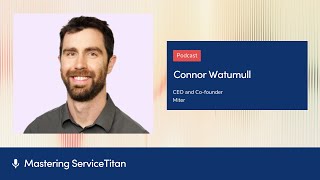
Podcast interview (Mastering ServiceTitan, Ep. 47) where host Josh Liu interviews Connor Wadamol, co-founder of Mitre. Covers Mitre’s contractor-focused workforce platform (HR, payroll, benefits, recruiting, onboarding, training, performance), target customers (growing and multi-entity contractors), pain of legacy/manual systems, ServiceTitan and accounting integrations, and product roadmap priorities (training/safety and performance management).
People are the most important part of your business. Who you hire, who you retain, how fast you can grow, how efficiently you operate. The cost of not having a really powerful workforce management system is your team is less talent dense than it should be.
Welcome to Mastering Service Titan, where you get expert advice from power users. Josh. I'm your host, Josh Liu, and today I'm joined by Connor Wadamol, and we are diving into Mitre's integration with ServiceTitan. Connor is one of the founders there and so very lucky to have you on the show. Thank you for being here.
Thanks for having me, Josh. It's great to be here.
Awesome. Let's dive right in. First question, can you share maybe what Mitre is and then how this came to be? Like, what were the pains and challenges you were seeing in the industry that led to Mitre?
Yeah, absolutely. So Mitre's a workforce management platform built for contractors. And we have two big goals when starting the company. Number one, help contractors build amazing teams. And then number two, help contractors simplify the back office. So we have a suite of HR payroll benefits tools available over mobile app, available on the browser, integrated with the rest of your platform. So if you're on QuickBooks, if you're on Service Titan, if you're on Sage, we integrate with all of those tools. So I have a technology background, but have always been close to and fascinated by the trades and was sort of seeing a lot of the changes going on on the payments landscape. And we got inspired by a new technology that allowed us to build a full service payroll platform at a fraction of the cost. We were very familiar with the challenges that contractors face when doing job costing, when hiring new people, when dealing with compliance requirements, depending on the kind of work you do. And we felt like we could build a new kind of platform catered to contractors that solved a lot of those problems.
And are there specific types of contractors who benefit the most from using mitre? Like a best fit for you guys?
Yeah. So we've been surprised. We thought early on we were going to be really a good fit for trade contractors with 50 to 100 employees doing heavily regulated work. But what we found over the last few years is that we're really a great fit for any sort of service or construction contractor with 15 to even 1,000, 2,000 employees. So we have a pretty general suite of HR, payroll and benefits tools that help all kinds of contractors build their team and eliminate manual back office work. Where we really shine, though, is a growing contractors. So if you're a contractor that is either growing fast today or plans to grow fast in the future. What that means is that A, you're going to be hiring ton of people. And hiring people comes with paperwork. You have to train and make sure those people are up to speed on your business and conserve your customers. It also means that your back office work is going to compound in complexity and we help solve a lot of those challenges. We're also a really good fit for multi entity contractors. So more and more folks in the home services and commercial services world are growing through acquisition. I know it's a topic that this audience is probably really familiar with. Just like if you're hiring lots more employees, if you are acquiring a lot of new businesses, the reporting requirements get more complex. Transferring employees between different entities gets more complex. Doing job costing or keeping track of your revenue and costs gets a lot more complex. And so we really specialize in multi entity contractors. The final segment where we do really well and where we feel like Mitre's an amazing fit is for contractors doing a mix of both residential work, but also commercial work or maybe some construction work. The moment you start doing commercial and construction work, you often run into very different requirements around reporting, around compliance, around the way that your business operates. And MITRE was really built with those situations and scenarios in mind.
For the contractors that work with you all, when they first start talking to you guys and they're interested in having Mitre, what is their current situation usually look like? Is it pen and paper and a mix of different tools or what's their, what's like the old way look like?
Yeah, the old way comes in a lot of different forms. And I'll, I'll talk about maybe three flavors of the old way. The number one and maybe the most common old way that we see is a contractor that is using HR, payroll benefits, timekeeping that wasn't designed for contractors. QuickBooks, ADP, paychecks, those are phenomenal platforms, but they were not built for the nuances of running a contracting business. They usually don't really integrate all that well with whether it's Service Titan or QuickBooks or the other tools you use, they don't integrate understand the nuances of job costing. They don't have all the reports you need. So very often we talk to contractors that are on one of those platforms that we'll call sort of generic or horizontal and they're frustrated it's creating manual work. They feel like those platforms don't understand their business. The second flavor of old way that we see is manual. Very few contractors are actually running payroll manually anymore. If you are filing your own taxes or not using direct deposit, definitely give us a call because we can help with that. However, there's lots of sort of processes around the employee experience that continue to be manual. A couple that we see really, really often is benefits. Any growing contractor knows that the benefit package that you offer your team is really important and attracting great talent, retaining great talent, rewarding great talent. And most contractors we talk to, their benefits programs are pretty manual. Maybe they have a broker that's helping them, maybe not. But we automate a lot of the benefits administration process. We automate things like recruiting and applicant tracking. We automate things like performance reviews and feedback cycles. Manual is sort of the second category. Third category is maybe you're running your employee experience and your payroll and your HR on a legacy on premise platform. This is most common among commercial contractors and construction contractors where they're often running payroll out of their old school accounting system that runs on their desktop. So we see those three flavors quite a bit. And again, the value of moving to MITRE is hey, you're getting a modern, extremely modern cloud based solution that was really built for contractors with the three flavors.
I know there's probably like a whole bunch of gray area in between. What's the cost to the business if they stick to the old weight that they may not be like so familiar with or like aware of?
Number one is we want to help contractors be build amazing teams. So we certainly believe internally at mitre, which we think is really true across industries is your team is everything. People are the most important part of your business. Who you hire, who you retain, that matters more than anything for the quality of the service that you deliver to your customers, how fast you can grow, how efficiently you operate. And the cost of not having a really powerful workforce management system is your team is less talent dense than it should be. You maybe don't have the right people on your team. It's tough to quantify the cost of having the wrong team. But any business owner knows that that's probably the biggest cost that you can have. So you know the right team, the right people that are motivated, that feel like they're compensated well, they're getting support from their colleagues, it's hard to quantify. The second is just back office efficiency. So once you reach a certain level of scale as a contractor, you don't want to be hiring an additional back office administrator for every sort of unit of growth. You need to start building operational leverage. And one of the biggest sources of back office Work is around the employee experience. And so we help a lot of growing contractors, a lot of multi entity, sort of aggregator contractors, really build that operating leverage. And so again, often tough to quantify just because, you know, different businesses, different contractors come to MITRE from different starting point. But the cost of having a very inefficient or outdated back office, again, very.
Very high, that makes a lot of sense. So let's dive into some of the key features here and maybe get into the nitty gritty a bit. So, yeah, let's start with recruiting. How does that look in Mitre?
We want to make the trades an amazing place to work so that contractors feel like they can attract and hire great people into their businesses. And that starts with recruiting. It starts with building a consistent employer brand. The why, you know, why would an employee out there, maybe someone who's never sort of heard of what you do, want to work for your business? How do you find those people? How do you get on their radar? How do you make it easy for them to apply? How do you assess whether they're a good fit for your open role? And we've built a suite of tools that helps contractors do just that. So MITRE is the place where you can set up all of your open roles across your business. You can set up sort of the job description. And by the way, we have a cool AI powered job description generator, which is, which is really helpful. Often you're hiring for a role and you don't know exactly what it should say. MITRE can help. So you set up your role description. You can set up a set of screening questions that candidates would fill out that will either post to their candidate profile within mitre, or you can just screen them out based on their answers to those questions. For example, you may want a minimum set of years of experience or you want this person to have a certain certification. You can screen out candidates that don't meet those criteria. From there, once you've sort of set up the role, MITRE will send it to all kinds of job boards. So indeed, LinkedIn, ZipRecruiter, etc. Will make sure that your job posting gets visibility across those different sites. So again, back to ways that MITRE can kind of help you build efficiency in your back office. You don't have to have someone manually post that job role and manage things as candidates apply on Indeed or LinkedIn. Those will funnel directly into Mitre, where your team can look at their profiles, screen their resumes and then potentially move them on to the next step. Throughout the process. As you're interviewing candidates, MITRE also allows you to communicate with those candidates from within mitre. So we allow you to text the candidates directly within the MITRE interface. So, you know, centralize your candidate communication. And then finally, once you hire the right candidate, you can send them an offer letter and have them sign it directly within mitre. So we believe our job is to help our customers not only sort of build their brands. And you know, I forgot to mention, we also help you host a careers page on your website where you can post all of your roles. But we want to help contractors build their brand, make sure open roles get seen by the right people, and then also help them actually select and hire the people that can really move your business forward. We're seeing a ton of demand. This is a part of our platform that launched about a year ago and it's been one of the fastest growing, growing modules that we've ever launched.
Very cool. It sounds so like very thorough, end to end all the way from the careers page all the way to signing the offer letter. Like every step is included in there. I just didn't realize. I just haven't thought very deeply about the whole recruiting process and how complex it is. What do you think is the number one mistake that a lot of contractors make in terms of recruiting?
I think it just comes down to your brand as an employer. It's no secret that it's really hard to attract great talent. And that's true in all industries, but especially in contracting. Not enough young people want to work in the trades. And so we as an industry have extra work to do to communicate who we are, why it's such a great career path. And so the main mistake I think contractors make is one, sort of not investing in the technology to really see candidates at scale. But two, do the work even before that. And building a website that you're proud of, building a story around your business, communicating the why behind your business. I do think that, you know, that's somewhere where we can help. We can help set up the careers page on your website, make sure that you're visible enough. But it's that pre work that why that is really, really important.
That's super helpful. Um, and I think a good actionable takeaway too, for, for people who are listening. It's also interesting to think about just that candidate experience and how using something like this like Mitre can give them a very professional experience throughout every stage of the interview process for the candidate. So I can see how that helps with the brand as well. Now, how about, let's say they sign the offer now they're joined your company as a new employee. What do you think is the biggest mistake contractors make when it comes to training new employees and getting them over that initial hump?
It's that a lot of contractors simply don't do it. Obviously, there's some types of training that you just need to do from a compliance standpoint, depending on your trade. Folks need to be OSHA certified, they need to go through fall protection, et cetera. Often it falls through the cracks and OSHA is just the starting point. Again, back to your employee value proposition. People want to join your company because they believe in what you do, but also they want to believe that it's going to send their career forward. Training and showing that you want to invest in your employees is one of the best ways to communicate. We're going to invest in you. This is going to be a place where you can build your career. So the best contractors that we work with invest a lot in setting up an onboarding program for new employees where obviously they work out all the administration's administrative stuff. Signing your offer letter, enrolling in benefits, adding your bank account, filling out your forms, but also training them on, hey, here are the values of our organization, here's why we exist, here's who our customers are, and then, you know, some more on the job type things. And so you can assign them, you know, both in person courses as well as online courses that kind of bring them up to speed on a lot of those things. And again, the best contractors we work with, they develop some of that content in house, especially the stuff where you're educating your new employees on who you are. But then they'll bring in best in class content from third parties and deliver that to employees when they onboard, and then also at regular cadences throughout the employee life cycle. So a lot of the certifications, you actually have to do continuous training, so it definitely helps. Obviously, a little bit of a miter pitch here, but it definitely helps to have a system that helps you automate assigning training content on a regular basis throughout your workforce.
Yeah, the best business owners, I hear them constantly say that the training really never ends, that onboarding, so to speak, is just a continuous learning process. I think I saw a graph years ago, like this lifetime value of an employee curve. And I think that initial stage when there's a new employee, that's like the most costly time for you as a business owner. Right? It's like you're not getting a lot of roi from them because they're still so new. And so is the goal as the business owners to shorten that time as much as possible?
I think yes, all else equal, absolutely. Always it's better to do more with less, you know, more training, less time. But my advice would be it's worth it. It's worth having a pretty robust onboarding experience because that employee is going to be so much more motivated and bought in to the mission and both the why and the how of what they should do if you invest in their onboarding. So you had a great point earlier. At every step of the employee journey, the employer is proving themselves. Right now folks in the trades have a lot of choices in where they work. As an employer you have to be constantly earning your employees loyalty. So that comes with the recruiting experience. Having a very structured tech enabled recruiting experience goes a long way in convincing someone to join you. Having a good onboarding experience convinces the employee that hey, this is a place that I can grow, I can build my career, they've got their shit together. And yes, it's a big cost, but relative to the value that a great employee will deliver throughout their lifetime, man, the onboarding cost is tiny. So I would encourage employers to really invest over, invest in that onboarding experience and then measure your retention because if you can retain that employee, that onboarding is worth it for sure.
And I imagine some of the features we're going to dive into here with like benefits, hr, payroll, some of it is around maybe business as usual type things and then others seem to be really nice perks, if you will, or pluses to retain employees. Where should we go next with some of the features here?
One blind spot we see a lot and somewhere where we find ourselves helping our customers quite a bit is around their benefits package. And so benefits is something that if you're a business owner, you know you have to offer, it's kind of a pain in the butt. You know, it's super costly. But often you're not a benefits expert. You're working with a broker who can give you advice, but you're not completely up to date as hey, should I offer an HSA to my employees? What kinds of local hospital systems should we be working with? So we recently launched benefits consulting service where we've hired in house benefits brokers that only work with contractors to design benefits plans for their employees. That has grown again extremely quickly among our customer base. We also offer sort of open enrollment platform. We communicate with the carriers behind the scenes to ensure that your team's not doing Manual work so that we can really focus on understanding, hey, what is the profile of your average employee? What kind of benefits would they actually appreciate? What's your budget like? How do you want to share costs with your employees? What might be the ROI of sponsoring, you know, more of your employee benefits? And so we found that that is a huge lever for business owners and contractors to drive retention and even attract the right talent. I think a lot of young employees may not even work somewhere if the benefits aren't competitive. I have a lot of thoughts on, you know, whether employers should or shouldn't be in the healthcare business. But the reality is that employers are. You just, you have to. It's a way that you need to compete against the competition. By the way, your competition absolutely wants your best employees, and they're going to bid up on the benefit side. But you also need to be smart. Benefit costs, like for most owners and most businesses, are skyrocketing. And so it's also important that you're rational and you're thinking through the ROI of investing in certain types of benefit packages.
Benefits seems like a topic that would be like, pretty low on the list of what a new business owner maybe will think about. And there's some expertise here that sounds like they need to learn how the heck do contractors do this in the old way? Like what, what do a lot of contractors who start talking with you guys, like, what do you guys see in terms of what they're doing for benefits?
There's sort of two mistakes that we see contractors make when it comes to benefits. The first is more simple, and it's just their spending too much time in the back office managing benefits programs. And so if you're running payroll and you're having to download files to Send to your 401k provider and your benefits carriers, that's a mistake. That's a mistake that will. You are not going to scale if you are manually doing that. And by the way, 80% of contractors are basically streamlining the flow between your HR payroll system and benefits is important to scale. But really what a lot of contractors do is they've been working with the same benefits broker for 5, 10, 20 years, maybe a friend of theirs, and they're allowing their benefits to renew each year without really interrogating. Do our employees actually like the benefits? What issues do they have? Are they seeing the doctors that they want to see? Should we sponsor life insurance? What I would encourage every contractor to do, every business to do, but especially contractors, survey your employees. And this is something where Mitre Helps. We do this for all of our customers for free. We help you survey your employees, we ask them, tell us about your benefits. Do you even know what benefits you have? Would you like this type of benefit? And we basically build a profile of what your employees actually want and we can sort of help you determine are your benefits up to snuff or not. So that's kind of the first thing I would do. But unless you have a really engaged benefits consultant or partner who's down to do that work, ideally every year or multiple times a year, you're not going to know. And you're not really going to know until an employee leaves because the contractor down the street has a really amazing package.
I'm like, surprised, but also not surprised that 80% of the contractors that talk to you guys are doing it that way because, I mean, it's so important and yet it's, it seems like something that could just easily fall through the cracks for a lot of these business owners. So it's cool. You guys connected it right to the HR and payroll piece there. And HR and payroll, maybe that'll make sense to most people listening, but for those who maybe they're a little bit smaller business or not as refined. Can you describe what some of those functionalities are and how MITRE works?
What does the HR even mean? HR refers to lots of different things. We see it as just managing the entire employee life cycle, serving as the information system or the system of record for your employee data. So hiring, performance, learning, etc. Obviously, you know, if you've run a business for a week, you know what payroll is. It's how you pay your employees. Payroll is complex, especially in the United States. Just because taxes, payroll taxes are really complex. In the US A great payroll system will completely take tax compliance off your plate. Ideally, they'll file things like garnishments with the right state, they'll help you automate benefit deductions and those kinds of things. So that's table stakes. Like if your payroll system is not automating direct deposits and taxes for you, definitely give us a call. But where payroll actually becomes even more complex for contractors is there are both unique compliance requirements depending on the type of work you do, but also very unique ways that you might compensate or pay your employees. You know, complex commission structures, complex pay rates depending on the type of work that an employee doing. That's especially common in commercial and construction contracting is you have employees earning one rate for this type of work on Monday, a different set of rates on Thursday, Friday, maybe they're actually working across state lines and they're subject to different overtime rules. And so Mitre was really built to automate all of that. So you kind of load in your configurations and how you want compensation and pay rates to work for your employees and let Mitre handle the rest. So that's where a lot of contractors we work with are running into trouble. They're managing a lot of that manually and then we can help. The final thing that is really tricky, your payroll doesn't integrate with your other tools. And so that's kind of why we've partnered with Servicetitan is getting data out of your operational system or your time tracking system into payroll can be a message at best. It might be a clean file that someone, a human, has to export out of another system, import into the system. And that's the best case scenario. We partner with Servicetitan as well as dozens of other software companies spanning accounting and project management to make sure that you can avoid CSV files. So as an example, when your technicians are doing work and recording their work in Servicetitan, maybe they're earning overtime, maybe they're earning commissions, all of that data syncs directly into mitre. So all that your team needs to do is go into mitre, review the payroll and click Approve. And then Mitre will handle all the direct deposits and tax processing. So that saves an immense amount of time. And then on the back end, MITRE is deeply integrated with all accounting systems that contractors use, whether that's QuickBooks, Sage, Acumatica, Netsuite, etc. And so that's another way that contractor payroll is really different, is the integration.
Requirements are very, very different for the integration with servicety. Is payroll the main part of the integration or are there other aspects of MITRE that pulls in data from servicety and do they. Yeah. What do they use to inform each other and etc.
Yeah. So you hit on the main one, which is MITRE can import our labor hours from Servicetitan that are accurate up to date, as well as not only labor hours, but commissions and other forms of pay directly into MITRE for payroll processing, which is a huge time saver. The other thing that we do is we also retain all of the job cost information. So if you really need complex reporting based on department, business, line, entity, often you may be missing that. There may be a disconnect between what happens in Servicetitan and your accounting system when you're using the integration. All of that information, all of those dimensions that you may want to report on are Retained from the moment the employee clocks in to a work order or a job, all the way into your accounting system. So if you want to do analysis on, hey, what were my employer taxes or benefit expenses in this department or in this business unit or in this area of the country, you can do that in your accounting system. And we make that easy. So the sync between gross pay and Service Titan to payroll to the accounting system is really, really neat. One of my other favorite parts about the integration is when you hire someone and Mitre will set them up and Service Titan, and so you don't need to double, double enter. At worst, when you hire someone, they're coming into the office, they're filling out their forms, pen and paper, they're going through training. So with Mitre, they get a text saying, hey, your offer letter is ready to sign. They log into Mitre, they sign their offer letter, they enroll in benefits, they add all their information. And then optionally, Mitre can also set them up and Service Titan. So that's pretty cool as well. The final thing that is coming soon that we're extremely excited about is we want Mitre to be able to post fully loaded job costs and labor costs back into ServiceTitan for analysis. So that's something that not quite ready to share fully yet, but we think it's going to be incredibly exciting for contractors to be able to analyze more of their labor costs and service tech.
That's awesome and great news for service contractors. What else is next for Mitre? I know there's probably a million different directions you can go. Customers are probably asking for a ton of things. The AI wave is here. Prioritizing what comes next seems like a huge challenge and a big question. How do you guys think about what's next?
Yeah, yeah, I'll avoid AI because I think that's a given at this point and everyone's tired of hearing about it. First thing is we're leaning into training and specifically safety. We believe that we have a huge role to play in helping contractors deliver the right content to the right employee at the right time. And all the contractors we work with are saying that they're hungry for better ways to keep their workforces trained, developed, and safe. So that's one big area that we're leaning into. The second is leaning into performance management. We are thrilled to see so many contractors wanting to roll out a performance program at their companies. A way for every one of their employees to get feedback from their manager or their peers on a regular basis. And so we're incredibly excited to deepen that part of our product as well, to make it again, very easy for someone to get structured sort of professional development feedback from a wide set of people they work with. So those are sort of the two immediate things we're excited about. Much more longer term. But, yeah, stay on the lookout for better training and safety content as well as performance management.
Very cool. And then last question, especially as a founder in the software startup world, the chaos and craziness of that world. What is some advice for a business owner in the trades? What's something they could learn from the software startup world that can translate over to their world?
Yeah, I think, for one thing, I don't think the software world does everything or even majority of things right. I think there's probably more the software world could learn from the contracting world. One thing that does strike me though, as pretty unique about the software world is software companies are not afraid to overinvest in employees and in the employee experience. Because I think there's this sort of tribal knowledge that, hey, the best people, if you can hire them and retain them and keep them happy and motivated and aligned with your mission, are going to benefit the business just so much that the incremental cost is tiny and I think would love to. And starting to see this more among our customers is honestly, the best contractors are over investing in training and safety and the employee experience and I think seeing huge dividends. And again, these investments are hard to quantify because the returns are a little squishy. It's like, hey, what is a 1 to 2% increase in my retention rate? It's tough to know how that actually impacts your bottom line, you know, five years from now, but it really, it really does in powerful ways. The cost of recruiting great people is really high. Someone who's really good at their job, you know, can often deliver 2x as much as a good employee. And so I'd encourage contractors to maybe think through that and not overthink investing in the employee experience because I think the benefits are there.
Amazing. Where can people go to learn more about mitre? And I know we'll include some links in the description, but if they're just listening and want to search it up online real quick, where should people go?
Yeah, mitre.com.
That'S m I t e.
R.Com and miter.com Perfect.
Connor, thank you so much for joining us today and we will catch you all on the next episode.
Thanks so much. Take care.
More from Bill




Capturing the 80%: How SmartAC’s Gen-2 Targets Non-Membership Homeowners | Podcast Ep. 296

Build better customer data with every booking in ServiceTitan | TAD Tune-Up Series

The Biggest Change for Roofers Coming From Other Roofing Software to #ServiceTitan?

