The Impact of Getting Your Pricebook Right | Podcast Ep. 26 | Mastering ServiceTitan
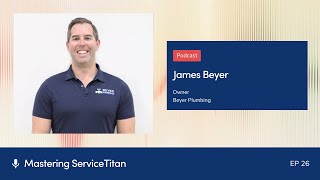
James Byer, owner of Beyer Plumbing, moved from a custom flat-rate system to ServiceTitan's PriceBook Pro after five months of planning. His old system had undifferentiated rates and numeric codes that were hard to decode. He now uses dynamic pricing rules for margins, after-hours work, and regions, plus monthly material updates tied to vendor costs.
Foreign.
Welcome to Mastering Service Titan, where we get expert advice from power users. I'm your host, Josh Liu, and today I'm joined by James Byer, the owner of Beyer Plumbing. And we're jumping into the topic of PriceBook Pro, how to get the most out of it. And so, James, welcome to the show.
Ah, thanks for having me.
Of course. I'm super excited to dive into this topic. PriceBook Pro has a dear part of my heart because when I first joined Servicetyon, they had me work on the marketing for PriceBook Pro and wow, it has evolved so much since then. And for those maybe living under a rock or new to ServiceTitan, if they don't know what Pricebook Pro is. Can you give us a brief explanation?
Absolutely. PriceBook Pro is a pro product that you can purchase alongside inside Servicetitan, but it does more than a lot of other things that you would think of. So Price Book is always one of those things in the service industry where we always get hung up on how difficult it could be, how complex it could be, how many items that are in it. It can go on and on and on. PriceBook Pro did a really good job of making it where you can customize it based on your industry and then you can make it lean as, as lean as you want it, or you can make it as complex as you want it. And so what Service Titan has done is they, they've helped all of us service minded people and they've come up with all these tasks and services for us already out of the box. So that way when you're ready to turn it on, it's ready for you to go. It's a really good product that they have just to kind of help any service business of any size get started.
Yeah. So it's a perfect flat rate Price Book. You can get started with it and kind of go from there out of the box. It's funny, I remember, I think maybe in my first month here I was asking people, how do contractors think about Price Book? And she said, oh, contractors, they think about it like doing their taxes. It's like something, you know you have to do, you got to work on it. But it's like, I'm not looking forward to this.
That is so true.
So with that mindset, can you take us back to before PriceBook Pro and what kind of price book you had and what were some of the challenges that you had with it?
So before we had Price Book Pro, we had our own custom price book that it came along with us when we started Servicetitan and so we brought it over and it brought over all of our different services or tasks, whatever you may want to call it. It was the most complex thing that we could probably bring over. Everything was based off of like a numbering system and it depended on what category it was, it was a different number. And then the end of that 12 digit number would give you the minutes that you're actually working. And so that for a long time a lot of our technicians, that's how they function, they realized, okay, well, I'm going to be doing this for 30 minutes, I'm going to find the task that has a 30 on the end of. So it was a lot of numbers, it was a lot of issues. And then on top of that, it just came in as a, like a flat rate. For many years that we were sitting here as we were starting service site and getting diving more into it, we realized that the price book was one of our weakest links for years. It sat on top of our to do list. Okay, we're going to fix the price book. We're going to fix the price book. And so finally we jumped in. I jumped in and I was like, okay, I'm going to, I'm going to do it this year. You know, this year of 2022, whatever it may have been, it was like 2022, I'm gonna make it the year of the price book and I'm gonna do it. And so all year round I went through our existing price book, leaning it down. I was trying to get rid of all the fluff, trying to rename things, doing all things just to make it easier. We got to a point where we realized that our price book was not made for service. Titan is what we had to realize. And so it had no way of differentiating between the materials and the labor. And so that was the biggest thing coming out of COVID You had a huge spike in material costs that, that the service industry was having to eat a lot of because our price books weren't catching up in time. And then on top of that, labor was going up, so labor cost was going up. So we had no way to be able to differentiate between the labor and the material. We couldn't bring up the material cost and bring up the labor cost. And so it was kind of, it was not working. And so finally when I went to Pantheon, I, I went to the pro products area and I sat with the guys and I talked to them about price book and they definitely sold me. They were like, oh, when I walked in they're like this, this guy's a sucker. He's gonna buy it for sure. And so I walked them through our pain points and they were like, oh man, you, you're the perfect person for this. Lo and behold. It's one of my favorite products because it was an easy implementation for that reason and it got us what we needed.
Wow, that is, that is so funny. It reminds me that, of this idea that a lot of people don't change something until it becomes way too painful. And you're like, you know what? Okay, I can't deal with this anymore. Now's the day we're going to start over. So can you go into a little bit of the details of how it was set up before? It sounds like if I'm hearing you correctly, did you have like one service or task and then just the price. There was no labor like sold hours linked to it and there was no materials linked to it. It was just kind of one item for every service.
Right. So we, it had the, just like the price that we brought in. So like from this other system that we had out some other third party program that we had made and used, it created this price. And so when we brought in our price book, it was just a flat rate. It had the labor hours on there that needed to be tweaked, but other than that, whenever you would go and if you needed to change anything, you couldn't figure out how much material cost was in that price. And so what we had to do for, you know, that year of the year of me trying to figure out the price, but we just had to go to the price builder on the side of the price book and just kind of add in. You would say, bring up, increase this by a certain percentage. And we had to do that just to get by, just to kind of help us figure out how to fix it and what the right solution was.
And during that year of the price book, were you working on this like a daily thing, like chipping away at it or was it more like, you know what, I'm taking this weekend and like every quarter I'm just going to review like a bunch of items. What did that look like?
I think it was, it was more like a once a week type of thing. It was like I tried to chip away at it and then you'd get frustrated, be like, yeah, this is not, this is not worth my time right now. I'm. There's other stuff going on. So just little things at a time. Little, little by little.
Gotcha. Doing Your taxes every week for months and months. And then you mentioned that you realized the price book was the weakest link in the business. Is there a specific situation or like, breaking point that made you realize that?
Absolutely. One, because we couldn't keep up with the material costs. And so every week during that, during that time, we were all being hit with notices about, you know, copper piping going up. Water heater, they love to up their water heaters in any time there's a natural disaster in any of the Gulf Coast. Say we have a hurricane, it could rain tomorrow. We're getting notices already from all the PVC people, you know, so, like, oh, we're going up in price because of xyz. So, I mean, during that time, it was a lot. And I know everyone on here probably has felt that pain. It was just hard to keep up with by having it and trying to figure out how to fix that problem is what. Where we came down to finally implementing Price Move Pro. I started, you know, late in 2021, probably looking into it, and then by 2022, we were full on trying to find something. And then by end of April, when I went to Pantheon, that's when we're. I was like, this is the solution. So it took, you know, five months to find the right solution, or more than five months really. But it, it was. Turned out really good.
Awesome. I'm glad it turned out. Turned out good. Um, what did the transition look like? Like, what'd you do with that old price book? And how'd you transfer over everything and delete things that you didn't need? Like, what was that like?
So what it started out was I sat down with the service manager and I was like, hey, let's look at this price book. Then we're going to compare. This is what pricebook Pro is. It has. There's like printing out the whole Excel spreadsheet, which is like 8 million lines long. And like, let's compare. Like, what do we need to keep. What do we need to go. And so for a while we sat there like, okay, well, maybe we need to keep these certain tasks. Maybe we need to get rid of these certain tasks. And then so we, we went back through and we were like, okay, well, maybe we do these certain things. And then after a while, it was just obvious. It was like, I don't need anything from the old price book. This is not making any sense. We're going to throw the whole thing out and we're just going to completely go in pricebook Pro, all to get all in. And so that's what we did. It was. Made it an easy transition, really, because I was like, you know what? There's no point in us losing all this time and effort of trying to mesh it together with something else. We're going all in on it, and we're going to make it work. And so that's exactly what we did.
Amazing. So just burn the boat. It's gone.
Oh, man. I don't want to see it again.
I know. In pressbook Pro, I don't know if this feature came out in by the time you started with it, but there's something called Smart Start. Now we're in, like, five steps. You, like, pick your trade, you pick your size, your region, and it'll, like, pull in basically, like a 80, 20 version, like 80% of everything you need. And I think it's in minutes. You can get started right away and then kind of fill in the rest later. Was that how it was when you started with?
Yeah, absolutely.
Oh, cool.
They made it so easy. Like, you go in there, go to the catalog, you pick your industry, you pick what inside the plumbing industry that you want to bring over. And you don't have to bring over everything in there. We don't have everything that PriceBook Pro has in our price book. We have a lot of it, probably about, you know, 85% or more. But it has so many different things that they've come up with over the years. And now with AI or ti, you know, with all that, it's amazing. And so it makes. It made everything so easy that we went in there, we grabbed what we needed, and then if we didn't have it right away, you know, say we went on a job and we went to their. Went to a job, and they're like, hey, this random thing is not in our price book anymore. Like, where. What happened? I could go on there, go to the catalog, and be like, oh, well, here. We forgot to bring it over from Price Book Pro. We would activate it, bring it over instantly, gets plugged into our price book. They sync it and it's there.
So easy.
So easy.
How about the change management? Like, what did that look like? When did you start telling your technicians and guys in the field that, you know, this change is coming? And did they all. Were they all pissed and how'd you handle all that?
No, I think they. They all understood that we had a. We had a price of a problem. And so they were. They all understood that, hey, you know, we're going to make it a little bit easier Beforehand everything was all written out. You had to like find your way through our, our maze of map of how we mapped everything. And then once we got into price book Pro Service Titan has these really beautiful graphics and that makes it really easy. So you just click on what you're doing. What part of the house are you in? I'm in the kitchen. Kitchen. You know, like it's. What am I doing? Sink repair. Like it made it so easy for everybody that it, I think it sped everything up because it was just so much easier to find what item you needed in to be working on.
Yeah, you didn't have to decode that 12 digit number. Look at the time. Oh my gosh. So was it that easy? Like you guys just switched on end of day Friday or something and then Monday everyone just showed up and they were all happy with it.
Yeah. And we did the training, we said, here, this is how you get around it, this is how you navigate it. If you can't find something, just call us and let us know and we'll help you walk you through it. It was pretty fast. And everyone that adapted to it was, you know, they were all positive about it and they, they realized how much easier it was to find everything. So it really did make an easy transition from the office side all the way down to the field techs.
How about the maintenance of the price book these days? Like how often are you looking at it, making adjustments? Were there things missing you had to add back in?
Yeah, so we do that probably we do that at the end of the year. We look back through mainly because we want to see how our efficiencies are on all of our know services. So we go, we pull a report, job type report, and then we kind of go from there and we kind of say, okay, well how, what's going on with these job types? What are we using in them? Are we being efficient in them? Are we keeping our times correct? You know, what's going on? So we, we do that pretty much for sure every year between there, you know, we're tweaking it constantly, like, oh, we're going to, you know, make this special or we'll make a special or we'll make a new item that may not be in it. Coordinating that with our vendors and our consignment and trying to get all that through. It gets tweaked quite a bit and then the material gets updated monthly. So that way we can have material constantly the correct amount. So through there. So it's always being adjusted, I guess is what I should say, yeah.
Are you using the automated like material price updates or you know how I think you can like check and accept some of them and not accept some. Is that how you're updating materials or are you doing it on your own separately?
So we actually, we partner with our consignment vendor, Hajoka and so they give us a material, they know our material that's in our price book and so they will give us our exact material cost for that. But price book does have a great feature of what you just talked about and it does have that. If you don't have that same relationship that we have with our consignment, they have that material that they're looking out for you on and it will notify you, say, hey, this material has gone up X amount, you know, percentage or whatever it may be. You may want to look into changing it. And so that was one of the really cool selling features too on PriceBook Pro. Is that not only is it going to make it easier for you, but it's always in the background, it's looking out for you. And they do that with looking at the material costs and it looks at dynamic pricing, which we haven't talked about yet, and then what may be changing in the background. So it's, it's always looking at things to help you and make sure that you are going to, you're giving your best pricing to all of your customers.
Oh, we should definitely talk about dynamic pricing. This is a Service 9 core feature so you don't have to be on PriceBook Pro. But I know this, in order to set it up, you need the sold hours and the link materials. And so with PriceBook Pro, you know, it already comes with that. So you can basically just turn on dynamic pricing in a, in a couple steps. This kind of goes back to what you were saying earlier with PriceBook being the weakest link because it touches so much within service time. It's kind of like the backbone of servicetein. And so when you have a messed up price bug, like, yeah, so many other things get messed up. Can you share about your experience with dynamic pricing and how advantageous it's been to have that?
Yeah, I loved how simple it made it. And so once you figure out your, your labor rate that you need to be charging, then you go in there, you plug that in and then it says takes you to the next step. It's like the most easiest thing. And then you're like, okay, well what kind of material, what material markups do you want to do? You could be across the board. Hey, I'm going to mark up this percentage across the board or you can do a ladder type thing. It depends on, you know, it's a weighted scale so you can do it that way. On top of that they added in all these extra cool features where if it's a weekend, are you going to go up in price? If it's a holiday, if it's after hours, you have all these rules that you can make that you can kind of. The price book automatically adjusts to where things are if you, I think it even goes into capacity. You know, it uses your whole service Titan platform and make sure that you're going to get paid what you need to be paid and you're going to use the exact. What you need to be using on a job to become, you know, profitable.
Yeah. So you can like have your desired margin and then basically back into it with all these rules and you just set the rules and then every time a technician pulls up, you know that item, the price will automatically adjust. If it's, you know, after hours a weekend, it'll automatically show the right price so that you get that margin that you're, you're looking for across the board and they don't have to think about it, which is really, you don't have to duplicate items. Now you have like giant price book and all that. So. Yeah, yeah, I love that feature. I think it's really underrated. It's a core feature. So I, I feel like everyone should definitely be using that, that feature that.
They'Ll save you and it's like then they also have a regional average. So then you can see how much people around your area, whatever the region that you're in, you can see what people are charging for that particular task that are also in the price book. I know, I think they've talked about it. I know Vahe has talked about it and talks about how during that time it was so hard for all of the Service Titan customers to keep up with material costs. And so that this is the, this was the solution. It was, we need to revamp our price book. We need to make it where it's easier for everyone to use to make sure that nobody, nobody wants to go out and do business for free. So make sure everyone is being at the profit that they want and they need to be able to function and that's exactly what service site did and they delivered. I again, it's one of my favorite products.
Yeah, I can, I love hearing the passion in your voice about, especially because of how rough it was before. So, like, it really. Yeah, it made a big impact. So, yeah, that regional pricing average is really cool. That that part is only in pricebook Pro. But yeah, you can see where your business kind of stacks up. Can you talk a little bit about templates? Were you using estimate and proposal templates before PriceBook Pro? And has PriceBook Pro made an impact on your use of templates?
Yeah, we had a couple in there, or a few really, that we've created with the old pricebook stuff because you kind of had to. It's like, okay, well, we need to kind of make something up. We're also BDR members, and so we're very big proponents on always offering good, better, best, fantastic type of options. So how can we give something to the guys that. To make it easier for them so when they show up to a job, boom, they can make sure that they have the good, better, best, fantastic, or whatever it may be options ready for the customer. And so with the templates in the price book, you're able to do that and you create your proposal templates and your regular templates, and then you kind of curate it to what you want. It's the easiest way for us to do specials. And so whenever we're doing this particular special, like right now down here in San Antonio, we're doing, if you buy a water softener, we're giving you a free rock. So it's an easy for us to add in these items where it's making that service, it's making those tasks, we can go in there, add in that ro. So that. That way when the guys are on the job, it's really simple and it's easy for them to keep up with and add to the projects. And so the templates, it keeps everything updated. It's dynamic. So if you change the price and the price book, it's automatically going to change it across the board. Everyone gets synced and I mean, it's. It's a really great tool.
Yeah. For those who don't use estimate proposal templates, wow. Are they missing out? Like the average ticket rates and going up, the close rates going up. Like you've already paid so much just to be at that customer's house and so really want to maximize it.
And what's really neat is that they came out with TI to help you. So now you can also turn on the function of ti, the AI component of service item. If you turn that on, it will look back at your past projects and it will actually create templates for you based off of what you were, you know, previously, previously done. Really neat insight because you kind of see, okay, well, apparently we do a lot of toilets. I'm just like, it'll pull all random things for you, but it's a really. It's a really neat tool. And it created all these new templates, proposal templates, whatever it may be. And so it's, it's made it really simple. So if you're looking for simple that you just want to jump on and have a bunch of things ready, it definitely does that for you already. And you just have to push a button and you're ready to go.
How does that one work? So it looks at everything that's been sold in the past, and it'll just generate some for you. Do you have to, like, accept them all and they're all yours now, or do you just select some of them or.
So what happens is, I think if they could pulls it in and then you can go in there and deactivate the ones that you don't want. So it's one of those things where we activated it and then we'll go and we'll purge it and be like, okay, well, we won't be using these. You know, these are a little bit off. You know, it's. It's AI so it's pretty accurate, but it's not always going to be accurate. So you got to make sure you do your due diligence and go in there and make sure that you're getting rid of the things that you don't want to show up and that are. Make no sense.
Right. Sounds like a great starting point. But if you're on price per pro. Yeah, just pull those in and then boom, all of a sudden you have a starting place and you go make your tweaks later. But it saves a lot of time, and it's not as intimidating looking at a blank sheet and now how to come up with it on your own. You talked about specials and in the, in our pre interview when we brainstormed about this, this was one kind of caveat you wanted to warn people about if they're doing specials. When it comes to like, activating, deactivating. Can you talk a little bit about and, like, warn our customers of what can go wrong here?
Yeah, of course. So what we've had in the past is actually recently we forgot to deactivate a special that we were running a couple months ago. And so we all communicated, hey, this is only for this month. You know, we're only doing it this particular task, it's drain clean for this, you know, low amount of money just for this certain month. And then lo and behold, two weeks ago, you know, surprise, we, somebody used that task. We're like, hey, what is going on? Why are you using this? Where did you find this? And it's because we forgot to go in and deactivate it. And so that's important. It was like if you're doing a quick promotion, if you're trying to do those things, you gotta make sure that you're going back and doing your due diligence of turning it off and or turning it on, you know, whatever it may be. And so make sure you are paying attention to what's in your price book at all times.
Do you have any other warnings or watch out fors when it comes to PriceBook Pro and people implementing it?
If anything, I think it's just encouragement, like such an easy way to help your company and become more profitable, become more efficient. Whatever it may be. PriceBook is the, is the solution. I believe I'm, I'm a huge like I. This is like I'm hype girling the whole time but. And so when I'm on discovery calls, if I'm on a call with the contractor that's maybe on the fence about Service Titan, I make sure to always bring up Price book because it does so much and it really does help your company. We do residential and commercial and so we have customer specific pricing for certain customers around our area. We do all that as time and material. And so whenever you're automatically at that job or that location, when you pull up a time and material task, it's already going to know what labor rate to put it at. It's really smart, it keeps you functioning and it's one of the best tools I believe that Service Titan has.
Yeah, client specific pricing. That one's the one, that one's a core feature. And is that the one you basically set up a rate sheet or something like that for each specific client and that way when you go do a job for that client, those prices for that client will be applied correctly. You don't have to, yeah. Duplicate your price book and name all the things. So I know we covered some stuff that's core, some stuff that's pro. But what's nice about PriceBook Pro is that was like the first step, right. You got rid of the old one, got the new one in, and then from there expanded into creating the templates, the dynamic pricing, the client specific pricing. And so yeah, it really Is that backbone or starting place? How hard do you think it would have been to set up all these other things with your old price book? Like could you, could you.
You know, we, we talked about it. We are, we were about to do it. So it was one of those things where it was a long spreadsheet. And so sitting there looking at this daunting spreadsheet and figuring out, making sure that we could import it into server site. So we had to create all these different columns, figure out the material cost without what is in there, figuring out the labor, figure out the labor cost, labor cost, labor, you know, labor rate, whatever it may be. That was all I had to figure out into the Excel spreadsheet before you can import it. But what lacks if you do it that way is that you also have no way to link materials to those services. Right now we're able to go in there. All of our services can have all these linked materials or, and equipment and whatever it needs to be. But that material cost changes on our import, it changes in that price, that price changes and it's automatically going to sink. If we did it the other route, if we kept our old price book and we kind of piecemealed it together with what the material cost is and everything, we would still be stuck back in 2022. Like it wouldn't be, we wouldn't have functioned as fast. I'd say 22, May 21, we would be stuck back there in the same spot, you know, and there's no way to move forward. And so by joining in PriceBook Pro and doing all this, it brings your whole company forward. I believe it helps you customize everything. It keeps you on task, all the different tasks that you need. I mean, to me, it was a no brainer at the time and still is a no brainer. It's one of those things where I tell people all the time, coming to Service Titan, you really should look at PriceBook Pro and what it could help your company do, because it's truly one of the, one of the best ones.
That's awesome. No wonder the, the sales guys at Pantheon were like, oh man.
Yeah, you really. This guy's a sucker. Yeah, I'm definitely a sucker.
I know we've been hyping it up a lot. What is the most challenging or difficult part of PriceBook Pro, either when you first started or now that people should keep an eye out for?
I think it's just keeping up with it again. Don't, don't be like me and leave a special that is still in there, that one day you will walk in and be like, wait a second, why are we doing this? Make sure that you're doing your, your, your own process of keeping up with it, purging what you don't need, adding in what you will need. Because there's going to be all special times. You're going to add in all these little things and you're going to add in all your own little, you know, nuances that may be custom to your own company and what you do in your industry. And so, I mean, those are all great. You can add those in. It all still works with whatever custom thing that you're bringing in. And the biggest thing is it works great with job costing. Going back, making sure you set it up right the first time. So that way, when you're doing your actual job costing reports, looking back at how profitable you are on specific jobs or projects or whatever it may be or job types, making sure it's all set up beforehand correctly. And so that way you're getting your correct job costing and accurate amounts, accurate hours. For us, we, we do everything off of billable efficiencies. So making sure that our, our guys are billing 100% or more of the hours that they're working. And so that's kind of what they're, they're spiffed on. And so that has been very helpful. So making sure that you have accurate labor amounts, labor hours is important.
It sounds like you can't just get price with Pro and it's gonna solve all your problems. There's, you know, it's still work. You still gotta maintain and keep on, keep on top of it. But I guess that's the challenge of, you know, any price book.
So, yeah.
Any closing thoughts or advice for people listening when it comes to Pricebook or Price Book Pro?
Yeah, I think if you're on the fence about it, if you have a complicated price book like I had that you've been carrying around for a long time, I would definitely look into what Price Book Pro can help you do. And it's just, it's a great thing that's going to keep growing. It's never going to stop. ServiceTitan is number one at listening to your pain points and helping you through them. So if you have any issues, if you have any, you know, questions about PriceBook, how your Price Book would work in the PriceBook Pro, you know, system, they're always there to help you answer those questions too. It's great community and you're always going to have somebody to have your back and to help you through it. But if you're definitely on the fence, look into it. It's going to save you. It's going to save you lots of time and lots of effort that you may not get doing something else.
So yeah, we'll put a link in the description if you want to go check out a demo of PriceBook Pro and then if you're already on PriceBook Pro take advantage of how easy and great everything is set up in the foundation and use those estimate proposal templates. Get dynamic pricing set up. If you're doing some commercial use client specific pricing and make sure you maximize what you already have. And so I love that we covered everything. You know some of the core stuff and the pro stuff today. I appreciate you sharing with us your story. What a cool turnaround in the business. So thank you for coming on James.
Yeah, no it was a pleasure.
Awesome. We will catch you all on the next episode.
More from Bill




Capturing the 80%: How SmartAC’s Gen-2 Targets Non-Membership Homeowners | Podcast Ep. 296

Build better customer data with every booking in ServiceTitan | TAD Tune-Up Series

The Biggest Change for Roofers Coming From Other Roofing Software to #ServiceTitan?

