The Need for Strong Leadership Teams | Podcast Ep. 204 | Toolbox for the Trades
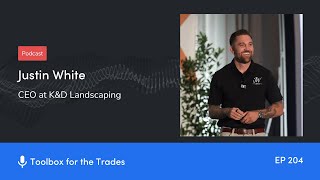
Justin White grew K&D Landscaping from $1M to $22M in nine years. He nearly went bankrupt in 2021 chasing growth, then rebuilt by hiring coaches, installing financial controls, and building a leadership team. His 10-year goal is to create a large landscape platform.
Hello, contractors, and welcome to Toolbox for the Trades. My name is Jackie Aubel and today I spoke with Justin White, CEO at K& D Landscaping. Justin is the first landscaper to come on our show and he did not disappoint. We spoke about the steps needed to grow an eight figure business, how to create a vision that inspires your team and BHAG goals, which, for the record, is my new favorite business acronym. I hope you enjoyed this episode as much as I did.
Foreign.
Justin White, you are the CEO at K& D Landscaping in the Bay Area, I might add. Today you and I are going to be talking about how to hit 10 million in revenue and beyond, as well as creating a vision for your company. Justin, welcome to Toolbox for the Trades.
Jackie, thanks for having me. I'm so excited to be here. Talk landscaping, talk trades, talk what has happened over the last 10 years in this crazy journey we've been on over here at K and D Landscaping.
And I will also say, Justin, I'm so excited to have you on because you in over 200 episodes, you are my first landscaping guest and I could not be more excited to chat with you about this. Just for a little background from the audience, Justin is on Service Titan's sister software called Aspire, and he has graciously offered to give us some of his expertise in the landscaping world that I think will apply really well to all my folks in H vac, electrical, plumbing, garage door, all you fine folks out there. So, Justin, I'm excited. It's going to be a day of firsts for you and I today. So let's get right into it. Got an icebreaker question for you. My favorite icebreaker of all time. What song, if any, would be the soundtrack of your life?
Oh, my gosh. This is such a hard question, right? But I go back to this song that whenever I'm cruising on the highway and going somewhere, I always put on Sweet Home Alabama by Lynyrd Skynyrd. She's got a vibe.
Oh, my goodness. So I would have to have a vibe. Have you ever been to Alabama?
Luckily, I have been. I knew that was coming. I visited a good friend of mine in Fort Payne, Alabama, and we spent a couple days traveling around the countryside. It's beautiful down there.
Oh, my goodness. I actually don't think I've been to Alabama yet. I've been to quite a few states now. Part of it with all the cool stuff I get to do with Service Titan, but I don't think I've hit Alabama yet. I Imagine it's just very beautiful, very lush, all that good stuff.
Yeah, sunsets are amazing, they've got tons of rivers. And it's, it does get cold in the winter, so watch out for the ice that got us. We were there in January. I would recommend maybe the fall or spring.
Sounds like a plan. So, Justin, why don't you tell me how you got into the trades?
Well, I was, I guess you could say I was born into em. My parents started their landscape business right around the time I was born because my dad and mom both realized they needed to make a little more money to support a growing family. I'm the first or oldest of three kids, so I was born right into em and, and grew up going to the job site with my dad, seeing and landscaping firsthand. It was mostly a residential maintenance service company in our first 10 to 15 years and we've changed since. But that was what I grew up doing. Going to the job sites, meeting with his clients. You know a funny story I like to say is whenever he had to collect checks, he'd always send me in to go knock on the door when I was like 10 years old to be like, can we get paid? Let me tell you, I got really good at collecting checks.
I'm sorry, I'm like picturing you like in some Oliver Twist. Get up. Just like knocking on the doors like, excuse me sir, will you pay your bills?
Oh yes, please pay.
Please pay, sir. So I may eat. That's kind of devious of your dad, but also in brilliant. I think I low key love that strategy.
Yeah, genius. And I, and I'd always get a little tip, you know, a little $5 tip from the, from the client. And that was like huge back then was A dollar or $5 was pretty big.
Oh my goodness. So you grew up in the business, born in the trades, built by the trades. Something that we like to talk about here. When did you originally take on the role of CEO?
After high school. I wasn't very motivated, should I say, to get into the trades. I was looking at that as my last resort, my fallback plan. But as you know, you go through life and you find out that you can make a lot of money in the trades. And as I looked at other opportunities to make money, I realized, man, I know this business so well. I love operating equipment. So I just went full fledged into it at a young age at like 17, I started working full time. Tractor operator, masonry, that kind of work. And I realized pretty quick though, that that is not where I want to spend my life because it's really, really hard work. So I started learning the back end of the office and worked my way up into a project manager role, kind of working side by side with my mom and dad. And at 25 years old was my opportunity that I had. We were about a million in revenue. And I basically went to my parents and said, look, I think I have this thing figured out. Let me take over as CEO and let me grow it to something much bigger than what it is today. And first, first response I think was like, what are you thinking? This is so much harder than you think it's going to be. And at 25, you're very naive. I'm 35 today. I think I'm still pretty naive about things, but I had this naive confidence that we can make something really big happen and grow this business to, who knows, something huge that could then support the entire family instead of just parents. So that was when I had that first opportunity to take over CEO. And after about a year of non stop requests and plans, I finally got the title of CEO. And in 2015, late 2015, I was dubbed the CEO.
Amazing. Amazing. So can you tell the folks listening a little bit about K and D landscaping, what services you guys provide, how many employees, annual revenue, anything that you want to share?
Yeah. So in 2015 I took it over. We're doing about a million in revenue. We had roughly about 15 employees. But any service based businesses know it fluctuates throughout the year, especially with seasonality. So we started growing that company and, and I'll just fast forward to today and, and today we're a multi service company. We have about 30% is home service, mostly project based work. We're doing a lot of high ticket projects. Our average ticket's about a hundred thousand and then another, which is nice, right? Yeah. Another 30% is commercial bid build little bit bigger projects. We do projects between 102 or 3 million in revenue that is commercial focused. Think warehouses, industrial complexes, big apartments. And then another 30% is commercial maintenance. And that is the bread and butter of what we do. It's just week in, week out maintenance, mowing the lawn, doing all that fun stuff. And then the remaining 10% is kind of made up of design and irrigation work. And that kind of falls into a couple subsets that we're really working on growing those two areas really higher profit. The team members in those areas are making a little bit more money than your conventional landscaper. So an irrigation tech that's certified or a landscape architect who has gone to school. Those are two areas that we're just getting off the ground, but are taking off like wildfire. And we're really excited about increasing that average wage for our team members and support. Big, big part of our mission. So that's kind of our, our service mix, our total revenue. Right now we're just wrapping up 20, 24, so it's a perfect time. We should end at about 21 or 22 million in revenue.
Amazing. Congratulations.
Thank you so much. And 130 employees, which is we, we're just so, so honored, so blessed to been able to grow this company from that 1 million mom and pop to now over 20 million in revenue with over a hundred full time employees.
Okay, I need to circle back on something. You said $100,000 average ticket. Is that just for the residential side or is that all of your different service areas combined?
That is all just residential. And so yeah, we've been working on that. We were probably 15, 20,000 average project and we've worked that up now to the six figures. And a big part of that is being a design build firm where we attract high end residential clients who want to either build a new home or renovate their existing. Usually they have an outdoor kitchen. The big components today in California specifically are outdoor kitchens, believe it or not. Pools are really in style right now. Big, big pergolas and big covered areas that create outdoor living spaces that really boomed during COVID and we are putting in just a ton of exterior entertainment. So speakers and lights and TVs and pizza ovens. People have really taken their living outdoors. And with heaters and everything else, we can really do a 12 month outdoor season here in California. So those together add up to really nice high ticket projects.
Dang. So your average ticket right now is 10% of the annual revenue of what your parents had at the business when you took over. That's like one way to look at it.
Yeah.
That's so cool.
Really cool. We just wrapped a job up that is over 2 million. Actually we just wrapped two jobs up, both over 2 million. And, and so one of those jobs is double what our revenue was for an entire year in 2015. Really, really cool stories there.
So taking on CEO role as a 25 year old, you and I were talking, you know, when we did our pre interview here about differences between you and I when, when we were 25. Cause we're the same age. Tell me a bit about the biggest challenge you had to overcome, taking on that leadership at a very young age and how you overcame it. How you did it.
Yeah. There you run into a lot of challenges. You don't realize that maybe you're going through in the moment. So, reflecting back in that time, I think my biggest challenge was the inability to trust myself. And I felt this need to get everyone else's approval before I made a decision, which slows down the decision making and honestly waters down your ability to be decisive and push the company forward. So it took me a few years to figure out that I can trust my decision making, and I am the person in charge, taking over from your parents, who have ran this business for nearly 30 years. At this point, I was very worried about ruining it and killing the business. And I was like, gosh, I don't want it to die on my watch. And I have these team members that I worked hand in hand with growing up who I'm now in charge of making sure they have work every Monday and they get a paycheck every Friday. So it took a few years. I think it took three years before I really had the confidence to trust my own decision making. And one of the ways I was able to get around that is I brought on a executive business coach that I met with every single week and still actually meet with on a monthly basis. His name's Jonathan Goldhill. He's out of la, believe it or not. And he helped me through that period of, obviously, you can call it imposter syndrome or what have you, but really it just came down to a lack of self belief and a lack of self trust. That was the biggest challenge I ran into. And like I said, I didn't realize it at the time. Looking back on it, I can really reflect back. That was the biggest challenge.
Yeah, I totally relate to that. That inability to trust yourself. I see that in myself sometimes as a leader where I'm constantly double checking with the folks who work me and work for me. It's like, hey, does this sound good? Does it sound like, are you guys okay with this? My psyche is telling me I just want to make sure that I'm not, you know, surprising anyone or really upsetting anyone with this decision. So I'm going to kind of make it more of, I want to say democracy in some ways, but then I could see how that could slow things down, and that could actually make you pretty ineffective.
Yeah. And it doesn't build that compounded confidence that I think you need as a leader. You know, it's funny, I just had this happen this morning. I'm working on a new sales script right now, and I'm going back and forth with one of my consultants and I had this urge today to send this out to like 10 of my close friends and mentors and ask them, hey, what do you guys think about this sales script? And then I just had this literally happened an hour ago. And then I was like, you know what, I'm probably the best person to define this sales script and finalize it and share it with my team. So I trust myself to do that. And so you constantly kind of have to be on guard around this lack of self belief and lack of self confidence. I don't think it's something you grow out of or it goes away. I think the most successful people today still struggle with that and probably it's a day in and day out fight for most of us.
You mentioned something in one of your previous answers about how when you took over for the company, you didn't want to tank it. For a variety of reasons, but one of them is that you have these people working for you and their families. The bigger your your company gets, the higher the stakes essentially the more you trust yourself to like make these decisions. At the same time you're growing, you're growing, you're growing. The consequences of your decisions or the rewards from your decisions are going to just get bigger and bigger.
And something that I like to point out to my leaders who are growing up in the company, I try to mentor a lot of us and what I tell them is, look, as you grow into an organization, you step up to more of an executive role. Like you say, the responsibilities increase, but the ability to do something about it decrease. So now you're not out there selling, you're not out there doing these jobs, you're not really managing the quality very closely at a VP level, but you have all the responsibility, maybe more responsibility than you had when you were a crew leader or maybe an account manager. So I, I have to really embrace this idea of confidence because as you become an executive, you have more responsibility, more risk, but you have less ability to control the outcomes of the day in to day out company performance, which is just this constant dichotomy that we grow in this gap that's ever increasing as you increase your career and your executive climb.
Yeah, you have to release control of certain areas where you're an expert in order to grow and flourish and give other people opportunities to grow and flourish. It is a dichotomy and it is definitely, I think, a struggle for folks who are growing in their career. Do you mind chatting with me a bit about what happened in 2021?
Oh, gosh. Yeah. So 2021 was pretty amazing year. I learned the most in 2021. I always relate businesses back to professional athletes and I do believe we're professional athletes at the business level. And I think any professional athlete will tell you they learn more when they have a really terrible season versus the year they go to the super bowl. So in 2020, that was our Super bowl year. In 2020 we had Covid. Everything happened. We just came together as a team. It was really, really amazing what happened. We had one of our best years yet. We hit 10 million in revenue for the first time. So we broke through that eight figure number and we were just on fire. And so in 21 I was like, hey, we just grew from 1 million to 10 million in five years. We are going to now just continue doing that. Like now let's grow another. Let's go from 10 to 100 million in five years. So I was very ambitious and so I started hiring all of these really high level professionals. We took on some jobs we really had no business taking on. We bought a bunch of new vehicles and mind you, right, 2020 and 2021 prices are going through the roof for vehicles, for tractors, for everything, for fuel. So all of our sga, our overhead expenses are ballooning. I'm not really catching into this because I'm a younger CEO, not really understanding the financials. We don't have a really strong CFO or controller at this point. So our revenue ended up stagnating in 2021. It was just one of those moments that we needed to take a base camp breather in terms of revenue and growth. However, I did not move that same direction in overhead. So I spent all this money in overhead thinking we were going to go to 15 million. And then we only got to 11 million. And this gap of revenue versus overhead became very obvious in July of 2021 when luckily I had a financial part time CFO that came to me and said, justin, you are going bankrupt. I'm like, what are you talking about? He's like, your current ratio is out of whack. You're taking on all this debt. Your overhead is growing twice as fast as your gross profit. So all of a sudden I started writing all these KPIs down and tracking them from a balance sheet standpoint, realized we are growing broke. We're literally growing broke. We ended up maxing out our line of credit of over a million dollars and we were just in a really bad position. We ended up finishing the year in 2021 and posting a loss of $800,000, which was an incredible hit. But also like mid year, we were on track to lose close to 1.5 million. So believe it or not, like losing 800 was still a bit of a win. And that was the moment I realized just how much I had on the line. My wealth, my parents wealth, my entire family's wealth, all of our money is tied up, at least 90% of it in this business. And here I am just like cowboy in it without really a good strategy. And so that year we really went back to the drawing board and refocused, reshifted the company into 2022 and we've, we've bounced back and this year we're going to, like I said, we're going to wrap up a little over 20 million. So we are going to still make that nice little double from 2020-24. And our profit's now well above industry average. We're going to be doing really nice profit this year, which has been a main focus, as I'm sure you can imagine, after having such a difficult year in 21, 22, 23 and now 24 has really been focused on profit, cash positioning and just getting ready for that next phase of growth. So that's, that's a little bit of the story of 21 and what happened.
Beautiful way of telling it. It sounds like you learned a ton from it. And I, I'm, I just so appreciate how open you are with it because it's so easy to get on the show and talk about all the great things that you guys have done. So I applaud you for being able to come on and talk about these lessons learned because I think it's so important you use the phrase grow yourself broke. It's like, yeah, I can see how in that position you're like, I, I didn't even anticipate this was coming up because I was a first time CEO. This is the first time I'm doing this. So thank you for being so trans about that.
Oh yeah, it helps me run open book at our company at home. So I don't worry about sharing anything because my team members have already heard and see, they see the numbers every month, every quarter. So that helps. When I come online to podcasts, I can really be open and honest about things.
That's great. So with that all being said, you have a pretty strong opinion on how service companies can hit 10 million and beyond. So I'm curious, what, why do most contractors not get to 10 million. And how do they get to 10 million?
This is what I have been so fortunate to have in my careers. A lot of mentors that have grown their business to 50, 100 million and beyond. And so I'm constantly getting information from them and I feel like it's almost my responsibility to share some of the feelings, opinions and experiences I've had with those that are that, that 3 to 7 million mark. And I really think that is a position of trades businesses that are very, very profitable and can provide a great income for someone, but are very hard to eventually sell out of and become truly an entrepreneur and not just like a really high paid business owner when you're 3 to 7 million and below too, but like up to 7 million. I call it superhero mode. You can pretty much run the business on the back of your shoulders and you can be everything. If you have a really good account manager or office manager that can run kind of the day to day at the office and you can be out there doing the sales, you've got a few people kind of managing the technicians, you can get to a really nice revenue point. But at some point you're going to hit a ceiling. And for some of the more high ticket service based technician focused businesses like H Vac, electrical service, plumbing, I think it's closer to like 3 or 4 million. Once you get to the more employees and you're kind of running a little bit bigger of an outfit with a lot of recurring revenue, maybe you can get 7 million. That's maybe more like landscaping where you have a route. So it just depends on the service mix. But at some point you're going to hit a ceiling and typically it's 3 to 7 million. And to break through that, what you need to do is build a leadership team and you need to onboard some type of operating system. So we use eos, the entrepreneurial operating system. I think a lot of people are familiar with that and I just use that as an example of an operating system that everyone in the company agrees to operate by. So just like you need a operating system for your technicians to go and install and maintain things properly and systematize that you need the same thing on the back end. And that's the biggest missing component in seven figure companies is a really true operating system and a leadership team to run that operating system. Once you get the operating system and you get the leadership team, that is in short the formula to get to eight figures and 10 million in revenue. So I think that's the biggest missing piece.
Got it. So when you're talking about building up this leadership team, I assume this also means providing some pretty substantial career pathing and also pretty competitive salaries. I mean, especially you're in the Bay Area, which is like one of the most expensive places to live in the United States.
States.
So how are you offering that to the folks at your company?
So I'll run you through kind of like what I think the typical areas of a business that you need to focus on when you're scaling to eight figures starts with a vision. You need to tell your team you want to be a 10 million company. No one's going to assume that out of you. They're just going to think that wherever you're at is the peak. So you need to communicate the vision and have a vision. Number two is culture, which you're asking about. And culture is so important. I'll come back to that. Number three is sales. You need to have sales, you need to get the work and have work just constantly coming in. And number four is marketing. You've got to be able to market your brand and get your name out there. Execution. If you can't do the work efficiently and at a higher rate in terms of work per hour and at a higher quality than your competition, you're going to have a hard time really selling your value proposition. Number five is going to be financial optics and number six is going to be self mastery. So you need to be able to have discipline and self control around what you do as a leader or CEO or owner of the business. So let's go back to culture. Culture is number one. Everyone says it. You talk to any private equity company and you ask them what is, what do they like to see in a business they want to invest in, they're going to say culture number one. And then they're going to go on to financials pretty quickly actually.
But then they're going to go into financials pretty quickly. They're going to say culture, wink, wink. And then they're going to look at your financials.
No, we're just kidding.
To all my private equity listeners, we are just kidding. Continue, Justin.
Yeah. Yes, yes. We love culture. We really try to live it, not just put it on the walls. And so it's almost like it's your buy in to the game. You need to have culture to attract really good people, but it's not going to retain really good people. You also have to have an incredible compensation plan that encourages people to do the things that you want done. So if your vision is to become the Most highly profitable $5 million plumbing company in the world, then incentivize around profitability. If your vision is to become a hundred million dollar landscape platform, then incentivize around growth and understand that you may sacrifice some profitability in that in the meantime. So you've got to incentivize about what you want the company to accomplish. And if you're aligned with your incentive package, your executive team or leadership team and where the company is going in terms of vision and those three come together, I think you can attract some amazing people without having to pay them a lot more. And sometimes you can pay them less than the competition because they're buying into the vision. And if they see progress and if they see growth and if they're a part of that from a ground floor level, they I think are going to be more apt to stick around because they believe in the future of where you're taking the company now. By no means does that mean you can pay them less or a certain percentage below market rate. You still got to meet that. But I think you can increase your retention simply by getting the right vision together and then aligning the compensation package with that vision.
Got it. Yeah, I mean, I agree with that. It's interesting how if the vision is so robust and compelling, you can actually pay people less than maybe they had been making at a competitor or at a previous position. So I'm curious, what is your vision for K and D?
So over the next 10 years, our vision is to grow a landscape platform to 1 billion in enterprise value stretching across the southwest United States. So we're very clear and we have a big vision. We call it our bhag. And so that's bhag, the goal. Big, hairy, audacious goal.
Love that, Love that.
I worked on a lot of different visions for 2035, and to be frank, I went back to my leadership team. They just kind of kept telling me that's like a layup. That's a layup that's not big enough. And so that's where I was finally forced to throw out the billion dollar term and come up with a vision that seems absolutely unattainable, which is the point of having a bhag. Now, our vision, technically, what's on paper, what our three, five and ten year plan is, it is similar to that. But day in and day out, we have a very strategic vision that we're really working along. The billion dollar goal is really that pie in the sky. If all the things align and everything goes amazing, we'll get There. But frankly, if we get anywhere close to that, I think our entire team will call it a success.
Shoot for the moon, you'll still hit the stars kind of thing.
Exactly. Yep.
Yeah. It sounds like this was. This vision is new. It's fairly refreshed. Right. You, like you had your leadership team chime in on it. So how do you cultivate vision and then adjust it as the company is growing and evolving?
Yeah, it is actually. It's like in its infancy in this vision. So in 2025, officially, this vision kicks off. So technically, we're in pre planning phases and we're still in the guise and the oversight of our old vision, which is to grow a 20 a $30 million company by 2030. So that was our bag in 2015, when we were doing 1 million in revenue, we said, hey, if we can get to 30 million, that'd be 30x. That'd be an insane amount of growth. We'd have 300 employees approximately. So that's been our BHAG since 2015. And now that we are closing in on that goal, we expect to hit that in the next one or two years. I am worried about this we've arrived syndrome, this idea that the team starts to get lazy because they feel like, hey, we're coming up on our vision. I don't know what Justin's goals are after 30 million. So I don't want my executives to get antsy or lazy and start looking for other opportunities because they think we're just going to coast. So I felt the need to roll out a new, revitalized and much bigger vision for the next 10 years, which is what we've done. How we communicate the vision is it's a multi tiered process and it's never finished. People need to hear the executives talk about the vision on really a daily basis and tie it back to every conversation. Definitely every annual review you do with a team member, you need to communicate this vision to stakeholders, both internal and external. So if you're looking at investors, I would say be more open than you think you should be. If you're talking with vendors, especially partners like Aspire and Service Titan, I share my vision with all of your team members because I believe if I share it with them, they can help me get there. And then every quarter we do a planning session, and that goes back to our operating system, our EOS system. And so we have a quarterly planning session. And every quarter I give, usually it's 30 to 45 minute motivational speech, I would call it to my management team and it's about 30% of our company. So anyone that's managing people comes in and we do a full day training. We do a lot of fun stuff, team building. And we end it with a speech from myself where I go over the vision and I give an update on the last 90 days and how far we've come in the last 90 days to attaining our vision. Our goal in these planning sessions is to accomplish one year worth of growth in the next 90 days, which is a pretty big ask of my team. But that is our mindset is we want to accomplish a year's worth of progress, decision making, promotions and market share capture in 90 days. And that is really the stump speech that I give my team. If we're going to reach our goals, we've got to accelerate the way we make decisions, the way we operate, the way we run the business.
This is really interesting and in your last answer, you just gave me something that I haven't thought about before, which when it comes to retention of employees, which obviously the trades, we are all about retaining the employees that are working for us and are doing good for the company. I never thought about that, getting into that lazy phase after hitting a goal and how you have to constantly reiterate and reinvent if you want to keep certain members of your organization engaged and excited to work for you. So that's like just. I don't necessarily have a question about it, it's just really a comment. It's not something I thought about before. And I'm sure the folks listening too, there's a couple of people that haven't thought of that before. So anything else you want to share on that?
I'm glad you highlighted that. I think when we have employee retention issues, we have turnover and people leave. There's so many reasons behind it, but one of the most common is that they've fallen out of love with the company that they work for. And at some point they decided to come work for you and be a team member and up in their life, whether they moved or didn't move. Either way, moving careers and changing companies, a big move even for a technician. So at some point they were in love with your business and when they leave, they most likely have fallen out of love with your business. And I think a lot of that goes back to the vision and the promise and hope of a better future. I think we're all looking for that and it's our jobs as leaders to communicate what that looks like in our companies. And look, if you came to the team and was like, next year is going to be so much worse than this year. There's nothing we can do about it. Sorry. Guys like Grubhub actually just sold and it and they lost like 90% of their enterprise value over the last four years. What a terrible place to work. Who wants to be at a company that has lost 90% of their enterprise value over the last four years? And if that's the vision, like you don't want to be around. So whether you're growing or you're not growing or you are going through a tough period, you still have to have some level of optimism and positivity at the highest level or you will, I think, lose some of the best people on your team.
Wow. I 100% agree with that. I'm curious, how the hell did you learn all of this stuff? Is this all through trial and error? You mentioned you've had coaches and mentors. Are there any books that you like, really transformed it for you? How have you gotten all of this insight into entrepreneurship and into leadership, which is frankly very impressive?
Well, first off, thank you. And the best I could say is everything. Books, mentors, coaches. I'm involved with two peer groups at the moment, networking, going to conferences like Pantheon and Aspire's conference Ignite. I mean, I'm a bit of a conference junkie. I just love the energy. So I was in Orlando, like both a month apart for both Ignite, Aspire's annual user conference and Service Titans. And I just get so much inspiration from people I talk to. And the community aspect of the trades industry is so, so expansive. It was really interesting at Ignite, being in the landscape industry since I was born, basically I've gotten to know a lot of people and I go to these events and I know, you know, half the people in a thousand person crowd. Then I go to Pantheon, where there's over 4,000 people. I know zero. Like I knew like five people there. I'm like, this is so exciting. So I started just going up to people and asking them what they do and so many amazing stories. So community networking is a big part of it. Reading books is huge. I'm not like college educated, so to speak. I didn't love school. I wanted to move faster than school allowed. So I dropped out of high school when I was a junior, believe it or not. And I say that to encourage others who maybe don't have a formal education or maybe I've met a lot of high school dropouts who were afraid to tell anybody. And once I Say it. They're like, oh, yeah, I actually don't have my diploma either. And I just say, look, if I could do it, you could do it. It's just a matter of putting your brain and attention to it and grinding it out, making it happen.
I'm glad you shared that. We have had plenty of entrepreneurs on this show who do not have a formal education that is, I would say, surprisingly very common. And I've done over 200 episodes of the show. It's rare that I find someone who has a college degree. And it's fairly common for people to not even have finished high school or got their ged. I do think there's something about the entrepreneurial brain that, like you said, like, school moved too slow for me. And I think there's definitely some truth in that.
Yeah, it's kind of this idea of convergent versus divergent thinking. So the convergence is like, I'm going with the flow. I'm just going to kind of do the things that have always been done and follow the status quo. And then Divergent is looking at something saying, well, the last million people did that, but why don't I be the one in the million to not do it that way? And I get a lot of pushback from people including specifically lawyers and accountants who are like, you can't do that. And I'm like, show me where I can't. They're like, no, you just can't. Like, that's. I'm like, show me the IRS thing. Show me this, show me that. So I'll. And sometimes it will, but sometimes they're like, okay, like, let's try it. So we are always trying, like, really out of the box things. And I really encourage our leadership team to think completely out of the box. I call it our unfair advantage. We want to create unfair advantages in our business mix. And that, you know, frankly, pisses off a lot of competitors. But we follow a very strict moral code, and as long as we're within that, then we feel like we are doing the right thing.
Unfair advantage. Can you say more about that? It's okay if it's a trade secret and you don't want to share that.
No, it's. It's just a concept. And gosh, I wish I could remember who I learned this from. It's definitely a well known author, but I can't remember the name right now. The idea behind it is, let's say, for example, you create a strong personal brand in a market and you're an influencer in your trade for example, we're seeing a lot of these pop up and you have access to materials and software and resources and other things that other people would have to spend a lot of money to get. The access allows you to run your business more effectively, more competitively, maybe even getting discounts on certain things to help other brands. And by doing that, you reduce your cost of overhead and you're able to be more competitive at a price point that actually still makes more net profit at the end of the day than your competition. So you're sometimes underpricing your about your product or what have you or your service, but still making more net profit due to these brand partnerships. And your competition will be like they're under balling the market, they're undercutting the market. This isn't fair. You know, the fair question and comment comes up, but you're actually making more money. And I believe that the 20 year olds who are starting businesses today, specifically in the trades, who are taking an AI based approach or taking an automated approach, they have almost no back office and they can run this at a five or six million dollars company. They're able to make a ton of money and actually charge the same or a little bit lower of a price point, deliver way more value to the client and they're walking home with way more cash at the end of every day and the end of every month. That's what's going to disrupt our industry over the next five years. And that is unfair advantage that we're always trying to look for. For. That's the unfair advantage. In one example, I googled it while.
You were explaining it and it is a book by Ash Ali and Hassan Kuba. Is that what you were referring to? All right, that's the unfair advantage. If anyone is interested in learning, I'm fairly interested in it. So I might watch like a little explainer video because I mean, yeah, fair versus unfair. Those are interesting words to use in business. I appreciate that. You're like, we have this moral code and as long as we're operating within that, we feel good, but we're always going to. It sounds to me like it's more like ruthlessly seeking opportunities that will put you at an advantage. That's kind of how I'm interpreting it. Do you feel like that's fair?
Exactly.
Fair. Unfair.
Exactly. Fair. Unfair. Yep, that's, that's a great. Yeah, that word comes up a lot. And I always challenge it in business because I do. We have 30 fundamentals that we live by and, and six core values. So we have a very, like, strict fundamental guide of how we operate internally and externally. So I tell my team, as long as we're within these lanes, these bumpers that we've established and agreed by, there are few rules that we have to play by. And those unwritten rules that everyone's played BY since the 1980s corporate revolution, we're not going to really abide by those. We're going to change the way we do things, and we're going to innovate and just try to create unfair advantages. It sounds a little toxic when you say it, but overall, when you dive into it in a strategic session, it's a really fun exercise to ask ourselves, what are our current unfair advantages and how we can create more.
Yeah, yeah, it's interesting. It's definitely a really interesting topic. I want to learn more about it, and I am pretty sure our listeners are going to want to learn more about it, too. Justin, I'm going to talk a little bit about. I want to end this call on talking about your community, but before I do, is there anything I should have asked you that would have made this a better interview?
I want to shout my team out real quick. I know a lot of them are going to be listening to this and just want to give them a huge thank you because we just won the Business of the Year for our local chamber, which is huge.
Congrats.
Thank you. And it's. It's such a huge accomplishment. So we won another chamber. We operate in multiple areas. We run another Business of the year in 2020, and we were the first landscaper to win that in like a hundred years. This chamber has been around for 120 years. We're now the first landscaper there. But I had nothing to do with it. Like, my team has just ran this community effort for the last two or three years without really me being involved. And they just told me, like, hey, we just won business of the year. I was like, what? How. How the heck do we do that? And it just. It goes to your team. And I just want to shout out my. My whole team at K and D because previously I've always been the superhero mode to do that, and now I'm seeing it come to fruition where they are going out and they are making these amazing accomplishments. So just. We get a. It's in two. We're recording this today, Thursday. I get to accept that award tomorrow on behalf of the team. And it's just a huge honor to see the team accomplish those kind of things. I just wanted to shout My team out for that.
I'm so happy you did it. Says you're used to being in superhero mode, but you created superhero other superheroes in the process. So that is a wonderful, wonderful accomplishment. So tell me a bit about the Disruptors community.
Yeah. So the Disruptors community, I consider myself a disruptor and looking at, I'd say it's accurate, right? Yeah. So I talked to a lot of great people. I mentioned I'm a conference junkie. I'm always going around and attending speakers and I meet these amazing people who are in the 3 to 7 million mark and they're wondering, how do I get to 10, how do I get to 20? I'm struggling. I'm working 80, 90 hours a week. So I created a community online which is a 24, 7, 365 conference slash peer group. You can go in there and ask any question you need. There's going to be tons and tons of people in there that have either been there or are going through what you're going through. I also love the fact that you can help other people in the community. A lot of people think that entrepreneurs just want to learn, but truly we want to give back. We want an opportunity to inspire. That's why you have over 200 episodes of us talking about what we do because we want an opportunity to talk about ourselves. And that's what we're creating. We're creating this really cool network. We've got some great courses that we've built within there that are all based on the eight figure mindset. And we have some really amazing speakers coming in. And it goes live January 1, 2025. So if you guys want to get some more information, you can just go onto my website, jwhite group.com and you'll find a link there to follow yourself right to the Disruptors club.
Awesome. Well, Justin, thanks so much for taking time out of what I'm sure was a very busy day to share your insight. Thank you for being a wonderful first landscaper to be on the show. I'm sure you'll be back. I'm sure we'll be doing more content with you. But for now, thanks so much. I enjoyed this episode. I know our audience will too.
Awesome. Thanks so much for having me. Jackie. It was a pleasure.
More from Bill




Capturing the 80%: How SmartAC’s Gen-2 Targets Non-Membership Homeowners | Podcast Ep. 296

Build better customer data with every booking in ServiceTitan | TAD Tune-Up Series

The Biggest Change for Roofers Coming From Other Roofing Software to #ServiceTitan?

