The Tough Stuff is the Good Stuff | Podcast Ep. 121 | Toolbox for the Trades
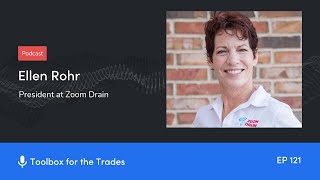
Ellen Rohr built Zoom Drain from a Philadelphia startup in 2017 to nearly 40 franchise locations by scaling through referral partnerships and operational discipline. She runs on a mantra of calls, texts, and trucks, uses Monday.com to transfer knowledge across franchises, and believes the hard problems are where growth happens.
Ellen Rohr, welcome back to Toolbox for the Trades. Thank you so much for helping me kick off season eight of this.
Yeah, I'm so happy about that. We love each other, and I was. Oh, yes, let's talk. We get to talk and record it. Why not? So. I'm so happy. I'm so proud of you. I'm, I'm delighted to be here. So. Yes. What's on your mind, Jackie? Kick off our season.
Well, I have an idea of what I want to talk about today, but before we even get to that, right before we hit the record button, you were telling me a bit about all the things that have changed at Zoom Drain.
Yeah.
The last, I don't know, like, handful of years. So tell me, what's going on with you professionally? What are some new lessons that you've learned?
Well, I have a lot of empathy for our vendors who are growing really, really fast, including Scorpion, because we are, too. And just what that does to an organization and how you deal with. Our plan was to grow Zoom Drain, and I didn't want to be the fastest growing franchise. I wanted to get our feet under us. It took us five years to get to 15 locations, and then we decided we would put the gas pedal on. So by design, we connected with a franchise sales organization. I mean, this was well planned, well thought out. We've gotten investors. So even with all that strategy, we. Wow, has it been a wild ride. So since the beginning of 2022, now we've added 25 more franchises. So we're at 40 franchisees, and it's been a wild ride. So exciting. I've got scars to show for it. And, you know, you know, like, lessons learned. Just like I think empathy is one that we're going to make mistakes. Our overall philosophy is that we plan it, we execute, and then we measure results. Debrief. Okay. What can we learn from this? And keep going. And my encouragement if you're on the call today is that never goes away. It never goes away. I heard this once. You'll never get it right and you'll never get it done. And you'll never get it wrong. You just keep going. You'll never get it done. You'll never get it wrong. You're just going to keep going on the path, and it's a delightful path. I love our franchisees, but I'm happy to dig into some of the more specifics of what we've learned and how we can do better. And, and, and these are the conversations I love when I call my friends who have businesses of all shapes and sizes. This is what we talk about, you know, what have you been working on? What are you learning? So, yes, let's do that.
Let's dig into it. But before we do, can you actually just give a brief synopsis, a brief overview, if you will, of Zoom Drain? I make this mistake sometimes. I have my friends come on the show, and I'm like, I know what this is, but I'm thinking of me, who might be listening to this as the first episode. So tell us a little bit about Zoom Drain and how you got. How you started the business.
Well, once upon a time, I married a plumber. That's how I got into the business. And you know what I love about him? I love about tradespeople in general. There are no nonsense. It either works or it doesn't. It's either plumber. It's not. And I got turned onto this really cool arena. And as I don't have any of these technical skills, it's always particularly fascinating to me, or what trades people can do. So that was really my start in the career. And then I am a Frank Blau disciple. If your listeners don't know who Frank Blau is. B L A U. Frank was the one who really got me on a prosperous journey in the trades because as the wife of a plumber in a mom pop shop, we were just hating each other and losing money until I figured out my asset from my elbow with Frank's help and started to charge more than costs. And that really was like being born again to me. Like, I was like, how did I not know this? I have a college degree, I have all this experience, and I still didn't know what a balance sheet was. So that made, you know, was a big quantum leap, shift, shift for me. And most of my career has been helping other business owners, you know, figure out the money. Honey. I've written a few books and I had a lot of consulting clients. One of my opportunities was I was the first and only employee of Benjamin Franklin, the Punctual Plumber, which is now a worldwide massive success with authority brands. And I learned about franchising at that point and really dug the concept. You're basically in business by. For yourself, but not by yourself. It could save you a lot of time and energy, maybe 10 years as someone else has already put the brand together and the manuals together, etc. So after I left there, I always had an idea, I wanted to do it again. And then one of my clients, Jim Crinitti, reached out to Me and Al Levy, who was one of, you know, friend of yours who is one of our original investor. Was our original investor. And we hung up our shingle as Zoom Drain. And that was about 2017. So this is where we're. We took a couple of years to really get the, the mothership going. The main location is Zoom Drain Philadelphia. And from that model center, we've branched out now to 40 locations. And it's just drain. So we just do south of the drain. Our favorite lead source are plumbers. Even plumbers who say they do drains sometimes you don't really like to do drains. And we have a whole truck devoted to drains with jetter and cables and camera and locators and all this stuff so that we can be that specialty contractor. If a plumber is a general practitioner, we like to think we're the brain surgeons. So that specialty niche has been very, very lucrative, very exciting. It's a simpler model. We don't have a lot of materials. It's a, it's a equipment play, a labor and equipment play. And we have it really dialed in. So we're excited to grow. This year has also been marked by people with no experience in the industry coming on board now. They need to find an experienced tech to get started. That's going to keep them safe. It's going to, you know, help them meet licensing requirements. There's a lot of great reasons to, you know, have some tribal knowledge on your team, but the scalability of our model is really never evers, you know, young people, at least young at heart. I hate to be ageist as I am old, but, you know, to find someone who's looking for a career, we pay to train you. You can get up to speed faster in drains because the scope of work is smaller than trying to do all of plumbing. So there's a lot of reasons for me to fall in love with drains. And I have. I never thought though. I mean, when you were a kid, did you think you and I'd be here talking about drains someday?
No, I was going to be a paleontologist slash ballerina, so no had no idea I was going to be talking about drains. What about you?
I wanted to be an actress, so. See, I'm making that dream come true. I was a theater kid, so there you go. That's a million other things. You too. Like, we've had these varied careers, but isn't it goofy that here we are and I love it here. I love you. I love the people in our industry, so it's really fun to talk about it. Yeah, I agree.
And thank you for that short synopsis. I want to talk now about, you know, you've grown from. It took you five years to get to 15 locations. Now you're at 40. And by the way, I started at Service Titan in 2017, so how funny is that? That's when you started. That's where I started. Service Titan. Here I am. You're episode number 121 of the podcast. I've done an obscene amount of webinars since then.
So.
So talking about growth, right, You've grown, but you're noticing there's different pain points as you grow and as you add on these more locations. So tell me, you mentioned marketing, and so how is marketing different for you right now? How are you struggling with marketing? What are some things that you're learning?
Well, just for the OGs in the, in our audience today, I mean, I used to think, as many of us did, that there was nothing that could be worse than Yellow Pages. You could spend, you know, $50,000 a month on an ad and you hoped it was good. So you'd spend months on the ramp up, you'd pull the trigger. There was nothing you could do about it for a year. You had to live with it and you had to pay for it. And I mean, people went bankrupt doing that for sure. And I thought, it can't get worse than this. Oh, it got so much worse in terms of the complexity and the decisions and the frustrations. Because now with digital marketing and certainly Scorpion is, you know, a core. We use Scorpion for our websites. It's a core piece of, of this pay per click trying to figure out Google, lsa, all of those aggregators. You know, everyone is angling and, well to back up a little bit our focus every day. And it's not going to be unique to my business. But this is what we talk about every day, is calls, texts, and tracks every day, whether you have one truck or 100 trucks. Do we have enough calls? Do we have qualified, trained people to go on them? And is the truck fueled up? Is the equipment working? Are we ready to rock? Like, every day, that assessment and that, you know, shuffle juggle that happens whether you're one truck or 100 trucks. And that's never going to go away. So if you're getting started and you're thinking, oh, as soon as I get to seven trucks, it never goes away. I asked Mike diamond once upon a time, is a hundred and one hundred trucks enough? He said, Sometimes there's 50 texts with nothing to do. And the next day I need 50 more. So, like, that is just the way it goes. Thanks, Mike, for the ageless advice. So, calls, text and trucks every day. And the greatest of these is calls. The greatest of these is calls not to discount people. People are going to get your attention every day. Alan o' Neill says he likes his people to feel safe and happy every day. Right. And that. That is, you know, people are everything on that. If you can create and magnetize good people to come work with you, the trucks, you'll get figured out. Even in tough times, the mechanics, the operations, the technical pieces, you'll get it figured out. And the people, you'll put those systems in place, and some people are going to come and go. But if you're a good person trying to do the right thing, working on your leadership, you can magnetize a great team that will come and work with you. I don't believe that kids today are weird or anything. They're just people. And, you know, it's up to you. The, The. The. The denominator is you in that equation, like to make that work. But calls, there's so much out of your control with calls. There's a lot you can do. There's a lot you should pay attention to, and it depends so much on what other people in your market area are doing. So, you know, in the world of contracting, boy, 30 years ago, a $5 million company was iconic there. Like, you would travel the earth to go visit the guy sitting at the top of that mountain. You know, what are you doing? How did you get there? And now that's become a Tuesday for some of these bigger companies. So, you know, there are these behemoth companies in the marketplace. Makes me so happy that there's that kind of wealth and attention in our industry. So good. And yet, if you're a. If you're a shop trying to get some leverage in your market area, you might be competing against someone who has no problem paying, you know, a thousand dollars, $2,000 for a customer, you know, if their acquisition cost is 2,000, but the lifetime value of that customer is $30,000 to that company, they're going to spend it, and they're going to outspend you. So I think from a marketing standpoint, you know, calls, texts, and trucks every day. But calls is the one that. This is why I color my hair.
It looks great, by the way.
Thank you. Just got it done.
It looks wonderful. So when you talk about, you know, doing all of this, like, competing with the big guys, a lot of it comes with pivoting strategies a lot. And at the top of this call, you mentioned to me that you're doing a lot of planning, a lot of execution and a lot of measurement. Right. And you're repeating that over and over and over again. So tell me a little bit more about that process.
Well, in. In our plan, you know, just to spill some of the Zoom drain secret sauce, we've got this really dialed in. But we are very strategic about referral marketing. So what you can do, always can do, because it's within your control, is this relationship piece. So this again, the relationships, the relationships you have with your team, with each other at the company, and the relationships you can make in the community with influencers. You know, someone in the media, a real estate mogul, you know, someone who's just top of the heap at Keller Williams and then other contractors. Those contractors who say they do drains are spending millions to get customers, and they're getting those drain calls very often. They don't like to do drains or just picture the picture. Their truck is full of, you know, a general practitioner set of tools and equipment. There's only so much room for the drain equipment. So this is again where we can, we can do a win, win. He, hey, we don't do plumbing. We'll refer plumbing work to you. And when you get in over your head with drains, let us help you out. So that is one of the ways that we're going to market. But any contractor, like, if you talk to these guys who've grown their company, they're going to bring up the relationships that they've made with the people in their marketplace. You know that they're the re. They're the respected referral contact. Ask Ellen. She knows everybody. She'll turn you on to a good roofer or a good landscaper. You know, just to be in the community in that way, that's a David versus Goliath move that will pay off for you. And so whatever we're doing with our digital marketing, with our lead aggregators, you know, you can complain about them, but they're just, you have to do it. And so you get out there and you do your best, you measure results, you make some guesses, etc. And then we. But you're. You're all the time focusing on that referral partnership love on them. If you have a problem customer, make sure you get back out there. You take a little video of you getting better, of making it good. You respond to negative stuff. I mean, I fail every day on this this is how we should do it. And that's what I think the work is. It's like, how did we miss that? Wait, we did. Who did that? What did you say? Oh, that wasn't good. Okay, now how are we going to respond to that in such a way that we can make this. Our shining hour is really the. The work of it every day.
Yeah. You know, every time I talk to you, I'm always blown away by how positive you are while you're saying something like, every day I fail. And I just think that's such a wonderful energy to possess, especially as a leader, because I know a big part of your job at Zoom Jane right now is going to the franchises, getting them riled up, getting them excited, and taking back what you're learning from them back to HQ and implementing that on a global scale. And I could just, like, see your energy just being so beneficial within that role.
Well, and I tell you, getting old has such advantages. I mean, physically, I wish I looked like I did 30 years ago, but my perspective is so much better. On a great day, I'm going to celebrate it because I know there's going to be another. There's going to be another side of this that I won't like. And on a bad day, it's just like. Just hang in there. We can run through this. Like, it doesn't. It goes like this. Even if you're. You're winning big time, there's still going to be these ups and downs. But that's where the songs are written and the art is created. It's in that. Those moments of, you know, what do I not want? That point you to what I do want, and then how do we make it great? I do like to think, although I have been in some technically terrible situations where I was so helpless that my team makes fun of me all the time. In fact, they don't think I should sit in an exit row in an airplane. They don't think I will do well in. In that kind of an emergency. Just saying. But I also know that one of my skills is I will talk to people. I'll have difficult conversations. I'll do, you know, look at what we can do within our hula hoop. And we will always lean into a problem. We'll always go in the direction of transparency and trying to do what's right for everybody. And that's a. That's a good skill to have. It breeds confidence. I mean, your willingness to go in when others may shy away is a good skill to develop. Like I'll. I'll call them. Who are we not wanting to call? I'll call. You know, that's a. I'll just, you know, try and make sure that we're dealing with each other as human to human, that we're loving each other through. Through problems. They're gonna be problems, but that doesn't make it terrible. You know what else, Jackie? You're gonna relate to this. How many friends we have who've sold their businesses.
Oh, my gosh.
Made a lot of money.
Yeah.
Isn't it exciting? And then what do they do after they've sold their business? What do they do?
They stay on board.
They either stay on board or they get back in. They get back. They started over, and they're literally nostalgic for those difficult days that you as, as a emerging contractor may be like dreading going into the office right now. But if you stick with it, what will happen is you will long for these moments where it was a small team. I'm getting goosebumps thinking about it's a small team. You know, everybody, you know, you. You get through a tough day and you're high fiving, or you all go out and have dinner together. Like those sweet moments of growing your company. Solving those. Those problems are something you're going to long for later. So I think I've got a little bit more perspective now that the tough stuff is the good stuff. The tough stuff is always the good stuff.
Did you just title this episode? I think you might have. Tough stuff is the good stuff.
I say it a lot. The tough stuff is the good stuff. Like that's where our lessons are going to be. That's where the procedure is going to come from. That's where our reputation will be made. That's where your character will be developed. Like, that is the good stuff. Like, you don't have to shy away from it and you'll be fine. We're all going to get through this. I mean, if you kill a man, that's a hard one to recover from. But most of the time you won't. And I say that. I mean, that's heavy, right? But as soon as you put your business in a truck, that truck is the most dangerous piece of equipment you have. Right? We're on the truck. We're in truck businesses, and that's a dangerous business. So you accept responsibility for that. You get insurance, you put safety and procedures in place. And still I know some terrible stories and you do too. But most of the time that doesn't happen. So another Thing, you know, just a little bit of inspiration today. Don't make emergencies out of non emergencies. The fact that the DMV didn't, you know, have room for you today or you. That is not an emergency, that's an annoyance and you can give it a little bit of energy but not too much and then move on to the next. Like I really. My partner Jim is so good at focusing on the levers that will matter. Like push the lever that's going to have the greatest effort to effect ratio. He is really good at that. So even if I come up with an idea, I think we should do something. He's like, I don't see how that's going to be move much. Like if I move that lever, is that going to move much in terms of the effect it has on something? One of our new franchisees says that he does this for a decision making tool. You know, because you're always choosing all day long. You've got too much to do, you'll never get it done. So you have to choose. And one of our new franchisees, I'm so excited about him. Nathan says he doesn't make a move unless it's going to have a 10% increase. Like is it? Can I get 10% more by doing this project? That's a high bar. But think how much time you save if you focus and how much result you would get if you focus on those. Those items that are going to have a great effort to effect ratio.
Yeah. And one thing I love.
So I know that's a little philosophical, we can get more details here.
But no, I love that.
And I think I'm a philosophical girl.
I know. That's why we get along so well. So am I. I'm constantly thinking philosophically so talking about execution and figuring out okay, what's going to get me 10 more. Right. So one of the reasons I asked you to come on and help kick me kick off season eight is because not only have you been a guest at Service Titans user conference Pantheon, you've also a guest. You've also been a guest speaker. So you've attended and you've been a guest speaker at the conference. Ready for the one that's coming up in 2023, September 11th through 13th in Orlando, Florida. We're leaving Los Angeles, we're going to Florida. And when it comes to going to a conference like Pantheon, learning a bunch of stuff.
Yeah.
About how you choose. Okay. We learned all of these new things. How do you choose which ones to execute when you get back home?
Oh, that's so good. And even let's talk conferences. Because some people, I think Alevy coined this term are guru junkies. Flavor of the month, new book, new speaker, new program. They listen to everything and they follow everything. And what can happen is when you come back from the event, your team is like, oh, here we go. Flavor of the month. And they're just waiting you out to see if this is going to drop off. So just in getting advice in general, I learned a lot of this from Al Levy. Because I'm a guru junkie, for sure. I can take a lot of information. The inside of my head is very chaotic. It makes sense to me, but it's more than. It's different than other people process. But what Al did with me is he said, okay, now, first off, we need a common language for things. So this is going to seem so small, but it's so important. If you're going to call a meeting, that meeting, it's going to have zero power. But if we call it the service tech sales meeting, now, we know what that meeting is. Is it a budgeting meeting? So you're going to have the language if you call them customers, call them customers. If you go to a seminar and they call them clients, be careful because you come home and you start calling them clients. And as someone who's got a manual, I've got this manual that's like 1000 pages, maybe more than that. If I use different words, even when we switch from calling them CSRs to service coordinators, it took us a year to get that language cleaned up. So be specific about the language that you use. So you're going to go listen to this speaker, you're going to read this book, attend this podcast, and then pull their information into your system and filter it in in such a way that you can layer it in without just starting your team over on a brand new form, a brand new process is this. I can see your face. Like, you get this, right?
Yeah. Because it's totally disruptive. If you start using different language the team isn't acclimated to. Even if they hear client versus customer, the brakes in their brain are going to go off and they're going to be like, what? And they're going to be thrown off. So I really love this idea of taking the concept of what you learned and integrating it into the processes you already have. The language that you use in terms of.
Yeah, right. You've got something that works. Build on that. Returning to your question about, like, how do you go to a Seminar, you're going to get these ideas and bring it back. One is to make sure you're building on the systems you already have, including the language. A consistent vocabulary at your company is very, very important. Another thing to, to pay attention to is Project Management 101. A lot of folks in our industry use Traction. Gino Wickman, I think he was at. He's been at Pantheon.
I think so. Yeah.
Yeah. The, the fellow who wrote that book. And the EOS system is a very good one. Is a very good one. Like, you don't have to start this from scratch. You can take one and use it and you'll find classes. But what will happen with that list of projects? This is going to sound very mundane. It's so important, that list of projects. If it's on your list and I don't like post its. I like either an electronic tablet, this is a remarkable tablet. Or you can use your iPad like this, or you can use a notebook, a spiral bound notebook. But this is the deal. If it's on your list, it's yours. You're stuck with it and you can't delegate it in this format. So you need some kind of accessible tool that you and your team can get on, literally get on the same page. So this year we've adopted Monday.com. are you familiar with Monday?
Of course, yes.
Okay, well, there's Basecamp and Asana and Trello and Keep. And there's a billion of them. And you're well served to pick one. You're well served to pick one and not have five. Right. Because you. This app thing is getting beyond nutso at our, at our shop. Right. So we've got all these apps and we've got a use them for different reasons. And we do need an app to keep us straight on our projects. And one thing that Jim. And we've got a new. Amy Hunt is our director of knowledge and knowledge management. So this idea of we've got these systems, how do we transfer this into workable knowledge to our team members? And so that's her title and her responsibility is to help us to, you know, communicate, disseminate and train our team members, get them the information and get them trained up on it in some kind of form. Well, that ties into. So that's a project now that has to tie into our goals, our mission, our vision, our goals, we call them objectives, then our initiatives by department. And then those have to be then not have to. But this is what we're insisting that they go on the Monday board. So we can collaborate and you can, can you feel the energy? It is not easy. It's easy because you can do it. I, I don't mean to say it's like it's not, it's just a lot, but it goes against it all on the board and to get the team disciplined to use it because you'll, you'll keep going back to this notebook and even if you're disseminating the information, your team members are siloing it up.
Yeah, it goes against like, because I think also too, this is going back to philosophic. It's philosophical. Right. More than ever, the human race has access to information at their fingertips. We're doing incredible things. We're creating businesses that not only are 5 million a year, are a hundred, two hundred, five hundred million dollars a year businesses. Right. I really think that our brains are not designed to share information like that naturally. And so using a tool like Monday.com@servicetitan, we and my team, we use Hive, which is more of a web based tool. But having someone who is the person between big idea and sharing it with the team, I think is so smart. Because you're describing it, you're like, it's not easy. Well, no, it is easy because you can do it. But it just goes against the way that we think about communication.
Like if you think about where were.
We in 1923, we're in 2023 right now. We didn't have this type of intel that we were sharing on a broad level back in 1923. It's almost like we're, the technology is just going, is moving so rapidly. We have to be really intentional about how we use it. You know what I mean? Are you picking up what I'm throwing down?
I do. And then to that point, without all that, in 1923, through the Depression through, there were multi hundred million dollar businesses built that are now multi billion dollar businesses built with someone using a notebook, with someone using a, you know, a chalkboard. So while we do this, I think an appropriate question is the expression I got once upon a time is don't use a backhoe if a teaspoon will do. While we can keep adding apps and plugging things in, does it make sense sometimes to just put the list of to dos for that initiative on a dry erase board in the tech area? Or you see where I'm going Or could we use. We still use paper tech scorecards even though we use Service Titan, even though all that data is available. It's like when you go golfing this is the analogy I got once upon a time from Harry Friedman. When you go golfing, you still use that, that little cardboard thing and that small stubby pencil and you're going to write your score in. And there is this visceral moment with keeping track of a manual score. So what we're trying to put together is when does it make sense to go high tech and when does it make sense to go manual and then how do we connect this app stack? And you won't do this right either, but these are questions that you should be having with your strategy team. And it does start with you got to have the, the, you don't have to, but I so encourage you have a strategy session where you talk about your mission. Why are we doing this? What are we doing and why? Your vision. This is what it looks like, our vision at Zoom Drain. A truck. A truck in every neighborhood and the first choice for service. A truck in every neighborhood. The first choice for service. Our vision is to own our industry. So exciting. So then if that's the case, then what are the initiatives? What are the objectives which are those two have by when BHAG goals, big carry, audacious goals and then break those down into initiatives which are going to be beefy projects and then the projects underneath them and who's going to do them and who's going to go through steps of delegation and all that. And it's exhausting. It's not hard, it's just exhausting. I would say it takes energy, but if we can get this incorporated into our culture, then we can be a 500 million dollar company. That's how we feel about it right now. So to just while we're where we are. I'm getting misty. It's really, it's really a big part of what we're doing right now is so connected with that bigger vision. So you can see how that fits together. If we didn't have that big a vision, we wouldn't need to do this. If you want to be a small company and there's no problem with that, you can make a lot of money. If you charge a lot of money and you're exclusive about who you work with, you can make money as a one man, two man shop, but in that case you can yell at each other, hey, did you do this? You know, but if you want to get big, you've got to put systems into place. So that's why the vision and the mission is so important. That's a really good conversation for us to have as Our kickoff.
Yeah, I think so too. You know, I, I don't know if you can relate to this because sometimes I talk to, I talk to people of all on all different levels of the spectrum at, within the trades. Right. I talked to Ishmael a couple episodes ago, who's business and never has to work again, but still is working at the business. Sure. I'm talking to, yeah, I'm talking to people who just are about to hit their first million dollar month and are so excited about it. And now I'm talking to you and I feel like you and I are kind of on the same level here. We've been at this for a couple years. We're going, we're trying to, we want to add fuel. We're kind of like in this medium area and I think it's important when you're in that medium area to revisit why you started in the first place.
Oh.
Because I don't know about you, but like I sometimes can get really lost in the. Every day in the minutia and in the. Just check, check, ch. And then I think I really need to come back and be like, well, why am I actually doing this? What is driving me here? And I think that having a good grip on why is so integral to maintaining your energy and to keeping your focus. Keeping your, keeping your energy focused.
Do you agree? Oh, yes. And personally, why are you doing it? And then collectively, you know, that energy of, of bringing a team together, like, I like the collaboration, I like the energy of a team. My husband is a lone wolf. You know, he works at a company and he's a valued member of the team, but he doesn't have that itch to like, oh, let's meet, let's pull it together like I do. You know, I just, that is definitely. That gets my juices flowing and my why has changed. You know, I had a low bar, I think, but I've exceeded anything I thought I could do in this lifetime. Who knew? Okay, that's good. Now what? Now why? Really for me, now comes down to this is such a cool industry. I feel so good about being involved in the trades. How can I help other people find the deliciousness of this industry? And how can we, you know, raise the, the standard and the expectation and the pride of the trades? How we can, can we develop real careers and not just jobs? And, and with franchise, a model that's going to help you shave 10 years off of your growth and get to where most contractors never get. I mean, I remember when we did the When I. I've written for all the magazines, and they have either those cards that you mail in or the surveys you take online. How many checks do you have? How much do you do in sales? What kind of work do you do? Well, they assemble that information. And I remember talking to a couple of the magazines, and this is, you know, rough justice math. But I remember like that it was about 80% of all contractors never get past the third track. And of those contractors, most are one man bands. So it's just such a highly fragmented industry. That's where the opportunity is nowadays. There are a few broken out, and we've created these big conglomerates, and there's more who've gotten to four trucks and 10 trucks, et cetera, than there ever have been before. But, you know, you do have the opportunity to say, I like working all by myself. I think this is. I'm fine doing that. Or, you know, two or three trucks and my kids in one of them. If you're happy, if it's what you want, there's ways to make money, to have a great business, any shape or size. But the question of what I want and why is one that we should all take a moment to answer. The 40 days and 40 nights moment in your life where you're. You're allowing yourself to think these thoughts and now what's important to me, and it's going to change as you get older. It is going to change. You know, like, maybe Ishmael wants to retire. I doubt it.
I don't think so.
Just the energy. He's going to put it into something. But you, you know, money buys options. And as you establish some success in your life, you do have more freedom to. To do more things. And so often those things become about. In the Tim McGraw song, remember to turn around and help the next guy in line.
Yeah, exactly. I could talk to you for days. I know. I love you, too. And I just want to say I. You were my first call in the morning. I am energized. I'm ready to take on the day. I want to go back. I want to just ask you a few more questions, and then we're gonna. We're gonna get out of here.
Okay.
Back to the why and going back to, you know, why are we here? What are we trying to learn? Taking that back to something like Pantheon. Right. Zoom is coming this year. You're spending a good amount of money to send you and your teammates to Florida to learn all this stuff.
Yes. Yeah.
You're gonna get there. There's gonna be 70 plus breakout sessions with five learning tracks. There's gonna be keynote speakers, there's gonna be networking opportunities. Going back to your. Why? How do you decide? What am I gonna do?
Because I think, yeah, in general, we will divide and conquer. So we'll have some kind of meeting ahead of time and the marketing guys will say, I want to go to these things. You know, the operations guys are going to go to this, the technicians will go to things that are appropriate and I will probably not sign up for anything and crash things. So there's that. And I do, I do like, I feel like it's summer camp. I am going to see my friends there. It's, it's, it's really the who's who of the industry. So, you know, do you do want to, like, be brave enough to talk to, to someone that, you know, oh, there's Ken Goodrich or there's Wyatt Hepworth or, you know, go, go ahead and, and reach out to those superstars and make some acquaintances and have those conversations and I, I don't like to whine. As soon as someone starts talking about, like the economy or kids today being crappy or any of that, I will find another group to talk to or I'll time them out. I'll just time them out. Okay, duly noted. What else do we want to talk about? You know, because again, like, I don't want to waste time while I'm there. But we will divide and conquer. We'll have assignments, you'll come back and there'll be a couple of things that you could check out. Jim, I know, always checks out. Vendors. So at Pantheon, the vendors are there, you know, what are the apps we're missing? Who are the people? Because your apps are as good as the people who are going to support, support you through the implementation. Most apps never get fully implemented. So, you know, we, we're humbled by that. You know, which ones are we going to use? How are we going to use them? So that will be our approach. But it's going to come back and it'll get on those Monday boards or it will be put, we call it parking lot. It'll be put in the parking lot there. The parking lot Ideas could be 150 items long, but they don't make it to the initiative boards unless it's determined they're going to have enough effort to effect ratio.
Yep.
And you decide that. You just decide. You have a meeting. And ultimately Jim decides because he's the CEO, you know, we weigh in, he may say what do you think? And to whoever's in charge of that project. But you have to champion that idea to get it to the point where we're going to implement it. So, you know, just again, tying that into what we were talking about with project management and you know, that's how we'll handle the ideas. But another reason to go is just the, the juice you and I are getting out of talking to each other. You know, it's, it's very energizing to be there to see those companies. And you ask somebody, how'd you get to be 100 million? And they'll say, I don't know. It came after 99 million. I didn't know how to do it until I did it. Is what you're going to hear over and over. If you're a one truck company who aspires to be a 30 track company, that 30 truck company was once your size. You're on the path. So you can ask about some of the challenges they had, but they don't, they didn't know ahead of time how to do it either. Exactly. Exactly.
And, and honestly, I will be there, Ellen will be there. And if, I mean anyone listening, if they don't listen to the show and then stop you and say, oh my God, I want to talk to you, then I don't know what you're. I want to talk to you. I can't wait to meet you in person. It's going to be great. I have a new Icebreaker question that I'm testing out this season.
Oh, I love icebreakers.
Okay. Last 40 episodes I was asking people about their music taste. So I actually have learned quite a bit about the music taste of my guests here at Toolbox of the Trades. But this is my new favorite question.
Oh.
If you could eliminate one thing from your daily routine, what would it be and why?
I don't like actually typing on a spreadsheet in any way, shape or form. So I, I like the data and I know I gotta look, but I don't ever want to actually put my fingers on keys and fill in a spreadsheet again. Now I, I'm not there yet. And I, and it's by design in some ways too, because I should be paying attention to this stuff and sometimes you have to do it. But I'm. For all my understanding of basic balance sheet profit loss accounting and bookkeeping, I am self diagnosed dyslexic and I find these skills very. It takes some energy for me to actually do that work, you know?
Yes, yes.
So I would say the spreadsheet gives me a little agita. I love the data, but. Oh, the spreadsheet itself. I am looking for the day where I can just point out the mistakes that someone else has made in that particular arena. But, you know, so much of my life, I love. I absolutely love it. You know, on music, too. Just another thing, something I just got turned on to. Do you ever go to YouTube and find that, like, alpha wave music or some classical music? Oh, yeah, like an old person. Kids today use this, right? I think it is incredibly centering. Like, I put on a couple of playlists, and I'm like. Like, I'm full focused. It really works for me. So that's just another, like, that was new in the last six months that I got. Because usually I have to have silence, but that is better than silence. I don't know.
Yeah, I really like it, too. Lo fi. Hip hop beats to study slash chill, too. That's my favorite YouTube.
Is that the one you like? Okay, I'll go find it. Send me a link. Okay.
I would love.
Yeah, so that's like, something I didn't. I didn't even know it existed, and I kind of fell into it. Oh, this is what those kids are listening to. And then I saw it on their screens. Like, I would walk into, like, Service Titan or Scorpion, and I'd see it, and I go, oh. Oh, that's it. Yeah. So, yeah, that's a. That that works for. For a highly distractible person like myself. Me too.
All right, Ellen, thank you so much for helping me with kickoff this season. I am so excited to see you in September. The theme for Pantheon is Journ the Top. So you and I will journey to the top together, and I will see you soon, and I hope you have a great rest of the season. And we'll talk soon. All that good stuff.
Thank you so much. I love, love, love you. Thank you for having me on. And we'll talk soon.
More from Bill




Capturing the 80%: How SmartAC’s Gen-2 Targets Non-Membership Homeowners | Podcast Ep. 296

Build better customer data with every booking in ServiceTitan | TAD Tune-Up Series

The Biggest Change for Roofers Coming From Other Roofing Software to #ServiceTitan?

