TradesFormation: Growth Advice From a Plumber-Turned-Coach | Podcast Ep 217 | Toolbox for the Trades
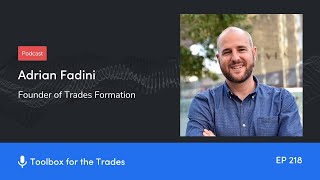
Adrian Fedini sold his plumbing business in 2012 and built TradeSformation into a 14-person coaching firm for trades. He teaches a seven-step sales system and pushes plumbers to move from hourly to flat-rate pricing using data to track what actually works.
Questions this video answers
April 3–4, 2025.
2012 (with a two-year earn-out period after the sale).
14 staff, including 5 coaches.
They are the first ServiceTitan certified partners/providers in Australia.
Hello, contractors, and welcome to Toolbox for the Trades. My name is Jackie Aubel and today I am speaking with Adrian Fedini, the founder of TradeSformation, our very first Australian service Titan certified provider. Adrian is passionate about helping tradies develop exceptional businesses and he's really good at sales training. I hope you enjoy his energy and enthusiasm as much as I did. Adrian Fedini, you are the founder of TradeSformation. Today you and I are going to be speaking about transforming the skilled trades in Australia.
Welcome to the show, Jackie. Absolute pleasure to be here. Thank you.
You are going to be our second guest with an Australian accent. I hope you are just as excited as I am. And this is all in celebration of an upcoming event that we are doing in Sydney, Australia, at the beginning of April 2025. I'm so excited to chat with you.
Absolutely. Yeah. Look, I'm in good company. We've obviously got Service Titan coming to Australia for that conference. I've been to Pantheon and I met you there face to face, which was phenomenal. And we're so excited about what's coming up for Australian trade businesses.
I know. We are too. So we had Scott and Vicki Irwin on who will be the episode before you. And I believe this episode is going to be airing when the World of Titans takes place. So I cannot promise that registration will still be open. But for folks who are interested, this is the World of Titans Australia event in Sydney, Australia, April 3rd and 4th, 2025. We're probably going to do another one if this one's successful, but let's get to it. Adrienne, I want to hear what is the best piece of advice you've ever received?
So the very first piece of advice, and it's hard when you're younger and it gets easier as you get older, is stay the course. Stay the course, remain consistent, don't give up. And there's a little adjunct to that as well, like, yes, don't give up, stay the course. I've been in Trades trades my whole life, like, from a very, very young age. I worked one year with my father and we decided after one year of working together, we go separate way. However, I never left the trade. I had a little moment where I stepped back out, but I came back very, very quickly and the fact that I remained consistent made me successful. The other little adjunct that I want to add to that too, is that stay the course, but don't keep doing the same thing over over and over and over again. Because some people might say I've got 20 years experience but do you just have one year of experience that you've repeated 20 times? Or are you growing? Are you evolving? And get advice from the right people that have been there that have experienced the highs, the lows, the mistakes to avoid how to set yourself up for success. Stay the course, but get advice and support from the right people.
Perfect segue into what it is that you do over there in Australia, which we're going to get to in a second. I want to hear about your journey from plumber to business coach. How did that happen?
Yeah, it was bumpy, to say the least. It was also exhilarating and emotional. And we, we exited the business in 2012, which is a fantastic. Anyone that sells a business, congratulations, hats off to them. It's not easy. At one point and. And I shared with you, share this with you. My wife and I went through an early period in the business. Like, actually it was. I was talking to Ellen the other day on a podcast she did. She did an episode on ours and I loved the line that she said, we made all the mistakes you could. We did the same thing. And 99% of business owners are going through that. Unfortunately, that resulted in us having to sell the family, family home. So that was quite a, like a pivoting moment where we went, all right, we either go down or we get better. And my wife and I just got stronger together. We got the right advice with the right mentors, and then many years later, we built the business. Being able to sell in 2012 to a gentleman by the name of Tim Cook, even though he's got the same name as the Apple CEO, it's not Tim Cook. And I actually learned just as much. So I had what we call an earn out. I don't know if the listeners are familiar. You probably are familiar with an earn out. So that basically means I was connected to the business for two years after I sold it to make sure the clients came over and all the contracts more so that the clients came across because we had what you call condominium work. We had a lot of COD work, which is working for mums and dads in residential areas. But we also had some Strata contracts, which is condominiums in the States. So we had a nice mix of both. We wanted to make sure all the clients came over. And in that two years of doing my earn out with Tim, by the way, it was the best two years of my life. Time to focus on one thing only, and that was selling. And I learned as much in business of having my own business for 10 years as I did with Tim for two years. Tim. Tim's a bit of an industry leader around. He's very good, very, very close friends with Scott and Vicky Irwin and yeah, plumber to the rescue to this day still goes on and Tim runs it now and we love what we do. I catch up with Tim and Scott and Vicky often. Again, I'm using the figure of putting a bar around a nice little bar around it.
Again, you just put so much history and backstory into that answer. I'm going to have to dissect it a little bit. Okay. And also I want to go back to when you mentioned you worked with your father for a year and you guys were like, nah, this isn't going to work. So is your father a plumber as well?
I'm actually a third generation Italian plumber, so. In Australia we had a thing called the Snowy Mountains Hydro Scheme back in the 1950s. My grandfather came out for that. My dad actually didn't come out until eight years after my grandfather, which is. Has its own challenges and it was actually one of the biggest engineering projects in the. I get emotional. It was huge. Excuse me. I think we had about 300,000 immigrants come to Australia, mainly from Europe. Italians, Greeks, Spanish, Eastern Europeans, Czechs hardly had two words of English between them. And they built one of the most phenomenal engineering feats in the world. Excuse me, sorry. As you know, I wear my heart on my sleeve. But it's, it's. Yeah, it's, it's really, really well regarded. And if you, if any listeners in America are listening right now, check out the Snowy Mountains Hydroelectric Street. The first one, the second one they're doing at the moment, that's not going as well as the first one, but it was. My father came out, he worked with his father, they were down in Coomber. And then my father moved to Canberra and had a business called Summit Plumbers which he. Yeah, he did. Not much maintenance, more construction stuff. And I just, I'm not into construction. Home services is where it at and I love talking to people, building relationships, building teams and you don't get that in construction. Construction is just a lot more. It's a bit more transactional. You can't build great value, you can't build great service. So it really, it limits the amount you can earn because people aren't really worried about paying top dollar for a great communicator in a construction project. Compared to when you get somebody in your home that you love and you cherish and you want them to protect it and look after it and give you the right advice. That's when obviously service comes into it. Everybody wins. The customer wins. They get an amazing customer experience. The actual technician wins because they can make sales where they get a great commission and the businesses win because they make good profits. So it's a much more holistic and great industry to be in, being in the home services as opposed to construction.
Wow. So you are first generation Australian. You're a first generation Australian citizen. That's incredible.
Correct. Happy to be adopted by any Americans. I love America too, so. So I'm a bit old to be. I'm 50 years of age now, so I'm a bit old to be adopted. But yeah, I love the States and even though I love Australia, I absolutely adore Australia. There's just a lot of good things happening in America too. Is, I know it's, it's a bit up in the air at the moment, but in essence what it stands for is opportunity and success. And there's a lot, there's a lot of good stuff. There's.
Yeah, yeah. So, okay, so dad was more on the construction side. That wasn't where you were finding your bliss. So you decided to go off on your own. Create plumber to the rescue. And your wife was in the business with you as well. It sounds like.
Yes, Nadia. Yeah, Nadia is my wife's name. And the, the ongoing joke. I don't know if it's the same in the States. You marry a plumber and automatically Ellen can attest to this as well. Automatically you become a marketing manager, a social media manager, an accounts manager, finance manager. Like start wearing all these poor hats, like hats for the poor wife. We found out soon that we had to get experts in all of those roles. So yeah, it took some time. But it also puts a lot of strain on when you work together, live together, and then when you have conversations over the dinner table and it's around work, it definitely makes it hard. We have been, and I've been in this business 10 years this May, which is phenomenal. Nadia is not, not as involved in this business and it's just nice to have that separation. And I said one day on a social media post, I look, I really want to climb Mount Everest or I want to go and run three marathons back together, back to back. And I said this the other day too when I was talking to Scott, Vicky and Ellen. But then I realized I'm in a business with my wife and that's nothing to disparage her, but just that emotional triggering and what comes up and how that all kind of plays out can really, really make you grow. And both of us, so. So it really. It's a monumental event in its own.
Yeah. I mean, trust me, we've been doing this show for over 200 episodes now. I've had plenty of husband and wife duos come on together. Come on separately. I mean, and Ellen herself, her and her husband, they work together, and then they decided not to work together. So it's really. It is a very special thing when folks can make it work, but it's also an incredibly hard thing. And you alluded to the fact that you had to sell your family home because you got to a point in the business. And I know this is part of where the passion for Trades Formation is, so that's why I kind of want to stay on it. You experienced a pretty tremendous personal loss because of where the business was going. And then was that what inspired you to seek help and to figure out, what am I supposed to do to get me out of this?
The best motivator in the world is pain. It's not pleasant, but it is by far the best motivator. When you are in pain, you will learn things that you said, oh, I don't like numbers. I mean, I love numbers, but you don't. I mean, I love numbers. Now, did I love numbers back then? Probably not as much. Right. But when you have that level of pain and also to a commitment to be resilient and to find the answers, you're never going back there ever again. And also to not. You're never going back there ever again to that place where it was so much discomfort and so much pain. You're going to make sure that you can take. I'm going to cry again. I'm taking as many business owners as I can on the right journey to the right destination to make as much money as they possibly can, honestly, ethically and morally. So that's. That's my passion. Now you can see I'm not.
Adrian. You're not going to be the first person who I've made cry on this podcast. You certainly will not be the last. Do not worry about it. I'm glad that we stuck up on that, because I think this is where your passion comes through in the work that you're doing at Trades Formation. You sold Plumber to the Rescue in 2012, did your work with Tim Cook for two years to make sure everything went smooth, and then you decided to pivot to this coaching business because you wanted to help other contractors succeed. And you wanted to help them avoid the same mistakes that you had made in the past. So tell me how that, how that started and you know what the first few years of that business was like and where you're at now.
I'll give an insight to. I was always into personal development and I'll touch on something which we may do as another episode down the track where we can get you Jackie on ours and we can talk about that as well. There was stuff that happened in my childhood that led me to personal development. We'll leave it at that for today. So I knew how transformative that stuff could be. Okay. Then I went, well, what I know from those experiences, plus what I know from my business experiences, plus I tried to reach out and there was a million white collar coaches out there and again, no disrespect to them, they have a place and they're fantastic. But they simply do not even tradie coaches in Australia or even. I'm not sure what the state of the industry is in America, but you could have a business coach that understands a construction plumbing business that has no or even a commercial plumbing business that won't understand home services or what we call a COD business. But there's so much, it's almost like a master's degree at university just to understand how home services work. And then also too in Australia we have a lot of businesses that are a hybrid of COD which is mums and dads and hybrid of B2B which is strata nursing homes, daycare centers, which also brings another level of complexity. So I said like I've got some amazing experiences and some information and we just started to package it together and now we're 10 years later coaching all across Australia and 14 staff, which is amazing. Five coaches. We've got a lot of support staff as well. So yeah, it's, it's one hell of a journey, but it's been amazing.
That is awesome. All right, so let's get into the actual coaching of it. All right. I love to get experts takes on this show. So folks listening can, you know, think about it, mull on it. And I wanted to mention when Adrian and I first did our pre interview that prefaces the this one I mentioned how service sti. You know, I've got some of these, I got like my elevator pitch for, for, for toolbox for the trades and I was like, okay, so basically we try and get tips and tricks from contractors to help other contractors. And the first thing Adrian said was I don't like that phrase. I don't like it, but I prefer to use the phrase proven strategies and techniques. So I would love to hear if you could give me an example of a strategy or technique, not a tip or trick that you've used to help a trades business succeed.
I'll speak from my personal experience and from Australia often don't necessarily start out wanting to be a tradie. They kind of are the usual. And again, I don't agree with this. I actually hate it. It's part of my life mission to change this. You didn't do very well at school. Let's look at a trade for you because you didn't get to college or university. And that straight away puts us with a little bit of a low self esteem. And then when we get into our trade it's tips and tricks and like things that aren't professional. And I really want to bring professional language back to it. So we're professional, we're worth every single dollar we make. We provide great lifestyle. We had lockdowns in Australia and the only people working were essential services, plumbing, electrical, air conditioning, et cetera. And the same was in the States, I'm sure. So I really want to change that language. That's why I love we do professional, we do strategies, we do techniques. And that's the kind of the background on that.
So I love it.
Thank you. Thank you. So my number one thing is data driven decisions. I love data. Okay. I'm a very emotional guy and I have definitely been caught in my emotions in the past and I understand there's a place for both. It's great to be in touch with your empathy and compassion for other people. But don't let your empathy and compassion run a business because it won't last very long. You need to have a nice balance between compassion and empathy and data driven decisions. So some of the strategies and techniques. Look, we always. And again, I know this sounds crazy, but one of the biggest issues with Australian trade businesses is they've either never worked out the labor rate or they haven't done it for three or four years or five or six years. And I guess I would assume that it would be somewhat similar in America. People do it. Yeah, I did it two years ago and then all of a sudden we have inflation and this went up and Johnny wanted to pay rise and I had to buy another two trucks and this happened and they broke the relining thing and I had to spend another $40,000 on that. So then all of a sudden your overheads and expenses have crept up and crept up so we start always with a labor rate calculator. Right. So we always look at the numbers. That's kind of rudimentary and fundamental. Everyone's probably heard that before. But then we start to look at what are you tracking inside the business. Because if you're not tracking, this is also too why I love service Titan because it gives us so much information and it can be dangerous for. I suppose it's a great time to say we're the first service titan partners in Australia. Certified service titan partners in Australia. We're so stoked to have that honor. And what can be dangerous is when you get a lot of information with no context. Okay. Because then it just goes into analysis paralysis and you don't know what to look at. So then what we do as a proven strategy and a proven technique to bring it back to your question is start to look at what are the sales metrics or the revenue metrics. Because when we have money coming in and we have money in the bank, all other problems can be solved over time. But if we don't have revenue and we don't have money in the bank, it's suffocation of a business. That can happen very, very quickly. So we start looking at, okay, what's your average ticket? What's your revenue per day? How many jobs are the guys attending? Again, pretty basic stuff. But then we'll start getting into some more granular details. How many minutes are the technicians spending on the job? Okay, how many options? Again, we always say minimum of three options. And if you can get better at that, you can can go higher again. But we start to look at the more granular data around sales first after we've got the labor rate right. And then we start to look at what's going on in the field. And then we'll turn our eyes most likely to. I mean, again, every business is different and we prescribe, we don't have a cookie cutter approach. We all do. Everything we do is one on one coaching. And every single business gets a prescribed business coaching and sales coaching journey from us. So then it, it usually starts, labor rate, calculator, sales data, and then it could go to either processes and delivery, or most of the time it ends up going back to marketing data. And then we go really deep into that as well.
Got it, Got it. I mean, like you said, like, these are very basic things, but sometimes, especially when you're in the thick of it as a business owner, I feel like having a coach come in and support you while you uncover this data can be so effective. And I also, I want to give you props for mentioning that you are a, you know, you're an emotional person and you didn't maybe like data as much. Now you do. I am currently on that journey of learning how to love data myself. So it's nice to see someone on the other side of it.
I love embracing both. Look, it's, it's funny. People that know me, like we're getting a business coaching session and someone go, this, this is a big problem. Adrian, can we call you and one of the coaches and they'll say, oh, this is a story. This is. Okay. Okay, let's look at the. We've also created some dashboards which are fantastic to help out with. No longer needed now with Service Titan. But we look at those reports we can get from Service Titan or our old dashboards and see what, what is the numbers telling us and then we can go, all right, cool. Now we can start to make some more informed decisions. Like I said, data driven decisions.
Very cool. So you have mentioned before that you like the sales side of things. That was what was so great about you working with Tim Cook as you got to focus on sales. So let's really get into the way you think about sales. So can you walk me through your seven step sales system?
Absolutely, absolutely. So it's nice and simple. We always start with great first impressions. So step one is all about making that first impression. Here's obviously how we address and I mean, I know it sounds silly, but gentlemen, please, if you have cotton press shirts with button ups, which I love, iron them, please iron them. And if you're a business owner, look at what it costs if you, if you're not getting. I mean, the guys should be able to do it themselves. But I've even had a client that I ended up getting them pressed for $2 a shirt each and they worked it all out in their Spiffs and whatnot. So therefore they didn't have to worry about it. Because there's nothing worse than having a lovely uniform and then having your logo and having a brand and then the shirts all look like you've grabbed it from behind the lounge or something and the cat may have slept in it. That is really horrible. But there's so much more than first impressions. It's about how to build small talk, how to build rapport, how to find common ground. I say, how do we connect heart to heart, not head to wallet. I'll repeat that again because it's important. How do we connect heart to heart, not head to wallet, especially in the first impression, because people don't really care too much about the transaction and the sale until they know how much you care about them and what's going on in their place. And it's really, really important to get that. So that's step one, first impressions. Then we move into step two, which is gathering information. So I use questions in heaps of different places inside the sales process. Definitely gathering information. In fact, that's where I coach to stay the longest amount of time in a sales process. The more time you spend gathering information, finding out their fears, their desires, their wants, what's happening with their house, how many people live there, how old are the children, all that type of stuff really starts to build a really good picture of what the solutions and what the options will be. Then we go into providing options. So we go from gathering information to providing options and doing an inspection, then presenting those options on an option sheet. And I still, I know you had Phil Folaski on, on the other day. And my understanding is he, even though he like does amazing numbers, he still loves and I could be wrong, but I've got a feeling Brent Buckley as well loves paper option sheets and then uploads them into Service Titan because they're just so old school and they work really, really well.
I don't know that I have to find out if Phil does that.
I might be spilling beans. I, I, I could be wrong. I'm, I'm happy to be corrected, but I've spent some time with Brent in Fetch Attack over in Las Vegas two years ago. G', day, Brent. Lovely to, yeah. Spend that time with you. We still talk a little bit through social media, but I might, I could be wrong. Things may have changed and I hope I haven't let the cat out of the bag.
Oh my God, if you have, I hope someone comments on the comments on this episode and tells us if you've left the cat out of the bag. That would be, yeah. Fascinating if like the 20 million sales.
If I have guys just blame me that I was wrong.
All right. Yeah, exactly. Exactly.
Yeah. Adrian had no idea. So I love doing that too. I also love like using your iPad and being able to present those options. However, some days you should always charge your iPad. But the Internet goes out, something goes wrong, there's always something. And then you, you don't want to be trapped by one mode of one modality. So you can go back to that. And also too, when we present options, we talk a lot about what actually was said in gathering information. So we're looping back statements the customer has told us to make sure we're not using our language. We're using the language they offered us when we gathered information back in step two. So that's how we present in step four. And then step five is understanding objections. Okay? Not overcoming, not dealing with them, not handling them. Okay? Because if you deal with them, overcome them, et cetera, you start a conflict and you start a fight. And that's the last way that you want to actually work with the client to get to an agreement is to overcome them or handle them. So I love the concept of understanding and I'm going to share my learn formula. Learn being a way that I neutralize or understand the objections. And then finally the final two are then closing the sale. And then also to how to get a five star Google review. I don't want a Google review. I want a five star. So I'm very clear and have a lot of intent in the language that I use to get the outcome that I'm looking for. So that's it.
I mean, I love it. I mean, I've had sales experts come on this show before, and you're not reinventing the wheel, so to speak, but it is so important to stick with these convictions as you're going through that sales process and making sure. I love what you said about heart to heart, not head to wallet. I think that's so important. And actually just bringing it back to podcasting. That's why I do my pre interviews, because before I hit record and I want people to, you know, and I want to interview people about their expertise. I want to meet them ahead of time and be able to say, hey, this is me. This is what I'm all about. This is what I'm trying to do. So this way they can better understand me. And that puts people at ease. So I absolutely love that. The heart to heart before head to wallet.
We're human beings at the end of the day, and that's what it is. It's about connection, it's about service. It's about making their. Improving their lifestyle, their comfort. Something. Something that is. Is personal and intimate to them. So y. You got to start as a human being.
So you already hinted at your questions. You're obsessed with asking quality questions because you want to get as much information as possible. Tell me about that. What are some of your favorite questions to ask potential clients or that you coach your clients to ask their customers?
They're ridiculously simple. They're so simple. So one of my favorite Ones is, why do you feel that way? Oh, a bit of tonality added into it. You get an objection of some sort, I need to get second other bids or I need to get a second opinion, I go, okay, what do you feel that way? So. So rather than me going straight into a defensive strategy of, oh, you should get it all done today. And then straight away I'm getting that conflict that I mentioned earlier. I'm buying a little bit of time, and I'm also pausing to allow the customer to think about why do they think they need it. So that gives. It's not always going to get me the sale straight away, but it's going to buy me time to keep me in control. And that's something that's really important for all the listeners out there. If you're not asking, when you're talking, especially in a sales situation, you should be at least 70% of the time talking. Maybe you make a statement, always tag with a question. If you're not tagging with a question at the end, you're not in control of that conversation and therefore you're gonna. Everything will unravel for you. And again, we're always using these skills to make sure that we get the right outcome for the customer. So there's nothing about manipulation here. It's all about how to honestly, ethically and morally influence and persuade them to get it done. Because I train my guys to believe in themselves and also believe that there's almost like a divine right, that it's happened, that I'm meant to be in front of this customer today. It's not like, oh, maybe I'm not. No, no, no, it's happened. The stars are aligned. You've worked at the right company, they've called your business. You're there. It's meant to be. It's synchronicity. So then if once you have that certainty and that and that feeling, that, yes, I am the right solution for you, because if you get anybody else to do it, they're not going to do as good a job as I. Another one of my favorite questions would be, Jackie, does that make sense? Like it literally.
Yeah, that is the question I ask all the time. I literally, I think I say the phrase, does that make sense? At least 10 times a day, I'll have to ask my team to pull.
It's just so simple and it's great. Does that make sense? And then I could even. I could take that a dozen different ways. I could use that when I'm gathering information. I could use it In a selling situation. My final one is when, depending on what trade. If you're H Vac, plumbing, electrical, et cetera. I'm a plumber, so I'll say, okay, so when was the last time you had a plumber in the house? And then no matter what they say, I have two different options to segue into an inspection. And I'm not asking for permission, I'm asking for forgiveness. And I'll explain that a little bit better if they said to me, oh, look, I haven't had a tradesman here for age, or I say tradesman because I coach plumbing. All the, all the different pest control you mentioned before we started as well. Anyone that's home services, plumbing, electrical, H Vac, pest control, locksmiths. We even had carpenters in our course. We had an intensive last week as well, which was phenomenal. Home decorators and painters as well. So it's. Oh, wow, right. That's why I like to use the word tradesman. But in this case, I use plumbing. When was the last time you had a plumber here? Okay, they got, let's say they haven't had one there for years. I haven't had one here for 10 years. Okay, great. I'm going to do a quick whip around and make sure that there's no nasty surprises. Right? Or let's say they go the other way and they say, oh, look, I only had one here a month ago. All right? And then I'll again, a bit of a flinch. Okay, straight away, that's a clue to me. Well, if you had one here only a month ago and he's not back, he must have done something wrong because otherwise you would have called the same one back. So that's something I put in the parking lot to use later on in my sales presentation. But then I'll also ask. Then I'll also say, well, I'll just make, I'll just do a quick whip around, make sure he didn't miss anything, because more than likely if he's not back, he's probably missed something. Either way, I'm moving back into the house to move around, not asking for permission to do an inspection and, and being able to go and find things that are honest, ethical, moral, are going to improve the customer's life.
I love it. I think that's great. Let's talk about understanding objections in the sales process. So you mentioned that too when you were breaking down your seven step sales process. Right. Or your seven step sales system. So how do you understand these objections and then eventually overcome them?
If I want to understand, in order to understand, I must learn. Okay, did that make sense? So it's like to understand part of understanding is learning. So what I did, I made an acronym, acronym for learn. So it's listen, energy, ask, repeat, then neutralize. So we want to straightaway listen to isolate the exact objection. So we might often I've seen this happen either in a, like a ride along or in a role play scenario. Technicians often think they've heard an objection to be X and it ends up being Y. And most of the time they think it's price when they haven't listened carefully to the customer and then it hasn't uncovered exactly what the objection is. So the very first part is listen carefully, isolate and identify the objection so you know what they're objecting to. Okay, so that's the first part of learn. The second part then is energize. So what technicians. And I'm going to just get my body language right here for this one. What happens is I'm going to get other bids subconsciously. This is what happens 99% of the time with untrained or even trained, but just haven't been role playing. They go, oh, their shoulders sink, their head drops, their energy drops. They go, all right. They didn't even realize it happens in a millisecond. And it's subconscious. So I really want to go, okay, great, all right, cool. There's an objection here. I'm getting. I'm here to serve you, to help you to understand where you're coming from. So when you open up, your shoulders bring energy and get a little bit excited, not too excited, but getting excited enough to make sure that you counteract what you would normally do. And then we ask a question similar to the ones that I said before. It's, oh, yeah, why do you feel that way? Or depending on the objection, we could go half a dozen different types of ways. Once we've asked that question, we always repeat the answer that they've said to buy us a little bit of time. So we also too are encouraging understanding. We want to make sure that they know that we've heard them and we're not rushing. And that's definitely still to this day. One of my things, I like to go a million miles an hour. So we need to slow down and that repeating of that answer helps. And then we go to a neutralization which starts with one of my rebuttals. And we finish the rebuttal with a tag question. I'll give you an example. So let's say, I've gone through all of those four parts and I get to the final part and I go straight to my neutralization. And they've said to me something to the effect of, Adrian, I can get it from this other guy at 30% cheaper. And I go, that's exactly why you should be going with us. 95% of businesses in Australia have never sat down to work out what their cost of business are and they end up going broke within about 95%. So I have no idea if they're going to be around to fix any warranties to do anything like that in the future because their numbers inherently wrong. However, I know exactly how my business comes up with our numbers. Our business owner sits down with our management team. We look at our overheads, our expenses, and we allow a small margin for profit so we can offer you lifetime labor warranty. So then that way you don't have any peace of mind issues and you can basically purchase without having any regrets whatsoever. Does that make sense? So then you go into like a does that make sense tag question at the end of it. So you don't finish a rebuttal without having that tag question on the end as well. Does that make sense, Jackie?
It does make sense. I know. I was gonna, I was gonna tease you for hitting me with the does that make sense? A couple times throughout that explanation. And it did, it did make sense. Thank you. Really, really awesome stuff. And I love that acronym. I totally, from the therapist angle that I have my, my education background, just repeating that is just a way to affirm, affirm someone's reality and that is already winning you goodwill in their eyes. When you're able to repeat what they said back to you in a way that shows that you were really listening and you understand what they're saying. So I love the acronym. I think it's so, so cool, man. This episode is jam packed full of information. But I'm curious. I want to, I want to start wrapping us up here and I want to hear from you. What is the biggest misconception people have about selling in the trades? It's like, especially in Australia.
Okay, so if you're on alley rate listening to this, you're not selling. It's, it's. There's no such thing. And also too, and I, I hate to be the bearer of bad news. The inherent business model is completely flawed. The customer can't win. You can't win. Your staff can't win.
I'm going to stop you right there. You said ally rate.
What was that, Sorry, sorry. It's the Australian accent. Hourly rate, hourly rate, hourly rate.
I was like, hourly rate. What is that? Yes. Okay, so if you're doing the hourly rate, you're not winning. The customer is not winning.
Correct. Nobody can possibly win in an hourly rate business. And I know that could be confronting for a lot of people listening. It's probably one of the things we do the most is moving people from hourly rate, even large, large businesses. We've got a business with almost 100 staff that we helped a couple of years back. They were already on the way. They had bits and pieces on flat rate, but then we moved the rest of the business into upfront pricing. There's just no way that the tradespeople can get paid what they, what they deserve. There's no way the customer can get all their problems fixed because everyone's rushing from one job to another. You're just not selling. What you are is rushing. Like in Australia we use the expression, I gotta be very conscious of how fast I talk. You're running around like a chicken without a head. Do you use the same expression in America?
Yes, yes, of course, of course, yeah.
Lovely, lovely. So that, that is probably 80% of our market in Australia. It's also too, that sales is, is a, it's not a four letter word, it's a five letter word. But it's like it's, it's a bad thing as well. Right. When you sell honestly, ethically and morally and you learn a process like ourselves, it absolutely transforms so many things. You get more five star Google reviews, you get happier staff, you actually get happier clients, you get happier team members. It just absolutely transforms. Like I said earlier a few moments ago, everybody wins on the journey. The customer wins, they get more stuff done. They're not worried about watching a clock when you start, when you stop. But you've got to, you've got to take that first step of understanding that if you're in alley rate, you've got to move to flat rate. We can help you do that as well. So that gives a little sneaky plug. But also too, it's not as scary as you first think, right? And if you say, I'll do it one day, I'll do it one day. You keep delaying it, that's going to be probably three years down the track. You go, I wish I did it three years ago. Because yeah, the quicker you do it, the quicker everybody in your business and your clientele winners as well.
Awesome, awesome. So I should mention real quick, you are our first service Titan certified provider in Australia. Congratulations. Just want to be explicitly clear, you do you only work with clients in Australia?
No, we're happy to work with anyone. We've got plans for New Zealand, also the States. Service Titan's not in the UK yet, but we're also looking at anywhere where there's home services businesses we can help. So if you. Yeah, absolutely. Absolutely.
Okay. I just wanted to make that clear for anyone who's liking what you're saying wants to learn a little bit more. So we started this way at the beginning of the show. You're so you're going to be attending Service Titans first ever World of Titans event, which may actually be happening the week this airs, April 3, April 4, 2025 in Sydney. If folks choose to attend, if they're going to be there, what can they expect to hear from you if they run into you?
Yeah, sure. Come and pick my brain. As you can tell, I'm very passionate. I love sharing. And look, we talked about sales and by any stretch of the imagination we are head and shoulders and no disrespect to any other competitors, we're just at another level when it comes to sales coaching in Australia. We also are amazing at helping you with your marketing, helping with your business, it doesn't matter. And obviously helping you with Service titan. We got 14 staff and growing. I think we're recruiting at least two or three. Not, not the same speed as Service Titan, but we're recruiting two to three people a month at the moment. It's been going great and we can help you with any aspects. If you want to come and have a chat to me, there's no topic that's off limits. Happy to chat about anything. Marketing, sales, anything to help you get a better business that makes a positive impact upon your team, your family and your community. We're down for amazing.
Adrian, thanks so much for joining me on Toolbox for the Trades. This was an awesome conversation. Thanks for sharing all of your insight with us.
More from Bill




Capturing the 80%: How SmartAC’s Gen-2 Targets Non-Membership Homeowners | Podcast Ep. 296

Build better customer data with every booking in ServiceTitan | TAD Tune-Up Series

The Biggest Change for Roofers Coming From Other Roofing Software to #ServiceTitan?

