What Contractors Should Know About Marketing to Women | TBFTT Ep. 3
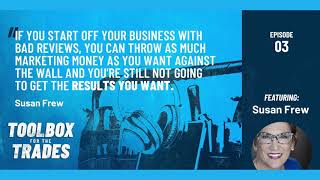
Susan Frew runs a 10-truck Denver plumbing company and explains why she's keeping it small and planning to sell in 4 to 5 years. She focuses on EBITDA, documented processes, and a customer database via ServiceTitan to make the business attractive to buyers. For women customers, she emphasizes clear communication, technician photos and bios, and respectful behavior over assumptions.
Foreign.
You're listening to Toolbox of the Trades brought to you by Service Titan, a podcast for top service professionals where we interview leaders for their best tips and tricks of the trades. Learn how industry trailblazers stay ahead of the competition and how you too can be at the forefront of an industry. Let's jump in.
I really believe that we help people in the trades. What would you do without us just on your drive to work if there were no tradesmen? Look at everything you see and it would no longer exist, right? If we did not have tradesmen to put our world together. We are the foundation of our country.
Hello contractors and welcome to the Toolbox for the Trades. I'm your host, Jackie Aubel and today's guest is Susan Frue, a public speaker, business growth expert and and the owner of Sunshine Plumbing, Heating and Air, a boutique service shop in Denver, Colorado. Throughout her time at Sunshine, Susan's received countless awards from trade organizations, the bbb, even Inc. Magazine for her dedication to customer service and creating a terrific workplace culture. This interview is filled with tips like how to match your long term personal goals with the growth goals for your business, how to work effectively with a significant other, and most importantly, how the trades can better market to women and it's so important to their overall business success. In fact, we're giving listeners exclusive access to Susan's video what Women Want from Their Contractor. Stay tuned to the end of this conversation to see how you can get access. Enjoy. Susan Frue, welcome to the podcast.
Hey Jackie, how are you? So good to see you.
Great to see you too and I'm doing well. How about yourself?
Excellent. Thank you.
Can you tell the listeners at home a little bit about yourself?
Sure. My name is Susan Frew and I'm the president of Sunshine Plumbing Heating Air and I own Sunshine with my husband William who is a master plumber, a NATE certified H VAC technician and back in the day he was a journeyman electrician. So he is a jack of all trades. We have sort of a boutique plumbing, heating and air conditioning company in Colorado. We have 10 trucks and we like it that way and we have no desire to be one of the 30, 40, 50 truck operations. We like where we are and we have a great team, great reputation. We are known for white glove, really high touch customer service with our customers. That's we've been written up many times and won a ton of awards for that. We made Inc. 5000 lists last year and my background is I was a business coach for a long time and prior to that I Was an international general manager with AT&T Wireless. And in addition to working at Sunshine, I'm also a professional speaker. So I am out of the office about 30% of the time speaking to people at trade conventions and meetings and events and things to that nature.
Nice. That's a nice summary. I would love to learn how you went from the business world, the business side of things, to getting into trades. So can you talk a little bit about that?
Sure. As a business coach it was really interesting. I coached 17 different traits, about 150 different companies altogether, but weirdly, 17 different traits and they just kept referring me to each other. And my dad was a carpenter, so I sort of feel like it was meant to be. And then when I met and married my husband William, we started Sunshine Plumbing, Heating and Air in Denver. He was Sunshine Solar and Mechanical up in the mountains. So we like to joke that we merged when we got married and business coach meets tradesperson and Sunshine Flaming Keating Air was born.
I love that. And I know we've talked about this before, your dad's a carpenter. My dad is also a carpenter. But you had no inclination to like even go into the trades when you first began your career, is that correct?
No. I mean I was in a white collar sales role for my whole life. Basically I worked for ADP payroll and paychecks. And then I worked for AT&T Wireless in New York City. I lived in New York City for a long time. I grew up in New Jersey and when I was transferred out to Denver it was through AT&T Wireless. And then I ultimately ended up in the country of St. Vincent and the Grenadines in Grenada. And I was an international general manager for those two countries when we were building out the wireless 3G networks down in the Caribbean early 2000s.
That's such an interesting background and such a variety that you have in your resume. So talk to me about what do you like, what do you look for in work opportunities? What kind of problems do you like to work on and what are some of your professional goals?
Well, one of the things that I love and naturally gravitate towards is the sales and marketing and really high touch customer service. And I've always pushed my clients when I was coaching to really have that as the forefront to make yourself known for your customer service and really high end whatever you can do that's unique and different to set yourself apart. And I call that the pufferfish effect. So to make yourself look bigger than you really are, you need to create a great reputation for Yourself. And nothing is better than creating a reputation based on outstanding customer service. So that is something that I am always clanging the bell about. And professional goals. For me, that was the other part of the question. I love. When I'm not speaking, I love it. I really would like to ease myself into in this next year to be out of the office 60% of the time. That's the goal. 60%. I think more than that, I think Sunshine would suffer, and it has, because I've been gone more than that before. You know, I really need to be here a good portion of the time.
Gotcha. I want to get into that, and I want to talk about how you're able to kind of be out of the office for those different percentage levels. But before we do that, I would love to hear more about how you and your husband came together, met, and then decided to go into business together. You know, in the trades, there's so many family businesses. There's a lot of husband and wife duos. So talk to me about your experience and what you found in your work coaching and speaking with other tradesmen and women.
Well, my husband and I have learned to really stay in our own lanes. Okay, so he really is in the field, and he manages the field guys, and he is our boiler genius. No one knows boilers anywhere like my husband. He's been published 11 times for his boiler work. I mean, it's absolutely spectacular. So when he's in the field, he is the happiest as well, because a few years we brought him into the office. We were growing really fast. And he came into the office for three years and he really wasn't happy. So we have really created job descriptions. And that is key. When you are working with a family member, you have to have job descriptions just like any other employee. And so he sticks with his field work and I stick with the office. So I work very overarching. So I work on strategy, marketing initiatives, growth of the company. I do the final interviews, and I create the annual and quarterly planning. So that's basically my role. And his role, which he loves, is being out in the field with the guys and with customers.
So it sounds like for your business, and I'm imagining, coincidentally, your marriage to work, you guys really have found that defining those roles and sticking to them has really created harmony.
Yes. And my husband and I get along great. He is a super easy to get along with person to deal with me. I'm a pretty strong personality, but he just really gets lights on when he's out in the field. And he's meeting with customers. It also is good for us. It was really good for us to have him go back out into the field because I think there were some processes and procedures that needed refining. And you can't really tell that sometimes when you're sitting in the office, you need to actually be in the field doing the do sometimes to figure out what needs to be altered and adjusted.
Yeah. And I just got. You guys got me thinking about something else. And I imagine that these lessons could also be applied to any type of business partnership, essentially. So, like, recognizing the strengths of each partner and making sure that they are empowered to utilize those strengths and finding someone who's compatible with you that is better in areas where maybe you could use some work on.
Absolutely. And that is really key is to playing to your strengths and doing things that you enjoy. And I love what I do, and he loves what he does.
Can you tell me about the personal journey you went on to discover what your strengths are and what it was you liked about this line of work?
Well, you know, I was in corporate America for a long time, and I really thought that was going to be where I ended up. And when I came back from my international assignment, they wanted me to go to two cities that I really didn't have an interest in going to. But then I started working with the small businesses, being a business coach. I bought a business coaching franchise and was trained and certified by them. And I did that for seven years and through all the 150 companies that I work with. I mean, I just love companies that are business to consumer because I think that you can have such an impact when you are B2C because you can really make people happy and you can serve all these amazing needs for them. And I really believe that we help people in the trades. What would you do without us just on your drive to work if there were no tradesmen? Look at everything you see. And it would no longer exist. Right. If we did not have tradesmen to put our world together. We are the foundation of our country. And everything that we see and think and do every day is built by the trades.
Totally. So it seems like one of your maybe core personal and professional values is to really create that customer experience. And you found your love of doing that in the work that you do in the trades.
Absolutely. And, you know, sometimes we fail. You know, we don't make everyone happy every single day. I don't want to, you know, I don't want to ever say that, because sometimes we just don't do a Good job of that. Or something falls through the cracks or we are late to an appointment or there's traffic or whatever it is. You know, we, we do our total best every single day. And I think that's all you can do is to bring your A game every single day.
Gotcha. Is there anything about your personal journey to get where you are today that you want to talk about that we haven't talked about yet? I know you're very involved in other women in the trades organizations.
Well, I, I have found that in our particular business, because we are 51% women owned, that a large percentage of our clients are women. And they are our clients because they feel that I have done a really good job of background checking, setting up expectations, training, setting boundaries for my technicians that are really high bar for them to hit. And our women clients continue to come back to us and continue to refer us. And I think that's really powerful. And I do belong to a lot of women's groups and all of them send their friends and everyone over to us. We just had one, this woman had been looking around for a boiler system for a really long time and she ran across one of my women's group's friends and they called us and it's this huge job and we will be installing that in the next two weeks. So it's just because of the reference from another woman owned business.
I love that and this is the topic that I really want to get into. But before I do, I would love to talk a little bit about what you said when you were first describing sunshine, plumbing, heating, air. You said we're 10 trucks and we like it that way. Talk to me about that.
Well, you know, when we first started I always said we are not going to get any bigger than X. And the reason for that is this. We love our little team. And if we were to get bigger than we are right now, William and I have a dream of retiring in the next four to five years. Right. And if we were to get bigger than that now, we would need to then bring in some additional overheads. Cfo. We would definitely need some different layers of management which we don't have now. We right now run very, very lean. So it is our goal in this next four to five years to sell our company. Right. So we want to be as profitable as we possibly can and have a team that's happy and ready to move along to another owner or become employee own. And we have offered stock to two of our employees this year. So maybe at the end when we're ready to retire, they may decide to purchase all of the other shares of stock and then they would be owners. That's completely up to them. But I'm starting to get ready now because it takes you three to five years to really get ready to move on. And our goal is to do that. So that is why I feel like if we continue to grow, grow, grow, we're going to take our eye off the ball of getting ready to sell and make money as we possibly can for our retirement.
I love this, and I want to talk about this more because I feel like in business in general, like in our country, in our, in the American culture, there's always this need to want to grow, grow, grow to be the best, to make as the mut. As most, as the much money, as much money as you can and to achieve all of this astronomical success. But it sounds like you're being incredibly strategic in how you want to run your business. And I love that you're think retirement and four to five years out. So talk to me about how you guys came to that decision and what you're also hearing from other contractors.
Well, our daughter lives in Wilmington, North Carolina. My husband is an avid snowmobiler. Which, you know, Jackie, because last time you were here, I had a broken leg from my snowmobiling adventures. So we really would just like to play and I would like to be speaking full time. That is a dream and a goal for me. And my husband would love to travel with me while we do that. So that is our plan. But what I have found after coaching all of those businesses is sometimes revenue is an ego number. So If I had 20 trucks and $8 million in revenue, but my profit wasn't there, then what would I have at the end of the day? Right. It's very, very strategic and it's a whole other animal that I personally could not do on my own. I would need a legion of to get to that size. And I admire the guys who have done it, guys and ladies, because I know that there's a lot of female teams out there as well, and I think it's fantastic. But we kind of started a little late. You know, we didn't start when we were young and in our 30s. It's not our first job. So we want to retire early and enjoy our time. And it might turn out where we continue to own sunshine and just collect a paycheck for ever, you know, who knows? I don't know what that's going to look like. But the key is to get Ready. And that's what we are doing now. We are running lean and we're going to continue to run lean for the next couple of years and then we'll see what our value looks like then. And I do get my business evaluated every two years, which I know a lot of business owners haven't even done it because you need to know what your company is worth. Because I will tell you this, I've seen it a million times, is people always think their business is worth more than it really is. So the soon as you can get a business evaluation done so you know where you are and what work needs to happen to get to your number, the better.
So it sounds like for business owners who may be caught up in this growth, maybe caught up in an ego number, which again, like I give the same amount of credit to folks like that who've achieved astronomical success. Like, that's amazing. But it sounds like as a business owner you really have to be strategic about what do I want my life to look like in 5, 10, 15 years and what do I need to get it there? And also how much is my business worth? Because if you're just focusing on growth and you're not doing that regular business evaluation, you may be making assumptions that aren't actually true.
Right. And business sales are based off formula called EBIT or ebitda. Earnings before interest, taxes, depreciation and amortization. Right. And if you don't have strong ebitda, it doesn't matter how great your top line numbers look, if the bottom and the EBITDA score doesn't make sense, it is not happening. You're not going to be able to get the money that you need to sell it for unless your employees take it over or something to that effect. That might be something that's in the cards for you as well.
What are some resources that you would recommend to contractors listening at home right now who are now thinking about all these things and need a kind of a primer as to better understand these numbers and better understand what the process is for evaluating their business and potentially selling it.
Well, some CPAs can do it. I personally use a company that I love and sometimes we go to conventions together. They're called Rain Catcher. And they did a business evaluation for me this year. So they did where I am now and where I want to be. So they did the evaluation in two different stages. So now I can see what needs to happen and what do I need to do in the next three to five years or whatever that looks like to turn it to. So I get the money that I want at the end. And there are great business broker firms out there. Definitely do your research though, because there's some that aren't great. Another thing I like about Rain Catcher too is they're national. And the reason why I like that is because there could be someone from another state that wants to buy your business. And also now right on the front page of some of the trade magazines, I've been seeing that venture money is out there in the trade significantly right now because they know that trades, especially service trades, are recession proof. And if we have a dip in the economy, our businesses are going to stay really strong. The big investor groups are doing consolidations and purchases, et cetera. And you also want to make sure your company's ready if that opportunity comes along. And that might look really good to you and you might decide to bring a venture partner in and grow or bring a venture partner in and leave. Like whatever. It's all good. If that's your plan.
That's so interesting. I love that so much. So it sounds like you've been very transparent with your employees about yours and William's intention to retire in four to five years. How has that been received?
It's great because we are creating ways for our employees to potentially have ownership. It's not going to happen this year. We did offer a small share to one of our two of our employees right now because they have been loyal. They've been with us through a lot of different things. There's been some things that have happened in this last two years that, you know, they've stuck through with us. And we would like to at some point open that up to more employees. So they're excited about that and sometimes never going to go away, that's for sure. It just might look a little bit different in the leadership.
Gotcha. So in addition to, you know, setting your personal goals, getting your business evaluated, letting your employees know, it sounds that the change will happen in the next four or five years. It sounds like you have to do a lot of work to lay the foundation to make your business sellable. So you mentioned you have a great team, you have great reputation, you've won, you know, countless of awards, including the Inc. 5000. What kind of work do other service businesses need to do to ensure that their business is sellable in addition to just the EBITDA numbers and the financials making sense?
Well, one of the big things is having processes and procedures. The other thing, thank you to service titan because you know, our company is Very valuable when they were doing this evaluation because of the amount of email addresses that I have in my database. So I've been using Service Titan since 2014. I was one of the first people that got on board. But we have captured every single email address since then. That makes us incredibly powerful because the fact that now we don't have to spend as much money on marketing because we have that giant customer base. We just bought another plumbing, heating, air conditioning company that moved. They were also on Service Titan. So now we are merging their database into ours. Over the next few months, we will start marketing that database for H Vac because the other companies did a little bit of H Vac and they sort of backed away from it in the last two years. But they have 10,000 people in their database that we will then start contacting to cross sell them on H Vac products. That's another great thing. You have to have that database. And we've looked at other companies to buy over the years, like underneath us, smaller companies or solopreneurs. And if they don't have database, I don't want any part of it. Like, what am I going to do with this? This is just paper. And how do I know that they're going to use me now that I own the company? No guarantee of that. So that's something that's really important. Policies and procedures, job descriptions, having things on autopilot, really, and a way to be able to look at your key performance indicators if you're not going to be there every day.
Gotcha. You said, I want to make sure that they don't use me now that I own the business. Can you elaborate on that a little bit?
Right. So we looked at a small plumbing company a while back and the guy was a solopreneur. He didn't have anything electronic. He had employees in and out over the years, but never like on their own. So when I went back and looked at his reviews, they all used his name. They didn't say Sunshine Plumbing, Heating Air was great. They said John Smith. Fake name is great. Right. So that means that if he sold to me and customers call, they only want to deal with John Smith. So you want to make sure that your company is the one getting the reputation, not just your name. Because then when you try to sell, then people are like, oh, well, John Smith isn't there anymore. I'm going to find someone else. So it's good. The new owners aren't going to have as much stickiness if, you know, you don't set yourself up Properly.
That's really interesting. And this actually came up, this come up in a couple of my conversations with other owners who have said, and this by no means is any anything negative to people who do name their businesses after themselves, but I choose the name Sunshine Plumbing Heating Air because my name's not tied to it. The reputation goes to the business, not to me. So now it's an asset that I can sell and make money and step away so I can go snowboard, snowmobiling with my daughter.
Yeah. And that. And that's really part of the deal. And, you know, I learned that in business coaching too. But Sunshine is named after our daughter, so we just don't use her name. We use her nickname Sunshine. So.
Oh, I love that.
Yeah.
So we've been talking. You're given a whole lot of information, and I'm loving it so much. Before we move into how to market to women as a contractor, I would love to learn a little bit more about some of the things, some of maybe some patterns that you saw when you were a business coach for different trades. Like, what are some common, I don't want to say mistakes, but what are some common, like, learnings that you noticed your clients would. Would make? Like, oh, I didn't realize this was a thing, and now I have to learn this. Does that make sense?
I do. And I think one of the bigger, biggest things is just, just like with me and my husband, right. He knows the traits and he knows how to install things. He knows how to quote things, he knows how to fix things. He knows the trade with regard to the back end and the business side of it. He doesn't care for that. It's not like he couldn't learn it if he wanted to. He's really smart. He could, but it's not of any interest to him whatsoever. But then the next step in that is finding people that you trust to do those things for you. And we learn that the hard way, which I've alluded to before. And we may get get into that a little bit more later. But you have to have checks and balances in your business. So if you're going to have an inside bookkeeper, you also need an outside accountant to look in on the inside bookkeeper. You need to have ability to delegate effectively. So that means really good job descriptions, holding people accountable. What we do here is we have daily status reports for all department heads. They turn into me every single day of all of their, like, the key performance indicators that they're responsible for. They give me a report so when I'm on the road or even not, I know exactly what's going on and I don't have that anxiety of worrying. I also have the ability to log into ServiceTitan when I'm traveling and see what's going on. I can log into the bank, I can log into QuickBooks. But if you are actually in the field doing the work 24 7, it's really hard for you to do the other things. So as you grow, you need to find where that break even point is where you can start hiring people to help you with the things that aren't your strengths.
Gotcha. Yeah. And I appreciate you saying, like, William's not interested in it, but he could learn it if he want to. If he wants to. What I'm finding as I'm speaking to more and more contractors is there are technicians who were like, I'm great at this. I'm an awesome technician. I want to go into business on my own. And then they get a boot camp version of an mba, essentially.
Yeah, they do. And it's really hard. I mean, my husband even went out networking for a while and he's very likable and networking was going really well, but he, he didn't have really good time management skills. Right. He's a person who was used to a schedule. He goes to his three jobs a day and then that's it. Right. So now we have this free schedule. Right. So he was not using his time efficiently and he knew that like that's something that he'll say himself, that he really needed managing his calendar. And that's a huge part of running an office, is you need to have efficiency and you need to be putting your time and efforts towards things that are going to be revenue generating.
Totally. So coming back to the main topic I want to talk to you about today, you mentioned that 51% of trade businesses are owned by women. Is that correct?
No. 51% of our business is owned by a woman. So in order to be woman owned, you need to own 51%.
Gotcha.
So that's how the government designates true women owned companies. And I actually did go and get my woman owned certification.
Gotcha. So 50. So 51% of your business means Sunshine Plumbing or 51%. Oh, gotcha.
Cool.
Very cool.
Is more than 51% women. I think that call on us.
Talk to me about what that's been like for you working in a trade that's been predominantly owned and run by men.
You know, I have to tell you, Jackie, honestly, with the exception of a couple of vendors and I don't use them anymore, have been a little slanted towards me. I really don't find that I've made it my business to understand our business. Right. I can't install plumbing, but I can speak to you about it and I can let you know in theory exactly how it works. I know what parts are higher end, what are lower end. Same thing with H Vac. Why should you use this brand over that brand? How do you use this product over that product? I've just made myself really knowledgeable and I've also gotten really involved in the industry. So I was a president of the Colorado PHCC plumbing heating cooling contractors for a long time. Now I'm their legislative chair. So I got really involved with that. I was on the national board. I'm involved with my chambers of commerce. I just get involved so that I can learn. And then you're able to create a reputation that you know what you're talking about.
So gotcha. So you've essentially created a Persona for yourself in this industry that people know that you know what you're talking about and you're just as knowledgeable and an expert as any male owned company. Essentially.
Yeah, I mean, it's a matter of confidence too. I don't really let anybody stop me on that. But as I, as I said, there are a couple of vendors that have been kind of condescending and then, you know, there's other vendors.
There are other vendors. So talk to me a little bit about how you feel your perspective as a woman helps your businesses. Bottom line. You produced a fantastic video that I believe we're going to link to in the page that this episode is hosted in that speaks to what women want from their contractors. So can you talk to me a little bit about that?
Well, I did this interview. I found all of these women through the Colorado Women Chamber of Commerce. And I took women that were sort of like me. They were business owners, they were business people. And I interviewed them and said, what do you want in your service contractor? Like what's really important to you? Because I don't think anyone's ever asked them. Like they come out like I'm marketing to women, but they never really asked the women what they wanted. So these are some of the things that came out of that being on time. And if you can't be on time, you need to let them know. Right. And to be respectful that like if you say your appointments one to three, you can't make the one through three, you need to call. Right. So that was key. A lot of people said that they called contractors and they never show up. And that is bad. No one likes that. But this was especially problematic for them. One of the things that the women told me they loved and more than one woman told me this, that with Service Titan, when we hit dispatch and the customer gets a photo of the technician with their bio background, that they love that they wanted to know who was coming to their house and they wanted to make sure that I, Susan Frew, owner of Sunshine Plumbing Heating Air, had background, checked these guys to make sure that they were safe to go into their house. Another thing that they said they liked was they wanted, if we did a plumbing inspection, say, and we found 10 things wrong, they would like us to stage that and say, you need to fix these two things. Now these three things can wait. The rest of them are optional. So right now it's going to be $500. And next year plan on spending 1,500. Your water heater is getting up there, you know, start making plans. Now. They loved that they didn't like being spoken down to. And then the other thing is they did not like long technical speak. So don't get it. And you know, I personally don't like that anyway. That's, you know, I'm a high D in the disc profile. Like, I want the nuts and bolts, man. Just get to the bottom line, what's going on? And fatal flaw number one, don't ever say ever. Contractors, if you're listening to this, don't ever say, do you need to discuss this with your husband? Because you will lose right there. You can say, is there anyone else in the household that's involved in this decision? You can definitely say that because you don't know what their home life, what their situation is anyway. So you shouldn't assume anything and just be as kind as you can and be very respectful. And park your truck in the street. That was another thing. Don't ever park your truck in the driveway because it could leak. Put shoe covers on. That seems like a no brainer to me. Clean up after yourself. We make sure everyone has a vacuum. So those are some of the main points that I was hearing from Linda in.
I think that's wonderful and I can totally agree with that. So I'm not a homeowner. I live in Los Angeles. That's, that's, that's a pipe dream at this point. But I, I have a car and one of my mechanics, I don't know anything about cars, but while I Was searching for mechanics out here. I'm from New York and I had a family mechanic that I went to forever. But when I came out to la, I was actually kind of nervous about finding a mechanic because there's all this stigma around mechanics. Like, they'll cheat you, they'll lie, yada, yada, yada. Kind of similar what it's like in the trades. Like, there is a reputation there that I feel like in my. I'm not a homeowner, so I can't say whether or not that that reputation is merited, but it's definitely something that a lot of contractors have to fight against. When I found the mechanic that I still go to now, it's because while he was doing my inspection, he was like, hey, come over here for a second. He lifted up the hood and was like, this is what's happening. Like, this is what we need to fix. You should know that this is eroding. You probably have to replace this. Your battery's kind of old. You're probably at your have to have to replace that in six months. And he just won my business. I don't even live in the town that he. That he operates out of, but I will drive there if I need him. And just having that trust and so having someone explain it to me in layman's terms and just prepping me for the financial investment really made a difference.
Yeah, I agree. Just stage it out. Just be really smart about how you present your options.
So you talked about, you know, we talked about how customer experience is so important to you. Sunshine Heating and Air. How do you. How did you share these lessons with your technicians and how do you ensure that they follow those. When they're arriving at a home that may be female owned or has only, or they're visiting with a customer who's a female and that's it.
Well, we follow up on every single customer with phone call. We also send a survey out through Service Titan, which everyone does too. But we also personally call every single customer to find out their experience. And then we coach our guys. That's part of our Tuesday morning trainings is, you know, we've had a lot of complaints about not wearing shoe covers. Let's really get back to that. And it's just a matter of refreshing everyone all the time and keeping it relevant and keeping it, you know, conscious. Like, let's. We cannot sort of let this go. We moved last year, we moved our shop, and it was a really long process moving that much stuff. I think that we got a little sideways on our customer service, we took our eye off the ball a little bit, and it was really time for us to bring it back. And we were like, okay, guys, today we're starting new again, and we need to get back to what made us awesome in the first place. And these are our things, and we have our core values listed in our shop, and they're not just for wall decoration. They are real. Our points of culture are about things that we live every day.
What are your values?
Well, there's 12 of them, so I don't know what all of them are off the top of my head, but one big one is we give 100% of our time every 100% every single day, even if we don't feel like it. Another one, which is one our guys remember the most, the customer is not always right. And although we are great customer service advocates here, we also believe in defending our technicians, and we think that's really important to hear their side of a story. Another thing, one of our values is that we believe in forward growth and expansion. So we're always looking for new ways and a new technology to move the needle forward. And that we are a boutique company, that we deliver white glove, top shelf service all the time.
I love that you refer to your company as boutique company, and I think that's. Do you include that in your marketing at all?
All we do, but my technicians hate that. They think that's ridiculous. But I'm like, boutique is small and classy. Like I think of a Kimpton hotel or, you know, something that's beautiful and fabulous and really great service. And that's what I want us to be. I don't want us, you know, I don't want us to be chucking a truck on Craigslist. And I don't. I'm not going to live enough years to be a hundred truck organization. And, you know, 10 trucks give me enough gray hairs. I don't need 100.
I really like the definition of boutique. And I also love Kimpton Hotels. Oh, my gosh, they're great. Talk to me about the benefits that kind of being very intentional about your values being very intentional about knowing who your customer is. It's usually a woman. And how training your techs to appeal to them has really benefited. Sunshine Plumbing Heating there.
Well, there's this one big group called the Camp Camp experience. So there's 5,000 women that are attached to this group, and they sort of overlap with other groups, so. Such as the Colorado Women's Chamber of Commerce and the Women's Group, the Metro North Chamber of Commerce. And so our guys know that all of the camp experience women call each other Camp CIS women. And we have these little stickers on each truck that says, I'm a camp sister, and they're on the back of our truck. And so our guys just love it. And we do things together that raise awareness for camp sisters, too. So we did a sock drive. They collect socks for the homeless. So our guys, in the whole month of December, any customer that gave them a new pair of socks for a homeless person would get $50 off their bill. They also help at the food bank. So we all go down to the food bank as a team, and we serve once a quarter, and everyone gets involved with that. And that's something that our community loves and our woman community loves as well. So we always try to do things like that. And we will always ask. It's really funny. One of our clients fell in love with our technician so much that she and her husband invited him and his grandma grandfather to come over for dinner on a Sunday. And she cooked for them. And she's a social media person. That's her business. So we were all over social media about this. Is Sunshine's technician on a Sunday having Sunday dinner with one of our customers. But that's what they think about us. Like, we're family now.
That's incredible. And I imagine your technicians must love that, too, having customers that they see frequently, who know them by name, who are happy to see them.
Them. Yes, yes. They love that.
Yeah. And, I mean, you're plumbing. You're plumbing an H Vac right now. So I know plumbing for the most part, is pretty consistent, but H Vac is seasonal. How does that. Do you guys do memberships? Does that help influence, like, any type of membership sales or club memberships?
We have a lot of membership. We have a lot of memberships in the hopper, so that's awesome. And yes, it does help. Regardless, though, H Vac is still going to have a little bit of a dip. So we've been really working on things like air quality products like humidifiers and additional things like that, and then picking up a fair amount. We don't want to be 100% commercial, but we want to have enough commercial accounts that will keep us busy throughout the year. Because commercial accounts, even in the H Vac space, don't have as much flux as homeowners. Right. Because homeowners really only call us when something is broken and it's done. Like, my air conditioner broke. It's 20 years old time to get a new one. But businesses will think more further ahead. So if I'm a restaurant and my air conditioner is 20 years old, I would think about replacing it in the off season before we get busy. And of course it's going to break down on the busiest and hottest day of the year, no doubt. And it will usually happen at midnight on a Saturday.
What do you think about you? I mean, you've created such a wonderful career for yourself in the trades. In terms of the gender dynamic, it's still primarily, you know, a male business. So what would you say to women who may be thinking about career opportunities? What would you tell them about the trade industry as a whole and what opportunities are here for them?
Well, first of all, we have a massive shortage, right? So any business that you go into and you are skilled in a career that has a shortage, it is going to be long term reliability and long term wealth for you because you're going to have the ability to fill in all of these goals. You can ask for a higher wage, you can look for something that's going to be sustainable for you and your family long term. I think that women don't realize how much technology now is in the trades, that it's a lot easier to do a lot of the repairs and things like that in the past. And there's also other avenues in the trade that might not be a drain technician. I think that when people hear plumber, they automatically assume that they're going to be cleaning drains. That is not true. We have technicians that don't ever touch a drain, ever. And the ones who do touch a drain make a lot of money because drains turn into digs and digs turn into Big Ten, $20,000 jobs. And really learning to run that camera is pretty neat. And all of the technology that we need. So women coming into the trades, I really would encourage you to take look at what this business means now with the advent of technology and smart homes. So in the H Vac space, Right. Alexa is taking over the world in home automation and that's all attached to the H Vac system. So, you know, if you have a passion for computers and integration, you could put H Vac in there. You could also be in sales or you could be an H Vac technician. There's so many different things that I just encourage people to really take a look at what opportunities there are in our industries now.
And it's just like you said earlier, this is recession proof.
Yes, it is. That's why all of these investors are Looking for plumbing and H VAC companies. They're not dummies. They don't know really anything about our businesses. That's not their business to know that. But they know that we make money even if the economy dips. And we will. And that is one of the reasons we personally Sunshine Plumbing, Heating Air went into service service because William had gone through the recession as Sunshine Solar and Mechanical, which was mainly commercial or new builds. And then when everything stopped, then he stopped. So that is why we do the type of business that we do, and that is why we like service.
Gotcha. I love that. What advice would you give to any contractors listening right now? What is one thing they can do to improve their business?
Deliver really awesome customer service and make sure your reviews are solid. Because that's how we grew our business. Like, we started getting Angie's List reviews and then we would send a thank you card and brownies to almost every single customer. So we made no money the first year, but we were able to really garner that database of customers that I'm talking about. Now we have thousands and thousands of them. But if your reviews are bad, you need to find a way to fix them. First of all, respond to them and don't do it again. So whatever the people are complaining about on your bad reviews, you need to make a conscious effort moving forward that you are going to deliver better service. And a great way to respond to a bad review is, thank you for pointing that out to me. I wasn't aware that we did that, or I'm really sorry that we did that. This is a good training opportunity for next time and you need to be honest and say, I own it. You know what? We screwed up. I own it. I'm sorry. Let's move forward. But that's going to be key. Because if you start off your business with bad reviews and you don't have a good customer service strategy, you can throw as much marketing money as you want against the wall and you're going to not get the results that you want.
And that also, I think, speaks to what you were talking about earlier, the pufferfish effect. The more reviews you have, the bigger you look.
Exactly. It also is good for attracting new talent. Right. Because technicians, especially if they're on commission like mine are, they do not want to work for a company with a bad reputation because it makes it harder for them to sell something. So I go to your house and I have a bad reputation and I'm trying to sell you a tankless water heater and you're Already skeptical because you've read some bad reviews online about me and my tankless water heater sales. So you want to make sure that you have good reviews because your technician will appreciate that. It will make their job so much easier. Our technicians love when they walk into one of our existing customers homes and they roll out the red carpet for us.
That's great. So as we wrap up, there's one thing that we kept alluding to throughout this conversation, and it's that you had a pretty. The last few years have been pretty difficult for you. So can you tell me very, very little bit about what happened?
Yes, we made a bad hire. And in the very beginning of this interview, I said that I only want to ever travel more than signal more than 60%. And I've done it more before. So a few years ago, I had the opportunity to. I was doing a lot of speaking engagements. I was doing some training, some technician trainings. I was subcontracted out. I was writing a training curriculum for an organization like, you know, it was great because I had employees that were going to handle everything while I was gone. And I thought I was safe because I could see the bank, I could see QuickBooks, I could see Service Titan, I could see where all of our trucks were. I thought I had it down and I checked everything every day. But I made a bad hire and it ended up costing our company a lot of money. A lot. And I learned a lot of lessons about that. So if you're listening to me, I'm going to tell you one thing. Get your own mail. And I don't care how busy you are or whatever, if you need to have your mail sent to your house so it's easier for you, do not let any employee get your mail. And I'll talk more about that at Pantheon. But that is my number one rule right now. And we are on the recovery training trail after that happened. And we are grateful that we had such loyal clients and loyal employees that stuck with us through this. But it's been a rough 19 months.
Yeah, I can hear it in your voice. Thank you for sharing that with me right now. I know we're so appreciative that you're going to be at Pantheon 2020 service Titans user Conference, where you're going to be talking more in depth about how this happened and what other contractors can do to prevent it. So. So I'm so happy to hear that you're still on track for your retirement goals. That's wonderful. And it sounds like you really have steered the ship you learned your lessons and are now ready to move on and continue to achieve incredible things.
Yes, we are. Thank you, Jackie.
No problem. Is there anything we should have talked about that we didn't?
I don't think so. We covered a lot of ground. We did.
We did. Susan, as this is I think now my like third or fourth time talking to you, it's always a pleasure. Is there anything besides your talk at Pantheon that you want to plug?
Well, you know, as I said earlier, I am a convention speaker. I speak to all different types of groups. So that is my passion. And you know, now that I have a new system in place so I like to do about 55 engagements a year. So if anyone has an engagement, they would love to have a speaker. You can find information on susanrobertsfrew.com that is my personal website with my speaker website and I would love to hear from you.
Wonderful. Well, thank you, Susan. This was an incredible talk.
Thank you. Bye, Jackie.
Hey guys. I hope you enjoyed my chat with Susan. She is the expert on how service shops can better market to their female demographic. To get access to some of her research on this very topic, visit servicetitan.com Susan, that's servicetitan.com.
The grit and know how required to tackle your community's toughest jobs hasn't changed, but the way companies run their business has. Servicetitan is the only field service software that was born in the trades, Built for the trades. If you're interested in seeing what Servicetitan can do for your business, request a demo@servicetitan.com trades and we'll send you a new Milwaukee tool set plus a free free iPad when you sign up. That's servicetitan.com trades. You've been listening to Toolbox for the Trades presented by Servicetitan, the leading home and commercial field service software. Please subscribe to Toolbox for the Trades wherever you get your podcasts to hear all of our episodes.
Want to learn more?
Check out servicetitan.com podcast. Thanks for listening.
More from Bill




Capturing the 80%: How SmartAC’s Gen-2 Targets Non-Membership Homeowners | Podcast Ep. 296

Build better customer data with every booking in ServiceTitan | TAD Tune-Up Series

The Biggest Change for Roofers Coming From Other Roofing Software to #ServiceTitan?

