When Growth Is Necessary for Survival | Podcast Ep. 79 | Toolbox for the Trades
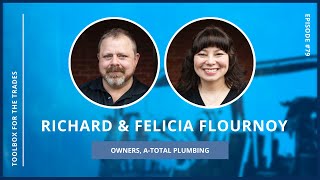
Richard and Felicia Flournoy built A Total Plumbing from a one-person van into a 32-employee company in Atlanta. They signed with a home-warranty provider the day after September 11, 2001, later switched to cold-call retail, promoted long-time employee Chad Chapman to partner after 17 years, and aim for 34 technicians by 2022.
Questions this video answers
The day after September 11, 2001.
22 technicians.
32 employees.
34 technicians.
About 17 years.
Richard and Felicia Flournoy, owners at A Total Plumbing in Atlanta, Georgia. Welcome to the podcast. I'm so excited to have you guys on board.
Hello, how are you?
Hey Jackie, how are you doing?
I'm doing great. I am really excited to talk to both of you. So I'm going to kick off this podcast the same way I do every single one, which is ask you how did you get into the trades? Richard, maybe you can start answering that question first.
So my dad was a plumber. So every summer from the time I was. I live in a truck. My grandfather was a plumber. Almost every man in my family is a plumber and a couple of women. And it's been really good to me and my family says it's. Yeah.
Nice. So family. Family business, more or less. And Felicia, did Richard bring you into the trades or did you have some trade background yourself?
No, I didn't. I come from the restaurant industry. And funny story, me and Richard were working at Amazon back in 99 and we were working third shift and he said he couldn't do that anymore. It was very difficult working third shift and he wanted to go work at a plumbing company. But because his driving record, he had too many speeding tickets. So he asked if his girlfriend could drive him, slash be a helper and they said yes. And that's how I got into filming.
Oh my goodness, that's a fantastic story. So this was at a company before you started your own, correct?
Yes, yes.
Okay, so what was the point in your relationship, in your lives that you guys decided we're going to go out on our own and do this on our own.
So I, it was difficult just starting dating and then working together and living together. And after a couple of years I decided to go back to the restaurant industry and a few months later Richard decided to open a Total Plumbing, I think more or less probably because he lost his helper. And that's how we started atotle. He was tired of working, I think by so nice.
And so I would love to know a little bit about how you went from taking Atotal plumbing from a one man operation to the 22 person operation I believe you have now. Richard, maybe you can answer that.
So actually I rented a van for my grandfather, $50 a week. I got a half page ad in the yellow pages because that's the way you advertise back then. There was no Google, Yahoo, Bing, none of that stuff. So we did kind of good. And then we ended up doing home warranty work. We actually signed up with home warranty work the day after September 11, 2001. It's easy to remember because it's anchored in my mind that way. And then we kind of grew a little bit at a time. It's mostly me and a helper. Up until 2003, 2003, we found out that we were pregnant with our first son, Jackson, and we knew Jackson was going to have a lot of medical problems. So I thought to myself, I got to grow Atonal Plumbing really, really quick. So I called the warranty company, and I begged for a lot more calls. Instantly went up to four trucks. Asked Alicia if she'd come back in the business and help. And, you know, we haven't looked back since. And if you keep. Keep going all the way up until 2015, we did home warranty work. And then in 2018, we actually reached out to Chris Hunter because we wanted to move away from home warranty work and start doing what we call cold call retail. So we made the trans. Chris Hunter helped us transition from warranty to cold call retail. We did that rather quickly. We were probably 11 technicians at the time. And then today, as of January 1, we were 22 technicians and 32 total employees.
That's awesome. Felicia, I worked in restaurants as well. Did Richard have to take you kicking and screaming from the restaurant industry, or did you go willingly?
I went willingly.
Yeah.
Sometimes I think it's easier and sometimes not so much. But I think it was just a natural transition at that point, being pregnant and, you know, not wanting to work so many hours on your feet and that type of thing, so. And it kind of worked out good because I took care of the office side, and Bridget was able to stay home with our son. When he came home from the hospital, it was easier for him to, you know, talk to the technicians on the phone, pay bills, do advertising, that type of thing. And I could run, you know, the call center and dispatch from our office on that end. So it kind of, kind of worked out when I came back that way.
Got it.
Yeah.
That's actually one of the big things I wanted to talk to you guys about today is I talk to a lot of couples who run service businesses together, and I'm always fascinated to hear how they make it work. So it sounds like you originally delegated those responsibilities based on Richard being able to be home with Jackson when you first brought him home from the hospital. And, Felicia, you were able to use your restaurant skills to really manage the customer service stuff, the call and dispatch area, also the back office. How has your delegation of responsibilities evolved as the business has grown, I think.
We each sometimes take on different roles over the years. There's been times where I've helped manage the technicians, and Richard's taken a backseat to things. He's never really worked in the office, though, but he's not a great multitasker. But, you know, as of like right now, I take a very backseat role to the business, and he's more upfront dealing with employees. And I do mostly, like, procedures.
She does all the stuff that I. That I'm not smart enough to figure out.
All the back office stuff, all the accounting stuff.
Yeah, you know, if they have a problem, he'll come to me and I'll try to figure out a solution. Or I just, with service titan, just onboard it for payrolls pro. So that took a minute to get all that ready to go. And going live with that. So that's kind of where I'm at right now in the business, is doing the back end, so to speak. I'm not in front of my customers or my employees so much as Richard is now. But, you know, I'd like to say something great about working together as a married couple, but it's not easy. You know, I think over the years, it's just progressed into a give and a take. Sometimes fight a little harder for what you want. Sometimes, you know, you're a little nicer. Sometimes not so much. But I think it's worked out, I think, too, with our son. He has a lot of medical problems. He's bent and oxygen dependent. We've had to learn to kind of work together and almost in a way of knowing what each other's thinking without saying it. Because sometimes when you're in a situation medically, like with our child, it's just you do it without even sometimes speaking to each other. And I. I feel like that is kind of delved over.
We feel like our why is so strong that. That we. I mean, we know each other so well, but our why is so strong. We just do what we got to.
Do, and that's the way it is. I think it just flows into the business as well. It's like, you know, we sit down, we might not each like something. We hash it out and we move on. And if we don't hash it out, we still move on. You know, it's just. It just works, I think, sometimes that way.
That's awesome. I mean, it's really. I think it takes a lot of maturity in a relationship and not just in a working relationship, but in a partnership to be Able to have to hash things out or to just deal with things as they come and keep moving on and know that no matter what, your partner has your back.
Yeah, that's true. That's very true.
Yeah. So you, you know, you were growing the business. You had Jackson, who, as you mentioned, is vent and oxygen dependent. Correct. You also had. Do you have other kids as well?
We have a daughter. She's a year younger than Jackson. So we had that called on there as well.
Just an extra. Oh, and we have another one coming.
We have another one coming. But I feel like in our business, it's worked out so well. Like, Our son is 19 this year, and taking a step back and looking at it, you know, at the time and in the chaos of everything, you know, there was probably times where we were like, we should just get out of this and go do something else. But I can now see, like it had afforded us to be at the hospital when he had surgeries or emergencies. And we were able to work, you know, our business from the hospital, and we're able to be at home with him if he's not able to go to work with us, and he's able to go to work with us, which is great. Also, outside of owning our own business, we wouldn't have been able to do that. And as a business owner myself, sometimes I sit back and think, my goodness, if I had an employee that took off as much as we did the first couple of years of his life, we were at the hospital, hospital, like every other day, and it's like, you know, how. How would you have done that? And it's just worked out so great being a business owner when you have a situation like that going on. And I also think because he lived.
In the hospital for the first year, the entire first year.
Oh, my goodness.
They. They. In the. The. But the. The happy part of it is that they sent him home and they didn't expect him to live very long, and he's going to be 19 in July.
That's insane. That must feel. I have no idea how that must feel, but that must be some really powerful emotions on both of your parts. And I imagine some of the people that work with you who've seen Jackson grow up.
Oh, yeah. I think, you know, our business is a huge accomplishment in itself, being over 20 years in business. But I think also having the business and having a child like Jackson, you know, is just so, so big in my mind. I remember one time when I was in the hospital, they had a pamphlet in the waiting room. That talked about, like, over 70% of marriages fail when you have a special needs child. And later on, we went to some plumbing conference and they had something else I read there that was like, over 50% of marriages fell of business owners who are married business owners. And I was like, dang, we're never going to make this out alive over here. You know, we're getting it from both ends. But it's funny because I really think that both our business and our son has made us stronger as a couple and not just individually. So I think it's just a huge accomplishment all the way around.
Hell yes.
Heck, yes.
Oh, my goodness. I can't imagine having to read that just, like, pamphlet on both of those sides and just looking at each other like, well, we've got quite the challenge in front of us, don't we, honey? Richard is our.
I will say we're very committed to anything that we do, and I think that's helped us a lot.
That's awesome. All right, so pivoting to your business a bit, obviously knowing that your family and your business are very intertwined. And Felicia, thank you again for bringing up that point about how being able to own your own business gave you the time you needed to be with your son. That's a point I never would have thought about. So I'm glad you brought attention to it. I would love it if you guys could tell me, looking back on the business now 20 years, what was the biggest challenge that you had to overcome?
I think for me, it was a lot of fear. We had got very dependent on the home warranty company, and it become a little unstable, and it was very fearful to, like, step out. And when I was thinking about taking that step and putting money out there to start advertising and really trying to grow the business in a different way than what we have you been doing for so long. I remember back in the early days that I was very fearful when Richard came home and was like, hey, I spent X number of dollars on. On a phone book ad. And I was like, oh, wow, that's. Are we gonna eat tomorrow? You know, and it's overcoming that fear of, like, the next step or, you know, am I. Is the business going to keep going? And I think at this point, you know, I've moved past that fear and I just, you know, we just work right through it and it's, you know.
And I was thinking the exact same thing. When we switched from home warranty to retail, we had 17 families that depended on us. And so it was pretty, pretty stressful and everything. Every decision we make is always. We always think about the team first and think about everybody that works with us rather than ourselves, because if we take care of them, we're going to be taken care of automatically. And we prayed about it and we. We came across that culture book that Chris Hunter had put out, and we reached out to Chris Hunter and he. I'm not going to say he held our hand, but almost. He literally held our hand step by step to transition us. And we knock on wood. We. We've never been slow.
That's awesome. And you mentioned Chris Hunter a couple of times. For anyone who's this is their first episode. Listening. Chris Hunter is now the director of customer relations at Service Titan, but he's also been a guest on this podcast a couple times. But he is the owner. He was the owner of Hunter Super Tax, which sold to Turnpoint Services. He's a big champion in the trades. Was it Chris Richard who convinced you guys to go to cold call retail, or was that something that you had been thinking about for a while?
He pretty much told us if we didn't go to cold call retail, we'd be out of business. So wasn't too much convincing.
I think, though, we had. We're having a lot of issues growing where we were with the home warranty company. And what he did was come on, come in and rip the band aid off. He was like, look at the store that you have right here. It's not healing. You're not doing the right things, so to speak. And that it was a hard one to kind of look at and go, wow, you know, I've never looked at it from that way. And it was a real eye opener. But he was very. Anybody who knows him and talks to him, he's. He's a very gentle guy, very loving guy. So he did in a very loving way. But it was, you know, it was a lot of fear behind it. And I think that's kind of what had been holding us back from growing so much, was we were comfortable and living in the fear. And, you know, I try to tell everybody this. People come to me and say, oh, I'm starting a business, and I'm like, don't live in the fear. Just jump right in. Just, you know, do what you're gonna do. Because if you live on that edge of that fear, you won't. You won't ever take that step to do it.
That's fantastic advice. So, Richard, you mentioned that 17 families were dependent on you guys at that time. When you Made the switch. What did you guys do for your team members to assure them, like, we're making this big change and we want you guys to come on board with us and help us succeed. What was that process like?
So we shared the plan with them. We were very open with everybody. I mean, we share the books, we share the. That's something I would recommend anybody. Open book management. Share your numbers, share your plan, share your vision. And they came along for the ride. And you know, we've had. We have several team members that's been here more than more than 10 years, one of them going on 17 years.
That's awesome. That's really great, Felicia, because you were also focusing on removing your fear barriers. Did you have any heart to hearts with folks or did you have any strategy that you were trying to implement as you guys were making that change?
I think they were about to probably have a party when we told them that we were moving away from the home warranty work. The ones that have been here the longest, that work some years with us through the home warranty. I think they were very excited. And I think if you spoke to any of them today, you know, they would say that their workload is less and their paycheck is more. And you know, they couldn't be happier with the switch. I think they probably convinced us more than we had to convince them with this. But, but that, you know, again, it was a fear that some of them wouldn't want to stay if we made that jump, but they did.
A lot of them did. You know you just mentioned you have someone who's been with you for 17 years in the realm of today labor crisis, the labor shortage and the trades. That's incredible. So this past year you guys hit your goal of having 22, was it employees or technicians by 2021? Richard?
Technicians.
Technicians. So you hit 22 technicians by the end of 2021. You have 32 employees. Now, how do you guys team and attract new members? Because I know your goal Is to hit 34 by the end of 2022.
Well, I would like to tell you something magical, but, you know, I really don't know at this point. Some of it is a give and a take. Now, I will tell you that we have shifted our focus a lot on the company culture, trying to make that work life balance a little better for the technicians. A technician is, is a lot harder of a job to have that work life balance. You know, a plumbing problem happens, you know, at all hours of the night. But we really have shifted a focus for that. And I know Richard has some exciting news that we just shared.
So we, we hired our first dream manager. He actually starts Monday. And.
And you know, tell her what a dream manager.
So it's based off the book, the dream manager. And his job is going to be basically to come in and make. Make this the best place for everybody to work. And of course, he's going to recruit and he's going to. He's going to focus on employee retention, parties, and anything they want.
Dream manager. That is a new term on the toolbox for the trades podcast. You're going to have to tell me more. So there's a book called the Dream Manager.
There is, and a lot of contractors have read it.
Okay.
But sometimes if we, if we go, if we just automatically give our employees what we think they want, most of the time it's not what they want. And so his job is going to be to figure out what, what exactly would make him happier working here. So there'll be a lot of research involved in that.
Yeah, we realized, you know, we have such significant roles. You know, Richard, not only is he working with the technicians and the CSRs and dispatchers, he's also doing marketing. You know, as far as I'm doing HR and payroll and this. That we realized that we are missing some key components. We need somebody to do that employee relations and give them that the fun side of the business, you know, the get togethers and the parties and fun meetings and stuff. And it's like we kept thinking, where did we put that in our time? And you know, try to fit that all in. And Richard read this book and he's like, I'm gonna look for a marketing manager, but I'm calling him a dream manager. And I was like, that works for me. It'll be a dream for me if it's. If it's not one more thing on my plate. So I think that, you know, we realized that we needed to have somebody there that could focus just on them and helping them to feel more like at home at work and, you know, not.
And to help us achieve that work life balance. For if we want it for us, we want it for our. For the people that work with us. So we want to help them achieve that as well.
That's awesome. I think work life balance is something that's so important to businesses now in business nowadays. I think employees being seen, heard, understood, and being able to manage their life with their work is just. That's critical. Like that's what's going to be the Difference between the which companies succeed and which companies don't. And the fact that you guys have hired a role that is focused on this is incredible. Congratulations. That is definitely something to be proud of, Richard.
It's. It's a large investment, but I feel like it's going to make everybody's life so much better.
Well, when you talk about culture and when you talk about growing the business like, those always require giant investments, and you have to invest back in the business in order to grow it to the way you want it to be. Right? Yeah. So I'm. I'm really excited for that for you guys. You have to update me in a few months and let me know how things are going, because Your goal is 32 employees by 20. End of 20. 22, right? Or 34 techs.
Yes, ma'. Am.
34 techs. Perfect. Now, when we were first talking, you guys actually told me that you hadn't developed the role of maintenance tech until recently because you uncover, I believe it was you uncovered some data that informed like, oh, hey, we could really develop this department. So I would love to learn how you guys are changing the types of services you offer based on your growth and the kind of data you're getting and how you're using that to inform, you know, where Atotal Plumbing goes next.
Well, with our service agreements, we. It was very lacking. It was just something probably most companies are like, hey, everybody has this. Let's get one. And then we kind of didn't do much anything with it. And we had a coach who came in and looked at some stuff, told us to look at some stuff. And he was like, you know, you have, you have something here. We just need to do something with it. And at the same time that was happening, we were having some growing pains between helpers and apprentices and apprentices moving to technicians. And he was like, what if we took your lack here in the service agreements and gave a stepping stone from an apprentice to a technician with a maintenance tech? And so they, they go in and they run our maintenance agreements, you know, doing the maintenance and the inspections and stuff. And that's kind of where we were lacking, because we'd be so focused on, you know, the cold call work that it was like, when can we fit this in? Unlike with heat and air, sometimes they have slow periods. Plumbing, most of the time, there isn't a slow period. So it's like we weren't fitting those calls in there and we weren't doing anything with them. And this has been a huge transition of just Instead of throwing an apprentice out to be a tech, they have. They're eased into it, I guess is a better word with that stepping stone of going into a house and talking to a customer by themselves without having the technician over their shoulder. So I think it's. We just started it, but I think it's going really well to be a stepping stone in between those.
And we've shifted the focus to what can we do for the customer instead of what can we get from the customer?
Yeah, that was a huge thing with our coach. We went to a little conference thing, and he was like, don't make the service agreement a pain for the customer. And I sat there and I was like, I don't even know what that means. And he was like, you got to do something for the customer. He was like, don't just go in and be like, oh, problem, problem, problem. And so it was a huge focus we had at the end of last year on really trying to make the service agreement for the customer. And when we started building out the maintenance tech, I thought a lot of what. What could be for the customer, you know, when they go in and do their service instead of just going to find it every problem, you know, just to give an estimate, so to speak. And I think that has helped the customer to see a value in the service agreement that maybe they probably weren't seeing before. We were lacking on our side doing something. So now that, you know, I feel like they're really getting the service out of it instead of us creating that pain, so to speak, for them.
That's brilliant. I love two things you just said. I want to recap. I love providing that stepping stone for your plumbing apprentices so they can really familiarize themselves with maintenance work. And I just love that, you know, mental shift of instead of what can we get from the customer, what can we do from the customer? Again, like, these sound.
When you.
We talk about them in these conversations, it sounds so like, duh. But when you're actually in the thick of it, when you're running your business, you don't really think of it that way. What coach do you use? Who, Which. What coach? Who, Whom do. Who do you use?
Blue Collar success group. Chris Crew and Jeremy.
Chris is great.
Yes, we love Chris.
Chris is awesome.
Great too. He. He's the one who really. Chris is the one who told us it was a pain for the customer. You know, it. And Jeremy south, he's the one who really helped us hash out the maintenance tech and to get that rolling. But, you know, I Want to. I want to say that when you're just starting off in a business, get yourself a coach. They're not. They're not cheap. But, I mean, Chris Hunter was our first coach, and, I mean, it has done wonders for us. You know, we. When we first got with Chris Hunter, he was like, you need to start training your people. And we were like, oh, gosh, we can't bring them into office to train. That's crazy. We don't have time for that now. We train all the time. Like, it is probably a mantra in our business. Train, train, train. Everybody's training, we train. They have to come to office twice a week, sometimes three times a week for training. They do training over the computer, but.
We have vendors come in and they say, I've never seen a company that every time I walk in, y' all are doing some. Some type of training.
But it. You know, without the coach there, we probably wouldn't have never done it.
I'm gonna make a prediction that when this podcast airs, you may get some people reaching out to ask you about the details of your training program or if visit your shop. So giving you the heads up there. Yeah. I mean, it's. I agree with you 100% on the coaching. I've never run a service business, but in all the talking I've done with owners, they're like, it just totally changes your perspective because, again, you're just in it. You're trying to survive, you're trying to make sure that you have work because so many families are dependent on you. And it's just so helpful to have that extra set of eyes on the numbers, on the way you're doing things to provide objective feedback. Right?
Yeah. I call it a springboard. It's. It's. I'm able to tell you, does this idea sound right? Or they're able to, like Jeremy did with the maintenance tech, say, hey, you. You have something here. Let's sit down and figure out a solution to this. Because like you said, sometimes you're in the thick of it, and you can't. You can't see the. The metal on the other side of it. It's just right there. Without somebody helping, you go, you're almost there. Just. Just keep going. So that it's. It's great to have somebody on the outside kind of looking in and. And helping you see that path that you can't see from where you're at right now.
I love that. I did a little Googling on you guys before the podcast, and I saw that you Guys have an amazing reputation. You guys have over a thousand Google reviews and 4.8 stars. So I would love to learn a little bit more about how you guys treat your customers and how you maintain that great reputation.
So we really deliver the ultimate client experience. Everything is about customer service. We make sure from the telephones to the, to the service that everybody is focused on serving the customer. Because if you make it about the customer, then everything else falls in place.
Yeah. 100.
No secret. Just, just, just treat people the way you want to be treated and, and make sure you do a thorough job.
And I'm not gonna lie. I'm not. Sometimes I think the reason I'm in the back is I'm not always that as nice as Richard is. You know, I, I, I'm very by the book. Like our invoice says, this is our warranty period. And we're just like, no, let's step back and look at this. And I think that's so, so we're.
We'Re a very core, core value driven company. And so a lot of times instead of, you know, they always say there's three rungs of companies. There's the top, the bottom rung is, is this legal? Is the middle rung, is this ethical? And the top rung is, does this align with our core values? And we tend to make most decisions or almost all decisions based upon our core values.
I love that that's helped with our reviews and just the customer service that we provide. Because sometimes I'm too like, by the book of things. And he's like, I understand it's six months outside of the warranty period, but I think this is probably the right thing to do and it usually is. I don't like to always say that he's right about things, but, you know, most of the time it is. And you know, the next thing I know, I'll be like, don't do that. And then we get a five star review from the person. So it's like, okay, I was wrong about that. But I think that's a huge thing is I think sometimes they don't expect that. You know, when you, they look at the invoice and they say, oh, you have, you know, a year warranty and it's been two years. I think a lot of them are upset. And then we get some of those good reviews because we have done more than what is, you know, stated on our invoice. And just that extra step of stuff.
That's awesome. And I won't hold you. I hold it against you for being by the book. Felicia, that is just your years of restaurant experience. And I can confer. I have a. Confirm. I have it as well. So, no, it says this. So it'll not hold up against you. And that's. Imagine one of the many things that makes you guys such a great team. Richard, real quick. What are your core values? Or, Felicia? Both of you can answer, obviously.
So they are, do the right thing, win together, grow together.
What's the third one? I have a mother here. We have. I can't see them. We have wins together, grow together, do the right thing. I'm so sorry.
If you want to take a moment and step out if you want to. Yeah, I do think it's always very funny. I mean, I've been a service titan for four and a half years, and I. I always forget one of them. Like, you just. I just always forget one of them. So that's why they, you know, that's why they reinforce it all the time.
Pretty much do the right thing covers almost everything. But. And. And you're the pro. Is the therapy.
So hunger for excellence.
And there's. Yes.
And.
What was. You're the pro. Hunger for? Okay, do the right thing. You're the pro. Hunger for excellence. What were the first two? The other two.
The other one is stay humble and hustle hard.
I love it. I love all of them, and I love the vulnerability of being like, let's just check real quick to make sure we know that. That's great. I think those are all great values to live by.
We have them posted everywhere. Not where we're sitting that in front of me, but in each room, we have them posted. So that way. And we have them on our phones, and we send them out to the technicians all the time. And anytime that they have a dilemma, Rachel will be like, which. You know, which core value. Can we learn from this? Or can we, you know, pull from this to see how we can help this situation? So we. We do try to put them everywhere. I. I should. I should memorize them, but I have the.
You got a lot of things on your plate, Felicia. This is fine. So I want to talk to you guys about a couple more things. Mainly is that you just made an employee, Chad Chapman, a partner in the business, which I'm sure other folks listening have maybe considered that. So I would love if you guys could tell me about that process and what made you do it.
So Chad actually is the one that's been with us 17 years. He was actually 17 when he. When he started oh, my goodness. He started out as a part time dispatcher, then, then we ended up moving the office and he said it's too far for me to work for this, this to be a part time dispatcher. So we made him an apprentice. Then he became a technician, then a journeyman plumber, then the service manager, and now he's vice president. And I will tell you that it's probably the best thing we've done. And he was long overdue. He. Without him, our business wouldn't be what it is today. He's really helped us build it from way back, way back to the warranty days. And he works so hard and he deserves everything that he's got. He hasn't. Let me rephrase that. He. He's amazing.
He. I think he's a stepping stone between us and the technicians because sometimes, you know, they see you as evolves and maybe when there's a problem, they don't always want to approach you with it. And Chad's just a very lovable, you know, kind of guy and easy to talk to. And I think it's just been a natural progression for him to take, you know, that spot and for us to move him into that role. And he's just been great, you know, and it's hard. You know, we've obviously came through a lot of employees over the years. He's very loyal, very honest, very upfront with things. So for us, it was a no brainer. One of our coaches was like, you know, have y' all thought about this? Y' all need to think about this. We did think about it for a while and, you know, we realized that it was just. There was no question to it.
That's awesome. And what a way to reward someone who's literally been with you from the beginning of his working career. That's incredible. And it also most likely clears it up for you guys to further empower him and allow you to step away a little bit more and gain more of that work life balance for yourselves. Am I correct in that assumption?
Yeah, we really needed that. Because any business owner, there's. There's never a time of a day off or a vacation. You know, you might have moments off, but there's no full day of somebody not calling you with, you know, something going on. And it really has.
Or the cell phone bill. When you're on a cruise, that's a thousand dollars because you've been on your phone the whole day and they charge you 250aminute on the cruise ship.
So that's really helped us to, you know, start taking those actual time off without having to be attached to the phone by putting them in that role and giving them that responsibility to, you know, make those owner type of decisions without having to, you know, call us or worry, you know, am I going over and beyond what a manager should do? And it's. It's helped out a lot, and it's been great.
That's awesome. I'm guessing that cruise ship story is from personal experience, huh, Richard?
Yes, ma'. Am. And I did not learn from it. It's happened many times.
So the last thing I want to talk to you guys about before we wrap up with some final questions is that you just opened a second location in South Atlanta, and I want to know how that's working out for you guys so far.
So we actually originally started in South Atlanta, so we have a pretty large customer base down there, and Chad lives there, and we have several employees that live there. So it was a no brainer to open up back down there. And then it's actually our third most profitable zip code. It's not by design, but we. We do really well down there, and we. The goal is to probably try to grow that location to get to the 34 technicians.
Nice. So I know we're going for 34 in 2022, but I would love to learn what other things you have on the horizon. What are some other goals you guys have in place?
I mean, we have. We want to be the most dominant company in our market. That's a pretty big, pretty tall thing. Atlanta is pretty big. So I don't know where that takes us, but we do have it mapped out for next year.
That's awesome.
My goal is just to get in a bigger office.
I did. I did forget to mention something. Felicia is also a licensed master plumber.
Oh, my goodness.
Yeah.
So, Felicia, can I tell you how happy this makes me because you will be the second female master plumber on this season. That is awesome.
Who's the other master plumber?
Her name is Jessie Cannizzaro and she's from Waukesha, Wisconsin. So she's on the other side of the. Yeah, she's on the other side.
I might have to find that. That one. We. We did our research and we listened to a few of your podcasts before we did this.
Thank you. So real quick, before we go into the final questions, what's it like being a master plumber, Felicia?
It's very different. You know, I get. I get asked a lot. If I actually do do the Plumbing. I don't anymore. I used to. When me and Richard worked together, he really treated me like his apprentice. And I had to get down and do all the nasty, gross stuff. And if I have to, I'll do it. I have done it at our house a few times. But, you know, there are some perks to being an owner that he still goes out and helps them when there's a problem, but I don't have to do that anymore, so. But it is great. It's. You know, sometimes when he's not able. Like, he was sick last week, and so then I'm able to, like, step in and still have those conversations with them. And I think it's gave us security in our business as well, or with me, anyway, that I know that if, God forbid, something was to happen with him, that I. I do have the ability to continue to do what I'm doing, because I do have that knowledge and I do have that license. And so that's always giving me a peace of mind, I think, too, as well, sometimes to kick those boys in the butt when they think I don't know something. I love that.
All right, I just have two more questions for you guys. If you could go back in time and give yourselves one piece of advice from the early days of your company, what would it be?
Train, train and train some more and get a coach.
Got it. This is a new question I'm asking people for this season. If you had to choose a song to be the soundtrack of your life, what would it be?
Okay. I had to think about this one. And we asked some family members, and it was almost like a consensus. And it's going to be funny, but who let the dogs out? We got.
Okay, I need it. I need some. I need some context there.
We have nine dogs, so. And we have five cats and two pigs, but there is no song with that. But it is a constant. Who let the dogs out in our house?
And when I'm calling Felicia on the phone, she's at home. Come on, guys, we gotta go outside.
Oh, my goodness.
They range from Chihuahua all the way to Neapolitan master.
So we have them all breeds, all sizes.
I mean, I knew I liked you guys before we started this podcast, but now I like you even more. I love dogs. Do you guys just get a bunch of rescues or. Or what's the deal? I just. Nine dogs. Sounds so.
I will. So there is a story. Felicia. I never thought I would ever want a Pomeranian. And I was thinking, why would anybody want a small dog? So, Felicia, Found a blind and deaf Pomeranian. He can see a little bit. He can see like a foot in front of him. And he has turned out. I'm not gonna say he's my favorite, but he's one of my favorites. He is amazing. And if you've seen him, you would not. If you just came into our house, you wouldn't think he was Launderdale because he gets around. Like, he can run now. Every now and then he'll trip over stairs and run into the wall. But he. He goes around the house and he's. I love him to go.
A good bit of them are rescues. Sometimes people tug at my heartstrings. You know, they know that we have some dogs. So then they'll be like, oh, you have to get this one. And then we did have some purebreds. We have two Australian shepherds and then the neonastas. That was our recent addition. And I will tell you another funny story. All of our animals have very different names.
Continue a new one.
His name is Kmart. And then we have Bucket and Broom Lunch and Tamale and Falkor and Riddick and Beulah and Did I miss somebody? And Tamale and Ever. So they all have crazy names.
I mean, I really like Bucket. Bucket's a personal favorite of mine. I love dogs with crazy names.
Well, Bucket is probably. She's probably the nicest dog we have, too.
Yeah, she's an Australian shepherd. She's. She's the mother hand. She watches out for everybody.
We did rescue a dog that. What did it say? It was on the papers.
Oh, Fulton county is a kill shelter, so she was going to be euthanized because she was too young. She still needed to be mothered. And so they had these rescues come in and try to, like, get them out really quick. And I don't know if the paperwork got mixed up in that rush to, like, rescue her, but she is some type of three pound terrier. And her paperwork, though, says a golden retriever.
That's so funny.
I'm assuming it got mixed up in that rush of trying to. To rescue her, but I have no idea what she really is. It does say elder retriever.
Oh, my goodness.
That's ever.
That's ever. Who let the dogs out. Indeed, that is. Yes. Richard, Felicia, I really enjoy chatting with both of you today. Thank you so much for being guests on Toolbox for the Trades. And I can't wait to see what a total plumbing has in store next.
Well, thank you for having us on.
Thank you.
More from Bill




Capturing the 80%: How SmartAC’s Gen-2 Targets Non-Membership Homeowners | Podcast Ep. 296

Build better customer data with every booking in ServiceTitan | TAD Tune-Up Series

The Biggest Change for Roofers Coming From Other Roofing Software to #ServiceTitan?

