When Hard Work Pays Off: HVAC National Championship 2022 | Podcast Ep. 120 | Toolbox for the Trades
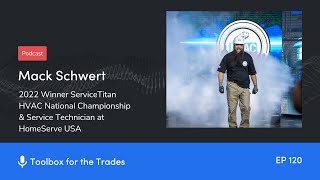
Max Schwert, 2022 ServiceTitan HVAC National Champion at HomeServe USA, entered the competition on a whim through an online quiz and won after live rounds in Tampa. He started in trades after a job fair, moved from plumbing to HVAC through EPA certification, and credits training and communication skills for his success.
Max schwert from Marlboro, Massachusetts. You are a technician at HomeServe USA. And more importantly and the reason that you are here with me today, you are the winner of the 2022 Service Titan H VAC National Championship. Welcome to the podcast.
Thank you for having me, Jackie.
I am so stoked to talk to you. I unfortunately did not get to go down to Tampa with the rest of my team to watch the competition. So I'm so happy to have the time with you. Now, before we even get into this, I just want to let folks know a little bit about what the heck the Service Titan H VAC National Championship is. So this happened back in Tampa in November, I think, right at the Tampa Convention Center. We partnered with TRAIN to create challenges for techs all over the country such as yourselves. And you guys competed to figure out who was the best tech tech there was in the competition. We had service time industry experts judging as well as TRAIN judging the event as well. And you won. So tell me about you entering the competition. What inspired you to do it?
So I kind of entered the competition on a whim. So like I signed up for all the things on the Internet, you know, H vac related. And one morning I just came across an email about the, the championship, you know, and since it was the first one ever, so I knew absolutely nothing about it. But the first round was, you know, like a five minute Nate question quiz. So I just did it in the morning, didn't think anything of it. And a guy I work with, I emailed that link to him just so he could do it too. And then we could kind of like battle back and forth and see who does it better. And I think I forget how many I got right out of the gate, but he like doubled the amount that I got right. So I was like, oh my God. So then I just went back. We kind of like battled back and forth for like a, a couple weeks. And then as soon as I did better than him, I was like, cool, that's it, I'm happy, I'm done. And I didn't think anything of it. And I think that was in like July or something. And then I got an email in September that said, oh, he qualified for round two.
I was like, oh, wow, what was round two?
So round two was they were gonna send you a kit to your house that you had to put together and braise and, you know, do it with all the PPE and the proper procedure, putting it together and make a video and time yourself. So I kinda waited A while to do it. And then I think we had, like, a birthday party we had to go to for my kids or whatever. And it was like the last weekend before I had to send it in. And I'm like, tell my wife, oh, I was gonna have the kids film me do it. And then my wife came, and so she filmed me and did it. Didn't think anything of it, submitted it, whatever. You know, it was just something cool to do. And then fast forward another month in October. All of a sudden, I got an email that said, oh, congratulations, you're going to Tampa. And I was totally shocked. So I was totally surprised by that. And then. And then I remember getting an email in, like, the middle of October, and it was like, oh, hey, by the way, you're gonna be on television. Can you answer these questions? Or whatever? So I was like, yep, nope, not doing it. I told my wife, I'm not doing it. I'm like, that's it. I'm all set. And when you got kids, anytime you get away, she's like, oh, hell no. You're gonna. You're doing it. We're going to Florida. We're gonna go away for a couple days.
Sure, sure.
Next thing I know, we're flying to Florida right after Halloween, you know, so it's pretty wild. Yeah, because we had an early flight that morning, so we had Halloween. We do Halloween in my house. Got a good neighborhood, walk around. So we were up late with that. And then we had to wake up at like, three in the morning to go catch a plane that got delayed because there was ice or whatever. And then we missed a connected flight. It was like 14 hours to get from Boston to Florida. It was a nightmare.
Oh, my goodness, that does sound like a nightmare. But another nightmare that it sounds like you alluded to is the fact that you did not want to be on television. You had no idea that was part of the deal. Tell me about that. And now I have you on camera right now talking to me on for a podcast, but continue.
So it was. I don't know. I've never been on television. I didn't think I had a face for TV or any of that. Plus, it was the unknown. Like, you know, I had nothing to compare it to. I didn't know, you know, any previous years what they did or anything like that. So I was just totally out of my comfort zone. You know, I spent my life in a basement or an attic with no cameras on me whatsoever. So that whole experience was pretty new and wild.
Yeah, well, tell me about like the actual competition. Because there was two live rounds, right?
Yes. Yeah. So the first round, well, in the morning, we got to watch the Apprentices go first. So that was kind of cool. It kind of took the edge off. Like you could see what's going on. You didn't really go in totally blind. So that was kind of cool to watch Apprentices do their thing. And then next thing you know, we go to this, like, briefing room and. And you watch this, like, you know, two minute video on what you're gonna do. So nobody knows what you're actually doing till, like, I think it was like 15 minutes before we went out there and did was pretty cool. And then so we basically, we had a vent furnace and we had to do the condensate for the furnace. You know, we had the specs, how we had a vent it, you know, and how they wanted everything done. So, you know, it's just doing. It was like, stuff I do all the time, you know.
Sure.
That kind of made it easy in a way where it's like, okay, just go to work, you know, do your job. So, yeah, so that was pretty wild going out and then, you know, we all lined up in a row, then they called us out. Next thing you know, you're out there and. But when it goes to work, I kind of just, you know, tunnel vision and do my job, you know.
I'm sure that tunnel vision helped because like you said, it's like I do. It's like what I do every day at work, but now I'm in front of a live audience. It wasn't just in front of cameras. You also had a live audience watching you do it. So what was that like?
Yeah, but I mean, like, I'm used to people watching me work because you go in people's houses all the time and, you know, everybody wants, you know, come watch what you do. And that never bothers me. I'm like, pull up a chair, you know, we'll figure it out together. Whatever you want to do. So having somebody watching me really doesn't bother me while I'm working at all. So that, that kind of made it easy, actually.
If they really wanted to, like, turn up the heat on the competition, they should have you actually doing work on someone's house. Someone who's very particular and a very high micromanager. An engineer. Yes. Have you all compete at an engineer's house? That would really spice it up for next year. Note for next time. But anyway, you had a few rounds. You eventually got into the final round. And I know you had some issues with. With a filter dryer. So tell me about how you dealt with that.
Yes. So the. It was kind of cool because, you know, the way they had all the stations set up, you couldn't see what anybody else was doing, you know, in the first round. So you couldn't. I couldn't really, you know, look at what anybody else was doing. So it was just, you go to town, do your own thing. And in the final round, you really, you know, was spaced out where you really couldn't see what anybody else was doing. So when I was going along, you know, we had a zoom locking up the refrigerant lines, going up to the condenser and everything. So I was just kind of listening to hear if I could hear them still zoom locking or if they were on to that, to the wiring. And so I went and put the filter dryer in, you know, and at that time in Florida, I was sweating because I live in Massachusetts. I like the cold, so. And then you got to wear the hard hat and the PvE and all that stuff. So every time I look down, I'd sweat and my. The glasses would just. It was like, I'm looking underwater, looking through the glasses, looking at my tape measure and everything. So when I put the filter dry and I didn't think about it, put it in, and then I come back and I'm like, oh, I think I put it in backwards, you know, So I had two options. I could flip the sticker around, but then I'm on camera, so you can't. So. So luckily, you know, I had enough couplings and everything. I could cut it out, splice it around. And at that point, I thought totally, like, that was it. I just shot myself in the foot, you know. So after that, I was kind of, like, mad at myself for a little bit, and then. And then I was just like, you know what? Whatever. Just fly and do the best I can and go from there.
Well, you weren't. That wasn't the end. You ended up winning the competition, which is freaking amazing. So tell me, how did it feel to win that competition, and how did it change your opinion of yourself?
So I was very shocked that I won because I didn't like going down there. I didn't expect anything. It was just, like, fun, you know, it was cool to meet other guys in the trade from all over the country, you know, doing what I do every day. So in all the guys down there that I met, everybody was wicked cool. Everybody's really nice. So winning it was. It was a very humbling experience because, you know, you do this every day, right? You know, you go put a system in a basement or an attic or whatever, and the second you go upstairs or climb out, you shut the light off and nobody ever sees it again until something goes wrong, you know, so to be on like a stage like that and to win, it just kind of like, like recertified what you're doing out there. Like, okay, you know, you. You're doing good. It's worth it. It's not, you know, not worth anything. So it was really good. It just boosted your confidence in what you do every day.
Of course. Yeah, I totally get that. You know, when you work at a trade for so long and we're going to get into your history in a second, you know, sometimes it becomes your day to day. It becomes, you know, the regular minutiae of everyday life. You know, I work a job to support my family, so it's kind of cool when you're declared that the best of. The best of what you do for something that you just on a whim were like, hey, let me submit to this competition. So that's super cool. I'm so happy that you got that experience. That sounds incredible.
Oh, me too. And I'm so thankful for all the service titan and all the sponsors that they even, you know, wanted to put that on for the trades, you know, just all the bringing awareness to the trades, you know.
Yeah, well, actually, we partnered with Elite Trades and they've been doing this for electrical contractors for so long. And so we wanted to bring the H Vac competition forward, and I believe we're doing it again next year. And we've had a couple of our customers say, hey, what about plumbing? Which you are a plumber too, and we'll get to that in a second. So I think this is just a great way to celebrate the trades because truly, truly, truly, if we did not have H Vac, plumbing and electrical, like, what would life be like? Right? So, yeah, I want to. I want to move forward and get to know you a little bit. So we're switching around my normal podcast format. You and I have something in common. Both of our dads are carpenters. So I would love to know a little bit about how your dad's career influenced your. Your decision to eventually become an H Vac technician.
So I guess I've been around the trades my whole life, you know, with my father. And it was the weirdest thing is when once I entered the trade, like, growing up, I thought Everybody, like whenever something broke at your house, you just fixed it. Like, whatever it was, you fixed it. You didn't call anybody to come over to do anything. And that's the way I grew up. It was like, okay, that's something broke, you fix it, whatever it is, you know, the roof, the plumbing, the electrical, whatever. So once I entered the trades and realized that no, like, there's a lot of people that don't even know how to the right way to turn a screwdriver. It was just mind blowing to me. So with my father, you know, he told me, you know, you want to get a job with a license like an electrician or a plumber, you know, in Massachusetts it's to become a plumber in Massachusetts, it's now it's a five year apprenticeship. And then, and I'm not sure what the electrician apprenticeship is, but you know, to be a carpenter, you just got to go take a test and boom, you're a carpenter. So he kind of steered me to electrical or plumbing, you know, because once, once you get that license, a lot of people won't go that far through school and everything. So it makes you kind of more valuable. And once you get it, you know, you're set for life. So at the time I, I was living in Florida, came back, start life over again, and I was working at a supermarket, and every day I would go out to my car, open up the phone book and call a plumber out of the phone book. And at that time, it was like as many lawyers in the phone book there was plumbers. So I think it took me all week calling them because I would call and they'd be like, oh, what's your experience? And I'd, I'd say, I have none. They say, get some experience and call us back. And like, how do you, how do you get experience with. If you can't hire me? You know, So I remember I went all the way to Friday and I ended up on like, W's. And I called this one company and they're like, oh, we're having a job fair tomorrow. Come on down. And so I went down and then this guy Keith hired me. Well, he made me go to three interviews before he hired me. So I owe a lot to Keith.
I just need to say Keith's full name because the Keith, who this was is Keith Mercurio, who's been a guest on this podcast and a speaker at Service Titans User Conference Pantheon. He was a next gen trainer. A next gen. Oh my goodness. Next star trainer for years. And he's a really big name in the trade. So when you told me that Keith Mercurio got you your first plumbing job, I was like, what? So how serendipitous, how crazy. And I love that that was available to you. But also, what a hustle. You went from A to W in the phone book before you got a plumber who was willing to take you on without experience.
Yeah, that was a nightmare.
Oh, my goodness. You know, it's like, crazy to me. So we're going to get into some other stuff in a second because one of the reasons I wanted you on is in. At the show. In the show, I talk with owners and operators all the time about how I can't find text. I can't find good text. How do you retain and hire the best techs? And you are arguably one of the best techs. So I want to talk to you about that. Right, so what are some things that owners and operators should consider as they look to hire the best techs in their area?
So that company, what they wanted when they hired me was they wanted. You know, they wanted people that knew nothing, so they could kind of mo. You know, so you had no bad habits coming in. You had. And they could kind of mold you into what they wanted you to be, you know, so starting out from nothing, that was a great place to come into and learn the trade. I guess once you're established in the trade, for people to hire somebody, you know, communication skills is huge. Being able to talk to a customer, being dependable. When it comes to H Vac, being Nate certified is really good. You know, then you. You know, you have a background on what you're doing, being customer focused, you know, paying attention to the customer's needs, what they want have. I guess having a personality goes a long way when you're dealing with customers. There's a lot of people that I run to the trades that are. I don't know how to say it, like duds going into houses, you know, and. And with the homeowners, I don't know, they want. I feel like, you know, you break down a lot of barriers when you're friendly with them and that they end up trusting you, you know, But I don't know. I don't do much higher and so.
Well, actually, I realize it's a shitty way for me to ask that question, so I want to. I want to try it a different way when it comes to people in your experience, because you've worked at a couple companies now, right?
Yeah. Who.
Who make what kind of qualities do you see the best techs tend to have?
So the, the best text are positive people. Because I run into a lot of people in the trades are negative, negative all the time. And it's, it's, it's really easy to be negative, I guess. So the best techs I run it to are positive people that always want to learn, want to do the training and are willing to work, you know, hard workers. They don't, you know, don't give up on a job. You know, they want to figure it out, stay there. That's really, you know, the core of a good tech.
So when you were training at Keith's company, when they were molding you into that perfect tech, did you go from. How did that work for you? Were you, like, in classes at the company for a couple weeks, then you went to apprentice? What did that look like? Do you remember?
So that place. So I got really lucky there. So there was actually a good group of guys working there at the time that were, if you were willing to learn and, and were into the trade and like, just not like a job like you were really into the trade, then these group of guys, they were willing to teach you, you know, like what you put in. They were willing to teach you. And, and so every day, you know, you line up the shop and they pick you for an apprentice and you ride along on the day. So if you didn't, if nobody wanted to work with you, you were, you got the, you, you know, low end of the job and with the guy that, you know, didn't want to go with. So if you were showing, like, enthusiasm and you really wanted to work, I got lucky, like with a good group of guys that wanted to teach and spend the extra time with you. So I got really lucky there. And that made me have that same mentality to want to teach other people. If you want to learn, you know, piggyback on me and we'll, we'll go to town and do everything together, you know. So I got really, really lucky there. Also like a really good experience there. The owner of that company, he would go out on a limb and send you away for training. So like one, one year he sent me to the ultimate technician academy in Arkansas. And it was, you know, to invest the money in you to be a better technician, you know. So that was a really cool experience for me where they wanted to invest into the employee to grow in the trade, you know, so that, that was really cool and that I was able to learn a lot real quick by the Group of guys I was with in the training that he was sending me to.
That's dope. And how long ago was this, by the way?
Probably like 2010, 2012 in that period.
Got it. Very cool. Very cool. So, by the way, when did. So this was all for plumbing at the beginning. When did you add H Vac to your skill set?
Yeah, so we were plumbing, and then, you know, the summertime, we would do like an outdoor shower, simple stuff. And then one day, I just remember going to the shop and they were like, hey, you know, you, you and you and you, or going to the Splash to get your epa and we're going to start doing ac. So I think I spent three nights at a supply house, got my epa, and the next day I had a no AC call and had no idea. Just praying it was a dirty filter.
So it's because the company you were working at decided to add H Vac and they identified you as. Okay, he's one of our best text who's going to learn this and we'll send him to train, basically.
Yeah. Yep. Overnight, that's it. Boom. We're doing ac.
But that's great for you because that makes you. I'm sorry, that makes you more competitive and that makes you able to transfer your skills to more and more companies, right?
Oh, absolutely. Like here in Massachusetts, it's. It's pretty common that, you know, if you can book, if you can get a plumbing license and do air conditioning, it's like you're. You're almost guaranteed a job wherever you want to go. And, you know, H Vac is becoming so big now that it's almost like you gotta, you know, as far as the heating world, you gotta. You gotta know it.
Yeah, exactly. All right, so I want to get a little bit more into the nitty gritty of actually working with owners and operators, because, again, I talk to so many of them on this podcast. It's so rare that I get to speak to someone else who's on the other side of it. Right. So tell me if you would be so kind about your best experience with the boss and your worst experience with the boss.
So I think my best experience would be like, that. The first company I worked at with Keith was. Was him just believing in you to spend the money, to send you away and to do all this training so you can grow. To me, that's huge. Like, you know, it shows that he. He, you know, expects. Expects you to learn and wants you to grow in the trade and invest the time and money and the training into you. I mean, that. That would be probably the best experience with a boss that believes in you and wants to, you know, put you out there. The worst experience I had was when I was a. I was at a plumbing apprentice, and I went to this one company. I think I was only there for a month. And so this company, the way the owner would do it, it was crazy. So say I went to go work with a guy, and we were gonna go, like, put in a toilet or whatever. And as an apprentice, I'm carrying in the, you know, the tank or the bull, and say I hit the wall and break the tank. That tank would come out of the other technician, the licensed plumber's paycheck. So he would. So if you. You broke apart or whatever, it would come out of the technician's paycheck, you deducted out of the guy's pay. So the. The previous apprentice at this place broke a lot of stuff. So when I came as the new apprentice, nobody really wanted, like, I could. I would just stand there, you know, I remember sitting in the guy's truck, and he told me, you know, we're gonna walk in this house, and you shut the up. You don't say a word. You do anything to ruin the sale, you're gonna walk back to the shop, like, that's it. So it was real awkward. And then there, you know, nobody would want you to come work with them because they didn't want you to. To ruin their sale or, you know, break something that may come out of their check. So then I'm just sitting around the shop, and he would make me, you know, weed the bark mulch. I remember one day he made me go to his house and put in his patio furniture for the fall and wanted me to rake his yard. And I'm like, I'm not learning anything, you know? And my buddy called me, and he's like, hey, you want to go do new construction? And I was like, yep. So I had tailed it out of there and did new construction for two years.
Oh, my God, what a.
That would be the worst, worst experience.
Yeah, that's like a trade internship from hell. At least you were getting paid for that, right?
Yeah, minimum, minimal wage.
And actually, speaking of, I should ask. So you've worked in new construction as well, Right now, do you primarily do residential service and replacement?
So, yeah, the company I work for now, they're really primary, all residential. And probably 90% of the work we do is, like, policy work. So you take a contract out on your equipment, your air Conditioning, you know, heating or your water heater. And it's. The contract covers pretty much 95% of all the components with it. Covers everything other than repair. You know, there's no fee for us to show up to your house, do whatever you got to do, order whatever part and fix it and move on. So it's really nice. So I don't have to really worry about selling or sell to live. I just got to be a tech and figure it out and fix it.
So I love what you just said about your, about your current employer. So the way they have it set up. And it's a union shop too, right?
Yeah, well, it's union, but it's not like I go to a hall and check in every day or any. It's not like that. So they used to be the. So they. We used to be the service side to a utility company in Massachusetts. And then they bought out this utility company, didn't want to do service anymore, and they bought out that service side. So that's where the whole union thing came from.
Got it. But what your company has that you really like is that all of these customers buy into this policy. So they already covered everything. And you don't have to worry about upselling them for something. You don't have to worry about selling. You said selling to live, so.
Yes.
Interestingly enough, a lot of the people that I have on this show, they endorse performance based pay. They endorse sell, having, selling texts. And I would love to know your opinion on that. What's. And your personal preference too, because. Right. Everyone's got their own way how they like to do things. But for you, it sounds like you don't really enjoy selling, which is totally fine.
Yeah, so I don't. So a company I did work for, they. We were paid by the hour. And then they, they did switch to commission, you know, performance based. I guess that's a nicer way to say it. So it was like a commission based. So you got a percentage of whatever you sold. So what I experienced there with that company was, you know, the little old lady that can't walk downstairs to the basement, they would sell her ridiculous stuff that she doesn't need or they'd sell her something and not do it, you know.
Yeah.
And so I ran into like a lot of unethical selling, which isn't everywhere, you know, but, but the selling, you know, they, they always said, you know, treat them like your, your mother or your sister. And then they go out there and like selling stuff you don't need. That was a huge turn off for me. So I ended up doing install for that company, which was great because if somebody else would sell it, I go in and then just do what I had to do and go on from there. But people that can sell.
More from Bill




Capturing the 80%: How SmartAC’s Gen-2 Targets Non-Membership Homeowners | Podcast Ep. 296

Build better customer data with every booking in ServiceTitan | TAD Tune-Up Series

The Biggest Change for Roofers Coming From Other Roofing Software to #ServiceTitan?

