Why Personal Branding Matters in the Trades | Podcast Ep. 129 | Toolbox for the Trades
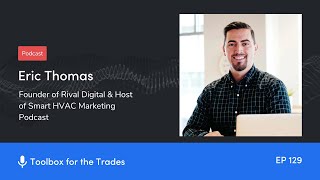
Eric Thomas went from HVAC apprentice to founding Rival Digital in 2020. He explains how contractors build personal brands through consistent messaging and storytelling, where the homeowner is the hero and you're the guide. He recommends Donald Miller's StoryBrand and Marcus Sheridan's They Ask, You Answer as frameworks.
Eric Thomas, you are the founder of Rival Digital and the host of the Smart H vac Marketing podcast. Welcome to my podcast toolbox for the trades.
Hey. Hey Jackie, how are you doing? Thanks for having me.
I am doing great. So happy to have you here. You have such a great relationship with so many of the service titan customers and a bunch of my fellow employees at Servicetitan. So I can't wait to dig into today's topic with you. I do feel like I have to mention to the audience that I have a guest coming co host with me today. Her name is Goldie. She's a four year old Chihuahua Pomeranian mix and she may come on screen, she may want to, you know, put in her two cents. So I hope that's not, I hope that's not a problem for you, Goldie.
We're excited to have you with us today.
She's also excited she can't speak English, but I can tell in her, in her, in her eyes, she's very excited. All right, Eric, this is the way we kick off every single show which is how did you get into the trades?
Oh, that's my favorite question. Like most kind of just stumbled face first into it on accident. So I think, I think I've shared this a few times maybe on my podcast. So I, going back to the summer of 2013, I was an apprentice for a commercial heating and air company here in Virginia. And when I say apprentice, it was really just kind of a glorified summer job for me. It was kind of in between years at college and I was, I was more or less a parts runner, for lack of better words. So that's kind of how I got my first, I guess, taste into the trades. And then, you know, fast forward. After college I was moving back home. I was looking for a gig into the digital marketing world. So I got my degree in marketing and I got a job doing SEO SEM for Mosquito Joe, which is a franchise pest control company. Well, you know, shortly after I started there, they got acquired by the Dwyer Group, which later became neighborly. So airserve, Mr. Rooter, Mr. Electric, all those, all those different home service franchise brands kind of fall under that umbrella. So, you know, I spent a couple years there, about two and a half years there and then when Covid hit, I wanted to kind of sprout my wings and go try some new things. And I feel like that's kind of been the case for a lot of folks, you know, in more the white collar side of the trades or just in general is that you Know, once we realized you could work from home, like there's opportunities to do anything anywhere. So I kind of was like, I'm going to sprout my wings and kind of see what I want to do here. And then that's kind of when Rival Digital kind of came about was in October of 2020. And so just kind of been going at it pretty strong ever since. And so still doing the digital marketing and website design development and whatnot for HJC Plumbing electrical contractors. And I just, I love it. The people are great. And yeah, just being able to, you know, just help them grow their business, watch them hit their goals, watch them achieve their missions and all that good stuff is just, it's such joy. And yeah, I love every bit of it.
That's awesome. I love how you said that, like many white collar folks, when Covid came around, it kind of unlocked this possibility of, wow, we can work from home. There's so much, especially when it comes to digital marketing that we can do from home. And it really has opened the door for so many people. So tell me a bit about your entrepreneurial journey so far at Rival. So you started in October 2020 and now today we're recording it's May 2023. Where did you start and where are you now? What are some, like, markers that the folks listening can. Can hear about to learn a little bit about your growth?
Yeah, so, yeah, we started with, you know, just with one client and a computer and a very fluffy, enjoyable colleague, my dog. And he's, he's still on our website. So when we first made the Rival Digital website, I put him up there as an employee, just so you know, it wasn't just my face. So that was, you know, October. About a month into it, I was like, I'm start a podcast, just talk about marketing and to be able to help, you know, even if it was just one tip, you know, each episode on I don't know how to improve your LSA account or small things you can do to, you know, rank higher in the map pack or different ways you can highlight your company on social media. So it was really just an opportunity to be able to, you know, interview contractors, talk about what's working for them, what's not working for them, you know, very similar to Toolbox for the trade. So that was in November 2020. Started that, that podcast, Smart H Vac Marketing Podcast, and that's been going ever since. It's weekly on Wednesdays, I guess really, you know, it was kind of a whirlwind and I know we're going to talk about this later, but, like, the. When I started to realize, like, what personal branding was and, like, how it can. I can brand myself without not having to constantly be branding the company. I could brand myself and use that as a way to grow the company. I feel like things started to click and change and grow a lot quicker with the podcast and with the ability to start building a personal brand. That's where I started building relationships with folks like service titan, and some of these are software companies and best practices groups and what have you. And so that kind of sped up things a lot, which has been really cool. So, yeah, where we're at now, we've got 10 employees now, and they're spread out remote, and we got contractors all across the country that we help, and it's just rocking and rolling over here.
That's awesome. I have to say, I've had now a few folks on who also have podcasts and are also in the podcasting game, and it's such a phenomenal networking opportunity that I love when people take advantage of. I just had Alyssa Rogers, who's the host of the Rogers Radio podcast, and she's like, it's a great way for me to network with business owners in the area and for me to highlight my team. Like, it's been such a great tool for us to use. And so I love talking with fellow podcasters. Honestly, it's changed the. It's changed my life, and I've really seen how it can transform personal brands and businesses as well.
Yeah, yeah. Alyssa is great. And, you know, what she's doing with her podcast is awesome. And I'm really excited to hit on this topic today because we have the privilege to work with Alyssa and to help her produce that podcast and put it out so that she can kind of reach more people in our community. And just seeing from the sidelines what that has done for their brand has just been phenomenal. And it's been so much fun to watch. And so, yeah, podcasting, really, it's networking multiplied. Like, you have me on your show, and now I'm going to go share it with my audience. That's nothing but organic exposure for you. So that's where, like, I just think it's so powerful and there's room for it in a B2C business. A lot of contractors think, I can't do this because I'm going after homeowners. You can totally do it. And you can get in front of a ton of homeowners in front of you. Know the homeowners in front of different community leaders who also own homes. So there's definitely, you know, an opportunity for everyone to do something like this. For sure.
Yeah. That's great. I didn't realize you worked with Alyssa, too. I love this. I'm just dropping names of former guests, and you're like, yep, work with them. Work with them. So happy to hear that we're in good company. So I want to get to this topic of personal branding, which is going to be the main part of our discussion today, But I want to hear a little bit more about your entrepreneurial journey, because that's really what the show has been about, is asking people how they run their businesses successfully and how they've overcome challenges. So tell me, what is one of the biggest lessons you've learned since starting rival Digital?
Oh, you know, I was thinking about this last night, like, what I would say if this type of question was asked. And, you know, I feel like the default answer that most people would, you know, kind of fall back on is, you know, price yourself accordingly and have processes in place and believe in yourself and all this stuff. I think for me, it would be to really, the biggest lesson learned is the value and the importance of a strong company culture. Just because if you can cultivate a team that is here to achieve a common goal or mission, they have a culture that they can embrace, there's room for them to grow, and there's people that they enjoy working with, then you can pretty much achieve anything you want. And when, you know, when good things happen, when bad things happen, you can celebrate together, you can work together to go through difficult times. And so I would just say, like, from day one, focusing on that culture, for sure.
Yeah. Yeah. I mean, this is a lesson that has been echoed throughout the history of the show time and time again. A strong culture, working with people that you work well together. I was about to say that you like, and I think most people would agree that, yeah, you should like the people you work with. But I'm also calling back to an episode with Kathy Nielsen. This was a while back. She was like, you don't have to like them. You just have to like the kind of work they do. She said something along the lines of that, and I believe in that, too, too. But going back to your point of having a strong culture and what it's like a spring pad for your business, you have that, then you can really go anywhere. It sounds like.
Yeah. And, you know, I call, you know, our employees, I call them my friends from work Just jokingly, because, you know, that's actually something my wife started. She was like, yeah, your friends from work. And I was like. I was like, babe, those are. Those are my employees. She was like, yeah, but you guys seem like you're all friends. And I'm like, so from there on out, I'm just like, yeah, I'm just hanging out with my friends from work. You know, we're just working on this project together, me and my friends. But, yeah, and. And, you know, I think what held us back, too, we were chatting earlier about, like, different benchmarks and kind of the journey so far in May of 2022. So last year, my wife and I took a vacation, which. Taking a vacation when you run a business is a very daunting and stressful task. But I hadn't really taken a vacation like that, you know, leading up to then. And I was like, because up. Up until then, it was me, you know, I was. I was doing the ppc, I was doing the SEO, I was doing the websites, and I had, you know, a team at the time. And I was like. I was like, this is going to be the end of us. I was like, I'm going to go on vacation and it's going to blow up. And I was like, yeah, I might as well just enjoy my week off. And so right before I left, I was like, all right, you guys are in charge. You know, please govern yourselves accordingly and don't do anything I would do. And when I was surprised when I came back from vacation, the company was in better shape than when I left. And I was like, oh, wow, like, these people are awesome, and I can trust them. And so from that moment, that's when, like, that's when it kind of clicked. That's where I kind of wish I had learned that sooner, was like, you hired these awesome people for a reason. Like, get out of their way, you know, block and tackle for them. But, like, let them. Let them do what they're here to do. And, you know, if you see a need and you can meet it, then meet it. But other than that, you know, just having that culture, though, like, if. If you can trust them and they can trust you, and you know that, like, we're going to be, you know, we're kind of working through this together, then everything's going to kind of work out in the end.
I think that's so amazing that you were able to leave on vacation and come back and the business was stronger. You know, I've had Tommy Mello on a couple times. And when he talks about acquisitions, he always says, if I'm going to acquire a company, I want to take that owner and their partner out on a two week, four week vacation and see what the business is like when they get back. And if it's still running smooth, yep, let's acquire them. But if it's not, then now I know what I'm actually purchasing. And I also. The idea of friends from work, I wrote down the way I talk about my, my friends from work is I say this is my co worker, but they're also a friend. So I have definitely a few of those there. It feels so weird. It's like, here's my co worker. It's like, but you're so much more than a coworker to me. And I want to convey that too. Right?
Yeah. Well, I mean, you spend so much time with these people, you know, like it. You spend a lot, I mean, nine to five. No, no matter what time zone you're in, typically nine to five. For contractors, it's probably, you know, six to seven to seven. Six to five, you know, whatever. You know, your schedule looks like. You're spending so much of your life around these human beings. Like, you should have people that you enjoy to be around and to be able to enjoy working with.
Yeah, 100%. So again, we're going to get to personal branding. But before we do, I love how I keep. This has turned into a tease, a tease episode. But you know what? We're going to go with it. What are some of them? So what are some things that your most successful clients are doing right now with their marketing?
Oh, so most successful clients. One is that they have their own personal brand. I know we're gonna keep, keep teasing that for a second. But, you know, as you mentioned, you know, you had, you had Stephanie on. She's building a strong personal brand. You had Alyssa on, She's building a strong personal brand. I'm sure there's been other guests in the past that have been our clients. And that is what we totally encourage our clients to be doing is building your personal brand. Like, obviously, you need to be building your company's brand too. You need to be branded. Well, with your logos and your truck wraps and your website, all that stuff needs to be in place. But you need to be able to personify your brand. And because people buy from people, we all know this, it's kind of cliche, but building a strong personal brand. That way they know when they're, you know, when their ACs out or when they Want a new ductless system installed or whatever it is. We're calling Alyssa, we're calling Stephanie, we're calling Jackie. It's not. We're calling ABC Cooling Company. So one, they're building a strong personal brand. Two, is that no matter what they're doing online, the messaging is consistent. I think that is something huge is identifying your story brand, essentially, and putting that online and having it be consistent everywhere. I know I referenced this on the webinar that we did, but we're huge Donald Miller fans around here. So building story brand marketing made simple, Business made simple. All those books are really, really good books. And I totally recommend them for our, you know, these listeners because in the trades we see that a lot of contractors like to position themselves as the hero. But if you can position. And they, they position their messaging around that, like we're the hero, we're going to save the day. We're gonna, we're gonna be there and we're not comfortable until you're comfortable until that's all great. They should be comfortable. But if your messaging is about you being the hero of the story, then where does that leave the homeowner? Where does that leave your customer? So, you know, our successful contractors are creating a story brand where the homeowner is the hero and you as the contractor are the guide. It's just like any zero to hero story out there. Like Hercules. Hercules met a guide, then he became Hercules. Before that, he was, he was scrawny and lame. And then he became Hercules because he met a guide that showed him the way. Star Wars Yoda was a guide. He helped Luke Skywalker. So if you can become the guide, then you're going to be able to be a little bit more successful in your storytelling. So, you know, those are the two things that I think of right off the top of my head. Outside of the typical making sure you're answering your phones, making sure they're all happy, making sure you're investing properly and, you know, a nice, healthy marketing mix.
But yeah, yeah, I love this idea of. And I read story brand that book years ago. And so I'm dusting off the cobwebs of my mind as you're talking and remembering all of those wise words of Donald Miller. But I love this idea of being the contractor being the guide and the customer, the homeowner being the hero, because you're in a situation where not only is the customer going to get tangible service from your company, but they also get this almost added ego boost a bit, which I think Separates the really success has the opportunity, I should say, to separate the really successful contractors from the run of the mill contractors.
Yeah, yeah, absolutely. And you know, and once you define that, it can be, it could be in everything you do. It can be in your Google Ads creative, it can be in your, your website copy, it can be on your billboards, it can be in your, you know, your marketing campaigns and your email marketing campaigns, through Marketing Pro, through your sms, all that stuff. So, yeah, I totally think like, if you can position the homeowner as the hero of their story, they're the hero for calling you. You're the guide that's going to show up and be like, you know, here's where I think you can become the hero of this story is by, you know, here's some options. Here's again, it's just like Hercules, I mean, he's. He, he shows them. He shows Hercules, Phil, I think is his name. He shows Hercules along the right journey to become Hercules.
So I so wish that I had the music licensing to that song. Zero to Hero and Hercules, such a great Disney movie. Very underrated.
I. Yeah, yeah, it's a good one.
All right, so let's talk about personal brand. For folks listening, tell me, what is it and why should contractors have one?
Yeah, so essentially, you know, for me, personal brand is just, it's kind of the process of defining like, who you are and what you stand for as an individual. And it's also the culmination of your experience, the skills that you have and the values that differentiate you from other people. And so there's, you know, there's a lot of benefits to this. You know, obviously it improves your credibility. And this is why podcasting is so powerful. Because when you become a podcaster, you have instant thought leadership, you know, just tagged on to you. It differentiates you, you know, kind of when you explain what sets you apart and then it creates kind of a lasting impression. So when you have a strong personal brand, when people see certain things or they hear certain things, they're going to think of you. So you're essentially, you know, I hate to use this term, but you're essentially living rent free in people's head where they know they think of you when they hear something because of what you stand for and who you are.
Yeah, I love that. Who you are, what you stand for.
Yeah. And. Cause as I was mentioning earlier, like, again, it's cliche, but people buy from people. So like, if they know that, you know, Jackie's the one to call, well, then they're going to call Jackie. They're not going to think to call ABC Company. They're going to think, oh, I know. I remember Jackie from that Facebook group or from that podcast as the person, you know, the go to person for this service or for this product.
I want to throw something at you, and I'm curious if you're going to agree with me. Do you think so we're both entrenched in the contractor space, right? Let's take Facebook, for example. We know the contractors that are the most active on Facebook. Do you think that they're building a personal brand intentionally, or do you think that their personal brand has come from the fact that they just want to help people?
It's probably a mix. So I think your personal brand, either you can define it or it's going to define you. So if you go onto Facebook and your intentions are to help people, then your personal brand will be associated with someone who likes to help people. If you go on Facebook and your intentions are to be a butthead, then you're going to be branded as that butthead that's always stirring up trouble online. So I think there might be a mix, you know, a mixed bag of both. But, you know, I do think a lot of them, if they know it or not, have done a lot, a really, really good job branding themselves as someone that can help and is wanting to help.
Yeah, I love that personal brand. You either define it or it's going to define you. This is just. I have these moments every once in a while and these conversations on the podcast where I just get so I think existential is the right word. And I like, my mind, like, zooms out and I'm like, talk about the power of your digital footprint and how you're marketing yourself and all of this. And these are things that. This is a conversation that I graduated high school in 2007. This is a conversation that people were barely having when the Internet and social media was still kind of in its infancy. And the fact that now in 2023, we're having this conversation and I'm just thinking back to all of the ways that I may have accidentally defined myself and created a personal brand when I didn't mean to. It's just really fascinating.
Yeah. And, you know, and social media has made it. It's made it really easy to create a personal brand. It's also made it, you know, a bit challenging if you're not proactive enough with it because, you know, perception is reality most times on social media. So if other People are saying, you know, Jackie's this and Eric's that. Well, then that's going to be the reality. But if you are proactive in your personal branding and you are like, no, I am this and you are that, then when someone comes along and, you know, if I go on there and say, hey, I'm a marketing expert, and someone else goes on there and says, oh, Eric's really good with HR compliance, they would say, no, Eric's a marketing expert. He knows nothing about hr. So you have to be able to be proactive with it. And, you know, I heard a quote one time about, you know, just branding in general, or maybe it's even in regards to personal brand, where it's like, you know, your personal brand isn't always what you say about yourself. It's typically what other people say about you when you're not in the room. And so, like, if. If you're in the room, everyone's gonna be like, oh, yeah, Eric, whatever, or Jackie, you know, so great. But if you're not there and then they're just like, oh, oh, yeah, yeah, you know, this. This contractor's really shady. Don't. Don't work with them. That's what your actual brand is going to become. So having a good personal brand, getting in front of it and being proactive can really help, you know, kind of shape that messaging and also kind of shape who other people say you are when you're not around.
Yeah. Wow. I knew this. I knew when you pitched me this topic, I knew it was going to take me down a really thoughtful road for myself as an individual, and I am there. So we're going to circle back. We're going to bring my brain back to this conversation. And you said personal brand involves defining who you are, what you stand for, and what values differentiate you. So how do. How does someone even begin to start answering these questions?
Oh, great question. So to be able to figure out who you are, there's really. There's. And I did a webinar on this about two months ago, and Stephanie attended, and she's rocking it. There's really kind of. There's really kind of four steps to it. So the first thing that you want to do to kind of figure out who you are is you want to list down what you struggle with. You want to write down what drives you, what motivates you, you want to write down what kind of tasks, what kind of things drain my energy. And you also want to know, what do people compliment me on? So those are kind of Kind of help you figure out who you are. Because the best way to figure out who you are is first figure out what do I struggle with because I don't like that or I need to get better at it. What drives me, these are the things I love. What kind of tasks drain me, you know, these are the things I hate doing. I don't want to be known for something I hate doing because, you know, if I hate doing duct cleaning and I get, you know, branded as the guy that does duct cleaning, then I'm going to hate that because then I'm going to get all these jobs for something I don't want. And then also, what do people compliment you on? So that's the first step for kind of like figuring out who you are.
Nice. And you mentioned this idea of your personal brand is what people say when you're not in the room. Would you recommend having folks enlist their friends or their customers or former customers in helping define this personal brand?
It can be helpful reinforcement for sure. Especially if, you know, if what they're saying is aligned with what you're saying. And also I think it's. See, this is where it gets tough because I think a lot of people now are a little bit more prone to sniffing out things on the Internet. Like If I have 20 people go onto Facebook and say, oh, Eric's the best at this one thing that he says he's the best at, well, then everyone's gonna be like, how much is he paying you to say that? But if it's, you know, if it's organic and if it's authentic and natural, then it might be a little bit more believable.
I, I see why, I see, I see where you got that answer from. I'm thinking more of like getting into this brainstorming phase and answering these questions. Who are you? What do you stand for? What values do you have? How which tasks strain my energy? What do people compliment me on? What do I struggle with? These great, you know, kind of open ended questions that we can answer. Selfishly, I'm a bit asking for myself right now because I'm sure there's people out there who have the same, who have similar brains as I do. I really struggle with this kind of stuff. So I'm thinking, like, it may be beneficial to enlist the help of some of my closest friends or a partner or parents or siblings to really inform the answers to those questions.
Yeah, I got you. Yeah, no, I think that's a great idea because, you know, you're, you're, you know, In. In your perspective or in my perspective, like, we might not enjoy doing a task or, you know, we might think that we love doing a certain thing, but other people's, you know, perception of us in that, you know, particular instance might be different. So I think it would be good to. Yeah, definitely. To, you know, get some. Some outsiders opinions on things.
Yeah. All right, cool. So let's say we've got our personal brand set. We've defined all these things. Is there, like a guideline or a guidepost that you. That you encourage people to create? I'm actually thinking of this example where there's an influencer I follow who talks all about creating your style, and she has you come up with three words that define you. And mine were 70s, soft and cozy. And so I'm wondering if there's like, a guidepost or something that someone can create for their personal brand, like a quick way that they can reference back to it. So when they're facing the public, when networking, they can always kind of call back to that.
Yeah, you know, I'm not. I'm sure there is. There's not one in particular that, like, I kind of follow. I know this is pretty cheesy, and I don't think a lot of listeners would probably implement this, but I think, you know, creating a vision board helps.
Oh, I have a vision board in this room with me as we speak. I love vision boarding. And anyone who doesn't can come find me outside. You know, I love vision boarding.
Yeah, I think that that's super helpful because that can be something that you can have on the wall to reference. I think it's really just finding two or three things that you want people to think about you for when they see or when they hear it, and then just beating that drum all over the Internet, all over everything. For example, I don't know how many listeners out there are friends of me on Facebook. If you're not, you can find me. You go to facebook.com hvac Eric. I think just search Eric Thomas. I'm sure I'm mutual friends with someone that's your friend on Facebook. I talk about red Robin a lot, and it's one of those things where that is a component of my personal brand. And it sounds ridiculous. And everyone is like, why are you always talking about red robin? But there is a red robin in every major city in the United States of America. And when anytime someone drives past a red robin, they think about me, and it's because I talk about it on Facebook. It's all over my TikTok. It's all over my Instagram. And you would be surprised, like, weekly, sometimes daily, people go to Red Robin and they snap a selfie in front of it, and they go post it on my Facebook wall, and they're like, hey, look where I'm at, Eric. I'm at Red Robin.
Like, what?
Good for you. But it's just things like that, you know, aligning yourself with something. And why. Why is Red Robin part of my personal brand? I like their freckled lemonade. I like the bottomless french fries and that. That's pretty much it. It's just somewhere I enjoy going to lunch every once in a while. And I just started talking about it and people. It resonated with them. It resonated with me. So I just kept on going with it, and now it's, like, at the cornerstone of my personal brand at this point, which is. It's kind of crazy. And like I said, if you don't define your personal brand, it'll define you. That wasn't my intention for that to be what it is now. But once I realized this is something that people associate me with is Red Robin, like, I ran with it. I'm like, all right, I'm running with this because it's. It's working. And.
Wow.
Yeah.
So tell me that's where you have all of your client meetings.
Yeah, it's. We have company. We have. We have company lunch there every once in a while. We're going this Friday for company lunch. You know, anytime, literally. Jackie. I wish I had taken a picture. I got almost $1,000 in Red Robin gift cards from, like, clients and friends this past Christmas. Like, people are just sending them into the office. And, like, I still have a stack of them back here. And, like, when I was in Phoenix for the Women in H vacr event, I took one of my clients to Red Robin for lunch when I was there, and it's just. It's just kind of become its own little thing.
I mean, if you don't get a sponsorship deal from Red Robin at some point, I mean, I don't know.
I don't know.
Their marketing team isn't doing enough influencer listening or something.
I've been. I've been trying to. I've been trying to.
I'll find you on TikTok. I'll like your stuff. I'll boost it, Try and get the attention of their social media manager. So. I'm so happy you brought up this wacky Red Robin thing that is working for you, because I'm trying to think. I'm a contractor, right. I'm hearing Jackie and Eric talk about personal brand and why it's something I may want to consider as I look to expand my reach. I think, like, the bad version of this is like posting my face on a park bench like a realtor or one of those, like, quick lawyers. And it's like, oh, I hate that. I don't want that to be it. But the example you just gave highlighted that personal brand can show up in many different spaces in many different ways and can be kind of quirky like yours is.
Yeah, yeah. So I. It can be a lot of things. So there is. Let me see. I'm trying to find the website. Okay. There's a law firm. This is. I know this isn't contracting related, but this is just a related story. When you mentioned park bench. There's a law firm in down in, like, Flowood, Mississippi, called the MW Law Firm, something like that. And this lady's personal brand is Mama Justice. And when I was down there for a wedding about a month ago, we were driving my wife's two little cousins to get ice cream. They're six and four. And they kept saying like, oh, Mama Justice, Mama Justice. And I'm like. I was like. I was like, dude, who is. Who is Mama Justice? And they were like, oh, everybody knows who Mama justice is. If you get into a wreck, first you call your mama, then you call Mama Justice. And they started rattling off the phone number. And like, I was like, this Mama justice, that's not even the name of their law firm. But if you go Google Mama justice, it's going to take you to, you know, the website or whatever. And so, like, you can find what it is. Like, there's. There's a guy here in Virginia Beach. He goes by Mini Split Matt, and that's what everyone knows him as. And that's his personal brand. So there's. There's just so many different opportunities for it. And that's why it's important to kind of go through that exercise and find out who you are, what do you stand for, and, like, what's something that can be your calling card, per se.
Wow, that's so interesting. Mama Justice. I really j. Names don't have very good verbs attached to them. It's like joking, jumping, jaunting. Like, nothing that's very marketable. So I'll have to. I'll have to noodle on that for me in the future.
Yeah.
What. What haven't we talked about personal brand that we should have talked about.
I would just say, like, if you're gonna do it, go all in and be committed and be consistent with it. Um, it's going to be.
It.
It might not be something that pays off immediately. It's because you're, you're taking the approach of kind of a thought leadership on something like Mama Justice. She's the one you call if you get into a car accident. I imagine it wasn't overnight that that became the thing or mini Split Matt or whoever, the, you know, whoever else is doing stuff like this out there. Like, it doesn't just happen overnight. So just be consistent with it and be willing to change with it. Like, you can go back to the drawing board and, and switch it up a little bit if needed.
Yeah. All right, cool. So, for folks listening who want to hear more from you, which episode of the Smart H vac Marketing podcast is your favorite?
My favorite one all time. Marcus Sheridan. He's the author of they ask, you Answer. I'm not going to pretend to know what episode number it was. It was 90 something. But if you just, you know, if you go on like Apple or Spotify and you search for, you know, Marcus Sheridan under the podcast, it'll. It'll pop up. It was, it was a great episode. And, you know, Marcus is kind of like the king of selling through, providing the answers to people's questions. I feel like so many times contractors want to hide behind, like, oh, I can't, I can't address price online. I can't address these things online because I need to get on, you know, in the kitchen, sit at the kitchen table with them. But his book and his story and his testimony just proves that, like, you can make a whole lot of money by just answering these questions that you're already getting. And so it was a really, really good, good episode. And he's super smart. That's another book I totally recommend. They ask, you answer.
Awesome. All right, very cool. I'll have to check that out. That sounds really fascinating. And I must ask, was that like a big kind of celebrity get for you?
Yeah. Yeah, I would say he was probably. Probably the, the big celebrity I've ever had on there, per se, I can think of. But there's. Yeah, I've had some other really, really great people on there who are super smart and. But that was definitely one of my probably all time favorite conversations, for sure.
Another thing about having a podcast, which no one ever, you don't realize until you have one, is that it's the perfect excuse to shoot Your shot and try to talk to people you really admire. And that sounds like that was for you with Marcus.
Yeah. Yeah. I, like, I literally just, like, cold reached out on. On LinkedIn, just DM'd him. I was like, hey, man, I host a podcast on marketing. It's for home services. I know that you owned, like, a pool company, would love to have you on the show. And he was just like, sure thing, man. Here's my link. Go find a time that works best for you. And I was like, oh, wow. Like. Like, I was expecting, you know, no answer, but it was. It was so cool. So, yeah, that's definitely cool. And again, if you're listening to this and you. You are thinking you want to start a podcast, I would say just do it like you should do it. Even if you post it once a month or every other week, it is such an easy way to grow your brand for your company and for yourself. And so it's. It's amazing.
That's awesome. All right, Eric, this has been a great conversation. You've got my wheels turning. I know you've got our listener wheels turning, so thank you for sharing your wisdom. I'm going to link everything that you mentioned in the show notes, but if folks want to get in contact with you, what's the best way to do it?
Yeah. Thank you so much. Yeah, the best way to get in contact with me if you're, you know, if you're interested in digital marketing or website stuff would just be rival digital dot com. If you're interested in starting a podcast for your company, go to h vac podcast.com and we've got, you know, we can do that for you as well. So that's the best way to get ahold of me. Other than that, Facebook is, I know, like, you shouldn't be sitting on Facebook all day or whatever, but that's just a great place to reach out with me and connect with me. So if you just go on Facebook and search Eric Thomas Red Robin, I'm sure it'll pop up, and that's probably how you can find me.
All right, cool. I have an icebreaker question for you, because I love ending these shows with icebreakers, even though I really should have them at the front. But that doesn't matter. If you could have eliminate one thing from your daily routine, what would it be and why?
I would say there's a lot of things wrong with my daily routine. I'm definitely not, like, the motivational person you see on Instagram who's like, I'm up at 4:30. I go for 10 mile run and I do all this stuff. I'm not that person. If I could eliminate one thing about my personal my daily routine, it would be my inability to just get up out of bed. Because sometimes I'm sitting there, I'm just like, snooze, snooze, snooze. And then it's like 6 o' clock and I'm like, all right, so I'm it up. I would say the ability to just hop up in the morning and get out of bed would be amazing. I don't know how some people do that so early, but I'm just not one of them. It takes me a solid 20, 25 minutes to finally kind of mozy my way on out of bed.
Dude. Same, same, same. I nothing is better. I have to tell you, right? The way my schedule is right now, the only days I get to sleep in are Sundays. And waking up on Sunday, naturally, it's like a drug to me. It just feels so good. But I'm the same way with you, man. And I've tried everything. I've tried putting the alarm on the other side of the bed. Now that I'm dog sitting, it's been a little bit easier because she's like, wake up, I gotta pee. But yeah, I'm with you on the waking up thing, man. That is tough. If I find a solution, I will be sure to share it with you.
Oh yeah, I'd appreciate that. For sure.
All right. Eric Thomas, thank you so much for being a guest on Toolbox for the trades.
Yeah, thank you so much, Jackie.
More from Bill




Capturing the 80%: How SmartAC’s Gen-2 Targets Non-Membership Homeowners | Podcast Ep. 296

Build better customer data with every booking in ServiceTitan | TAD Tune-Up Series

The Biggest Change for Roofers Coming From Other Roofing Software to #ServiceTitan?

