Why Your Service Business Needs an AI Operating System | Podcast Ep. 268 | Toolbox for the Trades
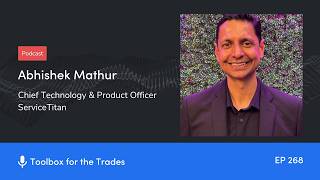
Abhishek Mathur, ServiceTitan's new Chief Technology and Product Officer, explains how AI can work across service businesses: voice agents handling calls, routing optimization, proposal generation, and back-office automation. He describes ServiceTitan's plan to embed AI as an operating system for trades, drawing on his experience at Microsoft, Meta, and Figma.
Chapters
Hello contractors and welcome to Toolbox for the Trades. My name is Jackie Aubel and I have a very special guest for you today. Abhishek Mathur is ServiceTitan's newest CTPO, that's Chief Technology and Product Officer. Abhi has an incredible background in technology and we spoke all about AI in the trades, what's currently available and how AI will shape the future of the industry. I hope you enjoy this conversation as much as I did. Abhishek Mathur, you are the new CTPO of ServiceTitan. Today, you and I are going to be talking about AI in the trades, the current state, and we're also going to make some future predictions. I am so excited to welcome you to Toolbox for the Trades. Thanks for joining me.
I'm so excited to be here.
Let's get right into it. I've got a million questions for you, but as always, I want to kick off our interview with an icebreaker. And Abhi, I would like to know if you had to pick a song to be the soundtrack of your life, what would it be and why?
Wow, nobody has asked me this question before. Maybe it would be "What a Wonderful World" by Louis Armstrong. I live every day with childlike curiosity. I've been so blessed to have amazing, wonderful family, friends, colleagues who have lifted me up. So I'd say that would be one of the songtracks of my life.
I am pretty sure no one has ever said that. It is a delightfully optimistic song, and I'm going to take that because I'm trying to challenge myself this year to be more positive, and I think listening to that song will definitely help me.
It is a beautiful song, and I truly, truly think there is so much wonder even with the progress of technology that is happening. I just feel we live in a world that is changing so fast, and I feel like an intern every day with the changes that are happening. So it really checks out in that way as well.
Well, if you feel like an intern every day already, you chose the right company to join. Let me tell you, I've been at ServiceTitan for 8 and and a half years, which is wild, and we are always growing and evolving. So you will be definitely used to that feeling. When ServiceTitan CEO Ara Modisyan first introduced you to the company, he said you were smart, ambitious, hardworking, and a wonderful human being. What nice praise. And prior to joining us at ServiceTitan, you did exceptional work at Microsoft, at Figma, and Facebook. I would love to hear what inspired you to join us over at ServiceTitan.
Throughout my career at Microsoft, Facebook, and then at Figma, my role has been to build tools to elevate others, to make them more productive, make people more successful. And when Ara talked about the job of service titan in the world, it really resonated with me. On a personal front, this trade and trade business is very close to my heart. Me and my wife, have sort of worked together on building some affordable housing. She is now a real estate professional, and we see the missing technology that could really accelerate all of these trades, make tradesmen more successful, make housing and construction more efficient. And also it's a huge cost. Like, you know, housing and living situations are such important things. This is an important goal for the world to be doing, and I'm so happy to be contributing to that.
That is awesome. I've said this on the show a million times, but you've never heard this from me. My father was a carpenter, and when I first started this podcast, he said, man, if I had your podcast when I was running my own business, things might have been a little bit different. And so similar to you, I see the opportunity that working in the trades provides, like giving the software that is enabling these companies to grow to levels they never thought possible before. It's really been incredible since I joined in 2017 just to see how contractors are going from pen and paper to now you and I are about to talk about how contractors are using artificial intelligence to run their business. It's like almost whiplash in some ways, but also really exciting.
It is. And one thing I have noted is there are so many employees in ServiceTitan that are here not only for technology or product development, but they genuinely, genuinely care about the cost. Like you talked about your Dad being a carpenter, Ara, Vahid told me about their stories as well, that their parents were in trade business as well. So there is a lot of passion in addition to sort of very smart people about this domain. That's what makes this space really special for me as well.
Yeah, I think you will also be surprised by how much our customers love to help one another and even the folks listening who aren't on the ServiceTitan platform for whatever reason. It's been amazing to see how contractors are so eager to support one another. And that's how I've been able to do this show, 'cause I always ask people, entrepreneurs to come on and say, tell me what mistakes can you help our listeners avoid that you made? And they're like, well, let me tell you. So it's really, really awesome to be working in an industry that is so passionate about helping lift one another up.
It is incredible.
Yeah. So you've led teams that have been at the forefront of developing groundbreaking technology. Most recently you developed AI power tools for Figma, Before we dive into AI that's specific to the trades, I would love to hear your thoughts on AI in general and how it's transforming the lives that we live and we work right now.
I think of AI as a force multiplier. It is an accelerant. It is an enabler. With AI, what I feel is that most jobs can focus on the core element of the job and remove the mundane. So that human beings can focus on creative problem solving or a deeply difficult problem and not sort of the things that come along with a job. So if you are a, for example, a programmer, you would imagine that programmers spend majority of time writing really deep, difficult code. But in reality, they are spending a lot of their time plumbing code, which is like, hey, how do I write a test for it? Can I integrate with this other API? Let me find a different API that did the same functionality. For example, in development is helping engineers become more efficient so they are focusing more on building the best business logic and not on the boilerplate code that you need to write. Similarly, in design, when I was at Figma, AI can help everybody be a designer. So the directionality of AI is to be an enabler and a force accelerant and helping people focus on the core unique value prop, the art, the craft of the job that they're doing, and remove the mundane and leave it for computers to do.
I love that point of view, actually. You know, we did a 2026 AI in the trades report earlier this year, and a lot of sentiment we heard from folks we polled is they were hearing that AI and they were hearing words like AI and automation and they were worried about AI replacing their jobs. And I think from my own perspective, I'm hearing that on a worker level, like people getting a little queasy about it. So I appreciate your insight that it's going to be used as an accelerant to hopefully take away the mundane. For the developer example, example, combing through code and trying to find where's the odd comma that's causing this thing to break. What would you say to anybody who is nervous about AI adoption and worried about AI taking their jobs?
I have empathy on, on the fast-changing world that we live in, but also excited about the ease with which adoption can be done. AI earlier, if you think maybe 4 years ago or 5 years ago, it used to be something that you needed to be a scientist to, to utilize or build. But it is becoming so embedded with the way you operate in regular scenarios that it is much more achievable and approachable. I would encourage people who are afraid to have a more open mind and try things. Maybe start small. It is something that will differentiate really, really successful business to businesses that will start to find it hard to be relevant because the productivity gain, the acceleration that you could get is not maybe 0.5 or 0.25. It's often 2x or 3x. I don't think it's an option to not try AI anymore. Yeah, it is. It is mostly to figure out how to approach it, how to take small steps and see what works for your business. I don't think it's an optional activity anymore.
Yeah, I agree with you. I think to stay marketable in some ways, at least coming from a marketing perspective, it's like, okay, I have to figure out how to use these tools because other people are. And if I don't— if they know how to do it and I can't, it's going to be harder for me to be employable moving forward. But I appreciate that you said that you have empathy for the pace at which some of this change is hitting us because it is a lot.
It is. And I truly like— I am saying when I say with all heartfelt thing that I feel like an intern now. Genuinely, the way in which software development was done or design was done or product management was done is changing so rapidly. And being able to keep pace with it, being able to utilize it is a new learning every day, but also very very achievable. There are people who I've met who always had brilliant ideas but didn't have the right tools to be successful. And AI is giving them so many of these tools that are natively integrated in the apps that they were familiar with. So at ServiceTitan, our goal is also not to make AI its own thing. It is so integrated and seamless with the experience that our users are already familiar with so that it feels natural. You know, you should be able to talk to ServiceTitan. You should be able to get a human-like response. So that's the directionality that we are going, where the learning curve becomes much more simpler and easier for people to adopt.
That was really aligned with what Vahé had said at our last Pantheon in 2025, which, if folks haven't heard that yet, is on the Toolbox for the Trades and the Mastering ServiceTitan podcast feeds. And I appreciate that insight that at what we're trying to do at ServiceTitan, which again, when I joined the company, we were trying to convince contractors to get off pen and paper. I appreciate your insight that we're trying to embed it into the platform. So it's making the usability easier because ServiceTitan is a behemoth of a product. And I'm sure you would agree given your background. And I mean, you've, you've been like fed to the wolves, my dude. You like joined us. I think as of this recording, you're not even publicly part of ServiceTitan yet, but you really We have been drinking from the fire hose since joining. It's a big, big product, and I'm really excited for the way AI can hopefully help our contractors leverage the technology faster and more efficiently to grow and streamline their business. You've mentioned that you're an intern, but you're not. You're a CTPO, or you feel like an intern. So CTPO, Chief Technological Product Officer?
Chief Technology and Product Officer.
Chief Technology and Product Officer. So for our folks listening at home, again, most of the folks who listen to this show are folks in the trades. Can you just tell us what is a CTPO and what is your job?
Yeah, as a CTPO, you wear multiple hats, but I'll probably like sort of classify the job in 3 broad categories. The first one is product. In ServiceTitan, we believe our success is our customer success. So there is a really smart group of product managers, researchers, designers who are constantly thinking about how do we make our trade professionals more successful at whatever they are doing. So imagination is job number one. Job number two is taking that imagination and turning it into reality. So that's the engineering job. How do we do this efficiently? How do we do it quickly? How do we do it at scale? So that's job number 2. So converting the imagination into reality with programming and technology. Third one is equally important, which is production. Now this code has to run in production in an available manner, in a secure manner. A lot of businesses completely rely on ServiceTitan from an incoming call to an outgoing invoice. And we take this responsibility very, very seriously. So I spend a lot of my time making sure that we are providing the best experience to our users in the office, in the field, on the go. So that's sort of the third part of the job, which is making sure our service, either when you're onboarding or when you're using it, is always available and world-class. So I would say these are the 3 things: product, technology, and production.
Product, imagining where it can go. Technology, building that idea from the imagination. And production, making sure it's on and it's working and it's not impacting anything else.
That's correct.
I know it's such— how does it feel coming from— well, Microsoft, I would imagine the work you did in Microsoft was also very impactful. It touched a lot of businesses. Meta too, in some ways, and Figma obviously as well. So all of the 3 big companies that you've worked at before, they are really critical to a lot of businesses. Like you have to have all of those suites set up in order to do your job. Does it feel a little different on the ServiceTitan side compared to the impact that Microsoft, Facebook, and Figma had?
I think they all, uh, are in similar business of enabling others to be more successful than they would be without the software. Like Figma is the enabler for creating beautiful experiences for the things that you want to accomplish. And my job at Facebook was to work on videos and livestreaming, which enabled everybody to have a voice. You are a very talented artist yourself. So creating a forum for anybody to be able to reach millions of people is such a big Audition. So it was again in the business of providing tools for creators to be more successful. And my job at Microsoft was 3 parts. I got to work on the first version of.NET. So this was making developers better and more successful. I got to work on the first version of a product called Office 365. Half of the world runs their email and chats on that platform. So that made information workers better. And then my last job at Microsoft was in Azure, which is the PaaS platform that everybody uses to host their applications on. ServiceTitan is built on.NET and runs on Azure. So it's a full circle for me.
Yeah, I mean, I'm just— this happens sometimes when people do interviews with me. I make realizations in real time. You really have had such an impact on the technology that so many people interact with every single day. How does that feel?
It feels unreal and I feel very blessed. Even like when we started on videos, Facebook used to be a photo and a text company. And now, of course, it's a very video-first company. The number of media and assets that get created is in billions, billions every day. It sort of just blows my mind and I feel very privileged to have played small parts in making all of these successful in some ways.
Actually, when we did our very first, either was the first or second user conference or ServiceTitan, we announced it on Facebook Live because I was doing social media for ServiceTitan at the time and I was like, oh, we should try live streaming it on Facebook. So in some ways you are already making an impact with us.
I, I am so happy to hear that. I did not know that. And I'll tell you a story of Facebook Live. Facebook Live, few of us got together in hackathon in Facebook. It was called Code Under the Stars, where we all sat on the roof of one of the buildings and built Facebook Live. The first Facebook Live happened on my laptop and rest is history. We have billions of really amazing streams. Good, bad, ugly has happened on that. But it is one of the more cooler products and more difficult products that I got to work on, and I'm so proud of that.
That's so funny. Do you, you have two younger children. One of them is a teenager, I'm imagining. I don't know. I don't know. But like, I just feel like the work you did at Facebook Live is probably informing some of the way that they're going to be interacting with social media now. Do you ever get to go like, You're welcome.
I do. I feel the work that the team did on this, of course, there's a lot of entertainment, but you see so much unfiltered reality on Facebook Live. The whole premise of Facebook Live was to create original content on Facebook. Sometimes you think of problems in the world as statistics or news headlines, but when you see a Facebook Live of things that are going on, you sort of build a different type of empathy. It gives voices to people who would have not found voices. So in addition to the kids interfacing with technology with this, I feel it is a new way of operating in the world. It is— some of these platforms have given a news channel in everybody's hands. So I feel more information is always empowering, and I feel great about the little that I contributed to those.
That's so cool. I'm just kind of realizing your impact in real time. So I, I'm excited about you joining ServiceTitan, and I'm sure our listeners are too. I wanna pivot back to AI. The way you said it before, it's an accelerant. We think it's gonna be the way it can be used today is it can help take away some of the mundane tasks that bog us down and allow us to focus on what really matters in our day-to-day, in our companies and our businesses. Let's go into what you think AI will offer or currently does offer contractors specifically.
Contractors want to spend most of their time fixing difficult problems for their customers. They want to be able to do that much faster, quicker. They want to create artifacts like invoices or proposals that they can feel proud of and are accurate. And that's where we are thinking that we could help a lot of the contractors be much more successful. I'm talking about the people in the field. But if you look at the whole funnel of things, how do I get business? How do I become a bigger business is one aspect— demand generation. How do I provide the best user experience to my customers when they're calling, when they're trying to reschedule a job, when they're trying to find out if the part has arrived? The third category is the backend, the back office people. How can AI help people be more successful in back office? Like how much time do we need to review invoicing? Can I do this much faster, quicker, better, only act on things that are needing attention? So these are the 4 areas where owner is able to get all the insights they want. The front office is much more successful with acceleration with AI. Technicians in the field get the best of the world with AI, and then back office is accelerated. So these are the four dimensions in which I think about things. And maybe I could give some examples of things that we are already doing that people should try and benefit from. For example, we have a product called Voice Agent. An AI agent is available to take your customer's call. Now imagine this agent is available 24/7, never gets tired, has all the context of an incoming call. That could be a huge accelerant for a business. Or when technicians are going in the field, they have the best routing possibly available so that they are spending less time on the road and more time on the job. Technicians being able to create amazing proposals that are on brand, on point, accurate, and credible so that it can help you grow the business or detect problems and debug them sooner with the information that is available. So some of this is already reality that people should absolutely try, and people who are not using it are sort of missing out. From here, we are only growing and expanding. My hope is that we sort of automate away most of the mundane tasks that take away the focus from running an amazing business.
I think that's great. And I know that this podcast is intended to introduce you, but we also have another very big announcement on this podcast. I've been hosting this show for 2020, and one of my running jokes is that because I live in Los Angeles, I'm not a homeowner, so I can't actually interact with ServiceTitan? Well, as of February, I am a condo owner in Los Angeles, and I interacted with one of ServiceTitan's AI voice agents to help me troubleshoot my Nest thermostat. I selected one of our customers. I will not say which one because I'm not going to play favorites, but I called and I was like, I think this is the voice agent, but it was so good. Like, it was so good. So I talked to the voice agent. I told them what my issue was. They got my address. They said, okay, I think we'll be able to get to you from you know, 2 to 3 or whatever day it was. And then about 15 minutes later, I got a call from a human at the office and said, hey, I saw you spoke with our AI chatbot. They were asking one or two more details and then they gave me, we're actually going to give you this appointment instead. So what the AI voice agent enabled me to do, enabled them to do, is to screen my call, see what kind of effort this was, and to be better able to dispatch their technician accordingly. And then I had the technician come. and I was like, hey, full disclosure, I work for ServiceTitan. He's like, oh. And then he told me how he went to another company that didn't have ServiceTitan after working in ServiceTitan for several years. And he was like, and it sucks so bad because I got— he's like, on my way here to your, to your home, your condo, I got to listen to you talk to our AI voice agent and hear what your issue was. And it's so helpful to me as a tech to have that information that now when I go do jobs without ServiceTitan, It's almost like I'm in the dark.
It is incredible to hear this real, real life story. And congratulations on your new condo. But things are going to get better from here. Even, even, even more. For example, it is, it is very difficult for a human being to map out the best routing plans in a bigger city with matching a technician to the best possible important job. Being able to predict how things should change based on weather and inventory. These are things that AI is going to be so useful for, where a lot of the back office operations is taken care of and human beings get involved when there is an escalation. Like in the case that you were talking about, the call center professionals there saw that it was an important call. They should prioritize it. ServiceTitan can help flag all of these things so that then you prioritize the most important business calls that are coming into your system.
It was very cool. And I have to say, I wanted to work with a ServiceTitan customer because I wanted to see if I could get one who used AI voice agents. I was like, I want to see what this is like. Like, I knew it was AI because I guess I'm a millennial, so I kind of know. But I'm like, it was really good.
It is. Really good, and we will continue to make it better. I don't know whether you noticed there is a small background noise which looks like typing. So it looks like— human ears are very powerful. It is very easy for human ears to distinguish between artificial voice and a real voice. But a lot of work is going on to make these voices be even more natural and real. A little bit of intentional back-office noise that is added to these calls. Oh, sure. So it looks much more real. Already in a lot of situations, a voice agent is surpassing the call booking rates of human CSRs. So—
I know it's— I'm actually— I have some stats in front of me. One of our customers, Northwind, is currently seeing booking rates of 80 to 85% with AI voice agents, and it's health them handle roughly 7,000 calls in a week during a January winter storm, which is so cool. But like, think about when you're in a winter storm and a bunch of equipment all goes out at once all across your service area. How can you even begin to start fielding those calls?
It is not possible.
Yeah. So I could really see the benefit there. I wish I knew about the background noise when I was on the call with my AI voice agent because I would've looked out for it. You know, and I think You were right. I think that might have tricked me because the only tell I had that it was probably an AI agent was just the pause after my— after I spoke, the pause after I finished and then they began was a little too long. That was the only way I knew.
Yeah, I think it'll become indistinguishable very soon.
I'm fine with it. Like, I still got an appointment very quickly and I got a clarifying call shortly after. So I had a great— I had a I had a great time. That's going to be our new AI voice agent testimonial from Jackie, host of Toolbox for the Trades. I had a great time.
I had a good time.
Well, with that all being said, like the impact that ServiceTitan currently has in our product, going back to this AI in the trades report that we unleashed earlier this year, we uncovered that 35% of contractors haven't touched AI at all. And I think I kind of know what your answer to this would be, but I would love to hear what you would say to them if they said, I'm not dealing with that stuff?
They're missing out on a lot of efficiency, missing out on possible additional demand, missing out on being able to focus on the core tenets of the business, which is connecting with the customers or fixing really complex problems. And it is easier than you would imagine. You know, it's not a thing that you need to be very technically sophisticated to utilize. It is now so integrated with the part of product that you are very familiar with, that not giving it a try seems like missing out on a very, very critical opportunity. And the other one is that AI generally might be creating an economy which will look very different for people who are with the technology and without the technology. Like I said at the starting of the podcast, the difference is not 0.4 2.5, like you talked about, the, the revenue of a contractor doubling. So we're talking about a very big delta. So I would encourage people to sort of give it a try and of course give us feedback. We can always make things better. There's amazing group of customer success representatives in ServiceTitan who are always available to help and make this easier to adopt as well.
Yeah, for sure. And also I want to shout out one of our customers and former podcast guest, Stephanie Allen launched a trade-specific community called Just Start AI that I've actually been lurking on the last couple of weeks, and they are constantly pushing out information on how contractors are using all of the various AI tools out there, including what's currently available in ServiceTitan. So I will link that in the show notes, which again, going back to what I was saying before, contractors just helping each other grow because they see the opportunity.
That is so unique and, and so incredible to us.
Yeah. What other industry do you have where you have competitors going into a community together and saying, how are you figuring this out? It's really, it's really unique.
And I think the, the pie size is so big that everybody can be very, very successful. I think so. I think that also gives some help here.
I agree. So we talked a little bit about what ServiceTitan currently offers. Can you give us a big picture vision AI for— I mean, we did talk a little bit about how the state will be that AI is really embedded in the platform. But can you give me any big picture thing without, you know, giving too much away about what we can expect for AI development and ServiceTitan moving forward?
Yeah. So the way I think about this is that we are the operating system for trade already. That was our mission and we have been on that journey for a long time. And the transition that we are making already is We are the AI operating system for a trade. What it means is that from an incoming phone call, which is maybe in some situations handled with a voice agent, to being able to dispatch in the most logical manner, create demand, and using that demand statistics, change scheduling, being able to predict where inventory situation is, being able to optimize proposal generations or financing to being able to automate some of the back office operations like payroll and accounting is the direction in which we are going. So the majority of focus for business owners would be on their craft and less on logistics. The other thing that is uniquely possible with AI is the deeper insights that you could get from your business. So we are always used to mechanisms where we are querying for information from software. You say, run me a report, tell me which are my most important customers. But imagine it flipping on its head and the product telling you to do things and giving you insights on, hey, have you thought about XYZ. Have you thought about changing these routes, or have you thought about going forward with this kind of a proposal, or being able to say these technicians need some additional training because their rates are below other technicians? We will also move into a world— some of this is already possible, but more of it will be available— where software is telling you insights and mostly doing the job in the background. But where human judgment is required, it is coming to you and then you are interfacing with it.
That is really cool because that's almost like a consultant that's just running in your software.
It is like a chief of staff, like the best chief of staff you could imagine, who could sort of think about all the domains in your business and have that in their mind. And remind you at the right time.
Yeah, that's so cool. I mean, I'm already seeing it. I just— again, not maybe not the fastest AI adopter over here trying, but I just set up Cloud Cowork the other day and I was surprised by the prompts that it was asking and communicating with it to do certain tasks and the way it suggested. And it gave me the option to opt in or opt out of that suggestion, seeking ways to make me more efficient, but still making sure that I'm the one overseeing that change.
Yeah, I think that is a very important thing. This is the design principle we have in mind where there are situations where judgment from humans is always needed, and that's when you surface that information. And sometimes you codify it as a rule. You could tell the AI, hey, you know, this is something that I want you to remember. Don't ask me again.
Yeah.
Or this is something that I want you to check with me. So that's the direction which we are going. And I'm so excited and pumped about it.
That is awesome. So you have been so generous with your time already. I want to just ask you another question that I know folks listening, especially ServiceTitan customers, are thinking. I know a lot of our AI offerings right now are tied to our Pro products. I would love to hear your goals for ServiceTitan's core product. What impact are you hoping to make on the core platform today?
Our direction is to build an AI OS for trades. AI will be just embedded across all of the layers. My hope is that majority of business should be focused on actual trade work and less on the backend activities. Hopefully ServiceTitan will be able to take care of all the things from demand generation to fulfillment, to invoicing, to proposal generation, and then most of the technicians are focused on doing their trade work. So that's the direction which we are going.
Mm-hmm. So great. So AI embedded in all elements of the platform, essentially. Yeah. And working on that production side, which is making sure that the product is operating as smoothly as it possibly can.
Yeah.
I lied. One more question for you. What advice would you give contractors who are trying to cut out the AI noise and select the best AI solutions for their organization? Because there's a lot of different AI tools that are cropping up, and I've heard from folks they're kind of maybe overwhelmed and not taking action or taking too much action and getting too many different little AI add-ons. Do you have any advice, especially coming from a software perspective of like how to select which tools you really need to be using and which ones maybe you don't?
Yeah, I've built very high-scale software all, all my life, and most of the products that I've built, millions of people use them every day. One thing I've learned is sometimes less complex is better, and there is value in simplicity. So I'll give a non-trade example. So when you're building a software, you could create a mesh of complexities and have like 50 vendors in a software path. They are not tested with each other. They are not sort of flowing with each other. The information does not work very well. And there are so many people needed of different types of knowledge to make that operate, or you need to work with 50 different relationships to make something happen. So my approach has been to simplify and focus on a few key partners and work with them much more deeply. For example, in Figma, AWS was our core provider. There were other providers that could partially give a little bit better database than what AWS could, but instead of that, working with AWS felt like the right thing so that you have a much more sane system that when people change, when you need something, there are fewer interfaces to tackle. So the thing that I would advise people who are playing with AI is to see how can you make the system simpler to use and be a little bit like homogeneous rather than too much variety. There was a customer call we were on and there was there was this situation where there were like 7 different vendors involved in debugging an issue because different people in the organization had bought different parts of technology stack and they have sort of since then moved on. So the owner was just like puzzled on how do I tackle this scenario. So I would sort of make a bet on a platform and really work with that platform, evaluate that, make sure it is— if it is not, of course, working for you, then that's an obvious choice, but I would pick a platform and then gradually adopt things that are relevant to your business, will gel with your current company size and technology adoption curve. That would be sort of one advice, but not doing anything is probably not the right answer.
Yeah, I think simplicity is definitely that. And also what I've heard from former— from guests on the show is when you adopt a new technology, make sure you know what you want it to do so you can actually measure if it's doing that for you. And I love how you brought up the example of like sometimes when at a business, if we have turnover or we have multiple people who have been in different positions, like you can kind of look and be like, why do we even use this? What is this and why are we paying for it?
And what is the login? Like, I'm not joking. Like the one thing which was unclear was why do these services exist and who is the admin and how do we change settings in that? Being very thoughtful on how to change the technology curve is a very, very important thing. So pick fewer partners and really invest in them.
Amazing. Abhi, thank you so much for your time. This has been so great. I— what a privilege for me to get to talk to you in such an intimate way and learn about the way you think and how excited you are about coming on board. We are all so excited for you to join Surface Titan. I know our customers are going to be excited as well. I mean, the only other thing I can think to end this— do you have a personal example of how you're using AI that has been really fun for you?
Yeah, I've been an engineer all my life, but as I continued to sort of progress in my career, the proximity to code became harder and harder to get. Being able to build again with AI is so rewarding now. Being able to do things that you always wanted. I wanted, like, I have some mechanism on how I think of a task. And being able to just create one without needing to have a backend deployment or learning to code again is so magical. So a lot of the people and leaders, including Vahé, who is our co-founder, are just rediscovering the joy of programming and building again. So that's, that's one thing that I am really excited about doing.
That's awesome. I love that answer. Well, Avi, thank you so much for joining me on Toolbox for the Trades.
So good to be here. Thank you.
More from Bill




Capturing the 80%: How SmartAC’s Gen-2 Targets Non-Membership Homeowners | Podcast Ep. 296

Build better customer data with every booking in ServiceTitan | TAD Tune-Up Series

The Biggest Change for Roofers Coming From Other Roofing Software to #ServiceTitan?

