You're Sabotaging Your Sales Team
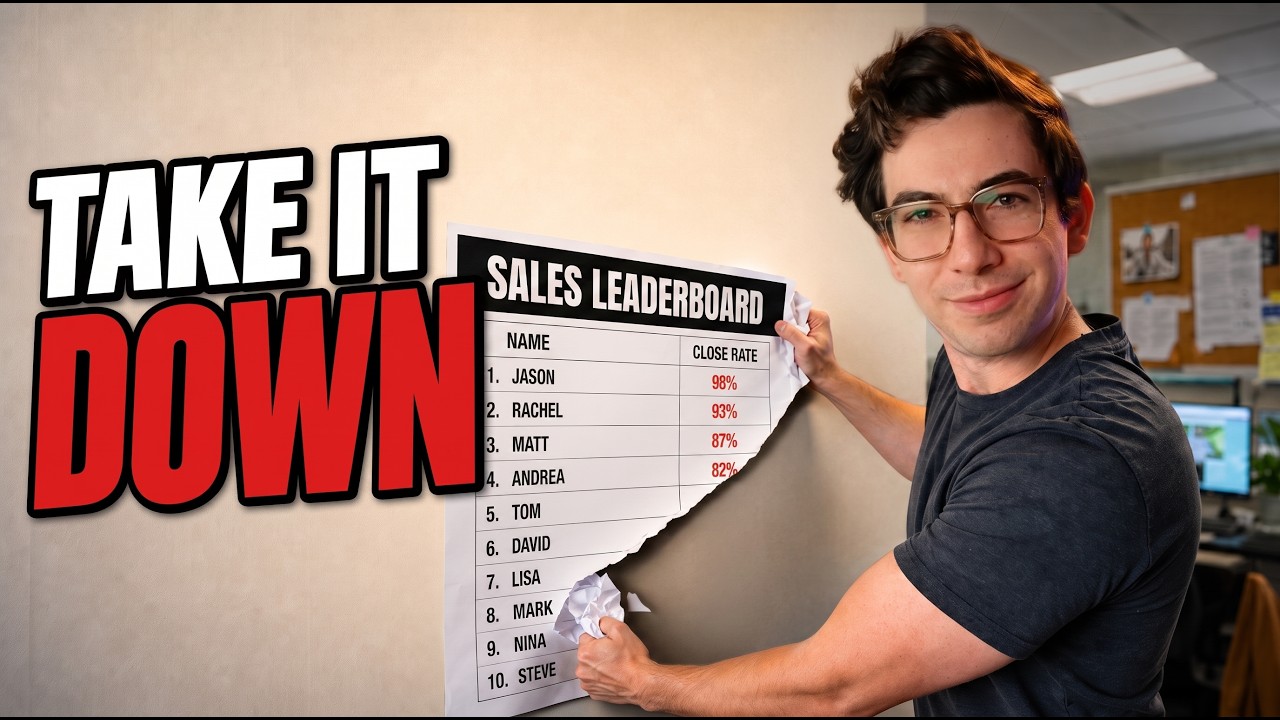
Richard Kovriga argues sales leaders sabotage their teams by obsessing over close rates, which makes reps anxious and pushy. Focus on controllable behaviors instead: follow-up cadence, role-plays, authentic personality. When salespeople feel desperate to hit a number, they attract low-loyalty customers and start gaming metrics.
Chapters
The harder you try to close a sale, the worse your odds get. And then when it does occasionally work, congratulations, you just landed yourself a worse customer. Focus entirely on behaviors which are in your control and genuinely accept that the outcome is not in your control. Shoving the close rate in their face and saying, we need to get this number up, this number is too low, that is not helping them, that's making it worse. What's going on everybody? It's Richard Kovriga here, the Blue Collar Nerd. You are probably sabotaging your salespeople and it's not in the way you think. You're sabotaging them by focusing too much on their actual sales metrics, and I know that sounds kind of weird, so let me explain. So traditionally, sales training focuses on one main goal, which is making the sale, and that makes sense, right? Like, you're a salesperson, your job is to make sales, which means that when owners and managers are evaluating the success of a particular salesperson, they're doing that by looking at a particular metric, typically close rate. And so, when a salesperson's close rate is consistently not looking good, that's taken as a sign that the salesperson needs training and so they're given things like particular sales scripts and sales processes. And I'm not here to tell you that there's no place at all for sales processes and some amount of scripting but there's going to be a very limited amount of success that you can squeeze out of those because of the human element. People like to buy from people that they like and connect with. So things like charisma, social aptitude, likability play a huge role here. These are personality traits. And while I think that everybody sort of knows this, I think it's not trained because it is seen as just like, well, that's your personality, either you're like that or you're not. So here's the problem: when all of the training and all of the measurement point at the outcome— did we make a sale— well, then the salesperson starts putting an enormous amount of importance on the sale. This customer needs to buy from me today. And putting a high level of importance on the outcome is going to backfire. Here's why. So let's for a moment think about dating. Now, I know it's been a while, Grandpa, but try and remember. So when a person is romantically interested in another person, there's a very specific balance that needs to be hit. On the one hand, you do need to express interest, and that needs to be fairly unambiguous, AKA you need to actually muster up the courage to ask them out. So, the sales version of this is that you have to actually ask for the sale, which takes some courage. But you probably shouldn't ask somebody out like right away, like you just see them across the room, walk up to them, and ask them out. That's probably not going to work. I mean, it might, but if it does, they're basing that entirely on how you look, which kind of translates on the sales side to like entirely on price. There's nothing else they could possibly base it on at that point. They don't know you. So, step 1 in both dating and in sales is to get to know them and help them to know you. So thinking about dating, what are the ways in which this could go bad? Well, they could get to know you and be just not that fond of you, and you don't have any control over that. That just is what it is. Same in sales, can't win them all, that's okay. But some other ways that this could go wrong is either A, you do a poor job, you know, kind of showcasing your personality, that they don't really get to know you very well because you are anxious, or B, you end up giving off kind of a pushy energy Where the other person feels like, this person just like wants something from me and I'm not into it, like I'm pulling away because I just— that's an uncomfortable energy. That's going to work the same exact way in sales. Anxious vibes and pushy vibes are not very comfortable to sit in. So people are going to naturally pull away and try to not engage with that. And the reason somebody might act one of those 2 ways, either anxious or pushy, is because they are focused on a particular outcome. They're putting a lot of importance on a particular thing happening. I need to make this person like me. I need to make this person buy from me. You can't. And so when you try, you end up hurting your chances. Now, some people will still engage with this energy, especially pushy energy. Some people will say, okay, you know, this person's really into me, or this person really wants this sale from me. Fine. Okay, you know, I'll cave. You can take me out, but we're gonna go to the fanciest restaurant in town. I'm gonna order the most expensive thing on the menu. And, you know, I haven't paid taxes in like 4 years. I've got some penalties that I need to cover. Could you help me with those? So now, through your own behavior, You have specifically selected for people who are going to be abnormally demanding of you and show you less respect than a quote-unquote normal person might. So the sales translation of that, a polite, you know, normal quote-unquote customer gets put off by the desperate vibes and the pushy vibes, and they find a polite way to say no. And the customers who are gonna take you up on the discounts and the freebies and the groveling, that's gonna be your more demanding, more disrespectful nightmare of a customer a lot of the time. And this is not you getting unlucky with a lot of bad customers, you're specifically filtering for them. And you know this part already, this isn't new information. Any customers that you're gonna acquire through like discounts and major concessions, they're generally gonna be your more difficult customer, they're more likely to churn, they're less loyal, they have more complaints, they have a laundry list of demands, all while at the same time paying less than a regular customer. But it still tends to leak through, especially on the sales side. You're selecting for that type of customer, Because sales is typically bigger ticket items, there is more desperation. And it's not a sales problem per se. It's an anxiety problem. It's a confidence problem. It's a desperation problem. It's a personality problem. And maybe that sounds harsh, but let's define personality. I'm defining personality as the way a person responds to the external world. Those patterns can be changed. So what I'm describing as personality is is not really something you're just like born with and stuck with and that's just who you are. You can alter it. And for an anxious or desperate salesperson, a key step in that alteration is not putting too much importance on making the sale, which again, I know sounds kind of weird, but importance placed on the outcome drives a person's behavior in subconscious ways and gives them, for lack of a better term, a vibe. So again, going back to dating, in the dating world, success tends to come from a more relaxed vibe. So if you're interested in somebody but it's like, ah, you know, it's cool either way. If you want to go out, if you don't want to go out, I'm genuinely okay either way. When you're starting from that mindset, you're able to be more fun, be yourself, be more relaxed. Your vibe is better and so your chances for success are better ironically because you care about that outcome less. And when I say care less, let me be clear about what I mean because maybe care is not the right word. It's not about not caring. It's about not worrying. It's about not worrying about the outcome Because you have the confidence to know that whatever this person decides, it doesn't say anything about you personally. And if this one doesn't work out, some other one will. If this person does not like me, it doesn't mean I'm unlikable. If this person does not want to buy from me, it does not mean I'm a bad salesperson. And no matter the outcome of this particular interaction, I'm gonna be all right. If they say no to me, yes, that's not my preference, but I know I'm gonna be just fine. So it is about feeling secure. Okay, so then the question is, how do we encourage salespeople to feel secure? Hey, real quick, if you use ServiceTitan and you're tired of figuring everything out the hard way, then check out my Ultimate ServiceTitan Guide. It's got over 180 step-by-step walkthrough videos covering the entire platform. You can go to bluecollarnerd.com to check it out. All right, back to the video. So ultimately, the solution here is to focus on behaviors, not outcomes. Focus entirely on behaviors which are in your control and genuinely accept that the outcome is not in your control. You cannot make somebody buy from you. It is not within your power. In the same way that a farmer cannot make a seed grow. They can plant a seed, they can water it, they can make sure they put it in the right spot with the right type of soil, and probably it will grow. But it still might not, because the farmer doesn't have control over whether or not a seed grows. They only ever have control over their behaviors that make growing more likely. So if a farmer plants a whole field's worth of seeds, and then they do the right behaviors on every single seed, They're still not all gonna grow, but chances are a lot of them will. So you shouldn't weigh yourself on any single one, any single seed or any single sale. Trust that across the entire field, a lot of them are gonna grow. It doesn't matter what happens with this one in particular. We're good either way. And we're gonna learn from the field, not from any particular seed. Any single outcome is noise. The entire field is the signal, which means that yes, as a manager, as an owner, You should still measure the outcomes in the macro. The point of this video is not to say stop pulling reports on your close rate. That's not what I'm suggesting. But the outcomes shouldn't be what the salesperson is focused on. You, the manager, or the owner are going to use outcomes to learn what the right behaviors are across seasons, across the entire field, and then detach from them one seed at a time. Now, I got to be straight with you. There's a catch here. Unless your salespeople are all like high-level monks somehow, detachment is kind of a luxurious mindset because if your salespeople are in an environment of scarcity, it's really, really hard to be detached. So, the prerequisite to detachment is volume. If you've only got 2 or 3 seeds and whether or not these seeds grow determines whether you eat this week, it's going to be really hard to be detached from the outcome there. Desperation is just kind of the natural human response in that scenario so in the same way, if your salespeople are starved for leads, and they're not making enough money, they're probably gonna behave in ways that are anxious and desperate because they are anxious and they are desperate. So lead volume is a marketing responsibility and it's an internal process responsibility. You have to be feeding your salespeople enough leads that detachment is even like psychologically in the cards. So volume helps enable detachment and detachment improves results. You might feel a kind of dissonance inside of you, a sort of tension about the idea of feeding your salespeople a whole bunch of leads With the specific objective of making them care less about each individual one, because the natural fear is that they're going to be throwing away expensive leads. I challenge you though to let that go. Volume enables detachment, detachment improves results, and then those results justify more volume. So this is a cycle that feeds itself. Now, to be clear, I am not telling you that salespeople should be passive. Don't hear detachment from the outcome as you should stop following up. I'm asking you to detach from the outcome, not the customer. So following up with a customer until they give you a straight answer, like they actually tell you no or they buy from you, that's not desperation. That is a seed-watering behavior for a service-type relationship, which this is, right? So there's some nuance here. I was comparing this to dating earlier, but it's not exactly the same. This is a different type of relationship. This is a service relationship. So yeah, in the dating world, if you ask somebody out and they were like, let me think about it, and then you kept calling them like every day until they told you a firm no, that would be pushy. It would be inappropriate for that type of relationship. For a service relationship, things are a little bit different. But when you are following up with that customer, when you're doing it while being detached from the outcome, it feels different on the customer end. It's going to read as true service, just, hey, you know, I'm making sure that you're taken care of, instead of, I want something from you, give me your money, why are you making me work this hard, why is the money not in my hand already, where's the money? Same actions, different energy, Different effects. All right, so to dive even further into the nuances here, let's say we've got like a big commercial account that's gonna be doing like 20+ HVAC systems and we've given them a huge bid. So now we're dealing with somebody who's about to spend an enormous amount of money and oversee a giant project. So contacting them frequently, spending a whole lot of time with them, doing a little bit more for them than you would for like a residential one-system replacement, that's not under the desperation bucket, assuming of course we're doing it with the right energy. That's just attentiveness. That's watering the seed correctly for the type of seed that it is. Some seeds require more watering. It's not really about the amount of attention so much as it is what's the driver behind that attention. Service-oriented attentiveness is driven by the customer's needs, the size of their decision, the complexity of their project, and what that customer needs to feel confident moving forward. It's driven by the other person's needs. Desperation is driven by your needs. Your close rate, your commission, your financial anxieties. So again, for all you owners and managers out there, I am not saying stop looking at reports and stop looking at dashboards. Keep the reports. But when you're face-to-face with your salesperson, your visible concern should not be the number. It should be that they are comfortable and that they fully understand what the right behaviors are. Shoving the close rate in their face and saying, we need to get this number up, this number is too low, is doing the exact opposite thing that you wanna be doing. You're placing all the importance for them On the number, aka on the outcome. That is not helping them, that's making it worse. Now, can we just directly measure the behaviors instead of measuring the outcome? Well, there's an old idea from an economist named Goodhart, and it basically says that as soon as a measure becomes a target, it stops being a good measure. And the classic example tied to this is that back in the day in British colonial India, they used to have a bounty on dead cobras to help fix a cobra problem. So there were too many cobras, they implemented a system where you could get paid to bring in dead cobras. So what happened? Gaming of the system. People started breeding cobras for the explicit purpose of killing them and bringing them in for the bounty. So the government killed the program, and then the breeders released the now worthless cobras, resulting in even more cobras than when they started. We did it, Patrick! We saved the city! So applying that same thing to close rate, if we make close rate the target, then it starts to get gamed. We get things like salespeople who are heavily attempting to cherry-pick their leads. We get salespeople who might start discounting inappropriately to get the close rate up. We start to get salespeople who are maybe not as honest as they should be, and we start to get bad reviews as a result of that. And notice here that gaming the metric is a desperate behavior. So you might think, fine, we'll measure the behaviors instead of the outcome. So maybe, for example, a metric that we're going to start measuring is how many follow-up calls the salesperson does. Congratulations, now you've got salespeople who are spamming your customers and pissing them off. Goodhart's Law is gonna kick in there too. If you measure a metric, there's gonna be some gaming of that metric. There is no ungamable number. The problem was never the measuring, it's what the measurement is for. A metric can be a thermometer or it can be a scoreboard. You should use close rate as more of a thermometer. You just kinda glance at it, you check in on it once in a while, and use it as a general gauge to see where you are. But once you make it a scoreboard that you wave in people's faces, It stops telling you the truth, and you make your salespeople worse at their jobs. So behaviors aren't really something so much to track with KPIs, but they are something to be coached. Ride-alongs, role plays, etc. These aren't going to be perfect. You have things like the observer effect where you do a ride-along and they're going to behave a little bit differently because they know they're being watched. I acknowledge that. I'm not saying that this is like an easy problem to solve. I mean, close rate became the default scoreboard in the first place because it's objective, it's easy to track, it's cheap, it's right there on the report. Behaviors are much harder to observe, but we want to coach behaviors. By the way, giving somebody a script and telling them that they need to very strictly follow the script is not coaching behaviors. That's actually stripping away everything that makes a salesperson effective, which is like their humanity, the way that they relate to the person that they're working with, all of this personality stuff, all of this vibe stuff. You absolutely strip all of that away when you say just like, here, follow this script. You've just made a script-reading robot at that point. Like, you might as well just outsource this to AI and save yourself some labor cost. You have to give the salesperson freedom to speak the way they speak and let their personality shine through. That's not to say you can't have a quote unquote script. It just shouldn't be, in my opinion, something that's very rigid where it's like you say this exact phrase and then you say this exact phrase. And if they say this, then you say exactly this. It should be more like just bullet point type guidelines. Here's some ways we could generally think about handling this particular type of objection and the way that you phrase that, the way that you bring that about Is sort of you through your filter, through your personality. And as owners and managers, we know that we have something to correct for when we glance out at the field and it's like super barren. So we can dig into behaviors at that point. We can kind of see, are certain behaviors not being taken? Are we not watering the seeds properly? But they might be getting watered just fine and something else is off. Sometimes you just get a bad batch of seeds. Sometimes there's environmental stuff, a big storm. So you have to be willing to accept that it might not be the salesperson's fault if you're feeding them truly low-quality leads. If you've recently skyrocketed your pricing, that's gonna make their job a lot harder. If you are in the slow season, like, we have to acknowledge that that's gonna make things harder. It doesn't mean that there's nothing we can do, but more watering probably isn't the solution. We might have to come up with strategies that we've never needed before. So there's a big cold snap, maybe we need to get into greenhouses. But when you look out at the field and you see that it's barren, the conversation shouldn't be, Hey, we're not getting the outcome. You're doing something wrong. You need to get these seeds growing. It would be something more like, hey, I noticed the seeds aren't growing. Let's look into it. And maybe you look into it and you say, you know what? It looks like you're doing everything right, actually. Let's figure out what else is going on and let's find a solution together. And none of this means that nobody's accountable. It's not like we're taking accountability completely away from your salespeople. So, like, if lead volume is there and the coaching is there and seasons keep passing and the field is still barren, and you can't find any other issues, maybe you've got other farmers who have very lush fields, well then you might be looking at a deeper personality fit issue. And like I said, I do believe that personality is like a thing that can be changed, but it's often slow, hard work, and it's not really your job as an employer. So at that point, it might just mean that this salesperson is not going to work out for you. Now, somebody out there might hear all of this and say, Richard, you know, quota-driven sales organizations do great. Like, they make money all day long. I know tons of them. And yeah, absolutely. I mean, I acknowledge it can work, but I just think you're leaving behind a lot of people who could have been really great salespeople. There are some people out there who can have a lot of focus placed on the outcome and still manage to be cool and charismatic and likable. I just wouldn't say that that's the norm. Plus, when you go that route, you eat some reputation costs. I think people kind of intuitively know this. When you picture like a bigger organization that's very focused on numbers, what do their reviews typically do? You get more complaints, customers feel like salespeople are being more pushy, they feel less cared for, they feel like the service relationship breaks down. That doesn't necessarily equate one-to-one with financial failure of the company. But to say that something can work is not the same as saying that something better doesn't exist. But focusing on behavior versus outcome does have trade-offs. There's way more management attention and like judgment call necessary versus just like running a leaderboard report and pointing at it. That is why it's rare. But charisma and confidence can be trained. It takes practice, and it takes a trainer who isn't fixated on outcomes. And anxiety rolls downhill. It's contagious. So if you as the leader are anxious about money and close rates and outcomes, it's going to be hard for the rest of the team to not pick up on that. So whatever you're feeling about the numbers, the people on your team are feeling some version of that within like a week. And that chain of anxiety extends all the way out to the customer's kitchen table. So this isn't just something for salespeople to work on. This is something for owners and managers to work on too. Calmness and likability is trainable, but it's trained from the top down. The trainer absolutely needs to lead by example there. Anyways, that's all I got for today. I can teach you and everybody else in your organization how to get the most out of ServiceTitan, and you can learn more about that at bluecollarnerd.com. Appreciate it. Peace. Peace.
More from Bill




Capturing the 80%: How SmartAC’s Gen-2 Targets Non-Membership Homeowners | Podcast Ep. 296

Build better customer data with every booking in ServiceTitan | TAD Tune-Up Series

The Biggest Change for Roofers Coming From Other Roofing Software to #ServiceTitan?

