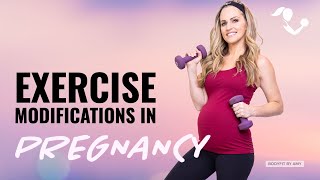
Amy, a prenatal exercise specialist, explains which moves to skip when pregnant and how to modify them safely. Avoid crunches, front planks, and prolonged lying on your back. Instead use quadruped positions, wall push-ups, bridges, and standing variations to protect your core.
Hey everybody. I'm Amy from Bodyfit by Amy. And today I'm going to show you exercise modifications in pregnancy, what you need to modify, what you need to avoid, and how you can modify. So the first thing I want to say is that no matter what, you want to make sure that you have doctor's clearance from your doctor or your midwife for exercise during pregnancy and that you talk with them about what is specific and appropriate for for you and your pregnancy. I'm a trainer and a fitness instructor. I'm a mom of two. I'm a prenatal and postnatal exercise specialist. So I can give you the guidelines, but you need to make sure that you are talking to your healthcare provider about what is right for you. The easiest way to modify your exercise during pregnancy is to seek out specific prenatal workouts and prenatal programs. I have tons of prenatal workouts here on my channel, as well as a prenatal curated program. You can check out the links in the description below. Making sure that you're doing workouts with a prenatal and postnatal exercise specialist, knowing that not every trainer or fitness instructor is prenatal and postnatal certified. Beyond that, I want to show you some specific exercises that we should avoid or modify and how to do that. So the biggest changes in our exercise in pregnancy come in protecting our core. So we want to avoid exercises that increase what we call intra abdominal pressure, which is pressure out on our abs and down on our pelvic floor. So we can reduce our risk for things like ab separation, diastasis, recti prolapse or other pelvic floor dysfunction like incontinence. So we want to avoid things that put pressure on our core, avoiding all things in the front plank or push up position. So that is in that high plank here or here, or anything that we do in that, such as a pushup and a mountain climber. As you can tell, gravity is pushing down on your abs. So we want to avoid and modify those moves, especially when we get in our second and third trimesters or once that belly starts to pop and grow. So how do we do that? Well, the easiest way to do it that I do in a lot of my videos is to just drop to your knees, hands and knees, what we call a quadruped position that gives you the support through the core. You also want to make sure that you're supporting through your deep core, your transverse abdominals and lifting up on your pelvic floor. But anything we do from that position you can do from here. So you can take your push up here. You can take your mountain climber stepping back instead of setting in. Or you can take to a very common pregnancy exercise, the bird dog, which is a great way to modify but still get your core engaged. You can take it to your knees from here. However, that still does put a lot of pressure on. Or even if you elevate, which is sometimes recommended to an incline, you're still putting pressure down on that abdominal wall. So once that belly is really starting to grow, I say take everything. Two hands and knees in the quadruped position. Or the other option is that you can take it to a wall. So you can always do a wall push up or walk your feet back and do a wall plank. That's a great modification as well. So. So taking it to all fours or taking it to standing is a good way to modify anything in that front plank position. Still talking about the core, we want to avoid crunches and our traditional core on our back. So our crunches, our bicycles, scissors, anything we do from here, there's no reason to get that, what we call spinal flexion, because we're just crunching in our core here. It's not really doing much, and it's again going to increase that pressure. So. So, again, the easiest way to modify is to take things to a bridge, which is, again, a great pregnancy move. You get glutes and hamstrings, but you're also engaging your core, so taking it to the bridge. Or the other option is to take whatever motion you're doing down on the floor to a standing position. You can do a crunch, bringing your knees up from here, or even a bicycle. Little taps like this. Notice I'm not twisting when I do that. Or again, excessive flexion. Which brings me to my next point. We want to avoid twisting. Isolated torso twisting, so your bicycle like we just showed. Or if you're just twisting without moving your hips, the perfect way to modify that is to make it full body rotation. So instead of twisting for a core move, here, you make sure you're turning in your knees and your toes and your hips like a wood chop, or bringing the knee across things where we're not isolating the torso and twisting. So you've probably also heard that you want to avoid exercises flat on your back. In general. That's a good recommendation. It's for the same reason that doctors tell us not to sleep on our backs in pregnancy. If we spend extended periods of time on our back, there is a concern that it can reduce the blood flow to the uterus. For most women, we're okay for a few minutes at a time, but there are some options. In some of my workouts, you'll see you can elevate yourself into an incline up on some pillows. So you're here, head and neck and shoulders are here. So you can take whatever move you were doing at the incline. Or again, the easiest way to do that is to take everything to a bridge. So let's say it's a chest press or triceps. If we're lifting those hips, we're taking the pressure off. The bottom line is if it doesn't feel good for you to be on your back, if you experience any dizziness or nausea or anything like that, you want to get up from that and avoid that move completely. But generally speaking, taking it to a bridge and just making sure that you're only there for a few minutes at a time. And again, most of my prenatal workouts will avoid this or only be down for a couple minutes. So the next thing we want to talk about is single leg and balance moves. Generally speaking, in pregnancy we want to avoid balance moves like using a Bosu ball or things completely on one leg. But it is beneficial to do the things that we do. Our one legged deadlifts, our lunges, traditional exercises. However, for some people our balance is a little off. We're experiencing that relaxin, that hormone that makes our joints and connective tissues a little bit looser. So if it doesn't feel good for you, a great way to modify is just to take those single leg moves to one leg. So instead of a lunge, you could just take it to a squat. Instead of a one legged deadlift, you could take it to a two legged deadlift. So all you need to do for that is if it doesn't feel right, just take it to a more traditional move using two legs instead of just one. That's about it, guys. The other obvious one is nothing flat down on our stomach or that excessive flexion or spinal extension like an up dog. The reason for that, again, obviously we don't want to put that pressure of our belly on the floor. But even if we're in an up dog or something like this, where we have room for our belly, we're still pushing out on the abs. So a great modification for that up dog is just to take it to that cat to cow, which again is a really good exercise to engage our deep core and to get that back release. So beyond that you just want to monitor your intensity level. You can lift heavy, you can go hard, but you want to make sure that you're listening to your body, that you're using the talk test, exercising when you can still carry on a conversation and what feels good for you. What but bottom line, modify your core work, monitor your intensity, listen to your body, and of course, talk to your doctor or midwife about what is right for you. Be sure to check out all of my prenatal workouts here on my YouTube channel, as well as my prenatal program where you will find everything that you need to know.