Rethinking Alcohol: Insights from Our RDN Vivian Schemper
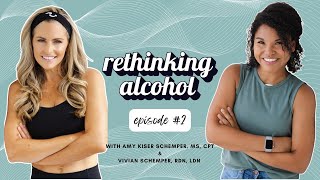
A conversational podcast episode (host Amy Schemper with guest Vivian Schemper, RDN) that explores whether and how to rethink alcohol use during perimenopause, menopause and beyond. Key points: the guest emphasizes there is no fully "safe" amount of alcohol, cites research linking even moderate drinking (e.g., 1–2 standard drinks/day or ~7/week) to measurable brain changes, and explains ethanol’s unique physiology (small molecule that crosses the blood–brain barrier and is not a biologically necessary nutrient). Practical counsel includes measuring actual serving sizes (many pours exceed a standard drink), experimenting with mocktails, reframing alcohol as a nonessential coping tool (compared to food which is biologically required), and reducing frequency (e.g., moving from weekly to monthly occasions). The episode also addresses cultural norms around drinking, especially "women and wine" mom-culture, and concludes with the guest’s personal approach and fitness goals (lifting heavier).
You blow my mind. I don't know if you know yet. Hi, everyone. Welcome to the be where you are today podcast where we connect with experts in the fitness and nutrition space to help you wherever you are in your journey today. I'm really excited because we have one of our team, Vivian Skeper, who is our other partner in crime here at Body fit by Amy. She is our registered dietitian nutritionist. She co leads the Body fit athletic club with me on the body fit by Amy app. She does so many things in the company and is one of my favorite people. Welcome, Vivian.
Thanks for having me.
We always have a good time because we do this a lot in the bodyfit athletic club where we do live streams together. So hopefully I won't ramble too much. But today we are talking specifically about something that we recently talked about in the body fit athletic club. We have an unpause focus group which is focused on perimenopause, menopause and post. So we've been talking about a lot of different things on the nutrition and the fitness side. And most recently, Vivian covered alcohol. And if that's something that we need to rethink during those time frames, perimenopause, menopause and beyond. And it was really interesting. It was a really great video that lots of people responded to in different ways. And we're going to talk about some of those things today because we thought we should be sharing this with everybody. So but before we start, let's start with a few icebreakers and I have some fun ones that are nutrition related. So are you ready, Vivian?
I am ready.
Okay. What is your signature dish to bring to a party?
Well, I don't get out much, which is a problem. But on the rare occasion that I am invited somewhere, buffalo chicken dip is usually my go to and I usually bring lots of veggies. And there will probably be some form of white bean in there because, you know, fiber.
Yes. Yum. I love it. What is the weirdest food combination you enjoy?
So I love, you know that I love white rice. It's my favorite food ever. And I love lentils. So being from Central America, being from Panama, rice and lentils is a pretty common food combination and I love it. But I have no idea how I discovered this, whether it was on accident or what. But rice, lentils, and ketchup, best thing. Amazing.
Oh, my gosh. I would never put this together. Somebody's gonna try that. And if you do, please report back to us.
I mean, you said you're gonna love It.
I love all three of those things separately. So now I'm curious. Next one. If you could eliminate one food so no. No one would ever eat it again, what would you pick to destroy?
Oh, my gosh. That sounds so aggressive. I mean, I hate banana cream pie. Banana cream anything. So I feel bad for the people that love it, but I would love to have it destroyed just because I don't want to hear about it. I don't want to smell it. I don't want to see. See it. I don't want to think about it. Yeah, that's it. That's the one.
Do you have a local food truck or a local restaurant you enjoy? And I do know that you live in an area with amazing restaurants. So do you have a current.
Oh, my goodness. So I'm such a foodie. I love restaurants, and I. So here in Tampa recently, we discovered a place called Tori Bar, which is like sushi, very good cocktails. But I am rethinking those, and I'm sure we're gonna talk about that, and. But yeah, I just love the sushi. I love the environment, the ambiance. It's just such a fun, cute little place.
It's so good. Last one for both of us. And then our listeners can decide who's right and who's wrong. When is a banana ready to eat?
Oh, my gosh. Okay, so I. I'm actually looking at a banana right now. So the banana needs to have some green for it to be edible. The moment there is no green present, that banana is damaged and should be destroyed.
I disagree. I think the banana has to have gotten rid of all the green. Have some really good yellow and maybe a few little brown spots.
Oh, that's the worst. No, rotten, terrible.
We can agree to disagree. One of the things I think we disagree. Yeah.
Okay.
Well, that was fun. Now let's get into our topics. So again, we've been talking about this in the Body Fit athletic club in our unpause focus group. And I know that, Vivian, when you were preparing for that video, you did a ton of research, and it's actually something that I think we're hearing a lot about, not just in the menopause world, but also just in general. So I would love to hear from you. When you were prepping for this, what are a couple things that really stood out to you? You.
Then the number one thing is how there really is no safe amount of alcohol. And I know many people, myself included, in the past, I was under the perception that if I consumed alcohol within Certain guidelines, it was totally fine and a. Okay. And there was no harm at all to my health. And while there are many factors at play that can harm somebody's health, for sure, it was really interesting to learn and research and realize that there are immediate consequences to drinking. Even one drink that was very eye opening. The other thing that was really eye opening and perhaps it's not that surprising, but I think when you research this and you learn how ingrained alcohol is in our culture and not just here in the United States, but worldwide too, but also drinking rates depending on the region. So here in America, we love our alcohol. Europeans really like their alcohol. But certain other regions, like looking at certain African countries for instance, and their drinking rates were quite low. So also just sort of the shift and I guess you can say what a successful marketing campaign alcohol has had and how it's influenced us a lot. So I would say that those are probably a few of the takeaways. I'm sure we'll probably dive into more, but.
Yeah, yeah, yeah. I think it is that thing where we think, you know, there are specific guidelines and we think, oh, I'm usually I'm within that maybe here or there I have, you know, a weekend where I have more. But we tend to think of, you know, when it comes to health specifically that, you know, the problems are with people who are excessive drinkers or, you know, maybe are suffering with alcoholism or people who, you know, are binge drinkers. And I think most of us are like, that's not me. I'm just a social drinker. I'm just, you know, I stay within the guidelines. And I think we also have heard, you know, the. And maybe you can speak to this a little bit more if there's actual truth behind this of the, well, red wine is good for your heart. There's cardiovascular benefits. Yeah, yeah. So I don't know if you can talk a little bit about those again, those things that we have heard, heard over the years of, you know, is that really true? Like you said, there's no safe amount, but are there any health benefits like we've been told in the past?
Yeah. So it's really interesting looking at that research, you know, and no hate to the researchers, right. This studying humans is really difficult and there are a lot of factors at play and we get better every year, I would say, at studying humans behaviors, patterns and really being able to hone in, into the factors that possibly impact someone's health. So there were some studies that were done in the past, a very well known One is the whole, oh, my gosh, alcohol, red wine, it's good with your heart, for your heart, because it has antioxidants. And, you know, antioxidants are so good for you. And that study just. It was just so blown out of. I think it was just exciting for people. Like, oh, good. Finally something that is actually sort of naughty is, like, good for me. Right. And I think the media really ran with that message. And then before you know it, everyone's like, oh, I'm just drinking a little red glass of wine because my heart. Antioxidants, you know, and their reality is, in order to really get. Get the antioxidant benefits from red wine, you would have to consume a lot of red wine to the point of possibly, like, blacken out. And at that point, I feel like there's going to be a whole lot of other issues. Right. And the antioxidants are not going to offset that, you know, and also, it's this sort of interesting. Antioxidants, antioxidants. And it's like, well, you get so. So little. But the amount of oxidation and damage that happens from the drink, too, it just really offsets it.
Yeah. And not something that we think about. I think it was. It was definitely a case of a really great headline that everybody was excited about.
Definitely that. And I will say, you know, there's so many other factors, too. Like when we look at who are the individuals who are able to have wine at the end of a day, for instance, these are generally individuals who have decent socioeconomic status. These are generally individuals who clearly have a little bit of spare time to maybe sit down and enjoy a glass of wine after dinner with dinner. And those things also play a really huge role in heart health and blood pressure and triglycerides and cholesterol. So when we actually start to isolate those factors, it. Is it really that the wine itself and the antioxidants are good for us, or is it that people who drink a glass of wine generally have lower levels of stress, financial security, a safe home to sleep in, and those things really do impact our cardiovascular health.
Yeah, yeah. And I think, you know, we talk about this a lot in the athletic Club. You do see so well about just. There are so many other factors beyond what it is you're putting in your body that are influencing your health. And, you know, this one particular study may not be looking at all those other confounding variables, and that's really, really important to remember. Yeah. And I think it became one of those things where you know, I would have training clients over the years who would be like, well, I drink, but I only, I only drink wine because I know it's healthier. Right. There was this misconception, this was the healthy drink. Right?
Yes.
Speaking as a red wine drinker myself.
Yes.
So, and Kurt as well, also raising his hand. So follow up questions. Even if there is a little bit of antioxidants that we get with moderate drinking, can your body even absorb that?
That's a really good question. And the answer is yes, your body can absorb the antioxidants. But something that's really important to keep in mind is our bodies are constantly oxidating and antioxidating. So the sort of, the idea of I want absolutely no oxidation at all in my body at all whatsoever. Well that'd be great except you'd be dead even. Sometimes the process of breathing alone. Right. It does create some oxidation. So the goal really is to create this sort of balance where we have more anti oxidative things coming into our lives, like exercise, eating well, sleeping, all of these, these things. And then we want to reduce the likelihood of creating more oxidation in the body. So the ways that we reduce that likelihood are going to be by drinking less, not smoking, eating more wholesome foods, that type of thing. So our goal really is going to be how can we create this balance and how can we have more anti inflammatory factors sort of at play to offset the natural oxidative factors? And so when it comes to alcohol. Yes. Are there some antioxidants in the wine because it's red and because of the grapes? Absolutely. But also, let's just throw out some numbers here for context. Let's say you're getting 10 antioxidant units from the red wine. However, the drinking of that red wine produced 60 pro accident units. So yeah, you get the 10, but you're still left with the net of 50. So it doesn't really balance out or offset anything. In the end, it's still like, yeah, well, you didn't quite come out on top.
Yeah. Wow, that's so interesting to, to think of it that way. Not something that I, or probably most people have ever thought about, which I think is like nutrition as a whole. We think of the, you know, it's all risk versus benefit and we want to grab on to the one little benefit that this might have, even though overall it may not be beneficial in the long run. Thank you for that. So we talked about this in our unpause focus group, so I would love for you to speak A little about what's important about how we think or rethink about alcohol consumption in. In those years in perimenopause, menopause, and post menopause. Don't hate me.
I know what you're gonna say. I think that. I think we can all, all men and women, all of us can evaluate how much we're actually drinking. I think of being a dietitian for several years now. The number one thing I see is that people don't actually know how much they're drinking. So oftentimes, right, we have that, oh, I glass of wine at the end of the night. Is it one glass but three servings? Or is it one glass and one serving? And oftentimes it's more like one and a half, two, sometimes three servings. And then if that person's having a couple of glasses of wine, then are we really looking at, you know, three, six servings, for instance? So I think the first thing is we all need to maybe pull out a little measuring cup or a measuring something and just get an idea of how much alcohol am I actually intaking. And it doesn't have to be this sort of, oh, no, now I'm like, measuring things. It's simply a matter of just. I'm just trying to create some awareness and just see what's going on here so we can maybe understand that first. And then from there, can we reduce. What are some of the occasions that are like, sure, I drink here, but I need to probably not, versus I'm at a wedding and, you know, the whoever is the bartender creating these super special cocktails. Okay, well, that sounds like a really special occasion. And so I think it would be. It's good for anyone in the perimenopausal, menopausal stage, but really anyone to just start understanding what is my alcohol intake actually like, and are there any opportunities for me to cut back on my intake?
Yeah, I think it does bring up the social norms like we were talking about that we grow accustomed to. Like, you go to a restaurant, they give you the drink menu first. And I fall into that habit of like, oh, yeah, when we go out to dinner, of course I order a drink, because that's what we do. But, you know, do I have to also, I will say, being in the parenting community, especially as moms, there's. I mean, it's kind of a joke, but not a joke of like, oh, mommy needs wine, or, you know, I got it. In order to get through the day, I gotta get to that glass of wine and I definitely, you know, certainly during like pandemic years, we got into the habit of that. I think that was certainly a different time. But it does become something that just is normalized in a way that we kind of fall into those patterns. And then we think, did I really want that or certainly did I need that? Maybe not, but did I really even want it? But it just, those things are kind of ingrained in us of like, oh, you go to a party, you have a drink. Oh, you to get. Celebrate getting through the day, to unwind, things like that, when there are clearly other things that we could do. And. And certainly I think I'm noticing, and this is something that we talked to a lot of people in our athletic club have mentioned. Just as I've gotten into my 40s, like, it. I don't feel as good. I don't sleep as well. I don't, you know, it's not like when we were in our 20s, then we could just wake up and go to work. And so to me, that is a sign that our bodies are changing. We know our bodies are changing physiologically and all these other ways with menopause, but in how we metabolize things. Things. Right. And how our body processes what's happening when we consume alcohol.
So. Absolutely.
Yeah.
And you know, that's a big thing too is as we age, our livers become less effective at being able to remove and break down, essentially break down and metabolize alcohol molecules. So it takes longer for it to leave our bodies to. Hence why so many of us kind of have that experience of, oh, when I was, you know, 22, I could have eight drinks and then wake up like nothing happened. And now I have, I mean, my own personal experience. I'll have one drink and I'm like, I've been hit by a car.
Like, this is terrible.
What happened? Yes, something happened. Yeah.
Well, that brings me to something else that, you know, I had mentioned to you when we had just talked about one on one, that something that I personally struggle with, that I think could be a thing for many people, is something that we always talk about in the athletic club and I think is a big part of your nutrition philosophy and I love it, is that all foods fit. Right. That so many of us grew up with diet culture, with restriction, with the 1200 calories as the magic number, with we only eat this. And I went through that. I definitely had periods in my teens and twenties where I was like, oh, I'm never going to eat ice cream. I'm only going to eat Frozen yogurt. And part of the healing from that, and I think this is true for most people who have an eating disorder or disordered eating past. Part of the healing from that is that I'm not going to restrict anything. I'm going to allow myself the freedom. You know, that's one of the tenets of intuitive eating, right? Unconditional permission to eat things and not feel guilt and shame. So I struggle a little bit as I've tried to rethink alcohol with it feeling restrictive, even though logically in my brain I know it's different. But I think for so long I convinced myself, oh, I'm not gonna eat sugar, I'm not gonna eat fat, things like that for health. Whereas that really wasn't the reason it was diet culture. It was feeling like I had to do this or I had to stay skinny or things like that. Whereas alcohol does feel different. But I still, still feel that anxiety probably about restricting. And then sometimes if it's like, oh, well, we'll just wait and when we're friends on the weekend, we'll have a drink. Then it feels a little all or nothing, like, oh, then I at least have to have two because I don't drink during the week. So I guess as a dietitian and someone who I think is really in tune to women and you know, women who have grown up with what we have grown up with, diet culture, you know, when it comes to alcohol, are there, you know, is there something you would say if you were approaching a client or even, you know, your friend, your co worker, your sister in law, you know, to sort of reconcile that? Because it is different. But I don't want to fall back into those patterns of feeling like I'm restricting myself or I'm, you know, having to be all or nothing?
Mm, yeah, that's a really good question. And it's, it's so nuanced and complex. What I would say here is we have a biological need for food. We do not have a biological need for alcohol. Every food that we consume, even those that we deem as unhealthy or not as great for us, have some combination of the three main macronutrients, carbohydrates, protein and fats. Typically, some of the foods that we deem as less nutritious are going to be higher in carbohydrates and they're going to be maybe higher in fats. Our bodies require those three macronutrients in some form or another. Sure. Does the body require them from cookies and brownies? No, but it does require glucose, amino acids and fatty acids. And that's what carbohydrates, proteins and fats break up into in our bodies. We need that. They are called essential macronutrients because we need to get them from our diets. Our bodies cannot produce those alone, otherwise we would not be well. So we have a biological need for, for food. So even as we get into the topic of restricting sugar or something like that, it's a little bit tricky because we're talking about glucose, which, yes, straight up sugar can get converted into glucose in the body, but so can quinoa, for instance. And so at the end of the day, the molecule ends up being glucose, fatty acids or amino acids, which are essential to the human body. Ethanol is the molecule that alcohol contains. And there's actually, interestingly enough, three types of alcohol in the world and only one of them is fit, fit for human consumption, which is ethanol. So isopropyl alcohol is probably the one that you would clean with that one. We don't consider consume that one. So ethanol is the one that we are going to consume. Ethanol is just ethanol. Ethanol is a really interesting molecule in the fact that it meshes very well with both water and fat, so it can move around in our bodies very easily. It's also a very small molecule which also helps it move around the body very easily. And because of this syrup, I can mesh with fats and water in just about anybody. And it also has the ability to cross the blood brain barrier. When we think about our blood brain barrier, I like to think of this as this like top notch security guard that's like, you're not coming in here. The brain is like highly protected, very much VIP in here. Somehow alcohol managed to just like, I don't need access, I just come right on in. I've got my own VIP pass. And it can come in and in an interesting way that's actually kind of terrifying that this molecule that we voluntarily introduce into our bodies has this ability to get into this very sort of protected place in our bodies. And it sure does take effect when it's in there. So you have, of course, this molecule that is very unique in the way that it's able to enter your body. And then you also have this molecule that when in the body behaves very differently than other foods like carbohydrates, proteins and fats. So all of this, what I'm trying to say here is that alcohol, ethanol is not food, it is not biologically necessary. We don't actually require it. And that makes a difference, different. Something that I like to sometimes say to clients when they're sort of in this like, but restricting it makes me want it more. I will say, can we try to maybe reframe it where we think about alcohol in the way that we do cigarettes? How does it sound for us to say, well, I'm going to try to not smoke cigarettes during the week, but then if I get to the weekend, then I'm going to definitely have a cigarette. But then, oh, because I can't have them during the week, maybe I'm going to have like four more cigarettes or maybe five more cigarettes. And sometimes reframing it that way can be really helpful. And I think the reason that's difficult is even though they kind of, in terms of health impact, they're probably not that different. They're both not that great for you. But the difference is that alcohol, in my opinion, has not gone through the negative press and the smear campaign that smoking has.
Yeah, yeah. I mean, years ago, like many years ago, doctors were recommending cigarettes for digestion and it was just not uncommon, you know, to see everybody smoking or you know, pregnant women smoking. Like things that now would just be unheard of because we know so much more. So that's, that's definitely something to think about of, you know, will we in 20, 30, 50 years be looking at alcohol in the same way as we do cigarettes?
Definitely.
I mean, I certainly think one of the reasons that alcohol seems to really be in the news a lot, one, newer research, you know, health risks, things that we kind of know, you know, increasing your risk for heart disease, cancer, things like that, but also brain health. And I think that's been something that we're talking a lot about more certainly in fitness with strength training and aerobic exercise and things how they affect your brain. But that's something that, you know, I think I worry a little about, a little bit more about for my long term health, you know, what I want for myself in my 70s, 80s, hopefully 90s, I want to protect my brain. And that, that whole blood brain barrier thing like that is intense. It's, it's like we talk about that in fitness. It is, there are not very many things that get past that. And the fact that alcohol can is kind of scary. Yeah.
And recently there was a pretty large and well executed study that evaluated the impacts of moderate alcohol intake on the brain. And this was pretty unique because it looked at moderate drinking, you know, versus I think most of the research studies will sometimes look at this person's having 30 drinks a week and oh no, something's gone wrong with their brain. Like, well, okay, but what about that? Like occasional glass of wine? What about like a drink at the end of the day? What about that? And the study did find that just consuming one to two standard drinks per day or having like seven standard drinks and key here on the standard drink. So I would argue people are probably having a little bit more than that. So this is a standard drink per week led to some degree of deterioration in the brain. That was very eye opening to me. Just noticing that a little bit of drinking, it's that sort of moderate drinking that we, that we talk about that somehow seems okay, is actually having impact on our brain integrity.
Yeah, it's so interesting. It just gives you a lot more to think about beyond just the physical side of how we feel when we consume alcohol and thinking about long term health in the sort of traditional ways that we talk about. We want our brains to be in good shape, right? Yes, we do.
Yes.
Thank you for explaining that in such detail. It gives us a lot to think about. So when we come back, we are going to talk to Vivian about where she is today, where she is with alcohol consumption, how she approaches it as a dietitian, maybe in her own life. And also maybe we'll talk a little fitness. We'll be right back. And we're back. So, Vivian, we always close the podcast asking the guest where you are today? So usually it's fitness related. But I would love to hear from you since we've been talking about this really important topic, how where you are today, how you approach alcohol, you know, as an individual. And also maybe how you've shifted how you counsel clients when you're discussing it.
Yeah, I love that question. That's so fun. So personally, I, I'm definitely just reevaluating my intake and definitely the instances of getting a drink. Good, because I'm out to dinner. Why do I do that? Do I have to have a drink every single time I'm out to dinner? There's that. So kind of just reevaluating things. I will say the other one is I don't know how many people actually love the taste of alcohol itself.
Yeah.
And I think sometimes I don't. I mean, at least for me, it's like, well, I do love a margarita. I love the, you know, smell, muddled strawberries or the muddled watermelon in there, you know, with the lime juice. And it's so delicious and refreshing on a hot summer day. And so then sometimes it can be helpful to think. I think I'm just looking for something that is flavorful and refreshing, that feels special and different than the usual water. And so with that, I have been having fun with experimenting with some mocktails. So I think that can be a really fun thing to explore with. And I think for most people, you will find that sometimes it's more of the experience of having something different and refreshing, and that can really do the trick. I'm really trying to think about drinking more in terms of a yearly monthly thing instead of a weekly thing. So I don't really want to think about drinking at least once a week or anything. But more. What about once or twice a month? Also, your wallet will totally thank you for this. There's that going out to dinner is like, wow, that makes a huge difference. So there's that little side benefit as well. I will say I think this is really big. So I was born and raised in Panama, and here in the United States, there's that big sort of women and wine and mom and wine culture is so big here. And so kind of reassessing. Are we sort of more just following this norm, or is it really something that we enjoy? And then I think from there, it could also be helpful to evaluate if that is your only sort of coping and unwinding mechanism, then I do think it may be time to explore whether it's with a therapist or yourself or somebody that knows you well and you feel that you can trust them to kind of talk about, how else can I unwind, release some of this tension that I have from the day, and let go that does not always involve alcohol. Can we have fun at dinner with friends and still connect and have a wonderful time without needing to be influenced? And I will wrap it up with, I think, the one thing that we had when we were talking about what really stood out to you. And I think we drink for one reason, really, and that is to feel different than we would otherwise at the core. Right. So I'm stressed. Well, let me have a drink and then I'll be less stressed. Or maybe I'm kind of nervous in the social setting. So let me, like, have a little something and then I'll be more chatty. And that's really eye opening to think about too, that are we that uncomfortable with our feelings, our emotions, and ourselves that we need to rely on alcohol? And I'm not demonizing it. I'm not fully eliminating it from my personal life because I do love me a really special craft cocktail sometimes, But I do Want to just think more about. Every time I go to dinner, I can still connect with the people that I'm with without needing to have some form of influence.
Oh, that's so helpful. And I think too when we talk about, you know, we talk about this a lot in of front fitness as a form of self care. And there is research on your brain feeling and your body feeling the same positive effects from, you know, that runner's high that we talk about, that adrenaline rush, the endorphins as you get from something like alcohol or another substance. So it's really helpful to think of it in that way of like this is for most of us, it's not our only thing. So why are we not pursuing some of those other ways to unwind, to feel good, to practice self care. Yeah, definitely something I've been thinking about so well. This has been a great conversation. Before we close, where are you today with your fitness? Besides of course all your body fit by Amy workouts. Of course we have to get you back out here so you can be in enough one. But where are you today in your fitness journey?
Yeah, that's a fun question. And you know, I am excited about lifting heavy, about pushing myself in ways that I have not before. And I think this is, you know, you've been such a huge advocate for this but for so long, right? We've women have been told like, oh, you know, watch out with the weights or you know, maybe the little late dumbbells and just to lift heavy and get after it has been really fun and empowering and exciting and just kind of defeating some of these norms that we've been, you know, these messages that have been ingrained in us for so long and to kind of go against the grain and realize that there is so much benefit and power to going heavy and it's been great.
Yeah, I love it. Well, you are very strong and I'm excited for the next time we get to work out together.
I know, can't wait.
Well, thank you so much, Vivian. This has been a great conversation with will of course include some resources down below in the notes and I'm sure you'll be back.
I would love to be back anytime.
Thank you so much for joining us today for the be where you are today podcast. Big thanks to Vivian Skeper, my guest and my partner over at Body Fit by Amy. I'm Amy and don't forget to share. Show up, keep moving and be where you are today.
More from Amy

06: Dumbbell Tabata Build Workout | Full Body Strength + Cardio | BodyFit By Amy

01: Total Body HILIT Strength Workout | High Intensity, Low Impact | BodyFit By Amy | 30 Mins - NEW!

18: 🔥 Upper Body Fusion Workout | Strength + Mobility | Bands & Dumbbells | BodyFit By Amy

16: 🔥 Full Body Strength Ladder Workout | Dumbbells & Kettlebells | BodyFit By Amy | 31 Mins
13: 🔥 Lower Body Fusion | Strength + Mobility with Mini Bands, Dumbbells & Kettlebells (No Repeat!)
11: 🔥 Dumbbell Strength Complex Workout | Full Body Strength + Cardio | BodyFit By Amy | 30 Min

01: 🔥 Total Body Pyramid HIIT Workout with Dumbbells & Kettlebells | Strength + Cardio

Midlife Fitness: Ditch Old Advice, Embrace New Training! #midlifewomen #perimenopause
25: No Equipment Core & More Workout | 20 Mins Full Body Strength, Cardio & Mobility (Ab Focus!)